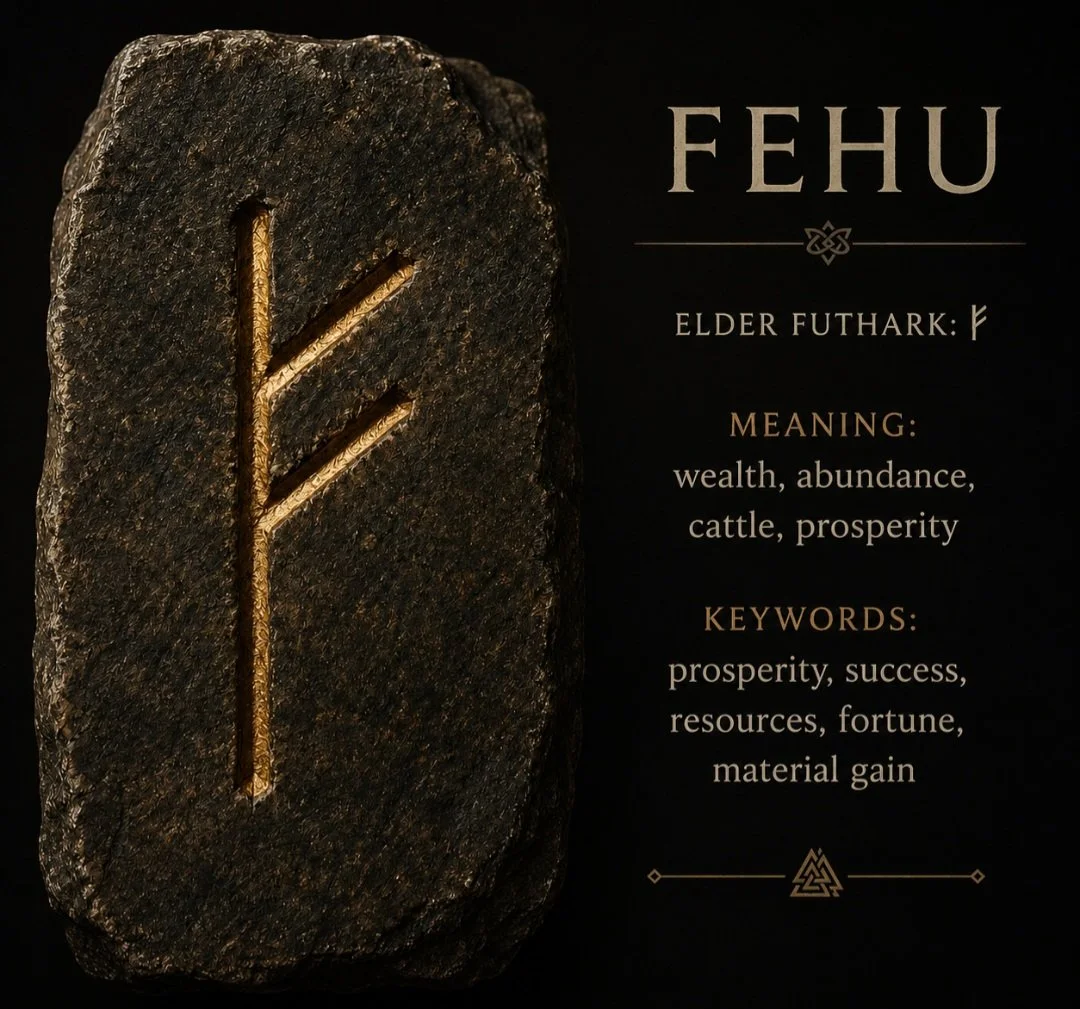
Discover the complete meaning of Fehu, the first rune of the Elder Futhark. Explore its historical origins, rune poems, archaeological evidence, Norse mythology, symbolism, divination meanings, magical uses, and the role of wealth, prosperity, and responsibility in the ancient Germanic world.
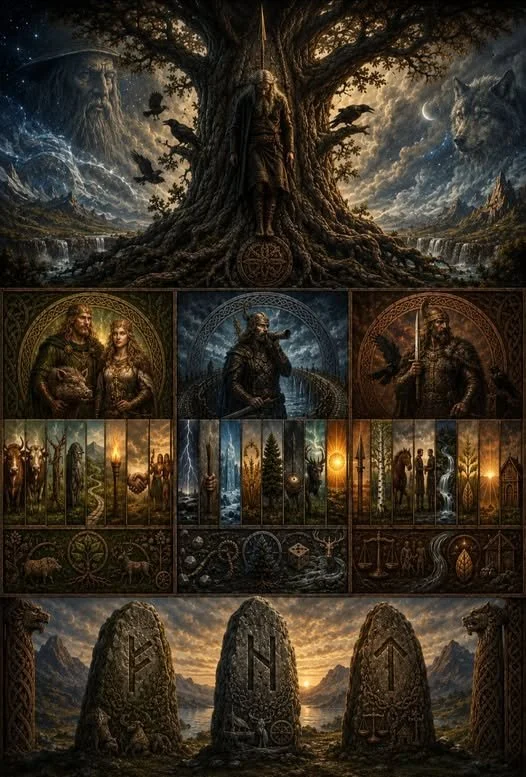
The twenty-four runes of the Elder Futhark are traditionally divided into three groups of eight known as ættir, yet no surviving Norse source explains why this division exists. In this first chapter of the Runic Series, we explore the historical evidence behind the ættir, their function as a mnemonic system, and the many modern interpretations that have developed around them. Discover the symbolism of the First, Second, and Third Ætt, examine their proposed associations with Freyr, Freyja, Heimdall, and Tyr, and learn where history ends and contemporary rune lore begins. Whether you are beginning your study of the Elder Futhark or seeking a deeper understanding of its structure, this chapter provides the essential foundation for the journey ahead.
Among the gods of Norse mythology, few are as enigmatic and unsettling as Váli. Born in a single night for one purpose alone (to avenge the death of Baldr) he stands apart from the other Æsir as a living embodiment of consequence itself. Neither driven by rage nor consumed by cruelty, Váli represents the inevitable answer to actions already set in motion. This exploration examines his mythology, symbolism, relationship to wyrd, divine vengeance, accountability, and why he survives Ragnarök as a lasting reminder that no deed, oath, or betrayal truly escapes the memory of the cosmos.
Among the many creatures of Norse mythology, few are as intriguing as Bygul and Trjegul, the two cats who draw the chariot of Freyja. Far more than companions, they represent balance, movement, traction, and the relationship between power and partnership. As Freyja journeys between realms as goddess of love, war, fertility, and seiðr, her feline companions serve as the forces that transform divine intention into meaningful motion. This exploration examines their mythological significance, symbolic meanings, connections to Norse cosmology, and the deeper lessons they offer about change, support, and the sacred act of moving forward.
Midsummer has become one of the most popular celebrations in modern Norse Paganism, but was it actually observed by the Vikings? This in-depth guide examines the historical sources, including Ynglinga saga, the Old Norse calendar, and surviving accounts of heathen holy tides, to separate documented history from modern reconstruction. Discover why Sigrblót is often confused with Midsummer, how the Norse understood the seasons, and why today's Summer Solstice celebrations are best understood as a meaningful modern observance inspired by ancient traditions rather than a clearly attested Viking Age festival.
Long before the Viking Age, the ancestors of the Norse developed one of Europe's most distinctive writing systems - the runes. This in-depth guide traces the origins of the Elder Futhark from its emergence during the Roman Iron Age through the Migration Period, examining how contact with Rome, linguistic change, and centuries of cultural development shaped the runic tradition. Discover the transition from the Elder to the Younger Futhark, the archaeological evidence behind the earliest inscriptions, and the historical realities behind one of the most enduring symbols of the ancient Germanic world.
Tanngrisnir and Tanngnjóstr are among the most unusual beings in Norse mythology. As the goats who draw Thor’s thunderous chariot, they embody a profound cosmic cycle of movement, consumption, death, and restoration. Slaughtered and eaten before being brought back to life through the power of Mjölnir, they reveal a deeper truth within Norse cosmology: that continuation requires renewal, and renewal often requires sacrifice. This exploration examines their mythological role, symbolic meanings, ritual significance, and what their endless cycle can teach us about endurance, transformation, and the necessity of change.
The four stags of Yggdrasil (Dáinn, Dvalinn, Duneyrr, and Duraþrór) are among the most overlooked beings in Norse mythology. Forever grazing upon the branches of the World Tree, they embody a profound truth at the heart of Norse cosmology: that growth cannot exist without limitation, and renewal cannot occur without loss. This exploration examines their mythological role, symbolic meanings, connections to ritual practice, and the enduring lessons they offer about balance, resilience, and the maintenance of existence itself.
Borr is one of the quietest yet most essential figures in Norse cosmology. Though scarcely mentioned in surviving myths, he stands at the threshold between origin and creation - the father of Odin, Vili, and Vé, and the unseen continuity that allows the shaping of the cosmos to begin. This mythopoetic reflection explores Borr not as a forgotten god of action, but as the hidden foundation beneath all beginnings.
Iðunn is not the warrior of the gods, but the reason the gods can continue at all. As keeper of the apples of renewal, she represents the quiet force of preservation within Norse cosmology - the unseen maintenance that keeps strength, vitality, and meaning from fading too soon. This deep mythopoetic reflection explores renewal not as immortality, but as the continual tending required for anything to endure.
Gríðr is not the storm, but the hand that shelters it. Though briefly mentioned in the Prose Edda, her role in Norse cosmology carries profound symbolic weight. This deep exploration examines Gríðr as the unseen architecture of endurance - the force that prepares, steadies, and equips before transformation and conflict. A meditation on quiet strength, survival, and the power that asks for no recognition.
Before Odin sought wisdom and before the gods shaped the world, there was Bestla - the quiet mother beneath the silence. Though scarcely mentioned in surviving Norse sources, her presence echoes through the foundations of creation itself. This mythopoetic exploration examines Bestla as the hidden architecture of becoming: the force that holds chaos long enough for order to emerge, and the unseen endurance beneath all things that continue.
Explore the Norse view of the soul as a layered structure of hugr, hamr, fylgja, hamingja and more. Learn how the self was understood in the Eddas and sagas, and what truly continues after death in Norse belief.
Magni and Móði are not gods of the old world, but of what survives it. As the sons of Thor who endure Ragnarök, they represent strength and wrath after collapse - the forces that remain when myth, order, and meaning have been exhausted.
Not all resistance is meant to be overcome. In seiðr, there are moments when guidance no longer supports your direction - when paths close, signs withdraw, and silence becomes the answer. This chapter explores how to recognise misalignment, respond to correction, and walk forward with clarity after being shown you were wrong.
Búri is the first emergence in Norse cosmology - not a god of action, but the moment existence begins to hold form. This mythic exploration traces his origin, symbolism, and the quiet foundation he lays beneath all lineage and creation.
Galdr is the power of spoken words in Norse tradition - chants, charms, and incantations used for protection, healing, and influence. This guide explores its history, sources, and how voice was used as force in the Viking Age.
Vili and Vé are often overlooked among the Æsir, yet they represent some of the deepest forces in Norse cosmology. Where Odin brings awareness, Vili brings will, and Vé gives form. Together, they stand at the threshold between knowing and becoming - the moment where thought turns into action and action becomes reality. This exploration looks at their role in creation, humanity, sacred boundaries, and the quiet but powerful mechanics of transformation itself.
True guidance is rarely loud. It does not arrive to control your life or remove uncertainty, but to bring clarity, restraint, and alignment. In seiðr, guidance often appears through small corrections, ordinary life, silence, and the body’s quiet knowing. This chapter explores how to recognise real direction, avoid projection, and walk forward with responsibility even when certainty is incomplete.
Dreams are often treated as messages, signs, or something sent from outside. But the Norse sources show something very different. Draumr was not a system, not a method, and not something automatically meaningful. This piece explores what dreams actually were in Norse tradition, where they appear in the sources, and why most modern interpretations miss the mark.
Spá is often misunderstood as certainty, guidance, or control. But the Norse sources show something very different. It is not about having answers, but about recognising what is already in motion—and understanding the weight of speaking it. This piece breaks down what spá is, what it isn’t, and why most modern interpretations miss the mark.
Not every dream is a sign. In Norse thought, draumr is shaped by the self, especially the hugr, and not all dreams come from the gods. This blog breaks down what the sources actually show, where people go wrong, and how to understand dreams without assumption.
As awareness deepens, the boundary between ordinary life and deeper perception becomes thinner. What once felt separate begins to overlap, and the ability to move between states becomes easier. But this is where many lose direction. Walking between worlds is not about going further - it is about staying anchored, maintaining control, and not losing yourself as the work develops.
Before thought, before speech, before memory… there is heat.
Lodurr is that heat.
In the creation of humanity, Odin gives breath, Hœnir gives mind - but Lodurr gives something far more dangerous. He gives warmth, blood, and color. He gives the spark that turns existence into experience.
Without him, life would move… but it would not feel.
This is not the fire that destroys, but the fire that awakens. The ember beneath the ribs that refuses stillness, that drives creation, love, anger, and transformation.
Lodurr does not shape the world.
He makes it burn.
Hugr is more than “the mind” in Norse thought. It is will, intention, mood, and the inner state that shapes how a person acts and is judged. This piece breaks down what hugr really is, how it appears in the sources, and why it sits at the centre of responsibility and behaviour.
Before war became language, before kings claimed land and law hardened into rule, there was something older.
Not conquest. Not command.
But the earth… at rest.
Nerthus is not a goddess who arrives with spectacle. She is carried, veiled, unseen and where she passes, violence stops. Not because it is resolved, but because it can no longer justify itself.
This is not peace as comfort. It is peace as condition.
An ancient force that reminds both gods and mortals that life is not sustained through dominance, but through restraint, attention, and alignment with something far older than human will.
Nerthus does not demand belief.
She demands recognition.
Because the ground remembers everything.
As awareness deepens, contact no longer remains something separate from daily life. It begins to follow you into ordinary moments, changing how you perceive and respond to the world. But this is where balance is tested. Living with contact is not about becoming consumed by it - it is about learning to carry awareness while remaining fully grounded in yourself.
Not all wisdom arrives in words. Some of it waits.
Hœnir is one of the most overlooked figures in Norse mythology, often described as silent, uncertain, or dependent on others. But this reading looks deeper. Not as weakness, but as function.
He stands in the space before decision. The moment where action has not yet hardened into consequence.
At the creation of humanity, while Odin gave breath, Hœnir gave something quieter - awareness. The ability to hold experience before naming it. The pause that allows meaning to form.
This is not a god of answers. It is a god of delay.
Because sometimes the most dangerous thing is not ignorance… but acting before you understand.
Hœnir reminds us that not every moment needs a response, and not every silence is empty.
Sigrblót is a Norse sacrifice for victory, recorded in the sources as taking place at the beginning of summer. While little detail survives about the rite itself, its place within the ritual year and its connection to sigr offer insight into how it was understood and how it is approached today.
Wyrd & Flame is more than a name - It is a forge.
A place where myth, Seiðr and spiritual truth meet fire. Here, the old gods speak, the Wyrd reveals and the flame burns away illusion. This is a space for the curious, seekers, seers and the wild hearted to remember who they are and learn more about the Myth, History and knowledge of Norse Paganism.
Meet the Authors
-

Ellesha Mckay
FOUNDER & AUTHOR
-

Jobi Sadler
CO-FOUNDER & AUTHOR
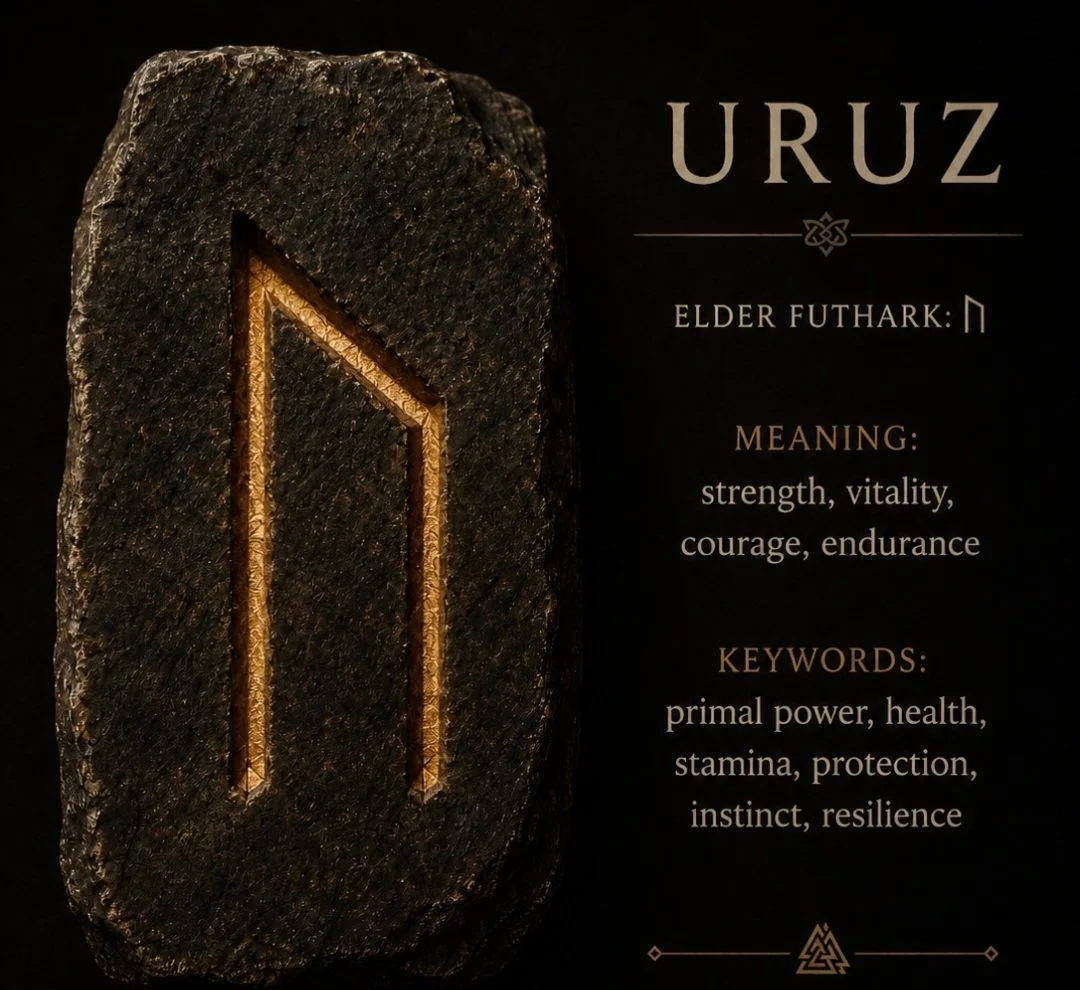
Explore Uruz, the second rune of the Elder Futhark, meaning aurochs, primal strength, vitality, endurance, and raw power. Learn its historical roots, rune poems, archaeological evidence, mythological connections, divination meanings, seiðr, galdr, bindrunes, and modern magical uses.