
Þrúðr: The Strength That Was Never Given a Story
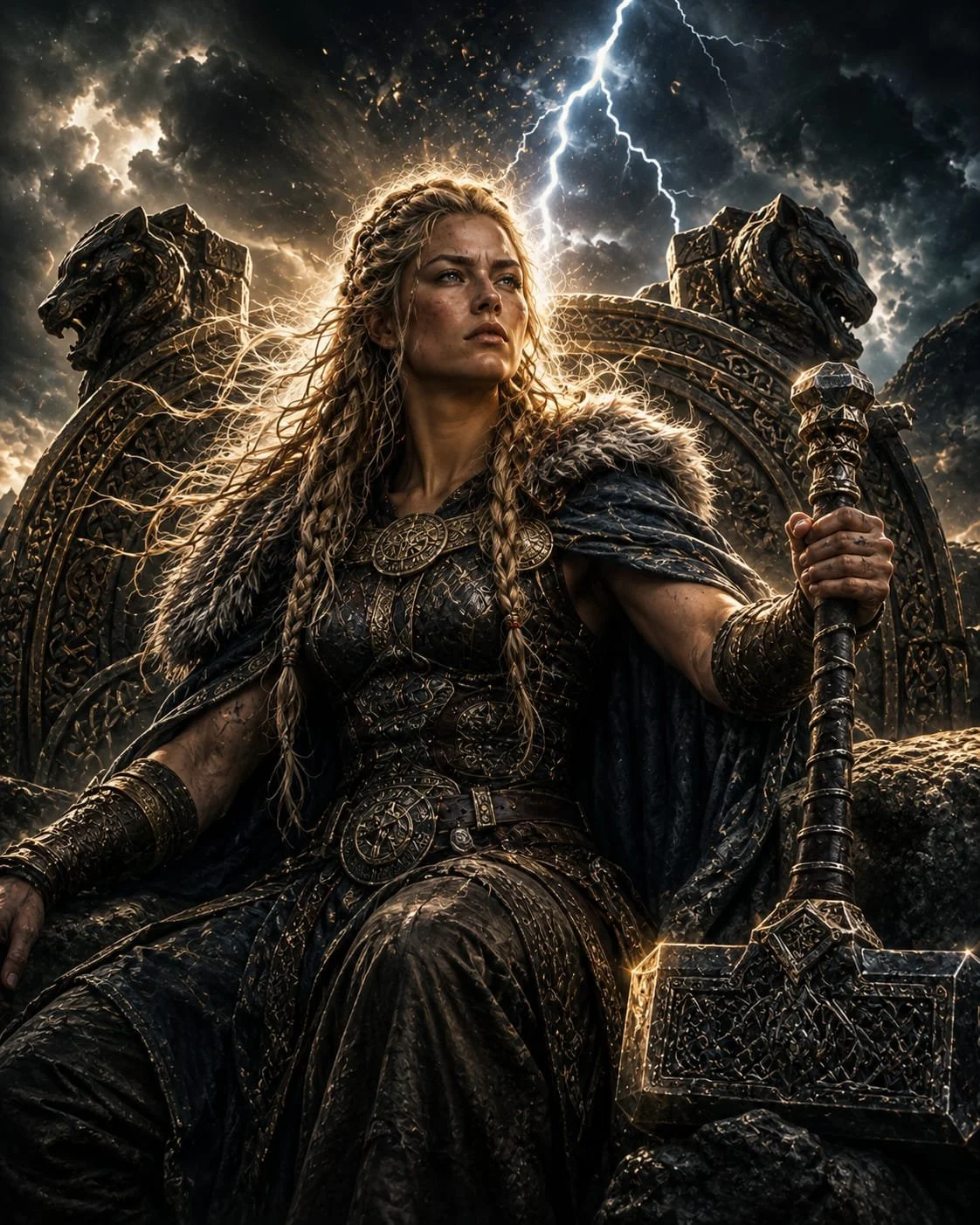
There are those whose power is remembered through what they conquer. And there are those whose power is already present before the struggle begins.” - Fragment attributed to reconstructed mythic commentary
Pause. Not to look for the warrior. Not to search for the battle, the weapon, or the moment when strength is finally revealed. Instead, look at the word itself: strength. Power. Might. Because there is something unusual about Þrúðr. She belongs to a family of gods whose identities are almost inseparable from force. Thor carries the hammer. Magni embodies strength. Móði carries courage or fury. Yet Þrúðr, whose very name means something close to strength or might, is given remarkably little narrative space. She is named. She is placed within a divine family. She is associated with power. And then, almost entirely, she disappears.
Þrúðr exists at the edge of several stories without ever becoming the center of one. A daughter promised in marriage. A name associated with a valkyrie. A figure whose identity survives in kennings and genealogy. A presence whose story may have once been larger than what remains. And perhaps that is precisely what makes her worth looking at. Because Þrúðr is not simply a forgotten goddess. She represents something deeper: the strength that exists before anyone has decided what to do with it.
***NOTE***
Before exploring this piece, it is important to separate what the sources actually tell us from later interpretation. Þrúðr is identified in Norse tradition as the daughter of Þórr and Sif. Snorri sturluson’s skáldskaparmál preserves Þrúðr in genealogical and poetic contexts, including the kenning “father of Þrúðr” for thor. Sif is likewise associated with her as her mother.
The poem alvíssmál tells of a dwarf named alvíss who arrives seeking to marry thor’s daughter. The daughter is not named in the poem, but Þrúðr is traditionally identified as the intended bride because she is the only named daughter of thor in the surviving material. Thor delays alvíss with a series of questions until sunrise, when the dwarf is turned to stone. Þrúðr is also named among the valkyries in grímnismál, although whether that Þrúðr is definitely the same individual as Thor’s daughter remains uncertain.
There is also a skaldic reference to hrungnir as “Þrúðr’s thief,” suggesting a story involving Þrúðr that is not preserved in full. What follows, then, is not a strict reconstruction of a lost Þrúðr myth. It is a mythopoetic reading of the fragments that remain.
So pause here, just for a moment. Because Þrúðr may be one of those figures whose silence tells us almost as much as her surviving name.
The Daughter of Thunder
To understand Þrúðr, begin with where she stands. Her father is Þórr, not simply a powerful god, but one of the most physically immediate forces in norse mythology... thunder, storm, hammer, protection, and violence directed against the jötnar. Her mother is Sif, the golden haired goddess whose presence is surrounded by imagery of beauty, kinship, and divine family.
From these two comes Þrúðr. Her name means strength, might, power. That is not a small detail. In myth, names often carry associations that exceed simple labels. Þrúðr does not have a name suggesting gentleness, silence, beauty, or wisdom. She is named for force. And yet the surviving stories almost never allow her to exercise it. The daughter of the thunder god is named strength, but the tradition does not give us a story in which she proves it. Perhaps that is because strength in Þrúðr is not something that needed proving. Perhaps it was already assumed.
The Silence Around Þrúðr
There is something almost haunting about how little survives. We know who her parents are. We know her name. We know that she was important enough to appear within poetic language. We know that thor could be identified as her father. We know that a dwarf sought her hand. We know that the name Þrúðr appears among the valkyries. And then there is silence. No surviving poem gives us her childhood. No surviving myth tells us how she came into her power. No preserved story shows her fighting beside her father. No dialogue reveals what she wanted. No myth tells us how she understood the gods around her. She exists almost entirely through the eyes of others.
One of the most common ways mythology preserves women is through relationship - daughter of, wife of, mother of, desired by, protected by, taken by, remembered by. Þrúðr is repeatedly positioned relationally. But perhaps the question should be reversed. What if we stop asking who Þrúðr belongs to and begin asking what the name Þrúðr itself carries?
The Meaning of Strength
Þrúðr is associated with strength, but strength is not the same thing as violence. This distinction matters. A mountain is strong without attacking anything. A tree is strong because it remains standing. A foundation is strong because it carries weight without demanding attention. A person can possess strength without ever entering battle. Norse mythology often makes strength visible through action. Thor strikes. Giants attack. Heroes endure. Warriors fight. But Þrúðr's name creates another possibility.
Strength can exist before action. It can be inherited. It can be embodied. It can simply be present. This makes Þrúðr fascinating as a mythological figure. She does not need to become powerful. She is named power already. Her unanswered question is not whether she possesses strength. It is what that strength was ever meant to become.
On the Name Þrúðr
Before we start interpreting Þrúðr, it is worth staying with her name itself. Old norse Þrúðr is generally connected with the idea of strength, might, or power, and this places her within a broader germanic vocabulary in which names can preserve qualities rather than simply identify individuals. The importance of this becomes clearer when her name is compared with the figures surrounding her. Thor is repeatedly associated with physical force and protection, while Þrúðr carries a name that expresses strength directly. Her identity therefore appears to preserve an attribute that already belongs strongly to her father's mythic character.
She is not named “daughter of thor” in her own right; she is Þrúðr, Strength. Yet linguistic meaning should not automatically be transformed into theological certainty. A name meaning strength does not prove that a historical cult once worshipped her as an abstract goddess of strength, nor does it establish a complete mythology around that concept. What it does provide is a significant interpretive clue. The surviving tradition repeatedly places Þrúðr within contexts of power, protection, marriage, conflict, and divine inheritance, making the meaning of her name unusually relevant to the fragments that remain.
The Daughter Who Was Promised
The clearest narrative associated with Þrúðr comes indirectly through alvíssmál. A dwarf named alvíss arrives to claim thor's daughter as his bride. The daughter is unnamed in the poem, but traditional interpretation identifies her as Þrúðr. Alvíss believes the marriage has already been arranged. Thor disagrees. The conflict that follows is not a battle of weapons. It is a battle of knowledge. Thor asks alvíss question after question: what do the gods call the sky, what do the giants call it, what do elves call it, what do dwarfs call it, and what do humans call it? The dwarf answers again and again.
The entire cosmos is opened through language. Everything has multiple names depending on who is looking at it. The sky is not simply the sky. The world changes according to the speaker. And while alvíss demonstrates knowledge, Thor is buying time until dawn, until sunlight, until the dwarf's own nature becomes his downfall. Alvíss is turned to stone, and Þrúðr is never given a voice. That silence is important, because the entire story concerns her marriage, yet she does not speak.
The Woman at the Center of the Contest
For some seekers and researchers there is something uncomfortable in the structure of alvíssmál. Þrúðr is the reason the encounter occurs, but she is not the participant. Alvíss wants her. Thor refuses him. The dwarf argues. The god tests. The sun decides. And Þrúðr remains absent. This is not unusual in mythology. Women can become the axis around which male conflict turns while remaining narratively silent themselves. But rather than simply accepting that structure, we can notice what it reveals.
Þrúðr is valuable enough to be contested, important enough to motivate conflict, yet insufficiently preserved as a character for us to know what she herself wanted. And perhaps this is where the silence becomes most powerful. Because there is a difference between being the object of a story and being the author of your own. We have the first. We do not have the second.
The Wisdom That Surrounds Her
There is another strange feature of Alvíssmál. Although Þrúðr says nothing, her story produces one of the most intellectually unusual poems in the poetic edda. Thor's questions force alvíss to name the world from multiple perspectives: gods, humans, giants, dwarfs, and elves. The poem becomes a catalogue of perception. One world, many names, many ways of understanding. And Þrúðr stands at the beginning of that exchange. She does not speak the wisdom, but because she is being claimed, the poem begins. That creates an intriguing symbolic reading.
Þrúðr becomes the threshold through which knowledge is tested. Alvíss believes possessing knowledge makes him worthy of her. Thor demonstrates that knowledge without awareness of circumstance is not enough. The dwarf knows names. Thor knows when to stop the conversation. One possesses information. The other understands timing. And the strength of Þrúðr remains between them.
Strength and the Sun
There is an almost poetic contrast here. Alvíss belongs to the darkness beneath the earth. Thor belongs to thunder and open sky. Þrúðr stands between them as the unnamed bride... think abour rhis for a moment. And the contest ends not because thor overpowers the dwarf with his hammer, but because daylight arrives.
Strength, in this story, is therefore not simply physical. The sun becomes the weapon. Time becomes the trap. Knowledge becomes the delay. And Þrúðr becomes the reason all of it happens. Perhaps this is one of the most interesting things about her. She does not need to lift a weapon to alter the outcome. Her existence creates the circumstances in which power, intelligence, time, and light collide.
The Thief of Þrúðr
Then there is the fragment that makes Þrúðr even more mysterious. Hrungnir, the giant who later faces Thor, is referred to in skaldic tradition as “Þrúðr’s thief.” The phrase is preserved. The story behind it is not. This is one of those small cracks in the surviving tradition through which an entire missing myth seems to look back at us. Why was Hrungnir called her thief? Was Þrúðr abducted? Was there a failed attempt to take her? Was the phrase metaphorical? Was another story once known to the poets that later sources no longer preserved? We cannot know. And that uncertainty should remain uncertainty. But the fragment matters here, because it suggests that Þrúðr may once have occupied a much more active place in myth than the surviving narratives allow us to see.
Perhaps there was a story of pursuit. Maybe a story of rescue. Possibly a story of confrontation. Could be something entirely different. We should not invent the missing myth and call it history. But neither should we ignore the evidence that something may once have stood behind the phrase.
The Skaldic Evidence
The poetic evidence surrounding Þrúðr becomes especially important when we move beyond the mythological narratives preserved by snorri. In skaldic poetry, Þrúðr survives partly through the language of kennings and genealogical references rather than through a complete narrative. The most intriguing example is the description of hrungnir as a “thief” or violator of Þrúðr, a phrase that appears to presuppose a story familiar to the poet or audience but no longer preserved for us in complete form. This is precisely the kind of evidence that makes reconstruction tempting and dangerous at the same time. The phrase suggests that Þrúðr was associated with an event involving hrungnir, but it does not tell us exactly what happened. She may have been abducted, threatened, pursued, or connected to the giant in some other way.
The surviving evidence cannot decide between these possibilities. What it can establish is that Þrúðr was not merely a genealogical name invented by later interpreters. Her name was meaningful enough within poetic tradition to function as a reference point for other figures. In this sense, the skaldic material may preserve the outline of a myth whose narrative body has disappeared.
The Valkyrie Question
Then comes another layer. Þrúðr is also listed among the valkyries in grímnismál. The valkyries are associated with battle, selection, and the warriors who enter valhöll. And suddenly the name “strength” appears in a very different setting. If the Þrúðr who serves among the valkyries is thor's daughter, then the implications are striking.
The daughter of the thunder god becomes a chooser of the fallen. Strength does not merely belong to battle. It participates in determining who passes beyond it. But we have to be careful. The surviving sources do not explicitly explain that the valkyrie Þrúðr and Thor's daughter are the same individual. The identification is plausible and traditional, but it is not certain. This uncertainty is not something to erase. It is part of her story. Þrúðr exists in a place where fragments overlap without completely joining.
One Þrúðr or Two?
One of the most important questions for researchers is whether every surviving reference to Þrúðr concerns the same mythological figure. The problem becomes particularly visible when comparing Þrúðr, daughter of thor, with Þrúðr among the valkyries in grímnismál. It is tempting to merge the two immediately. The name is unusual, the association with strength fits thor's daughter, and the combination creates a compelling image of a divine daughter who also participates in the selection of warriors.
But the sources themselves do not explicitly perform this identification for us. The valkyrie list simply gives the name Þrúðr among other valkyries, while other sources identify Þrúðr as thor's daughter. This leaves several possibilities. They may be the same figure, two figures who happened to share a name, or evidence from different poetic traditions that later became associated with one another. For modern readers, the distinction matters because once the two figures are merged, characteristics belonging to one can easily be transferred to the other.
The image of Þrúðr as a battle associated goddess may therefore be meaningful as interpretation, but it should not be presented as an uncontested fact of the surviving mythology.
The Name That Became a Kenning
One of the clearest ways Þrúðr survives is not through narrative at all. It is through poetic language. In norse skaldic poetry, names could become building blocks for kennings, allowing poets to describe figures indirectly through relationships and associations. Thor can be called the father of Þrúðr. Sif can be associated with her as her mother. And Þrúðr herself becomes part of a poetic vocabulary larger than the handful of stories in which she appears. A totally different kind of survival. She does not need a saga centered around her. Her name continues through the language of other poems. She becomes embedded in the way poets speak about gods. Not a story. A reference. Not an episode. A piece of poetic architecture.
Þrúðr in the Manuscript Tradition
Þrúðr also becomes more interesting when considered through the manuscripts that preserve her rather than through an imagined single norse mythological canon. The sources we possess were written down centuries after the religious traditions they describe had developed and changed. The poetic edda and prose edda do not represent a complete archive of pre christian norse belief. They are medieval literary witnesses preserving fragments of older poetic and mythological material within christian era manuscript cultures. This means that Þrúðr reaches us through layers of transmission. A name may have been preserved from an older poem; a genealogical relationship may have been clarified or reorganised by a later author; a poetic reference may survive even though the story it once belonged to has disappeared.
For researchers like myself for example, this makes absence particularly difficult to interpret. The fact that a Þrúðr myth is not preserved does not prove that no such myth existed. But equally, the possibility of a lost story cannot be treated as evidence that a particular reconstruction is correct. Þrúðr therefore exists at the intersection of mythology and textual survival, where what we know is shaped not only by what Norse tradition contained, but by what medieval writers chose or were able to preserve.
Þrúðr and the Children of Thor
Thor's family presents another interesting pattern. His sons magni and móði who we have covered before are associated with qualities of strength and courage. His daughter bears a name meaning strength. The thunder god's children therefore carry aspects of the force associated with their father. But Þrúðr is especially interesting because her name does not simply describe an action. It names an attribute. Magni is remembered through strength. Móði through courage or fury. Þrúðr through might itself.
She becomes almost elemental. Not “the one who fights,” not “the one who wins,” but strength as a quality of being. That makes her feel less like a warrior archetype and more like a personification hovering behind one.
The Strength That Does Not Announce Itself
There is a modern temptation to turn Þrúðr immediately into a warrior goddess. The imagery seems obvious - Thor's daughter, name meaning strength, possible valkyrie connection, possible lost conflict with hrungnir. But the surviving sources do not actually give us a detailed warrior biography. And i dont personally think we need one.
Strength can be quieter than battle. It can be the capacity to remain, to endure, to refuse, to withstand, to carry, to survive. The mythology of strength does not have to be mythology of violence. And Þrúðr's surviving fragments leave enough room for that interpretation. She is powerful without a preserved demonstration of power.
The Problem of Being Desired
There is also a darker pattern surrounding Þrúðr. She is wanted. Alvíss wants her as a bride. Hrungnir may have been connected to her through the mysterious phrase “Þrúðr’s thief.” Again and again, what survives places her in relation to someone else's desire. This raises a difficult question. What happens to a person in myth when their value is described primarily through being wanted? The surviving stories do not answer. They give us the father who protects, the suitor who claims, the giant who may have stolen, but not the woman herself. And perhaps that absence is precisely where modern reflection belongs. Because strength is not merely the ability to overpower another person. Sometimes strength is the right to determine what happens to you. And Þrúðr's surviving mythology leaves that question painfully open.
Father and Daughter
Thor is one of the most physically overwhelming figures in norse mythology. Yet going back to alvíssmál, his power is expressed through something almost unexpectedly paternal. He refuses the marriage. He challenges the suitor. He buys time. He protects his daughter through cunning rather than immediate violence. This is important. Thor does not simply destroy alvíss. He defeats him through patience. The god of the hammer wins by asking questions. And Þrúðr becomes the reason that side of thor appears. Without her, we would not see the thunder god acting as father in quite this way. She reveals a quieter dimension of him. Not only protector of worlds, but protector of kin.
The Strength of Refusal
Thor's central act in alvíssmál is refusal. No. Not this. Not while I am here. Not simply because the agreement already exists. The poem makes paternal authority the barrier between alvíss and Þrúðr. But symbolically, there is something else here. Strength is sometimes the ability to refuse a reality that has already been arranged for you. The marriage has apparently been promised. Alvíss believes the matter settled. Thor disagrees. The outcome changes. Þrúðr never speaks, yet her story becomes one of refusal. And perhaps that is one of the few ways the surviving myth allows her own name to echo. Þrúðr. Strength. The strength to remain unclaimed.
The Unfinished Story
Now I'd say the most important thing about Þrúðr is that her mythology feels unfinished. Not necessarily because we can prove that a complete story once existed, but because the surviving references feel like fragments of larger structures.
A daughter appears. A suitor arrives. A name is preserved. A dwarf is turned to stone. A giant is called her thief. A valkyrie bears her name. A father is identified through her. And then silence. It is very tempting to fill that silence. But perhaps the more respectful approach is to leave some of it empty. Myth is not only what survives. It is also the shape left behind by what does not. This also leaves it open to interpretation.
Reconstructing a Lost Þrúðr Myth
The phrase “Þrúðr's thief” creates one of the most tempting problems in her mythology: how much can be reconstructed from a fragment? Comparative mythology and textual criticism allow researchers to identify patterns, parallels, recurring motifs, and possible relationships between isolated references. But reconstruction has limits. A single poetic kenning can establish that an association existed without revealing the complete narrative behind it. If hrungnir is called Þrúðr's thief, we can reasonably conclude that the poet expected the audience to understand some relationship between the giant and Þrúðr.
Beyond that, certainty becomes increasingly difficult. Was she physically abducted? Was there an attempted abduction? Was “thief” metaphorical or conventional poetic language? Was the reference to a story now entirely lost? Each possibility produces a different Þrúðr. The responsible approach is therefore not to choose the most dramatic reconstruction and present it as recovered history, but to preserve the fragment at the level of evidence. The mystery itself is data. What survives tells us that something was remembered. What does not survive tells us that the limits of reconstruction must remain visible.
Source, Silence, and Certainty
Perhaps the most important methodological question surrounding Þrúðr is how we interpret silence. Researchers working with fragmentary mythology constantly face the temptation to treat absence as evidence. If a figure has no surviving cult, perhaps she was never worshipped. If she has no recorded myth, perhaps she never possessed one. If a name appears in two contexts, perhaps those contexts describe the same person. None of these conclusions necessarily follows. Silence can result from many things: selective preservation, literary priorities, transmission loss, regional variation, changing religious practice, or the simple accident of survival. Þrúðr demonstrates this problem particularly well. She is too prominent to be insignificant, yet too poorly documented to reconstruct confidently.
She is named in genealogy, appears in poetic tradition, is connected with Thor, appears among the valkyries, and is associated with a mysterious skaldic reference involving Hrungnir. Yet none of these fragments gives us a complete biography. For that reason, Þrúðr is perhaps best approached through degrees of certainty. Some things can be stated directly from the sources. Some can be proposed as reasonable interpretations. Others must remain possibilities. Keeping those categories separate does not weaken the mythology. It makes the surviving evidence stronger, because we are allowing the fragments to speak without forcing them to say more than they actually do.
Þrúðr and Wyrd
Norse mythology repeatedly returns to the idea that what is coming cannot simply be separated from what has already been woven. Fate is not merely an appointment at the end of life. It is the accumulation of conditions: lineage, choice, conflict, inheritance, timing. Þrúðr exists inside that web. She is born from thor and sif. She is positioned within the divine family. She becomes the possible bride of alvíss. She may be connected to the valkyries. She may be remembered in a lost confrontation with hrungnir.
Each fragment places her somewhere in the movement of events. But none gives her complete control over them. Perhaps that is why she feels so human. To possess strength does not mean possessing complete freedom. Sometimes the strongest person in the room is still standing inside a story others have written around them.
Before the Hammer Falls
Thor's hammer is one of the most recognizable symbols in norse mythology. But before the hammer falls, there is a decision. Before the battle, there is a reason. Before the protection, there is someone worth protecting. Þrúðr belongs to that space. She is not the hammer. She is one of the reasons the hammer is raised. This is not a small distinction. Myths often remember the weapon more easily than the person who made its use necessary. They remember the thunder. They remember the blow. They remember the giant falling. But sometimes the emotional center of a story stands just outside the action. Þrúðr is there.
The Unspoken Daughter
There is something almost archetypal about the unspoken daughter. She stands in the center of a family defined by enormous personalities. Thor is thunder. Sif is golden haired beauty and divine kinship. Magni is strength. Móði is courage. And Þrúðr is simply there. No grand speech. No preserved boast. No famous battle. No declaration of destiny. She does not need to announce herself. Her name already does. Strength.
Comparative Mythology: The Power Behind the Warrior
Across mythologies, divine families often divide qualities among generations. One figure becomes wisdom, another war, another fertility, another death, another sovereignty. But sometimes a child embodies the quality that already defines the parent.
Þrúðr is interesting because she does not appear to represent a completely separate domain. She intensifies something already present in thor. Thor is powerful. His daughter is named power. This creates a pattern of inheritance. Not inheritance of an object. Not inheritance of a throne. Inheritance of an attribute. The thunder does not simply create another thunder god. It produces a daughter whose very name carries the force of what came before. In that sense, Þrúðr is continuity made personal.
The Daughter of Two Worlds
Her parents also place her between different symbolic currents. Thor belongs to the Æsir and is one of the great defenders of the ordered divine world. Sif is a goddess whose mythology carries different associations and whose ancestry is less clearly developed in the surviving material. Þrúðr therefore belongs to relationship. She is not isolated. Her identity is born from union. And that is important because strength itself is rarely singular. Physical strength. Emotional strength. Familial strength. Generational strength. The strength to endure. The strength to refuse. The strength to survive what others expected to define you. Þrúðr's name can contain all of these without the sources ever choosing one for us.
What the Sources Do Not Say
They do not tell us whether Þrúðr was gentle. They do not tell us whether she was fierce. They do not tell us whether she wanted alvíss. They do not tell us whether she knew about hrungnir. They do not tell us whether she was the valkyrie of grímnismál. They do not tell us whether she fought. They do not tell us whether she had a cult. They do not preserve a prayer addressed to her. They do not give us her own voice. And this is thought provoking, because mythology should not become stronger by pretending uncertainty is certainty. Sometimes the most honest way to approach an ancient figure is to say...We know this. We suspect this. We do not know this. And somewhere between those three spaces, Þrúðr remains.
The Philosophy of Inherited Strength
There is another way to understand her. Strength is often treated as something we acquire. We become stronger. We train. We endure. We overcome. But some strength is inherited. Not necessarily through blood, but through example, through family, through memory, through everything that came before us. Þrúðr is literally a daughter of strength. Her existence reminds us that power does not always begin with the individual. Sometimes it arrives before us. We inherit circumstances. We inherit burdens. We inherit names. We inherit expectations. And eventually, we must decide what to do with what we were given.
The Strength of Becoming
Perhaps Þrúðr's missing story is not a weakness in the tradition. Perhaps it is an invitation. We know her as a daughter, but we do not know who she becomes. We know the name, but we do not know the full life. We know the relationships, but we do not know the interior. And that makes Þrúðr a strangely open figure. She has not been completely defined. She remains unfinished. And there is something powerful about that. Because not every identity is decided by the first name given to us. Not every inheritance becomes destiny. Not every expectation becomes fate. Strength is not merely what you receive. It is what you make from what you receive.
Before Ragnarök
Norse mythology is filled with endings. Ragnarök is the great collapse. Gods fall. The world burns. The old order breaks. Yet even within this destruction, continuity remains. Some survive. The world returns. Life begins again. Strength, therefore, is not only the ability to prevent destruction. Sometimes it is the ability to exist after it. And Þrúðr's very name fits strangely well within that structure. Strength is what remains when the spectacle is over. When the hammer has fallen. When the giants are gone. When the old world has broken. What remains? What carries forward? What survives? That is another meaning of strength.
Contrast: The Gods Who Act
Odin seeks. Thor strikes. Loki deceives. Freyr gives. Týr sacrifices. The valkyries choose. But Þrúðr? She remains. Her surviving mythology does not define her through a grand action. And perhaps this is why reducing her to “Thor's warrior daughter” misses something. Her power may not lie in what she does. It may lie in what her name represents. A capacity. A potential. A force waiting to become action. Or perhaps never needing to.
The Strength That Was Never Given a Story
There is something profoundly human about that. We often believe that a person becomes significant only after they have done something remarkable. After the victory. After the achievement. After the battle. After the world finally notices. But not all strength is spectacular. Some strength exists privately. In the person who remains. In the person who refuses. In the person who carries what others cannot see. In the person whose story was never properly recorded. Þrúðr may be one of those figures. A goddess whose name survived more clearly than her story. A daughter whose relationships survived more clearly than her voice. A possible valkyrie whose identity remains uncertain. A possible subject of a lost myth preserved only through a single poetic phrase. Strength remembered after the story itself has disappeared.
Recognition
Perhaps this is where Þrúðr belongs now. Not as a character we pretend to completely understand, but as a reminder. That silence does not always mean insignificance. That absence does not always mean weakness. That inheritance is not destiny. That being placed inside someone else's story does not mean you have no story of your own. And that strength does not always announce itself through destruction. Sometimes strength is simply the part of you that remains intact.
Invocation of Þrúðr
When you feel that your strength must be proven, pause. You do not always have to demonstrate what you carry. When someone else has already decided what your path should be, pause. A promise made about you is not necessarily a destiny chosen by you. When you inherit something difficult, pause. Inheritance can be transformed. And when your own story feels unfinished, remember Þrúðr. Her name survived. Her full story did not. And yet the absence did not erase her. It left a space. A space where strength could still be imagined.
Ritual of Strength (Modern Reflection)
There is no surviving ritual that can confidently be called a rite of Þrúðr. So let the ritual be simple. Stand somewhere quiet. Place both feet firmly beneath you. Do not ask for victory. Do not ask to become harder. Ask instead... What am I already carrying? What strength did I inherit? What expectations were placed upon me? Which of them are mine? Which are not? And finally...What do I choose to carry forward? Then remain silent for a moment. Not because silence is weakness, but because strength does not always need an audience or an applause.
The Unclaimed Strength
Þrúðr stands at the edge of the surviving Norse stories: daughter, possible valkyrie, desired bride, possible captive, poetic name, unfinished figure. She is never given enough narrative to become simple. And perhaps that is her greatest gift. Because simple figures are easy to understand. Incomplete figures make us think. Þrúðr asks us to look beyond the spectacle of mythology, beyond the hammer, beyond the battle, beyond the men who speak about her, and toward the thing her name has always carried. Strength. Not strength as domination. Not strength as conquest. But strength as presence. Strength as endurance. Strength as the ability to remain yourself while other people attempt to define your place.
Þrúðr: The Strength That Was Never Given a Story
Not forgotten because she was weak. Not silent because she had nothing to say. But preserved in fragments because the world that remembered her chose to remember what surrounded her more clearly than the woman herself. And perhaps that is why her name still matters. Þrúðr. Strength. A daughter of thunder. A name among the valkyries. A bride who was never claimed. A possible figure behind a lost story. A presence standing just outside the surviving narrative. And maybe, sometimes, strength is exactly that. Not being the loudest thing in the story. Not being the one who strikes first. But remaining. Still standing. Still becoming. Still yours.
The Strength That Survives the Silence
Perhaps that is where we should leave Þrúðr not with the certainty of a story we can no longer recover, but with the recognition of what her surviving fragments still allow us to see. She was named for strength. And yet the surviving world did not give her a great speech, a legendary battle, or a tale in which she stood before the gods and declared who she would become.
Her story is scattered. A daughter here. A name among the valkyries there. A bride someone attempted to claim. A mysterious reference to a thief whose story has almost entirely vanished.
Fragments. Silences. Questions. And still, her name remains. That is strength too. Not always being remembered in the way you deserved. Not always having your whole story preserved. Not always being given the opportunity to explain yourself, defend yourself, or show the world what you were capable of. Sometimes strength is what survives when the story does not.
So if you have ever felt that your own story has been overlooked, misunderstood, interrupted, or left unfinished, remember Þrúðr. You do not need a legend written about you to possess strength. You do not need everyone to understand what you have carried. You do not need to prove your worth through destruction, victory, or recognition. Some of the strongest things in existence are quiet.
Roots beneath the earth. Mountains beneath the snow. Fire beneath ash. A heart that continues after everything that tried to break it. Þrúðr's story may never be complete. It was never meant to be. But her name crossed centuries.
It survived the loss of poems, the silence of manuscripts, the changing of worlds, and the forgetting of those who once knew more than we do. And maybe that is the final lesson she leaves us.
You are not only the story that others managed to preserve about you. There are parts of you that exist beyond their version. Beyond their expectations. Beyond their memory. Beyond what they were capable of seeing.
Your strength does not become less real because nobody recorded it. Your journey does not become less meaningful because nobody witnessed every step. And your story does not end simply because someone else stopped telling it. Þrúðr means strength. So carry the name with you. Not as a command to become harder.
But as a reminder to remain. To endure without becoming bitter. To grow without needing permission. To reclaim the parts of yourself that others tried to define.
And when the world tells you that your story is too small, too quiet, or too unfinished to matter... remember the goddess whose story barely survived, yet whose name still means -
Strength.
