
Útiseta: Sitting Out With the Unseen - The Mysterious Norse Practice of Seeking Hidden Knowledge
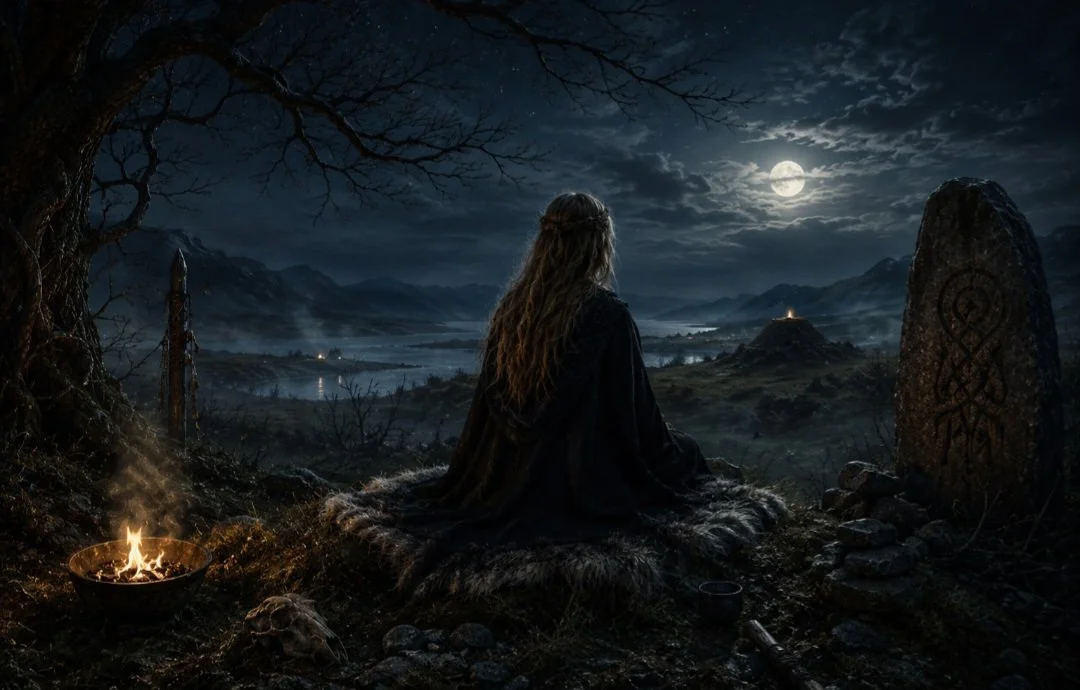
There is a strange phrase buried within the surviving literature and law codes of medieval Scandinavia: sitja úti - “to sit outside” or “to sit out”. On the surface, there is nothing particularly supernatural about it. People sit outdoors every day. Yet in certain Old Norse contexts, sitting outside becomes something entirely different. The person is alone. Supernatural knowledge may be sought. Strange beings may be involved. The dead potentially lurk somewhere in the background. Christian lawmakers condemn the behaviour. One particularly fascinating legal formulation associates sitting out with vekja tröll upp - “to wake up trolls”. From these fragments has developed the modern idea of útiseta: an ancient Norse practice in which someone deliberately withdrew from ordinary human society and sat outside in order to encounter the supernatural or obtain hidden knowledge. There is genuine historical evidence behind this idea, but what becomes much less certain is almost everything that comes after it. We do not possess a Viking-Age handbook explaining how útiseta was performed. We do not know that everyone practised it in the same way. We cannot confidently reconstruct a standard sequence of preparations, chants, fasting, trance techniques, locations or ritual gestures. Instead, we possess scattered references which together suggest that “sitting out” could carry a very particular and potentially dangerous supernatural meaning.
Even the word útiseta itself needs careful handling. Old Norse sources can describe the action using sitja úti, literally “to sit outside”. Modern discussions often turn Útiseta into the formal title of a clearly defined Norse magical system, almost as though it existed alongside named categories such as seiðr and galdr with its own fixed rules. The surviving medieval evidence is not that tidy. Sitting outside could obviously be completely ordinary, and the words themselves do not automatically indicate magic. It is the context (supernatural knowledge, magical intention, forbidden beings or extraordinary results) that makes particular examples significant. For that reason, it may be safer historically to think first about the practice of “sitting out” rather than assuming every reference belongs to one standardised ritual called Útiseta. This distinction becomes especially important when modern Heathen reconstructions include fasting, meditation, trance, ancestor work, nature communion or modern concepts of spirit contact. Those practices may be meaningful today, but they should not automatically be described as documented Viking-Age procedure.
One of the most important clues comes from medieval Scandinavian law. Christian legislation condemns forms of sitting out associated with heathen supernatural activity. Particularly famous is the expression útiseta at vekja tröll upp, usually understood along the lines of “sitting out to wake up trolls”. This is enormously important because it demonstrates that lawmakers were not concerned with somebody merely sitting outdoors after sunset. Something about what the person was attempting to contact, awaken or accomplish made the behaviour religiously unacceptable. The word tröll itself deserves considerably more attention than it normally receives. Translating it simply as modern English “troll” can immediately send the reader in the wrong direction. Modern popular culture has transformed trolls into a very specific category of creature: large, ugly humanoid monsters living in mountains, caves or beneath bridges. Medieval Scandinavian tröll could occupy a much broader semantic and supernatural territory. The word could refer to monstrous or uncanny beings and could also occur within contexts involving magic and supernatural forces. Therefore, vekja tröll upp should not automatically be visualised as someone sitting beside a rock attempting to wake a sleeping fairy-tale troll.
The verb vekja is particularly intriguing because it means to wake, awaken or rouse. The image created by the legal phrase is therefore active rather than passive. The sitter is apparently not merely waiting hopefully for a supernatural experience. They are accused of attempting to wake something up. That immediately brings us into another dark corner of Old Norse supernatural tradition: the awakening of the dead. One of the clearest examples occurs in Baldrs draumar. Óðinn requires knowledge concerning the ominous dreams troubling Baldr. Rather than simply knowing the answer himself, Óðinn travels towards the realm of the dead. There he reaches the grave of a deceased völva. Through magical means associated with valgaldr, he causes the dead woman to rise and speak. She does not appear pleased about being disturbed. Óðinn nevertheless questions her and extracts knowledge that belongs beyond the ordinary reach of the living. It is important not to claim that this scene is Útiseta. The poem does not call it that. But it demonstrates that the wider Norse literary imagination absolutely contained the concept of deliberately awakening a dead supernatural authority in order to obtain information. When this is placed beside a legal prohibition against sitting out to “wake up” supernatural beings, the comparison becomes extremely interesting.
The dead, in other words, could know things. Death did not necessarily erase knowledge. Instead, death could place knowledge somewhere inaccessible to ordinary living people. That idea appears repeatedly within Norse mythology. Óðinn's pursuit of wisdom frequently involves crossing boundaries to reach someone or something that possesses information he lacks. Mímir possesses knowledge. Giants possess ancient cosmological knowledge. Dead seeresses possess knowledge. Ravens travel throughout the world and return carrying information. Knowledge in Norse mythology behaves almost like a resource distributed unevenly throughout the cosmos. It has owners, locations and guardians. If the dead retained knowledge, then graves and burial mounds potentially became more than places where bodies were deposited. They could become boundaries between the living community and beings who possessed information inaccessible to it.
This possibility has naturally encouraged scholars to investigate connections between sitting out and burial places. Scandinavian burial mounds remained culturally powerful locations long after the deceased had been buried. Saga literature repeatedly imagines mounds as places where the dead remain present in some sense. Mounds can be entered. Their inhabitants can appear. Objects can be retrieved from them. The living can encounter the dead around them. Archaeology also demonstrates that burial landscapes could remain active places of memory, ritual activity and interaction long after the original funeral. Yet caution is necessary here as well. We cannot simply state that Útiseta meant “sitting on a grave mound”. The surviving evidence does not justify making that a universal rule. Grave-side sitting may belong somewhere within the wider tradition, particularly when necromantic interpretations are considered, but the evidence does not show that every person who sat out did so upon a burial mound or that communication with dead ancestors was always the purpose.
One of the most tantalising references comes from Vǫluspá. The poem contains the simple but extraordinary statement Ein sat hon úti — “Alone she sat outside.” The person sitting outside is the völva whose extraordinary knowledge forms the heart of the poem. Óðinn comes to her, and the surrounding stanzas concern wisdom, prophecy and knowledge extending far beyond ordinary human perception. This tiny phrase has therefore become enormously important in discussions of Útiseta. It is easy to understand why. Here we apparently have a supernatural female specialist, sitting alone outside, in a context involving Óðinn and extraordinary knowledge. If medieval law later condemns supernatural “sitting out”, it is enormously tempting to connect the two and reconstruct an ancient divinatory practice. That connection is possible, but the poem does not tell us enough to turn the scene into a ritual manual. It does not tell us that she sits on a grave mound. It does not tell us that she fasts. It does not tell us that she sits there from sunset until sunrise. It does not describe breathing exercises, trance techniques, protective circles, ritual directions or offerings. It does not even explicitly explain why she is sitting outside. We know that she sits outside alone and that the surrounding episode concerns extraordinary knowledge and Óðinn. Everything beyond that requires interpretation.
The following material in Vǫluspá makes the episode even stranger. Óðinn gives the völva treasures, and the poem speaks of wise speech or tidings alongside the notoriously difficult expression spá ganda. The seeress then sees widely across the worlds. This is particularly fascinating because gandr itself belongs to one of the most difficult areas of Old Norse magical vocabulary. The passage therefore brings together sitting outside, Óðinn, prophecy, supernatural perception and gandr without ever stopping to explain how those concepts relate to one another. This is characteristic of Old Norse magical sources. They frequently preserve fragments of practice without preserving the theory behind them. The medieval audience may have understood associations that are now lost to us. A poet did not necessarily need to explain what sitting outside implied any more than a modern writer needs to explain what somebody means when they say a person went to church, attended a funeral or visited a psychic. Cultural knowledge fills the gaps. Once that cultural environment disappears, later readers are left attempting to reconstruct meaning from scattered references.
Other medieval texts strengthen the case that sitting out could indeed represent deliberate magical activity. Orkneyinga saga contains the figure Sveinn brjóstreip, whose supernatural behaviour includes sitting out. The saga presents such activity through an explicitly Christian framework and associates it with communication with the devil. Elsewhere, Hákonar saga herðibreiðs contains another example involving Þórdís skeggja sitting out in connection with magical attempts concerning the fortunes of King Hákon. These references matter because they demonstrate that the phrase in Vǫluspá does not exist completely alone. Medieval Scandinavian authors could understand “sitting out” as something connected with supernatural activity. But Christian interpretation complicates everything. When a Christian saga author describes somebody sitting outside and communicating with the devil, we cannot automatically assume that the practitioner themselves would have understood the being they encountered as Satan. Christian authors routinely interpreted non-Christian supernatural practices through Christian categories. Indigenous gods could become demons. Magical beings could become devils. Older rites could become sorcery. Practices that once occupied complicated positions within pre-Christian religion could be reclassified simply as sinful.
This creates one of the strangest problems in studying Norse magic. Some of our most valuable evidence survives because Christians wanted the practices destroyed. Laws tell us what people were forbidden to do. Clerics tell us what practices they considered sinful. Saga writers occasionally preserve magical traditions while simultaneously interpreting them through a Christian worldview. The very hostility of the sources is sometimes the reason the behaviour was recorded at all. Yet that means the evidence cannot be accepted uncritically. When lawmakers condemn people for “waking trolls”, were they accurately describing what practitioners believed they were doing? Were they using a hostile Christian label for several different activities? Did tröll refer to dead beings, hostile spirits, monsters or simply supernatural entities considered illegitimate by Christian authorities? We cannot answer all of these questions confidently. That uncertainty is not a weakness in studying Útiseta. It is the actual history.
Modern reconstruction often tries to remove uncertainty by creating a complete system. Someone sits outside at night. They choose a burial mound. They fast beforehand. They enter trance. They communicate with ancestors. They remain until dawn. They return carrying wisdom. It sounds convincing because it forms a complete ritual. The problem is that the completeness comes largely from us. The medieval evidence provides fragments. Another common assumption is that Útiseta was simply a form of seiðr. Again, there may be overlap, but the surviving sources do not permit us to treat the words as synonyms. Seiðr encompasses a broad and extremely complicated range of supernatural practices, including prophecy, influence, harmful magic and other activities. Sitting out describes a particular action or circumstance. Someone performing supernatural sitting-out could conceivably be understood as practising magic, perhaps even seiðr in some contexts, but that does not mean every instance of Útiseta was seiðr or every seiðr practitioner performed Útiseta.
The famous ritual involving Þorbjörg lítilvölva in Eiríks saga rauða demonstrates why separating these categories matters. Þorbjörg arrives as a recognised prophetic specialist. Her clothing is described in unusual detail. She carries a staff. A special meal is prepared. She sits upon an elevated seat. Women form around her. Guðríðr performs the varðlokkur. Following the ritual, Þorbjörg communicates extraordinary knowledge. This is one of our richest literary descriptions of Norse magical practice, but it is not described as Útiseta. Modern reconstructions sometimes combine Þorbjörg's ritual with the Vǫluspá seeress sitting outside, legal prohibitions concerning útiseta, Óðinn's necromancy and later Scandinavian folklore. The result is then presented as one coherent Viking-Age ritual system. Historically, that is dangerous. Those pieces may indeed preserve related traditions. They may even represent different manifestations of overlapping ideas. But we cannot simply combine them because they fit together nicely.
The same applies to Óðinn. Óðinn is deeply associated with seiðr, magical knowledge, prophecy, necromancy and the deliberate acquisition of hidden wisdom. He is therefore almost impossible to avoid when investigating Útiseta. Yet the surviving material does not straightforwardly state that Óðinn himself practises something called Útiseta. What we have instead is a fascinating constellation of connections. A völva sits outside alone. Óðinn comes to her. Óðinn elsewhere awakens a dead völva to obtain knowledge. Christian law later condemns sitting outside to awaken supernatural beings. These pieces are close enough to demand comparison. They are not close enough to declare them identical.
Night-time is another feature heavily associated with modern Útiseta. There is some historical justification for connecting sitting out with darkness and nocturnal supernatural activity, yet there is no surviving universal Viking-Age rule stating that Útiseta had to begin at midnight or continue until sunrise. Still, night makes extraordinary sense within the broader cultural landscape. Darkness transforms familiar territory. The hall is illuminated while the landscape disappears. People sleep. Human activity diminishes. Sounds become ambiguous. Distance becomes difficult to judge. The burial mound visible and ordinary during daylight becomes something very different when encountered alone in darkness. This brings us to an aspect of Útiseta that may actually be more revealing than attempting to reconstruct missing ritual instructions: the meaning of outside.
The distinction between inside and outside was profound within the lived landscape of medieval Scandinavia. The farmstead, hall and cultivated land represented human order. Inside were fire, food, kinship, hospitality, law and social relationships. Beyond those controlled spaces lay uncultivated landscapes, mountains, forests, graves, darkness and beings who did not necessarily belong to human society. Norse mythology repeatedly works with similar boundaries. Gods construct enclosed spaces. Humans inhabit protected settlements. Dangerous or unpredictable beings inhabit outer regions. Journeys into those regions carry risk. To deliberately sit úti could therefore represent more than changing physical location. The practitioner leaves human space. That may be a fundamental part of the act. Instead of summoning the supernatural into the safety of the hall, the person moves towards the territory where supernatural encounters become possible.
This is one reason translating Útiseta as “Norse meditation” can be deeply misleading. Meditation is a modern category carrying its own expectations of introspection, relaxation and psychological self-observation. The medieval evidence surrounding magical sitting out is considerably darker. Christian law associates it with awakening supernatural beings. Literary examples associate it with prophecy, magical action or communication with beings Christian authors could identify as demonic. The dead hover around the wider tradition. Whatever subjective states practitioners may have experienced, the surviving sources do not primarily present Útiseta as sitting peacefully beneath a tree to become mindful of one's breathing. Something may have been expected to happen.
Another modern expression frequently applied to Útiseta is “Norse vision quest”. This should also be avoided in historical writing. “Vision quest” belongs particularly to discussions of Indigenous North American religious traditions, and using it casually for Scandinavian practices risks flattening completely different cultures into one universal category. The word “shamanism” creates similar problems. There is a legitimate scholarly debate concerning relationships between Norse and Sámi magical traditions. Norse and Sámi communities interacted extensively across northern Scandinavia through trade, political relationships, conflict, intermarriage and shared landscapes. Old Norse literature repeatedly portrays Sámi people as possessing extraordinary magical abilities. Some scholars have therefore explored whether particular elements of Norse magic, including seiðr and solitary supernatural practices, may have developed through cultural interaction. That possibility deserves serious investigation, but possibility is not proof. Saga portrayals of Sámi magic can themselves reflect Norse stereotypes about outsiders, so calling Útiseta “Norse shamanism” solves nothing.
Gender provides another surprise. Because Vǫluspá's famous sitter is a völva, modern depictions often portray Útiseta primarily as female magic. Yet medieval examples of sitting out are not exclusively female. Men could also be accused or described as engaging in such activity, and the legal condemnations do not establish a ritual belonging solely to women. This matters because seiðr itself possessed extremely complicated gender associations. Old Norse literature can connect male performance of seiðr with accusations of ergi and violations of masculine social expectations, even though Óðinn himself is said to practise it. If Útiseta were simply another word for precisely the same practice, we might expect its gender dynamics to appear equally consistently. They do not. Again, the evidence suggests that sitting out may be better understood as a technique, behaviour or ritual circumstance within a much broader supernatural world rather than as a single organised magical discipline.
Altered states present another fascinating possibility. Imagine the physical circumstances. A person leaves the settlement. They sit alone. Perhaps it is dark. Perhaps they remain there for hours. Ordinary social stimulation disappears. Sounds become amplified. Shapes become ambiguous. Fatigue develops. Fear or expectation may increase. From a modern psychological perspective, such circumstances can certainly affect perception and consciousness. It is therefore completely reasonable to investigate whether altered states played some role in historical sitting-out practices. What we cannot do is turn that possibility into evidence. The medieval sources do not provide neurological explanations. They do not tell us that practitioners deliberately used sensory deprivation to trigger hallucinations. They describe encounters, knowledge and supernatural activity according to the conceptual frameworks of their own culture. Modern researchers can ask what may have happened psychologically. Historians must still distinguish that question from what medieval Scandinavians believed was happening.
Fasting presents the same problem. Modern Útiseta instructions frequently recommend fasting beforehand. Others prescribe ritual purification, particular nights, magical circles, staffs, chanting, offerings, protective symbols or facing particular directions. Some of these elements may be inspired by genuine Norse material from elsewhere, but they are not preserved as a standard historical Útiseta procedure. This distinction is extremely important for modern Heathenry. A reconstructed practice is not automatically a false practice. Modern practitioners can build meaningful rituals inspired by historical material. Religious traditions have always developed, adapted and created new forms. The problem only begins when reconstruction is presented as documented Viking-Age fact. Saying “I practise a modern form of Útiseta inspired by medieval evidence” is historically defensible. Saying “this is exactly how Viking-Age völur performed Útiseta” requires evidence we simply do not possess.
So what can we actually say with reasonable confidence? We can say that medieval Scandinavian sources preserve the concept of sitting outside in contexts associated with supernatural activity. We can say that Christian law condemned supernatural sitting-out. We can say that one remarkable legal expression associates the practice with vekja tröll upp - waking supernatural beings. We can say that Vǫluspá describes its extraordinarily knowledgeable seeress sitting outside alone. We can say that medieval narratives preserve additional examples in which sitting out is associated with magical activity. We can say that Norse literature contains a wider tradition in which supernatural knowledge can be obtained from the dead. We can say that burial places remained culturally meaningful and sometimes dangerous locations where the boundary between living and dead could become unstable. What we cannot say is equally important. We cannot reconstruct one universal Útiseta ritual. We cannot prove that everyone sat on burial mounds. We cannot prove that practitioners always contacted ancestors. We cannot prove that they always entered trance. We cannot prove that fasting was mandatory. We cannot prove that it happened only at night. We cannot prove that it was exclusively women's magic. We cannot simply equate it with seiðr. And we cannot assume that every occurrence of somebody sitting outside in Old Norse literature describes supernatural activity.
Once those later assumptions are removed, however, what remains may actually be more fascinating. Útiseta becomes less like a lost ritual manual and more like a glimpse into how medieval Scandinavians imagined the boundaries of human knowledge. The person who sits out deliberately leaves the normal human environment. Inside is fire. Inside is family. Inside is law. Inside is the community. Outside is darkness. Outside are graves. Outside are beings who do not necessarily belong within human society. Outside is uncertainty. If supernatural knowledge existed beyond the ordinary boundaries of human perception, perhaps the person seeking it had to cross an ordinary boundary first. They had to leave.
That possibility gives the act of sitting outside an almost unsettling simplicity. There may have been no enormous temple, no elaborate altar, no written spell book and no complex magical apparatus. Perhaps, in some circumstances, the most important ritual action was simply placing yourself somewhere you ordinarily should not be: alone, outside, waiting. This may also help explain Christian hostility towards the practice. From the perspective of Christian authorities, somebody deliberately withdrawing from the community to seek knowledge from supernatural beings was not simply preserving an eccentric rural custom. They were obtaining spiritual authority from an unauthorised source. They were asking the wrong beings. They were seeking forbidden knowledge. They were crossing boundaries Christian institutions wanted firmly closed.
And this brings us back to perhaps the most haunting fragment of all: útiseta at vekja tröll upp - sitting out to wake supernatural beings. It is only a handful of words, yet those words preserve an extraordinary possibility. Someone goes outside. Someone sits. Someone waits. And someone (at least according to the people frightened enough to prohibit the practice) expects something to wake. We may never know exactly what historical practitioners experienced during these acts. Perhaps some sought prophecy. Perhaps some attempted communication with the dead. Perhaps others sought supernatural assistance, magical influence or information. Perhaps Christian lawmakers grouped several unrelated practices beneath the same condemnation. The evidence simply does not allow us to force every example into one system.
That uncertainty is precisely what makes Útiseta so fascinating. It survives at the edges of the historical record: a few lines of poetry, legal prohibitions, a handful of saga episodes, connections with prophecy, connections with forbidden beings and possible connections with death. Behind all of them lies the same disturbing image: a person deliberately leaving the human world behind for a while and sitting somewhere beyond its protection. Not necessarily to worship. Not necessarily to meditate. Not necessarily even to cast a spell. But perhaps simply to make themselves available to whatever existed beyond ordinary human perception.
The modern question tends to be: “How did the Vikings perform Útiseta?” Historically, we cannot answer that with certainty. A better question may be: why did medieval Scandinavians think sitting outside could become dangerous enough for the law to forbid it? The surviving evidence gives us one remarkable answer.
Because sometimes, apparently, the person sitting outside was not alone.
They were waiting for something to answer.