
Haustblót - The Autumn Sacrifice and the Coming of Winter
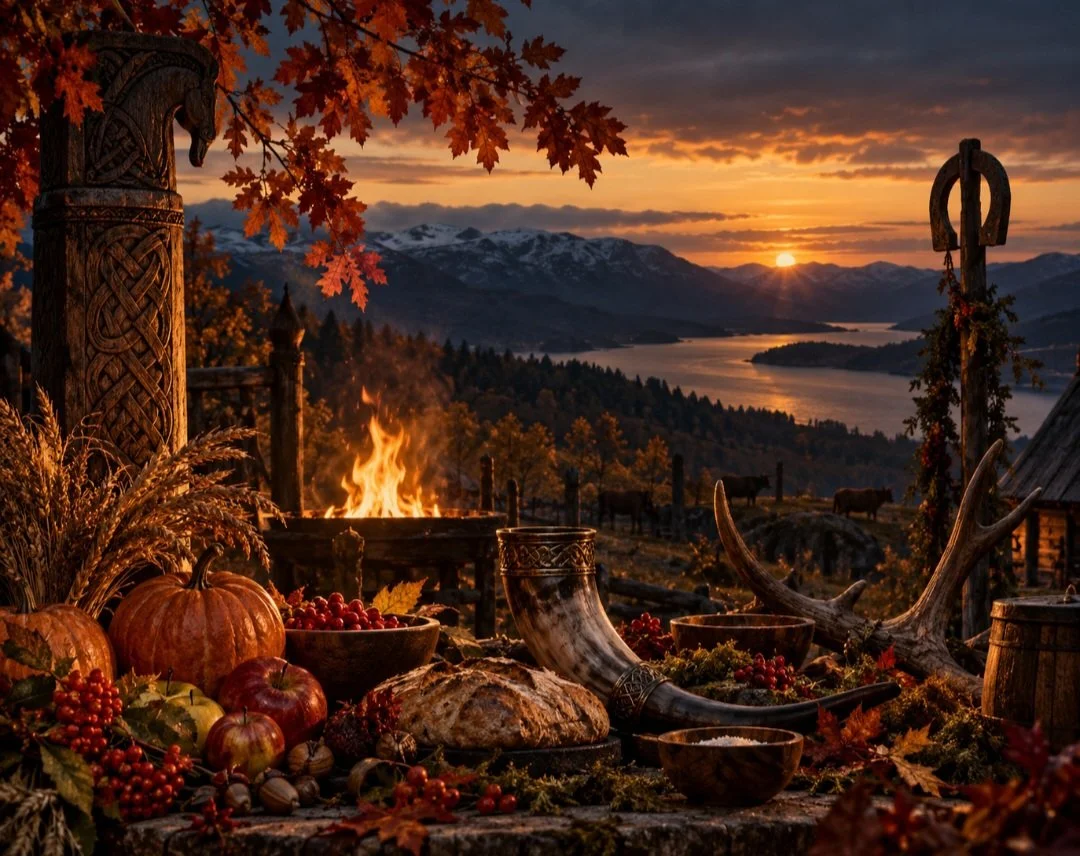
When autumn begins to settle over the northern landscape, the change is impossible to ignore. The days shorten, the light weakens, fields that spent the summer growing are harvested, livestock must be assessed before winter, and food has to be preserved and stored. What has been gathered during the productive months must now sustain the household through the darker half of the year. For the people of pre-Christian Scandinavia, this transition was more than a simple change in weather. It represented one of the great turning points of the year.
Within the surviving Old Norse literature we repeatedly encounter feasting, sacrifice and communal gatherings associated with the movement from summer into winter. Among the words connected with this period are haust, meaning autumn, vetrnætr, the Winter Nights, haustboð, an autumn feast or gathering, and the wider evidence for sacrifice performed as winter approached. From this world comes what modern Norse Pagans commonly call Haustblót: literally, the autumn sacrifice.
Today, Haustblót is frequently presented as one of the major festivals of the reconstructed Norse Pagan calendar. Search for it online and you will often encounter a remarkably tidy explanation: Haustblót was the Norse autumn equinox festival, celebrated around the 21st or 22nd of September as a thanksgiving for the harvest. It is simple, memorable and fits neatly onto a modern wheel of seasonal festivals. The problem is that the surviving Norse evidence is nowhere near that tidy.
The medieval sources do provide evidence for autumn sacrifice. They provide evidence for feasting around the beginning of winter. They describe people welcoming winter, sacrificing to Freyr and performing blót concerned with prosperity and the coming year. They also preserve a wider pattern of seasonal sacrifices structured around the movement into winter, midwinter and summer. What they do not provide is a surviving pre-Christian religious calendar telling us that all Norse people celebrated a standardized festival called Haustblót on the autumn equinox.
That matters because if we want to understand Haustblót historically, we first have to put aside the modern festival calendar and return to the language of the sources themselves. When we do, something much more interesting appears. Haustblót belongs to a larger story about how people in the Norse world understood the passing year, the movement between summer and winter, agriculture, communal feasting, sacrifice, relationships with the gods and the very practical uncertainty of surviving another northern winter.
The word itself gives us our first clue. Haust means autumn, while blót belongs to the religious vocabulary of pre-Christian Scandinavia and refers fundamentally to sacrifice or sacrificial observance. Haustblót can therefore be understood literally as an “autumn sacrifice” or “autumn sacrificial feast.” Calling it simply an “autumn festival” is not necessarily wrong in a broad modern sense, but it can hide the most important element of the word. A blót was not merely a celebration of the season. Sacrifice lay at the heart of the concept.
Exactly what occurred during a blót could vary according to place, period, community and circumstance. The surviving sources themselves were written in different contexts, frequently generations or centuries after conversion to Christianity, and they cannot simply be combined into a single universal ritual handbook. Nevertheless, they preserve enough material to show that blót could involve offerings, ritual drinking, feasting and the establishment or maintenance of relationships between human communities and divine or supernatural powers. We should therefore be extremely cautious whenever a modern reconstruction claims to reproduce exactly “how the Vikings performed Haustblót,” because no such complete ritual description survives.
One of the most important pieces of evidence comes from Gísla saga Súrssonar. There Þorgrímr prepares an autumn gathering around the Winter Nights. The saga states that Þorgrímr ætlaði at hafa haustboð at vetrnóttum ok fagna vetri ok blóta Frey - Þorgrímr intended to hold an autumn gathering at the Winter Nights, welcome winter and sacrifice to Freyr.
Those few words are extraordinarily useful because they connect several ideas that are sometimes separated on modern pagan calendars. There is an autumn gathering, it occurs at the Winter Nights, winter itself is welcomed, and Freyr is the recipient of sacrifice. Rather than presenting autumn as an isolated festival season positioned neatly between summer and winter, the passage places the autumn gathering directly at the threshold where winter begins.
A similar seasonal structure appears in Ynglinga saga, where Snorri Sturluson describes three major sacrifices. The text states: Þá skyldi blóta í móti vetri til árs, en at miðjum vetri blóta til gróðrar, it þriðja at sumri, þat var sigrblót. In broad translation, sacrifice was to be made towards winter til árs, at midwinter til gróðrar, and the third sacrifice occurred in summer and was called sigrblót, the victory sacrifice.
Again, the wording matters. The text does not tell us that sacrifice occurred on the autumn equinox. It says í móti vetri - towards, or at the approach of, winter. That might initially seem like a small difference, but historically it completely changes the way we should picture the observance.
Modern Western culture generally imagines the year as four approximately equal seasons: spring, summer, autumn and winter. Because that model is so familiar, it is remarkably easy to project it backwards. September becomes autumn, the equinox falls around the 22nd or 23rd, December becomes winter, and therefore an ancient “autumn festival” seems naturally suited to September. But the traditional Scandinavian and Icelandic understanding of the year could be organised much more strongly around the two great halves of summer and winter. The beginning of winter was therefore not simply another seasonal date somewhere after autumn. It represented one of the fundamental boundaries through which the year itself was structured.
This helps explain why the language surrounding autumn sacrifice repeatedly points towards winter. Í móti vetri: towards winter. Fagna vetri: to welcome winter. At vetrnóttum: at the Winter Nights. These expressions place the emphasis not simply upon “autumn” as we understand it today, but upon the transition from the productive summer half of the year into winter.
For an agricultural community this transition had enormous practical importance. Crops had been gathered. Animals had been raised through the warmer months. Households had to decide which livestock could realistically be fed through winter and which should be slaughtered. Meat needed preserving. Grain and other food stores had to be assessed. Fodder had to last. The shortening days were therefore accompanied by a very real calculation: had enough been produced to carry the household through the months ahead?
The abundance or failure of the previous growing season was now becoming impossible to ignore, while the success of the next remained completely uncertain. This makes the wording preserved in Ynglinga saga especially significant. The sacrifice towards winter was performed til árs. The phrase is commonly translated along the lines of “for a good year,” but the idea of ár in this context reaches beyond simply wishing for twelve pleasant calendar months. It is associated with fruitfulness, prosperity and successful seasonal production. A good year meant that the conditions necessary for life continued: crops grew, animals flourished, food was available and communities prospered.
The autumn sacrifice therefore occupied a fascinating position within the seasonal cycle. It looked backwards towards what had been produced and gathered while simultaneously looking forwards into uncertainty. People had reached the end of one productive season, but their survival still depended upon winter and upon the return of fertility and growth afterwards. Thanksgiving, preparation, sacrifice and hope for future prosperity could therefore exist together rather than belonging to separate modern categories.
This is why describing Haustblót simply as the “Norse autumn equinox” strips away much of what makes the historical material interesting. The surviving evidence points us towards a religious landscape concerned with the coming of winter, seasonal prosperity, communal gathering and sacrifice. A modern practitioner may choose to hold a reconstructed Haustblót at the autumn equinox, and there is nothing inherently wrong with doing so, but the choice should be recognised as a modern calendrical decision rather than presented as a securely attested Viking-Age date.
Haustblót was not simply about celebrating autumn. It belonged to the dangerous and important threshold between abundance and scarcity, light and darkness, summer and winter. To understand it properly, we therefore have to understand the Winter Nights themselves, because once we look closely at the surviving evidence, the neat modern division between “Haustblót” and “Vetrnætr” begins to become much less certain.
The Norse Year - Summer, Winter and the Turning of the Seasons
One of the biggest obstacles to understanding Haustblót is the calendar we carry around in our own heads. Today, most of us instinctively divide the year into four seasons: spring, summer, autumn and winter. We expect each to occupy roughly a quarter of the year, and we associate their beginnings with astronomical events such as the equinoxes and solstices. When we encounter a word such as Haustblót, the “autumn sacrifice,” it therefore seems natural to search for the corresponding autumn point on our own calendar and place the celebration around the September equinox. The problem is that this begins with our system and attempts to force the historical evidence into it, rather than beginning with the way time was actually organised within medieval Scandinavia.
The clearest evidence for an alternative way of structuring the year survives particularly well in Iceland. The traditional Icelandic misseri calendar divided the year fundamentally into two halves, or misseri: a winter half and a summer half. Each contained six months. Research into the historical calendar shows that by the tenth century Icelanders were operating a week-based system in which these two halves formed the basic structure of the year, with additional days and eventually an intercalary week used to prevent the calendar drifting indefinitely away from the solar year.
This does not mean that people were incapable of recognising spring or autumn as natural seasons. Old Norse certainly possesses words for them. Haust itself is the obvious example. Rather, it means that the formal organisation of the year did not necessarily give spring and autumn the same structural importance that our modern four-season calendar gives them. Summer and winter could function as the two great halves around which time was reckoned. This distinction is essential because it changes the way we understand expressions such as “towards winter.” Winter was not simply December arriving after three months of autumn. It marked the crossing from one half of the year into another.
The summer half likewise began considerably earlier than someone using the modern meteorological seasons might expect. The old Icelandic First Day of Summer survives even today and falls in April. Historical material preserved in Grágás describes the first day of summer according to the old system, while the Árni Magnússon Institute notes that the beginning of the summer misseri occurred regardless of whether the weather itself felt remotely summery. This is a useful reminder that words such as “summer” and “winter” in historical sources cannot always be translated directly into our assumptions about warm and cold weather.
The same principle applies at the opposite end of the year. The transition from summer into winter occurred around October in the traditional Icelandic system. That immediately creates a problem for the widespread modern claim that Haustblót was simply the Norse autumn equinox festival of September. If the religious language preserved in our sources repeatedly concerns sacrifice towards winter, gatherings at the Winter Nights and the welcoming of winter, then automatically fixing the observance to the September equinox risks moving it away from the very seasonal boundary emphasised by the surviving literature.
There is another important caution here. The Icelandic calendar cannot simply be declared “the Viking calendar” and projected unchanged across Denmark, Norway, Sweden and every Scandinavian community throughout the Viking Age. Much of the detailed calendrical evidence available to us comes from medieval Iceland, and regional variation must always be allowed for. The Scandinavian world covered a large geographical area, with substantial differences in climate, agriculture, political organisation and local custom. There is no reason to assume that every community from Iceland to eastern Sweden followed an absolutely identical ritual calendar.
Nevertheless, the Icelandic material is enormously valuable because it demonstrates something that is otherwise very easy for modern readers to miss: the movement between summer and winter could form one of the fundamental structures through which the year was understood. Once that is recognised, the language surrounding autumn sacrifice begins to make far more sense.
Vetrnætr - The Winter Nights
This brings us directly to Vetrnætr, literally the “Winter Nights.” The name refers to the period surrounding the beginning of winter, and the surviving literature associates it with gatherings, feasting and religious activity. Vetrnætr appears in a number of Old Norse sources and has attracted considerable scholarly attention precisely because the material surrounding it seems to preserve traces of a significant pre-Christian seasonal observance. Folklorist Terry Gunnell, for example, has examined the Winter Nights alongside evidence concerning the dísir and Dísablót, arguing for the wider religious significance of this seasonal threshold.
The plural form Vetrnætr is itself worth noticing. We are dealing with “Winter Nights,” not simply a modern festival day marked by a single square on a calendar. This immediately warns us against imagining the observance as something necessarily beginning at a standardized hour on one universally agreed date. The evidence instead points towards a seasonal period of transition during which gatherings and ritual activity could occur.
This is precisely where the passage from Gísla saga Súrssonar becomes so important. Þorgrímr's haustboð is held at vetrnóttum. He intends to welcome winter and sacrifice to Freyr. The autumn gathering and the Winter Nights therefore occupy the same ritual setting. That does not necessarily prove that the terms Haustblót, haustboð and Vetrnætr were interchangeable names for one standardized festival. It does, however, demonstrate that trying to separate “Haustblót” in September from “Winter Nights” in October as though the sources clearly describe two completely independent festivals is far too simplistic.
What we seem to be looking at instead is a broader autumn-to-winter ritual landscape. Different texts preserve different pieces of it. One source may emphasise an autumn feast. Another may speak of sacrifice towards winter. Another may associate the period with particular supernatural beings or divine powers. These fragments should not automatically be collapsed into one universal ceremony, but neither should they be artificially separated simply because a modern festival calendar needs each observance to occupy its own date.
The importance of the transition itself becomes easier to understand when we consider the society experiencing it. Winter in the medieval North was not simply an aesthetic season of snow, fires and darkness. It placed practical pressure upon households. Livestock required fodder. Stored food had to last. Travel became more difficult. Weather could isolate communities. A poor harvest or inadequate preparation could have consequences extending far beyond inconvenience. The arrival of winter therefore represented uncertainty in a very literal sense.
Against that background, fagna vetri (“to welcome winter”) becomes a much more interesting phrase. Welcoming winter does not necessarily imply that people were delighted about freezing weather. It marks acknowledgement of a transition. One half of the year had ended and another had begun. Communities gathered at the threshold, feasted, sacrificed and faced what lay ahead.
Haustblót and Vetrnætr - One Festival or Two?
This is where modern reconstructions often become much more confident than the evidence warrants. Contemporary Norse Pagan calendars frequently present Haustblót and Vetrnætr as separate entries. Haustblót may be assigned to the autumn equinox in September, while Vetrnætr is placed several weeks later in October. Once printed in a calendar or repeated often enough online, this arrangement can begin to look ancient in its own right.
The sources do not give us such a convenient schedule.
Instead, they give us overlapping terminology and overlapping ritual contexts. We have autumn gatherings. We have sacrifice towards winter. We have Winter Nights. We have the welcoming of winter. We have sacrifice to Freyr. Elsewhere we encounter religious activity associated with the dísir and, in another context, the álfar. These practices occupy a related part of the seasonal landscape without necessarily being identical.
This means the most responsible answer to the question “Were Haustblót and Vetrnætr the same festival?” is that the surviving evidence does not allow us to establish a universal rule.
In some contexts, an autumn sacrificial gathering clearly occurred at the Winter Nights. Gísla saga provides direct evidence of precisely that relationship. But we cannot take one saga passage and turn it into legislation for the whole pre-Christian North. Nor can we assume that every autumn gathering involved Freyr simply because Þorgrímr's did, or that every Winter Nights observance followed exactly the same ritual pattern.
Pre-Christian Norse religion was not a centrally governed institution. There was no single pagan authority distributing an annual liturgical calendar across Scandinavia. Religious life existed within households, farms, communities, regional cult centres and political networks, and practice could change across both geography and time. What happened at an autumn gathering in tenth-century Iceland need not have been identical to what happened in Sweden, Norway or Denmark.
That variation is not an inconvenience that needs to be corrected. It is part of the history.
Rather than asking which modern festival box each piece of evidence belongs inside, it is more useful to recognise a wider period of seasonal religious activity surrounding the end of summer and beginning of winter. Haustblót can then be understood not as a securely reconstructed pan-Scandinavian equinox festival, but as part of this broader autumn sacrificial context.
Why the Autumn Equinox Is a Modern Problem
The autumn equinox is astronomically real. What is much harder to demonstrate is that it served as the fixed date of a major Norse religious festival called Haustblót.
This distinction is extremely important.
Ancient and medieval peoples certainly observed the sky, the movement of the sun, changing daylight and the rhythms of the year. None of that is in dispute. But recognising astronomical cycles does not automatically mean that every solstice and equinox functioned as a major religious festival. To demonstrate that Haustblót was specifically an equinox celebration, we would need historical evidence connecting the sacrifice with that astronomical event. The surviving Norse sources do not clearly provide it.
What they repeatedly give us instead is seasonal language: autumn, the approach of winter, the Winter Nights, welcoming winter, prosperity, growth and sacrifice. Those are the markers we should allow to guide our reconstruction.
The equinox nevertheless offers an attractive date to modern practitioners. Our modern calendar requires fixed dates. People need to organise work, travel and community gatherings. The equinox is predictable, symbolically powerful and falls naturally within what we now consider autumn. There is therefore nothing inherently inappropriate about a modern Norse Pagan community choosing to celebrate a reconstructed Haustblót at the equinox.
The problem begins only when the modern choice is projected backwards and presented as historical fact.
There is an enormous difference between saying, “We hold our Haustblót at the autumn equinox,” and saying, “The Vikings celebrated Haustblót at the autumn equinox.”
The first describes a living modern religious practice.
The second makes a historical claim.
And historical claims require evidence.
If we allow the surviving evidence to speak on its own terms, Haustblót becomes far more interesting than a Norse replacement for a generic autumn equinox festival. It emerges from a world in which the end of summer meant reckoning with what had been produced, preparing people and animals for winter, gathering communities together, sacrificing for continued prosperity and crossing one of the great boundaries of the year.
And sitting at the centre of one of our clearest descriptions of that autumn gathering is a god whose presence is unlikely to be accidental.
Freyr.
Freyr and Haustblót - Fertility, Prosperity and the Good Year
Freyr's appearance in the autumn gathering described in Gísla saga Súrssonar is one of the most important details we possess concerning the religious character of the season. Þorgrímr does not simply gather his household and neighbours to welcome winter. The saga specifically tells us that he intends to blóta Frey - to sacrifice to Freyr. For anyone familiar with Freyr's wider place within Old Norse tradition, his presence in a rite occurring at the end of the productive season immediately appears appropriate. But this is also precisely where we have to be careful. It is very easy to move from the perfectly defensible statement that Freyr is explicitly connected with an autumn sacrifice in one source to the much larger claim that Haustblót was universally “Freyr's festival.” The first is attested. The second is a reconstruction.
Freyr belongs to the Vanir and is repeatedly associated in Old Norse literature with prosperity, fertility, abundance and peace. In Gylfaginning, Snorri describes him as ruling over rain and sunshine and thereby the produce of the earth, and says that it is good to call upon him for ár ok friðr. That expression, usually translated approximately as “a good year and peace,” is particularly important because the same conceptual pairing appears elsewhere in descriptions of sacrifice. Freyr is therefore not merely a vaguely defined modern “fertility god.” His literary associations connect him with the conditions through which human communities flourish: productive land, favourable seasons, peace and prosperity.
Ynglinga saga makes this relationship particularly explicit. In Snorri's euhemerised account, Freyr becomes a ruler in Sweden and establishes his centre at Uppsala. During his time, the text says there was ár um öll lönd (fruitful seasons or prosperity throughout the lands) and that the Swedes attributed this to Freyr. The people became wealthier through friðr and ár, peace and abundance, and consequently honoured him more greatly. After Freyr's death, the story continues to connect his presence with the continuation of ár ok friðr, and finally states that he was sacrificed to particularly for exactly those things.
The story in Ynglinga saga should not, of course, be read as straightforward historical biography. Snorri is presenting the gods through a medieval euhemerising framework in which divine figures are represented as extraordinary ancient rulers. Nevertheless, the terminology he associates with Freyr is valuable because it corresponds with Freyr's wider literary character. Again and again we encounter the same cluster of ideas: Freyr, fruitful seasons, prosperity and peace.
This becomes even more significant when compared with Hákonar saga góða. In its famous description of a sacrificial feast, ritual drinking follows a particular sequence. The first cup is associated with Óðinn and victory and royal power, while cups dedicated to Njörðr and Freyr are drunk til árs ok friðar - for fruitful seasons and peace. Later in the same saga, the farmers demand that King Hákon participate in sacrifice til árs þeim ok friðar, again placing successful seasonal production and peace among the fundamental purposes for which sacrifice was expected to be performed.
This phrase deserves more attention than it normally receives because modern English translations can make ár ok friðr sound almost sentimental: “a good year and peace.” To an agricultural society, neither concept was sentimental. A “good year” meant successful production. Crops needed suitable conditions. Livestock needed to reproduce and survive. Hay needed to be gathered. Food stores needed to last. Fishing, trade and other economic activities needed to succeed. Peace likewise had material consequences. Warfare, raiding, feud and political instability could damage farms, disrupt exchange, remove labour and threaten the security upon which production depended.
Prosperity therefore did not exist separately from religion, politics, agriculture and community. They were intertwined. When a community sacrificed til árs ok friðar, it was expressing a desire for the conditions under which life itself could continue successfully.
This helps us understand why Freyr fits so naturally into the autumn ritual landscape. At the approach of winter, the results of the productive season were visible everywhere. The grain had either grown successfully or it had not. Hay had either been gathered in sufficient quantity or it had not. Livestock had multiplied or failed. Food had been stored, traded, consumed or lost. The household could look around itself and physically measure much of what the year had provided.
Yet the future remained beyond human control.
Winter still had to be survived, and after winter the land had to become productive again.
A sacrifice to Freyr at this threshold therefore makes considerably more sense when understood through the language of ár ok friðr. It was not simply a generic act of “thanking the fertility god for the harvest.” It existed within a worldview in which human prosperity depended upon continuing relationships between people, land, community and divine powers.
Til Árs - What Does a “Good Year” Actually Mean?
This brings us back to the expression found in Ynglinga saga concerning the sacrifice performed towards winter: blóta í móti vetri til árs. Sacrifice was to be made as winter approached til árs. Translating this simply as “for a good year” gives us the general meaning, but it can also conceal just how important the concept of ár was.
The Old Norse word ár can mean “year,” but in religious and political language it can also carry the sense of a fruitful or prosperous year. The distinction is subtle but important. Sacrificing til árs is not merely wishing that another unit of twelve months will arrive. The concern is with what that year will produce.
This idea appears repeatedly alongside friðr. When Freyr is associated with ár ok friðr, when Njörðr and Freyr's ritual cups are drunk til árs ok friðar, and when the farmers expect their king to sacrifice for ár and friðr, we are seeing a recurring vocabulary of prosperity.
It also reveals something important about the relationship between religion and rulership. The prosperity of the land could be associated with the ruler and with the ruler's proper participation in religious observance. In Hákonar saga góða, the conflict surrounding Christian King Hákon's reluctance to participate in pagan sacrifice is not presented merely as a private disagreement about personal belief. The farmers expect their king to perform the religious role traditionally associated with kingship. They explicitly demand that he sacrifice for their prosperity and peace.
Whether every detail of Snorri's account accurately preserves tenth-century ritual practice is another question. Heimskringla was composed centuries after the events it describes, within a Christian literary culture, and must be treated critically. But the narrative still demonstrates how medieval Scandinavian tradition remembered the relationship between communal sacrifice, rulership, prosperity and the successful year.
That relationship is particularly useful when thinking about Haustblót. If sacrifice at the approach of winter was performed til árs, then the rite was not solely retrospective. It was not simply a celebration thanking the gods for what had already been harvested.
It also looked forwards.
This creates an important difference between Haustblót and the way a modern “harvest festival” is sometimes imagined. A harvest thanksgiving naturally emphasises gratitude for what has already been received. The evidence surrounding autumn sacrifice certainly allows gratitude to make sense within a modern reconstruction, but the surviving language also contains a strong future-facing dimension. Sacrifice is made for continued prosperity. The community acknowledges what has been gained while asking that fertility, stability and abundance continue.
In other words, the autumn threshold looks in both directions.
Behind lies the productive summer.
Ahead lies winter and, beyond it, the hope that growth will return.
Was Haustblót a Harvest Festival?
Calling Haustblót a “harvest festival” is therefore both useful and potentially misleading.
It is useful because the agricultural context cannot reasonably be ignored. An autumn gathering occurred at a point in the year profoundly shaped by harvest, livestock management, food preservation and preparation for winter. Freyr's presence reinforces themes of fertility and prosperity, while the language of ár directly concerns successful production. Harvest is unquestionably relevant to understanding the world in which such sacrifice occurred.
The difficulty comes when “harvest festival” is allowed to become the entire explanation.
The sources do not simply describe people celebrating because the crops had been collected. They place autumn religious activity at the transition into winter. They speak about welcoming winter. They speak about sacrifice for future prosperity. They connect ritual drinking with ár ok friðr. They place human communities at a boundary between what has already been produced and what remains uncertain.
Haustblót is therefore better understood as part of a broader seasonal transition in which harvest formed one extremely important element rather than as the exact Norse equivalent of a modern harvest thanksgiving.
This matters particularly when modern symbolism is introduced. Apples, pumpkins, coloured autumn leaves, cornucopias and similar imagery may be perfectly meaningful to a modern practitioner, depending upon where they live and what they grow, but they should not automatically be presented as reconstructed Viking-Age Haustblót traditions. A modern altar covered in autumn produce may beautifully express the agricultural meaning of the season. It simply belongs to modern practice unless historical evidence demonstrates otherwise.
The same caution applies to claims about specific foods, colours, candles, herbs or ritual objects supposedly “used at Haustblót.” We possess no surviving Viking-Age Haustblót manual telling us that a particular coloured candle should be lit, that a particular herb should be burned or that a precise arrangement of seasonal objects belonged on an altar. Those details may be created within living Norse Pagan practice, but they should be identified as reconstruction rather than disguised as recovered ancient tradition.
Was Haustblót Exclusively Dedicated to Freyr?
Freyr's presence in Gísla saga gives modern practitioners an unusually strong historical foundation for including him in an autumn blót. Of all the gods one might choose to honour in a reconstructed Haustblót, Freyr has a direct textual connection with an autumn gathering at the Winter Nights. His wider association with ár ok friðr strengthens that connection further.
But that still does not make Haustblót universally “the feast of Freyr.”
Our surviving evidence is fragmentary. It comes from different places, different centuries and different literary genres. One household's sacrifice cannot automatically be turned into a pan-Norse rule. The fact that Þorgrímr sacrificed to Freyr tells us what Þorgrímr is described as doing within that saga. It does not tell us that every farmer in Norway, Denmark, Sweden and Iceland addressed exactly the same deity at exactly the same point in autumn.
Indeed, the wider religious landscape surrounding the beginning of winter appears to have involved several supernatural recipients. Sources concerning the Winter Nights and neighbouring autumn observances bring the dísir into view. Álfablót appears in Swedish material in an autumnal context. Ancestors and the dead also become relevant when we consider the broader seasonal evidence. None of this requires us to mash every autumn rite together into one enormous universal festival. Rather, it reminds us that seasonal religion could vary between households, communities and regions.
Freyr therefore occupies an important position in our reconstruction, but not an exclusive one.
The historically responsible statement is simple: we possess explicit literary evidence for sacrifice to Freyr at an autumn gathering held at the Winter Nights, and Freyr is elsewhere strongly associated with fruitful seasons, prosperity and peace.
That is already substantial.
We do not need to exaggerate it.
The Autumn Slaughter -Preparing the Household for Winter
There is another aspect of the season that modern romanticised accounts of Haustblót often soften or omit entirely: autumn was also a season of death.
For livestock-owning households, the approach of winter forced practical decisions. Animals required fodder, shelter and labour. A household could not necessarily maintain every animal born or raised during the productive months through the winter. The amount of available hay and other fodder placed real limits upon the size of the herd that could survive until spring.
Animals that could not be maintained were slaughtered.
This provided meat at precisely the point when preservation became essential. Autumn slaughter therefore belonged to the economic rhythm of northern farming life. It also provides an important background for understanding why sacrifice, slaughter and communal feasting could sit so naturally beside one another.
The modern tendency is sometimes to separate these categories completely. “Religious sacrifice” is imagined as one activity, “food production” as another and “feasting” as a third. In the society reflected by our sources, those boundaries could be far less rigid. An animal could possess economic value, provide food and participate in a religious act. A feast could simultaneously feed a community, establish social bonds and possess ritual significance.
The description of blót in Hákonar saga góða illustrates this overlap vividly. Animals, including livestock and horses, are slaughtered; the meat is cooked for the feast; ale is present; ritual cups are consecrated and drunk; and the gathering is explicitly religious. Whatever historical cautions we must apply to Snorri's thirteenth-century description, the picture he presents is not of sacrifice occurring separately from communal life. Sacrifice and feast form part of the same event.
This changes the atmosphere of Haustblót considerably.
The season was not simply golden leaves and gratitude.
It was abundance and killing, preservation and consumption, security and uncertainty. It was the recognition that life through winter depended upon what had been grown, gathered, raised and stored during the months before it.
In that sense, the autumn sacrifice stood directly at the meeting point between life and death. Some livestock died so that people and other animals could survive. Crops that had grown through summer were cut down and stored. The landscape itself moved towards dormancy. Daylight diminished.
Yet none of this represented an ending without continuation.
The sacrifice was still made til árs.
For the fruitful year.
The community entered winter carrying the hope that the cycle would begin again.
What Actually Happened at a Blót?
If Haustblót literally means an autumn blót, then understanding the observance requires us to ask a more fundamental question: what exactly was a blót?
This sounds as though it should have a simple answer. Unfortunately, there is no surviving pagan Scandinavian ritual manual describing exactly how a blót was to be performed. What we possess instead are fragments scattered across sagas, histories, poetry, legal material, archaeology and accounts written by Christian authors. Some sources provide considerably more detail than others, but all must be approached with caution. They were produced in different periods and for different purposes, and many were written long after Scandinavia had officially converted to Christianity.
The most detailed literary description of a communal sacrificial feast appears in Hákonar saga góða, preserved within Snorri Sturluson's Heimskringla. The saga describes religious gatherings in Norway during the reign of Hákon the Good, a Christian king ruling subjects who continued to expect participation in traditional sacrifice. Whatever historical problems surround the account, it provides one of our richest literary pictures of how medieval Scandinavian tradition understood a large public blót.
The saga describes farmers gathering at a cultic feast and bringing provisions. Livestock of various kinds are slaughtered, including horses. The meat is cooked in cauldrons over fires positioned through the hall. Ale is brought forward. Ritual vessels are present, and the feast is overseen by the person responsible for organising it. Sacrifice, cooking, drinking, religious observance and communal eating therefore appear not as separate activities but as parts of the same event.
The blood of the slaughtered animals is called hlaut in Snorri's description, while the vessels containing it are hlautbollar. Implements described as hlautteinar are used to distribute or sprinkle the blood. The blood is applied to the cultic structures and to the people present, while the meat of the sacrificed animals becomes food for the feast.
This is an important corrective to modern ideas about sacrifice. The sacrificed animal was not necessarily destroyed and discarded as though giving something to the gods required removing it entirely from human use. In the account preserved by Snorri, the animal enters a ritual economy in which slaughter, offering and communal consumption are connected. The sacrifice feeds the gathering while simultaneously participating in the relationship between the human and divine worlds.
The hall itself becomes part of the ritual environment. Fires burn through it. Cauldrons cook the sacrificial meat. Drinking vessels circulate. People eat together. The host or ritual leader consecrates the cups. Rather than imagining Norse sacrifice solely as a solitary individual leaving an offering in an isolated woodland, this source places blót directly within communal social life.
The drinking is especially significant. According to Hákonar saga góða, ritual cups are consecrated and drunk in a particular order. Snorri associates the first with Óðinn and with victory and royal power. Cups connected with Njörðr and Freyr are then drunk til árs ok friðar — for fruitful seasons and peace. The account also refers to drinking to departed kinsmen.
This tells us something important about the religious character of the feast. Drinking was not simply entertainment after the serious ritual had finished. The drinking itself could be ritualised. A cup could be dedicated, words spoken over it, and its consumption connected with gods, prosperity, victory or the dead.
Food and drink therefore operated within networks of religious and social meaning. Sharing the feast created community among the living while ritual drinking could simultaneously acknowledge gods and deceased kin.
That combination becomes particularly relevant when thinking about the beginning of winter. Haustblót was not taking place in an abstract theological environment. It occurred within communities whose survival depended upon cooperation, reciprocal obligation, food production and social stability. Eating and drinking together strengthened relationships at precisely the moment when people were entering the more difficult half of the year.
Hlaut, Blood and the Problem of Snorri
The description of hlaut is among the most memorable parts of Snorri's account, but it is also one of the places where historical caution becomes particularly important.
Snorri Sturluson was writing in Christian Iceland during the thirteenth century, roughly two centuries after Iceland's formal conversion and even further removed from some of the events he describes. Hákonar saga góða is therefore not an eyewitness report of a pagan blót. Snorri was drawing upon older traditions, poetry, stories and his own understanding of the pre-Christian past.
This does not make his account worthless. Far from it. Snorri remains one of our most important literary witnesses to medieval Scandinavian memory of pre-Christian religion. But “Snorri describes this” and “this is exactly what every Viking-Age blót looked like” are two completely different statements.
The vocabulary surrounding hlaut has itself generated scholarly discussion, particularly regarding precisely what the word originally meant and whether Snorri's interpretation of it as sacrificial blood reflects older practice accurately in every respect. This is exactly the sort of detail that should make us cautious about constructing a standardized ritual from a single prose account.
There is a wider methodological lesson here. Historical reconstruction becomes unreliable when several uncertain details are stacked on top of one another until the finished product is presented as fact. Snorri describes blood sprinkling; therefore someone reconstructs an exact sprinkling ceremony; then specific words are invented for that ceremony; then a particular number of circuits around an altar is added; then particular directions are assigned; and eventually a completely modern ritual is described online as “how the Vikings performed blót.”
The problem is not reconstruction itself.
Reconstruction is unavoidable in modern Norse Pagan practice.
The problem is failing to mark where the historical evidence ends and reconstruction begins.
Sacrifice, Reciprocity and Gift-Giving
At the heart of blót lies the act of giving.
Modern explanations sometimes reduce this to a transactional formula: “I give the gods something, therefore the gods give me something.” That captures part of the logic but risks making the relationship sound like supernatural shopping. Gift-giving in Norse and wider Germanic social culture carried much deeper implications involving reciprocity, relationship, obligation, honour and continued social bonds.
A gift could create or reinforce a relationship. Receiving placed the recipient within a network of reciprocity. Giving demonstrated generosity, status and commitment. Exchanges between rulers and followers, friends, households and communities therefore carried social meanings far beyond the material value of the object being exchanged.
It is tempting to understand sacrifice against this wider background.
When a community sacrifices til árs, the act can be understood not simply as payment offered in exchange for crops but as participation in an ongoing relationship between human beings and powers upon whom prosperity was understood to depend. Offerings acknowledge that human survival is not entirely self-created. The household works the land, raises animals, gathers resources and prepares for winter, but weather, fertility, fortune and countless forces remain beyond complete human control.
Blót therefore sits naturally within a worldview of reciprocity.
The people give.
The gods give.
The land gives.
The community shares.
And the relationship continues.
We should still be cautious about turning this into a rigid theological doctrine supposedly held identically by every pre-Christian Scandinavian. No surviving pagan catechism tells us precisely how every person understood the metaphysics of sacrifice. But reciprocal giving provides a powerful interpretive framework because gift exchange was deeply embedded within the social world reflected in Old Norse literature.
The Communal Feast
One of the strongest themes emerging from descriptions of blót is community.
Modern spirituality often emphasises private religious experience. A person constructs an altar at home, performs a solitary ritual, speaks privately to a deity and leaves an individual offering. Such practice can be completely meaningful within modern Norse Paganism, particularly when practitioners live far from others. But the literary evidence for major seasonal blót repeatedly directs our attention towards gatherings.
People came together.
Food was brought.
Animals were slaughtered.
Meat was cooked.
Ale was drunk.
Words were spoken.
Relationships were renewed.
The feast therefore operated simultaneously on several levels. It was religious, because gods and supernatural powers were acknowledged. It was social, because people gathered and ate together. It was political, because leaders could host or participate in sacrifice. It was economic, because food and livestock represented wealth and productive capacity. It was ancestral, because ritual drinking could include remembrance of departed kin.
A seasonal feast at the beginning of winter would have amplified all of these functions. Winter increased dependence upon household and community networks. Hospitality mattered. Reputation mattered. Reciprocal obligations mattered. Food mattered. Entering winter through a communal feast therefore made practical as well as religious sense.
This also helps explain why attempts to reconstruct Haustblót purely as a sequence of magical actions can miss the point. A historically inspired Haustblót does not necessarily require an elaborate ritual script. Sharing food with other people may bring a modern observance closer to the social world of historical blót than performing twenty invented ceremonial gestures supposedly derived from “Viking tradition.”
Ritual Drinking and the Sacred Cup
Drinking deserves particular attention because it appears repeatedly in descriptions of Norse religious gatherings.
Alcoholic drink, particularly ale, was not simply consumed because people enjoyed getting drunk at festivals. Drinking could possess ceremonial structure. Cups could be consecrated, dedicated and consumed for particular purposes. In Hákonar saga góða, the drinking sequence connects Óðinn with victory and power, Njörðr and Freyr with ár ok friðr, and the dead with remembrance.
The spoken word and the drink therefore intersect.
A cup is not merely filled and emptied. It becomes associated with a god, an intention or a relationship. Drinking physically incorporates participation in the rite.
This broader ritual importance of drinking is also useful when considering later descriptions of minni, memorial or commemorative drinking, and the wider Germanic tradition of ceremonial feasting. The exact forms changed across time and context, but the combination of speech, drink and social obligation remained powerful.
For a modern reconstruction of Haustblót, this provides considerably stronger historical grounding than many invented ritual details. A community may choose to dedicate a drink to Freyr til árs ok friðar, another to the gods or powers it honours, and another in remembrance of those who came before. The exact wording would necessarily be modern, but the underlying combination of ritual drink, dedication and communal participation has genuine roots in the source material.
Alcohol itself, however, is not the sacred requirement.
Historical communities used the drinks available and culturally meaningful to them. A modern practitioner who cannot or does not wish to consume alcohol does not somehow perform an invalid blót. Water, juice or another appropriate drink can fulfil the symbolic role within a reconstructed rite. Historical inspiration should not become an excuse for imposing modern social pressure.
The Role of the Host and Ritual Leader
Descriptions of communal blót also raise the question of who was responsible for conducting the gathering.
In Hákonar saga góða, Snorri describes the person who owns or oversees the feast as responsible for the event and for consecrating the ritual cups. Elsewhere, political and religious authority can overlap. Chieftains, household heads and rulers appear within the religious landscape, reminding us that pre-Christian Norse religion did not necessarily operate through a separate professional priesthood comparable to the structure of a medieval Christian church.
The Old Norse title goði is particularly relevant in Iceland, where it came to describe chieftains whose authority combined political, legal and, historically, religious dimensions. The precise development of the office is complex, and it would be misleading to imagine every goði simply as a modern “Norse priest.” Nevertheless, the title demonstrates how difficult it can be to separate religious leadership from wider social authority.
Within a household setting, the person responsible for the farm or feast could naturally occupy an important ritual role. At larger gatherings, powerful local figures could do the same. This reflects a religious world embedded within ordinary social structures rather than standing apart from them.
Again, this matters for reconstruction. There is no evidence that every modern Haustblót requires a person holding a reconstructed ancient priestly title. A community may appoint someone to lead the rite because organisation requires a leader, but that modern role should not automatically be presented as an exact continuation of a standardized Viking-Age clergy.
What Was Actually Sacrificed?
Animal sacrifice is unquestionably present within the literary evidence for Norse blót. Cattle and other livestock appear, and horses occupy a particularly striking position within several accounts of pre-Christian Scandinavian ritual and feasting.
The horse carried enormous practical, economic and symbolic value. It provided transport, status and wealth, while horse meat became sufficiently associated with pagan custom that its consumption acquired particular significance in Christianisation narratives. Hákonar saga góða famously places horse meat at the centre of the confrontation between Hákon and the pagan farmers, with the king's participation in the sacrificial feast becoming a test of religious and political compromise.
But animal sacrifice was not necessarily the only possible form of offering.
The surviving evidence for Scandinavian religious practice includes food, drink, valuable objects and deposits made in landscapes such as wetlands, water and other significant places. Archaeological evidence further demonstrates that ritual deposition could involve many different kinds of material.
This should prevent us from defining blót so narrowly that an animal must die for an offering to count.
At the same time, modern discomfort should not lead us to sanitise the historical evidence. Animals were sacrificed. They were slaughtered, eaten and incorporated into ritual feasting. If we want to discuss historical Norse religion accurately, that reality has to remain visible even when modern practitioners choose entirely different offerings.
Did Haustblót Have a Standard Ritual?
This is perhaps the easiest question to answer.
We do not know.
No surviving source gives us a complete ritual order for something called Haustblót. We do not possess instructions telling participants where to stand, what exact words to speak, which direction to face, how many offerings to make, what colour clothing to wear, what runes to carve, what songs to sing or how the rite should be opened and closed.
Anyone claiming to possess the complete authentic Viking-Age Haustblót ceremony is therefore providing reconstruction, whether they acknowledge it or not.
What we can reconstruct is the broader frame..
Autumn gathering.
The coming of winter.
Sacrifice.
Food.
Drink.
Community.
Prosperity.
Freyr in at least one important account.
Ár ok friðr.
Remembrance of kin within the wider sacrificial feast tradition.
Preparation for what lies ahead.
Those elements provide more than enough material from which a living modern tradition can grow without pretending that missing pieces of history have somehow been recovered.
And there is one element we have deliberately not dealt with yet, because it deserves considerably more care than a passing sentence.
When discussing Norse sacrifice, eventually we encounter the most controversial question of all.
Human sacrifice.
What Might Haustblót Actually Have Looked Like?
Having examined the wider evidence for blót, we can now return specifically to Haustblót. This is where historical reconstruction becomes both useful and dangerous. We possess enough evidence to identify several important features surrounding autumn sacrifice, but not enough to reconstruct a complete ceremony. There is no surviving text describing a Haustblót from beginning to end. We do not know the exact words spoken, how long the gathering lasted, whether there was a universal sequence of ritual actions, or whether different communities even understood the occasion in precisely the same way.
What we do possess are fragments that allow us to establish a broad historical framework. Gísla saga Súrssonar gives us an autumn gathering at the Winter Nights, the welcoming of winter and sacrifice to Freyr. Ynglinga saga gives us sacrifice towards winter til árs, for the fruitful or prosperous year. Wider descriptions of blót provide evidence for sacrificial animals, communal food, ale, ritual drinking and feasting. These sources were written in different contexts and should not simply be combined as though they all describe one identical ceremony, but when handled carefully they allow us to understand the kind of religious and seasonal environment in which an autumn sacrifice could take place.
The gathering itself was likely at least as important as the individual ritual actions. The evidence surrounding seasonal blót repeatedly places religion within communal social life rather than separating it from it. People gathered, food was prepared, drink circulated and sacrifice occurred within that shared environment. Haustblót should therefore probably not be imagined primarily as a short solitary ceremony. At least in some contexts, an autumn sacrifice may have formed part of a much larger gathering or feast marking the transition from the productive part of the year into winter.
Food would have carried particular significance at this point in the year. The productive season had reached its end. Grain, hay and other resources had been gathered, while livestock had to be assessed before winter. Animals that could not realistically be maintained through the colder months could be slaughtered, producing meat for preservation and consumption. A sacrificial feast occurring within this seasonal environment therefore brought together religion and the practical agricultural cycle. The food being consumed represented the accumulated productivity upon which the household would now depend.
Freyr's presence in Gísla saga gives us one of the clearest indications of divine focus. Þorgrímr intends to sacrifice specifically to Freyr while welcoming winter. Combined with Freyr's wider associations with ár ok friðr, fruitful seasons and peace, his inclusion fits naturally within an autumn sacrifice concerned with continued prosperity. Even here, however, we should resist turning one attestation into a universal rule. We can confidently say that Freyr is explicitly honoured at an autumn gathering in this literary tradition. We cannot demonstrate that every autumn sacrifice throughout the Norse world was exclusively dedicated to him.
The wording til árs in Ynglinga saga provides another important clue to the purpose of the seasonal sacrifice. The rite looked forwards as well as backwards. Modern descriptions frequently frame Haustblót primarily as thanksgiving for the harvest, but sacrifice for ár implies concern with continued fruitfulness and prosperity. The community could acknowledge what had already been produced while simultaneously seeking favourable conditions for the future. Haustblót is therefore better understood as an observance at a seasonal threshold than as a simple celebration of a completed harvest. Behind the community lay summer and its production; ahead lay winter and uncertainty; beyond winter lay the hope that growth and abundance would eventually return.
The Feast at the Beginning of Winter
If we remove the modern equinox framework, the timing of Haustblót becomes much easier to understand. The most relevant surviving evidence repeatedly points towards the beginning of winter. Gísla saga places the autumn gathering at vetrnóttum, at the Winter Nights, while Ynglinga saga describes sacrifice í móti vetri, towards or at the coming of winter. Neither expression provides us with a single universally fixed Gregorian date, nor should we expect one. The important marker within the sources is the seasonal transition itself.
This also explains why calling Haustblót simply a “harvest festival” is incomplete. Harvest certainly belongs to its context, but the gathering does not merely celebrate the moment crops are collected. It occurs within the period when the productive season has ended and the household must turn towards winter. The phrase from Gísla saga, fagna vetri, to welcome winter, captures this particularly well. Winter is acknowledged directly rather than existing merely as the background to an autumn celebration.
That phrase becomes considerably more meaningful when placed within the material conditions of medieval Scandinavian life. Winter could place enormous pressure upon households. Stored food had to last, livestock required fodder, poor weather could restrict movement and communication, and a failed harvest could turn the colder months into genuine hardship. The shortening days were therefore accompanied by practical uncertainty. The household knew what it had managed to gather, but it could not know exactly what the coming winter would bring.
A feast at the beginning of winter consequently carried significance beyond simple celebration. Eating together represented abundance at the precise moment when future abundance could no longer be assumed. Food that had been produced during summer was now being shared as the community entered the season in which production was greatly reduced. Sacrifice til árs simultaneously expressed the hope that the conditions necessary for prosperity would eventually return.
Thanksgiving and Future Prosperity
Modern Haustblót rites often focus heavily upon gratitude, and this is one area where modern practice can reasonably draw inspiration from the historical setting, provided that the distinction between evidence and reconstruction remains clear. An agricultural household reaching the end of its productive season had obvious reasons to recognise what had been obtained. Food stores, livestock, hay and other resources represented security through winter, and a successful year could be measured in very practical terms.
What we do not possess is an ancient standardized thanksgiving ceremony. There is no surviving Haustblót prayer in which participants list everything they are grateful for, nor is there evidence for many of the ritual formats now used within modern Paganism. Those practices can still be meaningful, but they belong to reconstruction rather than directly attested Viking-Age ritual.
The historical material instead gives us sacrifice associated with prosperity. This provides a stronger foundation for understanding the religious purpose of the season. The logic of Haustblót appears to move in two directions at once. The community stands among the results of the year that has just passed while simultaneously depending upon a productive year that has not yet happened. The harvest has been gathered, but the future harvest remains uncertain. The animals currently filling the farmyard represent present wealth, but their future reproduction and survival remain dependent upon conditions outside complete human control.
Haustblót can therefore encompass gratitude without being reduced to thanksgiving. Its deeper seasonal logic concerns continuity. What has sustained the household is acknowledged, winter is entered with what has been gathered, and prosperity is sought beyond the difficult season ahead. This interpretation fits particularly well with the language of til árs, because the sacrifice is directed towards continued fruitfulness rather than merely commemorating what has already occurred.
Did Haustblót Have a Fixed Date?
One of the most common questions asked by modern practitioners is simply when Haustblót should be celebrated. If that question means “what date did every pre-Christian Norse community celebrate Haustblót?”, the surviving evidence cannot provide an answer. There is no standardized pagan calendar assigning Haustblót to a particular Gregorian date. Instead, the sources use seasonal markers. Sacrifice occurs í móti vetri, towards winter, while the autumn gathering described in Gísla saga occurs at vetrnóttum, at the Winter Nights, and explicitly involves welcoming winter.
This places the historical evidence much closer to the beginning-of-winter transition than to a securely established September equinox celebration. Regional variation makes a universal date even more difficult to defend. Scandinavia covered an enormous geographical range, and agricultural timing, daylight, weather and local custom differed considerably. Icelandic calendrical evidence is enormously useful for understanding the summer-winter division, but Iceland should not simply be treated as a template that every Scandinavian community followed identically.
A modern Norse Pagan community therefore has to make a decision when placing Haustblót on a contemporary calendar. Some may choose a date inspired by the historical beginning-of-winter period. Others may choose a nearby weekend so that people can gather. Some communities use the autumn equinox because that date has acquired significance within their modern practice. None of these choices needs to be disguised as ancient tradition in order to possess religious value. The historically important distinction lies between saying that a modern community chooses to celebrate Haustblót at a particular time and claiming that all Norse people historically celebrated it on that exact date.
Haustblót Was Not the Norse Mabon
Another modern confusion deserves addressing because it appears surprisingly often in online descriptions of Norse Pagan festivals. Haustblót was not simply the Norse version of Mabon. The modern Pagan festival called Mabon and its placement at the autumn equinox belong to a much later religious context. There is no historical reason to assume that pre-Christian European religions possessed matching festivals arranged around one universal seasonal wheel.
The existence of an autumn sacrifice within Norse religion does not require it to correspond exactly with a Celtic, Wiccan or broader modern Pagan festival. Norse seasonal religion possesses its own terminology and its own surviving evidence. In the case of Haustblót, that evidence directs us towards autumn sacrifice, the approach of winter, Freyr in at least one important source, communal gathering, prosperity and ár. Those elements are sufficient to understand the observance without importing an external festival structure.
This distinction does not mean modern practitioners cannot celebrate the equinox or participate in traditions derived from other forms of Paganism. Modern religion is living religion, and practices naturally develop. The historical problem occurs only when those later developments are projected backwards and presented as evidence for Viking-Age practice.
What We Do Not Know About Haustblót
Despite everything the surviving material allows us to explore, the gaps in our knowledge remain enormous. We do not possess the words of a standardized Haustblót prayer, nor do we know that every community performed the same sequence of ritual actions. We cannot establish that every autumn sacrifice was dedicated exclusively to Freyr, even though Freyr is explicitly connected with an autumn gathering in Gísla saga. We cannot demonstrate that Haustblót universally occurred on the autumn equinox, and we possess no evidence for a required system of particular candles, colours, herbs, runes or altar decorations.
Likewise, we do not know whether every autumn blót involved the same offerings, whether every gathering lasted the same amount of time or whether one ritual leader performed an identical role across Scandinavia. There was no surviving pagan institution producing standardized liturgical instructions for every community. What survives is fragmented evidence from different periods and places, filtered through texts that themselves require critical reading.
These gaps do not make reconstruction impossible. They simply establish where reconstruction begins. Modern practitioners can create prayers, choose offerings, structure ceremonies and develop community traditions. What makes that reconstruction historically responsible is not pretending that every modern addition is ancient. A rite can be openly modern while remaining deeply rooted in historical evidence.
The strongest foundations are already available to us. Haustblót belongs to autumn and the coming of winter. Sacrifice stands at its centre. Freyr is directly attested in one important autumn gathering. Prosperity and the fruitful year are central to the wider seasonal sacrificial framework. Food, drink and communal feasting belong to our broader evidence for blót. These elements provide more than enough material from which a meaningful modern observance can be built.
What Haustblót Ultimately Represents
When later assumptions are stripped away, Haustblót becomes remarkably grounded in the realities of the society from which it emerged. It belongs to the end of the productive season, when communities could see what had been gathered and assess what they possessed before winter. It concerns food, livestock, prosperity, sacrifice and the continuation of the conditions necessary for life. It stands at the transition between the productive summer half of the year and the winter that followed.
This is what gives the autumn sacrifice its weight. Winter was not simply a spiritual metaphor, harvest was not merely symbolic and fertility was not an abstract religious concept. The success of crops, animals and households directly affected whether communities prospered or struggled. To sacrifice for ár was therefore to seek something profoundly practical: the continuation of fruitfulness and the return of favourable conditions.
Haustblót can consequently be understood as a moment of recognition and preparation. The community acknowledges the resources produced during the previous season, shares from that abundance, makes sacrifice, welcomes the winter that is arriving and looks beyond it towards the continuation of prosperity. Gratitude for what has been received and hope for what will eventually return exist within the same observance.
Rather than imagining Haustblót simply as the Viking version of an autumn equinox celebration, we can therefore understand it as something more deeply rooted in the rhythm of Norse life: an autumn sacrifice performed at the threshold of winter, when the results of one productive season had been gathered but the success of the next remained unknown. The household entered the darker half of the year carrying what summer had provided and seeking the continuation of ár beyond it.
That is the world in which Haustblót makes sense.
Is the Word Haustblót Actually Historical?
Before moving into modern practice, there is one important question that deserves answering directly: is Haustblót itself actually an Old Norse term, or is it a modern name created for a reconstructed Pagan festival?
The compound is historical.
Haust means autumn, while blót refers to sacrifice or sacrificial observance, giving haustblót the straightforward meaning of “autumn sacrifice” or “autumn sacrificial feast.” More importantly, the compound itself appears within Old Norse saga literature rather than existing solely as a modern reconstruction.
One particularly clear example occurs near the beginning of Egils saga Skalla-Grímssonar. The saga describes a gathering at Gaular in Norway and states:
Þat var á einu hausti, at fjölmennt var á Gaulum at haustblóti.
In broad translation, this means that one autumn there was a large gathering at Gaular for an autumn sacrifice.
This is extremely useful because it establishes something that can sometimes become confused in modern discussions. Haustblót is not merely a convenient modern Pagan name constructed by combining two Old Norse words. The term itself is attested.
What the attestation does not give us, however, is a complete festival calendar. The appearance of haustblót in Egils saga tells us that an autumn sacrifice could be described using that term. It does not tell us that every community throughout Scandinavia celebrated one standardized religious festival called Haustblót on the same date and according to the same ritual sequence.
This distinction becomes even clearer when Egils saga is compared with other saga material. Old Norse sources also use haustboð, an autumn feast or gathering. Some autumn gatherings occur at the Winter Nights, while others appear at different points during the broader autumn period. In Gísla saga Súrssonar, Þorgrímr's haustboð takes place at the Winter Nights and involves welcoming winter and sacrificing to Freyr. The terminology therefore possesses flexibility rather than pointing towards one centrally regulated festival.
That actually gives us a more interesting historical picture. Autumn sacrifice was real enough to possess its own vocabulary, but the evidence does not require us to imagine a single pan-Norse “Haustblót Day.”
The safest understanding is therefore that haustblót is an authentic Old Norse term for an autumn sacrifice, while the highly standardized modern festival often constructed around that term represents reconstruction.
Haustblót in Modern Norse Paganism
Modern Norse Paganism faces a problem shared by almost every reconstructed pre-Christian religious tradition: the historical evidence survives unevenly. We know enough to recognise important concepts, divine relationships, seasonal observances and ritual practices, but nowhere near enough to recreate an entire religious system exactly as it existed before Christianisation.
Haustblót demonstrates this problem particularly well.
The historical foundations are genuine. The term haustblót is attested. Autumn sacrifice is attested. Sacrifice towards winter til árs is described in Ynglinga saga. An autumn gathering at the Winter Nights involving sacrifice to Freyr appears in Gísla saga. Wider descriptions of blót preserve communal feasting, ritual drinking, animal sacrifice and prayers or ritual intentions connected with prosperity.
A modern Haustblót therefore does not have to be invented from nothing.
What must be reconstructed is the space between those surviving fragments.
We do not possess the opening words of an ancient Haustblót ceremony. We do not possess a standardized invocation to Freyr. We do not know precisely how an offering was presented at every autumn sacrifice. We do not possess instructions explaining where participants stood, what words closed the rite or what objects had to be placed in the ritual space.
Modern practitioners consequently create these elements themselves.
There is nothing inherently dishonest about that. Reconstruction is one of the ways living religions develop from incomplete historical traditions. The important distinction is whether reconstruction is acknowledged.
A modern prayer written to Freyr can be inspired by historical evidence without being described as an ancient prayer. A modern community can hold Haustblót on a convenient weekend without claiming that Viking-Age Scandinavians used the same date. A modern practitioner can decorate a ritual space with seasonal plants without claiming that the arrangement has been archaeologically recovered from a Viking-Age temple.
Historical grounding and modern creativity do not have to compete with one another.
They simply need to be labelled correctly.
For modern Norse Pagans, Haustblót can therefore become a living continuation of ancient themes rather than an attempted theatrical reproduction of a ceremony we no longer possess. The historical material provides the foundations: autumn, sacrifice, gathering, Freyr, the approach of winter, food, drink and the desire for continued prosperity. Modern communities decide how those foundations are expressed within their own circumstances.
How Can Haustblót Be Celebrated Today?
A historically grounded modern Haustblót does not need to be complicated.
In fact, simplicity may bring the observance closer to the surviving evidence than an elaborate ceremony filled with supposedly ancient actions for which no historical support exists. The central elements can remain remarkably practical: people gather, food and drink are shared, an offering is made, winter is acknowledged, Freyr may be honoured, gratitude is expressed for what has sustained the household or community, and good conditions are sought for the year ahead.
For a community, the gathering itself can become an important part of the observance. A meal shared between members fits naturally with the communal character of the blót feast described in the literary material. The food does not need to reproduce an imagined Viking menu. Locally produced or seasonal food can instead acknowledge the same underlying relationship with sustenance and production in a way that remains meaningful to people living today.
The offering can likewise reflect modern circumstances. Historically, animal sacrifice formed part of some blót feasts, but a modern practitioner does not need to reproduce animal sacrifice in order to engage meaningfully with the underlying religious structure. Food, grain, bread, ale, mead or another drink can be offered. What matters within the reconstructed practice is the act of giving and the relationship that act represents.
Freyr is a particularly appropriate divine recipient because his connection with an autumn gathering is explicitly preserved in Gísla saga, while his wider association with prosperity and fruitful seasons reinforces that connection. A modern Haustblót can therefore honour Freyr without claiming that every historical autumn sacrifice belonged exclusively to him.
The phrase til árs also provides an exceptionally strong historical foundation for the intention of the rite. A modern practitioner may ask for fruitfulness, prosperity and favourable conditions in the year ahead. In a society no longer composed primarily of subsistence farmers, prosperity can naturally be understood more broadly. Food security, stable households, successful work, health of livestock or gardens, the wellbeing of the community and the resources necessary to endure difficult periods can all occupy the conceptual space once dominated by agricultural survival.
This does not mean rewriting ár until it means anything whatsoever. Its historical connection with fruitful seasons and prosperity should remain visible. Rather, it means recognising that living religious practice has to speak to the material realities of the people actually performing it.
Welcoming winter can also remain central. The wording preserved in Gísla saga gives modern practitioners a remarkably simple theme: fagna vetri. The rite acknowledges that the lighter productive season is ending and another part of the year is beginning. Participants can consider what has been gathered, what must be protected, what needs to be carried through winter and what they hope will grow when the productive season returns.
A solitary practitioner can work with exactly the same ideas on a smaller scale. Community is historically important, but not every modern practitioner has access to a kindred, household or Pagan community. A meal, an offering, a dedicated drink and words to Freyr can form a simple Haustblót without pretending to reproduce an ancient household ceremony exactly.
A Historically Grounded Modern Haustblót
The following rite is a modern reconstruction. It is not presented as a surviving Viking-Age Haustblót ceremony. Its structure has been created for modern use while drawing upon the historically attested themes discussed throughout this article: autumn sacrifice, the approach of winter, Freyr, offering, communal food and drink, and the desire for continued ár.
The gathering can begin around a shared table, hearth, outdoor fire or another suitable place. Food intended for the feast can already be present, alongside the offering and a vessel containing whatever drink the participants have chosen. Nothing within the surviving evidence requires a modern altar, candles, runes or ceremonial tools, although communities may use such objects as part of their own established practice.
The person leading the blót can begin by acknowledging why the community has gathered:
“We stand at the turning of the season, when the work of the growing months lies behind us and winter approaches. What has been grown has been gathered. What has been earned, built and protected must now be carried forwards. We gather in gratitude for what has sustained us and in hope that prosperity will continue through the season ahead.”
Freyr may then be addressed:
“Freyr, giver of fruitful seasons, associated in the old stories with prosperity and peace, we honour you at this autumn blót. As winter approaches, we remember the old account of sacrifice made to you at the Winter Nights. Receive what we freely give and look favourably upon this household and community.”
An offering can then be presented. This might consist of drink, grain, bread or another appropriate portion of the feast. If the rite is conducted outdoors, practitioners should consider the environmental consequences of anything being left behind. An offering does not become more religiously meaningful because it harms wildlife or introduces unsuitable materials into the landscape.
The intention of the sacrifice can then be expressed through the historically grounded concept of ár:
“For what has grown, we give thanks. For what has sustained us, we give thanks. For the hands that worked beside us and the people who shared what they had, we give thanks. As we enter winter, may there be enough. May our stores endure, our households remain strong and our community remain in peace. May the season turn again towards fruitfulness. Til árs ok friðar - for prosperity and peace.”
A ritual drink can then be shared. If the community wishes to remain particularly close to the themes preserved in the sources, the cup may be dedicated to Freyr and to the hope for ár ok friðr. Each participant can drink from their own vessel rather than requiring a shared cup. Alcohol is not necessary; the religious significance lies in the dedication and participation rather than intoxication.
The community can then move directly into the feast.
This transition is intentional. The meal does not need to be treated as something occurring after the “real ritual.” Within the historical descriptions of blót, sacrifice, food, drink and communal gathering belong together. Eating with the people who share the observance can therefore form part of Haustblót itself.
During the meal, participants may speak about what the previous productive season brought into their lives, what they intend to preserve through winter and what they hope to cultivate when the season turns again. This is a modern practice rather than an attested Viking-Age ritual action, but it expresses the historical themes of seasonal transition and continued prosperity without claiming an invented antiquity.
The rite can eventually be closed simply:
“Winter comes, and we meet it together. What has been given has been freely given. What has been shared has strengthened the bonds between us. May the prosperity we have known sustain us through the darker season, and may fruitfulness return when the year turns again. Hail Freyr. Hail the gods. Til árs ok friðar.”
The feast may then continue without any need for a dramatic ceremonial ending.
Common Myths About Haustblót
Several claims about Haustblót have become so widespread online that they can easily be mistaken for established historical fact. The first is that Haustblót was celebrated universally on the autumn equinox. The surviving sources do not establish this. They instead associate autumn sacrifice with the broader autumn period and, importantly, with the approach or beginning of winter. A modern equinox Haustblót is a valid modern choice, but its date should not be presented as universally Viking-Age.
The second misconception is that Haustblót was simply the Norse version of Mabon. This imports a much later modern Pagan festival framework into Old Norse religion. Haustblót possesses its own historical vocabulary and context and does not need to correspond to another tradition's autumn observance.
Another common simplification is that Haustblót was exclusively a thanksgiving festival for the completed harvest. Harvest and seasonal abundance are clearly relevant, but the surviving evidence is also future-facing. Ynglinga saga describes sacrifice towards winter til árs, placing continued fruitfulness and prosperity at the heart of the seasonal sacrificial cycle. Haustblót therefore concerns what comes next as much as what has already been gathered.
It is likewise misleading to claim that Haustblót was universally and exclusively dedicated to Freyr. Freyr has an excellent historical connection with autumn sacrifice because Gísla saga explicitly describes sacrifice to him at an autumn gathering held at the Winter Nights. His associations with fruitful seasons and prosperity strengthen that connection. But one source does not establish a universal rule for every Scandinavian community.
Finally, we do not know the complete historical ritual. Any modern source claiming to provide the exact ancient Haustblót ceremony should therefore be treated cautiously. We possess historical pieces from which a reconstruction can be made, not an intact liturgy waiting to be copied.
Haustblót - At the Threshold of Winter
Haustblót becomes considerably more interesting once it is removed from the neat boxes of the modern Pagan festival calendar.
The word itself is historical. Egils saga preserves haustblót explicitly as an autumn sacrifice. Elsewhere, Gísla saga places an autumn gathering at the Winter Nights, where winter is welcomed and Freyr receives sacrifice. Ynglinga saga describes sacrifice towards winter til árs, revealing a concern not merely with what has already been produced but with the continuation of fruitfulness and prosperity.
Taken together, these fragments allow us to see the outlines of something deeply practical.
Haustblót belonged to a world in which autumn changed the conditions of everyday survival. The productive season was ending. Food had been gathered and stored. Livestock had to be managed. Winter was approaching. What the household possessed at that moment would help determine how securely it passed through the darker part of the year.
Sacrifice therefore existed within the same reality as food, labour, weather and community. Prosperity was not abstract. Fertility was not merely symbolic. A good year meant that the systems upon which life depended continued to function.
This is also why Freyr's presence within the surviving autumn material is so appropriate. His literary associations with fruitful seasons, prosperity and peace place him directly within the concerns that would have mattered at the threshold of winter. Yet the evidence does not require us to transform Haustblót into an exclusively Freyr-centred festival. What survives instead is a glimpse of one particular autumn sacrifice within a much larger and locally variable religious world.
Modern Norse Pagans inevitably reconstruct the parts that history has not preserved. That reconstruction does not weaken the tradition when it is done openly. There is no need to manufacture ancient prayers, invent fixed Viking dates or present modern ritual customs as archaeological fact. The historical foundations are already rich enough.
An autumn sacrifice.
A gathering.
Food and drink.
The coming of winter.
Freyr.
An offering.
Prosperity.
The hope that what has sustained the community will sustain it again.
Haustblót therefore does not need to become the Norse version of somebody else's autumn festival. Nor does it need an elaborate invented ritual history to make it meaningful. Its power lies precisely in how grounded it is: people standing at the end of one productive season, looking towards winter, sharing what they possess and acknowledging that their future prosperity can never be completely guaranteed.
The harvest has been gathered. The darker season approaches. What has been gained must now be carried forwards.
And the sacrifice is made til árs - for the fruitful year.
Primary Sources and Further Reading
The most important primary source for the actual word haustblót is Egils saga Skalla-Grímssonar, chapter 2, where a large gathering is described at Gaular at haustblóti. This passage is particularly valuable because it demonstrates that the compound itself belongs to the medieval Old Norse textual record rather than being solely a modern Pagan construction.
Gísla saga Súrssonar is essential for understanding the relationship between autumn gatherings, the Winter Nights and Freyr. Its description of Þorgrímr's haustboð places the gathering at vetrnóttum, describes the welcoming of winter and explicitly states that Freyr is to receive sacrifice.
Snorri Sturluson's Ynglinga saga, chapter 8, preserves the famous threefold seasonal sacrificial scheme in which sacrifice is performed í móti vetri til árs, towards winter for a fruitful year, at midwinter til gróðrar, for growth, and in summer as sigrblót, victory sacrifice.
Hákonar saga góða is valuable for the wider structure of blót feasting. Its description includes communal attendance, provisions, animals, meat, ale and consecrated drinking. Particularly important for the themes explored here is its description of cups associated with Njörðr and Freyr being drunk til árs ok friðar. It should nevertheless be remembered that Snorri's thirteenth-century account is not an eyewitness record of a Viking-Age Haustblót and should not be used as a complete ritual manual.
For modern scholarship, useful starting points include Terry Gunnell's work on seasonal ritual and the Winter Nights; Gro Steinsland's studies of Old Norse religion; Anders Andrén's Tracing Old Norse Cosmology: The World Tree, Middle Earth, and the Sun from Archaeological Perspectives; and Olof Sundqvist's An Arena for Higher Powers: Ceremonial Buildings and Religious Strategies for Rulership in Late Iron Age Scandinavia. These works are particularly useful because they place individual literary passages within the much wider archaeological, political and ritual landscape of pre-Christian Scandinavia.
For the primary texts themselves, readers should whenever possible consult critical editions or reputable scholarly translations rather than relying solely upon modern Pagan summaries. Saga evidence is invaluable, but the sagas were written within medieval Christian societies and frequently describe events supposedly occurring centuries earlier. They are evidence that must be interpreted rather than transcripts of Viking-Age religious ceremonies.
The strongest reconstruction of Haustblót therefore comes not from finding a single source that claims to explain everything, but from comparing the evidence carefully: Egils saga for the explicitly attested haustblót, Gísla saga for autumn gathering, winter and Freyr, Ynglinga saga for sacrifice towards winter til árs, and the wider blót material for the religious importance of sacrifice, feasting and ritual drinking. Together they do not give us a complete ceremony.
They give us something better: enough evidence to understand the foundations while still allowing us to see exactly where our knowledge ends.