
Beyond Prophecy: How the Norse Believed the Unseen Could Be Known
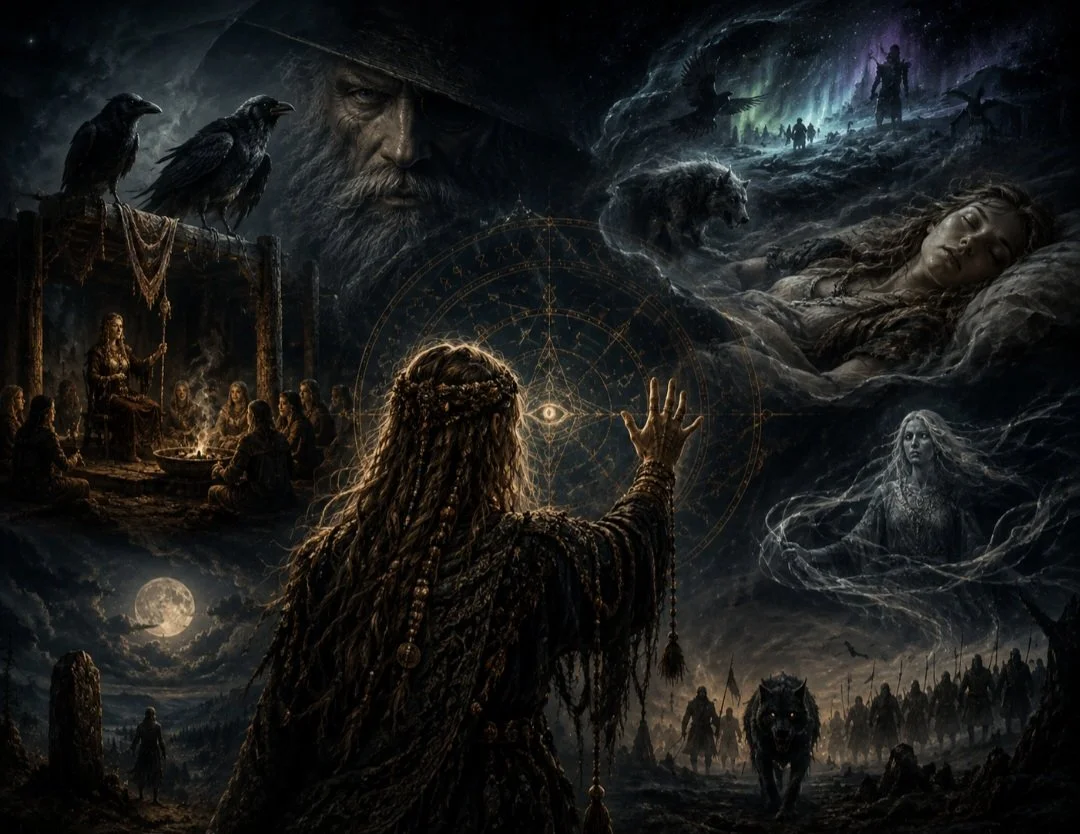
When discussions turn to supernatural knowledge in the Old Norse world, almost everything tends to be placed beneath one convenient modern label: divination. A völva predicts something, a person experiences an extraordinary dream, Óðinn discovers hidden knowledge, or somebody knows that disaster is approaching, and all of these experiences are treated as variations of the same ability to “see the future”. The surviving Old Norse material, however, presents something considerably more complicated. Medieval Scandinavian authors possessed vocabulary capable of distinguishing wisdom, foresight, prophecy, dreams, magical investigation and extraordinary perception. More importantly, their stories do not always imagine supernatural knowledge as simply receiving a prediction about an event that has not happened yet. Sometimes the information concerns the future, but sometimes it concerns something happening far away, something deliberately concealed, another person's intentions, the identity of an unknown person, or knowledge possessed by supernatural beings and the dead.
That distinction matters because knowing something hidden and knowing something future are not necessarily the same phenomenon. A person might know what was occurring far away without predicting anything. Another might correctly interpret an extraordinary dream. Someone could attempt to discover who had committed a theft or determine the outcome of a battle. A ritual specialist might seek information through supernatural means, while another person might experience knowledge spontaneously without performing any identifiable ritual at all. The dead themselves could possess information unavailable to the living and might therefore have to be questioned. All of these situations involve crossing the ordinary limits of human knowledge, yet they operate differently within the literature. Rather than imagining a single Norse equivalent of modern “psychic ability”, it is more useful to investigate the different ways extraordinary knowledge was imagined to become accessible.
One particularly revealing word is framsýnn, a term associated with foresight and literally constructed around the idea of seeing forward. The related framsýni likewise concerns foresight. John McKinnell has drawn attention to saga descriptions of women characterised as fróð ok framsýn (knowledgeable or wise and foresighted) showing that medieval authors did not always need the specialised title völva when describing somebody associated with extraordinary foreknowledge. This is important because modern discussions frequently collapse “seer”, “völva”, “prophetess” and “seiðr practitioner” into a single category. The medieval vocabulary is considerably less cooperative. A woman could apparently be characterised by her ability to foresee without the author necessarily telling us that she practised seiðr, possessed a particular spiritual office or acquired that knowledge through one standardised technique.
The vocabulary also warns us against treating every reference to foresight as supernatural. Old Norse forsjá, for example, can refer perfectly ordinarily to foresight, prudence or sensible anticipation. A person who prepares intelligently for something that is likely to happen can possess forsjá without possessing supernatural powers. Context is therefore essential. This seemingly small linguistic issue exposes a much larger problem in modern reconstructions of Norse spirituality: English terminology encourages us to identify fixed supernatural abilities such as clairvoyance, precognition, remote viewing or psychic sight, then search the medieval sources for equivalents. Old Norse authors were not working with that taxonomy. Their language often describes what somebody knows, sees, anticipates or discovers rather than placing them inside a universal classification of supernatural faculties.
The distinction becomes even more interesting when extraordinary knowledge is deliberately sought. Saga vocabulary can describe people attempting to investigate things through magical or heathen means, including determining matters that ordinary observation could not reveal. This suggests that supernatural knowledge was not always imagined as an involuntary vision arriving unexpectedly in somebody's mind. It could also be something actively pursued. That immediately raises questions of technique. If knowledge could be deliberately obtained, what exactly did the practitioner believe they were doing? Were they communicating with beings who possessed the information? Entering an altered condition? Performing a ritual that allowed hidden things to become perceptible? Unfortunately, this is precisely where the evidence usually becomes frustrating. Medieval storytellers frequently cared much more about the extraordinary information acquired than about leaving us a detailed explanation of the mechanism used to acquire it.
The famous account of Þorbjörg lítilvölva in Eiríks saga rauða illustrates this particularly well. Þorbjörg does not simply arrive, announce the future and disappear. Her consultation occurs within a deliberately constructed ritual environment. Her clothing and staff are described, she is seated upon an elevated structure, special food is prepared for her, and women are required to form a circle while Guðríðr performs the varðlokkur. Only after this sequence does Þorbjörg communicate what she has learned. Whatever historical layers lie behind the saga's account (and the text was written down long after Christianisation) the author imagines supernatural knowledge as something accessed under particular ritual circumstances. The knowledge is not portrayed merely as an innate psychic ability permanently operating inside the practitioner. Something is done to make access possible.
Even the elevated structure associated with such practice deserves attention. Old Norse seiðhjallr refers to a platform or elevated structure associated with magical performance. We do not know with certainty why elevation mattered. It could have possessed ritual significance, helped separate the practitioner spatially from the participants, enhanced visibility and authority during performance, or belonged to a ritual tradition whose original symbolism is no longer recoverable. What matters is that magical knowing could apparently be imagined as spatially organised. The practitioner occupied a particular place. Other participants occupied theirs. Songs could be performed. Objects could matter. Knowledge emerged from an event rather than simply appearing from nowhere.
Dreams provide a completely different route into the unseen. Dreams occur constantly throughout Old Norse-Icelandic literature and can reveal approaching deaths, enemies, political changes, family disasters and events that have not yet occurred. Animals frequently appear within these dreams and can represent individuals or groups, sometimes allowing the dreamer to recognise something about people they have not physically encountered. In such cases the dreamer has not necessarily performed seiðr, summoned anything or deliberately attempted to discover the future. Ordinary waking perception has ceased, and information inaccessible to the waking person becomes available during sleep. The dream therefore becomes a liminal environment in which the normal restrictions governing knowledge can temporarily fail.
Yet dreams also demonstrate how easily modern interpretations can outrun the evidence. Earlier scholarship sometimes interpreted dream animals as literal manifestations of external souls, fylgjur or other independently travelling aspects of a person. Some of those interpretations became extremely influential and eventually entered modern descriptions of the supposed “Norse soul”. More recent scholarship has become considerably more cautious. A wolf appearing in a dream before hostile men arrive might represent those men, their character, their intentions or their approaching danger without necessarily proving that an invisible component of each man's soul physically left his body, transformed into a wolf and travelled ahead of him. Medieval symbolic representation and literal supernatural manifestation are not always easy for us to distinguish, particularly because saga authors themselves do not stop the narrative to explain their metaphysics.
The hugr sits directly in the middle of this problem. Hugr occupies a broad semantic field involving thought, mind, intention, desire, disposition and interior mentality. Older scholarship sometimes interpreted the hugr as a separable soul capable of leaving the body, travelling independently and even assuming animal form. That idea remains extremely popular in modern Norse spirituality. Colin Peter Mackenzie's detailed research into Old Norse-Icelandic vernacular psychology, however, challenges the assumption that the medieval evidence consistently supports such a wandering “free soul”. Some passages previously interpreted as people sending their hugir outward can instead be understood as language concerning their intentions, dispositions or threatening presence. This does not prove that no Scandinavian ever imagined thought or consciousness as capable of external movement; it demonstrates that we cannot simply treat hugr as the documented Norse equivalent of an astral body.
That uncertainty is actually more interesting than a neat answer. Old Norse literature repeatedly allows another person's approach, hostility or significance to become perceptible before ordinary physical contact occurs. Sometimes this happens through dreams. Sometimes animals represent approaching people. Sometimes a person simply possesses extraordinary foreknowledge. The mechanism may not always be the same. A fylgja might be relevant in one story, dream symbolism in another, divine or supernatural warning elsewhere, and literary foreshadowing in another. Modern readers often want all these examples to belong to one supernatural system because systems are easier to understand. The medieval evidence instead gives us overlapping possibilities.
The gods complicate matters further because extraordinary perception does not always involve ritual divination at all. Heimdallr, for example, possesses extraordinary sensory abilities in Snorri's Gylfaginning. He can see enormous distances by night as well as by day and hear phenomena inaccessible to ordinary beings. This is not necessarily “prophecy”; it is supernatural perception. His senses exceed human limitations. Óðinn's relationship with knowledge is even more complicated because he acquires information through numerous different mechanisms. He observes, questions, sacrifices, performs magic, consults the dead and sends Huginn and Muninn across the world. His mythology is not simply the story of a god who automatically knows everything. It is repeatedly the story of a god who obtains knowledge.
That difference is fundamental. Óðinn sacrifices an eye in connection with wisdom. In Hávamál he hangs upon the tree during the ordeal associated with obtaining the runes. In Vafþrúðnismál he competes through knowledge with a jötunn. In Baldrs draumar he travels to question a dead seeress. Huginn and Muninn fly over the world and return with information. These traditions would make little sense if Óðinn were simply omniscient in the later theological sense of automatically possessing all possible knowledge. His mythology repeatedly portrays knowledge as something hidden behind boundaries. It has to be acquired, stolen, exchanged, remembered, discovered or extracted from beings who possess it.
The dead are particularly significant because death itself appears to create another boundary around knowledge. In Baldrs draumar, Óðinn does not simply predict Baldr's fate unaided. He travels to the realm of the dead and compels a deceased völva to speak. Whatever we make of the poem's date and transmission, the narrative logic is fascinating: the information exists, but it is held somewhere inaccessible to ordinary living people. Óðinn must cross into an abnormal environment and question someone who possesses access to it. Supernatural knowledge therefore becomes almost geographical. Some things are known elsewhere.
This idea appears repeatedly throughout Norse mythology. Wisdom can reside in wells, among giants, with the dead or in distant worlds. Information therefore behaves almost like a resource. It has locations, owners and guardians. Mímir possesses wisdom that Óðinn desires. Vafþrúðnir possesses ancient cosmological knowledge. The dead know things the living do not. Ravens travel outward and bring information home. Prophetic beings can perceive events inaccessible to ordinary humans. The cosmos is full of knowledge, but that knowledge is unevenly distributed.
This makes the relationship between sight and knowledge particularly important. Old Norse, like many languages, regularly expresses understanding through visual vocabulary. To see can metaphorically mean to understand, just as modern English speakers still say “I see” when they mean “I understand”. Consequently, terminology involving supernatural sight must be interpreted carefully. Someone described as “seeing forward” may possess extraordinary foresight, but that does not automatically mean the culture imagined an invisible magical eye literally observing tomorrow. Nevertheless, the repeated relationship between seeing and knowing creates a powerful conceptual vocabulary through which extraordinary perception can be described.
This is why simply calling everything “divination” hides so much. A dream revealing an approaching enemy is not necessarily the same thing as Þorbjörg conducting a ritual consultation. Þorbjörg's ritual is not necessarily the same thing as Óðinn questioning a corpse. Óðinn questioning the dead is not the same thing as Heimdallr hearing grass grow. A person characterised as framsýn is not automatically performing seiðr. Someone investigating hidden information through magical means is doing something different again. All of these examples cross ordinary limits of knowledge, but they do so in different ways.
There is also no reason to assume that medieval Scandinavians themselves possessed one systematic explanation connecting every example. Pre-Christian Norse religion was not preserved for us as an organised theology. Practices varied geographically and changed across time. The texts recording them were produced in different centuries, genres and intellectual environments. Eddic poetry, skaldic poetry, family sagas, legendary sagas, Snorri's works and later folklore cannot simply be combined into a single timeless description of “what the Vikings believed”. Christian authors inherited older traditions while simultaneously interpreting them through medieval Christian concepts of dreams, prophecy, magic and supernatural perception. Separating those layers is often extremely difficult.
What the surviving evidence does allow us to see is a culture fascinated by the limits of ordinary knowledge. The future was one boundary, but not the only one. Distance was another. Sleep created another. Death created perhaps the most dramatic boundary of all. Hidden intention could also be inaccessible. The identities and plans of enemies might remain unknown. Supernatural beings possessed senses and knowledge unavailable to humans. Magical practice, dreams, wisdom and encounters with the dead offered narrative ways through which those barriers could sometimes be crossed.
Sometimes knowledge came to the person without being requested. Sometimes the person deliberately went looking for it. Sometimes it arrived through a dream. Sometimes ritual created the conditions in which it became accessible. Sometimes another being had to be persuaded or forced to reveal it. Sometimes extraordinary perception belonged naturally to a supernatural being. Sometimes the future could be glimpsed, while at other times the hidden present was what needed to be discovered. The surviving literature therefore suggests not one universal Norse “second sight”, but a broad landscape of extraordinary knowing.
Perhaps this is one reason Óðinn's relentless search for wisdom occupies such an important position within Norse mythology. Knowledge is powerful precisely because it is limited. Humans do not possess all of it. Gods do not necessarily possess all of it either. To know what lies beyond your ordinary reach requires crossing boundaries, and crossing boundaries carries danger. Óðinn gives something of himself for wisdom. He enters the world of the dead. He confronts giants. He undergoes suffering. The pursuit of hidden knowledge is therefore not merely an intellectual exercise; it is an act capable of demanding sacrifice.
The modern question is usually, “Did the Norse believe people could see the future?” The answer is that their surviving literature certainly contains prophecy and foreknowledge, but that question is much narrower than the evidence deserves. A more revealing question is: how did medieval Scandinavians imagine someone could know something they had no ordinary way of knowing? Once we ask that, prophecy becomes only one part of a much larger supernatural landscape involving dreams, ritual, extraordinary senses, hidden wisdom, magical investigation, the dead and the deliberate crossing of boundaries between what humans can normally perceive and what lies beyond them.
That may ultimately be one of the least appreciated aspects of Norse magic. Magic was not represented solely as a means of changing reality. Sometimes its extraordinary power lay in gaining access to reality that was already there but ordinarily concealed.
Not simply seeing the future.
Seeing what should not yet (or could not ordinarily) be seen.