
Járnsaxa: The Jötun Who Stood Beside Thunder
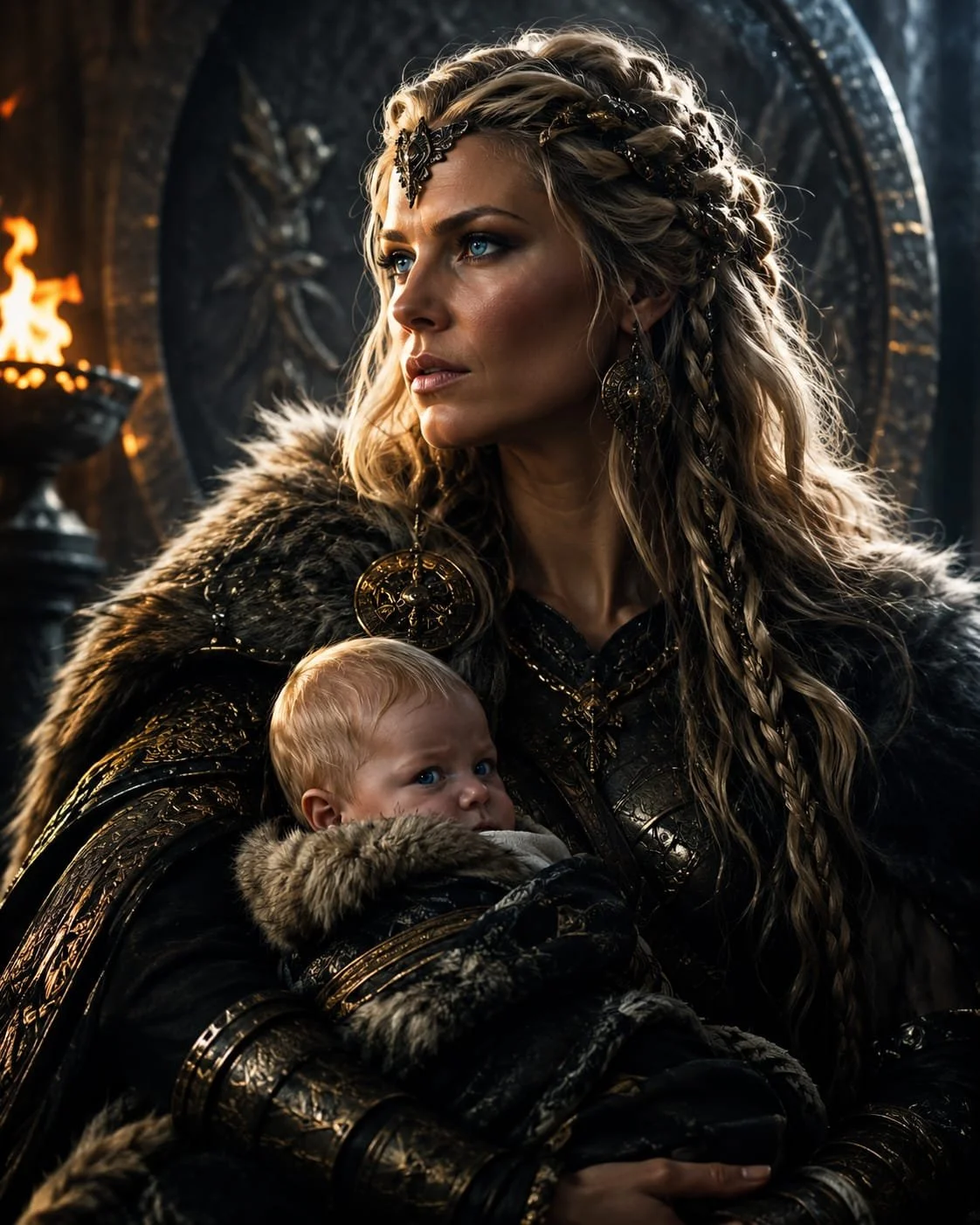
There are powers that do not belong to the hall, yet the hall would not remain unchanged without them. Some forces are not given a throne because they were never meant to sit beneath one.”
Pause. Not because the story is finished, but because the stories of the jötnar are rarely as simple as the gods would have us believe.We are accustomed to meeting the giants as enemies. They stand beyond the walls. They inhabit the wilderness. They cross boundaries that the gods believe should remain fixed. They are associated with mountains, storms, fire, winter, the sea, hunger, destruction, and everything that refuses to remain safely ordered. But the old norse world was never truly divided into good gods and evil giants. The boundaries were porous.
Gods and jötnar fought. They desired one another. They married. They fathered children together. They traded knowledge, objects, insults, and obligations. The same beings who could threaten the gods could also become part of their family. Járnsaxa stands within that contradiction.
She is not one of the most extensively described figures in surviving norse literature. Her appearances are brief. Her story is fragmentary. And yet, from those fragments, something remarkable emerges. A jötun woman connected to Þórr. Mother of Magni. A figure standing at the threshold between forces that the mythology repeatedly insists should remain separate. And perhaps that is precisely where her significance begins.
***NOTE***
Before exploring this piece, it is important to clarify that járnsaxa is a figure of norse mythology whose surviving evidence is extremely limited. She is named in snorri sturluson's prose edda as the mother of magni, Þórr's son, and she appears among the jötunn women named in skáldskaparmál.
The surviving sources do not provide us with a complete biography, detailed mythology, or extensive characterization of her. Her relationship with Þórr is therefore partly reconstructed from the surviving mythic material and later interpretation. What follows is not a strict retelling of a lost saga. It is a mythopoetic interpretation built around what the sources actually preserve, while acknowledging the silence surrounding everything they do not.
Járnsaxa does not arrive in the surviving myths with a speech, a genealogy stretching across generations, or a heroic saga of her own.She arrives as a name. And sometimes a name is enough to open a door.
Origins of the Jötun
To truly understand járnsaxa, we must first understand what it means to be a jötun. The word is often translated as “giant,” but that translation can mislead. The jötnar are not simply enormous creatures waiting beyond the borders of civilization. They are a category of beings deeply embedded within the structure of the Norse cosmos. They possess knowledge. They possess ancestry. They possess beauty. They possess desire. They possess terrible strength. They are sometimes monstrous, sometimes beautiful, sometimes wise, sometimes foolish, and often something much more uncomfortable - necessary.
The gods themselves emerge from this world of complicated relationships. Odin is descended from the jötunn bestla through his mother. Þórr's mother, jörð, is herself associated with the earth and counted among the jötnar. The boundary is never as clean as later imagination sometimes makes it. Járnsaxa exists within that old contradiction. She is not an outsider because the mythology has no true outside. She is part of the same cosmos. She simply belongs to a different side of its tension.
The Name Járnsaxa
Names in norse mythology can carry images within them. Járnsaxa is commonly understood as containing járn, “iron,” and saxa, related to sax, a cutting weapon or knife. The precise force of the name is not completely certain, and etymology should not be mistaken for biography. Still, the image is striking.
Iron. A blade. Something forged. Something capable of cutting. There is an undeniable harshness in the sound of the name. Járnsaxa does not sound like a figure associated with flowers or softness. Her name carries metal. It carries an edge. And yet, the mythology gives us no reason to reduce her to violence. That is an important distinction. A name can evoke an image without dictating a character. Maybe the iron is not simply what she destroys. Perhaps it is what she endures.
The Women of the Jötnar
If we speak of járnsaxa is also to speak of the women among the jötnar, because the old stories rarely allow them to remain simple figures of opposition. They are daughters, mothers, wives, lovers, seers, rulers, wanderers, and sometimes forces that stand entirely beyond the concerns of the gods.
Skaði enters àsgarðr seeking vengeance and leaves with a place among the gods. Gerðr, born among the jötnar, becomes the beloved of freyr. Angrboða becomes the mother of beings whose existence will shape the fate of the gods themselves.These women do not simply exist outside the divine order. They move across it. The jötun women are often portrayed through the eyes of those who fear them, desire them, or attempt to understand them. But their significance does not depend upon becoming accepted by the gods. They possess their own ancestry. Their own powers. Their own place within the cosmic structure. Járnsaxa belongs to this wider pattern.
Her surviving story is smaller than that of skaði or gerðr, but the underlying contradiction is similar. She is a jötun woman who becomes connected to one of the greatest gods, and through that connection, her lineage enters the future of the divine world. The mythology does not require her to stop being a jötun. She does not become meaningful by becoming less of what she is. That may be one of the most important things to remember when approaching the women of the jötnar. They are not simply obstacles standing between the gods and their destiny. Sometimes they are part of the destiny itself.
Þórr and the Jötun Woman
Þórr is one of the great enemies of the jötnar. He crosses the wilderness with mjölnir in his hand. He travels into their territories. He confronts them repeatedly. His hammer is one of the great symbols of resistance against the forces that threaten the divine order. And yet Þórr has relationships with jötun women.
This is not an inconsistency to be corrected. It is part of the mythology. The norse cosmos does not understand difference as simple separation. The enemy can become kin. The outsider can become ancestor. The force that threatens the gods can also become part of the gods' future. This is where i find Járnsaxa becomes particularly interesting. Because whatever the exact nature of her relationship with Þórr, their union produces something the mythology considers important enough to preserve.
A son. Magni.
And through him, the boundary between god and jötun becomes something more than a philosophical idea. It becomes blood.
The Other Women of Þórr
It is worth looking at the other women who appear around Þórr, because his relationships with women connected to the jötnar reveal something important about the norse mythic world... the boundaries between gods and jötnar were never as simple as they first appear. Þórr is remembered above all as the great adversary of the jötnar. Mjölnir is raised against them. His journeys repeatedly bring him into their territories. His strength is measured through encounters with beings who stand beyond the ordered world of the gods.
And yet the mythology also places jötun women within his family. Járnsaxa is the clearest example connected directly to his lineage. She is named as the mother of Magni, making her not simply a woman associated with Þórr, but the mother of a son who carries his strength forward. But another figure complicates the picture further - Járnsaxa is not the only jötun woman associated with Þórr's children.
In gylfaginning, Þórr's daughter Þrúðr is named, and in skáldskaparmál, Þórr's sons magni and móði are preserved within his genealogy. Yet the surviving sources are frustratingly sparse when it comes to the mothers and circumstances surrounding these relationships. This silence is important. It prevents us from constructing a complete family history where the sources do not provide one.
This is something fascinating. Þórr's mythology is not defined solely by opposition to the jötnar. His own family exists within a world already shaped by them. His mother is jörð, the personification of the earth and a figure associated with the jötnar. His son magni is born to járnsaxa. His divine identity is therefore already intertwined with the very forces he so frequently confronts. The enemy is not entirely outside him. It is part of his ancestry.
This is one of the other deeper contradictions within norse mythology. The gods do not stand apart from the jötnar as two completely unrelated peoples. They are connected by blood, desire, marriage, ancestry, and fate. Their conflict is real, but so is their kinship. And the women make that contradiction especially visible. Jötun women are not merely obstacles placed in the path of the gods. They can become wives, mothers, ancestors, lovers, and bearers of future generations. Consider Jörð.
She is not simply Þórr's mother. Her name means “earth,” and through her, the god most associated with thunder is born from a figure representing something older and more fundamental than the divine order itself. The earth does not belong exclusively to ásgarðr.
It is beneath everyone.
Gods and jötnar alike depend upon it. Then there is járnsaxa. Her presence is much quieter, but her importance becomes visible through magni. She gives Þórr a son whose strength becomes legendary and whose survival carries part of Þórr's lineage beyond ragnarök. And this creates a remarkable pattern. Þórr fights the jötnar. Þórr descends from jötun ancestry. Þórr fathers a child with a jötun woman. That child survives into the world after the gods fall. The contradiction is not an error. It is the structure.
The mythology seems less interested in maintaining absolute categories than in showing what happens when those categories collide. Thunder meets the wilderness. The god meets the giantess. The enemy becomes family. And the child stands between them.
This is why járnsaxa should not be reduced to “Þórr's giantess lover.” That description makes her relationship sound like an isolated curiosity. She is more significant than that.
She belongs to a recurring mythological pattern in which jötun women become connected to the divine world without ceasing to be what they are. Skaði is welcomed into the divine community after seeking vengeance for her father. Gerðr becomes the wife of freyr despite her jötun origins. Angrboða becomes the mother of beings whose destinies are inseparable from Ragnarök.
The stories repeatedly demonstrate that the jötnar are not simply a population waiting outside the walls. They are woven into the family tree. And járnsaxa is one of those threads. That is the most useful way to approach Þórr's relationships with the women connected to the jötnar. Not as contradictions that need to be explained away. But as evidence. Evidence that the norse cosmos was never divided into perfectly sealed categories.
The gods and jötnar could be enemies in one story and relatives in another. They could stand against one another with weapons raised, then become connected through blood. The same mythology that gives Þórr mjölnir also gives him a mother associated with the earth and a son born from a jötun woman. And when the old world finally breaks, it is not only the purest representatives of the divine order who carry the future forward.
It is their descendants. Their mixed inheritances. Their complicated bloodlines. Their children. That is the deeper significance of the women around Þórr. They remind us that the boundaries he defends are not the same as the boundaries through which life moves. Járnsaxa does not have to defeat Þórr to matter. She does not have to stand against him. She does not even need a surviving saga of her own. She becomes part of his story by becoming part of his lineage.
And through magni, that lineage continues.
The hammer passes forward. The gods fall.
The old order ends. But the bloodlines remain. And somewhere within those surviving lines is járnsaxa, the jötun woman whose presence reminds us that even the god who fought the giants most fiercely was never entirely separate from them. He carried their blood. He loved among them. He fathered among them. And through them, something of his own world survived.
The Strength That Crosses Boundaries
There is something deeply norse about this. The mythology rarely presents existence as a battle between completely separate categories. The gods depend upon beings they fear. They seek knowledge from their enemies. They marry across boundaries. They steal from one another. They make bargains. They betray one another. They become family. The cosmos is not held together by purity.
It is held together by relationship. Járnsaxa represents one of those relationships. Not because the surviving texts give us a long story about her, but because her presence changes the meaning of what follows. She is the mother of magni. And magni belongs to the future.
The Mother Who Is Almost Silent
This is where the fragmentary nature of Járnsaxa's mythology becomes almost haunting. We know her name. We know her lineage. We know that she bore Þórr a son.
And then there is silence. No surviving account tells us what she thought of Þórr. No surviving saga explains why they came together. We do not know what their relationship looked like. We do not know where she lived. We do not know how she regarded the gods. We do not know what she thought of her son. The silence is enormous. And it is tempting to fill it.
But perhaps the better response is to listen to it. Because the absence of information reminds us how much of norse mythology has been lost. The surviving eddas are not a complete archive of the pre christian norse imagination. They are fragments, preserved through medieval writers, shaped by christian era literary culture, and filtered through poetry, memory, manuscript transmission, and centuries of change.
Járnsaxa's silence may not mean she was unimportant. It may simply mean her story did not survive.
The Jötun Mother
There is another reason her position matters. Járnsaxa is not merely associated with a jötun. She is herself one. Her son is therefore born from two mythic worlds.
From Þórr comes the divine. From járnsaxa comes the jötun. But in norse cosmology, these categories are already entangled. The gods do not exist untouched by the forces beyond them. They descend from them. They desire them. They fear them. They reproduce with them. And ultimately, their descendants carry those connections forward. Járnsaxa reminds us that the future of the gods can contain the blood of those they spend their lives fighting. The enemy can become ancestry.
The Blood of the Jötnar
The more closely we examine norse mythology, the harder it becomes to maintain the idea that the gods and jötnar are completely separate. The separation exists.
But it is never absolute. The gods fight the jötnar, yet some gods descend from them. They seek their knowledge, desire their daughters, take their treasures, bargain with them, and sometimes bring them into their own families.
The divine order is therefore not untouched by the forces it opposes. it is entangled with them. Járnsaxa's relationship with Þórr becomes more significant when viewed through this larger pattern. Their son, magni, is not simply the product of an unusual union. He is another expression of a recurring truth within norse cosmology the boundaries between categories are real, but they are permeable.
Jötun blood can run through divine lineage.
And divine blood can enter the world of the jötnar. This makes the conflict between them stranger than a simple battle between good and evil. The gods are not fighting something entirely foreign. They are fighting forces that are, in many ways, already part of the same cosmic family.
Járnsaxa stands within that tension. Her significance is not that she somehow crosses the boundary and becomes one of the gods. It is that the boundary is crossed without requiring her to cease being a jötun.
Her son carries both inheritances. And that tells us something the mythology repeatedly demonstrates:
The cosmos does not preserve itself through purity. It preserves itself through continuation, relationship, conflict, union, and inheritance. The blood of the other can become part of what survives.
Magni
Magni means “mighty” or “strength,” and the name itself feels appropriate. In skáldskaparmál, magni is identified as the son of Þórr and járnsaxa. He is not merely another child in the background of mythology. He demonstrates something fundamental about the Norse understanding of power.
Strength does not always come from purity. It can come from mixture. From crossing. From union between things that appear opposed. And when Þórr falls, magni survives ragnarök. That detail matters.
The future does not belong exclusively to those who stood on one side of the cosmic divide. The son of a god and a jötun woman has a place in what comes after. The blood of járnsaxa does not disappear when the old order collapses. It continues.
The Child Who Lifted What Others Could Not
One of the most memorable stories concerning magni occurs after Þórr's encounter with the jötunn hrungnir. When Hrungnir is killed, his enormous leg falls across Þórr. The god is trapped. The others cannot free him. Then magni arrives. Still very young, according to snorri's account, he possesses extraordinary strength. He lifts Hrungnir's leg from his father's body. And Þórr recognizes his son's power.
There is something beautiful in this moment when considered through járnsaxa. Her child does not defeat the enemy because he has rejected his jötun inheritance. He defeats the impossible because of what he carries.
The strength of magni is not evidence that one side conquered the other. It is evidence that the boundary itself produced something powerful. A child born from crossing. A child whose existence complicates every easy distinction between god and giant.
The Inheritance of Magni
If járnsaxa herself remains largely silent in the surviving sources, her son does not. Magni is one of the clearest places where her presence becomes visible.
He carries Þórr's strength, but he is also the child of a jötun woman. When hrungnir's enormous leg falls across Þórr, it is magni who possesses the strength to lift it. The image is striking because the child does not merely inherit his father's power. He exceeds expectation.
He is young, yet strong enough to accomplish what others cannot. And behind that strength stands an inheritance that cannot be separated neatly into god and jötun. Magni's existence complicates the idea that power belongs exclusively to one side of the cosmic conflict. He is not simply Þórr's son. He is járnsaxa's son. Both matter.
Later, when ragnarök comes and the old divine order collapses, Magni remains among those who survive. Together with móði, he inherits mjölnir. The hammer therefore passes into the hands of a generation born from the old world's contradictions. Þórr is gone. But his weapon remains. His sons remain. and through magni, something of Járnsaxa remains as well. This is a different kind of inheritance.
Not the inheritance of a throne. Not the inheritance of a title. But the inheritance of strength, blood, memory, and possibility.
Járnsaxa does not need to stand at the center of ragnarök for her presence to reach beyond it. Her child carries her there. And perhaps that is the quietest form of legacy... To become part of a future you will never personally see.
The Iron in the Blood
Perhaps this is where the image of járnsaxa becomes most compelling. Iron is forged under pressure. Heated. Struck. Shaped. It becomes stronger not because it avoids force, but because it passes through it. This is only an image, not a statement about the literal meaning of her character. But it offers a useful way to approach her.
Járnsaxa belongs to a mythology where strength is rarely clean. The gods are powerful and vulnerable. The jötnar are dangerous and necessary. Creation contains destruction. Death contains continuation. Order requires the existence of forces capable of challenging it. Nothing exists alone. And járnsaxa's child embodies that truth.
Iron and the Jötun Nature
There is something about the name járnsaxa that invites us to pause. Járn is old norse for iron. Saxa is generally connected with sax, a knife or short bladed weapon. The exact interpretation of the compound is not entirely certain, and we should be careful not to turn the name into a biography. Járnsaxa is not explicitly described in the surviving sources as a goddess of iron, a smith, or a warrior. But names in norse tradition can still carry imagery. And the imagery surrounding járnsaxa is difficult to ignore. Iron is not born strong. It is worked. Heated. Hammered. Shaped. Cooled. Worked again. It passes through pressure before it becomes something capable of enduring pressure.
There is a certain resonance between this and the jötun nature as it appears throughout norse mythology. The jötnar are often associated with forces that exist beyond the ordered world of the gods. They inhabit wilderness, mountains, fire, ice, storm, sea, darkness, and places where human or divine boundaries begin to fail. They are not simply “evil.” They are older than that distinction.
They represent forces that cannot always be domesticated. And this is where iron becomes an interesting image for járnsaxa.
Not because the sources tell us she literally embodies iron. But because iron suggests something that has passed through transformation without losing its nature.
The jötnar are frequently portrayed as threats to the established order, yet the gods themselves are intertwined with them. Odin descends from the jötunn bestla. Þórr's mother is Jörð. Þórr fathers magni with járnsaxa. The boundary is there. But it bends.
And perhaps that is what the iron image allows us to see. Strength does not always come from belonging safely inside the walls. Sometimes strength comes from surviving outside them.
The jötnar exist in a relationship with the gods that is fundamentally adversarial, but not exclusively so. They are enemies, ancestors, lovers, parents, teachers, rivals, and kin. They represent what the ordered world cannot completely contain. Iron, too, carries this strange duality. It can be a weapon. It can be a tool. It can build.
It can destroy. It can become a chain or a blade. The material itself does not determine the purpose. It is what is done with it that gives it direction. This is one way to approach járnsaxa without pretending to know more about her than the sources allow.
She does not need to be transformed into an imagined warrior queen simply because her name contains iron.
She does not need an invented mythology of smithing, battle, or metalworking. The symbolism can remain symbolic. Iron can simply become a lens through which we contemplate the figure we actually have.
A jötun woman. A woman whose name carries the suggestion of metal and edge.
A mother whose son possesses extraordinary strength. A figure whose lineage enters the divine family and continues beyond Ragnarök.
There is another quality of iron worth considering. It remembers the force that shaped it. Not literally, perhaps, but metaphorically. Every strike leaves a consequence. Every heating changes what comes after. And the jötun world is filled with this kind of transformation.
The cosmos itself begins in violence and difference. Fire and ice meet. From ancient forces come beings, gods, and worlds. Order does not appear in isolation. It emerges from tension. The jötnar belong to that tension.
They are not merely the chaos outside creation. They are part of the conditions from which creation itself emerges. Járnsaxa therefore stands within a much older pattern than her surviving appearances might suggest. She belongs to the side of the cosmos that cannot be completely civilized. But she also becomes part of the divine lineage. She is both beyond the wall and within the family tree. That is the paradox. And perhaps the most important lesson is not that iron makes járnsaxa strong. It is that strength and otherness do not have to be opposites. We often imagine the strongest things as those that have been protected from pressure.
Norse mythology suggests something stranger. Strength may emerge precisely because something has encountered what could break it. The hammer does not fear iron. The hammer works upon it. And through that process, something new takes shape. Járnsaxa's name does not give us a complete story. But it gives us an image.
Iron. Something hard. Something shaped.
Something capable of carrying an edge.
And perhaps that is enough. Not to tell us who járnsaxa was in every detail. But to remind us of the world she belongs to.
A world where the wild cannot simply be erased. Where the other cannot always be kept outside. Where gods and jötnar remain bound together despite everything that separates them. And where, sometimes, the future is forged from the meeting of forces that were never meant to remain apart.
Járnsaxa. The Iron One. Not because we can prove that she was a goddess of iron. But because her name leaves us with an image that feels strangely appropriate... Something forged in tension. Something carrying an edge. Something that does not need to become soft in order to belong. Something shaped by the meeting of opposing forces...
and still capable of enduring what comes next.
The Boundary That Becomes Blood
The gods build walls. The jötnar exist beyond them. But blood ignores walls. It crosses rivers. It crosses mountains. It crosses realms. It carries memory where borders cannot. Járnsaxa's greatest surviving significance may therefore be found not in an action she performs, but in what she makes possible.
Magni. A son of Þórr. A descendant of a jötun woman. A figure who survives into the world after Ragnarök. Through him, járnsaxa becomes part of the mythology's answer to one of its oldest questions - What survives when the old order falls? Not everything. Not everyone. But something. And sometimes what survives is born from the union of things that were never supposed to belong together.
The Jötun Within the Gods
The gods and jötnar were never as separate as the stories sometimes make them appear. Jötun blood already runs through the divine family, through ancestry, motherhood, marriage, and children. Þórr himself carries this connection through Jörð, and through Járnsaxa, his son magni carries it forward. The jötnar are not simply something standing beyond the walls of Ásgarðr. In many ways, they are already within the walls, within the blood, within the lineage. The gods may fight the forces of the jötnar, but they cannot completely separate themselves from them. Perhaps that is the deeper tension of the norse cosmos... what we call the “other” is sometimes already part of us.
After Ragnarök
Ragnarök is not simply destruction. It is the breaking of an order. The gods fall. The world burns. The old structures collapse. But the story does not end there. Líf and lífþrasir survive. The world rises again. And among those who remain are magni and his brother móði, who inherit mjölnir after Þórr's death.
Think about that. The hammer of Þórr passes forward. But so does the blood of járnsaxa. The future carries both. God and jötun. Thunder and wilderness. Order and otherness. The old world does not survive unchanged. it survives transformed. And Járnsaxa is part of what transformation carries forward.
The World That Remembers Her
There is something fitting about the fact that Járnsaxa is remembered not through a great saga of her own, but through what she left behind. Her name survives. Her son survives. Her lineage survives into the world after ragnarök. When the old order falls and mjölnir passes into the hands of magni and móði, the future carries more than Þórr's strength. It carries the blood of the jötun woman who gave him one of those sons.
Járnsaxa does not need to stand in the rebuilt world for her presence to remain within it. Her story may have been reduced to fragments, but fragments can still carry a remarkable weight. A name preserved in a genealogy. A mother remembered through her child. A lineage that continues after the world that produced it has been destroyed.
This is a different kind of immortality. Not the immortality of the gods, but the persistence of influence through what comes after.
The world does not remember járnsaxa because it tells us everything about her. It remembers her because something of her could not be separated from what survived.
The hammer passes onward. Magni remains.
The new world rises. And within that future is a trace of the jötun woman whose name might otherwise have disappeared into the silence of the old stories. Some people are remembered through monuments. Others through songs. And some are remembered because something they helped bring into the world refused to end with them. Járnsaxa belongs to that last kind. Her story is quiet. But her legacy is not.
The Forgotten Ones
There is a strange injustice in the way old stories survive. Some names are carried across centuries, repeated until they become familiar, while others remain as little more than fragments in a genealogy, a single line of poetry, or a name whose story has almost entirely disappeared. Járnsaxa belongs among these forgotten ones.
We know that she was a jötun woman. We know that she was connected to Þórr and that she was the mother of Magni. Beyond that, the surviving sources become remarkably quiet. But forgotten does not mean unimportant. The surviving mythology is not everything that once existed. Stories were told long before they were written down. Some were altered. Some were combined. Some were lost completely. What remains is only what happened to survive the passage of time.
And so there may have once been stories of Járnsaxa that we will never hear. She had a greater place in the imagination of those who told these myths than the surviving texts suggest. Perhaps she was always a minor figure. We cannot know. What we can know is that her name endured. And sometimes, that is enough to remind us of how much has been lost.
The forgotten ones stand at the edges of mythology, not necessarily because they lacked significance, but because history is selective about what it carries forward. Járnsaxa is one of those names. A fragment.
A mother. A jötun. A thread within Þórr's lineage. And perhaps there is something fitting in remembering her precisely because so little remains. Not by inventing the story that was lost. Not by pretending the silence is an answer. But simply by saying her name again. Járnsaxa. Because sometimes remembrance begins there.
Járnsaxa and the Human Mirror
Lets look closely, and the pattern becomes familiar. There are parts of ourselves we keep outside the walls. Traits we were taught were too wild. Too difficult. Too strange. Too much. There are people we imagine belong to another world entirely.
And yet, sometimes, what we reject becomes part of what makes us strong. Not because every difference should be embraced without question. Not because every opposition should be dissolved. But because identity is rarely as pure as we imagine.
We are made from contradictions. From inheritance and choice. From tenderness and violence. From belonging and exile. From the things we were given and the things we learned to carry. Járnsaxa reminds us that the boundary does not always protect us from the other. Sometimes it prevents us from recognizing what the other might contribute.
The Silence Around Her
Eventually, we reach the boundary of what can actually be known about Járnsaxa. The surviving sources give us only fragments. We know her name. We know that she was a jötun woman. We know that she was the mother of Magni, the son of Þórr. Beyond these details, the story becomes quiet.
We are not told how she met Þórr. We are not given a detailed account of their relationship. We do not know where she lived, what she believed, what she thought of the gods, or what her relationship with her son was like. There is no surviving saga that steps forward to fill those spaces. And it can be tempting, when faced with silence, to create answers.
But perhaps járnsaxa deserves something different.
She deserves to remain partly unknown. Because the silence surrounding her is not evidence that she was insignificant. It is evidence of how much of the old Norse world has been lost. The myths were once part of living traditions, carried through voices, poetry, memory, and generations before much of what we know was written down. What survives in the manuscripts is not the whole mythology. It is what happened to survive. Some stories were preserved. Others vanished. Some figures were given entire narratives. Others were left as names. Járnsaxa stands among those names. And that makes remembering her more important, not less.
We do not need to invent a history for her to acknowledge that she had one. Somewhere beyond the surviving texts, there may have been stories about Járnsaxa that we will never recover. There may have been details, relationships, conflicts, and moments that disappeared centuries ago.
We will never know.
And that uncertainty should not be treated as an invitation to fill every empty space. Sometimes the most respectful thing we can do with a forgotten figure is to leave room for the unknown. To stand at the edge of the surviving story. To look into the silence. And simply remember her name. Járnsaxa. A name that survived even when the story around it did not.
Recognition
Járnsaxa stands where the walls become uncertain. She is not Þórr. She is not Æsir. She is not merely an enemy. She is not merely a mother in a genealogy. She is a jötun woman whose blood enters the lineage of thunder. And through her son, that lineage survives beyond the destruction of the old world. The future does not emerge from purity. It emerges from what survives contact with contradiction. The hammer passes onward. The world burns. The gods fall. And still, the child remains. Carrying the strength of Þórr. Carrying the blood of járnsaxa. Carrying proof that the boundaries we draw are not always the boundaries the cosmos obeys.
Invocation of the Iron One
When you find yourself standing between worlds, remember járnsaxa. Not as a goddess who will make the contradiction disappear. Not as a promise that every difference can be reconciled. But as a reminder that belonging does not always require sameness. You can stand at the edge. You can carry more than one inheritance. You can be shaped by forces that once seemed incompatible.
And perhaps what emerges from that tension will be stronger than either side imagined.
Járnsaxa.
The Iron One.
The Jötun Woman.
The Mother of Magni.
A name preserved at the edge of the surviving story. That is why she is worth remembering. Not because we know everything about her. But because we don't.
Because sometimes what remains in the fragment is enough to remind us that the old stories were larger than the pieces that survived. And somewhere beyond the surviving lines, there may have been a story about a woman who stood outside the walls of the gods... and whose blood would one day help carry their world into what came after.
Járnsaxa....
Not the thunder.
Not the hammer.
But part of what thunder left behind.
What Remains
And that is the lesson járnsaxa leaves us with. We do not have to be fully understood to have meaning. We do not need a great story told about us to leave something behind. Sometimes our impact lives quietly in what continues after us.
A name remembered. A strength carried forward. A life touched by ours. Not everything meaningful is remembered in detail. Sometimes it simply remains.
And perhaps that is enough.
