
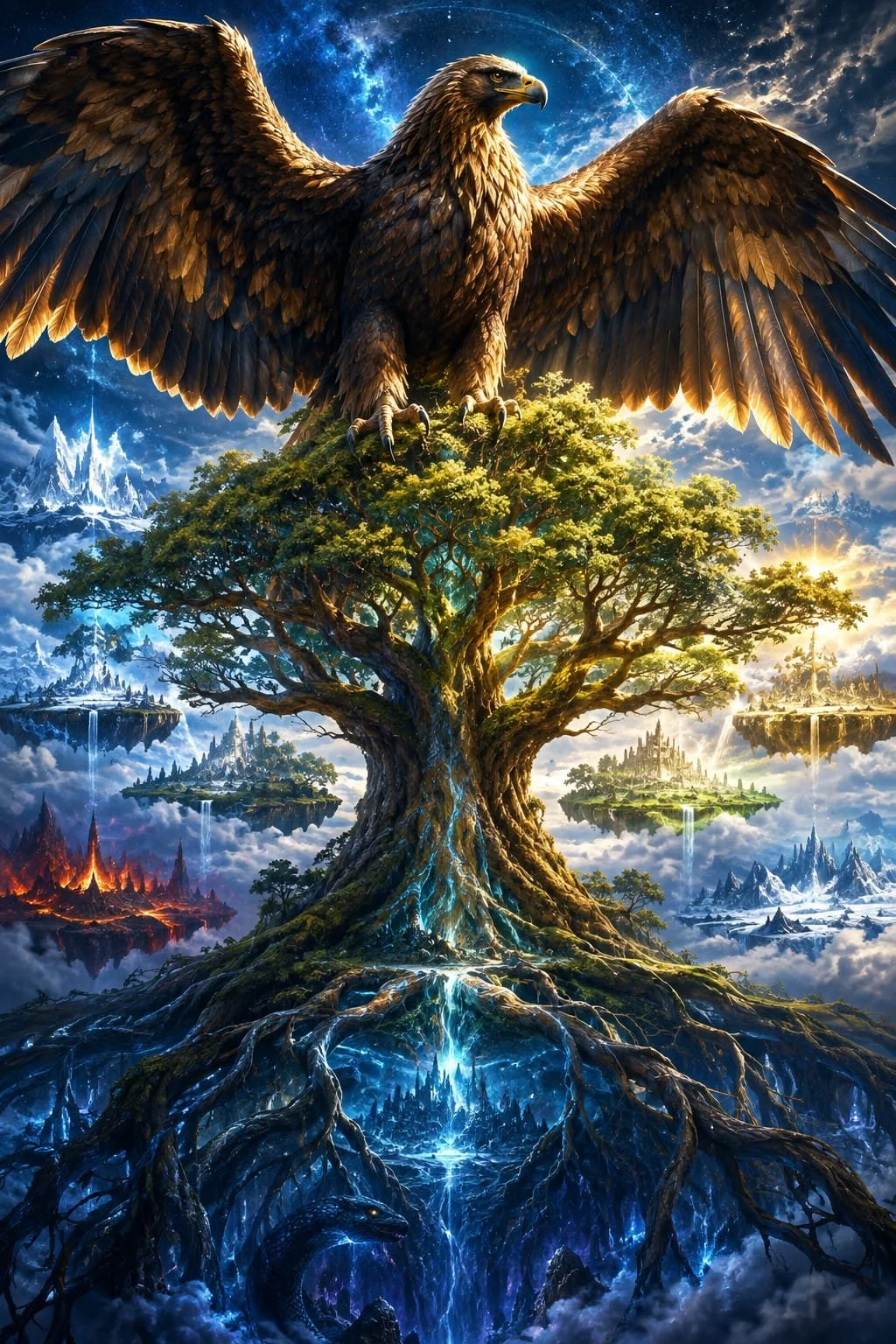
The Hawk of the Highest Branch, the Hidden Wisdom of the Nine Realms and the Eyes That See What Lies Beneath
“High above the roots that drink from the depths, above the branches that hold the heavens, a hawk keeps its silence. Beneath its wings, the worlds turn, the serpent coils, and the eagle’s gaze reaches beyond the sight of gods and men.”
The words above are a mythopoetic reconstruction inspired by the surviving norse sources concerning veðrfölnir, the hawk associated with the eagle that dwells atop yggdrasil. They are not a surviving quotation from the poetic edda or prose edda.
**NOTE**
Veðrfölnir, commonly written as vedrfolnir or veðrfölnir, is a fascinating but briefly described figure within norse mythology. The name is associated with a hawk positioned between the eyes of the great eagle that sits in the upper branches of yggdrasil, the world tree. The eagle itself is mentioned in the grímnismál and described in greater detail in snorri sturluson’s gylfaginning, where the hawk and the eagle are presented as inhabitants of the cosmic tree.
Unlike óðinn, Þórr, freyja or other prominent figures of the norse mythological tradition, veðrfölnir does not possess an extensive mythology, a known narrative of heroic deeds or a clearly documented religious cult. The surviving material provides only a limited description, leaving much of the creature’s identity open to interpretation.
This blog will attempt to separate the surviving textual evidence from mythopoetic exploration, examining veðrfölnir through the imagery of yggdrasil, the eagle, the hawk, the creatures of the world tree and the symbolic relationship between observation, height, wisdom and the hidden workings of the cosmos. Interpretations concerning veðrfölnir as a guardian, messenger, spiritual observer or embodiment of perception are speculative and should not be treated as established norse doctrine.
The surviving sources give us a figure of remarkable potential precisely because they tell us so little. More often or not, a small detail within a vast mythology opens a doorway into an entire world of reflection.
Prologue: Before The Eye Had Seen The World
Before the gods gathered in their halls, before humans raised their settlements beneath the open sky, before the paths between the realms were understood through stories and names, there stood a tree whose existence reached beyond the limits of ordinary life.
Yggdrasil was not merely a tree in the manner of an oak standing upon a hillside or an ash growing beside a river. It was the eorld tree, the great living structure through which the realms of existence were connected. Its roots reached toward mysterious and powerful waters. Its branches extended over the worlds. Creatures dwelled within its body, moved across its roots and inhabited its heights. The tree was not separate from the cosmos. It was one of the great images through which the cosmos could be imagined.
At its roots, serpents gnawed and ancient waters held their secrets. Along its trunk, the forces of life and existence continued their uncertain course. Through its branches, the heights of the heavens were connected to the realms below. The tree endured, yet it was not untouched by suffering. It lived within a cosmos where growth, decay, conflict and renewal were never entirely separated. And above it all, in the uppermost branches, an eagle was said to dwell.
The eagle was a creature of height, distance and the open sky. From above the World Tree, its position placed it beyond the immediate reach of the creatures moving among the roots and branches. Yet even the great eagle was not alone. Between its eyes was a hawk. Veðrfölnir. A smaller bird positioned upon the head of a creature that already occupied one of the highest places within the cosmic tree.
The surviving sources do not explain why the hawk was there. They do not tell us whether it served the eagle, watched over the worlds, carried messages or possessed a purpose known only to the gods. They simply preserve the image. And, an image is enough to raise questions that a complete story might never inspire.
Why place a hawk between the eyes of the eagle?
What does it mean for a creature of the sky to dwell within the branches of the world tree?
Is veðrfölnir merely an inhabitant of the eagle's body, or does the position of the hawk invite a deeper symbolic interpretation?
We must be careful not to answer these questions with certainty where the sources remain silent. Yet we may explore the imagery, provided we distinguish what is recorded from what we imagine.
Veðrfölnir is not a figure whose surviving mythology tells us everything. It is a figure whose presence invites us to look upward.
The Name Veðrfölnir: The Meaning Within The Mist
The old norse name veðrfölnir has attracted various interpretations, and its precise etymological meaning is not universally agreed upon. The name is often discussed in connection with elements relating to weather, wind or atmospheric conditions, alongside a component that may suggest paleness, fading or concealment. However, translating the compound into a single definitive english phrase is difficult.
In modern retellings, mythological names are sometimes given confident translations that become repeated until they appear to be established fact. Yet names preserved in old norse literature can be linguistically challenging, and a proposed interpretation does not automatically represent the meaning understood by every medieval author or listener.
The name should therefore be approached with caution rather than forced into a certainty it may not support.
Even so, the sound and possible associations of veðrfölnir evoke an atmosphere of the upper world...weather moving across the heavens, pale skies, mist, light and the shifting conditions of the air. These are poetic associations, not proof of a specific mythological function. The name is intriguing because the hawk is not placed upon the ground, within a hall or beside a known sacred spring. It is associated with the uppermost region of the world tree, close to the eagle whose dwelling belongs to the heights.
The name and location together encourage a reflection on the relationship between the heavens and the forces that move through them. The sky is never entirely still.
Clouds gather and disperse. Wind crosses the branches. Light changes across the worlds. Birds travel through distances that humans cannot cross without effort. What appears fixed from below is constantly in motion above.
A hawk inhabiting this space becomes an image of life within the moving heavens.
Yet the name itself must remain an open question. Where the sources are uncertain, wisdom begins with admitting uncertainty.
The Surviving Sources: A Hawk Between The Eagles Eyes
Veðrfölnir's principal importance comes from the medieval literary tradition that preserves the creatures of yggdrasil.
In the poetic edda, the poem grímnismál describes the world tree and the animals associated with it. An eagle is mentioned in the branches, alongside the hawk vedrfölnir in the eagle's vicinity. The poem also refers to other creatures inhabiting the tree, including the squirrel ratatoskr and the stag like animals moving through its branches.
Snorri sturluson’s prose edda, particularly gylfaginning, expands upon the world tree's inhabitants. There, the great eagle is described as dwelling at the top of the tree, and the hawk is identified as sitting between its eyes. This is the essential surviving image.
The texts do not give us a complete biography of veðrfölnir. There is no extended account of its birth, no recorded battle, no detailed conversation with óðinn and no explicit explanation of its purpose. The hawk's place is presented as part of the remarkable living structure of yggdrasil. That limitation is important for anyone studying the tree and its inhabitants.
It would be easy to turn a brief reference into an elaborate mythology and then present that invention as ancient evidence. However, the more responsible approach is to acknowledge the small amount of information we possess and explore its implications without confusing interpretation with documentation. The hawk is there. The eagle is there. The world tree holds them within its branches. Beyond this though, much remains unknown. Beyond this, much remains unknown.
Yet the image itself is extraordinary. The hawk is positioned between the eyes of the eagle, a creature already associated with height and a panoramic view of the world.
This is where the symbolism begins. Not as a proven ancient doctrine, but as an invitation to consider what the image might represent.
Yggdrasil: The Tree That Holds The Worlds
To understand veðrfölnir, one must first understand the extraordinary environment in which the hawk is placed. Yggdrasil is not merely the background to this creature's existence. It is the central structure through which the surrounding mythology gains its shape. The tree connects realms, shelters living beings and exists within a cosmos that is simultaneously sustained and threatened by the forces moving through it.
The world tree is described through its roots, branches, wells and inhabitants. Its imagery is not that of a simple, peaceful tree standing untouched by the passage of time. It is a living structure exposed to the continual processes of the cosmos.
The eagle belongs to the upper branches. The serpent like níðhöggr is associated with the roots. Ratatoskr moves along the tree, carrying words between the eagle and the dragon like creature below. Stags inhabit its branches, while the tree itself is subject to forces that threaten its continued existence.
The end result is a remarkable image of a world that is alive at every level. The heights are inhabited. The depths are inhabited. The spaces between them are inhabited. Nothing about yggdrasil suggests that the cosmos is empty or without movement. It is full of relationships, tensions and living beings whose activities contribute to the strange vitality of the world tree.
Veðrfölnir exists within this network. The hawk is not described as the ruler of the eagle or as the master of the tree. Nor is it explicitly presented as a cosmic judge. Its recorded position is more modest... it sits between the eagle's eyes. Yet this location places it within one of the most symbolically suggestive parts of the great bird's body.
The eyes. The organs through which the world is perceived.
The image therefore creates a natural question for reflection for our wyrd and flame seekers :
what does it mean for a hawk to occupy the space between the eyes of a creature that dwells above the world tree?
We cannot claim that the medieval author intended a specific symbolic answer. But we can examine the image itself. The eagle looks outward. The hawk sits between its eyes. And below them, the worlds continue to turn.
The Great Eagle: The Creature Of The Upper Branches
The eagle of yggdrasil is a powerful presence within the surviving descriptions of the world tree. It is not simply an ordinary bird placed upon a branch. Its position at the top of the cosmic tree gives it a scale and significance beyond the everyday experience of an eagle soaring above a mountain or hunting across a valley. The eagle is associated with the uppermost reaches of yggdrasil, a location that naturally evokes the heavens, the open sky and the distance between the heights and the roots below.
Yet the surviving texts do not provide a complete account of the eagle's identity or explain precisely what it knows. It is important not to confuse its elevated position with a documented claim that the eagle possesses universal wisdom, divine authority or omniscience. The eagle's height is recorded. The additional symbolic meanings are matters for interpretation.
Even so, the creature's placement is compelling. In many cultural traditions, birds of prey are associated with vision, speed, elevation and the ability to observe the world from above. These associations are not unique to norse mythology, but they provide a useful framework for understanding why the eagle can evoke a sense of distance from ordinary human experience.
A bird in the sky sees a landscape differently from a person standing upon it.
The traveller sees the mountain as an obstacle. The eagle sees the mountain as part of a larger terrain. The person crossing a forest sees individual trees. The bird flying above it may perceive the forest as a continuous expanse. This difference in perspective is not the same as possessing perfect knowledge. Height does not eliminate blind spots. Distance can reveal patterns while concealing details. A creature that sees a wider landscape may still fail to understand what is happening beneath the branches.
That distinction is especially important when considering veðrfölnir. The hawk is positioned upon the eagle, but the image does not establish that it sees everything or knows everything. We should not transform a creature of the upper branches into an all-seeing deity without evidence.
Instead, the eagle and hawk can be explored as a poetic pairing...two birds of prey associated with the heights, occupying a position above the complex life of the world tree.
One is immense in the imagery. The other is smaller. One carries the hawk. The other sits between its eyes. The contrast between them is part of the image's fascination.
Veðrfölnir: The Hawk Between The Eyes
Among all the details associated with Veðrfölnir, its location is the most distinctive.
The hawk is not merely said to inhabit the world tree. It is described as sitting between the eyes of the eagle. This is an unusually specific placement within a mythological image. It does not provide an elaborate story, but it gives the creature a clear relationship to another being.
The hawk is positioned at the head of the eagle. Its body is smaller, yet its location is close to the eagle's eyes, the part of the creature most naturally associated with sight. From a strictly textual perspective, the source gives us a physical description. It does not explicitly say that veðrfölnir acts as a second set of eyes, serves as a guardian or possesses a special ability to see across the worlds. Those ideas belong to later interpretation. Nevertheless, the image is rich in symbolic potential.
The eagle's eyes face outward from its elevated dwelling. The hawk occupies the space between them, a position that may be imagined as one of proximity to vision, orientation and awareness. The hawk's placement invites us to reflect on the relationship between what is seen and how it is understood. A person may possess sight without understanding. A king may have scouts without knowing the truth of what they report. A god may possess power without being aware of every movement within the worlds. And a creature placed between the eyes of another may evoke the possibility of observation without requiring us to claim that it is literally an embodiment of wisdom.
The difference between seeing and understanding is one of the most important themes that can be explored through veðrfölnir. The hawk does not need to be an omniscient watcher for the image to be meaningful. It only needs to occupy a place where the question of sight becomes impossible to ignore.
The Hawk And The Eagle: A Relationship Without A Recorded Story
The surviving sources do not explain the relationship between veðrfölnir and the great eagle in detail. We are not told whether they are companions, members of the same symbolic family, creatures bound by divine command or simply inhabitants of the same part of yggdrasil. The texts preserve their association without giving us a developed narrative of their interaction. This absence is very much worth respecting.
Mythology often contains figures whose relationships are extensively described, while others appear in brief images that later generations may expand through interpretation. When examining veðrfölnir, we should not assume that the lack of an explanation means that a hidden story is definitely known or recoverable.
The hawk and eagle may be understood as part of the same cosmic tableau without requiring a fixed relationship beyond what the texts establish. Yet their juxtaposition is fascinating. The eagle is the larger bird. The hawk is positioned upon it. The hawk's location places it in direct visual association with the eagle's head. This produces a sense of connection between two birds of prey, each associated in different ways with the upper world.
Their relationship can be considered through several poetic contrasts:
Scale and proximity. The eagle is larger, while the hawk is close to its head. This evokes the possibility that importance is not always determined by size.
Perspective and position. The eagle occupies the highest branches, while the hawk is placed between its eyes. Both are associated with the heights, but their positions differ.
Strength and subtlety. The eagle's scale suggests grandeur. The hawk's smaller form creates a contrasting image of precision, alertness and concentrated presence.
These associations are interpretive, not documented characteristics of the creatures in the surviving mythology.
The sources do not tell us that the hawk is wiser than the eagle or that it serves as the eagle's counsellor. Nor do they establish a hierarchy between the two. Still, the image reminds us that a smaller being may occupy a position of extraordinary symbolic prominence. The hawk does not need to be larger than the eagle to be placed at its head. It does not need to command the heights to be present within them. Sometimes, the most intriguing detail seekers is the one that occupies the smallest space.
The World Tree As A Living Cosmos
Yggdrasil is one of the most powerful images in norse mythology because it presents existence as interconnected rather than isolated. The realms are not described as separate worlds with no relationship to one another. The world tree offers a structure through which the cosmic environment can be imagined as a living whole, with roots, branches and inhabitants bound together in a complex arrangement.
Its roots are associated with significant wells and places of power. Its branches stretch into the upper world. Its inhabitants move through different parts of the tree, and its condition is connected to the continued existence of the cosmos.
The tree's life is not portrayed as simple or entirely peaceful. Creatures feed upon it or move within it. Forces of decay and destruction are associated with its roots. Yet the tree remains a central image of cosmic continuity. Veðrfölnir's place within this structure is significant because it positions the hawk within the living architecture of the cosmos. The creature is not described in isolation. It exists in a world populated by beings of different sizes, forms and functions. Some are associated with the heights. Others belong to the roots. Some move between them, carrying messages or participating in the ongoing tensions of the tree.
The world tree can therefore if we think about it be explored as a model of interconnected existence. What happens below is not necessarily separate from what happens above. The roots and branches belong to the same living structure. The eagle's position in the heights does not mean that it is detached from the rest of the tree.
And veðrfölnir's position upon the eagle places the hawk within this wider network of relationships.
How can we understand the world when every part of it is connected to something beyond our immediate sight?
The roots may be hidden from those who stand among the branches. The uppermost creatures may be invisible to those who dwell below. Yet the tree connects them.
The cosmos is not made meaningful by one location alone. It is made meaningful through the relationships between its different levels.
The Creatures Of Yggdrasil: A World That Is Never Empty
One of the striking features of the World Tree is the number of creatures associated with it.
The eagle occupies the heights. Veðrfölnir is positioned between the eagle's eyes. Ratatoskr travels along the tree. Níðhöggr is associated with its roots. Stags are described among its branches.
These beings do not all have the same narrative function, and the sources do not provide a single systematic explanation of how every creature relates to the others. Nevertheless though, their presence creates the impression of a tree full of life, movement and tension. Yggdrasil is not a silent monument. It is infact an environment.
This distinction matters. A monument may be admired from a distance, but an environment is lived within. Creatures move through it. Forces act upon it. Its existence is shaped by the activity of those who inhabit it.
The world tree is a place where life and danger coexist. The eagle does not stand in an empty heaven. It dwells in a cosmos where the roots are threatened and where beings move between different levels of the tree. The stags and other creatures contribute to the sense that the tree supports a living ecology of mythic beings.
Veðrfölnir is one part of this larger image.
Its significance does not depend upon being the only creature associated with the heights. Instead, it belongs to a wider pattern in which the world tree contains beings that embody different forms of movement, appetite, observation and relationship.
The eagle and hawk occupy the upper branches. Ratatoskr moves between levels.
Níðhöggr belongs to the roots. The creatures of the tree can be interpreted as reminders that the cosmos contains forces that are not entirely harmonious, yet remain part of the same structure.
The world tree is not a simple picture of perfection. It is simply a picture of existence. And existence includes beauty, conflict, growth, decay and uncertainty.
Ratatoskr: The Movement Between Heights And Depths
Ratatoskr (who we have covered before in wyrd & flames creatures section) is one of the most memorable creatures associated with yggdrasil. The squirrel is described as moving up and down the tree, carrying words between the eagle in the upper branches and the serpent like níðhöggr below. The surviving mythology connects ratatoskr with the transmission of hostile or contentious speech. The squirrel is therefore associated with movement between the heights and roots, carrying messages through the structure of the tree. It is important not to assume that every detail of tatatoskr's personality or motives is extensively documented. The sources preserve its role within the tree, but later interpretations may expand its character beyond the surviving evidence. Nevertheless, tatatoskr offers an interesting contrast to veðrfölnir.
The squirrel moves between the upper and lower regions of yggdrasil. Veðrfölnir is associated with the eagle's head, remaining within the upper part of the cosmic structure. One creature is known for movement along the tree. The other is remembered for its position beside the eagle. This contrast allows us to explore different forms of connection. Ratatoskr is associated with the movement of words.
Veðrfölnir can be explored through the imagery of presence and observation.
The distinction is not a claim that veðrfölnir was deliberately created as the opposite of ratatoskr. The surviving sources do not establish such a symbolic pairing. It is a comparison drawn from their different positions within the mythic landscape.
Ratatoskr reminds us that words can travel through the cosmos.
Veðrfölnir reminds us that the heights are inhabited by beings whose full purposes are not always explained. The tree contains both communication and silence. And sometimes, the contrast between them is more revealing than either one alone.
The Eagle, The Hawk And The Questions Of Sight
The eagle and hawk naturally evoke the imagery of sight because both are birds of prey known for their visual abilities in the natural world.
However, the mythology itself does not establish that veðrfölnir possesses supernatural sight, sees every realm simultaneously or acts as an al -knowing observer. These are possible modern symbolic interpretations, not documented attributes in the surviving sources. That distinction does not diminish the image. It strengthens the way we approach it. We can recognise the poetic associations without claiming that the sources explicitly confirm them.
Sight is one of the most powerful human metaphors for knowledge. To see something is often understood as the beginning of understanding. Yet sight alone does not guarantee truth. A person can see a distant shape and misinterpret it. A ruler can observe events and misunderstand their causes. A traveller can witness an action without knowing the motives behind it.
The eagle's elevated position offers a wider view, but the wider view is not necessarily complete. The hawk between its eyes introduces another layer of imagery. It sits in a position that can be imagined as closely connected to the act of looking, yet it remains a distinct creature rather than a documented extension of the eagle's vision.
This creates a poetic tension:
Does a wider perspective necessarily lead to deeper understanding?
Does proximity to sight mean possession of wisdom?
Can a creature see more clearly while still failing to understand what lies beneath the surface?
These are questions that can be explored through veðrfölnir without pretending that the ancient sources provide direct answers.
The hawk becomes a useful image for the distinction between observation and comprehension. To observe is to receive information. To comprehend is to recognise meaning, context and consequence. The two are related, but they are not identical. And in a cosmos as complex as yggdrasil, the difference between them becomes especially important.
The Heights Of Yggdrasil: Above The Realms Of Men
The upper branches of yggdrasil create an image of distance from ordinary human existence. The eagle's dwelling is far removed from the ground upon which humans travel. The tree's height places its upper inhabitants within a different visual and physical environment from those living among the roots and lower realms.
In norse mythology, elevation can carry symbolic associations with distance, power and perspective. Yet it is crucial not to assume that every high place automatically represents holiness, moral superiority or divine perfection.
The heights can be beautiful, but they are not necessarily safe. The roots can be hidden, but they are not necessarily inferior. The world tree connects its different regions, and the mythic beings within it exist as part of the whole. Veðrfölnir's position in the upper branches can therefore be understood as an image of the elevated perspective, without claiming that the hawk is inherently more important than every creature below.
The heights are one part of existence. They are not all of existence.
A bird that flies above the forest does not become separate from the forest. It depends upon the same world, even if it experiences it from a different position. Similarly, the eagle and hawk are associated with the upper branches, but their place within yggdrasil remains part of the interconnected structure of the tree. The image invites humility rather than simple superiority. To be above something is not necessarily to understand everything beneath it. A person standing upon a mountain may see a greater distance while still failing to recognise the details of the valley. The eagle may inhabit the heights, but the world tree extends far below its perch. And the hawk between its eyes remains part of a cosmos that is larger than any single viewpoint.
Veðrfölnir And The Symbolism Of The Hawk
The hawk is a creature with a distinctive place in the natural world. It is a bird of prey associated with speed, agility, hunting and aerial movement. Its flight is often more compact and precise than the expansive soaring imagery commonly associated with an eagle. These natural associations can provide a symbolic framework for discussing veðrfölnir, but they should not be mistaken for a definitive list of supernatural characteristics belonging to the mythological hawk. The surviving texts do not explain veðrfölnir's behaviour in detail. They do not tell us whether it hunts, communicates with other beings or participates in the activities of the world tree. The bird's presence is what the sources preserve. Yet the hawk's form can still inspire reflection.
A hawk is not usually imagined as a creature of immobility. It is associated with controlled movement, rapid action and the ability to navigate the air with precision. These qualities create a contrast with the enormous eagle upon which it is positioned. The eagle suggests scale. The hawk suggests concentration. The eagle evokes the breadth of the upper sky. The hawk evokes the focused presence of a smaller bird within that space. These are poetic associations, not documented mythological functions. They offer a way to explore the contrast between broad perspective and focused attention. A person may need both. The ability to see the larger landscape matters. So does the ability to notice the detail directly before them.
A wide perspective without attention to detail can miss what is happening close at hand. Focus without awareness of the wider environment can cause a person to lose sight of context. Veðrfölnir's position beside the eagle invites reflection on these different ways of seeing. The image does not require the hawk to possess supernatural powers.
It only requires us to notice where the hawk is placed.
The Silence Of The Sources
There is a particular kind of discipline involved in studying figures whose surviving mythology is brief. When a creature appears in only a few lines, the temptation to expand its story can become overwhelming. Modern imagination naturally seeks to fill gaps. We want to know where the being came from, what it wanted, what powers it possessed and how it interacted with the gods. Yet the absence of information is itself part of the historical reality. Veðrfölnir is not preserved through a large cycle of myths. The sources give us an image, a name and a position within the world tree. Beyond this, the record is limited. That does not make the creature unimportant. Nor does it mean that every interpretation is equally supported.
It means that we must distinguish between three different things:
The surviving evidence. What the medieval texts actually say about the hawk and its relationship to the eagle.
Interpretation. What the imagery may suggest when considered alongside broader mythological themes.
Modern reconstruction. New stories, spiritual meanings or imaginative expansions that are created by later writers and practitioners.
All three can be approached with interest, but they should not be treated as identical. A modern reconstruction can be beautiful without being an ancient quotation. A symbolic interpretation can be meaningful without being documented as a historical belief. And a short source reference can be important without requiring us to invent a complete mythology around it. Veðrfölnir teaches no explicit lesson in the surviving texts. We cannot claim that the medieval sources intended the hawk to represent a particular spiritual virtue. But we can explore the image respectfully. We can ask questions, yes. We can compare its placement with other creatures of the tree, absolutely. We can recognise the limits of what we know, definitely. And we can allow the mystery to remain a mystery, 100 per cent. Not every unanswered question needs to be forced into a definitive answer.
The Hawk And The Eagle As a Study In Scale
The contrast between veðrfölnir and the eagle is one of the most visually compelling features of the surviving imagery. The eagle is described as a great bird dwelling in the upper branches of yggdrasil. Veðrfölnir is a hawk positioned between its eyes. The relationship creates a striking difference in size and placement, though the sources do not provide a detailed physical description of the hawk or establish its exact proportions. The image can be considered through the broader theme of scale in norse mythology.
The mythology contains beings whose dimensions challenge ordinary human understanding. Jörmungandr extends around midgard. Ymir's body is connected to the formation of the world. Yggdrasil itself is a cosmic structure whose roots and branches connect the realms. Within such imagery, the relationship between large and small can be significant. A being's size does not necessarily determine its importance.
The gods can be threatened by creatures larger than themselves. Small beings can perform tasks that have consequences far beyond their physical scale. A creature that appears minor in a particular scene may still occupy a memorable position within the mythic structure.
Veðrfölnir's placement offers a way to reflect on this contrast without inventing a specific power or role. The hawk does not need to be larger than the eagle to be worth remembering. It does not need to possess a vast biography to invite meaningful study.
It exists within an image that connects the smaller creature to one of the highest inhabitants of the world tree. The contrast between scale and significance is not unique to veðrfölnir, but it is particularly visible in this image. The hawk reminds us that the size of a creature and the space it occupies in our imagination are not always the same thing.
The World Tree And The Limits Of Human Perspectives
Yggdrasil can be imagined as a structure that exceeds the ordinary limits of human observation. A person standing upon the ground cannot easily comprehend the full scale of a tree whose roots, branches and associated realms extend through the mythological cosmos. Even when the tree is described through familiar natural imagery, its dimensions are not those of an ordinary plant. The world tree is an image of existence that cannot be contained within one viewpoint.
Its roots and branches belong to a single structure, yet each part is associated with different beings and places. The eagle in the heights occupies a position that is far removed from the serpent like creature associated with the roots. Ratatoskr's movement connects different parts of the tree, while the tree itself remains the larger structure that holds them. This creates an important contrast between local knowledge and cosmic scale. A creature may know its immediate surroundings without comprehending the entire world. A human being may understand the ground beneath their feet without understanding every force that shapes the world beyond it.
Veðrfölnir's position can be considered within this tension between proximity and distance. The hawk is close to the eagle's eyes, yet the source does not explain what it sees or understands. The eagle occupies a high position, yet the mythology does not establish that it possesses perfect knowledge. The world tree extends beyond both creatures. The image encourages us to recognise that perspective is always situated somewhere. We see from a position. We understand through a context. And no single location necessarily reveals the whole.
This is a useful principle for mythological study, spiritual reflection and ordinary life alike. The desire to understand everything is natural. The ability to recognise what remains beyond our knowledge is equally important.
The Eagle Above And Níðhöggr Below
The relationship between the upper eagle and the creature associated with the roots of yggdrasil is one of the more memorable contrasts within the world tree's imagery.
The eagle occupies the upper branches. Níðhöggr is associated with the roots. Ratatoskr is described as moving between them, carrying messages. The surviving texts connect these creatures through the structure of the tree, but they do not provide an exhaustive explanation of the entire relationship or a complete account of their motives. Nevertheless, the contrast between height and depth is striking. The eagle belongs to the upper reaches. Níðhöggr belongs to the roots. The tree holds both.
This is not necessarily a simple division between good and evil, nor should every creature within the world tree be forced into a moral category without textual support. The mythology presents a living structure in which different beings inhabit different regions and participate in different activities.
The upper eagle and the root associated níðhöggr can therefore be explored as part of a broader image of cosmic tension.
The heights and depths are connected.
The branches cannot be entirely separated from the roots. The living tree is subject to forces acting upon different parts of its structure. Veðrfölnir, positioned between the eagle's eyes, belongs to the upper portion of this image. Yet the hawk is not isolated from the rest of the tree's ecology. Its presence is part of a larger cosmic arrangement.
The image encourages us all to consider how the different levels of existence relate to one another, without claiming that veðrfölnir was intended as a specific mediator between the eagle and níðhöggr. The surviving evidence does not establish that function.
What it does establish is a world tree inhabited by beings whose positions create a complex picture of life, movement and tension.
Veðrfölnir And The Mystery Of The Upper World
The upper branches of yggdrasil are associated with a creature of extraordinary scale and a smaller hawk positioned upon its head. This image can be understood as part of the mystery of the upper world. The heights are not empty. They are not simply a place where the gods look down upon the realms below. The upper branches contain their own inhabitants, and the surviving texts preserve the presence of creatures whose purposes are not fully explained. This is an important reminder that mythology does not always organise its beings according to the categories modern readers expect. Not every creature needs to have a complete biography, a clearly defined power set or an extensive role in the central stories of the gods. Some exist within a larger mythological environment. Their presence contributes to the atmosphere and structure of the cosmos. Veðrfölnir is one such figure.
The hawk's place in the upper branches creates an image of a living sky within the World Tree. The eagle and hawk belong to the heights, while the roots and lower regions contain their own inhabitants. The cosmos is full of life, but not every life is fully explained. This can be approached as a limitation of the surviving record. It can also be approached as a feature of mythological imagination. A world that contains mysteries does not need to explain every mystery in order to make it meaningful.
Veðrfölnir's brief appearance reminds us that the surviving mythology is not a complete catalogue of every being that the norse imagined. It is a collection of texts, traditions and descriptions that preserve some details while leaving others beyond our reach.
The hawk sits within that uncertainty. And the uncertainty is part of its enduring fascination.
The Bird Of Prey And The Human Desire For Clarity
The natural world has often inspired human beings to associate birds of prey with particular qualities. Their flight, hunting behaviour and ability to move through the sky make them visually compelling creatures. Yet symbolism is not the same as zoology, and neither is it necessarily a direct statement of ancient religious belief. When we explore veðrfölnir, we should distinguish between the natural associations of hawks and the specific details preserved by the norse texts. The sources do not tell us that veðrfölnir was worshipped as a god of vision or invoked in rituals to grant clarity. There is no surviving evidence establishing such a religious practice. However, the image of a hawk between the eyes of the eagle can still again inspire a reflection on the human desire to see clearly.
People often seek clarity when the world becomes uncertain. They want to understand what is happening, anticipate danger and recognise the truth of what lies before them. Yet clarity is not always immediately available. The world tree presents a cosmos in which different beings occupy different positions, and the surviving texts do not explain everything about them.
This provides a useful metaphor for the limits of knowledge. We may wish to see the entire structure of existence at once, but our understanding is always shaped by our position and the information available to us.
The eagle's height is not proof of complete knowledge. The hawk's proximity to its eyes is not proof of an ability to see beyond the eagle. The world tree remains larger than either creature.
In this sense, veðrfölnir can inspire a form of intellectual humility. Not because the ancient sources explicitly teach this through the hawk, but because the image encourages us to recognise the difference between what is visible, what is recorded and what remains unknown. The desire for clarity is natural.
The discipline of not pretending to possess clarity where none exists is equally valuable.
Veðrfölnir And The Question Of Guardianship
In modern spiritual and mythopoetic interpretations, Veðrfölnir may be imagined as a guardian or watcher of the upper branches of yggdrasil. Such an interpretation can be explored as creative reconstruction, but it should not be presented as an established role from the surviving norse texts. The sources do not explicitly describe veðrfölnir as a guardian of the tree, a protector of the gods or a sentinel who watches the paths between realms.
The hawk's location alone does not establish these functions. Nevertheless, the idea of guardianship is a natural response to the image of a bird of prey positioned in the upper branches, close to the eyes of the great eagle. A watcher is often imagined as someone who occupies a high place, remains alert and observes the surrounding landscape. The eagle's position and the hawk's association with its head can evoke this imagery, even if the historical evidence does not confirm that the creatures served as guardians.
There is a meaningful distinction between saying:
“Veðrfölnir is documented as a guardian of yggdrasil.”
And saying:
“The imagery of veðrfölnir may inspire a modern reflection on guardianship and awareness.”
Think about this...the first statement makes a historical claim that the surviving sources do not establish. The second acknowledges the imaginative nature of the interpretation.
Both approaches can be distinguished clearly. For those who engage with norse mythology as a source of spiritual reflection, the image of the hawk may provide a prompt to consider vigilance, responsibility and the importance of paying attention to one's surroundings. But these meanings should be understood as contemporary interpretation rather than recovered historical doctrine.
Veðrfölnir's documented role is limited.
The possibilities for reflection are far more broader. And the difference between the two should remain visible.
The Hawk And The Concept Of Inner Vision
The phrase “inner vision” is a modern spiritual and philosophical expression, not a documented title or function assigned to veðrfölnir in the surviving norse texts.
Nevertheless, it can be used as a metaphor when considering the relationship between sight and understanding. Human beings do not merely receive information through their senses. They interpret it through memory, expectation, emotion and experience. A person can look directly at something and still fail to recognise its significance. This is why vision and wisdom are often connected in symbolic language. Yet they are not identical.
The ability to see does not guarantee the ability to understand. A person may possess extensive knowledge and still misunderstand a situation. Someone may notice a detail but fail to recognise its broader meaning. Conversely, a person may understand a pattern without having directly witnessed every part of it. Veðrfölnir's position between the eagle's eyes provides a visual starting point for exploring this distinction. The hawk is placed near the organ of sight. The eagle occupies the heights. The world tree extends beyond them. The surviving texts do not tell us what the hawk understands, but the image can still be used to reflect on the limits of perception. In a mythopoetic reconstruction, the hawk might be imagined as a symbol of concentrated attention, while the eagle evokes the wider field of vision. This is a creative interpretation rather than an established historical meaning.
Such a reading can encourage questions:
What do we notice but fail to understand?
What do we understand only after changing our perspective?
Where do we mistake familiarity for truth?
What remains outside our field of vision?
The value of these questions does not depend upon claiming that the ancient norse people assigned exactly these meanings to veðrfölnir. They arise from the imagery as we encounter it today.
The Silence Between The Branches
The eorld tree is filled with activity. Creatures move through its branches and roots. The eagle occupies the upper reaches. Ratatoskr travels between different regions. Other beings inhabit the tree's living structure.
Yet the image of veðrfölnir also evokes a sense of stillness. The hawk is positioned between the eagle's eyes. The surviving description does not give us an account of its movement, speech or actions. We encounter it through a moment of placement rather than through a detailed sequence of events. This creates a sharp contrast between movement and stillness. Ratatoskr is known for moving along the tree. Veðrfölnir is remembered through its position upon the eagle.
The eagle occupies the heights. The tree itself continues to exist within the cosmic environment. These details create a visual image in which movement is present, yet the hawk is encountered in a fixed location. The contrast can be explored as a metaphor for the relationship between activity and attention. In ordinary life, constant movement can make it difficult to notice what is happening around us. A person may be busy travelling, working or responding to events without taking time to observe the wider situation. Stillness can create an opportunity for attention, although stillness does not automatically guarantee wisdom or clarity.
The surviving sources do not state that veðrfölnir was a symbol of stillness. That association belongs to a modern interpretation of its placement. This divine image invites us to imagine a creature situated in the upper branches, surrounded by the movement of the cosmic tree, while its own recorded presence remains remarkably quiet. The hawk does not need a long speech to become memorable.
Sometimes the silence around a figure is what makes us look more closely.
Veðrfölnir And The Nature Of Mythological fragments
Many mythological figures survive through incomplete records. A creature may be mentioned in one poem, a prose summary or a short description within a larger narrative. Its existence may be documented, while its purpose, history and symbolic meaning remain uncertain. Veðrfölnir belongs to this category of mythological fragment. The hawk is not preserved through a large body of stories that explain its actions. Instead, it appears within the descriptions of yggdrasil and its inhabitants.
This means that studying the creature requires a different approach from studying figures such as óðinn or Þórr, whose surviving narratives provide a much larger body of material. We cannot reconstruct a full mythology for veðrfölnir with the same confidence that we can describe the broad outlines of the myths concerning the major gods. The fragment is the evidence. The interpretation is what we build around it. That is precisely what we're doing today here. Building our own interpretation. This distinction is particularly important within modern norse pagan and mythological communities, where there is often a desire to understand the spiritual significance of lesser known beings. The desire to explore is understandable. Yet exploration should not require inventing historical certainty.
We can approach the sources with respect, examine the language carefully, compare the surviving descriptions and acknowledge where the record becomes unclear. A mythological fragment can still be worthy of study. Its limited documentation does not make it worthless. It simply requires a more careful relationship between evidence and imagination. Veðrfölnir offers an opportunity to practise that discipline. The hawk's presence is recorded. Its larger purpose remains uncertain. The questions it inspires can be meaningful without being presented as recovered ancient beliefs.
The Eagles Height And The Roots Darkness
The world tree connects places that differ profoundly in their imagery. The upper branches evoke open air, height and distance. The roots are associated with depths, wells and creatures that dwell beneath the visible surface. The tree itself holds these regions within a single living structure. This relationship between heights and depths is one of the central visual contrasts of yggdrasil. The eagle belongs to the upper branches. Níðhöggr is associated with the roots. Between these regions, creatures move through the tree, contributing to the sense that the world tree is inhabited at every level. Veðrfölnir's position beside the eagle invites reflection on the upper world, but it does not remove the hawk from the wider structure of the tree.
The heights cannot exist as an entirely separate reality. They are part of the same cosmic environment as the roots. The eagle's location does not mean that the upper branches are untouched by what happens below. The world tree is presented as a connected structure, and its different regions belong to one larger image of existence. This creates a useful metaphor for the relationship between what is visible and what is hidden. A person may see the branches of a tree without seeing its roots.
They may recognise the outward shape of a living thing without understanding the conditions that sustain it. They may observe a single event without comprehending the wider network of relationships that made it possible.
Yggdrasil itself reminds us that visibility and importance are not the same. What is hidden may still be essential. What is distant may still be connected. And what appears separate may belong to a larger whole.
Veðrfölnir is situated within the heights, but the heights are only one part of the tree.
The cosmos extends beyond the hawk's position.
The Watcher Interpretation: What We Can And Cannot Claim
Veðrfölnir is sometimes presented in modern retellings as a watcher, sentinel or guardian of the world tree. Such descriptions can be evocative, but they should be identified as interpretive or creative rather than established details of the surviving sources. The texts do not explicitly describe the hawk as guarding yggdrasil. They do not assign it a known duty of observing the realms, warning the gods or protecting the cosmic structure. Its position between the eagle's eyes is the foundation for this kind of imaginative interpretation, not a documented statement of its purpose. That is particularly vital when discussing lesser known norse beings.
A brief mythological reference can inspire a rich modern story, but the modern story should not be presented as if it were directly preserved in the medieval literature. We can imagine veðrfölnir as a symbol of watchfulness. We can explore the eagle and hawk through the language of observation and awareness. We can use the image as a starting point for a contemporary spiritual reflection on responsibility. But we should acknowledge that these are meanings we are drawing from the image, not roles that the surviving texts explicitly establish. The difference between historical reconstruction and modern mythopoesis is not a weakness.
It is a form of honesty. And honesty matters when we approach traditions that have survived through fragmented sources, later literary preservation and centuries of interpretation. The hawk can remain mysterious. The mystery does not need to be replaced with an invented certainty seekers.
Veðrfölnir And The Discipline Of Looking Twice
The imagery of a hawk positioned between the eagle's eyes naturally brings us back to the subject of vision. But there is another way to approach the idea of looking... the difference between seeing something and paying attention to it. A person may glance at a landscape without truly observing it. They may notice a sound without understanding its source. They may hear words without considering what they mean. Attention requires more than the presence of the senses. It requires a willingness to remain with what is being observed. This is not a documented teaching of veðrfölnir, but it is a useful modern reflection inspired by the image of the hawk and eagle. The eagle's height creates a broad view. The hawk's position evokes focused proximity to the head. Together, they offer a visual contrast that can be used to explore two different forms of attention.
One looks across the wider landscape.
The other is imagined through a more concentrated position. Neither is necessarily superior. A broad view can reveal relationships that are invisible from the ground. Focused attention can reveal details that disappear when we look only at the larger picture. Wisdom may require both. It may require the ability to step back and recognise the wider circumstances, while also remaining attentive to the small details that influence the situation. Veðrfölnir does not need to be transformed into a god of wisdom for this to become meaningful.
It can simply remain the hawk between the eagle's eyes. A small figure within a vast mythological structure. A detail that encourages us to pause. A presence that reminds us that even a brief description can lead to questions about how we see the world.
The ancient text gives us the image.
The reflection begins with you the readers.
The Unknown Purpose Of The Hawk
One of the most intriguing aspects of veðrfölnir is the absence of an explicit explanation for its purpose. The eagle is described in the upper branches. The hawk is placed between its eyes. Yet the surviving material does not tell us why the hawk is there. This leaves a space between documentation and interpretation.
It would be tempting to fill that space with a definite explanation... perhaps the hawk serves as the eagle's companion, perhaps it watches the worlds, perhaps it possesses a special function within the cosmic order.
But none of these explanations is securely established by the surviving descriptions.
The careful approach taken is to acknowledge the uncertainty.
Veðrfölnir's presence is meaningful as a textual detail, even if its precise purpose remains unknown. This is not unusual within mythology. Ancient texts often preserve images without giving modern readers every explanation they might desire. Names, creatures and places may appear briefly, leaving their broader significance open to debate. Such uncertainty can be frustrating, particularly for those who want to understand the complete mythology of a figure. Yet it can also be valuable. It encourages us to distinguish between what the evidence supports and what our imagination supplies.
It encourages us to distinguish between what the evidence supports and what our imagination supplies. It allows the source to remain visible rather than being covered by later inventions. And it reminds us that historical knowledge is sometimes incomplete. Veðrfölnir is a small but striking example of this. The hawk is present. Its purpose is not fully explained. The world tree remains larger than the fragment we possess.
The Bird Above The Cosmic Tree: A Symbol Of Distance
The eagle and hawk occupy a position that is physically distant from ordinary human life.
Their dwelling is in the upper branches of Yggdrasil, a structure that extends through the mythological cosmos. Their location evokes the sky, height and the separation between the upper world and the ground below. Distance can create the impression of authority, but it can also create limitations.
A creature that is far above the ground may observe a wider landscape, yet it may not see every detail. A person standing at a distance can recognise a pattern without knowing what happens within it. The image of the eagle and hawk can therefore be explored through the tension between distance and understanding.
The heights provide perspective. They do not necessarily provide complete knowledge. This is a useful distinction when reflecting on the role of observation in mythology and in life. People often assume that a person with a wider view must understand more. Sometimes that is true. A broader perspective can reveal connections that are hidden from those who see only a small part of the situation. But perspective is always shaped by position. Every viewpoint has its limitations. The eagle's location within the world tree does not establish that it sees everything. The hawk's proximity to the eagle's eyes does not establish that it possesses a supernatural understanding of the worlds. The mythological picture remains open.
We can admire the grandeur of the upper branches without turning the creatures within them into figures whose powers are not supported by the sources. Veðrfölnir invites us to think about what it means to see from above. And it also invites us to remember that height alone is not the same as wisdom.
The Hawk As A Modern Symbol Of Attention
For those who wish to draw contemporary spiritual meaning from veðrfölnir, the hawk may be considered as an image of attention, precision and the importance of observing one's surroundings. These are modern symbolic associations rather than documented ancient attributes of the creature. The surviving texts do not tell us that veðrfölnir was invoked to improve concentration, guide spiritual practice or grant insight. Nor do they establish a ritual tradition centred upon the hawk. Nevertheless, symbolic reflection does not require the invention of historical evidence.
A person can engage with a mythological image as a prompt for contemplation while clearly recognising that the meaning is personal or contemporary.
A person can engage with a mythological image as a prompt for contemplation while clearly recognising that the meaning is personal or contemporary. The hawk can inspire questions such as:
What am I failing to notice?
Where have I allowed distraction to prevent me from understanding something important?
Am I paying attention to the details of a situation, or am I only seeing what I expect to see?
Can I step back from immediate reactions and observe the wider circumstances?
These questions are not teachings preserved in the medieval texts. They are questions inspired by the image. This important because it allows modern engagement with mythology to remain both imaginative and responsible. We do not need to claim that the norse people worshipped veðrfölnir as a symbol of attention in order to find the image worth reflecting upon. We can study the historical record. We can explore the imagery. We can acknowledge the boundaries between the two. And we can allow the modern interpretation to stand on its own terms.
The Cosmos Is Larger Than Its Most Famous Figures
Norse mythology is often introduced through its best-known gods and events - óðinn's pursuit of wisdom, Þórr's battles, freyja's associations, baldr's death and the events surrounding ragnarök. These stories form a significant part of the surviving tradition, but they do not represent every creature, place or detail preserved within the mythology. The world tree itself contains a remarkable variety of beings. Some are central to major narratives. Others appear briefly within descriptions of the cosmic structure. Veðrfölnir belongs to the latter category.
Its limited documentation does not mean that it must be inflated into a major deity to become worthy of study. Nor does it mean that its presence is irrelevant. The hawk contributes to the texture of yggdrasils imagery. It reminds us that the mythological cosmos contains more than the most famous gods and monsters. Its inhabitants include creatures whose stories are extensive, beings whose roles are only partially described and figures whose names survive through a small number of references. Studying these lesser known details can deepen our understanding of the broader mythological environment.
It can also encourage a more careful approach to the sources. Not every being needs to have the same kind of narrative importance. Not every name needs to be accompanied by a complete mythology.
Some details are preserved as part of a larger image, and that image can still be valuable. Veðrfölnir is one such detail.
A hawk between the eyes of the eagle.
A small presence within the upper branches of yggdrasil. A figure whose limited description reminds us that the surviving norse mythology is not a complete record of everything its original audiences may have known or imagined.
Veðrfölnir And The Limits Of Modern Reconstruction
Modern fantasy and spiritual writing often expand lesser known mythological figures into elaborate characters with detailed powers, histories and personalities.
Creative reconstruction can be a valuable way to engage with mythology, particularly when it is clearly identified as reconstruction.
The difficulty arises when later invention is presented as though it were securely documented in the ancient sources.
Veðrfölnir is especially vulnerable to this because the surviving descriptions are brief.
A modern author might imagine the hawk as a cosmic guardian, a messenger of the gods, a watcher of the nine realms or a creature that possesses extraordinary knowledge. These ideas can be used in fiction or mythopoetic writing, but the surviving texts do not establish them as historical facts.
The most responsible approach is to distinguish between the source and the interpretation. The source tells us that the hawk is associated with the eagle at the top of yggdrasil and is described as sitting between its eyes. The interpretation considers what this image might evoke.
The reconstruction develops a creative narrative around those ideas. Each has its own purpose. The source provides evidence.
The interpretation offers reflection. The reconstruction offers imaginative expression. They should not be confused. This distinction does not prevent veðrfölnir from becoming a powerful subject for a modern norse inspired piece. It simply allows the writing to be honest about where the surviving tradition ends and the creative exploration begins. The hawk does not need an invented biography to be compelling. Its mystery is already part of its character.
Research Guide: Where To Begin With Veðrfölnir
Those wishing to study veðrfölnir should begin with the primary medieval sources that preserve the creature's association with the eagle and yggdrasil. The relevant material we can offer and point you too includes:
Grímnismál - poetic edda. Examine the passages concerning yggdrasil and its inhabitants. The poem provides important information about the world tree and the creatures associated with it.
Gylfaginning - prose edda. Snorri sturluson's account expands upon the structure of yggdrasil and includes the description of the hawk positioned between the eagle's eyes. This is particularly important for understanding the specific placement of veðrfölnir.
Old oorse terminology. The spelling veðrfölnir and the possible interpretations of its name should be examined carefully. Translations may differ, and the etymology should not be treated as settled without considering linguistic scholarship.
The wider mythology of yggdrasil. Studying the eagle, ratatoskr, níðhöggr and the other inhabitants of the tree provides the context necessary to understand the hawk's place within the cosmic structure.
Research should distinguish the description of the hawk from later symbolic or spiritual interpretations. There is no need to treat modern claims about veðrfölnir's powers, divine status or guardian role as established historical evidence unless reliable primary or scholarly sources support them. The most valuable study of veðrfölnir may not be an attempt to create a complete mythology from a brief reference. It may be an examination of how the surviving image contributes to the larger picture of yggdrasil and the living cosmos.
Questions For Further Reflection and Research
What is the significance of placing a hawk between the eyes of the eagle at the top of yggdrasil?
How does veðrfölnir's limited description influence the way we approach the creature?
What can the eagle and hawk imagery evoke about perspective, attention and the difference between seeing and understanding?
How does veðrfölnir's position within the world tree compare with the locations of ratatoskr and níðhöggr?
What does the living structure of yggdrasil suggest about the relationship between the heights, roots and inhabitants of the cosmos?
Why is it important to distinguish historical evidence from modern mythopoetic reconstruction?
Can a figure remain meaningful without possessing an extensive mythology or clearly documented religious role?
What might the contrast between the eagle's scale and the hawk's smaller presence inspire us to consider about importance and perspective?
How can modern spiritual reflection engage with a mythological image without presenting speculation as ancient doctrine?
What does veðrfölnir's mystery reveal about the limits of what can be recovered from surviving mythological sources?
All valid questions you can use to find some useful information across the web to find out more.
Final Reflection: The Hawk Between The Worlds
Veðrfölnir is not among the most extensively described figures of norse mythology. It does not possess the elaborate narratives of óðinn, the battles of Þórr or the cosmic destiny of jörmungandr. Its surviving presence is brief, preserved within the descriptions of yggdrasil and the great eagle that dwells in the upper branches. Yet the image of the hawk remains striking. A great eagle sits above the world tree. Between its eyes, a hawk is placed. Below them, the living structure of yggdrasil extends through the realms, its roots and branches inhabited by creatures whose relationships form part of the mythological cosmos. We do not know the full purpose of the hawk. We do not possess an extensive story explaining its origin, its motives or its destiny. And we should not pretend that we do. But we can recognise the value of the gran picture.
Veðrfölnir reminds us that mythology is not only composed of the figures who stand at the centre of the greatest stories. It is also made of smaller details, brief references and mysterious beings whose presence contributes to the texture of a larger world.
The hawk invites us to look more closely.
To examine what is recorded before expanding it through imagination. To recognise the difference between historical evidence and personal interpretation. To appreciate that uncertainty is not always something that must be defeated. Sometimes, uncertainty is the space in which deeper questions begin. The eagle occupies the heights. The hawk rests between its eyes. The world tree reaches beyond them both. And the worlds continue to exist within a structure far greater than any single creature can fully comprehend.
Veðrfölnir is the reminder that not every mystery requires a complete answer before it can inspire wonder.
Invocation To Veðrfölnir
**Mythopoetic reconstruction for reflection; not a surviving historical Norse prayer.**
O Veðrfölnir, hawk of the upper branches,
You who dwell between the eyes of the great eagle, Within the heights of yggdrasil,
Where the winds cross the ancient limbs
And the worlds extend beyond the reach of mortal sight.
Let us approach the unknown with humility.
Let us study what is preserved
Before we claim to know what is hidden.
Teach us, through the image of your presence, To distinguish observation from understanding, To recognise the limits of our perspective, And to remember that the heights do not reveal everything.
May we not mistake confidence for wisdom.
May we not confuse imagination with memory. May we not turn uncertainty into false certainty simply because we desire an answer.
Let our attention be patient. Let our curiosity be honest. Let our respect for the old stories be greater than our need to possess them.
As the roots reach into the depths, And the branches extend toward the heavens, May we remember that existence is larger than any single viewpoint.
Heil the mystery of the world tree.
Heil the wisdom of careful observation.
Heil the courage to acknowledge what remains unknown.
Heil veðrfölnir, the hawk of the upper branches.
The Last Lesson Of Veðrfölnir
Not every figure within the ancient stories speaks through great deeds. Some survive through a single image, a name preserved in a verse or a brief description within the structure of the cosmos. Veðrfölnir reminds us to look beyond the most familiar names.
To explore the lesse known details. To distinguish what the sources tell us from what later generations imagine. To understand that a small presence within a vast mythology can still invite meaningful questions.
The eagle occupies the heights, but height is not the same as complete knowledge.
The hawk sits between its eyes, but proximity to sight is not proof of wisdom. The World Tree connects the realms, but no single creature is shown to possess the full understanding of its existence. The wise seeker does not need to invent certainty.
The wise seeker can study, question, compare and remain open to what the evidence does not yet reveal. For the old stories are deep, the surviving sources are fragmentary, and the mysteries of the World Tree continue to invite our attention.
Sometimes, wisdom begins not with discovering every answer, but with learning how to ask the right question.
Heil Veðrfölnir. Heil the eagle of the upper branches. Heil yggdrasil, the living tree that connects the worlds. Heil the courage to seek knowledge without abandoning humility. Heil the mysteries that remain beyond our sight.
🔥 WYRD & FLAME 🔥
Veðrfölnir is the hawk between the eyes of the great eagle, a brief but remarkable figure preserved within the mythology of yggdrasil. Its surviving description reminds us of the richness of the norse cosmic imagination, where even the upper branches of the world tree are inhabited by creatures whose complete stories may no longer be known.
May we continue to research, share and learn with respect for the surviving sources. May we recognise the difference between what is documented and what we reconstruct. May we remain curious without pretending to possess every answer.
For the world tree is vast, the roots are deep, the branches reach high, and the old stories still have much to teach us about the importance of looking closely.
Heil the wisdom to see, the humility to question, and the courage to seek.
And
Heil the mysteries above, below and between the worlds.