
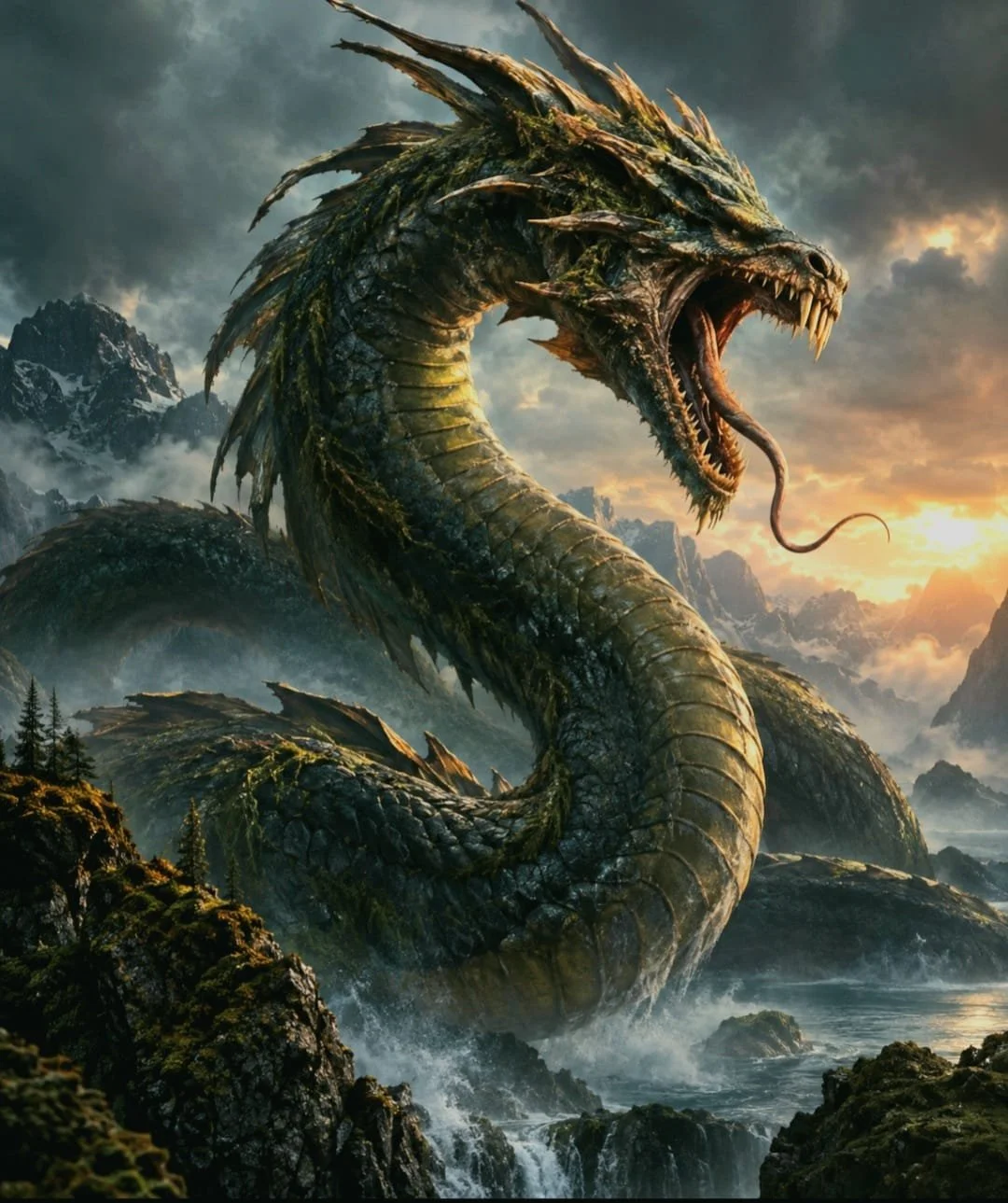
“The serpent does not always guard treasure. Sometimes it guards the boundary between what humanity understands and what lies beneath it.”
The words above are a mythopoetic reconstruction inspired by the wider germanic and scandinavian traditions surrounding lindworms, serpentine dragons, and the many forms of worm like beings preserved in northern european folklore. They are not a surviving quotation from the poetic edda, prose edda, or any single medieval source, but are intended to capture the deeper symbolic weight of the lindworm as a creature of the threshold, the wilderness, the underground, and the ancient forces that existed before human beings placed boundaries upon the world.
***NOTE***
The lindworm is one of those creatures whose importance is often obscured by the fact that it does not belong to one single, perfectly consistent mythological biography. Unlike thor, odin, or even more clearly defined legendary dragons, the lindworm exists across a broad family of traditions in which serpentine, elongated, limbless, or partially limbed dragon like beings appear in different forms. Some are monstrous predators. Some guard treasure. Some live beneath the earth. Some inhabit wells, rivers, forests, burial mounds, or remote wildernesses. Others appear in heroic legends as creatures that must be confronted before a kingdom, family, or individual can be restored.
The word itself is associated with old norse linnormr, old swedish lindorm, and related germanic forms meaning something close to a serpent, dragon, or worm like creature. Yet the lindworm should not automatically be imagined as the modern four legged dragon with wings, horns, and a torrent of fire. In many northern traditions, the lindworm is much closer to a great serpent long bodied, powerful, earthbound, and often associated with the hidden or uncivilised places of the world.
This makes the lindworm especially fascinating. It exists somewhere between serpent and dragon, between animal and supernatural being, between the natural world and the mythological imagination. It is not always a creature of the sky. Frequently, it belongs to the earth beneath our feet.
The more we delve the more we will find this distinction matters seekers.
Prologue - Before the Dragon Had Wings
Before medieval heraldry gave dragons their familiar forms, before modern fantasy filled the world with winged reptiles breathing fire across mountain peaks, the northern imagination already possessed a deep and ancient relationship with serpentine beings. The serpent was among the oldest symbolic creatures known to humanity, appearing in stories of creation, destruction, wisdom, fertility, death, rebirth, hidden knowledge, and the dangers that exist beyond the boundaries of human settlement.
The lindworm belongs to this older world of imagination. It is not necessarily a dragon in the later literary sense. It is something more ancient and less easily categorised. It may be a serpent enlarged beyond the natural world, a creature that coils beneath the earth, a guardian of a treasure hoard, or a monstrous being whose very existence represents the danger of the wilderness.
In northern europe, the world was never imagined as entirely safe or entirely domesticated. Beyond the farmstead were forests. Beyond the fields were mountains. Beneath the ground were burial mounds, caves, roots, stones, and the unknown. Rivers could nourish life, but they could also drown. Lakes could provide food, but they could also conceal things that should not be disturbed. The serpent belonged naturally within this landscape.
The lindworm is not simply a monster waiting for a hero. It is a reminder that the world we occupy has depths.
The Name Lindworm
The term lindworm derives from germanic and scandinavian linguistic traditions, most notably old norse linnormr and related scandinavian forms. The exact development of the word is complex, and translations vary depending on the historical language and context, but the general association is with a serpent-like or dragon like being.
The word ormr in old norse is commonly associated with a worm or serpent, and it appears in numerous mythological and legendary contexts. The term does not necessarily imply the small, harmless creature that modern english speakers associate with the word “worm.” In older germanic imagination, a worm could be an enormous serpentine monster of supernatural proportions.
Now this is important because modern readers can easily misunderstand the word. A lindworm is not a worm in the ordinary modern sense. It is closer to a great serpent or dragon like reptile, often long-bodied and sometimes depicted with one or more pairs of limbs depending on the artistic or regional tradition.
The linguistic history also demonstrates something important about mythology: creatures do not always remain fixed. Their names travel between languages, their shapes change through manuscripts and illustrations, and their identities shift as different communities reinterpret them.
The lindworm is not one single frozen creature. It is indeed a family of related images.
Canonical Presence in Norse and Germanic Tradition
Unlike odin, thor, freyr, or jörmungandr, the lindworm does not possess one central mythological narrative that defines its entire identity. Instead, the creature and concept appears across a range of scandinavian and germanic traditions, particularly in legendary literature, folklore, medieval art, heraldry, and later retellings of dragon slaying stories.
The old norse word linnormr appears in the wider vocabulary of serpentine and dragon like beings, while later scandinavian folklore preserves numerous accounts of lindormar, lindworms, and related creatures. These beings can appear in stories involving kings, princesses, cursed individuals, treasure, burial mounds, forests, wells, and isolated landscapes.
This creates a significant research challenge. When discussing the lindworm, it is important not to take every dragon story from northern Europe and assume that it describes exactly the same creature. Some traditions distinguish between dragons, serpents, worms, and other supernatural reptiles. Others use overlapping terminology. regional folklore also changes the creature's form considerably.
The secure conclusion is that the lindworm belongs to a broad northern tradition of serpentine supernatural beings, but its exact appearance and role depend heavily upon the source. And that is where the creature becomes especially interesting. The lindworm is not defined by one story. It is defined by a recurring presence.
What the Sources Actually Give Us
The surviving evidence surrounding lindworms is scattered across linguistic records, legendary literature, folklore collections, medieval illustrations, scandinavian traditions, and later artistic depictions. Unlike the mythology of ymir or bergelmir for example, there is no single surviving eddic passage that provides a complete origin story, genealogy, personality, and final fate for “the lindworm” as one unified being.
What we can establish is that serpent-like dragons and worm like supernatural creatures occupy an important place in germanic and scandinavian storytelling. They are often associated with wilderness, hidden places, treasure, danger, curses, and the boundary between civilisation and the unknown.
In some traditions, the lindworm is described as a long, serpentine creature without wings. In others, it may possess limbs, often two forelegs, while remaining distinctly elongated and serpent like. In still others, the distinction between lindworm and dragon becomes blurred.
We do not possess one universal ancient description that settles every question.
We do not know that every lindworm had the same number of limbs.
We do not know that every lindworm breathed fire.
We do not know that every lindworm guarded gold.
We do not know that every story involving a serpent like dragon belongs to one continuous religious tradition.
Those gaps are not weaknesses. Again lokw before, they are invitations to research.
Lindworm, Dragon, Serpent or Wyrm?
One of the most important difficulties in researching the lindworm is the tendency to treat all serpentine monsters as interchangeable. Modern fantasy often places dragons, wyrms, serpents, lindworms, drakes, and worms into a neat classification system. Medieval and folkloric traditions were not always so consistent.
A dragon might possess wings. A lindworm might be long bodied and earthbound. A wyrm might be a giant serpent. A ormr might simply mean serpent or worm depending upon context. A legendary dragon might be described using language that overlaps with several of these categories.
This means that the lindworm should be understood as part of a fluid mythological vocabulary rather than as a creature with one universally agreed biological design.
In some scandinavian depictions, the lindworm is shown with a serpentine body and two front legs. In other traditions, it is entirely limbless. Some artistic representations make it look almost like a giant snake with a dragon's head. Others give it a more recognisably draconic form.
The creature changes because the stories change. And as we know mythology has never been a zoological textbook.
The Serpent Before the Dragon
The serpent is one of the oldest creatures in human mythology, and the lindworm inherits much of that ancient symbolic weight. Long before dragons became symbols of treasure and heroic conquest, serpents were associated with the earth, the underworld, hidden wisdom, regeneration, fertility, danger, and the mysteries of life and death.
The serpent sheds its skin, making it a natural symbol of renewal. It moves without limbs, making it appear almost supernatural. It disappears into holes, roots, caves, water, and underground spaces, giving it an association with hidden worlds. It can remain still for long periods and then strike with extraordinary speed.
These characteristics made the serpent an ideal mythological creature. The lindworm expands those qualities to a monstrous scale. It is no longer simply a snake beneath a stone.
It is the ancient serpent magnified until it becomes a force capable of threatening human settlements, guarding sacred places, or representing the wilderness itself.
The Lindworm as a Creature of the Earth
Unlike winged dragons, which often occupy the sky or mountain peaks, lindworms are frequently associated with the earth. Their bodies coil across the ground, beneath roots, around hills, through caves, or within bodies of water. This gives them a distinctly chthonic quality.
The word chthonic refers to things associated with the earth, the underworld, or the hidden depths beneath the surface. In mythology, chthonic beings are often connected to ancestors, burial places, fertility, death, treasure, and ancient powers that existed before the present order.
The lindworm fits naturally into this category.
It is a creature that belongs below.
This does not necessarily mean it is evil. The earth itself is not evil. The underground is not evil. But both are places humanity cannot fully control. The lindworm therefore represents the reality that the world beneath civilisation remains ancient, powerful, and indifferent to human ambition.
The Lindworm and the Wilderness
In many northern traditions, the wilderness was not an empty space waiting to be conquered. It was a living environment filled with forces that did not necessarily recognise human authority. Forests were dangerous. Mountains were remote. Lakes could conceal monsters. Caves and burial mounds carried associations with the dead and the unknown.
The lindworm belongs to this landscape.
It is the creature that exists beyond the fence, beyond the settlement, beyond the cultivated field. It represents a world where human laws are weaker and where ancient forces continue to exist without permission.
This is why lindworm stories often involve a journey into dangerous territory. The hero leaves the familiar world and enters a place where ordinary rules no longer apply. The creature is encountered at the boundary between civilisation and wilderness.
The lindworm is therefore not merely an enemy. It is the wilderness given a body.
The Lindworm as Guardian
One of the most recurring roles of serpent like dragons in european folklore is that of the guardian. The creature may guard treasure, a hoard, a burial mound, a sacred object, a princess, a spring, or a place that should not be entered.
This role is particularly important because it changes the meaning of the monster. The lindworm is not necessarily attacking humanity without reason. It may be protecting something.
The treasure hoarding dragon is often interpreted as a symbol of greed, but the guardian role is more complicated. The creature may represent the danger of seeking what has not been earned. It may guard the wealth of the dead. It may protect an ancient boundary. It may be the embodiment of a taboo.
The question is not always “How do we kill the monster?”
Sometimes the question is:
“Why is the monster guarding this place?”
The Hoard Beneath the Earth
Treasure and serpents have been connected throughout indo european and germanic mythology for centuries. Gold buried beneath the earth, hoards placed within burial mounds, and wealth associated with the dead frequently become the property of supernatural guardians.
The lindworm fits naturally into this tradition.
The hoard is hidden. The serpent coils around it. The treasure belongs to a world older than the hero who seeks it. To approach the creature is therefore to approach not merely wealth, but the accumulated remains of the past. Gold in mythology is rarely just money.
It may represent power, ancestral wealth, kingship, death, memory, or corruption. The lindworm guarding it becomes the boundary between the living and the dead, between desire and consequence.
The hero who kills the lindworm may gain treasure. But the story often asks whether the treasure was worth the cost.
The Serpent and the Burial Mound
The association between serpents and burial mounds is particularly important within northern traditions. Burial mounds were places of ancestry, death, memory, and hidden wealth. They were not simply piles of earth. They were locations where the past remained physically present.
A lindworm emerging from or dwelling within such a place becomes a natural guardian of ancestral memory.
The creature is not merely beneath the mound. It is part of what the mound represents.
The serpent coils around the remains of the dead, the gold of the ancestors, and the history buried beneath the present world. This makes the lindworm a powerful image of the past refusing to surrender its secrets.
The living may desire the treasure. The dead may not wish to give it up.
The Lindworm and the Water
Although the lindworm is strongly associated with the earth, many serpent like monsters in scandinavian and european folklore are also connected with water. Lakes, rivers, wells, marshes, and springs are natural places for enormous serpentine beings to exist in the imagination.
Water is another threshold.
It reflects the sky but conceals the depths. It gives life but can also destroy. It separates communities and creates boundaries. A creature beneath the surface becomes a symbol of what exists beyond human vision.
A lindworm in a lake or well is therefore not simply a large animal. It is the unknown beneath the visible world. The surface appears calm. The depths remain unseen.
The Lindworm as a Threshold Being
The lindworm repeatedly appears in places where one world meets another. It may dwell beneath the earth, beside water, within a forest, near a burial mound, or at the edge of a settlement. These are all liminal spaces.
A liminal space is a threshold a place between states, boundaries, or conditions.
The lindworm belongs to thresholds because it is itself difficult to categorise. It is neither fully serpent nor fully dragon. It is neither ordinary animal nor divine being. It may be natural in shape but supernatural in size. It may be a guardian, predator, curse, or ancestral remnant.
The creature exists between categories.
And that is precisely why it is frightening.
Human beings are comfortable with things we can name clearly. The lindworm as always resists easy naming.
The Lindworm and the Fear of the Unknown
There is something especially ancient about fear of a serpent that cannot be fully seen. A wolf can be heard. A bear leaves tracks. A sword wielding enemy can be confronted face to face. But a lindworm may remain hidden beneath the ground, beneath water, within a mound, or in the darkness of a cave.
The fear comes not only from its strength.
It comes from uncertainty.
Where is it?
How large is it?
How long has it been there?
What is it guarding?
Has it always existed beneath the place where people now live?
These questions transform the lindworm from an ordinary monster into a creature of psychological terror. It represents the possibility that the familiar world contains something ancient and enormous just beyond perception.
The ground beneath us may not be so empty.
The Lindworm in Scandinavian Folklore
Scandinavian folklore contains numerous stories involving lindworms and related serpentine beings. These stories vary considerably by region and period, but recurring themes include cursed creatures, royal families, hidden treasure, supernatural births, transformations, and encounters between humans and enormous serpents.
One particularly important pattern is the lindworm as a creature connected to royalty or lineage. In some later legends, a lindworm may be born into a royal family, appear as the result of a curse, or become associated with a kingdom's fate. These stories often blur the line between monster and human.
The creature is not always something that comes from outside. Sometimes it comes from within the family itself. This creates a very different kind of horror. The monster is not invading the kingdom. The monster is infact part of the kingdom.
The Lindworm and Curses
In later scandinavian legends, lindworms sometimes appear in stories involving curses, transformations, or unusual births. These narratives are especially interesting because they move the creature away from being a simple wilderness monster and toward being a symbol of something unresolved.
A curse transforms a human condition into something monstrous. The lindworm becomes the physical expression of an imbalance, taboo, broken promise, or supernatural consequence.
This is a recurring mythological structure. A person becomes a beast. A family inherits a curse. A kingdom is threatened by something that should never have existed. The monster becomes a problem that must be understood before it can be defeated.
The lindworm therefore sometimes represents not an external enemy, but a hidden truth. The creature is what happens when something buried refuses to remain buried.
The Royal Lindworm
One of the most fascinating later traditions concerns the lindworm as a creature connected to royalty. In some of the scandinavian folktales, a lindworm is born to a king or queen, often under strange or cursed circumstances. The creature may eventually be transformed, married, redeemed, or revealed to possess a human identity beneath its monstrous appearance.
These stories should not be confused with the older mythological traditions of the eddas, but they are important because they demonstrate how the lindworm evolved within scandinavian storytelling.
The creature becomes a symbol of hidden inheritance.
The royal family may possess power, but it may also carry something monstrous within its bloodline. The lindworm becomes the secret beneath the crown.
This is a very powerful image because it challenges the assumption that nobility and monstrosity are opposites.
Sometimes the monster is born within the palace.
The Lindworm and the Human Shape
The transformation between human and serpent is one of the most compelling features of lindworm folklore. A creature that can become human, or a human who can become a lindworm, occupies an especially unstable position between worlds.
This raises multiple questions about identity, appearance, inheritance, and the nature of monstrosity.
Is the creature evil because of its form?
Is the human form more trustworthy?
Does the transformation represent a curse, or does it reveal something that was always present?
These questions are common throughout some of the european folklore, but the lindworm gives them a distinctly northern shape. The serpent becomes a symbol of the hidden self, the ancestral curse, or the truth beneath appearances.
The monster may not be what it looks like.
And the human may not be what they seem.
The Lindworm and the Dragon-Slayer Tradition
The dragon-slayer is one of the most recognisable heroic figures in european legend. A warrior confronts a monstrous serpent, defeats it, and gains honour, treasure, or liberation for a community. The story appears in many forms, including the famous traditions surrounding sigurd and fáfnir.
However, it is important not to assume that every lindworm is fáfnir or that every serpent-slaying story is directly connected to the eddic dragon. The traditions overlap symbolically, but they are not identical.
The lindworm belongs to a broader tradition in which the serpent becomes the ultimate challenge to human courage. It is powerful, ancient, difficult to understand, and often connected to wealth or forbidden places.
The hero's victory is more than physical. It is the triumph of human action over something that represents the ancient and uncontrollable world.
Lindworm and Fáfnir - Similarities and Differences
Fáfnir is one of the most famous dragon like beings in norse legendary literature, particularly through the völsunga saga and the wider sigurd tradition. He is a transformed being associated with greed, murder, and the cursed treasure of andvari. His story is deeply connected to the destructive power of wealth.
The lindworm, by contrast, is a broader creature category rather than one specific character. Some lindworms resemble fáfnir in their serpentine form, treasure association, and role as a monster defeated by a hero. But not every lindworm possesses fáfnir's genealogy, personality, or narrative.
The comparison is extremely useful because it shows how northern storytelling repeatedly returns to the image of the serpent as guardian of dangerous wealth. But the difference really matters. Fáfnir is an individual mythological character. The lindworm is a recurring type of being.
The Lindworm and Jörmungandr
The comparison with jörmungandr, the midgard serpent, is equally fascinating. jörmungandr is a specific cosmic being in norse mythology, the child of loki and angrboða, who grows so enormous that it encircles the world and holds its own tail in its mouth.
The lindworm is not automatically jörmungandr.
Jörmungandr belongs to the structure of the cosmos itself. Its existence is tied directly to ragnarök, thor, and the destruction of the world. The lindworm is generally a more localised creature, associated with particular landscapes, treasures, curses, or legendary encounters.
Yet both share the image of the serpent as something too large, too ancient, or too powerful to be comfortably contained by human civilisation.
Look at it like this, jörmungandr is the serpent of the world. The lindworm is often the serpent beneath the world.
The Lindworm and Níðhöggr
Níðhöggr is another important comparison. This dragon like serpent gnaws at the roots of yggdrasil and is associated with the underworld, decay, and the destruction of the cosmic tree. Like the lindworm, níðhöggr belongs to the hidden and chthonic dimensions of existence.
But again, the distinction is important.
níðhöggr is a specific mythological being with a defined place in the cosmology of the eddas. The lindworm is a broad folkloric and legendary category. They may share symbolic qualities, but they should not be merged into one creature.
The comparison nevertheless reveals a recurring northern idea... serpentine beings often inhabit the places beneath or beyond the ordered world. They are associated with roots, earth, decay, hidden wealth, and ancient forces that challenge the stability of creation.
The serpent is not always above us. Sometimes it is beneath the foundations.
The Lindworm and the World Tree
The image of a serpent associated with roots, trees, earth, or underground spaces is especially significant in northern mythology. yggdrasil itself is not merely a tree. It is the structure connecting the realms of existence. Its roots reach into deep and dangerous places, and creatures associated with decay, serpents, and hidden forces inhabit its wider mythological environment.
The lindworm fits symbolically into this landscape because it belongs to the world beneath the visible branches of civilisation.
The tree grows upward. The serpent coils below. One represents connection and structure.
The other represents the ancient forces that threaten, sustain, or inhabit the foundations.
This does not necessarily make the lindworm a direct inhabitant of yggdrasil.
Rather, it places the creature within the same symbolic environment - the deep world beneath the ordered surface.
The Serpent as Ancient Memory
One of the most powerful ways to interpret the lindworm is as a creature of ancient memory. A serpent living beneath a burial mound or within the earth is not merely hiding. It is occupying a place where the past remains physically present.
The lindworm may guard treasure because treasure belonged to the dead. It may inhabit a mound because the mound preserves ancestry. It may remain beneath a settlement because the land existed before the settlement did.
The creature becomes a reminder that the present is built upon older worlds. Human beings establish farms, kingdoms, roads, and houses.
The lindworm remains beneath them. The past is not gone. It is coiled.
The Lindworm and the Buried Past
There is a recurring mythological pattern in which something buried eventually returns. A forgotten king rises. A cursed ancestor emerges. A treasure is uncovered. A monster awakens beneath a hill. The lindworm belongs naturally to this pattern.
The buried past is dangerous because it has not been resolved.
The creature may represent an ancient wrong, a forgotten curse, an ancestral crime, or wealth that was never meant to be disturbed. The hero encounters the lindworm because someone has crossed a boundary between the present and the past.
This is why the creature often feels older than the people who encounter it. It was there before them. It may remain after them.
The human settlement is temporary. The lindworm is ancient.
The Lindworm as a Guardian of Boundaries
The lindworm can be interpreted as a guardian of boundaries between the human world and the older forces that surround it. These boundaries may be physical, such as a cave, mound, lake, forest, or mountain. They may also be symbolic, such as the boundary between life and death, wealth and greed, civilisation and wilderness, or knowledge and ignorance.
The creature does not always need to attack.
Its mere presence may be enough to establish that a boundary exists.
The serpent says: this place is not yours.
The mound says: the dead remain here.
The treasure says: not everything buried belongs to the living.
The lindworm becomes the living expression of that warning.
The Lindworm and the Fear of Greed
Many dragon and serpent legends connect the creature with treasure, and this association is particularly important in germanic storytelling. Wealth can provide power, security, status, and survival, but it can also corrupt those who possess it.
The lindworm guarding gold therefore becomes a symbol of the dangers of possession.
The hero may seek the treasure for noble reasons, but the story often reveals that wealth itself carries a curse. The dragon's hoard is not simply an opportunity. It is like all things in the norse world a test.
What will the hero do with it?
Will they become like the creature they defeated?
Will the treasure destroy them?
Will the victory produce a greater tragedy than the monster itself?
The lindworm may be defeated physically, but the danger it represents can survive.
The serpent dies. Greed remains.
The Lindworm as a Test of Kingship
In many legends, the defeat of a great serpent or dragon is connected to kingship, inheritance, or the restoration of order. The hero proves their worth by confronting a creature that ordinary people cannot defeat.
This makes the lindworm a test of leadership. A king who cannot protect the land is weak. A warrior who cannot confront the monster is unworthy. A kingdom threatened by a serpent becomes a kingdom waiting for someone capable of crossing the boundary between fear and action.
Yet the lindworm also complicates this heroic ideal. If the creature is guarding something sacred or ancestral, then killing it may not be a simple act of justice. The hero must understand what the serpent represents before claiming victory.
The true test may not be strength. It may be judgement.
The Lindworm and the Uncivilised World
The lindworm represents a world that existed before human civilisation imposed its structures upon the landscape. It belongs to the wilderness, the underground, the water, the forest, and the remote places where human authority is limited.
This makes it a natural opponent for heroes who represent settlement, kingship, agriculture, and law.
The hero builds. The lindworm coils.
The hero names the land. The lindworm belongs to it.
The conflict is therefore not merely between a man and a monster. It is between the human desire to establish order and the ancient reality that the world cannot ever be completely controlled. The lindworm is the reminder that civilisation has edges.
The Serpent Beneath the Kingdom
One of the most compelling symbolic interpretations of the lindworm is that it represents the hidden danger beneath political and social order. A kingdom may appear prosperous, stable, and secure, yet beneath its foundations something ancient remains unresolved.
The serpent beneath the castle becomes an image of buried corruption. The monster beneath the palace becomes an image of inherited guilt. The creature beneath the road becomes an image of history that has been ignored.
This is why lindworm stories can be read as political or psychological myths even when the original storytellers may not have intended such a modern interpretation. The creature gives physical form to the idea that no kingdom is built upon empty ground.
Every kingdom has foundations. And foundations contain the past.
The Lindworm and Transformation
Transformation is one of the most important themes associated with serpentine creatures. The serpent sheds its skin. The human becomes a beast. The beast becomes human. The creature changes form, revealing that identity is not always fixed.
In lindworm folklore, this can become a powerful image of hidden potential or hidden monstrosity. A creature may be cursed into serpent form, or a human may be forced to confront a monstrous identity that others cannot see beyond.
The serpent becomes the body of transformation.
It represents what happens when the familiar shape of a person is lost.
But it also raises the possibility that the monstrous form is not the final form. The lindworm may be a curse. It may also be a transformation waiting to be understood.
The Lindworm and the Fear of Birth
In some later scandinavian legends, the lindworm is connected with unusual births, royal lineage, and the arrival of a monstrous child. These stories are deeply unsettling because birth is normally associated with continuity, hope, and the future.
The lindworm reverses that expectation.
The child becomes a serpent. The royal bloodline produces a monster. The family that should represent the future becomes the source of fear.
This creates a profound mythological tension between inheritance and monstrosity. The creature is not simply an invader from the wilderness. It is born from the same lineage that rules the kingdom. The lindworm becomes the nightmare of inheritance.
What if the future carries the shape of the past?
The Lindworm and the Feminine Mystery
Serpents have often been associated with feminine symbolism in european folklore, particularly through their connection to fertility, birth, transformation, the earth, and hidden life. However, it is important not to assume that every lindworm tradition is specifically feminine or that the creature possesses one fixed gendered meaning.
What can be said is that serpentine beings frequently occupy symbolic spaces associated with generation and transformation. They emerge from the earth, coil around sacred places, and appear in stories involving birth, curses, and renewal.
The lindworm can therefore be interpreted as a creature of deep generative mystery. It belongs to the places where life begins.
It also belongs to the places where life ends.
The earth gives birth.
The earth receives the dead. The serpent moves between both.
The Lindworm and the Cycle of Renewal
The serpent's ability to shed its skin has made it a symbol of renewal across many cultures. While the lindworm is often portrayed as dangerous, its serpentine form also carries the possibility of transformation and continuation.
This is especially interesting in northern traditions, where destruction and renewal are recurring themes. Ragnarök itself is not simply the end of everything. It is followed by the emergence of a renewed world.
The lindworm is not directly responsible for this cosmic cycle, but it belongs symbolically to the same pattern. It is a creature that appears to possess an existence beyond ordinary human lifespans. It may sleep, hide, shed, transform, or remain beneath the earth while generations pass above it.
The serpent does not experience time in the same way humans do. It endures.
The Lindworm and the Passage of Time
A lindworm beneath a mound or within an ancient landscape represents a different relationship with time. Human beings build settlements, establish kingdoms, wage wars, and disappear. The serpent remains.
This creates a powerful contrast between human mortality and monstrous endurance.
The hero may live for decades. The lindworm may be imagined as existing for centuries.
The kingdom may rise and fall. The serpent may remain beneath the same hill.
This is why the creature often feels ancient even when the story gives no precise age. Its power comes from the suggestion that it existed before the current generation and may continue after it is gone.
The lindworm is not simply old. It is outside ordinary human time.
The Lindworm and the Fear of What Sleeps
Many serpent legends involve creatures that are dormant, hidden, or concealed until disturbed. This creates a particular kind of fear: the danger is not actively pursuing humanity. It is waiting.
A sleeping lindworm is more frightening than a constantly attacking monster because its silence suggests permanence. It does not need to chase anyone. It simply exists.
The creature beneath the hill may have been there for generations.
The serpent in the lake may have watched kingdoms disappear.
The worm beneath the mound may awaken only when someone crosses the wrong boundary.
This gives the lindworm an almost geological quality.
It is less like a predator.
More like an ancient force waiting for the world to disturb it.
The Lindworm as the Shape of Hidden Power
Power in mythology is often represented through size, strength, weapons, or divine authority. The lindworm represents a different kind of power... hidden power.
It does not need to rule a kingdom. It does not need to speak. It does not need to wear a crown. Its power lies in the fact that it exists somewhere humanity cannot fully reach. The creature beneath the earth is powerful because it is not visible, not easily understood, and not easily controlled.
This makes the lindworm a natural symbol for forces that operate beneath the surface of society. The hidden. The buried. The forgotten. The unresolved.
The Lindworm and the Hero's Journey
The lindworm frequently appears in stories that follow a familiar heroic structure. A threat emerges. The community is afraid. A hero is called or chooses to act. The hero enters a dangerous landscape. The monster is confronted. The boundary is crossed. Something is gained or restored.
Yet the lindworm adds a distinctive northern atmosphere to this pattern. The creature is not always a simple villain. It may be ancient, connected to treasure, associated with a curse, or tied to a place that should never have been disturbed.
The hero's journey therefore becomes a journey into the unknown. The monster is the guardian. The landscape is the test. The treasure is the temptation. The victory is never entirely free of consequence.
The Lindworm and the Cost of Victory
Dragon slayer stories often celebrate the hero's triumph, but northern mythology and legend frequently remind us that victory can carry a price. The treasure may be cursed. The monster's blood may be dangerous. The hero may become corrupted by the very wealth they obtain.
The lindworm is especially suited to this theme because its identity is often connected to hidden wealth and ancient places.
Killing the creature does not necessarily end the danger. The hoard remains. The curse remains. The desire that led the hero into the mound remains. The serpent may be dead, but the human weakness that summoned the conflict may survive.
The lindworm teaches us that defeating a monster is not always the same as overcoming what the monster represents.
The Lindworm and Ancestral Wealth
The connection between serpent guardians and buried treasure may also be understood through ancestral wealth. In many ancient societies, burial mounds contained objects of status, weapons, jewellery, and goods that symbolised the power of the dead.
A lindworm guarding such a hoard becomes a supernatural continuation of ancestral ownership.
The dead are not simply gone. Their wealth remains protected. The serpent becomes the guardian of a world in which the living cannot freely claim everything left behind by the dead.
This is one reason the lindworm feels so at home in burial mound traditions. It belongs to the same space as ancestral memory, hidden gold, and the unresolved relationship between the living and the dead.
The Lindworm and the Underworld
Although not every lindworm is explicitly an underworld creature, its associations with earth, caves, burial mounds, roots, and hidden places give it a natural connection to underworld symbolism.
The underworld in mythology is rarely just a place of punishment. It may be a realm of ancestors, wealth, hidden knowledge, death, fertility, and transformation. The serpent belongs there because it moves between visible and invisible spaces.
It can emerge from the earth. It can disappear beneath it. It can inhabit the boundary between life and death. The lindworm is therefore a creature of the below.
Not necessarily evil. But never entirely safe.
The Lindworm and the Ancient Serpent Archetype
The lindworm belongs to a much wider mythological pattern in which serpents represent forces that are older than humanity. Across cultures, enormous serpents appear as guardians of sacred places, enemies of gods, symbols of cosmic order, embodiments of chaos, or creatures associated with the beginning and ending of worlds.
The northern lindworm should not be treated as identical to every serpent in every culture, but the comparison reveals a recurring human fascination.
The serpent is strange because it moves without limbs. It is ancient because it sheds its skin. It is frightening because it can remain hidden.
It is powerful because it belongs to the earth.
And when enlarged into a lindworm, these qualities become mythological rather than merely zoological.
The serpent becomes the ancient world made visible.
The Lindworm and the Edge of Civilisation
One of the most consistent symbolic roles of the lindworm is its position at the edge of the human world. It may inhabit the forest beyond the settlement, the lake beyond the road, the mound beyond the farm, or the cave beneath the mountain.
This makes it a creature of the frontier.
The place where the known world ends.
The place where maps become uncertain.
The place where human law gives way to older powers.
The lindworm is a perfect creature for northern storytelling because the landscape itself was full of thresholds. Mountains, forests, fjords, lakes, islands, and remote valleys all create natural spaces where the unknown can remain hidden.
The monster is not necessarily far away.
It may be just beyond the last house.
The Lindworm and the Human Need to Name Danger
Naming a creature is one of the first ways humanity attempts to control fear. Once something has a name, it can be described, discussed, remembered, and passed into tradition.
The word lindworm gives shape to a particular kind of fear.
Not every serpent is a lindworm. Not every dragon is a lindworm. But the name allows storytellers to distinguish a creature that belongs to a specific family of supernatural forms.
Yet the name does not eliminate the mystery.
It merely gives the mystery a boundary.
The lindworm remains something larger than the word used to describe it.
The Lindworm and the Limits of Classification
Modern readers often want to know exactly what a lindworm “is.” How many legs does it have? Does it have wings? Is it a dragon or a serpent? Does it breathe fire? Is it intelligent? Does it guard treasure?
The honest answer is that the tradition does not provide one universal answer.
The lindworm is a category shaped by regional folklore, linguistic development, artistic representation, and later literary interpretation. Its form changes. Its role changes. Its symbolism changes.
This is not a flaw.
It is evidence of how folklore works.
Mythological creatures are not always fixed species.
They are living images.
And the lindworm is one of the clearest examples of that.
The Lindworm in Medieval Imagination
During the medieval period, dragons and serpent like monsters became increasingly prominent in european art, heraldry, bestiaries, legends, and religious symbolism. The lindworm participated in this wider transformation, sometimes becoming more dragon like as artistic traditions developed.
However, medieval artists did not always distinguish creatures according to the neat classifications modern fantasy readers expect. A serpentine dragon might be depicted with wings in one manuscript and without them in another.
A worm like creature might possess legs in one regional tradition and be entirely limbless in another.
This is why visual evidence must be interpreted carefully.
A picture of a dragon like creature does not automatically prove that the artist was depicting a lindworm in the modern sense. The image belongs to a broader tradition of monstrous serpents.
The Lindworm and Heraldry
The lindworm became particularly important in scandinavian and germanic heraldic traditions, where serpentine dragon like creatures were used as symbols of strength, guardianship, power, and ancestral identity.
Heraldic lindworms are often depicted with elongated bodies, wings or limbs depending on regional convention, and a distinctly serpent-like appearance. They appear on coats of arms, banners, seals, and decorative objects.
This demonstrates how a creature once associated with fear could become a symbol of authority.
The monster becomes the emblem. The serpent becomes the guardian of the kingdom. The creature that once lived beyond the settlement is brought into the centre of political identity.
This is a recurring transformation in mythology. What was once feared becomes a symbol of power.
The Lindworm and the Christian Middle Ages
As Christianity spread through northern europe, older supernatural creatures were often reinterpreted through new religious frameworks. Dragons and serpents could become symbols of sin, temptation, evil, or the forces opposed to christian order.
However, it is important not to assume that every earlier serpent tradition was simply transformed into a christian devil. Some creatures continued to exist in folklore without a strongly theological interpretation. Others became associated with saints, heroes, or moral lessons.
The lindworm occupies a complicated position between older germanic symbolism and later christian storytelling.
In one context, it may represent ancient wilderness. In another, it may represent sin.
In another, it may simply be a terrifying creature in a local legend.
The meaning depends upon the tradition.
The Lindworm and the Serpent of Wisdom
Although lindworms are often dangerous, serpents are not universally symbols of ignorance or evil. Across many mythological systems, serpents are also associated with wisdom, hidden knowledge, healing, and transformation.
The lindworm's hidden nature makes this interpretation especially interesting. A creature beneath the earth may guard not only treasure but knowledge. It may represent something humanity cannot access without confronting fear.
This does not mean that every lindworm is wise.
Rather, the serpent's form carries a symbolic ambiguity.
It can destroy. It can guard. It can conceal.
It can reveal.
The same creature may represent both danger and knowledge depending on how the story approaches it.
The Lindworm and the Burden of Ancient Knowledge
A serpent guarding a hidden place may be interpreted as a guardian of knowledge that humanity is not yet ready to possess. The treasure beneath the mound can be understood symbolically as memory, wisdom, ancestral truth, or dangerous understanding.
The lindworm becomes the keeper of what lies beyond ordinary human access. To approach it is to approach knowledge that may change the person who receives it.
This is why serpentine guardians appear so frequently in mythology. The serpent is a natural symbol of knowledge because it is associated with hidden places, transformation, and the ability to move between worlds.
The lindworm may not merely guard gold.
It may guard the consequences of knowing too much.
The Lindworm and the Unfinished Past
The lindworm can also be understood as a symbol of the unfinished past. A creature that remains beneath a mound, within a cave, or beneath a kingdom suggests that something has not been resolved.
The past has been buried. But burial is not the same as disappearance. The serpent remains.
It waits beneath the surface of the present world, reminding humanity that forgotten things can return. The lindworm becomes the physical expression of unresolved history.
The old king is dead. The hoard remains.
The curse continues. The serpent coils around the unfinished story.
The Lindworm and the Fear of Inheritance
In stories involving royal births, curses, or family transformations, the lindworm becomes a symbol of inherited fear. The creature is not something the hero chooses to encounter. It is something they are born into.
This makes the lindworm particularly powerful as an image of ancestry.
What do we inherit from those who came before us?
We inherit names. We inherit wealth. We inherit stories. We inherit wounds. And sometimes, in mythological language, we inherit monsters.
The lindworm becomes the embodiment of the idea that the past can shape the future in ways no one expects.
The Lindworm and the Human Shadow
The lindworm can be read psychologically as a representation of the shadow: the parts of existence that human beings do not wish to acknowledge. The hidden anger, greed, fear, trauma, ambition, or ancestral burden that lies beneath the surface of a respectable life.
This is a modern interpretive framework rather than an explicit ancient explanation, but it can help explain why the creature remains compelling.
The lindworm is what lies beneath. The monster in the cave may represent the fear within the hero. The serpent beneath the palace may represent the corruption beneath authority. The creature born into the royal family may represent the truth that nobility cannot eliminate monstrosity.
The lindworm is the shadow given scales.
The Lindworm and the Natural World
It is important not to reduce the lindworm entirely to symbolism. Folklore often emerges from humanity's relationship with real landscapes and animals. Large snakes, unusual fossils, crocodile like remains, dinosaur bones, fallen tree roots, and strange natural formations may all contribute to stories of enormous serpents.
The lindworm exists at the intersection of natural observation and mythological imagination.
A real serpent becomes enormous in the story.
A hidden cave becomes a monster's lair.
A burial mound becomes the home of a dragon.
A strange shape in the water becomes a creature beneath the surface.
This does not make the stories meaningless.
It demonstrates how human beings transform the unknown natural world into narrative.
The Lindworm and the Northern Landscape
The northern european landscape is particularly suited to serpent mythology. Long valleys, dark forests, lakes, fjords, burial mounds, rocky hills, and remote wilderness create spaces where enormous creatures can be imagined without difficulty.
The lindworm belongs to this environment because it is a creature of distance and concealment.
It does not need to live in a distant fantasy realm. It can live beneath the hill outside the village. It can inhabit the lake that people refuse to cross after sunset. It can coil around the ancient mound that no one dares disturb.
The landscape itself becomes part of the creature's body.
The Lindworm and the Fear of the Deep
Whether beneath the earth or beneath water, the lindworm is often associated with depth. Depth is frightening because it conceals scale. A small opening may lead to an enormous cavern. A calm lake may conceal something far larger than anything visible at the surface.
The lindworm becomes the creature of hidden magnitude. What appears small from above may be enormous below. What appears quiet may contain unimaginable power.
This is why serpentine monsters are so effective in folklore. Their bodies naturally suggest hidden length. A serpent can continue beyond what the eye can see.
The lindworm is frightening because it may be larger than the world allows us to perceive.
The Lindworm and the Boundary of the Body
The elongated body of the lindworm is one of its most distinctive characteristics. Unlike a conventional dragon with a recognisable torso, limbs, wings, and tail, the lindworm often appears almost entirely as one continuous line of muscle and scale.
This gives it a strange physical quality.
Where does the creature begin?
Where does it end?
How much of it is hidden?
How long is it?
The body becomes a symbol of continuity and endlessness. The serpent is not divided into familiar human proportions. It is a creature of uninterrupted movement.
Its form itself feels ancient.
The Lindworm and the Serpent's Gaze
Although not every tradition emphasises the creature's eyes, serpents are often imagined as possessing a strange, unreadable gaze. They do not express emotion in ways humans easily understand. Their stillness can be more frightening than aggression.
The lindworm's gaze becomes the point where the human meets the inhuman.
The hero may be brave enough to fight it.
But can the hero understand it?
Does it recognise fear?
Does it recognise honour?
Does it guard its treasure because it desires wealth, or because guarding is simply what it is?
The serpent's silence makes it difficult to know. And the unknown is often more terrifying than hatred.
The Lindworm and the Absence of Speech
Some dragons in literature speak with intelligence and eloquence. Lindworms, however, are often imagined more as beasts or supernatural creatures than as articulate philosophers. This distinction is very important because it changes the nature of the encounter.
A speaking dragon can bargain. A lindworm may simply exist. A speaking monster can explain its motives. A silent serpent cannot be reasoned with in the same way. This makes the lindworm closer to an elemental force. It is not necessarily cruel. It may simply be dangerous because danger is part of its nature.
The creature does not need to hate humanity. It only needs to be there.
The Lindworm and the Ancient Silence
The silence of the lindworm is one of its most powerful qualities. It does not need to announce itself with speeches or threats. Its presence is enough.
A serpent beneath a mound does not explain why it guards the dead. A creature beneath a lake does not explain what it has seen. A worm beneath a kingdom does not explain how long it has waited.
The silence suggests an age beyond human language. The lindworm belongs to a world before explanation.
The Lindworm and the Unseen Kingdom
A lindworm can be imagined as the ruler of a hidden kingdom beneath the visible one. The human kingdom has castles, roads, farms, and laws. Beneath it exists another world of roots, caves, bones, water, and ancient darkness.
The serpent belongs to that hidden kingdom.
It does not need a crown. Its territory is the earth itself. This makes the lindworm a powerful counter image to human kingship. The king rules the surface. The serpent rules the depths. The two kingdoms exist side by side. Only one is visible.
The Lindworm and the Ancient Right of the Land
There is a deeper ecological interpretation of the lindworm as a creature that represents the ancient right of the land to exist without human ownership. Before roads, paths, farms, castles, and borders, the landscape already existed.
The serpent becomes a guardian of that older reality. The human arrives and claims the land. The lindworm remains. This does not mean the creature is always a moral hero. It means the story preserves the idea that the land is not merely an object for human use. It has its own history, its own dangers, and its own powers.
The creature is the ancient claim of the earth.
The Lindworm and the Modern Imagination
Modern fantasy has transformed the lindworm into a recognisable dragon subtype, often depicted as a wingless or two-legged dragon with a long serpentine body. This interpretation is visually compelling, but it should be understood as a modern classification rather than a perfect reflection of one ancient universal design.
Modern fantasy likes categories. Ancient folklore likes variation. The modern lindworm may have a specific number of limbs, a defined habitat, and a consistent taxonomy. Historical traditions were far less uniform.
This does not make modern interpretations wrong. It simply means that the historical lindworm is more fluid than the fantasy version. The modern image is one interpretation of an older family of creatures.
The Lindworm and the Return of the Ancient
One reason the lindworm continues to fascinate modern audiences is that it represents something contemporary life often tries to suppress: the return of the ancient.
Modern civilisation is built upon technology, architecture, law, and systems of control. Yet beneath all of it remain forests, mountains, oceans, animals, geological time, and the forces of nature that existed long before humanity.
The lindworm embodies the idea that the ancient world has not disappeared. It is still beneath us. It is still waiting. And it can still emerge.
The Lindworm as a Symbol of Endurance
The serpent's ability to survive in hidden environments gives the lindworm a symbolic association with endurance. It may remain beneath the earth while generations pass above it. It may survive the fall of kingdoms. It may continue to exist after the people who first encountered it have become ancestors themselves. The lindworm is therefore not merely a creature of destruction.
It is a creature of persistence. It represents the things that remain when human structures disappear. The castle falls. The road is forgotten. The kingdom changes hands. The serpent remains beneath the hill.
The Lindworm and the Memory of the Land
The creature can also be interpreted as the memory of the land itself. A place that contains a lindworm is not simply a location. It is a place with a story, a history, a warning, and a hidden depth.
The serpent becomes a guardian of place memory. It remembers what the living have forgotten. It belongs to the landscape in a way that human beings never fully can.
The lindworm therefore transforms geography into mythology.
The hill is no longer just a hill. It is where the serpent sleeps. The lake is no longer just water. It is where something ancient coils beneath the surface.
The Lindworm and the Question of Evil
One of the most important questions surrounding the lindworm is whether it should automatically be understood as evil. Modern storytelling often divides creatures into heroes and villains, but folklore is rarely so simple.
A lindworm may be dangerous without being morally evil. It may guard something because that is its nature. It may attack because humans have entered its territory. It may be cursed rather than malicious. It may be a symbol of danger rather than a conscious embodiment of wickedness. The creature's moral status depends upon the story.
The lindworm is often better understood as a force that must be confronted than as a villain that must be hated.
The Lindworm and the Human Desire for Control
The hero who confronts the lindworm is often attempting to restore control. A village is threatened. A road is blocked. A treasure is inaccessible. A curse has disrupted a family. A kingdom cannot move forward until the serpent is defeated. The creature represents the obstacle that refuses to submit.
This is why lindworm stories are so compelling. They dramatise the human desire to make the world safe, ordered, and understandable. But the serpent reminds us that the world is not entirely ours to command.
There will always be forces beyond control.
There will always be depths we cannot map.
There will always be things beneath the surface.
The Lindworm and the Mystery of Scale
The lindworm's enormous length is not merely a physical feature. It is part of its mythological power. A serpent that disappears beyond the horizon, coils around a mound, or extends into unseen darkness becomes a creature whose scale cannot be fully measured.
This creates a sense of cosmic unease. The human body has limits. The lindworm appears almost limitless. The hero can see its head but not its tail. The creature may be present in a space that is too small to contain it.
The serpent becomes the image of something too large for human understanding.
The Lindworm and the Ancient Fear of Being Surrounded
A serpent coils. That movement has psychological significance. A coiled creature can encircle, trap, restrict, and surround. It does not always need to chase its prey. It can simply create a boundary from which escape becomes difficult.
This is one reason serpentine beings are so often associated with cosmic enclosure. Jörmungandr encircles the world. Other serpents coil around treasure, trees, mounds, or sacred objects.
The lindworm's body becomes a boundary.
The creature does not merely occupy space.
It controls the space it coils around.
The Lindworm and the Serpent as Guardian of Secrets
A hidden hoard, a forbidden cave, an ancient mound, or a cursed object all share one quality: they contain something humanity does not fully understand.
The lindworm becomes the guardian of that uncertainty. It stands between the seeker and the secret. The hero may want the treasure. The serpent protects it. The hero may want the knowledge. The serpent conceals it. The hero may want to reclaim the past. The serpent reminds them that the past is not freely available.
The lindworm is the keeper of secrets that have survived longer than human memory.
The Lindworm and the Price of Disturbing the Dead
In northern mythology and folklore, the dead are not always passive. Burial mounds, ancestral remains, and the wealth of the deceased can remain powerful long after death. A lindworm guarding such a place becomes a warning against disturbing what should remain undisturbed.
The creature is the consequence of trespass.
The treasure is not simply hidden. It is protected. The mound is not simply empty.
It is occupied by the past. The serpent becomes the boundary between respect and greed.
The Lindworm and the Hero Who Enters the Mound
The image of a hero entering a burial mound to confront a serpent is one of the most powerful scenes in northern legendary imagination. The hero descends into darkness, leaving the world of the living behind. Inside lies treasure, bones, ancient weapons, and the creature that guards them.
This is not merely an adventure. It is a descent into the past. The hero enters a place where ordinary life has no authority. The serpent represents the ancient force that has survived within the mound. The hero may emerge with treasure. But they have also crossed into the world of the dead. And such journeys rarely leave a person unchanged.
The Lindworm and the Burden of Gold
Gold is one of the most dangerous substances in northern heroic literature. It creates alliances, betrayal, murder, inheritance disputes, and curses. A lindworm guarding gold becomes the physical embodiment of wealth's destructive potential.
The creature's body coils around the hoard because wealth itself has become a form of imprisonment. The dragon does not merely possess the gold. The gold possesses the dragon. This is particularly clear in traditions where a being becomes monstrous through greed. The serpent form becomes the final shape of a soul consumed by possession.
The lindworm may therefore be both guardian and prisoner.
The Lindworm and the Question of Redemption
In stories where a lindworm is connected to curses or transformations, the possibility of redemption becomes especially important. If the creature was once human, then defeating it may not be the only possible ending.
The story may require understanding, compassion, courage, or the breaking of a curse rather than simple destruction.
This is a different kind of heroic narrative.
The hero does not merely kill the monster.
The hero discovers what the monster truly is.
The lindworm becomes a reminder that appearance is not always identity.
Sometimes the creature beneath the scales is still capable of change.
The Lindworm and the Shape of the Curse
A curse is often invisible until it becomes physical. The lindworm gives the curse a body. It makes hidden consequences visible.
The family carries the curse. The child becomes the serpent. The kingdom sees the monster. But the cause may lie generations earlier. This is why the lindworm is such a powerful folkloric figure. It represents the way the past can become embodied in the present.
The curse is not merely spoken. It coils.
The Lindworm and the Fear of the Family
The royal lindworm stories are particularly unsettling because they place monstrosity inside the family. The palace is supposed to be a place of order, legitimacy, and continuity. Yet the serpent child reveals that even the most powerful family cannot escape the mysteries of birth and inheritance.
The monster is not outside the bloodline.
It is inside it. This turns the lindworm into a symbol of the fear that something hidden within a family may emerge in a form no one can control. The creature becomes the secret of the lineage.
The Lindworm and the Serpent Bridegroom
Some later scandinavian traditions involve serpentine beings and marriage, transformation, or the eventual removal of a curse through unusual human relationships.
These stories are particularly interesting because they challenge the assumption that the lindworm can only be destroyed.
Sometimes the creature must be understood. Possibly the monstrous form is temporary. Maybe the story is about seeing beyond appearance.
The lindworm becomes a test not of physical strength, but of whether humanity can recognise the person or truth beneath the monster. This creates a very different kind of folklore. The serpent is not simply the enemy. It is the mystery of identity.
The Lindworm and the Ancient Pattern of Renewal
The serpent's ability to shed its skin makes it one of the most enduring symbols of renewal in human imagination. The lindworm, despite its monstrous appearance, can therefore represent the possibility that something ancient may transform rather than simply die.
A curse can be broken. A monster can become human. A hidden truth can be revealed. A buried past can be brought into the light. The lindworm is not always a symbol of permanent monstrosity. It is the shape of a transformation that has not yet reached its end.
The Lindworm and the Unseen Future
A lindworm emerging from a royal family or ancient landscape often represents a future that cannot yet be understood. The creature is unexpected. It disrupts plans. It challenges assumptions about what should come next.
This makes it a symbol of uncertainty. The future may not arrive in the form we expect.
The child may not resemble the parents.
The kingdom may not continue as planned.
The hidden creature may emerge when the world believes itself secure.
The lindworm reminds us that the future is never entirely predictable.
The Lindworm and the Human Need for a Monster
Human societies, communities, settlements etc often create monsters to give shape to fears that are otherwise difficult to express. The lindworm allows fear of wilderness, inheritance, greed, death, hidden knowledge, and the unknown to become a single image.
The monster becomes the thing that can be confronted. The fear becomes visible. The unknown gains a body. This is one of the reasons the lindworm remains so powerful in folklore. It gives form to fears that would otherwise remain abstract.
The serpent is not just something dangerous. It is the shape of danger itself.
The Lindworm and the Return of the Buried
The lindworm is particularly suited to stories about things that return from beneath the surface. A forgotten creature emerges. A buried curse awakens. A treasure is uncovered. A kingdom discovers that its foundations are not as secure as it believed.
The serpent becomes the return of what was suppressed. The past rises. The hidden becomes visible. The old world refuses to remain silent. This is one of the most enduring patterns in northern storytelling....
What is buried is not always gone.
The Lindworm and the Fragility of Human Order
The lindworm exposes the fragility of civilisation. A kingdom may appear powerful, but one ancient creature beneath a mound can bring fear to an entire population. A road may be built, but the serpent beneath the earth may remain. A castle may rise, but the land beneath it belongs to a much older world.
The creature reminds humanity that order is constructed. The wilderness is not. The kingdom is temporary. The earth is ancient.
The lindworm is the ancient reality that civilisation cannot completely erase.
The Lindworm and the Persistence of the Ancient
Perhaps the deepest symbolic role of the lindworm is persistence. It is a creature that belongs to the old world and remains present in the new. It survives changes in kingdoms, religions, languages, and storytelling traditions.
Its shape changes. Its name changes. Its meaning changes. But the serpent remains.
This is why the lindworm continues to appear across northern european folklore. It is an image that can adapt without losing its essential power.
The ancient serpent survives because humanity never stops fearing what lies beneath the surface.
The Lindworm and the Modern Search for Meaning
Modern readers often approach mythology looking for literal creatures, historical origins, or symbolic interpretations. The lindworm allows all three approaches, but none completely exhausts the subject.
Historically, it belongs to a family of serpentine beings preserved in northern European language and folklore.
Symbolically, it represents hidden power, ancient memory, wilderness, transformation, and the unknown. Psychologically, it can represent the shadow, inherited fear, buried history, and the parts of existence that remain outside conscious control. Mythologically, it is a creature of thresholds.
It stands between categories. And that is precisely what makes it worth studying.
The Lindworm Research Guide
For visitors and readers who want to travel deeper into the subject, the lindworm provides several fascinating paths into germanic and scandinavian mythology.
Begin with the linguistic history of linnormr, lindorm, and related germanic terms. This helps establish how the concept developed across languages and why translations can differ.
Then investigate the broader old norse vocabulary surrounding serpents, worms, and dragons, particularly the word ormr. This provides essential context for understanding how medieval northern writers described serpentine creatures.
Next, research the distinction between lindworms, dragons, wyrms, drakes, and other serpent like beings in scandinavian folklore and medieval art. Pay close attention to regional variation rather than assuming that every source describes the same creature.
From there, explore the legendary traditions surrounding fáfnir, sigurd, and the völsunga saga. These stories reveal the wider northern relationship between serpents, treasure, greed, heroic conquest, and cursed wealth.
Then examine jórmungandr and níðhöggr within the eddic tradition. These are not lindworms in the strict sense, but they provide valuable comparisons for understanding the role of enormous serpentine beings in norse cosmology.
Next, investigate zcandinavian folklore involving royal lindworms, cursed children, serpent transformations, and stories in which monstrous beings are connected to inheritance or marriage. These later traditions reveal how the lindworm evolved beyond the role of a simple treasure guardian.
Finally, explore medieval depictions of serpentine dragons in scandinavian and germanic art, manuscripts, heraldry, and church sculpture. Visual evidence is particularly useful because it demonstrates how fluid the creature's physical form could be.
The deeper one researches the lindworm, the less it becomes simply “a wingless dragon.”
It becomes a doorway for us.
Through the lindworm lies the history of serpentine beings. Through serpents lies the ancient relationship between humanity and the earth. Through the earth lies the hidden world beneath civilisation. And through that hidden world lies one of the oldest questions in mythology...
What exists beneath the world we think we understand?
Questions for Further Research
The lindworm leaves behind more questions than answers, and that is part of its appeal.
How did the old norse linnormr develop into later scandinavian lindworm traditions?
Were lindworms originally understood as distinct from dragons, or did the categories overlap from the beginning?
Why do so many serpent like beings become guardians of treasure?
How did burial mounds contribute to the image of the serpent beneath the earth?
Why are lindworms so frequently associated with royal families in later folklore?
How much did medieval christian symbolism change the meaning of the creature?
What role did real snakes, fossils, bones, and unusual landscapes play in the development of lindworm legends?
Why do serpentine beings appear so consistently at the boundaries between civilisation and wilderness?
And perhaps the largest question of all...
Why does humanity repeatedly imagine that beneath the ground, beneath the water, or beneath the foundations of the world, something ancient is still waiting?
We may never know it all. But that uncertainty is not a reason to stop researching. It is the reason to keep looking and diving further into the roots.
The Lindworm and the Shape of Ancient Fear
The lindworm's greatest power is not necessarily its size, its teeth, or its strength. It is the fact that it represents something humanity cannot fully contain.
It belongs to the earth before the road.
The wilderness before the settlement.
The burial mound before the kingdom.
The ancient world beneath the present one.
It is the creature that reminds us that the landscape is older than the people who live upon it.
The serpent may be hidden. The serpent may be sleeping. The serpent may be guarding something no living person remembers.
But it remains.
And through that simple image, the lindworm becomes more than a monster. It becomes the ancient world refusing to disappear.
Final Reflection - What Lies Beneath the Surface
The story of the lindworm asks a question that reaches far beyond scandinavian folklore. What lies beneath the world we think we understand?
Beneath the roads are older paths. Beneath the castles are older foundations. Beneath the fields are burial places, roots, bones, stones, and the remains of generations that came before us. Beneath every kingdom is a landscape that existed long before the kingdom was named.
The lindworm embodies that hidden depth.
It reminds us that the world is not merely what we can see. There are things beneath the surface that remain powerful even when forgotten. There are histories that have been buried but not erased. There are truths that wait beneath the familiar world, coiled in silence until someone disturbs them.
The lindworm does not always represent evil.
Sometimes it represents memory. it represents the wilderness. It represents the danger of greed. It represents a curse inherited from the past. IIt represents the part of ourselves that we would rather not confront. And sometimes, it is simply the ancient serpent beneath the hill.
The creature reminds us that civilisation is never complete. No matter how many roads we build, how many forests we clear, how many castles we raise, or how many maps we draw, the world remains older and deeper than our understanding of it.
There will always be places beyond the boundary. There will always be things beneath the surface. There will always be ancient forces that do not require our permission to exist.
And that is why the lindworm has survived for so long in the northern imagination.
Because humanity may change. Kingdoms may fall. Languages may disappear.
But the serpent beneath the earth remains.
Invocation of the Lindworm
May we remember the lindworm not merely as a monster to be slain, but as a guardian of the ancient boundaries between the known and the unknown.
May its story remind us that not everything buried should be disturbed, not every treasure is worth possessing, and not every mystery exists to be conquered.
May we respect the wilderness beyond our walls, the history beneath our feet, and the ancient forces that existed long before our names were spoken.
And when we encounter the things within ourselves that we would rather keep hidden, may we have the courage to face them rather than pretend they do not exist.
For the lindworm teaches us that what lies beneath the surface is not always something to fear. It is something to understand. It is something to respect. And it is something that has been waiting for us to remember.
The Last Lesson of the Lindworm
Perhaps that is the final lesson the lindworm leaves behind. Not that every monster must be destroyed. Not that every mystery must be solved. And not that every hidden thing should be dragged into the light. Sometimes the world is made more meaningful by the things that remain beyond our complete understanding.
The lindworm teaches us that the earth is older than our kingdoms, that the past is deeper than our memories, and that the unknown is not necessarily empty simply because we cannot see into it.
It reminds us that greed can awaken dangers, that inheritance can carry burdens, and that the things we bury may not always remain silent. But it also teaches us something about endurance.
The serpent survives. It remains beneath the hill while generations come and go. It watches kingdoms rise and fall. It exists beyond the ambitions of human beings.
And perhaps there is wisdom in that.
We do not need to control everything to respect it. We do not need to conquer every mystery to learn from it. We do not need to destroy every ancient force simply because it frightens us.
Sometimes the greatest wisdom is knowing where the boundary lies. Knowing when to enter. Knowing when to leave. Knowing when the treasure is not worth the cost. Knowing when the past should be remembered rather than disturbed.
So when you walk through an ancient forest, remember the lindworm. When you stand beside a burial mound, remember the lindworm. When you look across a dark lake and wonder what lies beneath its surface, remember the lindworm. When you discover that something buried within your own life has not truly disappeared, remember the lindworm.
You do not have to destroy everything that frightens you.... you only have to understand what it represents.
The world is older than us. The earth is deeper than us. The past is larger than us.
And beneath the surface of all things, something ancient may still be waiting.
A serpent. A guardian. A memory. A boundary. A lindworm.
🔥 Wyrd & Flame 🔥
May you respect the mysteries beneath your feet.
May you remember that not every hidden thing is meant to be conquered.
May you have the courage to face the monsters within and the wisdom to recognise the boundaries beyond which you should not trespass.
And when you stand at the edge of the known world, may you remember that the unknown is not always empty beneath the earth, beneath the water, beneath the roots of the ancient world… Something is still watching.
