
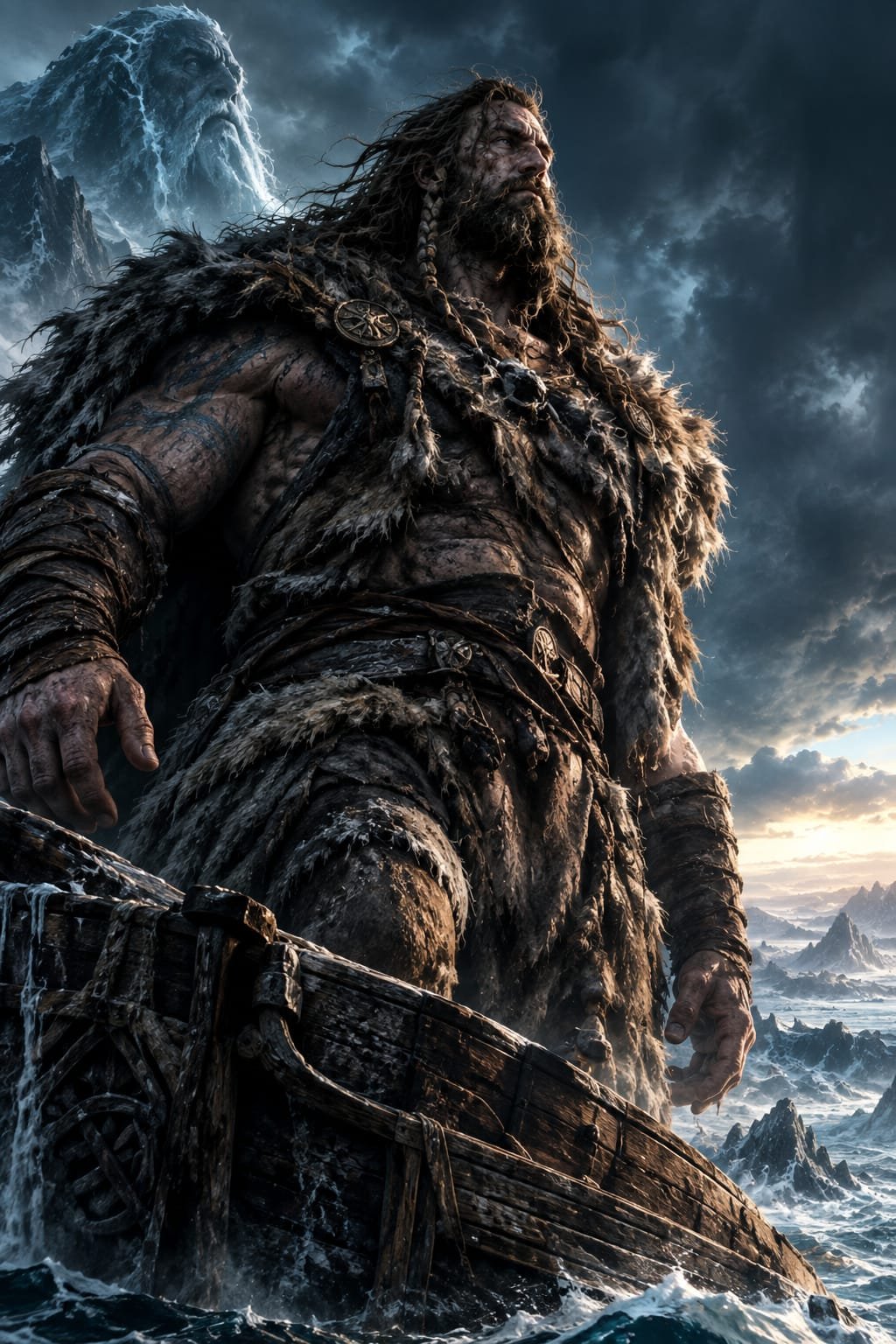
“What survives the drowning of a world does not merely inherit what comes after. It becomes the memory of what was lost.”
The words above are a mythopoetic reconstruction inspired by the surviving morse tradition surrounding bergelmir. They are not a surviving quotation from the poetic edda or prose edda, but are intended to capture the deeper symbolic weight of his story.
***NOTE***
Bergelmir is one of those figures in norse mythology whose importance is far greater than the amount of surviving material devoted to him. He does not possess a long cycle of adventures, does not appear repeatedly in the surviving poems, and is not given the elaborate personality of odin, thor, loki, or freyr. Yet in the brief account preserved in the eddic tradition, bergelmir occupies a position of extraordinary significance. He is the survivor of the first great catastrophe, the descendant of Ymir, and the ancestor of those who continue the existence of the frost giants after the primordial world is drowned.
The surviving sources tell us that bergelmir was the son of Þrúðgelmir and the grandson of ymir, also called aurgelmir in some traditions. When idin and his brothers killed Ymir, his blood flooded the primordial world and drowned almost all of the frost giants. Bergelmir and his wife escaped in a lúðr, the exact nature of which is uncertain and has been variously understood as a vessel, chest, trough, or large wooden container. From this survival came a renewed generation of frost giants. Much beyond this is interpretation, reconstruction, and symbolic reading rather than explicit surviving canon. That distinction matters, because bergelmir becomes most fascinating precisely where the ancient sources grow silent.
Prologue - The World Before the World
Before asgard had walls, before midgard had paths, before humanity knew the warmth of fire or the names of the stars, there was a world still becoming itself. Ginnungagap stretched between opposing realms, while primordial forces gathered at its edges. From the meeting of fire and ice came the first living forms, and from those forms emerged ymir, the enormous ancestral being whose body would eventually become the material of creation itself.
Bergelmir belongs to this older world. He is not a creature of the ordered cosmos that the gods later inhabit. He comes from the generation before the familiar divine order, from a lineage that existed before the world had acquired its final shape. To understand him therefore requires stepping backwards, beyond the familiar stories of thor's hammer, odin's wisdom, and the halls of valhalla, into a mythological landscape where existence itself is still unstable.
The primordial world is not peaceful. It is immense, raw, and dangerous. Life emerges from forces that have not yet been disciplined into the structures later generations will recognise as civilisation, law, kinship, and cosmic order. The giants are not simply monsters living at the edge of a finished universe. They are remnants and representatives of something older than the gods themselves.
And bergelmir is born from that oldness.
Canonical Presence in the Eddas
Bergelmir's story is preserved in two principal bodies of surviving norse literature... the poetic edda and snorri sturluson's prose edda. His poetic appearance comes most importantly through vafþrúðnismál, one of the wisdom poems in which odin engages the giant vafþrúðnir in a contest of knowledge. The poem moves through questions concerning the origins of the cosmos, the generations of beings, the sun and moon, the gods, and the eventual destruction and renewal of the world. It is within this ancient conversation that bergelmir appears, not as an active hero, but as part of the remembered genealogy of primordial existence.
In the poem, vafþrúðnir identifies Þrúðgelmir as the son of aurgelmir and bergelmir as Þrúðgelmir's son. Elsewhere in the poem, bergelmir is associated with the generation that existed before the earth had been shaped and is remembered as the ancestor from whom later generations of frost giants descend. Snorri's gylfaginning gives a more developed version of the flood account, explaining that ymir's blood overwhelmed the frost giants when the primordial giant was killed and that bergelmir and his wife escaped within a lúðr. From them came the later race of frost giants.
These sources are close enough to establish a firm core to the story, but they are not identical retellings. Snorri was writing centuries after the poems and was attempting to organise and explain an older mythological tradition. This means bergelmir must be approached through layers of evidence rather than treated as though we possess a single complete ancient biography.
And this is where the story becomes particularly interesting. The less the sources tell us, the more important it becomes to distinguish between what the norse tradition actually preserves and what later imagination has supplied.
What the Sources Actually Give Us
The secure elements are remarkably simple. bergelmir is descended from ymir/aurgelmir through Þrúðgelmir. Ymir is killed by odin and his brothers. The blood released from ymir's body causes a catastrophic flood in which almost all of the frost giants perish. Bergelmir and his wife survive by escaping in a lúðr. Their survival allows the frost-giant lineage to continue.
Everything beyond this core should be treated carefully. We do not possess a description of bergelmir's appearance. We do not know his age. We do not know what his wife was called. We do not know what they said to each other during the flood. We do not know precisely what the lúðr looked like. We do not know where they eventually came ashore. We do not know what became of bergelmir personally in the later history of the cosmos.
Those gaps are not weaknesses in the story.
They are invitations to research
Ymir or Aurgelmir?
One of the first difficulties encountered by anyone researching bergelmir is the appearance of different names for the primordial giant at the beginning of his family line. Readers will encounter ymir, but in vafþrúðnismál the name aurgelmir also appears. At first glance this can look like evidence for two different primordial giants, but the surviving tradition connects the names closely.
Ymir is the name most familiar from accounts of borse creation. He is the primordial being whose death allows odin and his brothers to shape the ordered cosmos from his remains. Aurgelmir appears in the giant's genealogy and in discussions of the earliest beings. The relationship between the names is part of a larger linguistic and mythological complexity surrounding the earliest strata of Norse tradition.
For someone beginning their research, this is an important warning...Norse mythology does not always arrive in a single consistent version. Names, genealogies and descriptions can vary between poems, manuscripts, translations and later retellings.
Rather than seeing this as a problem that needs to be eliminated, it is better understood as evidence of a living oral and literary tradition.
Bergelmir therefore sits inside a mythology that was already ancient and fluid before it was written down.
The Origin That Begins With Death
Bergelmir's story begins indirectly with ymir. He is not introduced through a personal adventure but through genealogy, and genealogy in norse mythology is rarely a meaningless detail. To know who someone descends from is to know something about the age and nature of the forces they represent.
Ymir who we have covered in a previous post is the primordial giant from whose body the ordered world is fashioned. His blood becomes the sea, his flesh becomes the earth, his bones become mountains, and his skull becomes the sky. The cosmos itself is therefore constructed from the corpse of a primordial being. Creation and death are not opposites in this mythology. Creation requires destruction.
Bergelmir inherits this contradiction.
He descends from the being whose death makes the world possible, but that same death nearly destroys his own people. The world of the gods is born from the destruction of his ancestry. The new cosmos therefore carries within it an ancient debt. The gods create order, but that order is established upon the remains of something older. Bergelmir survives that transition.
The Death of Ymir
The killing of ymir is one of the most important moments in norse cosmology because it represents the transformation from primordial existence into structured existence. Odin and his brothers vili and Vé kill the ancient giant, and the consequence is not simply the death of one being. Ymir's death unleashes the blood contained within him on a cosmic scale.
The primordial giant is therefore not merely slain. He is opened. His blood becomes catastrophe.
For bergelmir's people, the murder of ymir is the end of an age. The gods' act creates the conditions for the world they will inhabit, but for the giants it is an act of annihilation. This difference in perspective is essential. Norse mythology does not always present the creation of the cosmos as universally beneficial. What is creation from one perspective may be genocide from another.
The gods inherit a world made possible through ymir's death. The giants inherit the memory of what that death cost. And bergelmir becomes one of the few capable of carrying that memory forward.
Þrúðgelmir: The Forgotten Father
Between ymir and bergelmir stands Þrúðgelmir, a figure who is easy to overlook because so little survives about him. His importance is primarily genealogical - the Eddic tradition identifies him as the son of Aurgelmir and the father of bergelmir.
And that makes his silence fascinating.
Þrúðgelmir belongs to the generation between creation and catastrophe. He is close enough to Ymir to belong to the primordial lineage, yet his own story has largely disappeared. We do not have a cycle of adventures associated with him. We do not know how he lived, where he dwelled, or how he responded to the death of his father.
His existence is preserved because bergelmir exists. This creates a recurring phenomenon in mythology... some figures survive in the historical record not because stories were told about them, but because another figure's genealogy required their name.
Þrúðgelmir is therefore a reminder of how much of norse mythology has probably been lost. For every god or giant whose story survives, there may have been others whose names once carried entire traditions that are now gone.
The First Flood
The flood that follows ymir's death is among the earliest examples of cosmic destruction in norse mythology. It is not rain, storm, or ordinary water. It is the blood of the primordial ancestor himself. That distinction gives the flood a strange intimacy. The giants are not drowned by something foreign to their existence. They are drowned by their own ancestry.
The blood of ymir becomes both the substance from which the world is transformed and the force that destroys almost all of his descendants. Creation therefore becomes inseparable from catastrophe. The same primordial substance produces the ordered cosmos and the extinction of an ancient generation. The flood is not merely water. The flood is ancestry made liquid.
For bergelmir, this means survival is not an escape from history. It is an immersion in history. He survives precisely because he carries a fragment of the world that has been destroyed.
The First Flood in Norse Mythology
The flood surrounding bergelmir should not be confused with a conventional flood caused by rain or a natural disaster. It is a direct consequence of ymir's death. When the primordial giant is killed, his blood pours forth in such quantities that it overwhelms the world and drowns almost all of the frost giants.
This makes the norse flood radically different from many later interpretations of flood mythology. There is no storm sent from above. The catastrophe comes from below and from within. Ymir himself becomes the source of the waters.
This creates an extraordinary mythological inversion. The primordial ancestor is simultaneously the substance of creation and the source of destruction. His flesh will become earth. His bones will become mountains. His blood becomes the sea and, in the process of his death, destroys almost all of his own descendants.
Creation is therefore born through an act that is simultaneously catastrophic. The world exists because ymir dies. The giants nearly cease to exist because ymir dies. The same event is therefore creation from one perspective and annihilation from another.
This duality is essential to understanding bergelmir.
The Vessel
Bergelmir and his wife escape inside a lúðr. The precise meaning of the word remains uncertain, and translations have differed considerably. It may have referred to some kind of wooden vessel, chest, trough, or container. The ancient source does not give us the detailed construction, dimensions, or appearance of this object.
Yet the ambiguity itself is fascinating.
The vessel exists at the boundary between certainty and imagination. We know bergelmir survived inside it. We do not know exactly what it looked like. We know it carried him through the flood. We do not know how long the journey lasted. We know his wife survived beside him. We do not know her name. The ancient story leaves the vessel almost empty of detail. And that emptiness like most of norse mythology invites interpretation.
What Exactly Was the Lúðr?
The lúðr is one of the most intriguing mysteries in bergelmir's story. Translations vary because the old norse word does not provide modern readers with an unambiguous picture of an ark in the familiar sense. Depending upon the translation and interpretation, the object has been understood through terms such as a vessel, chest, trough, or large wooden container. The surviving account gives us its function more clearly than its physical form: it allowed Bergelmir and his wife to survive the flood.
This distinction is very important.
Modern retellings can easily transform bergelmir's lúðr into a fully developed ark complete with a deck, walls, provisions and a carefully constructed nautical design. None of those details are securely supplied by the surviving sources.
We simply do not know. Perhaps it was boat like. Maybe it was a large wooden container.
Possibly the ancient audience immediately understood the word in a way that modern readers can no longer recover. The uncertainty creates an excellent avenue for further research because it forces us to confront the difference between ancient evidence and modern visual imagination.
Bergelmir unquestionably survives through the object. Exactly what that object was remains one of the unanswered questions.
Bergelmir and the Great Flood Traditions
Bergelmir's survival naturally invites comparison with other flood survivors from world mythology.
Examples include:
Noah preserves life through the flood in the hebrew bible. Utnapishtim survives the great Mesopotamian flood in the epic of gilgamesh. Deucalion and pyrrha survive the destruction of humanity in greek tradition. Manu survives a catastrophic flood in Indian tradition. The similarities are striking enough to be fascinating. There is catastrophe.
There is a surviving remnant. There is some form of protection from overwhelming waters. And there is continuation after destruction.
But similarity should not automatically be treated as proof that all of these stories descend from one historical source. Flood mythology may develop through cultural transmission in some cases, independent development in others, or a mixture of inherited and locally transformed traditions.
What matters most is the recurring human question beneath the stories:
When the world ends, what deserves to survive? Different cultures answer differently.
Humanity. Animals. Sacred knowledge. A family. A lineage. In bergelmir's case, the answer is particularly narrow and particularly powerful. The thing that survives is the giant lineage itself.
He is not the saviour of every living creature.
He is the survivor of one ancient people.
The Silence Inside the Vessel
Imagine the interior of the lúðr not as mythology often portrays heroic journeys, but as a place of silence. The surviving sources do not describe bergelmir speaking, fighting, praying, or witnessing the flood in detail. We are given no speeches. No heroic declarations. No divine rescue. Only survival.
The world outside is being transformed by overwhelming violence, while inside the vessel there is almost nothing to do but endure. This makes bergelmir's story strangely different from the heroic traditions that dominate much of norse mythology.
There is no glory in waiting for the waters to recede.
There is only the refusal to disappear.
maybe that is precisely why the story has such power. Mythology frequently celebrates those who act. Bergelmir infact represents those who remain.
The First Survivor
Bergelmir can be understood as one of the first great survivors in the norse mythological imagination. He is not the strongest giant, nor the wisest, nor the most dangerous. His defining achievement is endurance. Survival itself becomes his myth.
That may seem simple, but in a mythology obsessed with inevitable destruction, survival carries enormous symbolic weight. The gods know that ragnarök will eventually come. Even the strongest structures of the cosmos are temporary. Against that background, bergelmir represents a different kind of strength - the ability of life to continue after catastrophe.
He does not conquer the flood. He outlasts it. And sometimes outlasting the end of the world is a greater mythological achievement than defeating a monster.
The Grandson of Ymir
Bergelmir's position as ymir's grandson gives him a special relationship with the primordial past. He is far enough removed to survive the immediate generation of catastrophe, yet close enough to retain direct ancestral connection with the being from whom the cosmos itself is fashioned. He stands between worlds.
Behind him is ymir and the primordial giant age. Before him lies the continuing race of frost giants, living within the cosmos created by the gods. This if you think about it makes bergelmir a genealogical bridge.
He is not simply the survivor of a flood. He is the surviving connection between two eras of existence.
The Three Generations
Bergelmir becomes much easier to understand when his ancestry is placed into its simplest form:
Ymir / Aurgelmir
↓
Þrúðgelmir
↓
Bergelmir
↓
The later generations of frost giants
This genealogy may appear straightforward, but it gives bergelmir a remarkable position. He is neither the primordial beginning nor merely a distant descendant. He occupies the middle generation through which the old world passes into the new.
Ymir represents the primordial source. Þrúðgelmir represents the generation immediately following him. Bergelmir then becomes the surviving bridge into the generations that follow the great flood.
Genealogy in norse mythology frequently carries more than biological information. Ancestry establishes proximity to primordial forces. The further a being is removed from the beginning, the more complicated the relationship becomes between ancient origins and later existence.
Bergelmir stands unusually close to the beginning. He is only two generations removed from ymir. That means the later giants are not simply descendants of some vague legendary ancestor. Their lineage reaches directly back into the primordial world from which the cosmos itself was formed.
The Giant Who Carries the Past
Every survivor carries something invisible.
bergelmir carries ancestry. He carries the knowledge that the giants once existed in numbers so great that their extinction could be described as the drowning of an entire generation. He carries the memory of ymir's death, even if the sources never explicitly describe him remembering it. His very existence proves that the primordial world was not completely erased.
This is one of the deepest functions of mythological survivors. They prevent catastrophe from becoming absolute.
A destroyed people can disappear physically, but if one descendant remains, the story has not entirely ended. Bergelmir is that remaining thread.
The Giant Who Remembers Before the Earth
One of the most intriguing aspects of bergelmir appears not in snorri's flood narrative but within the poetic tradition surrounding vafþrúðnir. Bergelmir is connected with an extremely ancient generation, reaching back to a time before the earth had taken the familiar shape known to later beings.
This gives him an almost impossible chronological position. He belongs to a world before the world. The later cosmos has gods, humans, oceans, mountains and organised realms. Bergelmir's ancestry reaches back to the age before those boundaries were established. He therefore functions symbolically as a living connection to a reality that no longer exists.
This is why his survival carries such weight. The flood does not merely preserve a biological lineage. It preserves a connection to the primordial past. Bergelmir becomes a kind of mythological memory. Not necessarily because the surviving sources tell us that he consciously remembered every detail of the ancient world, but because his existence itself proves that the ancient world had not been completely erased.
The Naming of Bergelmir
The exact meaning of the name bergelmir is uncertain, and interpretations of its etymology should therefore be treated cautiously. Norse names can preserve fragments of old linguistic concepts, but a definitive translation is not securely established enough to build a complete character interpretation upon.
What matters more is the role attached to the name. Bergelmir is remembered because he survived.
His name becomes attached to a moment when the old world almost vanished. Even if its literal linguistic meaning remains uncertain, its mythological association is unmistakable - Bergelmir belongs to the generation that endured the first drowning.
The Wife of Bergelmir
One of the most striking details of the story is also one of the easiest to overlook... Bergelmir does not survive alone. His wife survives with him. The sources do not give her a name, personality, genealogy, or individual story. She exists within the surviving account primarily as bergelmir's companion and as one of the two human like presences carried through the flood.
Yet without her, the continuation of the giant race would be impossible in the form the tradition presents it. She is therefore essential to the myth even though the surviving texts leave her almost entirely unnamed. Her anonymity reflects a broader pattern in ancient mythology, where women can become foundational to lineage while remaining frustratingly invisible as individuals. The silence around her should not be mistaken for insignificance. She survived the end of her world. That is significant enough.
Two Against the Flood
There is something profoundly human about the image of two beings surviving together while an entire world disappears around them. Bergelmir and his wife are not an army. They are not a community. They are not a pantheon. They are simply just two.
The catastrophe reduces existence to its smallest viable unit, and from that unit a future generation emerges. The story therefore transforms companionship into a form of continuity. The future of an entire people is contained within two survivors.
The old world collapses around them, but life remains possible because they remain together.
The Vessel as Cosmic Boundary
The lúðr can be interpreted as more than a physical container. Mythologically, it becomes a boundary between two states of existence. Outside lies the destruction of the old world. Inside lies the possibility of continuation.
This is a recurring structure in mythology: a small protected space exists within a vast destructive environment. The vessel becomes a miniature world, separated from the surrounding chaos by its boundaries.
Bergelmir therefore experiences a kind of temporary withdrawal from creation itself.
The world is being remade outside while he remains suspended between the old cosmos and the new. When he emerges, he is no longer simply living in the world of ymir.
He is living in the world that was made from ymir's death.
The Flood Does Not Ask Who Is Worthy
The flood does not distinguish between the powerful and the weak. It does not care about status. It does not recognise kingship, ancestry, courage, or pride. This is important within norse mythology because the gods themselves are not ultimately protected from destruction. The flood therefore becomes an early expression of a theme that will return at ragnarök...cosmic catastrophe does not negotiate.
Survival is not necessarily a reward for virtue. Bergelmir is not described as being saved because he was morally superior to the other giants. The story simply tells us that he survived.
This makes the myth uncomfortable, but also honest. Sometimes survival is not justice. Sometimes survival is simply what happened.
The Giants Remember
The survival of bergelmir means that the giants are not completely severed from their primordial ancestry. The old generation dies, but the bloodline continues.
This creates an important tension within norse mythology. The giants are frequently positioned against the gods, yet they are not alien intruders from some entirely separate reality. They are part of the same primordial family of existence.
The gods build the ordered cosmos.
The giants remember what came before it. Their conflict is therefore partly a conflict between order and ancestry, between the constructed present and the ancient forces that existed before construction began.
Bergelmir stands on the ancestral side of that divide.
The Gods Could Not Erase the Past
Odin and his brothers kill ymir, but they do not erase everything descended from him.
bergelmir survives. This is mythologically important because creation does not produce a clean break from the past. The old forces remain within the new cosmos. The giants continue to exist. The memory of ymir continues. The gods themselves remain connected to the primordial beings through complicated genealogies and relationships.
The past refuses to disappear completely.
The gods can kill ymir. They cannot kill ancestry.
The Blood of Ymir - Creation and Catastrophe
There is perhaps no stronger contradiction in the vergelmir myth than the role of ymir's blood. The gods need ymir's death to create the ordered cosmos. Yet ymir's death causes the destruction of nearly all the giants.
The same event therefore creates the world inhabited by the gods while almost destroying the ancestral population from which bergelmir descends.
This raises a fascinating interpretive possibility for us seekers...mythology does not always provide one universal perspective on creation. For the gods, the death of ymir establishes order. For the giants, it is a catastrophe. Neither perspective completely cancels the other. The world is genuinely created. The giants genuinely suffer. The cosmos genuinely becomes more ordered.
The primordial generation genuinely dies.
This is one of the reasons the norse creation story feels so physically brutal. Creation is not a clean emergence of beauty from nothing. It is transformation through violence. The world is made from what has been killed.
And bergelmir survives inside that contradiction.
The Shape of Giant Existence
Bergelmir's survival also helps explain something about the giants themselves. They are not merely a race of antagonists waiting to fight the gods. They represent something older, wilder, and less easily contained. Their existence persists despite cosmic ordering. They inhabit the edges, wildernesses, mountains, ice, and distant places beyond the centre of divine civilisation. They remain reminders that the world is never entirely domesticated.
Bergelmir is therefore an ancestor of a force the gods cannot completely remove.
The old world survives at the margins of the new.
The Survivor Becomes the Ancestor
This is perhaps the most important transformation in bergelmir's story.
Before the flood, he is simply a descendant of ymir. After the flood, he becomes an ancestor. The catastrophe changes his mythological status. He is no longer merely someone who belongs to a lineage. He becomes one of the reasons that lineage continues. Survival transforms him into origin.
That is one of the great paradoxes of mythology: sometimes the person who merely manages to survive becomes more important to future generations than those who possessed greater power before the catastrophe.
Survival Is Not Restoration
One of the easiest mistakes to make when interpreting bergelmir is to imagine that his survival somehow restores the world that existed before the flood. It does not. Ymir does not return. The drowned giants do not return. The primordial world is not reconstructed. The new cosmos remains. Bergelmir does not reverse the catastrophe. He carries a fragment of what came before into what comes after.
This distinction is important because survival is often mistaken for restoration. But survivors cannot always rebuild the world they lost. Sometimes all they can do is preserve enough of themselves that something can continue. Bergelmir therefore represents continuity rather than restoration.
The past cannot be recovered. But it does not have to vanish completely.
Comparative Mythology - Survivors Who Carry Tomorrow
Across cultures, flood and destruction myths frequently preserve the idea that the future must be carried through the death of the past. The vessel, seed, family, chosen remnant, or surviving pair becomes a container for tomorrow. Bergelmir fits this broad pattern without needing to be identical to any other flood survivor.
The differences matter. In the norse account, the flood is specifically associated with ymir's blood, and the survivors preserve the giant lineage rather than humanity as a whole. The myth is therefore deeply connected to the norse conception of cosmic genealogy.
Bergelmir is not saving the entire universe.
He is preserving one branch of existence.
And sometimes preserving one branch is enough.
Bergelmir, Noah, Deucalion, Manu and Utnapishtim
Comparing bergelmir with other flood survivors reveals both similarities and important differences. Lets revist the above once more
Bergelmir preserves the frost giant lineage.
Noah preserves his family and living creatures according to the biblical narrative.
Utnapishtim survives the mesopotamian flood and becomes a figure associated with exceptional longevity.
Deucalion and pyrrha survive the greek flood and become the means through which humanity is renewed.
Manu survives the great flood in Indian tradition and participates in the continuation of life.
The similarities create an intriguing comparative field, but the differences are equally important. These traditions emerge from different religious systems, different cultures and different ideas about why catastrophe occurs.
The norse story is especially distinctive because its flood is bound directly to the killing of a primordial giant. It is not primarily a moral judgement upon humanity. It is a consequence of cosmic transformation.
That makes bergelmir less a figure of divine selection and more a figure of ancestral endurance.
He survives because the ancient giant race does not completely disappear.
The Difference Between Survival and Salvation
Bergelmir is saved from destruction, but the story never presents his survival as salvation in a moral or religious sense. There is no promise that he has been chosen because he is righteous. No divine covenant follows.
No sacred mission is announced. He survives because he escapes the flood.
This distinction makes his story unusually stark. Survival does not mean that the survivor has been granted a special destiny by a benevolent universe. It means that the survivor remains. The meaning comes later.
The Psychology of the Survivor
Although the sources give us no psychological description of bergelmir, the archetype of the survivor naturally invites reflection on what remains inside someone after catastrophe. A survivor remembers what the world looked like before. They carry comparisons that those born afterward cannot possess.
The younger generation knows the world that exists. The survivor knows the world that disappeared. Bergelmir therefore symbolically occupies the psychological space between memory and continuation. He belongs to the past, but his existence makes the future possible.
Historical Memory, Ancestral Memory and Myth
It is tempting to describe bergelmir as though he personally carried a complete memory of the primordial world, but the surviving sources do not give us enough information to make such a claim literally.
What we can say is that the myth gives him a function resembling memory. His genealogy reaches backward. His survival reaches forward. He becomes the connection between the two. This allows us to separate psychological interpretation from ancient evidence. The norse sources do not provide a psychological essay about trauma, memory or survivor's guilt. Those are modern interpretive frameworks. Yet they can still help us understand why the image of the survivor is so powerful.
A survivor represents something that the dead cannot represent...continuity.
Through bergelmir, the primordial world remains present in the mythology even though the people who inhabited it have disappeared.
The memory is no longer merely something he possesses. His survival is the memory.
The Inheritance of Loss
The giant generations that descend from bergelmir inherit more than blood.
They inherit a world shaped by catastrophe.
They are born into a cosmos where their ancestors have already been defeated, where the gods have established their order, and where the memory of primordial existence survives only through fragments. This gives giant existence a particular emotional atmosphere.
They are the children of a world that lost.
Their hostility toward the gods can therefore be read, at least symbolically, as more than simple wickedness. It may represent the persistence of an older order refusing to accept complete replacement.
The World Made From a Corpse
The deepest irony of bergelmir's existence is that he survives into a world literally constructed from his grandfather's body.
The earth beneath his descendants is ymir.
The sea surrounding them is ymir. The mountains are ymir. The sky above them is ymir. They live inside the corpse of their own ancestor.
This makes the norse creation myth profoundly visceral. The universe is not born from nothing. It is built from remains.
Bergelmir inhabits a world that is simultaneously new and ancient.
Bergelmir and the Meaning of Creation
Creation in norse mythology is not innocent.
The world is beautiful, structured, and inhabited, but its foundations are violent. The gods establish order through the destruction of primordial existence.
Bergelmir reminds us that every new world may have a shadow. For the gods, ymir's death is creation. For bergelmir's people, it is catastrophe. Both can be true.
That is one of the great strengths of norse mythology....it rarely forces the universe into a simple division between good creation and evil destruction. Instead, creation and destruction are bound together.
Mythic Ecosystem - The Old Against the New
The gods and giants can be understood as different expressions of cosmic forces rather than simple heroes and villains. The gods establish boundaries. The giants resist them. The gods create structures. The giants embody what existed before those structures. The gods represent the ordered present. The giants preserve the memory of the primordial past.
Bergelmir's survival therefore becomes an important part of this mythic ecosystem. He ensures that the old forces remain present inside the new world. The past has not been defeated completely. It has been relocated.
The Flood as the First Wound
The flood can be understood as one of the first great wounds in the mythic history of the cosmos. Before the familiar cycles of war, betrayal, and ragnarök, there is already a catastrophic rupture. An ancestral generation is lost. A new world emerges. The survivors carry the wound forward.
This creates a fascinating parallel with the later norse understanding of ragnarök. The final destruction is not the first time existence has been shattered. Bergelmir's story suggests that the cosmos has always contained cycles of death, survival, and renewal.
Ragnarök is not an isolated catastrophe.
It belongs to a pattern.
What Must Be Carried Forward
Bergelmir's survival raises a simple question... what exactly must a survivor preserve? The answer is not necessarily buildings, possessions, weapons, or territory.
Sometimes it is simply memory. Sometimes it is lineage. Sometimes it is the knowledge that something existed before the current world. Bergelmir carries the possibility that the giants can continue. That alone is enough.
The future does not require the past to remain physically unchanged. It requires something from the past to survive.
A Traveler After the Flood
It i almost ghostlike about imagining bergelmir emerging into the aftermath.
The sources do not tell us what he saw.
We do not know what the landscape looked like. We do not know what he felt. We do not know whether he mourned the dead or spoke of ymir.
But symbolically, he stands in the position of the traveler who has entered a world that no longer resembles the one he knew.
The landscape has changed. The old generation is gone. The gods have built their world. And he remains. The survivor is always a stranger in the future.
The Vessel Within Us
The lúðr can also be interpreted symbolically as an image of the internal refuge. Human beings cannot always prevent catastrophe.
They cannot control every storm, war, loss, betrayal, or ending. But mythology repeatedly imagines some inner vessel that allows continuity.
For bergelmir, the vessel is literal. For us, the vessel may be memory, identity, family, tradition, or simply the decision to continue.
The world can change outside. Something within can remain.
The Silence After Catastrophe
Myths often times rush toward the next event. Bergelmir's story does not. There is a strange silence after the flood. The old giants are gone. The new world exists. Bergelmir survives. And then the story moves on.
That silence may be one of the most powerful aspects of the tale. Catastrophe is rarely finished when the destruction stops. There is always an aftermath in which survivors must exist inside what remains.
Bergelmir represents that aftermath.
The Old World Beneath the New
The gods may establish midgard, asgard, and the ordered cosmos, but the primordial world remains underneath it all. Ymir's body forms the physical foundation. The giants continue.
The old forces remain at the edges.
Nothing has truly been erased. The new world is therefore not a replacement for the old. It is built upon it. Bergelmir is the living proof of that buried continuity.
What Did Bergelmir Actually Remember?
This may be the most tantalising unanswered question in the entire story.
The ancient tradition places bergelmir extremely close to the earliest generations of existence, but it never gives us a personal account of his memories.
Did he remember ymir?
Did he remember the world before the gods shaped the earth?
Did he know what existed before the flood?
Did he remember the moment ymir died?
The sources do not tell us. And because they do not tell us, we should resist the temptation to invent an answer and present it as fact.
Instead, the questions themselves become part of the mythology.
Bergelmir is important partly because he represents knowledge that has been lost.
He is the ancestor who stands closest to the beginning, while the later generations can only hear fragments of what came before.
In this sense, Bergelmir represents the edge of memory.
Beyond him lies the primordial darkness.
Ragnarök and the Question of Survival
It is tempting to connect bergelmir directly with ragnarök, but the surviving sources do not state that he personally survives the final destruction.
What can be said is more interesting.
His story establishes that survival after cosmic catastrophe is possible within norse mythology. The first world ending flood does not destroy every descendant of the primordial giants.
This creates a precedent. The cosmos can be shattered and still produce continuation.
That idea becomes particularly meaningful when considered beside ragnarök, where destruction is followed by renewal. Norse mythology does not necessarily imagine existence as a straight line from beginning to end.
It imagines cycles. Worlds fall. Something remains.
The Giant Who Stood Between Worlds
Bergelmir is a figure of thresholds.
He belongs to the old world, yet survives into the new. He descends from ymir, yet becomes ancestor to later giants.
He is caught between destruction and continuation. Between memory and future.
Between the primordial age and the ordered cosmos. This is what gives his otherwise tiny myth such weight.
He stands between worlds because he is the evidence that worlds can change without completely severing their ancestry.
The Memory of the Flood
Perhaps bergelmir's greatest mythological function is memory. Without him, the first generation of giants could vanish almost completely into the past. With him, the story continues.
The flood becomes something that happened rather than something that erased everything that happened before it.
Memory is therefore a form of survival.
A world can disappear physically while remaining alive through the people who remember it.
The Shape of Their Survival
Bergelmir and his wife do not preserve the old world unchanged. They cannot. The old world is gone. Instead, they preserve the possibility of a future. This distinction matters. Survival is not restoration. The survivor does not bring the past back.
The survivor carries enough of the past forward that something new can emerge from it. That is precisely what bergelmir represents.
Why Bergelmir Matters
Bergelmir matters because his story reveals something about norse mythology that can easily disappear beneath the better known tales of gods and heroes. The mythology is not only concerned with warriors. It is also concerned with what remains after warriors have fought. It is not only about victories. It is about survival. It is not only about creation. It is about what creation destroys. Bergelmir exists in that uncomfortable space.
He is the reminder that the world of the gods has a history, and that history contains victims. His story also reminds us that the giants cannot be understood simply as enemies who appeared after the gods had already created the universe. They belong to the deepest foundations of the cosmos. They are woven into its ancestry. Bergelmir is therefore not an insignificant footnote.
He is evidence. Evidence that the primordial world existed. Evidence that ymir had descendants. Evidence that the flood did not destroy everything. Evidence that the old world continued inside the new. And most importantly, evidence that destruction does not always achieve complete erasure.
Something can remain.
A name. A bloodline. A memory. A story.
Bergelmir. The survivor. The ancestor. The remnant of a drowned age.
And through the simple fact that his name survived, the world before the world still speaks.
A Bergelmir Research Guide
For readers who want to travel deeper into the subject, Bbergelmir provides several paths into Norse mythology.
Begin with vafþrúðnismál, particularly the passages dealing with ymir/aurgelmir, Þrúðgelmir and bergelmir. This poem provides some of the oldest surviving poetic evidence connected with his genealogy and the primordial generations.
Then turn to snorri sturluson's gylfaginning, where the death of ymir, the flood of blood and bergelmir's escape with his wife are presented within a broader explanation of norse cosmology.
From there, investigate the meaning and history of the old norse word lúðr. This is one of the most rewarding linguistic rabbit holes connected with bergelmir because translations do not provide a completely uniform picture of the object that saved him.
Next, research ymir and aurgelmir, followed by Þrúðgelmir, and then the broader concept of the jötnar. This reveals that the giants of Norse mythology are not simply a single species of monster but a complex group of beings connected to the primordial structure of the cosmos.
Then explore norse creation mythology, particularly the relationship between ymir's death and the formation of the world. The more closely this is studied, the clearer it becomes that creation and destruction are inseparable in the norse worldview.
Finally, compare Bergelmir with the great flood survivors of other traditions...Noah, utnapishtim, deucalion and pyrrha, and manu. The goal should not be to prove that every flood myth has the same origin, but to investigate why the image of a surviving remnant appears so powerfully across human cultures.
The deeper one researches bergelmir i have found, the less he becomes a minor giant mentioned in passing. He becomes a doorway. Through him lies more on ymir. Through ymir lies the creation of the cosmos.
Through the flood lies the survival of the giants.
And through the giants lies one of the oldest and most complicated relationships in Norse mythology - the relationship between the forces that built the world and the forces that existed before it.
Questions for Further Research
Bergelmir leaves behind more questions than answers, and that is part of his appeal.
What precisely did the ancient norse audience understand by lúðr?
How old is the flood tradition surrounding bergelmir?
Were there versions of his story that have not survived?
How did different communities understand the relationship between ymir and aurgelmir?
What stories once existed around Þrúðgelmir?
Why was bergelmir remembered when so many other primordial beings disappeared from the surviving record?
Did the story once contain more information about bergelmir's wife?
How did the tradition of the surviving frost giants change over time?
And the largest question of all:
What did the norse storytellers themselves believe bergelmir represented?
We may never know.
But that uncertainty is not a reason to stop researching. It is the reason to keep looking...why we here at wyrd & flame keep researchin.
The Survivor Becomes the Story
Bergelmir's greatest achievement is not an act of conquest. It is existence. He survives long enough for his descendants to continue. That is all the ancient sources require of him. But mythology has a way of making such simple acts enormous.
The survivor becomes the ancestor. The ancestor becomes the memory. The memory becomes the story. And the story ensures that the drowned world is never entirely forgotten. Bergelmir. Not the giant who defeated the flood. The giant who outlasted it.
Final Reflection - What Remains When Everything Is Taken
The story of bergelmir asks a question that reaches far beyond norse mythology.
What remains when almost everything is taken away? The answer is not necessarily strength. Not wealth. Not power. Not victory. Sometimes what remains is simply the capacity to continue. Bergelmir loses his world. He loses his generation. He loses the primordial landscape of his ancestors.
But he does not lose existence itself.
He carries the possibility of continuation through the darkness. That is why his story feels strangely modern despite its immense age. Every generation inherits a world shaped by events it did not choose. Every generation stands upon the remains of what came before. Every survivor carries fragments of a world that younger people may never know.
Bergelmir embodies that burden. He is the one who remembers by existing.
Invocation of Survival
May we remember bergelmir not as a figure of conquest, but as a figure of endurance.
May his story remind us that survival does not always look heroic. Sometimes survival is quiet. Sometimes it is frightened. Sometimes it happens inside a small vessel while everything familiar disappears outside.
Sometimes survival is simply refusing to vanish.
And when the flood has passed, when the waters have fallen and the old world lies beneath the new, may there still be something within us worth carrying forward.
A memory. A name. A story. A spark.
Closing
Bergelmir is one of the quieter figures of norse mythology, but quiet does not mean insignificant. His story is brief because the ancient sources do not need to tell us everything. A primordial world dies. A flood rises. Almost an entire people disappears. Two survivors escape. A lineage continues.
That is enough. Because mythology is often at its most powerful when it leaves space for the imagination to stand beside the ancient words.
We do not know what bergelmir saw. We do not know what he felt. We do not know what words passed between him and his unnamed wife while the blood of ymir drowned the world outside. But we know that when the flood was finished, they were still there.
And sometimes that is the entire story.
The world ended. They remained.
Bergelmir ...the survivor of the first drowning, grandson of Ymir, keeper of a lineage that refused to disappear.
May the old stories remind us that endings are rarely as complete as they appear.
May the ancestors beneath our feet be remembered.
May the memories carried through the darkest waters never be lost.
And when our own worlds change beyond recognition, may we find the strength to enter the vessel, endure the flood, and carry something worthy into whatever world comes next.
For the old world may drown. The new world may rise. But somewhere between them, something always survives. And what survives becomes the story.
