
Vetrnætr: When Winter Came to the Norse World
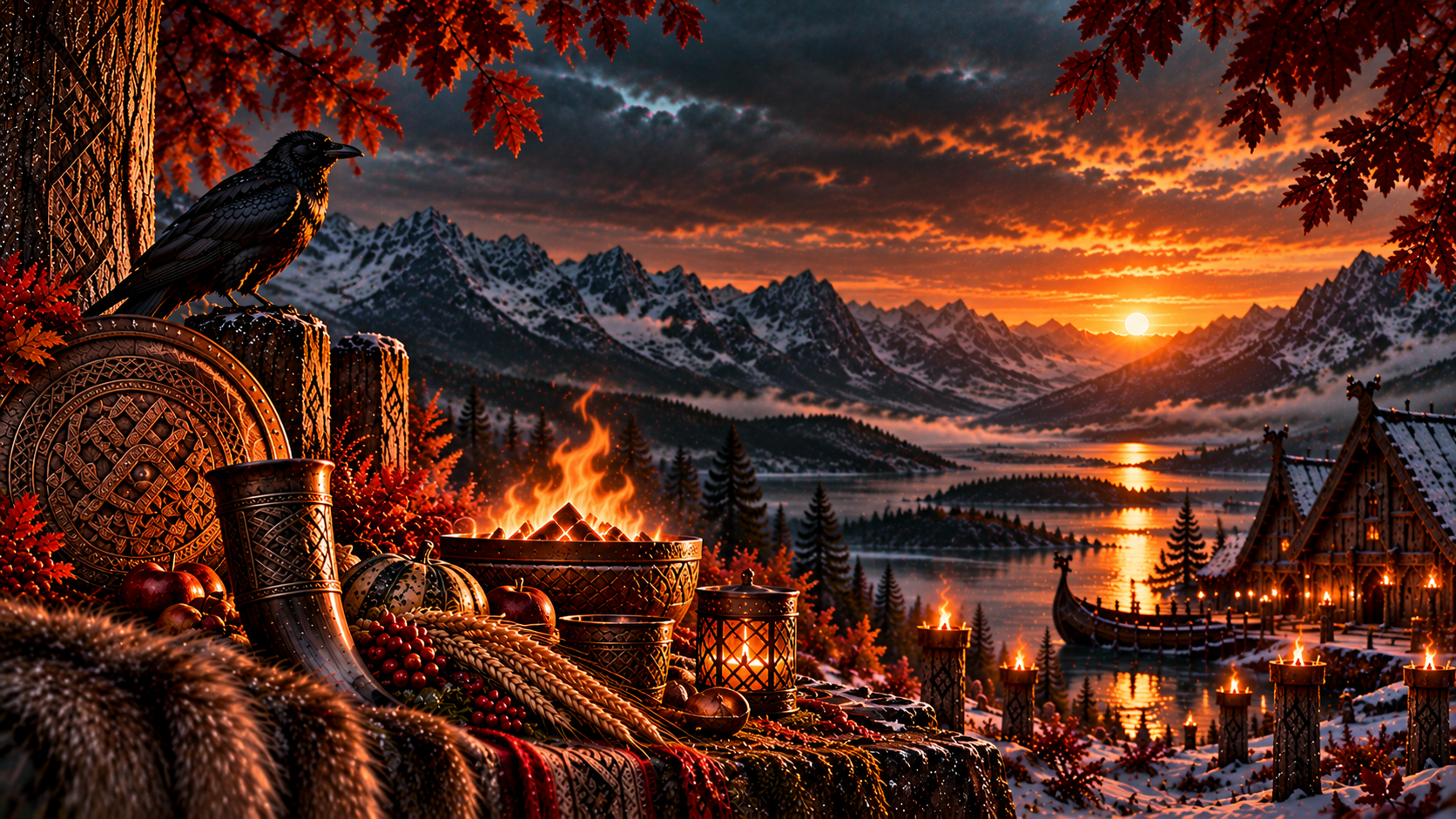
There is a moment in the turning of the year when the world seems to change its character. The fields have surrendered their harvest, the last warmth of summer has faded from the earth, and the trees begin to stand bare beneath a sky that darkens earlier with every passing day. What was once a season of growth becomes a season of preservation. The work that occupied the warmer months must now sustain the household through the cold, and the uncertainty of what lies ahead becomes impossible to ignore. For the people of the pre-Christian Norse world, this transition was far more than a change in the weather. It marked the beginning of another half of the year, a threshold between the productive months and the long demands of winter. In the Old Norse language, this turning point was known as Vetrnætr, the Winter Nights.
To understand Vetrnætr, we must first move away from the modern habit of dividing the year into four equal seasons beginning at the equinoxes and solstices. The traditional Icelandic calendar, which preserves important elements of earlier northern European timekeeping, organised the year into two principal halves: summer and winter. These divisions were not simply descriptions of temperature. They formed part of the structure through which time, agricultural work, social gatherings and seasonal obligations were understood. The summer half began in April, while the winter half commenced in October, long before the astronomical winter solstice in December. This distinction is particularly important because many modern Pagan calendars place great emphasis upon the equinoxes and solstices, sometimes assuming that the same astronomical framework governed all pre-Christian European religious observances. The surviving Old Norse evidence presents a more complicated picture.
The name Vetrnætr itself offers our first clue. It combines vetr, meaning winter, with nætr, the plural of nótt, meaning night. The literal translation is therefore Winter Nights, a term that appears repeatedly within medieval Icelandic literature as a recognisable point in the year. The nineteenth-century Icelandic-English Dictionary of Richard Cleasby and Guðbrandur Vigfússon records the expression as referring to the three days beginning the winter season and preserves related terminology concerning gatherings and religious observances associated with the period. The dictionary is a later scholarly compilation rather than an independent Viking-Age source, but its value lies in bringing together the linguistic evidence preserved in older texts. The term was not invented by modern Heathens seeking an ancient name for an autumn celebration. It belongs to the historical language and calendar of the Old Norse world.
Within the traditional Icelandic calendar, the winter half began with the month of Gormánuður. Its opening fell on a Saturday in late October, corresponding to a date between 21 and 27 October in the modern Gregorian calendar. In 2026, the First Day of Winter falls on Saturday 24 October, providing a useful reference for those wishing to reconstruct a modern observance of Vetrnætr. A three-day celebration from 24 to 26 October is therefore a reasonable contemporary arrangement. Yet we must be cautious about treating this calculation as evidence that every community throughout Viking-Age Scandinavia celebrated precisely the same festival on exactly the same date. The Icelandic calendar is an important historical witness, but the wider Norse world extended across regions with different climates, agricultural conditions and local traditions. Religious observances were not necessarily standardised from one settlement to another, and the surviving sources do not provide us with a single calendar governing all pre-Christian Scandinavian communities.
The importance of the winter transition becomes clearer when we consider the realities of life in northern Europe before modern heating, transport and food distribution. The survival of a household depended upon the successful management of its resources. Grain had to be harvested and stored, livestock assessed, food preserved, buildings maintained and sufficient fuel gathered to endure the colder months. A poor harvest or an unexpected shortage could carry consequences far beyond temporary discomfort. Winter demanded preparation, and the resources accumulated during the warmer half of the year determined how successfully a household could withstand the season ahead. In such circumstances, the beginning of winter naturally possessed a significance that extended beyond the calendar. It was the point at which the work of the preceding months began to reveal whether it would be sufficient.
This practical background helps us understand why religious observances might become associated with the seasonal transition. In societies where prosperity was closely connected with the success of agriculture, livestock and household management, the desire for favourable conditions was inseparable from everyday life. Yet historical interpretation requires us to distinguish between what seems reasonable within that context and what the surviving sources actually demonstrate. We can explain why a community might seek prosperity at the beginning of winter without claiming that every household performed the same ceremony, addressed the same deity or understood the occasion in precisely the same way. The difference between historical context and direct attestation is essential if we wish to approach Vetrnætr as a subject of serious study rather than a collection of modern assumptions.
One of the most frequently cited passages concerning sacrifice at the coming of winter appears in Ynglinga saga, preserved within Snorri Sturluson's Heimskringla. In chapter eight, Snorri describes a pattern of seasonal sacrifices associated with the legendary religious arrangements attributed to Óðinn. The relevant passage reads: Þá skyldi blóta í móti vetri til árs en að miðjum vetri blóta til gróðrar, hið þriðja að sumri. Það var sigurblót. In English, the passage describes sacrifice at the coming of winter for a favourable year, sacrifice at midwinter for growth, and a third sacrifice during summer, identified as Sigrblót, or victory sacrifice. Although the wording is brief, it is among the most significant pieces of evidence for understanding the relationship between seasonal change and religious observance within the tradition presented by Snorri.
The phrase í móti vetri til árs deserves particular attention. The words í móti vetri concern the approach or arrival of winter, while til árs expresses the purpose of obtaining a favourable or prosperous year. The Old Norse noun ár possesses associations with a good year, fruitfulness and prosperity, particularly within agricultural and religious contexts. The sacrifice described by Snorri is therefore not merely an acknowledgement that winter has arrived. It is presented as an observance concerned with the conditions necessary for future wellbeing. The distinction between this winter-onset sacrifice and the midwinter sacrifice til gróðrar, for growth, is equally interesting, because it suggests that different points in the seasonal year could be associated with different desired outcomes.
Yet this passage is also an example of why historical reconstruction must be careful. Snorri does not explicitly use the name Vetrnætr for the sacrifice he describes. He refers to an observance at the coming of winter, but he does not provide a precise date, a complete ceremonial sequence or a universal list of offerings. The passage also occurs within a medieval narrative concerning the origins and customs of legendary rulers, written long after the conversion to Christianity. It cannot simply be treated as a contemporary record of religious practice throughout the Viking Age. What it provides is evidence that a tradition of sacrifice at the approach of winter was preserved within medieval Icelandic historical writing, and that this sacrifice was understood in relation to prosperity.
A more direct connection between Winter Nights and sacrificial observance appears in Gísla saga Súrssonar, one of the Icelandic family sagas. The narrative describes preparations for a gathering associated with the beginning of winter, involving Þorgrímr and a feast. Particularly important is the association with Freyr, whose place within Old Norse religion is strongly connected with prosperity, fertility, peace and favourable conditions. In one version of the saga, the preparations involve sacrifice to Freyr, while another textual tradition preserves the expression vetrnáttablót, identifying a Winter Nights sacrifice. This is a valuable connection because it brings together the seasonal terminology, religious activity and the wider social setting of a feast.
The reference to Freyr is especially interesting when placed beside the passage from Ynglinga saga. Although the two sources are not identical and should not be merged into a single account, both preserve themes involving prosperity and religious observance around the beginning of winter. Freyr's associations with fruitfulness and wellbeing provide a meaningful context for the sacrificial activity described in Gísla saga. However, the passage does not establish that Freyr was the exclusive deity of Vetrnætr, nor does it prove that every community across Scandinavia dedicated its Winter Nights ceremonies to him. The association is historically significant precisely because it is attested within a particular literary tradition, not because it can be extended without qualification to the entire Norse world.
The manuscript differences within Gísla saga also deserve consideration. Medieval literature survives through manuscripts copied and transmitted over generations, and individual versions of a saga do not always preserve identical wording. Details may differ because of scribal decisions, the incorporation of alternative traditions or the wider processes of textual transmission. When a religious detail appears in one version but is expressed differently in another, we should not ignore that variation. It becomes part of the evidence itself. The task of historical reconstruction is not simply to select whichever wording provides the most elaborate picture of pagan ritual, but to consider how the different versions relate to one another and what can reasonably be concluded from them.
The feast described in Gísla saga also reminds us that religious observance and social activity were not necessarily separate spheres. Feasting provided an opportunity for hospitality, the strengthening of relationships and the gathering of people within a shared space. In societies where kinship, alliances and reputation were central to social organisation, such gatherings carried considerable importance. The presence of sacrifice within a feast does not mean that every moment of the gathering was religious, just as the presence of drinking and hospitality does not mean that the occasion lacked sacred significance. The two could coexist, and the surviving literature often presents them within the same narrative environment.
Another valuable reference appears in Laxdæla saga, particularly chapter forty-six, where the narrative describes arrangements for autumn feasting. Óláfr prepares a feast approximately half a month before winter, while Ósvífr arranges another gathering specifically for Winter Nights. The men invite one another and their companions, placing the seasonal transition within the ordinary organisation of social relationships. This passage may appear less dramatic than a description of sacrifice, but it provides an important form of evidence. It demonstrates that Winter Nights was a recognised calendrical occasion around which gatherings could be planned, and that the term was sufficiently familiar to function without elaborate explanation.
The distinction between the earlier autumn feast and the gathering at Winter Nights is particularly revealing. Modern reconstructions sometimes use the terms Haustblót and Vetrnætr as though they must refer to precisely the same celebration, while other modern calendars assign them completely separate dates and ceremonial functions. The surviving evidence does not justify either assumption as a universal rule. Laxdæla saga demonstrates that an autumn feast could take place before Winter Nights, but it does not establish a comprehensive religious calendar explaining the relationship between every autumnal feast and sacrifice. The broader season could contain several gatherings, and the specific importance of Winter Nights should not cause us to erase the variety of activities that occurred around it.
References within Eyrbyggja saga further demonstrate the importance of the Winter Nights period as a chronological and social marker. The saga situates gatherings and other events within the seasonal transition, reinforcing the impression that the beginning of winter was a familiar point in the calendar. Such references are valuable precisely because they do not always describe religious ceremonies. They show how the term functioned within the wider world of medieval Icelandic storytelling, where seasonal dates could help organise narratives involving hospitality, conflict, travel and communal life. Not every mention of Vetrnætr should therefore be treated as evidence for a sacred festival, but the repeated appearance of the term demonstrates that the seasonal threshold was culturally recognisable.
One of the most intriguing religious connections associated with the Winter Nights period concerns Dísablót, sacrifice directed towards the dísir. In Víga-Glúms saga, the narrative connects Dísablót with the time of Winter Nights, providing evidence that at least some Icelandic literary traditions associated this seasonal transition with observances involving female supernatural powers. The nature of the dísir is not straightforward, and any attempt to define them exclusively as one category risks simplifying the surviving evidence. Across Old Norse literature, the term appears in contexts involving protection, fate, family relationships, death and supernatural intervention, but these associations do not always form one consistent theological system.
Modern Heathen explanations frequently describe the dísir as female ancestors, ancestral guardians or protective spirits of the family. Such interpretations may draw upon genuine elements of the literary tradition, but they should not be presented as the only historically possible understanding. The surviving sources do not provide a single systematic definition explaining exactly what every dís was or how all communities understood them. Some references suggest protective or familial associations, while others present supernatural women in ways that are more difficult to categorise. Their relationship with other female supernatural figures, including valkyrjur and nornir, remains a subject of scholarly discussion rather than a matter that can be resolved through a simple modern classification.
The association between Dísablót and Winter Nights is also complicated by evidence from other regions. Traditions connected with Sweden, particularly those associated with Uppsala, place Dísablót within a different seasonal context, often connected with the late-winter period of Gói. This variation is extremely important. It demonstrates why we should resist the temptation to construct one universal Norse religious calendar by collecting festival names from different sources and assigning them fixed dates without regard for regional context. An observance associated with Winter Nights in one Icelandic narrative need not have occurred at the same time in every Scandinavian community. The surviving evidence points towards a religious landscape shaped by local traditions, historical circumstances and varying forms of communal practice.
Another fascinating source is Þiðranda þáttr ok Þórhalls, a short narrative preserved within the medieval manuscript tradition of Flateyjarbók. The story concerns Þiðrandi, whose fate becomes entangled with a supernatural encounter involving two groups of nine women, one darkly dressed and the other clothed in light garments. The encounter ends in his death, and the narrative has frequently been interpreted in relation to the dísir and the religious changes surrounding Christianisation. Its setting around Winter Nights has made it particularly attractive to modern interpretations that associate the season with supernatural activity, ancestral powers and the presence of beings normally hidden from human perception.
Yet the story requires careful reading. It is a literary narrative preserved in a Christian medieval environment, and its supernatural imagery contributes to themes involving fate, religious transition and the relationship between older and newer beliefs. The contrasting groups of women are not simply a neutral ethnographic description of what people expected to encounter during an annual festival. They serve a narrative purpose, and the religious meaning of the story must be considered within its wider literary context. The passage demonstrates that Winter Nights could become a setting for supernatural narratives, but it does not prove that every pre-Christian Norse household believed a boundary between the living and the dead became thinner at this time of year.
This distinction becomes especially important when considering the modern tendency to describe Vetrnætr as an ancient Norse festival of the dead. Old Norse literature certainly preserves traditions involving burial places, departed relatives, supernatural beings and the continuing significance of family relationships beyond death. Such traditions are important parts of the wider religious landscape. Nevertheless, the existence of ancestor-related beliefs does not establish that Vetrnætr was universally devoted to ancestor worship. The connection with the dísir may provide a basis for particular interpretations, but it does not justify reducing every Winter Nights observance to a ceremony for the dead.
The same caution applies to comparisons between Vetrnætr and Samhain. Both observances are associated with the transition towards winter, and both have acquired important places within contemporary Pagan religious calendars. However, Samhain belongs to the Gaelic linguistic and cultural tradition, while Vetrnætr belongs to the Old Norse seasonal calendar. Their historical evidence, terminology and development are distinct. The fact that two societies recognised the significance of winter's approach does not mean that they celebrated the same festival under different names. Seasonal similarities can be explored without erasing cultural differences, and a historically informed understanding of Vetrnætr does not require treating it as the Norse equivalent of Samhain or Halloween.
The wider autumn religious landscape also includes Álfablót, a sacrificial observance associated with the álfar, commonly translated as elves. One of our most important references comes from Sigvatr Þórðarson's Austrfararvísur, a poem concerning his journey through Sweden. During the journey, Sigvatr encounters a household where an Álfablót is taking place and is refused hospitality. The episode offers a rare and intriguing glimpse into religious activity that appears to have been associated with a particular household rather than an openly accessible communal gathering. The refusal of hospitality has often been interpreted as evidence for the private or restricted character of the observance, although the precise nature of the ceremony remains unknown.
Álfablót is frequently grouped with Vetrnætr and Dísablót in modern Heathen calendars, but the surviving sources do not establish that all three were universally celebrated together. Their association with the autumn or winter transition makes comparison reasonable, yet comparison should not become identification. The álfar, the dísir and the gods are not interchangeable categories simply because modern practitioners may choose to honour them during the same season. A reconstructionist approach benefits from preserving the distinctions found in the evidence, even where those distinctions leave questions unanswered.
When these sources are considered together, a more complex picture begins to emerge. Winter Nights was a recognisable seasonal transition within the Old Norse calendar. It could serve as a point around which feasts and gatherings were arranged, and particular literary traditions associate it with sacrifice and supernatural powers. Freyr appears in one important sacrificial context, while Dísablót is connected with the season in another. The broader beginning-of-winter sacrifice described in Ynglinga saga suggests that the approach of winter could be associated with the desire for prosperity. Yet the sources do not combine into one complete ritual manual. They preserve fragments of a wider religious and social world, and those fragments must be understood on their own terms before they can inform modern practice.
The limitations of the evidence are not a reason to abandon reconstruction. They are a reason to approach it with greater care. We can recognise the historical significance of Vetrnætr without claiming to know every prayer spoken during a blót. We can honour Freyr during Winter Nights because a literary association survives, while acknowledging that this does not make him the exclusive deity of the season. We can remember ancestors or honour the dísir without presenting those choices as compulsory elements of every Viking-Age observance. And we can gather for a feast or sumbel while remaining transparent about the difference between medieval descriptions of ceremonial drinking and the formalised structures used by many modern Heathen communities.
To move from historical evidence into contemporary observance, we must first understand what the word blót actually means. In Old Norse religious contexts, blót refers to sacrificial activity, and surviving descriptions include the killing of animals, the presentation of offerings, communal feasting and ceremonial drinking. One of the most detailed literary accounts appears in Hákonar saga góða, where Snorri describes a sacrificial gathering involving animals, blood, vessels, sprinkling implements and the preparation of meat for a feast. The account also describes ceremonial cups associated with Óðinn, Njörðr and Freyr, alongside memorial drinking for departed relatives.
This description is valuable because it demonstrates the relationship between sacrifice, feasting and formal drinking within the religious world represented by the saga. However, it is not a Vetrnætr ritual script, and we should not assume that every pre-Christian blót followed precisely the same procedure. The account belongs to a particular narrative about King Hákon and the religious customs of his subjects, written down in a later Christian context. Its details can inform our understanding of sacrificial practice, but they cannot be transferred automatically to every region, deity or seasonal observance.
For modern Heathens, blót commonly takes the form of a ceremonial offering made to the gods or other powers. Food, drink or other appropriate gifts may be presented with spoken dedication, often within a gathering that includes invocations, shared reflection and a meal. This is a contemporary adaptation of a historical religious concept rather than a complete reproduction of ancient animal sacrifice. There is no historical necessity for modern practitioners to perform blood rituals, and a respectful offering of food or drink can form the centre of a thoughtful contemporary ceremony.
The preparation for such an observance need not begin with ritual objects. In fact, one of the most meaningful ways to approach Winter Nights is to recognise the practical realities that gave the seasonal transition its importance. A household preparing for Vetrnætr might begin by ensuring that it is ready for the colder months, checking necessary supplies, preparing food and considering whether family members or neighbours require assistance. These activities should not be misrepresented as a fixed ancient ritual, but they can provide a contemporary expression of the responsibilities associated with the beginning of winter. A season concerned with prosperity and preparation offers an opportunity to think seriously about what sustains a household and how its resources might be used wisely.
The ceremonial space itself can be simple. A table, a suitable vessel for offerings and a place where participants can gather are sufficient for a modern blót. Some may wish to include candles, seasonal greenery, a drinking horn or other objects meaningful within their personal practice. Others may prefer an outdoor setting, provided it is safe and appropriate. There is no surviving evidence requiring every Winter Nights observance to take place within a forest, beside standing stones or before an elaborate altar decorated with particular symbols. Such settings may be aesthetically meaningful, but their use should be understood as a modern choice rather than a historically established requirement.
The selection of offerings should be approached with similar care. Bread, grain, seasonal fruit, prepared food, water, ale or mead may all be suitable choices within a modern observance, depending upon the recipient and the circumstances of those participating. These examples are not a preserved Viking-Age Vetrnætr offering list. They are contemporary options informed by the wider historical importance of food, drink and sacrificial presentation. The value of an offering should not be measured solely by its expense or quantity. Nor should participants feel compelled to give beyond their means. An offering made thoughtfully within the resources available to a household can be entirely appropriate.
The question of whom to honour is equally important. Freyr provides a historically grounded choice because of his association with the Winter Nights gathering in Gísla saga Súrssonar. His connections with prosperity and fruitful conditions also correspond with the concerns expressed in the winter-onset sacrifice described in Ynglinga saga, although the latter passage does not name him as its recipient. A modern blót dedicated to Freyr can therefore draw upon meaningful historical themes without claiming to reproduce an exact ancient ceremony. Other practitioners may choose to honour Njörðr, Þórr, Freyja, Óðinn or other gods according to their established devotional traditions, but those choices should be identified as contemporary rather than universally attested Winter Nights requirements.
Those wishing to incorporate the dísir may draw upon the Icelandic literary connection between Dísablót and Winter Nights, while remaining mindful of the regional differences discussed earlier. Ancestor remembrance can also be included, particularly where it already forms part of a household's religious practice. However, the dísir and the ancestors should not automatically be treated as identical categories, and a ceremony dedicated to one should not be described as historically interchangeable with a ceremony dedicated to the other. Careful reconstruction does not prevent the inclusion of multiple devotional elements. It simply requires us to explain their historical basis accurately.
A modern Vetrnætr blót might begin with the gathering of participants and a statement of purpose. The person leading the ceremony could acknowledge the beginning of winter, the work of the preceding months and the responsibilities of the season ahead. There is no surviving universal opening formula, so any words composed for this purpose should be understood as modern invocations. A simple opening might address the transition directly: We gather at the turning of the year, as the summer half passes and winter approaches. We recognise the work of the seasons, the food that sustains us and the bonds that hold our households and communities together. May this gathering be conducted with respect, gratitude and good intention.
The significance of such an opening lies not in its claim to antiquity but in its ability to establish the purpose of the gathering. It reminds those present that they are marking a seasonal transition and participating in an observance shaped by both historical knowledge and contemporary intention. A candle or suitable fire may be lit if desired, although this should not be presented as a compulsory element of ancient Winter Nights practice. The leader may then address the chosen deity or power, explaining why the offering is being made and what the gathering seeks to acknowledge.
For a blót dedicated to Freyr, an invocation might draw upon his literary associations with prosperity and fruitful conditions: Hail Freyr, giver of prosperity and fruitful seasons. As the winter half of the year begins, we honour you and remember the abundance upon which our households depend. We offer our thanks for what has sustained us and ask for favourable conditions, peace and wellbeing in the seasons ahead. May our efforts bear good results, and may we use what we have wisely. These words are a modern composition, not a translation of an ancient prayer. Their purpose is to provide an example of how historical themes can be incorporated into a contemporary ceremony without inventing a claim of direct preservation.
The offering may then be presented. A portion of food or drink can be placed within a dedicated vessel, accompanied by words identifying the recipient and the purpose of the gift. The person making the offering might say: Freyr, we present this offering in honour of the coming winter. We give with gratitude for the seasons behind us and with hope for the seasons ahead. May there be prosperity where there is need, peace where there is conflict and strength where difficulties arise. The ceremony need not become elaborate or theatrical. The deliberate presentation of an offering, together with a clear expression of its purpose, provides a coherent structure for a modern blót.
Where several people are gathered, participants may be invited to offer their own words. Some may wish to give thanks for the successes of the year, while others may acknowledge difficult experiences or express hopes for the coming season. Silence should be accepted as readily as speech, and nobody should feel pressured to disclose personal matters. In a community setting, the purpose of the observance is to create an opportunity for shared participation, not to require every individual to perform a public declaration.
If the gathering includes remembrance of ancestors or departed loved ones, this can take place as a separate dedication after the principal offering. A contemporary remembrance might acknowledge those whose lives shaped the world inherited by the present generation: To those who came before us, whose lives and actions shaped the world we have inherited, we offer remembrance. We honour the knowledge worth carrying forward, recognise the struggles of those who lived before us and seek the wisdom to build something better for those who follow. This approach allows ancestor remembrance to form part of the celebration without claiming that every historical Vetrnætr observance was devoted to the dead.
The blót can then be concluded by thanking the powers addressed and formally closing the ceremonial portion of the gathering. A closing might recognise the beginning of winter and the responsibilities it brings: We give thanks for this gathering, for what has sustained us and for the opportunity to meet the coming winter with preparation and care. May our households be strengthened, our communities remain united and our actions bring good results in the season ahead. The offering is complete, and this gathering is now closed. Again, the words are contemporary rather than ancient, and their significance lies in providing a respectful conclusion.
The question of what happens to the offerings afterwards is often overlooked, particularly in modern discussions that focus heavily upon the ceremonial moment itself. Historically, sacrificial practices could involve the consumption of meat within a communal feast, but modern offerings vary considerably. Food or drink placed within a dedicated vessel may be disposed of respectfully after the ceremony, and some practitioners may choose to compost suitable biodegradable materials. However, offerings should never be left where they may endanger wildlife, damage the environment or create hazards for others. Alcohol and other substances should not be poured into waterways, and food that could harm animals should not be abandoned outdoors. Respect for the environment is a practical responsibility that should accompany any contemporary religious observance.
Once the blót has concluded, a shared feast can provide a natural continuation of the gathering. Feasting is one of the strongest themes associated with Winter Nights in the saga tradition, and its inclusion offers a meaningful connection with the social character of historical seasonal gatherings. There is no surviving compulsory Vetrnætr menu, and modern practitioners need not attempt to reproduce an imagined Viking banquet. Bread, seasonal vegetables, soups, stews, meat where appropriate, or other foods suited to the participants can form part of the meal. Vegetarian and other dietary alternatives are equally suitable for contemporary gatherings. What matters is not the appearance of the table but the opportunity for hospitality and shared participation.
The importance of feasting becomes clearer when considered within the wider social world of the sagas. Hospitality was not simply a pleasant addition to community life. Relationships between households, the maintenance of alliances and the reputation of those offering or receiving hospitality could carry considerable significance. A gathering around Winter Nights might therefore reinforce relationships at the very moment when the approaching season made cooperation and mutual support especially valuable. A modern feast can recognise this social dimension by making participation welcoming and accessible, ensuring that those attending are included rather than treated as spectators at an elaborate ritual performance.
For those wishing to include ceremonial drinking, a modern sumbel can provide another opportunity for reflection and communal speech. The terminology and historical development of sumbel require care, because the structured ceremonies familiar within contemporary Heathenry should not be assumed to reproduce one universal Viking-Age format. Old Norse literature preserves traditions of formal drinking, memorial toasts and spoken commitments, and Hákonar saga góða provides important evidence for ceremonial cups associated with the gods and departed relatives. Yet the familiar modern arrangement of successive rounds dedicated to gods, ancestors and personal intentions is a contemporary structure informed by historical material rather than a complete ancient script.
A Vetrnætr sumbel might begin with a round honouring the gods and acknowledging the arrival of winter. Participants could speak of the importance of prosperity, favourable conditions and the responsibilities that accompany the coming season. A second round might be devoted to remembrance, allowing those present to speak of departed relatives, teachers, friends or others whose influence continues to shape their lives. A third round could focus upon the future, with participants expressing hopes, intentions or reflections upon what they wish to carry into the winter months. Such a structure provides a coherent contemporary observance while remaining honest about its modern arrangement.
One particularly important consideration concerns oaths. Old Norse literature preserves traditions in which spoken promises could carry considerable social and moral weight, and modern Heathen communities often approach oathing with similar seriousness. However, a seasonal gathering should not become an occasion where participants feel pressured to make binding commitments. There is an important difference between expressing an intention and swearing an oath, and that difference should be explained clearly. Someone may wish to speak about becoming more patient, supporting their household or completing an important task without transforming those words into a formal religious obligation.
Alcohol should likewise remain optional. Although alcoholic drinking appears in historical accounts of feasting and ceremonial observance, the use of alcohol is not necessary for meaningful modern participation. Water, juice or another suitable drink can be used, and nobody should feel excluded because they abstain. The significance of a sumbel lies in the gathering, the words spoken and the relationships acknowledged, not in the intoxication of those present. A community that values respect and participation should ensure that ceremonial drinking remains accessible and safe.
Some practitioners may wish to observe Vetrnætr across three days, reflecting the traditional description of Winter Nights as a three-day period. Such an arrangement can be meaningful, provided the activities assigned to each day are not presented as a universally attested Viking-Age sequence. A contemporary household or kindred might begin with a principal blót and feast, devote the following day to remembrance and community, and conclude with reflection upon the responsibilities of winter. This structure is a modern interpretation designed around historical and seasonal themes, not a recovered ritual calendar describing three different ancient ceremonies.
The first gathering could centre upon welcoming the winter half of the year. Participants might prepare their offerings, honour Freyr or another chosen power, and share a meal together. The following day could provide an opportunity for remembrance, whether through honouring ancestors, reflecting upon the dísir or simply spending time with family and community. The final day might focus upon preparation, with households considering what remains to be done before the colder months become more demanding. The conclusion of the observance could involve a small offering, a shared meal or a final expression of gratitude. There is no requirement that everyone follow this arrangement, and a single-day celebration may be more appropriate for those with limited time or resources.
For solitary practitioners, Vetrnætr can be observed without elaborate ceremonial equipment or the presence of a formal ritual leader. A simple offering, a spoken invocation, the reading of a relevant saga passage and a period of reflection can provide a complete and meaningful observance. The absence of a local kindred does not prevent someone from engaging seriously with the historical tradition. Indeed, solitary study can offer an opportunity to examine the sources carefully and develop a personal understanding of how the seasonal transition relates to one's own practice.
Families may approach Winter Nights through activities that make its historical and seasonal significance accessible to children. Preparing a meal together, learning about the traditional Icelandic calendar, discussing how people historically survived winter or sharing stories from Old Norse literature can provide meaningful forms of participation. Children might help gather fallen leaves or seasonal decorations, provided these activities are safe and appropriate. The emphasis should remain upon learning, cooperation and enjoyment rather than expecting children to perform complex ceremonies or make religious commitments they do not understand.
The educational value of Vetrnætr should not be underestimated. It provides an opportunity to explore the relationship between religion and the practical realities of historical life, demonstrating that seasonal observances did not exist in isolation from agriculture, social relationships and the environment. It also allows modern practitioners to question the assumptions that frequently surround pre-Christian European festivals. Why do we expect every ancient tradition to possess a fixed calendar date? Why are seasonal observances so often described as though they were identical across entire regions? And why do modern reconstructions sometimes become more elaborate than the surviving evidence allows?
These questions are not obstacles to religious practice. They are part of developing a deeper understanding of it. A reconstructionist approach should be capable of recognising uncertainty without treating that uncertainty as a failure. The surviving evidence for Vetrnætr is substantial enough to establish its importance within the Old Norse seasonal tradition, but it remains incomplete in relation to the precise forms of pre-Christian worship. We know that Winter Nights existed. We know that feasting and gatherings could occur around the seasonal transition. We possess references to sacrifice associated with the beginning of winter, and particular literary traditions connect the period with Freyr and the dísir. What we do not possess is one universal ceremony that can be reproduced exactly.
This distinction becomes particularly meaningful when considering the broader purpose of historical reconstruction. The aim is not to fill every silence within the sources with confident invention. Nor is it to insist that meaningful religious practice becomes impossible whenever a historical detail cannot be recovered. Rather, reconstruction involves examining what survives, considering its context and developing contemporary practices that remain transparent about their foundations. A modern invocation can be spiritually meaningful without being described as an ancient prayer. A shared feast can honour the social importance of Winter Nights without claiming that its menu reproduces a Viking-Age banquet. A household can remember its ancestors without insisting that every pre-Christian Norse community devoted the same seasonal observance to the dead.
There is also something worth considering about the meaning of prosperity within the surviving evidence. The phrase til árs, preserved in Ynglinga saga, concerns the desire for a favourable year. In an agricultural society, prosperity was deeply connected with the success of crops, the wellbeing of livestock and the ability of households to sustain themselves. Modern life has changed the circumstances through which many people experience these concerns, but the broader questions remain recognisable. What does it mean for a household to be secure? What resources are necessary for wellbeing? How can prosperity be shared rather than merely accumulated? And what responsibilities accompany the ability to support others?
A modern observance of Vetrnætr can give practical expression to these questions. Preparing the household for winter, ensuring that vulnerable relatives have what they need, sharing food with others or offering assistance within a community can all become meaningful responses to the season. These actions should not be described as fixed Viking-Age rituals, but they reflect a thoughtful engagement with the practical realities that made the beginning of winter significant. Religious observance need not be confined to the words spoken before an offering bowl. It can also influence the way people care for one another when the ceremony has ended.
The season also invites reflection upon the work of the preceding months. For some, the year may have brought success, growth or the completion of long-standing ambitions. For others, it may have been marked by hardship, loss or circumstances beyond their control. A meaningful observance should not require everyone to describe their year as abundant or successful. Sometimes the most important achievement is simply having endured. The coming of winter can provide an opportunity to recognise what has been learned, what remains unfinished and what deserves to be carried forward. Such reflection is a contemporary interpretation of the seasonal threshold, but it can coexist with historically informed ritual practice without being mistaken for a documented ancient doctrine.
The beginning of winter is also a reminder that growth is not continuous. The productive months of the year eventually give way to periods in which preservation, patience and preparation become more important. This is not necessarily a failure of progress. It is part of the seasonal structure through which human communities have long organised their lives. The traditional division between summer and winter makes this particularly visible, because the year is understood through two contrasting but interconnected halves. Each has its own demands, and the wellbeing of one depends upon the work accomplished during the other.
When viewed in this way, Vetrnætr becomes more than a date on a modern Heathen calendar. It represents a point at which the relationship between people, their environment and their responsibilities becomes especially apparent. The surviving literature allows us to recognise its historical significance, while contemporary practice provides opportunities to reflect upon what that significance might mean within our own lives. The two should remain connected without being confused. Historical evidence tells us what can reasonably be established about the past. Modern interpretation allows us to consider how that knowledge might inform the present.
Perhaps the greatest danger in reconstructing Vetrnætr is not that we know too little, but that we become unwilling to admit how much remains uncertain. It is tempting to imagine a complete ancient festival with fixed prayers, sacred symbols, prescribed offerings and an identical ceremonial sequence followed from Iceland to Sweden. Such a picture is reassuring because it removes ambiguity. Yet the surviving sources present a religious world that was varied, locally shaped and preserved only in fragments. Respecting that complexity is not a weakness. It is an acknowledgement that the people of the past possessed traditions far richer than any single modern reconstruction can fully recover.
The history of Vetrnætr therefore asks something of us beyond simply learning when Winter Nights begins. It asks us to recognise the difference between memory and evidence, between literary representation and historical practice, and between inherited terminology and modern religious development. It encourages us to approach the sagas not as unquestionable instruction manuals but as valuable witnesses whose testimony must be considered carefully. It also reminds us that religious traditions can continue to develop meaningfully without disguising that development as unbroken antiquity.
As the winter half of the year approaches, those who choose to observe Vetrnætr can do so with a clear understanding of its historical foundations. They may gather for a blót, honour Freyr, share a feast, remember their ancestors or speak together in sumbel. They may prepare their households, strengthen their communities or simply take time to acknowledge the changing season. These observances need not be identical, because the surviving evidence does not require one universal modern form. What matters within a historically informed approach is that the choices made are thoughtful, respectful and transparent about their relationship with the past.
The people who first used the term Vetrnætr lived within a world very different from our own. Their winters could bring hardships that many modern households experience only indirectly, and their religious traditions belonged to communities shaped by circumstances we cannot completely reproduce. Yet the importance of preparation, prosperity, hospitality and seasonal change remains understandable. Through the fragments preserved in language and literature, we can recognise a tradition that marked the arrival of winter as a significant turning point in the year.
The harvest has been gathered. The days are growing shorter. The work of the warmer months must now sustain what follows. For some, winter will be a period of rest and reflection. For others, it will bring responsibilities and challenges that demand patience and resilience. Whatever the coming season holds, Vetrnætr offers an opportunity to acknowledge the turning year with an understanding of both its historical significance and its contemporary possibilities.
We do not need to invent certainty where the evidence is incomplete. We do not need to transform every modern custom into an ancient obligation. And we do not need to reduce the complexity of Old Norse religious traditions to a single universal festival calendar in order to find meaning within them.
We can honour the past by studying it carefully, recognise the present by approaching it thoughtfully, and prepare for the future by remembering that prosperity is sustained not only through what we gather, but through how wisely we use it and how willingly we support one another.
As winter approaches, may we recognise what has sustained us, learn from what has challenged us and enter the coming season with wisdom, gratitude and care.