
Thurisaz Rune Meaning: History, Giants, Symbolism, Divination & Norse Rune Magic
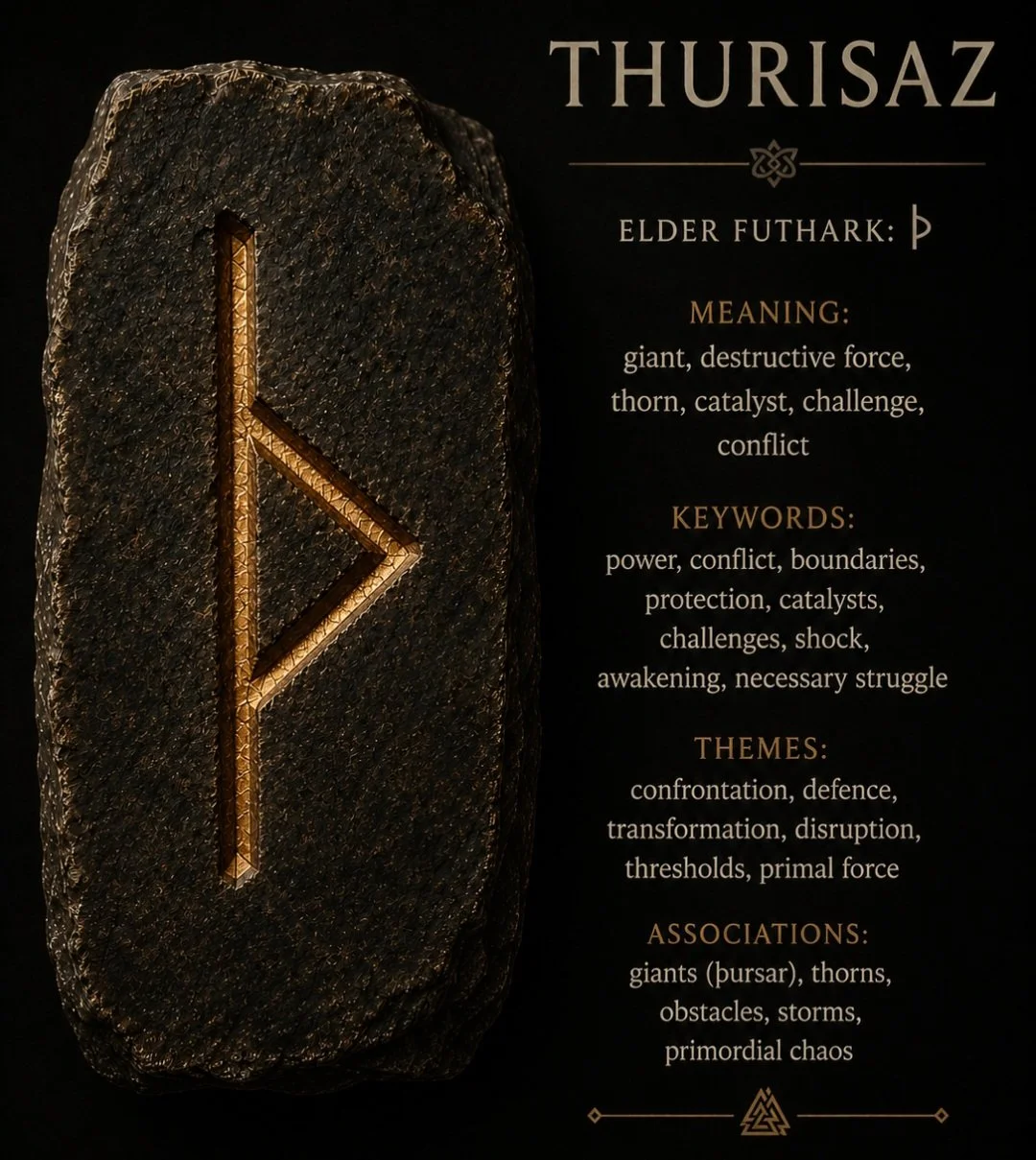
In-depth Rune series - Thurisaz
Name Variations: Thurisaz, Thurs, Þurs, Thuris, Thurisar, Þuris
Proto-Germanic: þurisaz (“giant,” “demonic being,” later associated with “thorn”)
Phonetic Sound: Þ / Th (as in thorn)
Ætt Placement: Third rune of the first ætt (often called Freyr’s/Freyja’s ætt in modern practice)
Meaning: Giant, destructive force, thorn, catalyst, challenge, conflict
Historical Concept: Represents giants (þursar) and chaotic, primal forces that stand in opposition to order; also associated with thorns as symbols of both defence and danger
Themes: Power, conflict, boundaries, protection, catalysts, challenges, shock, awakening, necessary struggle
Modern Deity Associations: Thor, Loki, or giant-kin (modern practice; not historical - no deity is explicitly tied to Thurisaz in early sources)
Thurisaz stands as the third rune of the Elder Futhark and marks a dramatic shift in the progression of the first ætt. Where Fehu represents resources and Uruz embodies the strength to wield them, Thurisaz introduces resistance - the moment when power meets opposition. Its name derives from the Proto-Germanic þurisaz, referring to giants (þursar), beings who embody untamed, chaotic forces. In Norse cosmology, giants are not merely adversaries of the gods but primordial powers from which the world itself emerged. Thurisaz therefore represents not evil, but challenge: the necessary friction through which growth and transformation occur.
The rune is also associated with the thorn, a small yet potent symbol of defence, pain, and awakening. A thorn protects by deterring harm, yet wounds those who grasp it without care. This duality captures the essence of Thurisaz - a force that may defend or injure, obstruct or catalyse, depending on awareness and intent. It teaches that even seemingly minor obstacles demand respect, and that pain can act as a moment of sudden clarity and change.
The rune poems reinforce these themes. In the Old English Rune Poem, þorn is described as “exceedingly sharp,” a source of suffering to anyone who sits upon it. The Norwegian Rune Poem portrays þurs as a source of torment and danger, while the Icelandic Rune Poem associates þurs with illness and strife. Across these sources, Thurisaz consistently appears as a rune of dangerous potency - one that warns of forces capable of harm, disruption, and upheaval.
Within the structure of the futhark, Thurisaz marks the first encounter with forces external to the self. If Fehu and Uruz concern the accumulation of resources and the cultivation of strength, Thurisaz introduces the catalyst that tests them. It represents the point at which capability is challenged by resistance, requiring adaptation, awareness, and conscious response. Thurisaz is the storm that shatters complacency, the thorn that sharpens perception, and the giant that must be faced before further progress is possible.
To understand Thurisaz is to recognise that challenge is not punishment, but a primordial force woven into existence itself. It demands respect rather than fear, awareness rather than force. Approached wisely, Thurisaz becomes an agent of transformation; approached recklessly, it becomes destructive.
Rune Poems
Old English Rune Poem (8th-9th century): Þorn
The Old English Rune Poem describes þorn (thorn) as sharp, painful, and dangerous to handle, especially for those who rest upon it. The emphasis is on sting and discomfort: something small, easily overlooked, yet capable of causing real injury. Symbolically, this presents Thurisaz as the rune of pain that awakens. It warns that careless contact with sharp or hostile forces brings consequences, and that suffering often arrives suddenly, through what first appears insignificant.
Norwegian Rune Poem (13th century): Þurs
The Norwegian Rune Poem names þurs as a source of torment and misfortune, particularly dangerous to women, and closely associates it with suffering and disruption. Here, þurs is clearly portrayed as a hostile power - an external force that brings trouble and distress into human life. This reflects the broader cultural view of giants and malevolent beings as chaotic forces originating beyond the boundaries of social order, threatening stability and safety.
Icelandic Rune Poem (15th century): Þurs
The Icelandic Rune Poem continues this portrayal, describing þurs as a cause of illness and affliction. In this context, the giant becomes a symbol of harmful intrusion (whether disease, spiritual attack, or malign influence) entering from outside ordinary human control. The emphasis lies on weakening, imbalance, and the vulnerability of the body and spirit when confronted by hostile forces.
Taken together, the rune poems present Thurisaz as a rune associated with pain, shock, and disruption. Across linguistic and cultural shifts, it consistently represents hostile or chaotic forces (giants, sickness, misfortune) and the idea of a concentrated point of impact, whether the sting of a thorn or the sudden strike of an external threat. Thurisaz is therefore the rune of confrontation and violent change: not evil in itself, but undeniably dangerous. It brings the test, the blow, and the awakening that occurs when one can no longer ignore the hard, sharp edges of reality.
Kennings and Literary References (Sagas and Eddas)
While the exact term Þurisaz does not survive as a recorded rune-name in Old Norse literary sources, its linguistic root þurs and related giant-terms appear extensively throughout myth and saga. Giants (variously called þursar, jötnar, and rísar) consistently represent the raw, antagonistic forces of the cosmos: powerful, dangerous, and frequently opposed to gods and humans alike. In skaldic kennings and poetic language, words such as “giant,” “ogre,” or “troll” often function as metaphorical components evoking overwhelming strength, hostility, or destructive potential. These terms signal forces that exceed ordinary human limits and threaten the boundaries of order.
The sagas and Eddas portray giants in complex and varied roles. They appear as monstrous adversaries, as possessors of dangerous or forbidden knowledge, and as liminal beings dwelling at the edges of the known world. The many encounters between Thor and giants (such as Hrungnir and Geirröðr) can be understood as quintessential Thurisaz narratives: clashes between structured, purposeful strength and chaotic, destabilising power. These stories frame conflict not as meaningless violence, but as necessary contention, maintaining balance between the ordered world of gods and the primordial forces that would otherwise overwhelm it.
The “thorn” aspect of Thurisaz also finds resonance in the literary tradition. Motifs of sharpness, piercing, and painful awakening recur frequently. Thorns appear as symbols of danger and enchantment, from defensive barriers and cursed objects to magical sleep induced by piercing wounds, as in later retellings of Brynhildr’s fate. More broadly, the recurring imagery of stings, wounds, curses, and enchanted weapons reflects the idea that small, concentrated points of force can alter destiny abruptly and irrevocably. The thorn teaches that what is minor in size may be immense in consequence.
Across skaldic poetry and saga literature, the themes aligned with Thurisaz emerge wherever we encounter hostile power embodied in giants, sudden calamity or ambush, contested boundaries between safety and danger, and weapons or forces that pierce, puncture, or break through established defences. These recurring patterns present Thurisaz as the rune of unavoidable confrontation: contact with dangerous power, the clash that tests limits, and the sharp threshold between order and chaos. It marks the moment when resistance is met directly and transformation becomes inevitable.
Archaeological Evidence and Notable Inscriptions
Thurisaz (ᚦ) appears in a number of early runic inscriptions from the Elder Futhark period, confirming its established place within the oldest rune row. It is attested on combs, amulets, weapons, and bracteates, most often as part of personal names, short inscriptions, or rune sequences rather than as an isolated lexical item. Its repeated appearance on personal objects suggests an association with identity, protection, and the assertion of force, rather than purely neutral writing.
On weapons (particularly spearheads and blades) Thurisaz sometimes occurs within personal names or formulaic inscriptions that may carry warrior-associated or forceful connotations. In these contexts, the rune’s presence plausibly reflects a desire to invoke strength, penetration, or decisive impact, aligning closely with its thorn- and giant-related symbolism. While it is not possible to determine with certainty whether such inscriptions were intended as magical acts, their placement on martial and protective objects strongly suggests that Thurisaz carried connotations beyond simple phonetic value.
The physical form of Thurisaz itself may also have contributed to its interpretation. The rune’s shape, resembling a pointed thorn or projecting spearhead extending from a vertical staff, visually reinforces associations with piercing, defence, and sudden shock. This visual symbolism would have been immediately apparent to carvers and viewers alike, strengthening the rune’s connection to confrontation and forceful contact.
On bracteates and other items of personal adornment, Thurisaz sometimes appears as part of partial futhark rows. These sequences confirm that the rune occupied a fixed and recognised position in the runic order from an early period, rather than being a later innovation or marginal sign.
Although no surviving ancient text explains Thurisaz’s meaning directly, the archaeological record consistently places it within contexts of identity, protection, and martial association. Taken together, this evidence supports understanding Thurisaz not merely as a phonetic sign, but as a rune associated with forceful encounter, defensive power, and decisive impact - qualities that align closely with its mythological and poetic resonances.
Cultural Notes (Law Codes, Social Customs, Worldview)
Culturally, Thurisaz reflects how early Germanic and Norse societies understood hostility, conflict, and danger. Life in these communities was precarious: threats arose from feuds, raiders, predators, illness, and harsh environmental conditions. The concepts embodied in Thurisaz (giants and thorns) symbolise these external and internal dangers, forces that could not be ignored but had to be recognised, confronted, and managed.
The legal traditions of the North, preserved in law codes such as Grágás and the early Norwegian laws, place strong emphasis on regulating violence through law, compensation, and controlled feud. This approach is deeply Thurisaz-like. Conflict and violence are not denied or idealised away; instead, they are acknowledged and contained. Unchecked hostility threatens social collapse, so destructive forces are structured, bounded, and redirected through legal mechanisms. In this sense, law itself functions as a kind of social “thorn,” protecting the community from chaos by limiting how violence may be expressed.
At the social level, boundaries were of critical importance. Clear distinctions existed between in-group and out-group, kin and stranger, homestead and wilderness. Beyond the cultivated fields lay the útangarðr (the “outside the fence” world) often associated with giants, trolls, and other hostile beings.
This view resonates strongly with Thurisaz as the rune of the borderland, the threshold where order gives way to wildness. Thorn-hedges, palisades, and natural barriers exemplify this principle: they mark limits, defend space, and warn of danger beyond.
Spiritually, misfortune, illness, and curses were sometimes understood as the result of hostile forces - trolls, giants, witches, or malicious spirits acting against human well-being. In this context, Thurisaz can be understood as the symbolic acknowledgement of opposition itself: the recognition that some forces are actively harmful and must be met with strength, awareness, and firm boundaries. Rather than promising safety or comfort, Thurisaz reflects a worldview in which survival depends on vigilance, restraint, and the courage to confront what threatens order and life.
Mythological Connections
Thurisaz is deeply woven into Norse mythology through the giants (jötnar / þursar) and their complex relationship with the gods. In the Norse creation myth, the cosmos itself emerges from the body of Ymir, a primordial giant: his flesh becomes the earth, his blood the seas, his bones the mountains, and his skull the sky. Reality is literally constructed from giant-force. In this sense, Thurisaz corresponds to the original, dangerous, and creative chaos that precedes order and makes creation possible.
The recurring mythic conflicts between the Æsir and the giants are fundamentally Thurisaz narratives. Thor’s constant battles with giants, and Odin’s perilous quests for wisdom from giantesses and giant-lords, depict ongoing confrontations with hostile yet necessary forces. The gods must continually resist and restrain giant power to preserve cosmic order. Yet they also depend upon it: giants possess ancient knowledge, powerful weapons are forged in their realms, and several gods take giantesses as lovers or wives. This ambivalent relationship shows that Thurisaz is not simply “evil,” but represents necessary opposition. Without resistance, there is no tension, no transformation, and no clearly defined order.
Thurisaz also resonates with mythic themes of curses, oaths, and sharp or dangerous speech. In Norse myth, spoken words can wound, bind, or bring catastrophe; they function as verbal “thorns” capable of piercing fate itself. Odin’s binding spells, Loki’s cutting insults, and various spoken maledictions reflect the same harsh, penetrating force embodied by Thurisaz. Language, like the thorn, becomes a weapon - small, precise, and capable of lasting harm.
Taken together, Thurisaz’s mythological connections centre on several recurring themes: giants and hostile powers, primordial chaos transformed into cosmos, battles that threaten or maintain order, and painful yet transformative encounters. Thurisaz is thus the rune of the cosmic adversary - terrible but necessary, destructive yet creative, and inseparable from the balance that sustains the world.
Symbolism and Core Interpretive Themes
Thurisaz symbolises impact, opposition, and the sharp edge of lived experience. It marks the point where inner will meets external resistance, where complacency is broken by encounter with something difficult, painful, or dangerous. Its twin symbols (the giant and the thorn) combine overwhelming force with piercing precision, expressing both scale and sharpness in confrontation.
At its core, Thurisaz encompasses themes of confrontation with challenge or hostility, the establishment of boundaries and defensive force, shock and sudden awakening, and the destructive potential that arises when power is mishandled. It also represents catalysts for transformation, moments of pressure or conflict that force change and adaptation rather than allowing stagnation.
Thurisaz is the hammer-blow, the storm front, the thorn in the flesh that cannot be ignored. It teaches that discomfort and struggle are often the beginning of awareness, growth, and necessary change. At the same time, it carries a warning: power applied without wisdom, restraint, or awareness can cause severe and lasting harm.
Light Aspect / Positive Expression of the Rune
In its positive expression, Thurisaz represents conscious confrontation. It signifies the courage to face problems directly, to set firm boundaries, and to act decisively when danger or injustice arises. In this aspect, Thurisaz is a protective force: the ability to say no, to push back, and to shield what must be kept safe. It is the guardian at the gate, the thorn-hedge around a fragile garden, the moment of clarity that halts a harmful pattern before it can continue.
Thurisaz can also appear as a powerful catalyst. It may manifest as an uncomfortable event, sharp realization, or sudden disruption that ultimately serves a beneficial purpose. By breaking through denial, inertia, or complacency, it forces awareness and movement where stagnation once ruled. In its light aspect, Thurisaz is not gentle, but it is truthful. It cuts away illusion and demands full presence, integrity, and responsibility in the face of reality.
Shadow Aspect / Difficult Expression of the Rune
In its shadow, Thurisaz becomes harmful, chaotic, or uncontrolled aggression. This may manifest as lashing out, overreaction, cruelty, or destructive behaviour born from pain, fear, or a perceived threat. It can also appear as internalised hostility: self-sabotage, harsh self-judgement, or entrenched patterns that keep the querent trapped in recurring cycles of hurt and conflict.
In its difficult expression, Thurisaz may also indicate being caught in another person’s aggression or in a situation of hostility beyond one’s direct control. Sudden crises, accidents, illness, emotional shock, or violent disruption may fall under this aspect of the rune. On a spiritual or psychological level, it can point to lingering curses, toxic dynamics, or unresolved trauma that continues to act like a thorn embedded in the psyche.
In all of these forms, the shadow of Thurisaz functions as a warning. Power without awareness destroys. Pain that is ignored festers. Conflict that is denied poisons the well. Thurisaz in shadow demands conscious engagement with danger, boundaries, and responsibility before damage becomes irreversible.
Divinatory Meaning - Upright
Upright, Thurisaz signals challenge, confrontation, and a turning point. It indicates that the querent is facing, or is about to face, a situation that demands clear boundaries, courage, and decisive response. This may involve conflict, a difficult choice, or an external force applying pressure. Thurisaz is rarely comfortable, but it is not inherently negative; it often marks the moment when avoidance is no longer possible and change becomes necessary.
In this position, Thurisaz can also represent a protective stance. It may appear when the querent needs to defend themselves, say “no,” or stop allowing harmful influences to persist. The rune urges vigilance, awareness, and conscious action rather than passivity or denial.
On a deeper level, Thurisaz upright can function as a catalyst for awakening. It may point to a painful truth, a sharp realization, or a crisis that exposes what has long been hidden. Rather than offering ease, Thurisaz invites the querent to meet the challenge directly, to act with integrity, and to understand what this confrontation is meant to teach.
Divinatory Meaning - Reversed / Merkstave
Reversed, Thurisaz often points to misdirected aggression, avoidance of necessary confrontation, or entrapment in destructive patterns. It may indicate that the querent is striking at the wrong target (projecting anger or fear outward where it does not belong) or refusing to face an issue that genuinely demands attention.
This position can also suggest weak or porous boundaries, leaving the querent vulnerable to manipulation, hostility, or self-destructive habits. In some readings, reversed Thurisaz reflects internalised harm: resentment turned inward, harsh self-judgement, or a reluctance to acknowledge one’s own power and responsibility.
Alternatively, Thurisaz reversed may signal overreaction or excess force - escalating conflict unnecessarily, clinging to rage long after its original cause has passed, or using confrontation as a reflex rather than a conscious choice. In this form, the rune calls for re-evaluation: where is your energy being directed, and is it protecting, transforming, or quietly causing harm?
Questions the Rune Asks in Readings
Thurisaz invites difficult but necessary self-examination. Rather than offering comfort, it confronts the querent with what can no longer be avoided. It asks what challenge is demanding attention now, and whether that challenge is being met directly or sidestepped through fear, denial, or distraction. Thurisaz presses the question of boundaries: where firmer limits must be drawn, and where passivity has allowed harm to enter unchecked.
The rune also asks whether conflict is being mishandled. Are you avoiding a confrontation that must occur, or provoking one unnecessarily out of anger, pride, or wounded instinct? Thurisaz urges reflection on the “thorn” lodged in your life - the unresolved pain, resentment, or truth that continues to wound because it has not been removed. It challenges you to examine where anger or fear may be quietly directing your choices rather than conscious will.
At its deepest level, Thurisaz asks what is trying to wake you up, even if the awakening is painful. It questions how power is being used: to protect and define healthy boundaries, or to injure, dominate, and escalate harm. Finally, it asks whether the pressure you are experiencing will become destructive or transformative. Thurisaz does not remove struggle, but it offers a choice - whether conflict becomes a force of growth or a source of ruin.
Warnings or Common Misinterpretations
Thurisaz is often labelled as a purely “negative” or “evil” rune, but this is an oversimplification. While it does herald discomfort, conflict, or danger, it also represents necessary confrontation and protective power. Treating Thurisaz only as a bad omen misses its essential teaching: some forces must be resisted, some truths will hurt, and some boundaries are vital for survival and integrity.
Another common misinterpretation is the careless use of Thurisaz in magic or bindrunes to “attack enemies.” This approach ignores the rune’s tendency to amplify and reflect aggression. When misused, Thurisaz can rebound on the practitioner, escalating conflict rather than resolving it. It is not a blunt weapon or a shortcut to dominance; it is a force that demands respect, clarity of intent, and a strong ethical compass.
Finally, some readers assume that Thurisaz always indicates an external attack - someone cursing, targeting, or acting against the querent. While this can occur, the rune more often points inward. It highlights unresolved anger, unhealed wounds, or patterns of self-sabotage that function like internal thorns. Blaming everything on outside forces avoids the self-examination that Thurisaz insists upon. The rune does not merely warn of danger - it demands accountability.
Seiðr Work / Trancework Interpretation
In seiðr and trancework, Thurisaz is often experienced as sharp, heavy, and electric. Practitioners commonly describe sensations such as pressure behind the eyes, a sudden jolt through the body, or an intense prickling along the skin. It can feel like standing at the edge of a storm - charged, unstable, and demanding full attention.
Visions of Thurisaz in trance frequently include towering giants, black storm clouds, jagged rocks, thorn thickets, or a single blinding flash of lightning. These images reflect the rune’s tendency to manifest as a threshold experience: an encounter with something larger, harsher, and more uncompromising than the everyday self.
In seiðr, Thurisaz teaches discernment and boundary-setting. It reveals where harmful energies are entering one’s field, where personal boundaries are weak or leaking, and where old wounds remain unhealed. It may guide the practitioner toward cutting ties, confronting long-avoided issues, or standing more firmly in their own power. For some, Thurisaz draws buried anger, fear, or pain to the surface - not to overwhelm, but to be seen, acknowledged, and transformed.
When approached with respect and awareness, Thurisaz becomes a rune of guardian-strength and hard truth. It teaches when to resist, when to defend, and how to meet conflict with integrity rather than denial or excess force.
Practical Magical Uses (Modern Rune Magic)
In modern rune magic, Thurisaz is approached with great caution and respect. It is a potent and uncompromising rune, most often employed in workings focused on protection, warding (particularly against hostile or intrusive forces), cutting away harmful influences, breaking entrenched patterns through disruption, and empowering firm boundaries or defensive magic.
Thurisaz can be invoked to establish a spiritual “thorn-hedge” around a person, place, or magical working, serving as a deterrent rather than a gentle shield. In this capacity, it does not soothe or soften; it warns, repels, and enforces limits. Thurisaz may also be used to break through stagnation or paralysis when subtler approaches have failed, though such work almost always involves discomfort, upheaval, or confrontation with difficult truths.
Because of its sharp and volatile nature, Thurisaz is generally unsuited to healing, reconciliation, or nurturing workings. Used without discernment, it can provoke unnecessary conflict, escalate emotional volatility, or draw confrontations the practitioner is not prepared to face. Thurisaz demands clarity of intention, ethical awareness, and a willingness to accept the consequences of invoking force rather than harmony.
Bindrune / Galdr Considerations
In bindrune work, Thurisaz functions as both a force-multiplier and a barrier. It is commonly used to reinforce wards and protections, particularly when combined with stabilising or boundary-focused runes such as Algiz, Tiwaz, or Eihwaz. Thurisaz adds a sharp, active defensive edge to combinations that might otherwise be passive, and it is especially effective in workings concerned with protecting space, property, or personal boundaries.
When paired with Algiz, Thurisaz strengthens repulsion and deterrence, helping to push hostile forces away rather than merely absorbing them. Combined with Tiwaz, it can channel conflict into focused, principled, and honourable action. With Uruz, Thurisaz directs raw strength into decisive defence. However, when joined with highly disruptive runes such as Hagalaz or Nauthiz, the resulting energy can become intense, volatile, and difficult to contain. Such combinations should be approached with caution, clarity of purpose, and strong grounding.
In galdr, Thurisaz is typically voiced as a harsh, vibrating “thhhhh,” “þuuur,” or “thor.” The sound bites into the air, tightening the jaw and resonating through the teeth and skull. This mode of chanting is often used to clear space abruptly, call forth protective or confrontational energy, or mark the beginning of boundary-setting, banishing, or warding rites. Unlike softer galdr tones, Thurisaz demands full presence and control from the practitioner.
As with all work involving Thurisaz, intention and responsibility are essential. This rune’s nature is to strike, sting, and awaken. Used with wisdom, it becomes a powerful ally in protection and transformation. Used carelessly, it can rebound, cutting both outward and inward, and leaving lasting consequences in its wake.