
Uruz Rune Meaning: History, Symbolism, Divination & Norse Rune Magic
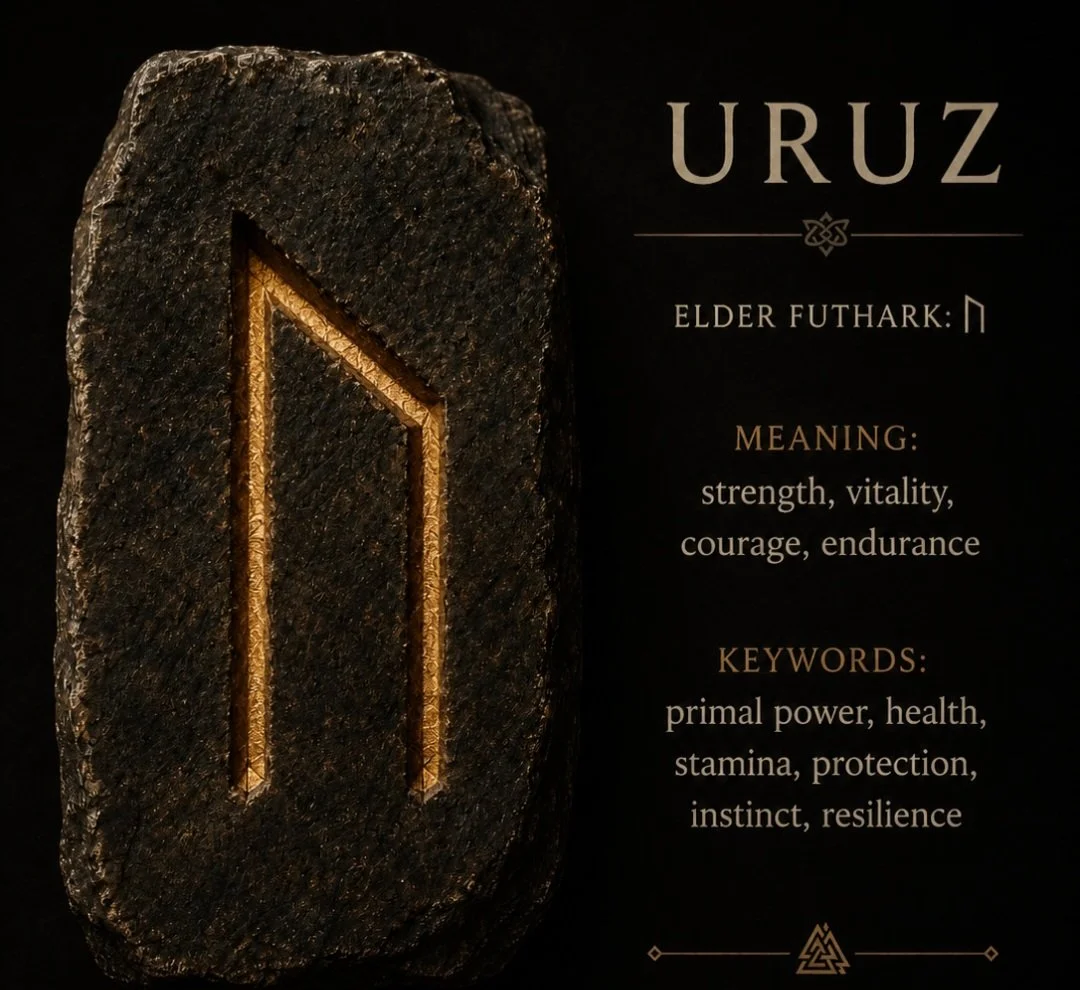
In-depth rune series - Uruz
Name Variations: Uruz, Ur, Úr, Urz, Uraz
Proto-Germanic: ūruz (“aurochs; wild ox”)
Phonetic Sound: U / Ū (long “oo,” as in root)
Ætt placement: Second rune of the first ætt (often called Freyr’s/Freyja’s ætt in modern practice)
Meaning: Aurochs, Primal Strength, Vitality, Raw Power, Endurance
Historical Concept: Untamed strength; the life-force of wild nature; physical health and raw potential before it is shaped by culture
Themes: Vitality, endurance, courage, physical power, primal instinct, initiation through challenge
Modern Deity Associations: Thor, the Vanir, or primal forces of nature (modern practice; not historical - no deity is historically tied to Uruz)
Uruz follows immediately after Fehu in the Elder Futhark, the second rune of the first ætt, and represents the next essential step in the unfolding of life. If Fehu marks the securing of resources, Uruz marks the awakening of strength. Its placement is deliberate. In early Germanic society, survival did not depend on wealth alone, but on the physical vitality, endurance, and resilience required to protect those resources and endure a harsh natural world. Uruz embodies this primal necessity. It represents the aurochs, the wild and untamed European ox, and by extension raw strength, health, and the life-force of nature before it is shaped by human culture.
To those who carved the earliest runes, strength was not an abstract ideal. It was lived reality: the stamina to farm unforgiving land, the bodily power to hunt dangerous animals, the resilience to survive winter, illness, and conflict. The aurochs, massive and fierce, symbolised this untamed vitality. Unlike domesticated cattle, it could not be easily controlled. To face such a creature was a test of courage and endurance, making Uruz a symbol of initiation through challenge. Strength was earned through struggle, not inherited through status.
The rune poems, though composed centuries after the Elder Futhark had passed out of use, preserve echoes of this understanding. In the Old English poem, the aurochs is fearless, horned, and relentless, a creature defined by its willingness to fight. In the later Scandinavian poems, although the meaning of the word shifts, the imagery remains tied to endurance, hardship, and the testing forces of nature. Together, these verses reflect a worldview in which strength is neither gentle nor passive, but forged through resistance, effort, and exposure to the elements.
As the second rune of the futhark, Uruz develops the themes introduced by Fehu. Where Fehu establishes the foundation of life through resources and exchange, Uruz teaches that life continues only through strength. It introduces vitality, endurance, and the capacity to withstand pressure as defining forces in human existence. To understand Uruz is to understand a core truth of early Germanic life: that survival, honour, and growth depend not only on what one possesses, but on the strength, one has to endure, defend and transform what has been given.
Uruz is the second rune of the Elder Futhark and the second of the so-called Freyr’s or Freyja’s ætt, a designation used in modern rune study rather than historical sources. Its core meaning is “aurochs,” a symbol of wild, primal power. To early Germanic peoples, this animal embodied physical strength, health, courage, and raw potential. Uruz therefore represents not comfort or security, but the living force required to meet the world directly - the untamed vitality that allows life not merely to persist, but to grow stronger through challenge.
Rune Poems
Old English Rune Poem (8th-9th century):
“The aurochs is fearless and greatly horned,
a very fierce beast;
it fights with its horns,
a great ranger of the moors,
it is a courageous creature.”
Norwegian Rune Poem (13th century):
“Slag is from bad iron;
often the reindeer runs on the hard snow.”
Icelandic Rune Poem (15th century):
“Drizzle is the weeping of clouds,
and the diminisher of the hay-harvest,
and the shepherd’s hatred.”
These verses show how the meaning of Uruz shifted over time as language changed, while its core themes endured. In the Old English poem, Uruz is explicitly associated with the aurochs: untamed strength, courage, and ferocity proven through struggle. In the later Scandinavian poems, the original animal meaning is lost, but the rune remains linked to harsh natural forces, endurance, and survival under difficult conditions. Across all three traditions, Uruz reflects strength that is not gentle or comfortable, but forged through resistance, hardship, and confrontation with the raw forces of the world.
Kennings and Literary References (Sagas and Eddas)
Although the aurochs itself appears only rarely in surviving Norse and Germanic literature, the qualities embodied by Uruz (strength, wildness, endurance, and raw vitality) are deeply embedded in the mythic and literary imagination of the sagas and Eddas. As with Fehu, the rune is never named directly, but its essence is carried through imagery, characterisation, and poetic language that consistently associates worth with physical power, resilience, and the ability to withstand hardship.
In skaldic poetry, strength is frequently expressed through animal kennings and metaphors drawn from the untamed world. Warriors, kings, and heroes are compared to fierce beasts, storm-forces, or unyielding natural elements. Such imagery reflects a cultural admiration for raw, embodied power - strength that is not decorative but functional, tested, and often dangerous. Courage, stamina, and the capacity to endure pain or exhaustion are treated as defining virtues, aligning closely with the core meaning of Uruz as primal force and vitality.
The sagas provide vivid human expressions of this ideal. Figures such as Grettir Ásmundarson in Grettir’s Saga are remembered for extraordinary physical strength and endurance, yet also for the burdens that accompany such power. Grettir’s immense strength enables survival in hostile landscapes and combat against monstrous foes, but it also isolates him, marking him as both formidable and dangerous. His story illustrates a recurring theme: raw power is a gift, but without balance or social integration, it can lead to exile, suffering, and downfall.
Similar tensions appear in the portrayal of berserkers, who embody uncontrolled or ecstatic strength. Their ferocity reflects the untamed aspect of Uruz, but their lack of restraint often places them at odds with social order. The sagas consistently show that strength must be mastered rather than indulged - a lesson that mirrors Uruz’s dual nature as both life-giving vitality and potentially destructive force.
In the Eddic tradition, strength is likewise forged through struggle. The gods themselves are not immune to trial or exhaustion. Thor’s repeated contests with giants, storms, and monstrous beings throughout the Poetic Edda reflect a worldview in which power is constantly tested against overwhelming natural forces. Nature in Norse myth is never gentle; it is cold, violent, and demanding. Survival (and worth) depend upon the capacity to endure. This cosmology resonates strongly with Uruz as the rune of physical reality, where life is shaped through resistance rather than ease.
The Icelandic landscape, so vividly present in saga literature, functions almost as a character in its own right. Harsh winters, barren mountains, relentless storms, and long journeys across inhospitable terrain form the backdrop against which human strength is measured. Endurance in such conditions was not merely admirable but essential. In this sense, the land itself becomes a living metaphor for Uruz: a testing ground that forges resilience or breaks those unable to withstand it.
Taken together, the kennings, sagas, and Eddic poems reveal a cultural reverence for unrefined power - the strength of body, will, and instinct required to survive in a demanding world. Uruz is not the strength of dominance or excess, but the strength of endurance, courage, and confrontation with adversity. Through myth and story, it emerges as a rune of initiation and becoming: the raw force that shapes heroes, tests limits, and forge’s identity through struggle.
Archaeological Evidence and Notable Inscriptions
Uruz appears consistently in the early archaeological record of the Elder Futhark, offering insight into how concepts of strength, vitality, and endurance were embedded within early Germanic material culture. Like Fehu, Uruz is attested from the earliest phases of runic use and occurs across a wide range of artefacts dating primarily to the Migration Period (4th-6th centuries CE). Its repeated presence suggests that the qualities symbolised by the aurochs (raw power, physical capability, and untamed vitality) were highly valued within the societies that adopted runic writing.
Although the Kylver Stone from Gotland is best known for preserving the earliest complete rune row, Uruz’s position as the second rune of the sequence is equally significant. Its placement immediately after Fehu reflects a structural logic within the futhark: once material resources and sustenance are secured, strength and vitality are required to defend, maintain, and transform them. While we cannot know the original intention behind this ordering, the consistency of the rune row across inscriptions suggests that the sequence itself carried meaning and was carefully preserved.
Uruz appears on a variety of artefacts, including weapons, tools, bracteates, and personal items. On bracteates (thin gold pendants often associated with ritual, identity, or elite status) Uruz sometimes appears as part of partial futhark sequences or within personal names. Its presence on objects of gold and high craftsmanship may reflect an association between strength, prestige, and vitality, rather than literal references to the aurochs itself. As with other early runes, Uruz is rarely used to spell out a complete word meaning “aurochs,” supporting the view that early runic writing was primarily symbolic, identificatory, or formulaic rather than purely lexical.
Weapons provide an especially relevant context for Uruz. The rune occurs within personal names or short inscriptions on spearheads, knives, and other martial objects. In these settings, Uruz functions at minimum as a phonetic element linked to ownership or identity. At the same time, its repeated appearance on items associated with combat and survival suggests that the rune may also have carried connotations of strength, endurance, and protection. While it is impossible to determine whether such inscriptions were intended as magical acts, their placement on weapons implies an awareness of the rune’s symbolic weight and its resonance with physical power and courage.
One of the earliest and most debated artefacts potentially connected to Uruz is the Meldorf Brooch (1st-2nd century CE). Some scholarly interpretations suggest that the inscription may contain an early form of ur, though this reading remains contested and the inscription itself is ambiguous. Regardless of whether Uruz is present on the brooch, the artefact demonstrates that runic signs associated with identity and power were already meaningful at a very early stage in the development of runic writing.
Taken together, the archaeological evidence indicates that Uruz was not merely a neutral phonetic sign, but a rune closely associated with physical vitality, resilience, and the raw forces necessary for survival in a demanding environment. Its appearance on weapons, prestigious ornaments, and personal inscriptions reflects a cultural emphasis on strength as both a practical necessity and a defining personal quality. In this way, Uruz emerges from the archaeological record as a rune of embodied power - one that speaks to endurance, capability, and the untamed energy required to meet the challenges of early Germanic life.
Cultural Notes (Law Codes, Social Customs, Worldview) -
In early Germanic and Scandinavian society, strength was not an abstract virtue but a practical necessity. Survival depended upon physical health, endurance, and the capacity to withstand hardship in an often hostile environment. Farming, herding, hunting, seafaring, and warfare all demanded bodily resilience and stamina. Uruz reflects this cultural reality: resources alone were insufficient without the raw strength required to protect, maintain, and make use of them. In this sense, Uruz complements Fehu. Where Fehu represents what sustains life, Uruz represents the power needed to hold and defend that sustenance.
Although no medieval law code defines a concept directly equivalent to Uruz, legal practice nonetheless assumes bodily capability as foundational. In societies governed by customary law, an individual’s ability to fulfil obligations (labour, defence, travel, and participation in assemblies) depended on physical and mental robustness. A household head was expected to maintain land, livestock, and dependents through strength and effort. Injury, illness, or diminished vitality could reduce a person’s legal and social agency, making them vulnerable to loss of status or dependence on kin. Strength, therefore, was not merely personal; it was socially consequential.
Strength also played a role in systems of honour and compensation. Wergild (man-price) valuations varied according to social rank, but the expectation that a man could defend his honour and kin through physical capability underpinned the system. Feuds, duels, and athletic contests all presuppose a cultural valuation of endurance and courage. Uruz resonates with this worldview as the embodied force that enables honour to be upheld and obligations to be met. Without strength, honour could not be defended, and without endurance, reputation could not be sustained.
Social customs further reinforce this valuation. Feats of strength, endurance, and resilience (wrestling, long-distance travel, hunting dangerous animals, surviving harsh winters) were admired and remembered in oral tradition. Heroes in the sagas are often defined by their physical stamina and ability to endure suffering as much as by their cleverness or wealth. Figures such as Grettir Ásmundarson exemplify this ideal: immense strength brings renown, but it also carries risk, isolation, and burden. Strength is thus morally neutral in itself; it becomes meaningful only through how it is used and governed.
The concept of hamingja also intersects with Uruz. While hamingja is often associated with luck and fortune, it is equally reflected in vitality and resilience. A strong body and enduring spirit were taken as signs of strong hamingja, inherited through lineage and reinforced through honourable conduct. Conversely, physical weakness or repeated injury could be interpreted as a sign of waning fortune or imbalance.
Uruz therefore bridges the physical and the metaphysical: it is strength as lived experience and strength as an outward expression of inner vitality.
Taken together, early law, social expectation, and worldview reveal Uruz as more than brute force. It represents the embodied capacity to survive, endure, and meet the demands of life in a world governed by challenge rather than comfort. Uruz is strength as responsibility - the power required to protect kin, uphold honour, and persist through hardship. In the early Germanic imagination, vitality was sacred because without it, no wealth, law, or social order could endure.
Mythological Connections
No surviving Norse myth or medieval source explicitly assigns Uruz to a single god or named narrative, and the rune itself is never discussed as a discrete symbol within the mythological texts. However, the qualities embodied by Uruz (raw strength, endurance, vitality, and untamed natural force) resonate deeply throughout Norse myth at a thematic level. Rather than being tied to a particular deity, Uruz aligns most closely with the primordial forces that underlie creation and the continual struggle between order and chaos.
The clearest mythic parallel lies in the image of the aurochs itself: a powerful, untamed creature of the wild. This places Uruz conceptually close to the giants (jötnar), who in Norse cosmology represent elemental, pre-cultural forces of nature. The giants are not inherently evil; they embody raw power, endurance, and the untamed energies that must be confronted, negotiated with, or overcome for the cosmos to function. In this sense, Uruz reflects the same mythic role: the strength that precedes structure, the force that exists before refinement and law.
Uruz also finds strong thematic resonance in the creation myth itself. The cosmos emerges from the body of the primordial giant Ymir, a being of immense physical magnitude. The transformation of Ymir’s raw substance into an ordered world mirrors Uruz’s deeper symbolism: unshaped power becomes meaningful only when engaged, directed, and transformed. Strength is not an end in itself, but the raw material from which form and order arise.
While not historically linked to the rune, Thor provides another powerful symbolic parallel. As the god who constantly confronts giants, storms, and monstrous forces, Thor embodies the necessity of meeting raw power with controlled strength. His myths emphasise endurance, physical exertion, and repeated testing rather than cleverness or wealth. This aligns closely with Uruz’s lesson that strength must be exercised, not possessed passively. Thor’s battles demonstrate that vitality and force are not static attributes but must be renewed through continual challenge.
Heroic figures within the sagas and legendary material further reinforce Uruz’s mythic dimension. Heroes such as Grettir Ásmundarson, Sigmundr, and other strongmen of legend endure immense physical trials that shape their destiny. Their strength enables survival and renown, yet it also brings isolation, danger, and suffering. These narratives reflect a core truth associated with Uruz: raw power is transformative but morally neutral, capable of both creation and destruction depending on how it is governed.
The natural world itself functions as a mythological expression of Uruz. Norse myth consistently portrays nature as testing rather than nurturing - bitter cold, violent storms, rugged mountains, and relentless seas shape gods and humans alike. Endurance in the face of these forces is a measure of worth. In this context, Uruz represents the primal vitality required to exist within such a world: the strength to stand, persist, and be forged rather than broken.
Uruz’s mythological connections therefore lie not in named gods or fixed symbols, but in the deeper mythic current of Norse thought. It embodies the raw, life-forging power that precedes order, the strength demanded by creation itself, and the enduring vitality required to survive in a cosmos defined by struggle. Through this lens, Uruz stands as the rune of primordial force - the living strength from which all growth, transformation, and becoming must begin.
Symbolism and Core Interpretive Themes
Uruz symbolises raw, unshaped life-force - the primal strength that exists before refinement, culture, or conscious direction. It is the vitality of bone and muscle, blood and breath, instinct and endurance. As the second rune of the Elder Futhark, Uruz follows directly after Fehu, marking a shift from external resources to inner capacity. Where Fehu represents what sustains life, Uruz represents the strength required to claim, protect, and transform those resources into lived experience.
At its core, Uruz embodies physical vitality, resilience, and the will to endure. Its symbolism is rooted in the aurochs, the extinct wild ox whose immense size and ferocity made it a creature of awe and danger. Unlike domesticated cattle, the aurochs could not be easily controlled. It represented power that had to be confronted directly, making Uruz a rune of initiation, trial, and transformation. Strength here is not inherited or given; it is earned through challenge and sustained effort.
Uruz also expresses the principle of becoming. It is the force that pushes growth through resistance - the surge that drives a seed through soil or a body through exhaustion toward greater capacity. This rune does not promise comfort or ease. Instead, it reflects the truth that life is shaped through pressure, strain, and perseverance. In this sense, Uruz is a rune of shaping: raw potential forged into strength through engagement with difficulty.
Beyond physical power, Uruz encompasses instinct, courage, and embodied presence. It speaks to the intelligence of the body and the necessity of trusting one’s inner strength. In early Germanic thought, vitality was inseparable from luck and spiritual force (hamingja). A strong body and resilient spirit were signs of inner fortune, while weakness could signal imbalance. Uruz therefore bridges the physical and the metaphysical, expressing strength as both bodily endurance and vital essence.
Yet Uruz is not inherently violent or destructive. Its power is morally neutral, capable of sustaining life or overwhelming it. Unshaped strength becomes destructive only when uncontrolled or misdirected. Thus, Uruz carries an implicit demand for balance: raw power must be integrated, disciplined, and aligned with purpose. True strength is not brute force alone, but resilience tempered by awareness.
As a core interpretive theme, Uruz represents the foundation upon which all growth rests. It is the force that allows one to face reality without retreat, to endure hardship without collapse, and to transform challenge into capacity. Through Uruz, the runic tradition teaches that strength is not a static attribute, but a living process - one forged through effort, sustained through endurance, and expressed through embodied presence in the world.
Divination and Practice (Modern Interpretation)
In its positive expression, Uruz manifests as strength that is alive, grounded, and life-affirming. It represents robust health, physical vitality, and the inner resilience needed to meet challenges without breaking. When Uruz is well balanced, it brings endurance rather than aggression - the capacity to persist, recover, and grow stronger through effort. This is strength that supports life, protects what is valued, and enables sustained action rather than reckless force.
Uruz in its light aspect encourages courage rooted in instinct and presence. It reflects confidence that arises from knowing one’s own body, limits, and capabilities. Rather than relying on external validation or power over others, this form of Uruz expresses self-trust, stamina, and the willingness to face difficulty directly. It empowers decisive action, steady commitment, and the ability to hold one’s ground under pressure.
This rune also signifies renewal of vitality. Upright and balanced, Uruz often points to phases of healing, recovery, or strengthening after depletion. Energy begins to return, momentum builds, and the body and spirit regain coherence. In this aspect, Uruz supports disciplined effort - training, practice, and the slow accumulation of strength through consistency rather than sudden exertion.
On a deeper level, Uruz’s light aspect represents strength aligned with purpose. Raw power is no longer chaotic; it is shaped into capability. Instinct is integrated with awareness, and effort is guided by intention. This allows Uruz to function as a stabilising force, grounding ambition in endurance and ensuring that growth is sustainable rather than destructive.
In its healthiest expression, Uruz teaches that true strength is not domination or excess, but the capacity to endure, adapt, and remain present in the face of life’s demands. It is the strength that builds foundations, protects boundaries, and supports transformation over time - power that serves life rather than overwhelming it.
Light Aspect / Positive Expression of the Rune
In its positive expression, Uruz represents healthy strength, vitality, and embodied power. It signifies a surge of life-force that supports physical health, resilience, and the capacity to endure challenge without breaking. This is strength that arises naturally from alignment with one’s body, instincts, and environment. Uruz in its light aspect reflects confidence rooted in capability rather than dominance - knowing what one can withstand, and trusting that inner power is sufficient to meet what lies ahead.
Uruz also expresses growth through effort. It supports disciplined action, perseverance, and the willingness to engage fully with demanding situations. In this form, Uruz is the steady force that builds stamina over time: the strengthening of muscles through labour, the sharpening of will through repeated trial, and the quiet confidence that comes from having survived hardship before. It encourages commitment to long-term goals and honours progress earned through persistence rather than ease.
At its healthiest, Uruz brings grounded courage. It empowers decisive movement, restores depleted vitality, and reconnects the individual with their primal sense of aliveness. This is not reckless force, but integrated strength - power that supports life, protects boundaries, and enables transformation without collapse. In its light aspect, Uruz teaches that true power is not loud or aggressive, but deeply rooted, resilient, and capable of sustaining growth over time.
Shadow Aspect / Difficult Expression of the Rune
Uruz’s shadow emerges when strength becomes unbalanced, suppressed, or uncontrolled. Because Uruz represents raw life-force, its difficult expression often appears at the extremes: either as excess force or as its absence. In one form, this shadow manifests as aggression, stubbornness, or the misuse of power - strength applied without wisdom, restraint, or regard for consequence. When raw vitality is allowed to dominate unchecked, it can lead to conflict, intimidation, or destructive behaviour toward oneself or others.
Conversely, Uruz’s shadow may appear as depletion rather than excess. Exhaustion, burnout, illness, or a profound loss of confidence can signal that the life-force associated with this rune has been overextended or blocked. In this expression, Uruz reflects weakened vitality - a body or spirit pushed beyond sustainable limits, often through constant struggle without rest or renewal. What should be a source of resilience becomes a site of strain.
On an inner level, Uruz in shadow can reveal fear of one’s own power. This may take the form of passivity, avoidance of challenge, or reluctance to step into responsibility. When instinct and strength are suppressed rather than integrated, they do not disappear; instead, they may surface as frustration, volatility, or self-sabotage. The rune highlights where raw potential exists but has not yet been consciously shaped.
Uruz’s difficult expression also warns against defining worth solely through strength. In cultures that valued physical capability, weakness could carry stigma, but the rune reminds us that strength is cyclical. Ignoring limits, denying vulnerability, or equating power with identity leads to imbalance. True resilience includes recovery, flexibility, and the wisdom to yield when necessary.
In this sense, Uruz’s shadow is not a punishment but a diagnostic force. It exposes where strength has been misused, neglected, or misunderstood. The lesson it offers is one of recalibration: power must be tempered, vitality must be replenished, and instinct must be guided by awareness. Only then can raw strength return to its rightful role as a sustaining, life-affirming force rather than a destructive one.
Divinatory Meaning - Upright
When upright, Uruz signifies strength, vitality, and the awakening of raw personal power. It represents a surge of life-force that brings resilience, endurance, and the capacity to meet challenges head-on. This rune often appears when the querent is entering a phase that requires courage, stamina, and decisive action. Rather than offering ease, Uruz signals the presence of the inner resources needed to withstand difficulty and emerge stronger through effort.
Uruz upright points to physical and energetic renewal. It may indicate improved health, recovery from illness, or a return of motivation after a period of weakness or stagnation. The rune suggests that the body and spirit are aligned, providing the grounding and strength necessary for sustained work or long-term goals. In this sense, Uruz is less about external support and more about internal capability.
On a psychological level, Uruz encourages the querent to trust their instincts and embodied wisdom. It calls for direct engagement with circumstances rather than avoidance, emphasising that growth comes through confrontation with reality, not withdrawal from it. This rune often appears when latent potential is ready to be shaped into action.
Spiritually, Uruz upright may reflect strengthened hamingja (the flow of ancestral vitality and personal fortune) manifesting as confidence, presence, and resilience. It affirms that the querent possesses the power required to transform their situation, provided they are willing to apply effort and discipline.
Above all, Uruz upright reminds us that strength is not a passive blessing but an active force. It must be used, tempered, and sustained. When this rune appears, it signals a moment to step fully into one’s power, meet challenge with integrity, and allow raw potential to take form through conscious action.
Divinatory Meaning - Reversed / Merkstave
When reversed, or appearing as a merkstave, Uruz points to weakened vitality, blocked strength, or misdirected power. This may manifest as physical exhaustion, illness, burnout, or a general sense that energy has run low. The rune often appears when the querent has been pushing too hard, ignoring bodily limits, or attempting to force outcomes without adequate grounding or recovery.
Uruz reversed can also indicate a disconnection from instinct and embodied wisdom. The querent may doubt their own strength, avoid necessary challenges, or feel overwhelmed by circumstances that demand endurance. In some cases, it highlights fear of change or resistance to growth, where the effort required feels too great and inertia sets in. Rather than a lack of potential, this reversal suggests strength that is present but inaccessible or suppressed.
At times, reversed Uruz warns of strength expressed without balance. This can appear as uncontrolled aggression, stubbornness, or impulsive behaviour, where raw power is acting without direction or restraint. In such cases, the rune cautions that force alone is insufficient; without wisdom, discipline, and awareness, strength becomes destructive rather than transformative.
On a deeper level, Uruz reversed may signal diminished hamingja - a depletion of personal or ancestral vitality. This can feel like loss of confidence, poor health, or repeated setbacks. Importantly, this is not a sign of failure, but a call for restoration. The rune urges the querent to slow down, tend to the body, rebuild foundations, and reconnect with instinctual strength before pressing forward again.
Rather than predicting harm, Uruz reversed acts as a corrective force. It reveals where energy is out of balance and where recovery, patience, and conscious recalibration are required. Its message is clear: true strength cannot be forced. It must be nurtured, respected, and allowed to return in its own time before it can be wielded effectively once more.
Questions the Rune Asks in Readings
When Uruz appears in a reading, it calls attention to the state of one’s strength, vitality, and capacity to endure. It asks where resilience is required and whether the querent is meeting life’s challenges directly or attempting to avoid necessary effort. Uruz often arises when growth demands confrontation with difficulty, reminding the reader that transformation is rarely comfortable and that true strength is forged through engagement rather than retreat.
The rune also invites reflection on the body and instinct. It asks whether physical, emotional, or spiritual vitality is being supported or neglected, and whether exhaustion, illness, or burnout are signs that strength has been misused or depleted. Uruz encourages an honest assessment of how energy is being spent, questioning whether force is being applied wisely or whether rest, recovery, and recalibration are needed before further action can be taken.
At a deeper level, Uruz examines one’s relationship with power and self-trust. It asks whether instincts are being honoured or suppressed, and whether fear or self-doubt is preventing the querent from stepping fully into their own capability. The rune highlights areas of raw potential that remain unshaped, urging the individual to claim their strength consciously rather than allowing it to remain dormant or chaotic.
Ultimately, Uruz asks whether inner vitality and outer action are aligned. It challenges the querent to recognise that strength is not a static possession but a living process - one that requires discipline, humility, endurance, and respect for natural limits. Through these questions, Uruz guides the seeker toward embodied power, grounded resilience, and the courage to meet life as it truly is.
Warnings and Common Misinterpretations
Uruz is often misunderstood as a simple rune of brute strength or aggressive force, but this interpretation flattens its deeper meaning. While Uruz does represent raw power and vitality, it does not advocate domination, recklessness, or constant exertion. In the early Germanic worldview, strength was respected precisely because it was dangerous if uncontrolled. To read Uruz as encouragement to push harder at all costs is to ignore its implicit warning: power without restraint leads to injury, burnout, or destruction.
Another common misinterpretation is treating Uruz as a guarantee of success or invincibility. Uruz does not promise victory without effort, nor does it shield one from hardship. Instead, it signals that challenge is unavoidable and that growth requires endurance. When misread as a “strength blessing,” Uruz can tempt the querent to ignore limits, dismiss vulnerability, or refuse rest, ultimately weakening the very vitality the rune represents.
Uruz is also sometimes mistaken as purely physical, associated only with the body or external force. While physical strength is an important aspect of the rune, Uruz encompasses resilience, instinct, and spiritual stamina as well. Neglecting its inner dimension can lead to imbalance, where outward power masks inner fragility or unacknowledged fear. True Uruz strength arises when body, will, and instinct are aligned.
Finally, some readers interpret reversed or difficult expressions of Uruz as omens of failure, illness, or loss. While Uruz can reflect depleted vitality or misdirected force, its appearance in such contexts is corrective rather than punitive. It draws attention to where strength has been overextended, suppressed, or misused, urging restoration rather than despair. Uruz teaches that strength must be cultivated, renewed, and respected. When its warnings are heeded, the rune becomes not a symbol of collapse, but an invitation to rebuild power on firmer, more sustainable ground.
Seiðr Work / Trancework Interpretation
In seiðr and trancework, Uruz is experienced as a deep, embodied force rather than a flowing current. Where Fehu moves, Uruz grounds and fortifies. Practitioners often describe its presence as weight settling into the bones, heat building in the muscles, or a steady pressure rising through the spine and chest. It is the sensation of being fully “in the body,” awake to instinct, endurance, and physical reality. Uruz does not drift or shimmer; it stands, presses, and holds.
In trance vision, Uruz may appear as a massive aurochs, dark and unmoving, a mountain rising from mist, a storm rolling across open land, or molten strength beneath the earth’s crust. These images emphasize the rune’s connection to primal nature and to forces that cannot be negotiated with or ignored. Uruz teaches through contact rather than symbolism alone. It asks the practitioner to meet power directly, to feel where strength resides and where it has been lost or resisted.
Uruz work often brings attention to the body as a vessel of memory and ancestry. In seiðr, the rune may reveal patterns of endurance, survival, or trauma carried through lineage, especially where strength was demanded at great cost. It can surface inherited responses to hardship: overexertion, rigidity, or the suppression of vulnerability. Through this awareness, Uruz offers the possibility of reclaiming strength without repeating harm, restoring vitality in a way that honours both resilience and rest.
Approached with respect, Uruz becomes a rune of initiation and embodiment. It does not offer escape or comfort, but grounding and capacity. In trancework, it teaches how to stand one’s ground, how to remain present in difficulty, and how to inhabit power without being consumed by it. Uruz reconnects the practitioner to the primal strength that sustains life through challenge, reminding them that endurance itself is a form of wisdom.
Practical Magical Uses (Modern Rune Magic)
In modern rune magic, Uruz is worked as a rune of strength, healing, endurance, and transformative effort. It is most often used in situations that require sustained energy rather than quick results. Uruz supports the rebuilding of vitality after illness, exhaustion, or prolonged stress, and is commonly employed in workings focused on physical health, stamina, and resilience. Rather than providing external aid, it amplifies the practitioner’s inner capacity to endure, recover, and persist.
Uruz is also used in magical work aimed at empowerment and personal transformation. It is particularly effective when confronting fear, breaking through internal resistance, or reclaiming suppressed instinct and confidence. In these contexts, Uruz does not remove obstacles; it strengthens the practitioner so they can meet them directly. This makes it a powerful rune for long-term goals, initiatory processes, and any work that demands discipline, commitment, and the willingness to face discomfort as part of growth.
In healing-oriented practice, Uruz is sometimes combined with breathwork, grounding techniques, or body-focused ritual to reinforce the connection between spirit and physical form. Its energy is stabilising and centring, helping to anchor scattered emotions and restore coherence between will and action. Because Uruz intensifies effort and focus, it is often used sparingly and with clear intention, especially in cases where burnout or overexertion is already present.
Uruz must be approached with care and responsibility. As a rune of raw power, it amplifies whatever condition it is applied to. When used with impatience, anger, or the desire to dominate, it may increase strain or provoke imbalance. When used with respect, clarity, and restraint, Uruz becomes a steady ally - supporting healing, strengthening resolve, and helping the practitioner build durable foundations for lasting change.
Bindrune and Galdr Considerations
Uruz functions as a foundational and strengthening rune in bindrune construction. When placed at the base or core of a bindrune, it provides endurance, stability, and the capacity to withstand pressure over time. It lends staying power to magical workings, reinforcing efforts that require persistence rather than rapid manifestation. Because Uruz embodies raw vitality, it is especially well suited to bindrunes intended for healing, long-term goals, recovery, or personal transformation through effort.
Uruz pairs effectively with runes that shape, direct, or refine power. Combined with Fehu, it strengthens new beginnings by adding stamina and follow-through. With Kenaz, it forges raw strength into skill, insight, or disciplined creativity. When paired with Tiwaz, Uruz aligns physical and instinctual power with purpose, honour, and will. With Jera, it supports slow, cumulative growth and the endurance required to reach eventual harvest. Care must be taken when combining Uruz with volatile runes such as Thurisaz or Hagalaz, as Uruz can intensify force and confrontation, potentially producing overwhelming or destabilising results if not balanced by grounding or harmonising elements.
In galdr (runic chanting), Uruz is typically voiced as a deep, resonant “uuuuur” or sustained “ooooh,” directing vibration into the chest, spine, and lower body. The sound is heavy and grounding rather than expansive, anchoring awareness in the body and awakening instinctual strength. Practitioners often experience this galdr as warmth in the bones, pressure in the muscles, or a steady internal pulse, reflecting Uruz’s connection to embodied vitality.
Galdr with Uruz is commonly used to build strength before demanding work, to stabilise energy during prolonged ritual, or to support recovery and regeneration. The chant should be steady and controlled, avoiding forceful projection. Uruz responds best to measured breath and sustained tone, mirroring its lesson that true strength lies in endurance and restraint rather than aggression.
In both bindrune and galdr work, Uruz acts as an intensifier of presence and capacity. It does not initiate movement like Fehu, nor does it bring sudden change. Instead, it fortifies what already exists, strengthening the practitioner so they can carry weight, face challenge, and remain grounded through difficulty. Used wisely, Uruz lends durability, resilience, and embodied power to any working it supports.