
Fehu Rune Meaning: History, Symbolism, Archaeology, Divination & Norse Mythology
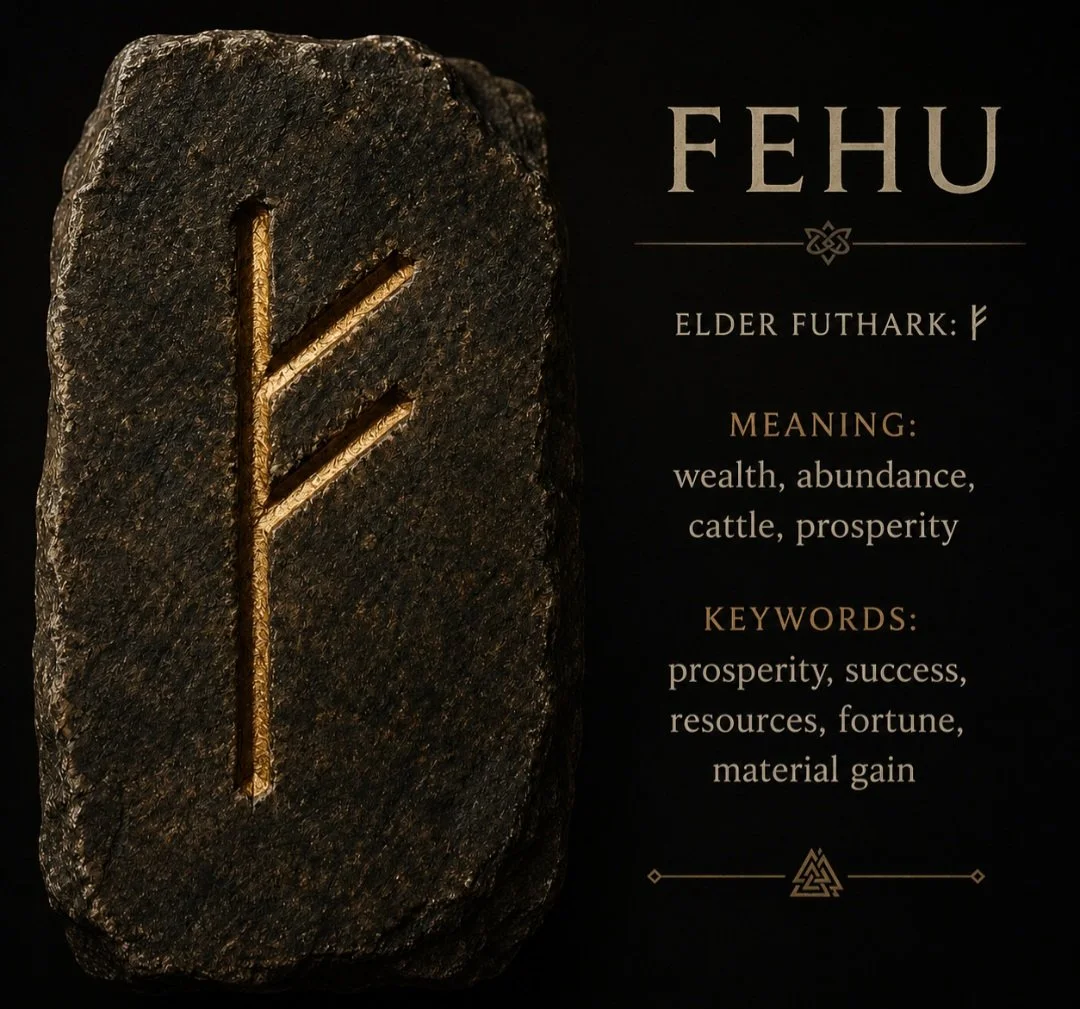
In-Depth Rune series - Fehu
Name Variations: Fehu, Fé, Feoh, Faihu, Foeh
Proto-Germanic: fehu (“cattle, movable wealth”)
Phonetic Sound: F
Ætt placement: First rune of Freyrs ætt
Meaning: Cattle, Wealth, Prosperity, Circulating Resources
Historical Concept: Movable wealth (fé) as opposed to inherited land (ódal)
Themes: Abundance, growth, vitality, new beginnings, prosperity, responsibility, circulation
Modern Deity Associations: Freyr and Freyja (modern practice; not historical)
Fehu stands at the threshold of the Elder Futhark, the first rune of the first ætt and the symbolic gateway into the world of the runes. Its position is no accident. In early Germanic society, life began with resources - food, livestock, tools, and the practical means to survive winter and maintain kinship bonds. Fehu embodies these essentials. It represents cattle, the oldest measure of wealth among Indo-European peoples, and by extension movable property, prosperity, and the circulating life-force of a community.
To those who carved the earliest runes, wealth was not an abstraction. It was the living presence of animals in the byre, the shared resources that held a family or clan together, and how honour was upheld through generosity. A leader was known as a fégjafi (“giver of wealth”), signifying that prosperity gained its true meaning only when it flowed outward. Fehu, therefore, is not a static sign of possession but a symbol of movement, exchange, and responsibility.
The rune poems, though composed centuries after the Elder Futhark had fallen out of use, preserve echoes of this worldview. They describe wealth as a comfort, a cause of discord, and a force as dangerous as fire. These paradoxes reflect a truth well understood in early societies: prosperity brings stability when handled with wisdom, but strife and ruin when governed by greed.
As the opening character of the futhark, Fehu introduces themes that unfold throughout the runic sequence - beginnings, vitality, growth, and the tension between blessing and burden. To understand Fehu is to grasp a foundation of early Germanic life: that survival and honour depend on how wisely one manages the resources entrusted to them.
Fehu is the first rune of the Elder Futhark and the first of the so-called Freyr’s or Freyja’s ætt, a designation used in modern rune study rather than historical sources. Its core meaning is “cattle,” which in early Germanic society represented mobile wealth and prosperity. Livestock provided food, clothing, trade, and status, making them central to survival and exchange. Unlike modern conceptions of wealth as abstract currency, cattle were living assets - the backbone of economic and social life.
Rune Poems
Old English Rune Poem (8th - 9th century): “Wealth is a comfort to all men; yet each must bestow it freely, if he wishes to gain honour before the Lord.”
Norwegian Rune Poem (13th century): “Wealth is a source of discord among kinsmen; the wolf lives in the forest.”
Icelandic Rune Poem (15th century): “Wealth is a source of discord among kinsmen, and a fire of the flood, and the path of the serpent.”
Together, these show that wealth was not simply positive but also brought responsibility, conflict, and danger if mishandled.
Kennings and Literary References (Sagas and Eddas)
Wealth (fé) appears throughout Old Norse and early Germanic literature, revealing how deeply Fehu’s core meaning shaped the moral and social world of the sagas. While the rune itself is never mentioned directly in surviving texts, the concept it represents is woven through poetry, myth, and law. The skaldic tradition in particular preserves numerous kennings (poetic metaphors) that reflect cultural attitudes toward wealth. Chieftains are frequently called fégjafar, “givers of wealth,” highlighting the expectation that leaders demonstrate honour through generosity. Those who distribute treasure, livestock, or weapons to their followers earn loyalty and prestige, while terms such as fénýtr (“spender of wealth”) commend generosity as an essential virtue. Conversely, kennings like fébani (“slayer of wealth”) and fégröf (“grave of wealth”) warn against waste, mismanagement, and the ruin that accompanies greed or poor stewardship. Through these poetic devices, wealth is revealed not as a neutral possession, but as a dynamic moral force.
The sagas reflect this dual nature vividly. In works such as Egil’s Saga and Laxdæla Saga, wealth functions as a means of building alliances, securing marriages, and maintaining honour within the community. A leader’s worth is judged largely by their ability to redistribute wealth, not merely to accumulate it. At the same time, sagas such as Njáls Saga and Gísla Saga reveal the darker side of fé: disputes over inheritance, compensation, and property often ignite feuds that last for generations. Wealth thus becomes both the glue that binds kin-networks together and the spark that tears them apart. This tension closely mirrors the Norwegian and Icelandic rune poems, which describe wealth as a source of both comfort and danger.
The concept of fé also intersects with the notion of hamingja, an individual’s luck, fortune, or spiritual power. Characters in sagas such as Grettir’s Saga and Vatnsdæla Saga reflect the belief that prosperity and luck are intertwined: those with strong hamingja attract resources, opportunities, and allies, while misfortune often manifests as the loss of wealth or status. Fehu thus carries an element of vitality and life-force that extends beyond material possessions alone.
The Eddic poems reinforce these themes. In Hávamál, the speaker warns that wealth is fleeting and unreliable, while generosity and reputation endure beyond death - an ethical principle that lies at the heart of Fehu’s meaning. The Poetic Edda also associates wealth with danger and transformation, from the cursed treasure of the Völsung cycle to the gods’ dealings with gold, payment, and deception in various myths. Snorri Sturluson’s Prose Edda preserves additional kennings that link treasure and cattle with power, obligation, and moral character.
Taken together, the literary landscape surrounding fé reveals a world in which wealth is powerful, unstable, and morally charged. It can nourish or destroy, foster harmony or provoke strife, depending on how it is used. This deepens Fehu’s significance far beyond simple “prosperity,” framing it instead as a rune of movement, generosity, responsibility, and the precarious balance between fortune and misfortune.
Archaeological Evidence and Notable Inscriptions
Fehu appears prominently in the earliest archaeological records of the Elder Futhark, offering valuable insight into its role and status among early Germanic peoples. One of the most significant examples is the Kylver Stone from Gotland, dated to the 5th century CE. This stone preserves the oldest known complete ordering of the Elder Futhark, with Fehu standing at its head. Its position confirms Fehu as the opening rune of the sequence and suggests that it held foundational importance within the runic system. While the precise reasoning behind this ordering remains unknown, the placement of Fehu at the beginning may reflect an early understanding of material resources and life-sustaining wealth as the starting point from which other aspects of life and society unfolded.
Fehu also appears across a wide range of early runic artefacts, including bracteates, amulets, weapons, and personal items, particularly from the Migration Period (4th–6th centuries CE). Bracteates (thin gold medallions worn as pendants) often bear partial futhark sequences, individual runes, or short inscriptions. In these contexts, Fehu frequently appears not as a standalone word meaning “wealth,” but as part of personal names or formulaic inscriptions. Its presence on gold objects is symbolically resonant: gold functioned not only as material treasure but as a marker of power, reputation, and exchange, qualities closely aligned with the broader cultural meaning of fé.
On weapons such as spearheads, seaxes, and knives, Fehu sometimes occurs within personal names or brief inscriptions. These contexts indicate that the rune functioned at least as a phonetic sign linked to ownership and identity. Some scholars have suggested that its placement on martial objects may also reflect hopes for strength, vitality, or good fortune. While it is not possible to determine whether such inscriptions were intended as magical acts, their repeated appearance on personal and martial items suggests that Fehu was closely associated with concepts of possession, status, and possibly protection or success in conflict.
Fehu is less commonly found as a fully spelled-out word (fé or fehu), a pattern that supports the view that early runic inscriptions were not typically used for extended, literal writing. Instead, they often served symbolic, ritual, or ownership-related purposes. In personal names, the presence of Fehu as an initial or internal letter may also have carried connotations of prosperity or strength, subtly reinforcing an individual or family identity associated with abundance and vitality.
Taken together, the archaeological record suggests that Fehu was not merely a linguistic sign, but a rune of recognised importance within early Germanic material culture. Its consistent placement at the beginning of rune rows, its appearance on valuable and symbolic objects, and its use within personal inscriptions point to Fehu as a marker of status, vitality, and foundational power. In this way, the rune echoes the central role of wealth, movement, and resource-flow in early Germanic society.
Cultural Notes (Law Codes, Social Customs, Worldview)
The concept of fé (the Old Norse term corresponding to Fehu) was deeply embedded in the legal and social fabric of early Scandinavian and Germanic societies. In the Icelandic law code Grágás, fé is used broadly to denote property, livestock, valuables, and other forms of movable wealth. This stands in contrast to óðal (or óðalfe), which refers specifically to inherited land and ancestral estates. The distinction between movable and immovable wealth is essential for understanding Fehu, as the rune represents dynamic, circulating prosperity rather than hereditary holdings. Movable wealth could be traded, gifted, used as payment, or redistributed - an important feature of a culture grounded in reciprocity and honour.
In a society where kinship bonds structured nearly all aspects of life, fé functioned as a stabilising force. Legal disputes were often resolved through compensation payments such as wergild (man-price), in which injury or death required repayment in cattle, silver, or goods. These payments helped prevent blood feuds, restore balance, and uphold the honour of both families. The use of fé in legal restitution shows that wealth was not merely personal property, but a tool of justice and social equilibrium. Through such practices, Fehu’s symbolism extends beyond abundance into ethical responsibility and conflict resolution.
Social customs further reveal the moral dimension of wealth. Hospitality and generosity were central virtues in Norse society, and the giving of gifts (whether cattle, tools, or precious metals) strengthened alliances and established reputation. A good leader was expected to be a fégjafi, a “giver of wealth,” whose generosity sustained loyalty and social cohesion. Hoarding wealth, by contrast, was associated with dishonour and social decay. This worldview is reflected in Hávamál, where wealth is described as fleeting and secondary to reputation. The cultural expectation was clear: wealth must flow to retain its value. Stagnant wealth invited conflict, envy, or misfortune, echoing the warnings found in the Norwegian and Icelandic rune poems.
The Norse worldview understood wealth not as a purely individual possession, but as part of a wider network of obligations. Prosperity was closely tied to the well-being of family and community, and fortunes were believed to rise or fall together. Wealth also reflected a person’s hamingja - the inherited and personal luck that shaped destiny. A prosperous household was often understood to be blessed with strong hamingja, just as misfortune could be interpreted as a weakening of one’s spiritual fortune. In this way, Fehu becomes closely linked with vitality: it represents not only material wealth, but the energetic, ancestral, and social forces that allow an individual and their kin to thrive.
Taken together, the law codes, sagas, and cultural customs reveal Fehu as far more than a symbol of wealth. It embodies reciprocity, justice, moral character, and the essential movement of resources that sustains both individuals and society. Fehu can thus be understood as an economic, ethical, and spiritual current running through the early Germanic world - a force that binds people together, tests their integrity, and shapes their fates.
Mythological Connections
While no surviving Norse text directly links Fehu to a single deity or specific myth, its themes of wealth, nourishment, and generative power resonate throughout the mythological tradition. One of the most striking parallels appears in the figure of Auðhumla, the primeval cow described in Gylfaginning. As the first living being to nourish the cosmos, Auðhumla embodies the idea of life-sustaining wealth: she feeds the giant Ymir and reveals Búri, the ancestor of the gods, through her licking of the rime-stones. Although Fehu was never historically assigned to Auðhumla, the thematic overlap is clear. Both represent the origin of sustenance, the flow of life, and the resources upon which creation itself depends.
The broader Norse worldview reinforces this connection between prosperity and the forces that animate life. In myth and poetry, wealth is often understood as an extension of fate (urðr or ørlög) and luck (hamingja). Families believed to possess strong hamingja tend to prosper materially, while those marked by misfortune often experience the loss of cattle, goods, or social standing. Fehu can therefore be understood as the material expression of a deeper spiritual vitality - the outward sign of an inner fortune shaped by ancestry, honour, and the favour of unseen powers.
The Vanir, the divine family associated with fertility, agriculture, and prosperity, also mirror key aspects of Fehu’s nature. Though not historically tied to the rune, they embody similar generative forces: the fertility of the land, the health of herds, and the cycles of giving and receiving that sustain communal life. Myths involving the Vanir (such as the exchanges of hostages and wealth between the Æsir and the Vanir) reflect the cultural importance of reciprocity, a concept central to Fehu’s meaning. Wealth must move to remain beneficial; likewise, alliances, obligations, and oaths must circulate to maintain balance among both divine and mortal powers.
Across the Poetic Edda, references to gold and treasure carry a moral ambivalence that mirrors the rune poems’ warnings about fé. Myths such as the cursed hoard of Fáfnir, the gold of Andvari’s curse, and the destructive power of wealth in the Völsung tradition all echo the dual nature of Fehu: wealth can uplift or corrupt, create prosperity or invite ruin. These stories show that the Norse did not view wealth as inherently good or evil, but as a potent force requiring wisdom, integrity, and restraint.
Fehu’s mythological connections therefore lie not in specific gods, but in thematic currents woven throughout Norse myth: nourishment, vitality, fortune, reciprocity, and the dangerous allure of material gain. Together, these elements shape Fehu as a rune of both creative force and peril, reminding us that all prosperity arises from the primal energies that sustain the world and all beings within it.
Symbolism and Core Interpretive Themes
Fehu symbolises the living flow of resources, the warmth of life-force, and the power of beginnings. As the first rune of the Elder Futhark, it stands at the threshold of creation, embodying potential seeking expression. Its symbolism is rooted in the ancient understanding that wealth must circulate to nourish both individuals and communities. Just as cattle must graze, move, and reproduce, so too must prosperity pass through many hands if it is to retain vitality. Fehu represents this dynamic movement - the principle that abundance grows through action, exchange, and stewardship.
At its core, Fehu encompasses themes of nourishment, vitality, fertility, renewal, and initiation. It reflects the energy required to begin new ventures and the momentum that carries projects forward. Fehu is also tied to luck and personal fortune (hamingja), expressing the belief that inner strength or ancestral blessing is mirrored in outward prosperity. Yet beneath all of this lies a deeper truth: Fehu is neither static nor passive. It is a living force - creative, unstable, and transformative. It invites growth, but it also demands responsibility, reminding us that all power must be balanced with wisdom.
Light Aspect / Positive Expression of the Rune
The positive aspect of Fehu is the healthy flow of abundance. When expressed well, Fehu signifies prosperity earned through effort, wise decision-making, and alignment with one’s true purpose. This abundance extends beyond material wealth to include emotional nourishment, creative inspiration, and energetic vitality. In its light aspect, Fehu encourages generosity, recognising that shared resources strengthen bonds and return blessings in unexpected ways. It promotes confidence, initiative, and the courage to begin new endeavours.
A well-balanced Fehu brings stability without stagnation. It teaches that prosperity grows through mindful cultivation and honest work. This aspect reflects a person or situation in which energy moves freely - opportunities arise, relationships flourish, and resources are used responsibly. Here, Fehu becomes a rune of thriving: of spiritual and material enrichment, and of the joyful momentum that accompanies a new beginning blessed with good fortune.
Shadow Aspect / Difficult Expression of the Rune
Fehu’s shadow emerges when wealth becomes a source of fear, greed, conflict, or imbalance. Because Fehu represents movement, its darker expression appears when energy becomes blocked, hoarded, mismanaged, or misdirected. This may manifest as financial loss, wasted opportunity, jealousy, or discord within families - exactly as the rune poems warn. In its shadow, Fehu draws attention to unhealthy attachments, whether to possessions, status, or outcomes. The more one clings to what must flow, the more stagnation and tension arise.
On a deeper level, Fehu’s shadow exposes the illusion of security. It reminds us that material wealth is impermanent, and that relying upon it for identity or power leads to disappointment. Greed, miserliness, or the use of wealth to control others fractures relationships and disrupts harmony. Spiritually, Fehu’s difficult aspect may reflect depleted life-force, burnout, or a sense of inward dryness - energy that no longer nourishes or inspires. In this sense, Fehu’s shadow is not a punishment, but a teacher, revealing where imbalance has taken root and where renewal must begin.
Divinatory Meaning - Upright
When upright, Fehu signifies movement, prosperity, and successful beginnings. It represents resources flowing in the right direction and opportunities arising through effort and alignment. This rune indicates that the querent is entering a phase in which abundance (material, emotional, creative, or energetic) is available and increasing. It often appears at the outset of new ventures, affirming that conditions are favourable and that the groundwork already laid is ready to bear fruit.
Fehu upright also reflects self-sufficiency, vitality, and personal initiative. It encourages the querent to act, make clear decisions, and trust in their ability to generate results. Spiritually, it may indicate strengthened hamingja (luck or fortune), suggesting support from ancestral or energetic momentum. Above all, Fehu upright highlights the importance of wise stewardship: using resources responsibly and generously to maintain balance and harmony.
Divinatory Meaning - Reversed / Merkstave
When reversed, or appearing as a merkstave, Fehu reveals disrupted flow, signalling stagnation, mismanagement, or loss. This may manifest as financial difficulty, wasted effort, poor investment of time or energy, or an inability to move forward due to fear, a scarcity mindset, or unresolved obligations. It warns against holding too tightly to what should instead be shared or redirected. Fehu reversed often highlights issues of possession, pride, and entitlement, drawing attention to places where clinging has replaced trust.
On a deeper level, Fehu reversed may indicate fatigue, depleted vitality, or spiritual dryness - a sense that the inner well has run low and renewal is needed. It can point to conflict over resources, envy, or a breakdown of reciprocity within relationships. Rather than predicting misfortune, Fehu reversed functions as a corrective force: it exposes where energy has become stuck so that it may be set into motion once again. It reminds the querent that abundance depends upon flow, and that stagnation must be addressed with honesty and courage.
Questions the Rune Asks in Readings
Fehu’s appearance often brings reflective questions rather than direct commands. It invites the querent to examine the state of their resources, relationships, and inner vitality, asking where energy is flowing freely and where it has become blocked. It prompts reflection on beginnings that require commitment and nourishment, and on what must be cultivated, invested in, or released in order to restore movement.
Fehu also turns attention to balance in giving and receiving: whether one is offering too little or too much, and how choices around wealth, time, and effort reflect deeper values of responsibility and generosity. At a deeper level, it asks whether prosperity is aligned with integrity, how comfortable one is with receiving and letting go, and what fears or attachments may be obstructing healthy flow. At its heart, Fehu’s questioning always centres on flow, responsibility, reciprocity, and intention - the moral dynamics of abundance embedded within the Norse world.
Warnings and Common Misinterpretations
Fehu is often misunderstood as a simple “money rune,” but its meaning is far deeper and more complex. In the historical Germanic worldview, fé referred to movable wealth, not currency alone. It encompassed livestock, goods, tools, and valuables - everything necessary for survival and social responsibility. Reducing Fehu to mere “financial gain” overlooks the rune’s emphasis on movement, ethical conduct, and the balance between advantage and danger.
Another common misinterpretation is the attempt to use Fehu to “manifest wealth out of nowhere.” In Norse tradition, prosperity was always tied to effort, honour, and wise management. Fehu supports action, but it does not replace it. Likewise, Fehu is sometimes mistaken for a symbol of guaranteed success, when in fact it serves as a reminder that wealth demands responsibility, and that mismanagement leads to conflict, envy, or loss - just as the rune poems warn.
Finally, many modern readers overlook the fact that wealth in the sagas is morally charged. Hoarding was dishonourable; generosity was noble. Fehu’s warning is clear: the more tightly one clings to what should flow, the more likely it is to stagnate or slip away. The rune teaches balance, stewardship, and reciprocity - not accumulation for its own sake.
Seiðr Work / Trancework Interpretation
In seiðr and trancework, Fehu is often experienced as a warm, flowing force - the sensation of life returning to cold ground, or the first spark of movement after stillness. Many practitioners describe Fehu as a rising heat in the chest or belly, a pulsing current that spreads outward and awakens stagnant pathways within body and spirit. It is the movement of nourishment (milk, fire, blood, breath) bringing renewal, vitality, and capacity.
When approached in trance, Fehu may appear symbolically as glowing embers, a flowing stream of light, a healthy herd of animals, or golden fields ready for harvest. These images emphasise one of Fehu’s deepest teachings: abundance is alive, relational, and never isolated. The rune invites the practitioner to examine the flow of their life-force - what is being given and received, what is hoarded, and what needs release. It teaches the importance of balance and reciprocity, both in the physical world and in spiritual relationships.
Fehu also connects to hamingja, the spiritual force of luck and vitality carried through ancestry. In seiðr, Fehu may reveal whether one’s hamingja is strong, blocked, depleted, or in need of renewal. It can draw attention to familial patterns involving the flow of resources (inheritance, generosity, withholding, or conflict) and help the practitioner heal or realign these ancestral currents. When approached with respect, Fehu becomes a rune of restoration, reconnecting the individual to the vital energies that sustain creation and community.
Practical Magical Uses (Modern Rune Magic)
In modern Norse-inspired magical practice, Fehu is regarded as a powerful rune for initiating movement and supporting growth in any area where resources, energy, or opportunity need to flow. It is commonly used in spells or rituals aimed at prosperity, but its effect is best understood as amplifying effort and intention rather than generating wealth without foundation. Fehu strengthens the capacity to act decisively, commit to goals, and follow through with consistency.
Fehu is also used to clear stagnation. When worked with ritually, it may help dissolve blockages related to self-worth, motivation, or fear of change. Many practitioners incorporate Fehu into practices intended to restore confidence, revitalise personal energy, or empower new beginnings. It is often used to bless new projects, homes, or relationships, imbuing them with momentum and a focus on growth.
In healing or energetic work, Fehu is sometimes employed to support the flow of life-force. When combined with breathwork or chanting (galdr), it may help warm and activate areas that feel depleted or dormant. Its nourishing quality makes it a supportive rune for rituals connected with fertility, creativity, or the restoration of personal power. However, Fehu also demands responsibility: intentions driven by greed or imbalance are traditionally understood to backfire, reinforcing the principle that abundance must be ethical and grounded in reciprocity.
Bindrune and Galdr Considerations
Fehu is a strong opening rune in bindrunes due to its role as an initiator of flow. It is often understood to “activate” the runes combined with it, enhancing their movement and expression. When paired with runes such as Uruz (strength), Kenaz (creativity), or Jera (harvest), Fehu is thought to amplify potential and encourage momentum. However, when combined with more volatile runes like Thurisaz or Hagalaz, Fehu may intensify unpredictable energies, producing swift and forceful outcomes that require careful intention and restraint.
In galdr (runic chanting), Fehu is typically voiced as a long, warming “fffffffff,” allowing breath and vibration to move outward. The sound resonates through the lips and teeth, encouraging circulation and awakening bodily awareness. Galdr using Fehu is often performed at the beginning of ritual work to open pathways, clear stagnation, or invite vitality. The tone should remain steady and controlled, reflecting Fehu’s principle of purposeful movement rather than unchecked expansion.
When crafting bindrunes, placement is significant. Positioning Fehu at the top or left side commonly symbolises initiation, outward flow, and the release of energy. At the base, it suggests foundation, nourishment, and support. Placing Fehu at the end of a bindrune may indicate completion that naturally gives rise to a new cycle. Practitioners are also encouraged to remain mindful of Fehu’s shadow aspect: combining it with runes associated with destruction, disruption, or boundaries can create conflict or unintended severance if not balanced by runes that stabilise or harmonise the working.
In all cases, Fehu’s role in bindrune and galdr practice is to awaken, empower, and set energies into motion - always in ways that honour balance, reciprocity, and responsible intention.