
The Three Ættir of the Elder Futhark: History, Meaning, and Modern Interpretation
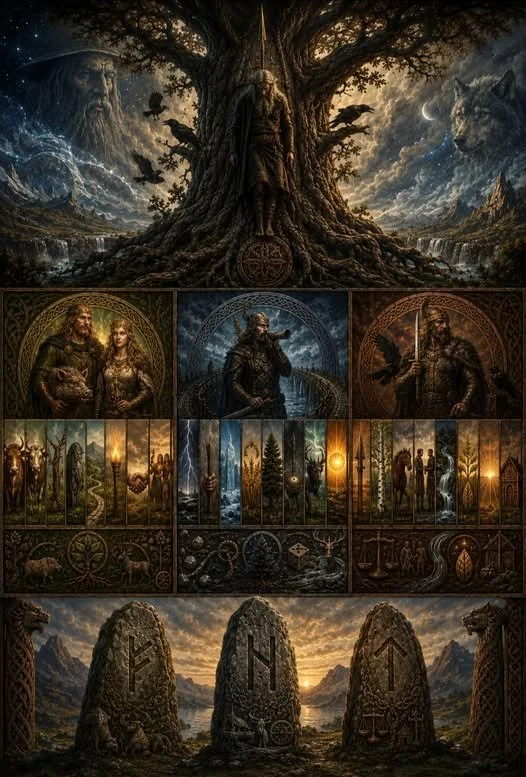
In Norse mythology, the runes were said to have been discovered by Odin, who sacrificed himself upon the World Tree, Yggdrasil, hanging for nine nights, pierced by his own spear, in order to gain their wisdom. This mythic origin, preserved in Hávamál, endowed the runes with a sacred and divine character. Although this story was written down centuries after the Elder Futhark had fallen out of use, it reflects how later Norse culture remembered the runes as more than mere letters: they were gifts of the gods, bound to fate, sacrifice, and wisdom.
Each rune carried multiple layers of meaning. At its most basic level, a rune represented a sound (a phoneme), but it also bore a name, usually connected to an object, concept, or force of nature. For example, Fehu meant “cattle,” the primary measure of wealth in early Germanic societies. Beyond their phonetic and literal functions, many runes also carried symbolic significance. Some became closely associated with deities (such as Tiwaz with the god Týr or Ansuz with Odin) although not every rune was explicitly linked to a god in surviving sources.
Over time, regional variation led to differences in rune names, forms, and interpretations. As Germanic peoples migrated and their languages evolved, the Elder Futhark gradually gave rise to new runic systems: the Younger Futhark in Scandinavia, the Anglo-Saxon Futhorc in England and Frisia, and later the medieval runes. These adaptations reflect both shifts in spoken language and changes in how runes were used within evolving cultural contexts.
The runes are therefore multifaceted: at once a writing system, a symbolic code, and a spiritual tool. From their origins in the Proto-Norse period, through their mythological elevation in the ‘Viking Age’, to their reinterpretation in the modern world, the Elder Futhark continues to resonate as both a historical artefact and a living symbol of cultural and spiritual identity.
ÆTTIR
The Elder Futhark, with its twenty-four runes, is traditionally divided into three groups of eight, known as ættir (singular ætt). The word ætt is an Old Norse term meaning “family,” “lineage,” or “clan,” reflecting the central importance of kinship in Germanic society. The runes are consistently arranged in these three sets across surviving rune rows, indicating that this division formed part of how the alphabet was ordered and remembered.
However, the reasons behind this arrangement remain uncertain. Unlike the Latin or Greek alphabets, whose letter orders have clearer historical lineages, no surviving source explains why the Elder Futhark was organised into ættir. No saga, poem, or historical text assigns explicit symbolic meanings to these groups. What can be stated with confidence is that the ættir functioned as a mnemonic device - a practical way of structuring the runes into smaller, more manageable sequences for learning and transmission.
Because medieval texts do not explain the meaning of the ættir, later generations (particularly modern rune practitioners) have sought to assign symbolic significance to this division. Many interpret the three ættir as representing broad stages of life, aspects of the cosmos, or phases of spiritual initiation. Others associate them with specific deities, although such links are speculative and vary widely between traditions.
For example, some modern rune manuals assign the first ætt to Freyr or Freyja, deities connected with fertility and prosperity; the second ætt to Heimdall or to the rune Hagal, often interpreted as a force of testing and transformation; and the third ætt to Tyr, the god associated with law, honour, and sacrifice. These divine correspondences are not attested in historical sources, but they have become part of the symbolic frameworks through which many modern practitioners approach rune study.
The First Ætt -
(Often called Freyr’s or Freyja’s Ætt)
The first ætt, which contains the runes from Fehu through Wunjo, is sometimes referred to in modern rune study as Freyr’s or Freyja’s ætt. It is important to emphasise that these divine associations are not attested in historical sources; rather, they are later interpretations developed to provide a symbolic framework for understanding the runes.
In Norse mythology, Freyr is associated with fertility, prosperity, and abundance, while Freyja is linked to love, beauty, and magic. Together, they embody primal forces of life, creation, and the bond between humanity and the natural world. For this reason, many modern practitioners interpret the first ætt as centring on themes of survival, prosperity, fertility, social bonds, and the foundational conditions of human life.
The eight runes of this ætt are Fehu, Uruz, Thurisaz, Ansuz, Raidho, Kenaz, Gebo, and Wunjo. These runes are commonly interpreted in modern rune study as representing the essential building blocks of existence: wealth and cattle (Fehu), strength and vitality (Uruz), the raw and often dangerous force of giants (Thurisaz), divine inspiration and communication (Ansuz), the journey or rightful path (Raidho), illumination and knowledge (Kenaz), partnership and gift-giving (Gebo), and joy, harmony, or well-being (Wunjo).
Taken together, this ætt is often understood symbolically as encompassing health, prosperity, kinship, and joy - the foundational conditions upon which both individual life and communal stability are built.
The Second Ætt -
(Sometimes referred to in modern rune literature as Heimdall’s or Móðgudr’s Ætt)
The second ætt runs from Hagalaz to Sowilo and is often interpreted in modern rune study as the ætt of challenge, transformation, and cosmic forces. The runes within it are frequently understood as reflecting the trials imposed by fate and the necessity of growth through struggle. Hagalaz (hail) and Isa (ice) represent forces of nature beyond human control, bringing disruption, hardship, and stasis. Nauthiz (need) and Jera (year, harvest) speak to necessity, endurance, and the cyclical nature of time, while Eihwaz (yew tree) and Sowilo (sun) are commonly interpreted as symbols of resilience, renewal, and eventual triumph. Perthro, whose meaning remains uncertain, is often associated in modern practice with chance, mystery, or destiny, while Algiz is widely interpreted as a sign of protection.
Some modern rune practitioners associate this ætt with mythic figures connected to watchfulness, trials, and liminal boundaries. One such attribution links it with Heimdall, the ever-vigilant guardian of the gods, and occasionally with Móðgudr, the guardian of the Gjallarbrú bridge leading to the realm of the dead. These associations, however, are not attested in historical sources and should be understood as part of modern symbolic frameworks rather than ancient tradition.
Symbolically, the second ætt is therefore often seen as representing change, challenge, and human trials. Its runes are commonly interpreted as addressing the forging of character through hardship, offering lessons of endurance, transformation, and renewal. The runes of this ætt are Hagalaz, Nauthiz, Isa, Jera, Eihwaz, Perthro, Algiz, and Sowilo.
The Third Ætt -
(Sometimes referred to in modern rune literature as Tyr’s Ætt):
The third ætt runs from Tiwaz to Othala and is often interpreted in modern rune study as the ætt of law, order, higher destiny, and spiritual transformation. It begins with Tiwaz, the rune associated with Tyr, symbolising justice, courage, and self-sacrifice. Berkano (birch) represents birth, nurturing, and renewal, while Othala (ancestral land) closes the ætt with themes of heritage, inheritance, and kinship.
Between these points lie runes associated with movement and trust (Ehwaz), humanity and social order (Mannaz), the flow of water (Laguz), fertility and continuity (Ingwaz), and transformation or breakthrough (Dagaz). Taken together, these runes are often understood in modern interpretation as reflecting leadership, responsibility, and the shaping of personal and communal destiny, as well as the seeker’s path toward wisdom and legacy.
In contemporary rune lore, this ætt is sometimes called Tyr’s ætt, reflecting the prominence of Tiwaz and its association with law and sacrifice. More rarely, it has been linked with Zisa, a figure known from later medieval German tradition whose status as a goddess remains debated. There is no evidence from the Viking Age or earlier that Zisa was connected to the runes, to Tyr, or to the ættir. Such associations belong entirely to modern symbolic frameworks and vary between contemporary practitioners.
Symbolically, the third ætt is therefore often seen as representing spiritual awareness and responsibility. It encompasses themes of justice, sacrifice, transformation, and ancestral legacy - the point at which the seeker confronts higher order, destiny, and the weight of inherited meaning.
The runes of this ætt are Tiwaz, Berkano, Ehwaz, Mannaz, Laguz, Ingwaz, Dagaz, and Othala.
Whether or not the original carvers of the Elder Futhark understood the ættir in symbolic terms, the division of the runes into three families has proven to be a powerful framework for study and practice. For modern readers, it offers a way of approaching the twenty-four runes not as isolated symbols, but as parts of an interconnected system encompassing prosperity and survival, challenge and transformation, and justice and legacy.
Taken together, the runes form a system that has carried multiple layers of meaning (linguistic, symbolic, and spiritual) across centuries. Even though the historical record remains silent on why the runes were arranged in this manner, the three ættir continue to provide a meaningful lens through which both scholars and modern practitioners can explore the Elder Futhark.