
The Sigtuna Healing Charm - Historic Norse magic
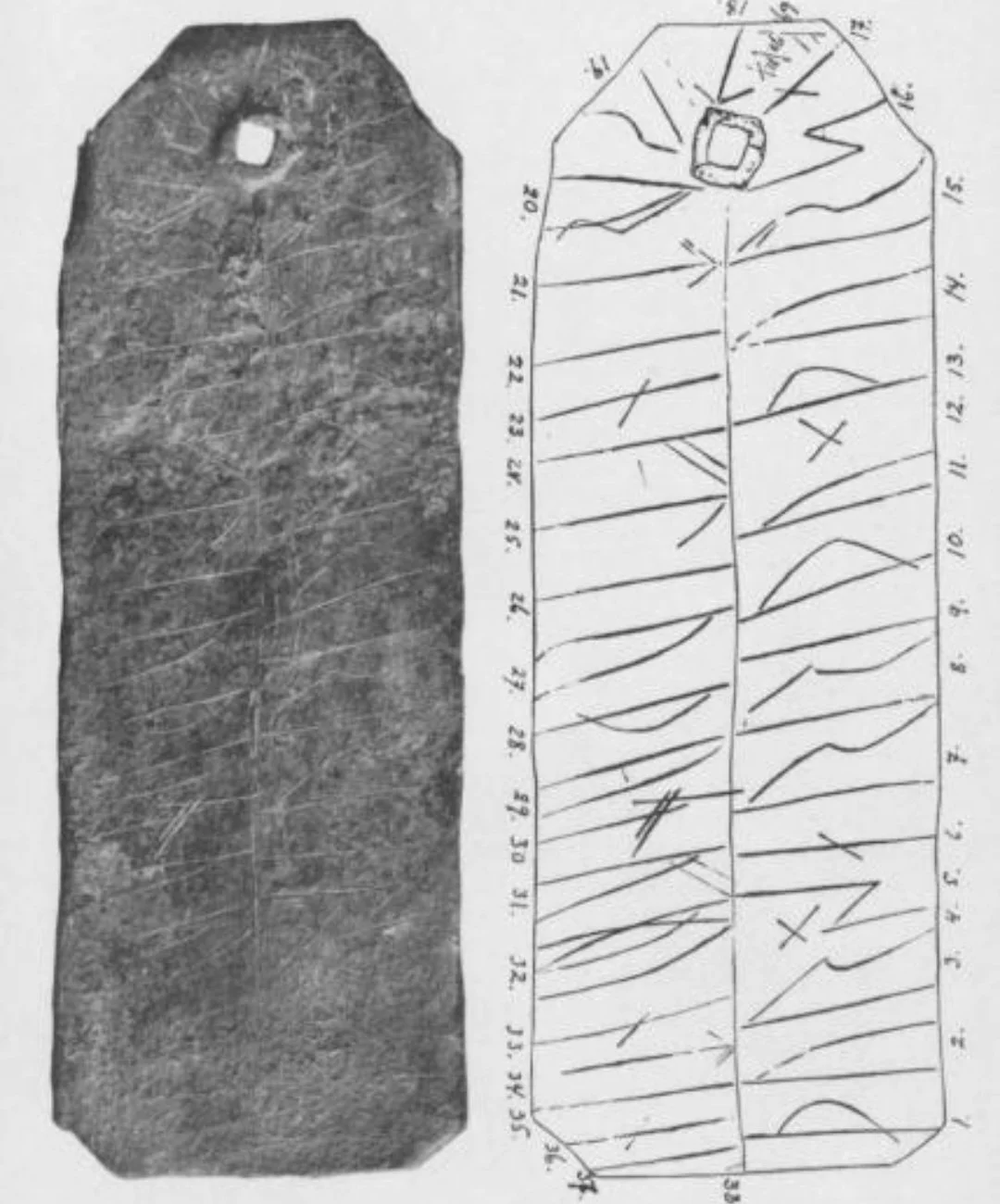
When people hear the words “Norse magic” today, they often imagine bindrunes, elaborate magical symbols, protection sigils and carefully constructed rituals. The problem is that a great deal of what circulates online as ancient “Viking magic” is actually modern. That does not mean magical practices were absent from the historical Norse world. Far from it. Occasionally archaeology gives us something much more valuable than a modern reconstruction: an actual magical inscription written by people living in medieval Scandinavia.
One fascinating example is known as Sigtuna Amulet I. It is a small copper plate discovered at Sigtuna in Sweden and generally dated to around the 11th century. Someone deliberately covered this object with a runic inscription which appears to preserve a charm intended to combat sickness or an affliction. We are not looking at somebody in the modern period trying to recreate what they imagine Viking magic might have looked like. We are looking at words that were actually carved onto an object roughly a thousand years ago.
One of the most striking portions of the inscription has been normalised approximately as “Þurs sárriðu, þursa dróttinn! Flý þú nú! Fundinn es.” Translations vary because parts of the inscription are difficult and scholars do not agree on every reading, but it can be understood approximately as: “Þurs of wound-fever, lord of þursar! Flee now! You are found.”
Those words tell us something incredibly interesting about the way the affliction is being treated. The charm does not simply ask for the sick person to become well. Instead, whatever is causing the sickness is confronted almost as though it were a hostile being. It is identified, addressed directly and then commanded to leave. The words “You are found” are particularly striking. Whatever has been causing the suffering is no longer hidden. It has been recognised, and once recognised, the practitioner attempts to drive it away.
The word þurs is important here. In Old Norse and related Germanic traditions, þurs refers to a class of dangerous supernatural beings. It is sometimes simply translated as “giant,” although that translation can obscure the wider associations of the word. Þursar frequently occupy the dangerous or hostile side of the supernatural landscape, and gods such as Þórr are repeatedly portrayed confronting them. In the Sigtuna charm, the language of the þurs appears in connection with sickness. The illness is therefore not described in anything resembling modern medical terminology. It is treated through the language of a threatening supernatural force.
The charm then invokes three torments and nine nauðir against the hostile being. Nauð can carry meanings connected with need, distress, necessity or constraint. Anyone familiar with runes will immediately recognise its relationship with the rune-name Nauðr/Nauthiz, but this is where we have to be careful historically. The presence of nauðir does not automatically mean that someone was repeatedly drawing the Nauthiz rune in the manner sometimes suggested by modern rune magic. What survives is the language of nine needs, necessities or distresses being directed against the threatening entity. We should not add a ritual method that the inscription itself does not preserve.
The number nine is nevertheless interesting because it repeatedly appears throughout Old Norse literature. Óðinn hangs upon the tree for nine nights in Hávamál. Heimdallr is associated with nine mothers. Nine-night periods occur elsewhere in the literature, and later Norse cosmological traditions speak of nine worlds. This does not mean every occurrence of the number nine had one universal magical meaning, but it does demonstrate that nine carried considerable cultural significance. Its appearance within a magical charm is therefore worth noticing without inventing meanings that the evidence cannot support.
Another intriguing word appearing within the charm is úlfr - “wolf.” Wolves occupied a complicated place within Norse mythology and culture, carrying associations with danger, predation and the wild. Mythological wolves naturally bring Fenrir, Sköll and Hati to mind, but there is no need to claim that the wolf mentioned here is Fenrir or another famous mythological wolf. The important point is the threatening imagery. Whatever is being confronted is described through language associated with something hostile and dangerous.
This is where the Sigtuna charm becomes particularly valuable for understanding historical Norse magic. Modern discussions often reduce rune magic to questions such as “Which rune represents protection?” or “Which rune should I use for healing?” Yet surviving historical material can reveal something much more complicated. Magic could involve identification, command, threat, repetition, supernatural terminology and the physical act of carving words onto an object. The runes were not simply little symbols carrying individual modern keywords. They were being used to write language, and that language itself was intended to accomplish something.
That distinction is extremely important. Runes were first and foremost writing systems. Norse and other Germanic peoples used them for names, memorials, ownership marks, messages, graffiti and many other completely ordinary purposes. A runic inscription is not automatically magical simply because it is written in runes. However, some inscriptions clearly appear within magical or ritual contexts. The Sigtuna amulet is one of the examples where the contents and apparent purpose of the inscription give us strong reasons to discuss magic.
The magical element therefore does not come from the idea that every individual rune was inherently a magical symbol. It comes from what was being written and done with those runes. Someone selected words, carved them into metal and apparently created an object intended to work against an affliction. In that sense, writing itself becomes part of the magical action. Language is being made physical.
The commands within the charm are particularly important. “Flee now!” is not a description of something fleeing. It is an order. “You are found” is not simply a statement of information. It establishes that the threatening thing has been recognised. The language is performative: the words are intended to cause something to happen. The practitioner speaks to the affliction as an opponent and attempts to exercise authority over it.
This idea becomes even more fascinating when we compare the Sigtuna material with another surviving Scandinavian magical text usually called the Canterbury Rune-Charm. Although preserved in England, its language points toward Scandinavian involvement, and it also concerns a harmful supernatural being associated with sickness. Within that charm we encounter an extraordinarily familiar name: Þórr.
A famous portion is commonly read as “Þórr vígi þik,” approximately meaning “May Þórr hallow you” or “May Þórr consecrate you.” The verb vígja concerns hallowing or consecrating something. Þórr's appearance in a charm against a threatening supernatural force makes considerable sense when we compare it with the role he occupies throughout Norse mythology.
Popular culture often reduces Þórr to simply “the god of thunder,” but his mythological function is much broader. Again and again, Þórr travels into dangerous spaces and confronts jötnar and þursar. He is one of the great defenders of the divine and human worlds against threatening supernatural forces. His hammer Mjǫllnir destroys these beings, but the hammer is not represented solely as a weapon of destruction. It also possesses a hallowing function.
We see this clearly in Þrymskviða. After Mjǫllnir has been stolen and Þórr disguises himself as Freyja to recover it, the hammer is eventually brought forward during the supposed wedding ceremony and placed in the “bride's” lap in order to hallow the marriage. The scene is deliberately humorous, but behind the humour is something important: Mjǫllnir can sanctify as well as destroy. That makes Þórr an entirely understandable divine figure to invoke when confronting a hostile supernatural force believed to be causing illness.
However, we should also avoid calling every historical Norse magical practice seiðr. That is another common modern mistake. Old Norse sources preserve several magical concepts and terms, including seiðr, galdr, spá, fjǫlkyngi, charms, supernatural healing practices and various forms of magical knowledge. Their boundaries are not always clear to us, and the surviving sources never provide a convenient handbook explaining exactly how every category worked.
For that reason, it would be misleading to confidently call the Sigtuna amulet a “seiðr spell.” We simply do not have enough evidence to make that identification. Describing it as a runic healing or protective charm is much safer. Historical accuracy sometimes means being willing to say that we do not know precisely what category the people who created an object would have placed it within.
There is another complication that makes Sigtuna particularly interesting. The amulet comes from around the 11th century, during the period when Scandinavia was undergoing enormous religious change. Christianity was becoming established while older religious traditions, beliefs, stories and practices did not simply vanish overnight. Sigtuna itself existed within this changing world.
We therefore should not automatically imagine the person who made the amulet as an untouched “Viking pagan” practising a perfectly preserved pre-Christian religion. Reality was almost certainly more complicated. Old beliefs could survive within increasingly Christian communities. Christian ideas could mix with older cultural traditions. Magical formulas could persist across religious boundaries. People do not abandon generations of cultural understanding the moment an official religion changes.
That does not make the charm less valuable as evidence for Norse magical tradition. In many ways, it makes it even more interesting because it allows us to glimpse a period when different religious ideas existed alongside one another. The supernatural view expressed in the charm may preserve concepts much older than the physical object itself.
Perhaps the greatest value of the Sigtuna amulet is that it forces us to move away from the simplified modern version of “Norse magic.” There is no neat chart saying Fehu means wealth, Gebo means love and Algiz means protection. Instead, we encounter something far more human. Someone was suffering. The suffering was conceptualised through supernatural language. The threatening force was identified. It was confronted. It was threatened and commanded to leave. Words were physically carved into metal, creating an object intended to participate in overcoming that suffering.
We do not know everything that happened around the creation of the amulet. Perhaps words were spoken while it was carved. Perhaps additional ritual actions took place. Perhaps it was carried on the body. Perhaps there were healing substances or other practices involved. Unless evidence survives, we cannot simply fill those gaps with whatever modern ritual seems plausible. That uncertainty is important.
But what has survived is extraordinary enough.
Someone approximately one thousand years ago took a piece of copper and carved a message directed toward something they believed was causing suffering.
They identified it.
They confronted it.
And then they told it:
Flý þú nú! Fundinn es.
“Flee now! You are found.”
The person who carved those words is long gone. The person for whom the charm was intended is gone. Whatever actions, prayers or spoken words accompanied its creation have disappeared with them. Yet the inscription survived.
That is why objects like the Sigtuna amulet matter so much when studying historical Norse magic. They allow us to move beyond asking “What do modern people think Viking magic looked like?” and instead ask a much better question:
“What evidence did the Norse themselves leave behind?”
And sometimes, buried beneath the ground for centuries, we actually find an answer.