
Gandr: When Magic Was Sent Forth in the Old Norse World
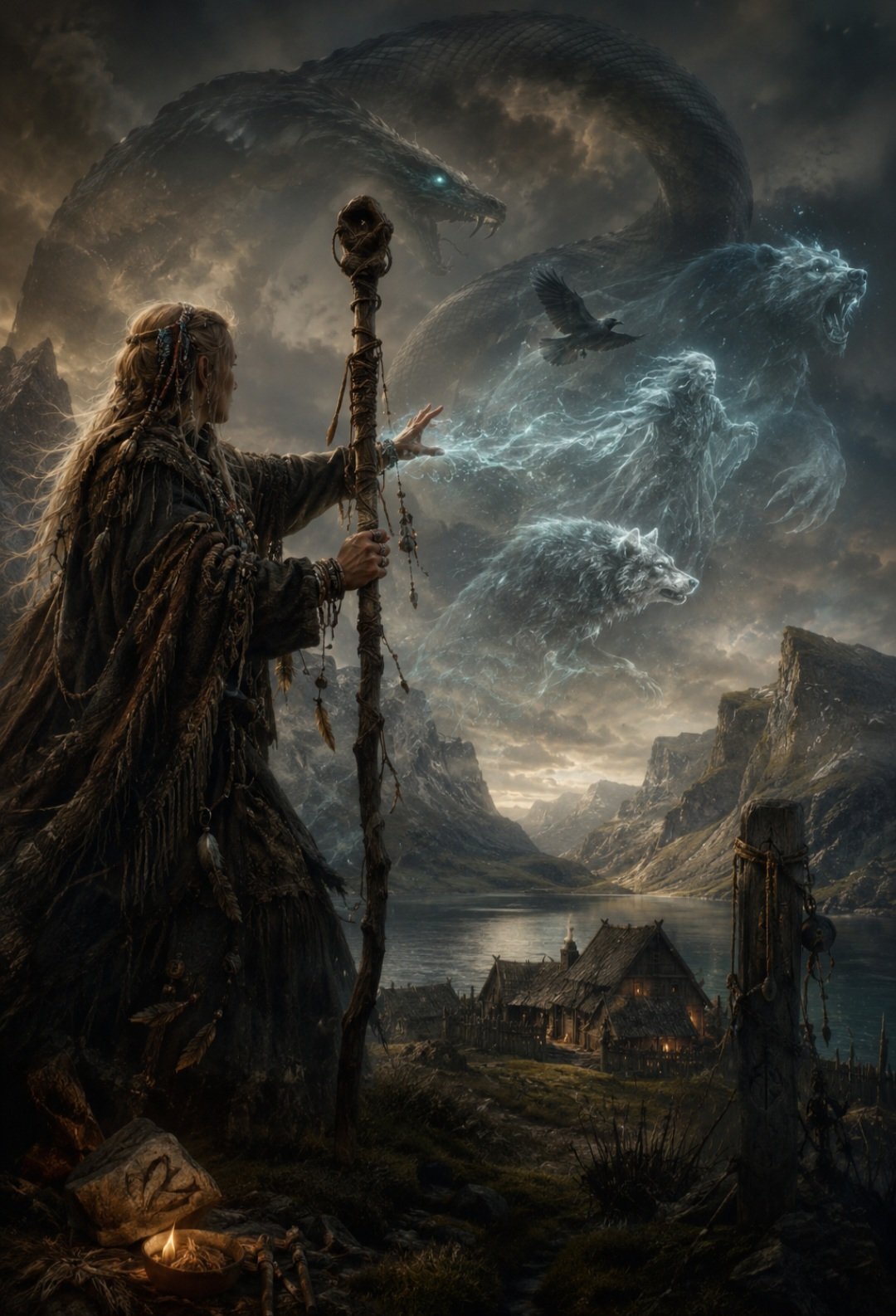
When we think about magic in the Old Norse world, a familiar collection of words usually appears: seiðr, galdr, runes, prophecy, the völva and perhaps Óðinn's own pursuit of supernatural knowledge. Yet buried within the vocabulary of Old Norse magic is another word that is considerably harder to explain. That word is gandr. At first glance, translating it seems relatively straightforward. Depending on the dictionary, period and textual context, gandr can be associated with a staff or magical implement, a supernatural being or spirit, a monster, and magical activity itself. The problem is immediately obvious. A staff is a physical object. A spirit is an independently acting being. A monster is something else again. Why should one Old Norse word move between apparently unrelated meanings?
This problem has fascinated scholars because gandr may preserve traces of a way of conceptualising supernatural action that no longer fits neatly into modern categories. Rather than simply meaning a “magic wand”, some scholars have argued that at least part of the semantic history of gandr concerns supernatural agency that could be sent or projected outward. Something belonging to, controlled by, or associated with a magical practitioner could leave its ordinary location, travel elsewhere and act independently. Depending upon the context, that agency might gather information, participate in supernatural travel or be directed against another person. If this interpretation is correct, gandr was not merely another Norse word for magic. It belonged to a much stranger conceptual territory in which magic could become mobile.
One of the most important scholars to investigate this problem was Clive Tolley, particularly in his study “Vǫrðr and Gandr: Helping Spirits in Norse Magic”. Tolley examined gandr alongside supernatural helpers, magical staffs, seiðr and traditions of supernatural travel. Rather than forcing every occurrence into one dictionary definition, his work demonstrates how the word sits inside a much larger network of ideas concerning magical beings and supernatural agency. Eldar Heide subsequently developed the problem extensively in his doctoral research Gand, seid og åndevind. Heide argued that one important underlying conception associated with gandr may have involved a spirit or soul-form being sent forth. In his reconstruction, a practitioner could potentially send their own supernatural agency, or a helping being associated with them, away from the ordinary body in order to perceive distant things or affect others.
This needs to be treated carefully. No surviving Viking-Age magical manual tells us that “a gandr is a projected soul” or gives instructions for producing one. What we have instead is a reconstruction based upon linguistic evidence, medieval literature, later Scandinavian traditions and comparison with neighbouring magical cultures. Heide's interpretation is influential and extremely useful, but it remains an interpretation of fragmented evidence rather than a universally accepted definition supplied by the medieval sources themselves. That distinction is important because gandr is precisely the sort of obscure concept that can easily be transformed into a completely systematic modern spiritual practice despite the historical evidence being anything but systematic.
The possibility that supernatural agency could leave the ordinary body is not isolated within Old Norse literature. Norse texts repeatedly describe people perceiving distant events, changing form, appearing through dreams, travelling supernaturally or affecting others without normal physical contact. Modern readers sometimes describe such things as “astral projection”, but that terminology belongs to a much later occult framework. There is no reason to assume that medieval Scandinavians possessed an identical concept. The more useful approach is to examine the vocabulary they themselves used, including words such as hugr, hamr, fylgja, vǫrðr and gandr. These concepts overlap in complicated ways, but they were never presented to us as a neat system of separate soul components.
What makes gandr particularly interesting is the idea of direction. Something supernatural could apparently be sent from one place towards another. Magical action therefore did not necessarily require the practitioner to stand beside the person they intended to influence. Heide's interpretation places considerable emphasis on this outward movement. Under this model, the gandr might not simply be the “spell” in the modern sense. It could instead represent the agent through which magical intention became mobile. The distinction is subtle but important. Rather than imagining someone casting an invisible abstract force, we may be dealing with a worldview in which magical intention could manifest as something capable of travelling and acting.
This also helps explain why gandr sometimes appears to overlap with beings and monsters. If supernatural agency could travel outside its ordinary source, it did not necessarily need to remain invisible. Some scholarly interpretations suggest that such externalised agency could acquire or be perceived in another form. Animal and monstrous imagery becomes particularly relevant here. Old Norse literature is full of creatures whose identities are not always as straightforward as they first appear. Wolves, birds, bears, serpents and other animals frequently occupy the uncertain boundary between ordinary creature, supernatural manifestation and altered form. This does not mean that every supernatural animal in Norse literature is a gandr, but it does provide a cultural environment in which projected supernatural agency taking visible form would not be conceptually unusual.
The aggressive possibilities are particularly fascinating. Later Scandinavian traditions preserve ideas of magical beings or projectiles being sent against opponents, while medieval Norse literature contains numerous examples of supernatural attack operating across distance. Heide compares gandr with traditions in which magical practitioners dispatch supernatural agents capable of harming another person. This gives the concept an almost projectile-like quality. It should not necessarily be imagined as a literal physical missile flying through the air, but rather as something sent towards a target. The important point is that magical hostility could be imagined as movement. Something leaves one place, crosses the distance between practitioner and victim, and arrives.
Comparative Sámi material has frequently entered this discussion because Norse and Sámi communities interacted for centuries, particularly across northern Scandinavia. Old Norse literature repeatedly associates Sámi people with supernatural knowledge, prophecy and magical ability, although those portrayals must be understood partly as literary stereotypes created by Norse authors. Scholars have nevertheless explored parallels between Norse and Sámi traditions involving helping spirits, supernatural journeys and magically dispatched agents. Such comparisons can be illuminating, but they have to be handled carefully. Sámi religion cannot simply be treated as a preserved fossil of pre-Christian Norse religion, nor can later Sámi traditions automatically be projected backwards into the Viking Age. Cultural exchange almost certainly occurred, but determining precisely which ideas moved between communities, when they moved and in which direction is much more difficult.
The linguistic evidence is important here because gandr itself appears to belong to Germanic vocabulary rather than simply being a Sámi loanword. This means that even if contact with Sámi supernatural traditions influenced Norse magical practices, the word had its own Germanic history. The most responsible approach is therefore not to choose between a completely isolated “Germanic” explanation and a completely borrowed “Sámi” explanation, but to recognise that northern Scandinavia was a zone of long-term cultural interaction. Magical concepts, ritual technologies and stories could cross boundaries without necessarily erasing their earlier histories.
One of the strangest clues to the meaning of gandr is hiding inside one of the most famous names in Norse mythology: Jǫrmungandr. The World Serpent's name contains gandr as its second element. The first element, jǫrmun-, carries a sense of something great, enormous or mighty. Translations of the complete name therefore vary, with interpretations along the lines of “great monster”, “mighty gandr” or expressions involving an enormous staff-like or serpent-like being. This does not mean that Jǫrmungandr should suddenly be interpreted as someone's magical projection. That would go far beyond the evidence. What the name does demonstrate is that gandr existed within a semantic field broad enough to encompass something monstrous, supernatural and extraordinarily elongated. That alone should make us suspicious of any claim that the word simply meant “magic wand”.
Another famous name contains the same element: Gandálfr. Long before Tolkien borrowed Gandalf's name, Gandálfr appears among the dwarfs named in Vǫluspá. The name combines gandr with álfr, “elf”. It is often rendered approximately as “staff-elf”, although the ambiguity surrounding gandr means even this apparently simple translation is not entirely straightforward. Once again we find the same strange overlap between the language of staffs, supernatural beings and magic. Rather than resolving the meaning, these names demonstrate how deeply embedded the word was in an older supernatural vocabulary.
The association with staffs deserves particular attention because staffs repeatedly appear in descriptions of Norse magical specialists. One of the most famous examples occurs in Eiríks saga rauða, where Þorbjörg lítilvölva arrives carrying a distinctive staff before conducting her prophetic ritual. The saga was written down long after the period it describes and should not be treated as a documentary recording of Viking-Age ritual. Nevertheless, the prominence of the staff is difficult to ignore. Archaeology adds another layer to the problem. Unusual iron staffs have been recovered from a number of Viking-Age graves, several associated with women, and scholars have explored whether some of these objects may represent the staffs of ritual specialists connected with seiðr. Neil Price, among others, has discussed these finds extensively while also stressing the difficulty of identifying a “völva” archaeologically simply because an unusual staff occurs in a grave.
The relationship between gandr and the staff may therefore be more complicated than choosing between a physical and spiritual meaning. Perhaps the categories were not entirely separate. A staff might function as a magical implement while simultaneously representing, facilitating or symbolising supernatural agency. Tolley's examination of the evidence shows that the staff interpretation cannot simply be dismissed as a later misunderstanding. At the same time, reducing gandr entirely to the physical object leaves too many other uses unexplained. The real historical concept may have allowed the physical implement and the supernatural action associated with it to overlap.
This becomes particularly fascinating when we encounter the Old Norse compound gandreið. The second element concerns riding or a journey, producing an expression associated with supernatural riding or travel. In Þorsteins saga bœjarmagns, a character preparing for a supernatural journey asks for his crooked staff before declaring that he intends to go á gandreið. The combination naturally invites the interpretation of someone riding a magical staff, an image that seems remarkably close to later European traditions of witches flying upon staffs or broomsticks. Yet even here the evidence refuses to remain simple. Heide has argued that gandreið may have referred more broadly to supernatural aerial travel rather than literally meaning that a physical staff was always being ridden. A story containing both a staff and a gandreið therefore does not necessarily prove that the original meaning of the word was “staff ride”.
The importance of movement appears again. Whether we imagine the practitioner, a helping spirit, an altered form or a magical agency travelling, gandr repeatedly seems to inhabit the boundary between something located here and something acting somewhere else. Old Norse supernatural literature is remarkably interested in precisely that boundary. Dreams communicate events happening elsewhere. Prophets perceive information unavailable through ordinary senses. People change form. Supernatural beings cross enormous distances. The dead return from their graves. Magical hostility can reach people who are nowhere near the person responsible for it. The supernatural world is not static. It moves.
Heide's work also explores an intriguing connection between gandr, breath and wind. Old Norse andi can refer to both breath and spirit, reflecting a conceptual relationship found in many languages. Latin spiritus, from which English eventually receives “spirit”, similarly belongs originally to the semantic world of breathing. Breath provides an extraordinarily powerful physical metaphor for supernatural agency because it exists inside a living body but can leave that body. It is invisible once released, yet its movement can be felt. It can travel through the air and affect things beyond the body from which it originated. Wind behaves similarly on a much larger scale. Heide therefore explored whether ideas surrounding breath and wind might help explain traditions of sending supernatural agency outward.
We should not turn this into an invented ritual in which Norse magical practitioners literally “blew their souls” at enemies. The evidence cannot sustain such certainty. The importance lies instead in the conceptual possibility. If people were attempting to understand how an invisible part of a person could leave the body and travel elsewhere, breath provided an obvious model. Something internal becomes external without ceasing to originate from the person. That relationship between interiority, movement and invisible force may help explain why breath, spirit, wind and magical projection repeatedly become connected across different cultures.
The possible relationship between gandr, hugr and hamr is equally fascinating. Hugr can refer to thought, mind, intention, disposition and aspects of a person's interior mental world. Yet Old Norse narratives sometimes treat thought and intention as having a potency that exceeds the modern idea of thoughts existing harmlessly inside the skull. Hamr, meanwhile, concerns form, shape or appearance and becomes especially important in narratives involving altered forms and supernatural movement. Related words such as hamhleypa belong to the vocabulary through which extraordinary changes of form could be imagined. If Heide's interpretation of gandr is broadly correct, the concept may overlap with both without being identical to either. The hugr could be associated with intention, the hamr with form, and gandr with something sent outward or operating externally.
However, turning those observations into a fixed three-part system would be another modern reconstruction. No Old Norse source tells us that the human person consisted of clearly labelled compartments called hugr, hamr, gandr, fylgja and hamingja, each performing one specific job. Medieval terminology overlaps, changes according to context and sometimes appears contradictory. The overlap may actually tell us something more important than any tidy classification. Old Norse ideas of personhood may simply have been less dependent than many modern Western models upon the assumption that a person's identity and agency were permanently sealed inside one indivisible physical body.
The comparison with the fylgja illustrates this problem particularly well. A fylgja can appear in animal or female form, accompany an individual or family, appear in dreams and sometimes anticipate death. Yet fylgja and gandr should not simply be treated as alternative names for the same thing. Tolley's research into Norse helping spirits demonstrates both the connections and the difficulty of separating these categories rigidly. One potentially useful distinction is contained within the vocabulary itself. A fylgja characteristically “follows”, whereas gandr, under Heide's interpretation, is more closely associated with something that can be sent or projected. That difference is extremely suggestive, although it remains an analytical distinction rather than a universal rule written down by medieval Scandinavians.
This naturally brings us to seiðr. Was gandr part of seiðr? The safest answer is that the concepts appear within overlapping supernatural environments, but we cannot reconstruct one universal ritual system connecting them. Seiðr itself was not necessarily one single practice performed identically throughout Scandinavia. Medieval sources associate it with prophecy, manipulation, harmful magic, supernatural perception and other forms of extraordinary action. Different texts were produced in different centuries and for different purposes. Gandr appears within this broader world, particularly in scholarship examining helping spirits, supernatural travel and magical attack, but stating that all seiðr practitioners possessed or dispatched a gandr would go far beyond what the evidence allows.
This is also why the popular phrase “Norse shamanism” requires caution. The combination of supernatural journeys, helping spirits, altered forms, prophecy, magical attack and interaction with Sámi communities has understandably encouraged comparisons between seiðr and circumpolar shamanic traditions. Some of those comparisons are genuinely productive. Similar ritual technologies can tell us a great deal about how people conceptualise supernatural movement and agency. But similarity does not establish identity. “Shamanism” itself covers culturally specific practices across enormous geographic and chronological distances. It is therefore much safer to compare individual features than to declare that Norse religion as a whole was simply a form of shamanism.
Another important point is that a gandr, if understood as an external supernatural helper or agency, was not necessarily harmful. Modern occult language encourages a division between “black magic” and “white magic”, but those categories are not particularly useful for reconstructing Old Norse practice. A supernatural agent capable of travelling might theoretically obtain information, assist perception, protect someone, oppose another supernatural force or attack an enemy. Heide's reconstruction allows both information gathering and harmful action. The moral character of the magic would therefore depend much more upon relationships and purpose than upon the supernatural technology itself. Something protecting one household might simultaneously be extremely dangerous to the household's enemy.
Perhaps the strangest possibility is that the gandr was not always an independent spirit at all. In some interpretations it could represent the practitioner's own externalised agency or soul-form, while in other contexts something closer to a helping being may be imagined. From a modern perspective these possibilities appear contradictory. Either something is “you” or it is another being. Yet that distinction may not have operated in precisely the same way within medieval Scandinavian supernatural thought. A supernatural manifestation could conceivably be understood as belonging to a person, representing that person's intention and nevertheless behaving as an apparently independent agent. The boundaries between person, spirit, thought and manifestation may have been more permeable than our vocabulary encourages us to imagine.
This possibility may also help us understand why animal forms matter so much. Norse supernatural narratives repeatedly use animals as manifestations of power, identity and otherness. A magical attack need not have been imagined as an invisible beam of abstract energy. It could be narrated as something coming for you. A creature appears. It travels. It watches, pursues or attacks. This transforms magical action from an abstract force into an agent with form and intention. Again, not every supernatural animal is a gandr, nor should every animal encountered in ordinary life be given supernatural significance. The importance lies in recognising that Old Norse narrative culture possessed a vocabulary in which supernatural agency could be embodied.
This brings us back to the extraordinary range of meanings associated with the word. A staff is elongated and connected with magical action. A serpent or monster is an animate supernatural being and can likewise possess an elongated form. A helping spirit moves independently. A magical projectile travels outward. Gandreið involves supernatural movement. A projected soul or supernatural agency leaves its ordinary location. It is possible that these meanings are not random dictionary accidents but fragments of a conceptual network involving extension, movement, supernatural agency and the act of sending something forth. That does not provide a perfect translation, but it may explain why every attempt to reduce gandr to one English noun feels inadequate.
There are, however, several things that gandr should not casually be called. There is no evidence that it was simply the Norse equivalent of modern astral projection. It was not necessarily a “spirit animal”. It cannot automatically be equated with the familiar of later European witchcraft. It was not an “energy cord”. A physical gandr should not automatically be imagined as a Harry Potter-style wand. Most importantly, there is no evidence that every Norse person possessed a gandr as one fixed component of the soul. Some modern reconstructions may choose to develop spiritual practices inspired by the historical evidence, but reconstruction should be labelled as reconstruction rather than presented as unchanged Viking-Age tradition.
Our sources make certainty particularly difficult. Much of the literature used to reconstruct Norse magic was written down after Scandinavia had become Christian. The Icelandic family sagas were composed generations or centuries after many of the events they describe. The Poetic Edda survives primarily through medieval manuscript transmission. Snorri Sturluson's Edda was produced in thirteenth-century Christian Iceland. Legendary sagas contain increasingly fantastic supernatural narratives. Later Scandinavian folklore belongs to still later cultural environments shaped by Christianity and European witchcraft traditions. None of this makes the material useless, but it means that gandr probably did not represent one perfectly preserved Viking-Age doctrine surviving unchanged for a thousand years.
The word itself had a history. Meanings developed. Ritual practices changed. Stories were retold. Christianity changed the conceptual environment in which older supernatural vocabulary was understood. Contacts with Sámi, Finnic, Baltic, Insular and continental cultures created additional opportunities for exchange. Consequently, a late medieval story involving gandreið cannot simply be treated as an eyewitness description of what a tenth-century völva did. At best, it preserves a medieval Scandinavian tradition containing older vocabulary whose relationship with earlier practice must be reconstructed cautiously.
Perhaps the most useful concept connecting all of this evidence is therefore not “spirit”, “staff” or “monster”, but movement. The supernatural world preserved in Old Norse literature is extraordinarily mobile. Thoughts can possess power. Dreams reveal distant events. Forms change. Spirits accompany people. The dead leave their graves. Prophets perceive hidden knowledge. Magical practitioners can affect others without ordinary physical contact. Supernatural beings cross boundaries that ordinary humans cannot. Gandr repeatedly appears near precisely this boundary between the person who is here and something acting somewhere else.
That is why the interpretation of gandr as something “sent forth” remains so compelling. It does not solve every occurrence of the word, and it should not be treated as settled fact. What it does provide is a possible conceptual bridge between meanings that otherwise appear almost absurdly unrelated. A staff, a supernatural being, a monster, a magical attack and a supernatural journey may all participate in a larger conceptual world concerned with extension and movement. Instead of asking which single English noun correctly translates gandr, we may need to ask what these different manifestations are doing. They extend beyond ordinary boundaries. They travel. They act.
So what was gandr? The most historically responsible answer remains that we cannot know exactly. We can nevertheless say considerably more than nothing. The word belonged to the vocabulary of Old Norse supernatural thought. It could be associated with staffs and magical implements. It entered the language of supernatural beings and monstrous entities. It occurs within compounds connected with extraordinary travel. Influential scholarship has argued that beneath at least some of these meanings lies an older conception of a spirit, soul-form, helping being or supernatural agency capable of being sent outward. What we cannot do is flatten every occurrence into that single definition.
The uncertainty surrounding gandr ultimately tells us something much larger about the study of Norse religion. Modern readers want to know whether something is a soul, spirit, spell, monster or physical object. Medieval Scandinavian vocabulary does not always respect those divisions. A person's supernatural agency might travel. A spirit might acquire form. A magical implement might overlap conceptually with the power it helped to enact. An animal might simply be an animal in one story and become the visible manifestation of supernatural agency in another. A single word could survive long enough for its meanings to spread across several of these categories.
Perhaps this is why gandr feels so alien today. We are looking at fragments of a supernatural vocabulary whose underlying assumptions were never systematically explained to us. The people who used the word did not need to write an anthropology of themselves. They already understood the cultural framework surrounding it. We arrived centuries later with dictionaries, manuscripts and archaeological remains, attempting to reconstruct a concept whose original context had largely disappeared.
What remains are tantalising fragments: Gandálfr, Jǫrmungandr, gandreið, magical staffs, helping spirits, stories of supernatural travel, distant attacks and later traditions in which magical agents could be dispatched through the air. None of these individually provides the answer. Together, however, they preserve the outline of something remarkable: a way of imagining supernatural agency in which power did not necessarily remain inside the person who possessed it.
It could move.
It could travel.
It could potentially take form.
It could be directed towards something beyond the ordinary reach of the practitioner.
And somewhere inside that lost conceptual world lies the original meaning of gandr.