
Raido Rune Meaning: History, symbolism, divination & rune magic
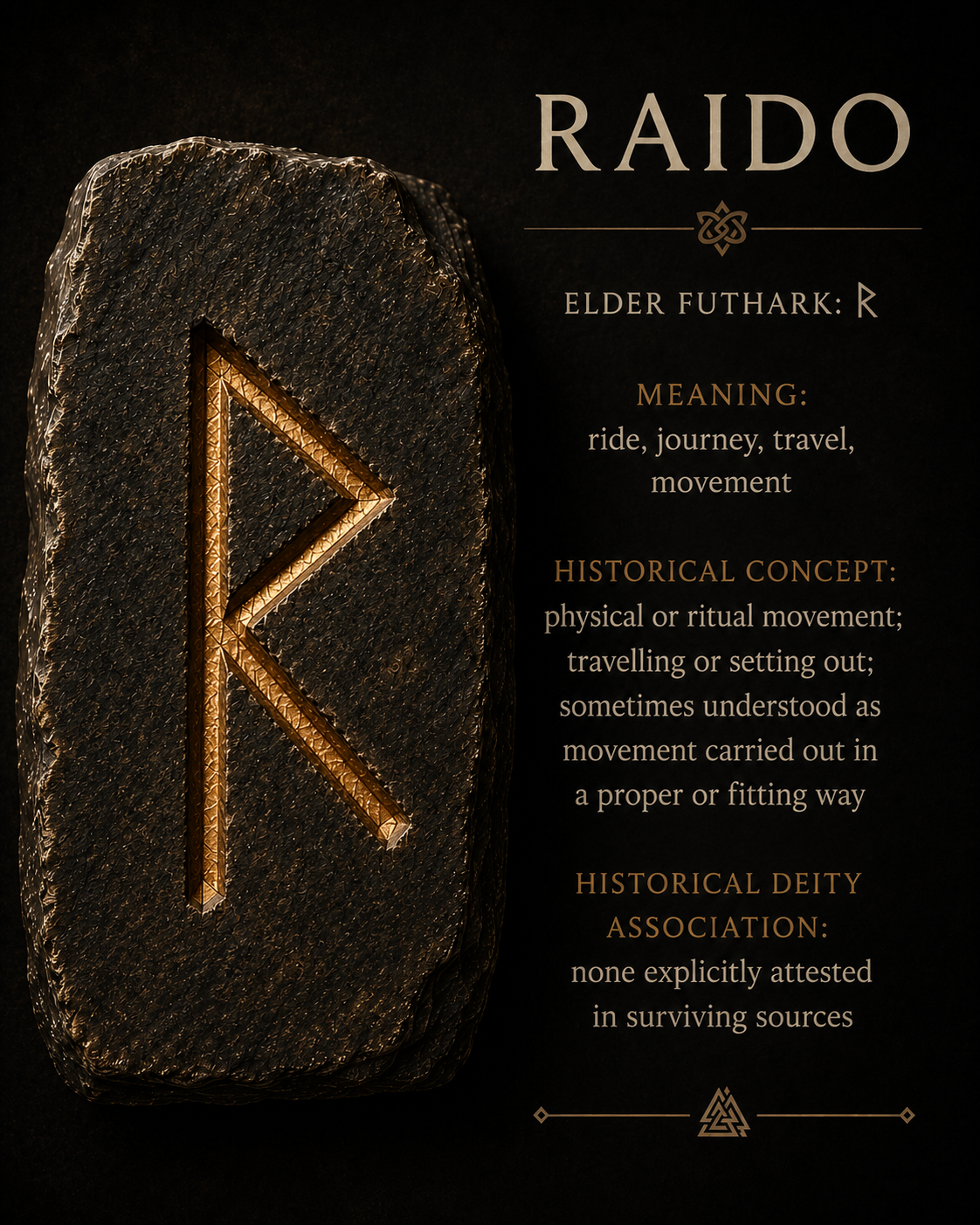
Name Variations: Raido, Raidō, Rēd, Rad, Raidho
Proto-Germanic: raidō (“ride,” “journey,” “riding”)
Phonetic Sound: r
Ætt Placement: Fifth rune of the first ætt (often called Freyr’s/Freyja’s ætt in modern practice)
Meaning: ride, journey, travel, movement
Historical Concept: physical or ritual movement; travelling or setting out; sometimes understood as movement carried out in a proper or fitting way
Historical Deity Associations: none explicitly attested in surviving sources
Raido is the fifth rune of the Elder Futhark. In many modern interpretations it marks a shift from inner development toward outward movement. Where earlier runes deal with resources, strength, confrontation, and communication, Raido introduces the act of setting out. It is the transition from intention to travel.
The name Raido derives from Proto-Germanic raidō, meaning a ride or a journey. At its most concrete level the rune refers to physical travel - movement by horse, wagon, or along established routes. Journeys were fundamental to early Germanic life. Trade, diplomacy, marriage alliances, seasonal migration, and attendance at assemblies all depended on the ability to move between places.
Travel in the Norse and wider Germanic world was both necessary and risky. Roads could be long, weather unpredictable, and hospitality uncertain. A successful journey required preparation, cooperation, and awareness of timing. Because of this, later interpreters often understand Raido as movement undertaken in a fitting or appropriate way - travel that proceeds according to expectation rather than chaos.
Raido can also be extended metaphorically to mean the course of action a person takes. Just as travellers follow known routes, social life followed recognised procedures. One set out for the Thing, for trade, or for kinship obligations along understood paths. In this way the rune has come to symbolise right progression or movement carried through in proper order, though such philosophical expansion belongs mainly to later interpretation rather than direct historical statement.
Within the structure of the futhark, Raido follows Ansuz naturally. After speech, advice, or command comes execution. Communication becomes action, and plans turn into lived movement. Raido is therefore the rune of setting forth.
Rune Poems -
Old English Rune Poem (8th–9th century): “Rād”
The Old English verse describes riding as comfortable for the mounted warrior yet strenuous for the one who must travel on foot. The contrast highlights the labour, strain, and differing experiences involved in travel. Movement is real, physical, and often demanding. Here Raido reflects both the dignity and the hardship inherent in journeying.
Norwegian Rune Poem (13th century): “Reið”
The Norwegian poem also speaks plainly of riding. Travel is presented as necessary but tiring, something that requires stamina and readiness. The emphasis again falls on the practical realities of motion rather than on abstract symbolism.
Icelandic Rune Poem (15th century): “Reið”
The Icelandic verse continues this theme, portraying the ride as a normal but effortful aspect of life. Journeys are part of the human condition, yet they involve strain and exposure to difficulty.
Taken together, the poems present Raido primarily as a rune of travel and exertion. They remind us that movement connects places and people, but it demands endurance from those who undertake it.
Later interpreters often expand this into ideas of right timing, proper course, or lawful progression, yet those meanings are not stated directly in the medieval verses themselves.
Kennings & Literary References (Eddas And Sagas) -
In saga literature, journeys are often decisive moments in a person’s fate. Exile, trading voyages, legal travel to assemblies, and expeditions abroad frequently mark turning points in narrative and reputation. Characters are judged not only by what they achieve, but by how they behave while travelling. Honourable conduct on the road builds alliances and renown; reckless or unlawful behaviour can lead to conflict, outlawry, or death.
Skaldic imagery surrounding travel commonly emphasises rhythm and cooperation between human intention and the surrounding world. Ships depend on wind, sea, and crew; horses require harmony between rider, animal, and terrain. Movement succeeds when awareness and environment work together. These themes resonate strongly with later interpretations of Raido as ordered or aligned motion.
Travel also had legal and social dimensions. Attendance at assemblies such as the Thing required timing, preparation, and knowledge of correct procedure. Disputes moved through recognised steps toward settlement or judgment. Although the rune itself is not mentioned in these contexts, the idea that important outcomes unfold through a sequence of actions has encouraged many modern readers to associate Raido with lawful progression and process.
Archaeological Evidence & Notable Inscriptions -
Raido (ᚱ) is well attested across the archaeological record of the Elder Futhark. The rune appears in inscriptions from the Migration Period onward and is found on a wide range of objects, including weapons, personal ornaments, bracteates, stones, and everyday items. Most often it occurs within personal names or short formulaic sequences, functioning as a phonetic character within a developing writing system. Its frequent appearance demonstrates that it was a normal and necessary element of literacy in early runic culture.
Because many inscriptions are brief and formulaic, it is rarely possible to determine whether a rune carried symbolic meaning beyond its sound value. Nevertheless, the contexts in which Raido appears are suggestive. Objects connected with travel, exchange, status, or communication between regions—such as portable wealth, trade goods, or items buried far from their place of manufacture—illustrate how movement itself was fundamental to Germanic life. While we cannot claim that every carved ᚱ consciously invoked the idea of a journey, the cultural environment in which the rune operated was one in which travel, mobility, and the maintenance of routes between communities were vital realities.
The graphic form of Raido, consisting of a vertical stave with a forward-angled branch, has often been interpreted by modern readers as visually implying motion or direction. Such interpretations are appealing and symbolically coherent, but they remain speculative. Runic shapes evolved from earlier alphabetic traditions, and we possess no contemporary explanation linking the rune’s appearance with the concept of riding or travel. Even so, the visual impression has undoubtedly influenced later esoteric and symbolic traditions.
Raido’s position near the beginning of the futhark is also significant from a structural perspective. It consistently follows Ansuz in the oldest preserved rune rows, including inscriptions such as those on early stones and bracteates that present partial or complete alphabets. This stability suggests that the order of the runes was carefully maintained and transmitted. Whether the sequence carried narrative or philosophical meaning for early users remains unknown, yet modern interpreters often see Raido’s placement after speech (Ansuz) as symbolising the movement from word into action.
What archaeology can say with confidence is this: Raido was common, early, and integral. It belonged to the shared symbolic toolkit of the Germanic world, appearing wherever people marked ownership, identity, memory, or connection. Any deeper meaning must be approached cautiously, but the rune’s later associations with journey, order, and right progression resonate strongly with the lived realities of a mobile and interconnected society.
Cultural Notes (Travel, Law, And Social Order) -
Travel in the Norse world was shaped by season, weather, and social obligation. Sea routes opened and closed with the year; mountain passes and grazing lands followed natural cycles; legal assemblies and trade gatherings happened at appointed times. There were therefore moments when travel was appropriate and moments when it was unwise or even dangerous. Raido reflects this sense of rhythm and timing. To set out without regard for conditions or custom could lead to practical disaster, reputational damage, or accusations of irresponsibility.
Movement was also rarely solitary. Roads, ships, and caravans depended on cooperation and shared understanding. A crew had to row in rhythm, follow a leader, and respond collectively to changing circumstances. Travellers relied on networks of hospitality, alliances, and mutual obligation. In this way Raido can be understood as symbolising alignment - the individual moving within the framework of communal order rather than outside it.
On a psychological level, Raido speaks to progress achieved through steadiness and discipline rather than impulse. A journey unfolds step by step. Each stage prepares the next, and haste can be as dangerous as delay. The rune therefore suggests movement guided by awareness, patience, and respect for process - the recognition that the right road is not merely taken, but followed.
Mythological Connections (Historical Themes) -
Raido is not tied to a single deity in the surviving sources, but it resonates strongly with the mythic theme of journeying itself. Movement in myth is rarely random or casual. Travel between realms (whether undertaken by gods, heroes, or messengers) usually follows known routes, established boundaries, and meaningful stages. Such journeys carry risk, but they also carry purpose. They unfold according to necessity, obligation, or destiny rather than whim.
In this sense, Raido governs lawful movement between places. It reflects transitions that require effort and awareness, where the traveller must follow the proper way if the journey is to succeed. Myth repeatedly shows that when routes are ignored or boundaries disrespected, consequences follow. Movement, therefore, is not freedom from order; it is participation in it.
Raido is also concerned with journeys that shape fate. To travel is to enter change. Meetings occur, knowledge is gained, alliances are forged or broken. A road can lead toward honour just as easily as toward catastrophe. What matters is not only that one moves, but how and when.
For this reason, Raido is often understood as the rune of right timing and correct sequence. Each stage prepares the next, and the traveller must remain attentive to rhythm, guidance, and responsibility. Raido is the rune of the path walked properly - movement in harmony with structure, community, and unfolding necessity.
Symbolism & Core Interpretive Themes -
Raido symbolises journey and travel, but more importantly it signifies movement undertaken in the right way. It is the difference between wandering and progressing. Under Raido, motion follows direction, preparation, and awareness of where one stands in relation to others and to the larger pattern of events.
A central aspect of Raido is right order and timing. Every action has its proper moment, and each step belongs within a sequence. When movement occurs too early, too late, or without regard for custom and circumstance, harmony breaks down. Raido therefore teaches patience, discipline, and respect for process.
The rune also carries the idea of cooperation and rhythm. Travel in the early northern world depended upon coordination - between rider and horse, crew and ship, traveller and road, individual and community. Progress required attunement. Raido asks whether intention and environment are working together or pulling against each other.
At a deeper level, Raido represents the alignment of intention and action. Plans must become deeds, but those deeds must follow the proper path. When thought, timing, and movement correspond, the journey advances with strength and clarity.
Raido is therefore the rune of movement with purpose - travel that shapes fate because it is undertaken consciously, lawfully, and in rhythm with the world.
Light Aspect / Positive Expression -
In its positive expression, Raido represents smooth progress and well-timed action. Movement unfolds without unnecessary resistance because preparation, intention, and circumstance are aligned. Effort is still required, but it feels purposeful rather than chaotic. Things advance because they are meant to advance.
Raido can point to successful journeys of many kinds. It may signal physical travel, relocation, or the forward motion of plans already in development. When it appears in this way, it suggests that conditions favour movement and that the traveller understands the responsibilities and rhythms involved.
This light aspect of Raido also supports cooperation and agreement. Progress is easier when people work in coordination, when expectations are clear, and when each participant knows their role. The rune therefore strengthens partnerships, negotiations, and shared objectives, provided they are entered honestly and maintained with discipline.
At its most reassuring, Raido in light suggests being on the right path. One’s actions follow a course that leads forward, not astray. There is a sense of guidance, momentum, and rightness in how events are unfolding.
Shadow Aspect / Difficult Expression -
In its positive expression, Raido represents smooth progress and well-timed action. Movement unfolds without unnecessary resistance because preparation, intention, and circumstance are aligned. Effort is still required, but it feels purposeful rather than chaotic. Things advance because they are meant to advance.
Raido can point to successful journeys of many kinds. It may signal physical travel, relocation, or the forward motion of plans already in development. When it appears in this way, it suggests that conditions favour movement and that the traveller understands the responsibilities and rhythms involved.
This light aspect of Raido also supports cooperation and agreement. Progress is easier when people work in coordination, when expectations are clear, and when each participant knows their role. The rune therefore strengthens partnerships, negotiations, and shared objectives, provided they are entered honestly and maintained with discipline.
At its most reassuring, Raido in light suggests being on the right path. One’s actions follow a course that leads forward, not astray. There is a sense of guidance, momentum, and rightness in how events are unfolding.
Divinatory Meaning – Upright -
Upright, Raido signals movement, travel, or progress unfolding in accordance with right order. It often appears when plans are developing as they should, when events are proceeding step by step, and when forward motion is both possible and appropriate. There is direction here, not drift.
This rune frequently marks the need for a journey, whether literal or symbolic. One may be called to relocate, to advance a project, to shift from one stage of life into another, or to carry intention out into the world through action. Raido reminds the querent that movement is part of destiny; standing still is rarely the answer.
Raido upright also encourages trust in process. Outcomes arise from following the correct sequence, respecting obligations, and moving in harmony with circumstance. Trying to force results too quickly or skipping necessary stages risks throwing the journey off course.
Attention to timing is essential. Raido asks whether this is the right moment to depart, to act, or to proceed. When the answer is yes, the path opens. When the answer is no, patience becomes part of wisdom.
Divinatory Meaning – Reversed / Merkstave -
Reversed, Raido often points to delays, detours, or frustration in the movement of events. Progress may feel blocked, plans may be disrupted, or the road ahead may seem unclear. What should be advancing smoothly instead becomes tangled, postponed, or misdirected.
This position can indicate impatience or a refusal to follow the proper sequence. The querent may be attempting to rush ahead, skip necessary preparation, or push circumstances before they are ready. When rhythm is ignored, the journey falters. Raido reversed reminds us that timing is not an obstacle but a law.
It may also reflect disorder within cooperation. Agreements break down, communication misfires, or people fail to move together toward a shared goal. Instead of alignment, there is friction. The road exists, but those travelling it are out of step with one another.
Above all, Raido reversed warns against forcing progress without harmony between intention, action, and circumstance. Movement that is out of alignment can lead farther from the destination rather than closer to it. The remedy is patience, recalibration, and a return to the proper path.
Questions The Rune Asks In Readings -
Raido asks the querent to reflect on the nature of the journey already underway. What road are you walking, whether in the outer world or within your own life? Every path has a direction, a purpose, and a destination, and Raido invites awareness of where your current movement is truly leading.
It presses further: are you moving in the right order and at the right time? Progress is not only about speed but about sequence. Some steps must come before others. Raido challenges any urge to leap ahead without foundation, reminding you that rhythm and preparation are part of success.
The rune also asks where you might be forcing motion rather than cooperating with it. Are you pushing circumstances, people, or yourself in ways that create resistance? Raido teaches that alignment often accomplishes more than effort alone. When movement follows natural timing, the road becomes smoother.
Attention is drawn to companions as well. No one travels entirely alone in the Norse imagination. Who walks beside you, and are you in step with them? Shared journeys require coordination, trust, and mutual understanding. If travellers pull in different directions, the cart will not roll far.
Finally, Raido asks what new path might open if you honour process instead of impulse. What becomes possible when patience replaces urgency? The rune reminds you that the right road reveals itself through disciplined movement, not reckless haste.
Warnings Or Common Misinterpretations -
Raido is often simplified in modern readings to mean little more than physical travel, but historically its meaning is far richer. It concerns movement that unfolds within structure, custom, and right relationship to time. A road is not merely distance; it is direction shaped by law, habit, and communal understanding.
The rune reminds us that motion without order easily becomes chaos. One can hurry and still arrive nowhere, or reach a destination in a way that creates damage, conflict, or regret. Raido therefore places emphasis on method. The manner of the journey is inseparable from its outcome.
Raido teaches that how you move matters just as much as where you are going. Are you proceeding with preparation, patience, and awareness? Are you respecting the steps required, the people affected, and the rhythms of circumstance? Right movement creates harmony between intention and world.
In this way, Raido is not simply a rune of roads, wheels, or miles travelled. It is the principle of purposeful progression. It asks for discipline, cooperation, and trust in sequence, reminding the traveller that a well-walked path carries its own form of wisdom.
Seiðr Work / Trancework Interpretation -
In trancework, Raido commonly manifests through imagery of roads stretching toward the horizon, winding paths through unknown terrain, horses carrying the rider forward, or ships moving in rhythm with wind and tide. Practitioners often experience it not as sudden speed but as a steady pull, a feeling of being carried along a course that is already unfolding. The sensation is one of momentum with direction rather than aimless motion.
Raido reveals how progress occurs through relationship with pattern. The traveller is not separate from the road, the rider not separate from the horse, the sailor not separate from the sea. Movement succeeds when one listens, adjusts, and participates in the greater rhythm already present.
In this state, Raido teaches alignment. It asks the practitioner to move with the current of order rather than struggle against it. When the rhythm is followed, the path opens; when resisted, obstacles multiply. The lesson is not surrender of will, but cooperation with timing, sequence, and necessity.
Thus in trance Raido becomes the guide of right motion. It reminds the traveller that every journey has a structure, and wisdom lies in recognizing how to step into it.
Practical Magical Uses (Modern Rune Magic) -
In modern rune practice, Raido is commonly invoked to support safe and successful travel. Whether the journey is physical, professional, or spiritual, the rune is understood to help movement unfold according to proper order. It favours preparation, awareness of conditions, and respect for timing, encouraging travellers to work with circumstance rather than against it.
Raido is also used to strengthen progress in long-term plans. It helps maintain direction over distance, supporting steady advancement instead of sudden leaps. Practitioners turn to it when patience, rhythm, and adherence to process are required for eventual success.
In matters of law, bureaucracy, or formal procedure, Raido is valued for its association with correct sequence. It supports doing things in the proper way, following steps, honouring agreements, and allowing outcomes to arise through legitimate channels rather than shortcuts.
The rune is equally connected to cooperation and coordination. Just as a ship requires crew working in harmony or a rider must move with the animal beneath them, Raido encourages unified effort. It helps groups find shared pace and mutual understanding.
Above all, Raido in practical work is about alignment between intention and motion. It sets things moving, but in ways that respect order, structure, and the realities of the road ahead.
Bindrune / Galdr Considerations -
In bindrune work, Raido is valued for its ability to establish correct sequencing and sustained forward motion. It helps ensure that actions unfold in the proper order and that momentum is maintained without losing direction. Rather than producing sudden leaps, Raido promotes structured progress - one step leading naturally to the next.
When paired with Ansuz, Raido supports planned action guided by clear communication and understanding. Intention is not only spoken but carried forward into lived reality. Combined with Jera, Raido reinforces cyclical development, helping long efforts mature in their proper season and preventing impatience from disrupting growth. With Eihwaz, it lends endurance to the journey, strengthening the spine of a working so that obstacles can be passed without abandoning the path.
In galdr, Raido is often sounded as a rolling “rrrr” or as “rai,” allowing the vibration to mimic rhythm and motion. The chant can produce a sensation of steady travel, like wheels turning or hooves striking earth in even cadence. This reinforces the rune’s essential quality: movement guided by order rather than haste.
Raido is ultimately the rune of the road itself - the living pathway that carries intention outward into the world when it is followed with awareness, discipline, and respect for the way things must unfold.