
Ansuz Rune Meaning: History, Symbolism, Divination & rune magic
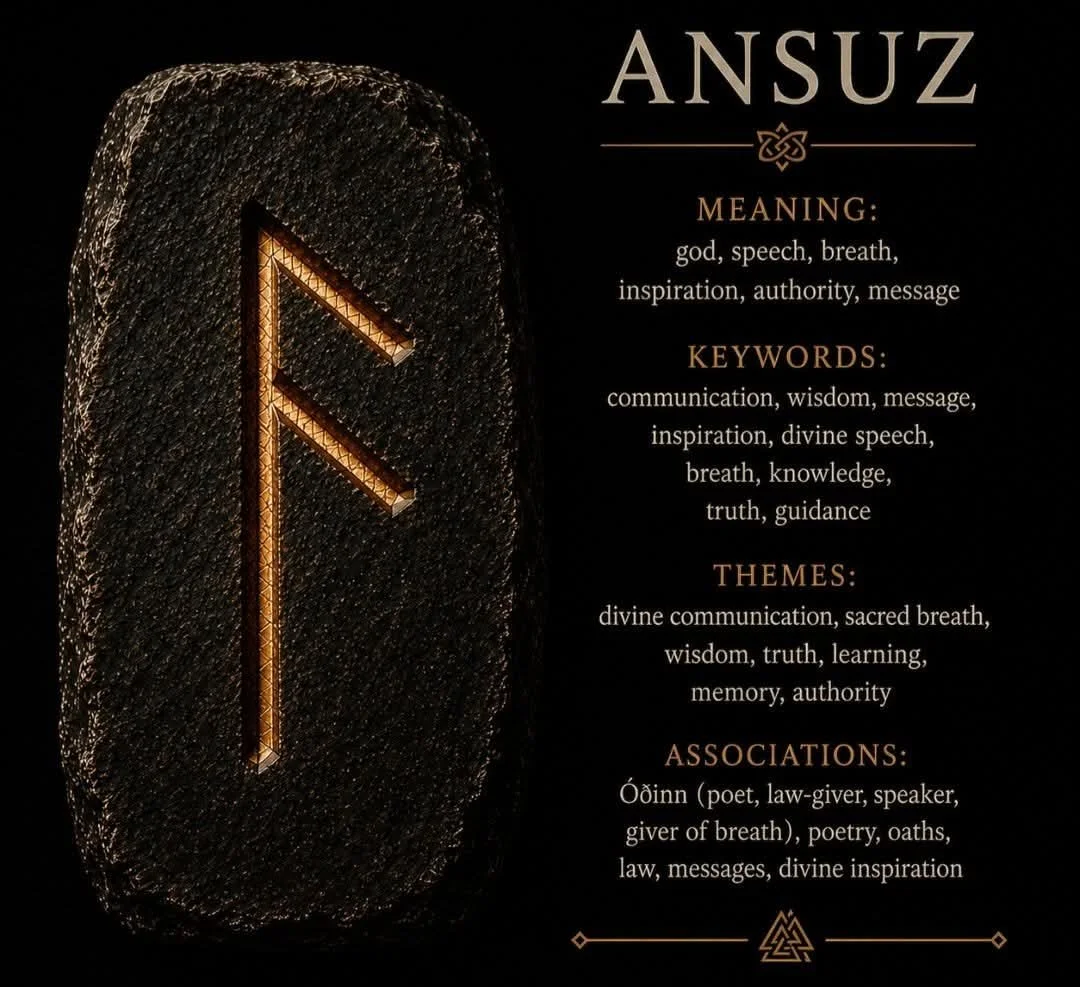
In-Depth Rune series - Ansuz
Name Variations: Ansuz, Ansur, Óss, Áss
Proto-Germanic: ansuz (“god,” “divine being,” “ancestor”)
Phonetic Sound: A (as in father)
Ætt Placement: Fourth rune of the first ætt (often called Freyr’s/Freyja’s ætt in modern practice)
Meaning: God, speech, breath, inspiration, authority, message
Historical Concept: Divine speech, sacred breath, and the power of words to shape law, memory, and fate
Historical Deity Association: Odin (as poet, law-giver, speaker, and giver of breath)
Ansuz is the fourth rune of the Elder Futhark and represents a profound shift in the movement of the first ætt. Where Fehu concerns possession and exchange, Uruz embodies raw strength and vitality, and Thurisaz introduces confrontation with hostile or disruptive forces, Ansuz brings consciousness, articulation, and meaning. It marks the moment when experience is given voice, and when power becomes directed through mind and speech.
The name Ansuz derives from the Proto-Germanic term for a god or divine being. In Old Norse this appears as áss (plural Æsir), the gods associated with order, law, memory, and culture. Ansuz therefore does not represent divinity in an abstract sense, but the divine as it operates through speech, breath, and awareness. It is the rune of the god who speaks, teaches, names, and commands.
In the Norse view, speech is never empty. Words create bonds, enforce law, provoke violence, preserve memory, and transmit wisdom. Oaths spoken aloud bind generations; insults can ignite blood-feuds; poetry can elevate a person’s honour or destroy it. Ansuz symbolises this cultural understanding that speech is an act with real and lasting consequences.
Ansuz is inseparable from breath. Breath is life, awareness, and spirit moving through the body. In mythic terms, breath is what animates matter and turns wood into living humans. Ansuz therefore marks the entry of consciousness into form. It is the rune of awakening, articulation, and the living voice.
Within the structure of the futhark, Ansuz follows Thurisaz deliberately. After confrontation and shock comes interpretation. After chaos comes the need to speak, understand, and integrate. Ansuz is the rune that names what has been faced and carries its meaning forward. It transforms raw experience into knowledge and memory.
Rune Poems -
Old English Rune Poem (8th-9th century): “Ōs”
The Old English rune poem presents ōs as a source of speech and wisdom, a comfort to the wise and a guide to proper language. The emphasis is on communication, learning, and the ordering power of articulate expression. In this context, Ansuz reflects the civilising force of speech - the way shared language allows understanding, counsel, and social cohesion.
Norwegian Rune Poem (13th century): “Óss”
The Norwegian poem identifies óss directly with a god. Here the rune points toward divine origin and sacred authority rather than everyday communication. Words under Ansuz are not merely spoken; they carry weight, legitimacy, and connection to powers beyond the human sphere.
Icelandic Rune Poem (15th century): “Áss”
The Icelandic poem likewise links áss with the gods and with inherited wisdom and tradition. Ansuz appears as the voice through which knowledge, law, and cultural memory are preserved and transmitted across generations.
Taken together, the three poems portray Ansuz as a rune of divine presence expressed through language. It governs inspired speech, authoritative communication, and the continuity of wisdom from past to present. Across their differences, they agree that words are never trivial; they are carriers of power, identity, and order.
Kennings & literary references (Eddas and Sagas) -
In eddic and saga literature, speech is one of the central instruments of power. Kings govern through proclamations, laws are recited at the Thing, and poets can wield influence comparable to that of warriors. A cutting insult may provoke feud and bloodshed, while wise counsel can prevent catastrophe. Words act; they shape reputation, obligation, and fate.
Poetry is frequently portrayed as a gift with divine origin, closely connected to Óðinn and the myth of the mead of poetry. Charms and galdr are typically performed aloud, giving voice and breath to intention. Sound carries authority and presence. This is Ansuz in action: inspiration becoming utterance, meaning entering the world through speech.
Ansuz, however, is not only about speaking but also about hearing. Wisdom in Norse tradition is often transmitted through listening - to counsel, to riddles, to prophecy, to remembered teaching. Knowledge moves from mouth to ear across generations. Ansuz therefore represents meaningful exchange rather than mere noise: communication that binds, teaches, and transforms.
Archaeological evidence & notable inscriptions -
Ansuz (ᚨ) appears frequently in Elder Futhark inscriptions, particularly within personal names and short formulaic texts. Its presence in names has often been interpreted as hinting at ideas of divine association, authority, ancestry, or inspired connection to the gods. However, because most inscriptions are brief and lack explanation, such interpretations remain informed possibilities rather than certainties.
On bracteates and amulets, Ansuz sometimes occurs within sequences that may have carried ritual or symbolic significance. Some scholars have proposed that its inclusion could imply divine protection or alignment with sacred power, but the evidence does not allow firm conclusions about intention. What can be said with confidence is that the rune was considered important enough to recur in prestigious and personal contexts.
The form of the rune itself (a vertical stave with projecting branches) has encouraged modern readers to imagine ideas of outward motion or transmission. This visual association aligns neatly with later symbolic interpretations involving breath, sound, and communication. Yet it is important to remember that such readings are speculative; we do not possess historical sources explaining the shape in these terms.
Cultural notes (law, social customs, worldview) -
Norse society was fundamentally oral. Law, myth, history, genealogy, and honour were preserved and transmitted through speech. Eloquence was a sign of wisdom, learning, and social authority, while careless or deceitful words could damage reputation or even provoke violence.
Legal assemblies depended upon spoken recitation, and oaths were made verbally and regarded as binding. To break one’s word was not a minor failing but a serious moral and social breach with real consequences for trust and standing within the community. Ansuz reflects this cultural reality: speech was understood to enact and uphold the structures by which society functioned.
Mythological connections -
Ansuz is most often connected in modern interpretation with Odin in his roles as poet, speaker, and relentless seeker of wisdom. Odin gains knowledge through sacrifice and ordeal, and he transmits what he wins through counsel, command, and verse. In this sense he is not only a war-leader but a figure of mind, breath, and articulated meaning.
Ansuz is also linked to the mythic gift that grants humanity breath and awareness. In the creation account, the gods give life and consciousness to the first humans, establishing speech and perception as divine inheritances. This places Ansuz symbolically at the centre of identity, animation, and the capacity to understand and communicate.
Within mythic patterns, Ansuz therefore resonates with sacred utterance, poetic inspiration, memory, and exchange between realms. It is present wherever wisdom is spoken, heard, preserved, or transmitted, and wherever communication bridges the distance between gods, humans, and worlds.
Symbolism & core interpretive themes -
Ansuz is commonly understood in modern interpretation as a rune of meaningful communication and the power carried by the spoken word. In societies where law, memory, and reputation were transmitted orally, speech was never neutral. Words could bind agreements, preserve history, declare judgement, or provoke conflict. Ansuz therefore represents speech that has weight and consequence.
The rune is also closely connected with breath, the sign of life and awareness. To breathe is to live; to speak is to express mind and intention outward into the world. Through this lens, Ansuz becomes a symbol of consciousness made audible, of inner understanding taking form through voice.
Ansuz further carries associations with inspiration, insight, and the transmission of knowledge. Wisdom moves from one person to another through teaching, counsel, poetry, and story. Authority, in this sense, is not merely power but the capacity to speak truth effectively and to be heard.
Taken together, Ansuz points to communication that shapes reality. Once spoken, words enter the social and moral fabric and cannot easily be withdrawn. The rune reminds the reader that language creates bonds, establishes responsibility, and participates in the making of fate.
Light aspect / positive expression -
In its positive expression, Ansuz represents clear communication, truthful speech, inspired thought, and wise counsel. It is the power of language used well - words that illuminate rather than obscure, unite rather than divide. When Ansuz appears in this way, it often signals learning, teaching, poetry, or the arrival of an important message at exactly the right moment. Insight may come through conversation, instruction, ritual speech, or sudden inspiration that seems to arrive from beyond ordinary awareness.
Ansuz in its light aspect also reminds us that communication is not only about speaking. Listening, remembering, and understanding are equally sacred acts. Wisdom grows where attention is given. The rune encourages patience in dialogue, respect for knowledge passed down, and the careful shaping of language so that it reflects truth rather than impulse.
Because words carry creative force, Ansuz asks for intention. Promises, agreements, advice, and stories have the power to guide futures and bind communities together. Used responsibly, speech becomes a bridge between people, generations, and even worlds. In this sense, Ansuz is the breath of inspiration moving through a willing mind - the moment when meaning becomes clear and can be shared for the benefit of all.
Shadow aspect / difficult expression -
In its shadow, Ansuz becomes deception, manipulation, empty rhetoric, and miscommunication. Instead of speech that clarifies and connects, language becomes distorted, self-serving, or deliberately misleading. The rune may point to lies, gossip, broken promises, or confusion born from speaking without knowledge or listening without care. Where Ansuz in its light brings understanding, its shadow spreads misunderstanding.
Because words in the Norse view carry binding force, their misuse has real consequences. An oath spoken falsely can fracture trust for generations. A careless remark can ignite hostility. Rumour can travel faster than truth, shaping reputations that may never fully recover. Under the difficult aspect of Ansuz, language loses its sacred responsibility and becomes noise, weapon, or veil.
This shadow can also manifest internally. One may be lying to oneself, repeating harmful narratives, or refusing to hear wisdom that challenges pride or comfort. Communication breaks down not only between people, but within the self. Insight is available, yet ignored.
Ansuz in this position is therefore a warning about integrity. Once words leave the mouth, they enter the world as living forces. They cannot simply be recalled; they must be answered for. The rune asks whether speech is aligned with truth, whether silence might be wiser, and whether the querent is prepared to accept the consequences of what they say.
Divinatory meaning - upright -
Upright, Ansuz signals communication, messages, learning, and guidance entering the situation. It often points to a conversation of real importance, the arrival of timely information, or an opportunity to receive or offer wisdom. Something meaningful is being said and it deserves attention.
This rune frequently appears when truth must be spoken plainly. It may indicate the need for honest dialogue, careful negotiation, or the clear expression of intentions. Avoiding conversation will not help; the moment calls for articulation. Words, when used properly, can create understanding, restore order, and open pathways that were previously blocked.
Ansuz upright can also suggest teaching and transmission. The querent may be asked to learn from someone more experienced, to seek counsel, or to step into the role of advisor themselves. Poetry, study, public speaking, writing, or spiritual instruction may be highlighted. Inspiration is available, but it must be voiced or shared to become real.
Equally important is listening. Ansuz reminds us that wisdom is not only spoken but heard. Guidance may come through another person, a remembered teaching, a line of poetry, or sudden insight carried on breath. Attention and receptivity are as powerful as declaration.
At its heart, upright Ansuz marks a moment when language shapes fate. What is said (and how it is said) has the power to influence outcomes in lasting ways.
Divinatory meaning - reversed / merkstave -
Reversed, Ansuz often points to misunderstanding, poor communication, false advice, or motives that are not what they seem. Information may be incomplete, distorted, or deliberately misleading. Something important is being said - but it may not be the truth, or it may not be heard correctly.
This rune in a reversed position can indicate blocked expression. The querent might struggle to find the right words, fear speaking honestly, or feel silenced by circumstance. Conversations may go in circles, producing more confusion than clarity. Attempts at guidance can miss their mark, and messages may fail to reach their intended destination.
Ansuz reversed frequently warns against believing everything one hears. Rumours, gossip, or persuasive voices may conceal agendas. Advice offered with confidence might still be wrong. It becomes essential to pause, verify, and seek deeper understanding before acting.
Listening problems are just as significant as speaking problems here. Someone may be ignoring wisdom that is already available, refusing counsel, or hearing only what they wish to hear. The rune can suggest intellectual pride, inattentiveness, or emotional filtering that prevents real comprehension.
On a deeper level, reversed Ansuz can reveal a disconnect from inner guidance. Inspiration feels distant, memory unreliable, or intuition muted. The flow between thought, breath, and meaning is interrupted, creating frustration and doubt.
At its core, Ansuz reversed reminds us that words shape reality - but when language is twisted, withheld, or misunderstood, the results can lead us away from truth rather than toward it. Care, patience, and discernment are required before speaking or trusting what is spoken.
Questions the rune asks in readings -
Ansuz asks the querent to examine the role of communication, authority, and understanding in the present situation. What needs to be spoken, and what needs to be heard? Are the necessary truths being voiced, or are important words still waiting for courage and clarity?
The rune presses further: are your words aligned with truth and responsibility? Speech is never neutral. Promises, advice, criticism, and praise all shape outcomes. Ansuz asks whether language is being used with integrity or carelessness.
It also raises the question of authority. Who truly holds influence in this exchange, and on what basis is that authority granted? Is wisdom present, or merely confidence? Are you giving your power of belief to someone who has earned it?
Listening is just as sacred as speaking. Ansuz asks whether you are hearing what is actually being said or only what you expect or want to hear. Meaning can be missed through assumption, pride, or distraction.
Finally, the rune asks: what message is trying to reach you now? Guidance may already be present in conversation, memory, or intuition, waiting for recognition. Ansuz invites attentiveness, humility, and a willingness to receive as well as to declare.
At heart, these questions revolve around reciprocity in communication - the living exchange between voice and ear through which wisdom travels.
Warnings or common misinterpretations -
Ansuz is often reduced to “communication” in the casual modern sense, as if it simply referred to talking, messaging, or the exchange of information. Historically, however, its scope is far more serious and far more potent. Ansuz represents speech that carries authority and consequence. In the early Germanic world, words did not merely describe reality - they helped create it.
Oaths sworn aloud bound families and generations. Legal formulas spoken at assemblies determined guilt, compensation, and honour. Praise poetry could elevate a reputation across entire regions, while insults might ignite violence that lasted for years. Spoken charms, blessings, and curses were believed to act upon the fabric of events indicate action, not metaphor. Under Ansuz, language is never empty sound; it is force moving through breath.
Because of this, Ansuz demands integrity. It asks whether speech is aligned with truth, responsibility, and awareness of consequence. Careless words are not minor errors; they are breaches of order. To lie, to twist meaning, or to promise what one cannot uphold risks social and spiritual fracture.
Ansuz therefore teaches reverence for language. It is the rune of measured voice, careful listening, and the understanding that once released, words travel beyond recall. In its presence, speaking becomes an ethical act.
Seiðr work / trancework interpretation -
In trancework, Ansuz is often experienced through sensations connected to breath, sound, and vibration. Practitioners frequently describe awareness gathering in the chest, throat, or mouth - areas associated with speaking, singing, and the movement of air that gives words life. The experience may arise as an impulse toward vocalisation, the forming of phrases, or the sense that meaning wishes to be carried outward.
Ansuz can also appear as moments of sudden clarity: a line of guidance, a remembered teaching, or language that seems to organise previously scattered thoughts. Rather than overwhelming spectacle, its presence is often marked by coherence. Things make sense. Connections arrange themselves into communicable form.
A central lesson attributed to Ansuz in trance practice is discernment. Not every inner voice is wisdom, and not every message is meant to be repeated exactly as received. The rune emphasises responsibility in transmission - the need to understand, filter, and speak in ways appropriate to context and listener. It highlights the delicate path between inspiration and distortion.
Because breath is shared between worlds (inner and outer, self and other) Ansuz becomes a bridge. It invites the practitioner to cultivate clarity, honesty, and restraint, so that what passes through them into speech serves understanding rather than confusion.
Practical magical uses (modern rune magic) -
In modern rune magic, Ansuz is commonly worked with in matters of communication, inspiration, and the responsible use of words. Practitioners turn to it when clarity is needed - whether in conversation, negotiation, study, teaching, or creative expression. It is thought to help thoughts take coherent shape and to support the courage required to speak honestly.
Ansuz is also linked with inspiration, poetry, and intellectual or spiritual learning. Many use it when seeking guidance, preparing to receive instruction, or attempting to remember and transmit knowledge accurately. Because it is associated with breath and voice, it is sometimes invoked to strengthen public speaking, chanting, or any work in which language must carry intention outward.
At the same time, Ansuz is treated as a rune of responsibility. Modern practitioners often approach it with the understanding that words have consequences. Working with Ansuz therefore involves cultivating precision, attentiveness, and integrity so that communication promotes understanding rather than confusion.
Bindrune / galdr considerations -
In bindrunes, Ansuz is often used to emphasise intention through language, understanding, and transmission. Practitioners include it in combinations meant to strengthen communication, clarify agreements, support teaching, or lend authority to spoken or written words. Because Ansuz is linked with breath and awareness, it is thought to help carry meaning outward so that a working is properly understood and received.
In galdr, Ansuz is commonly voiced as a sustained “aaa,” or sometimes shaped into sounds such as “ans” or “óss.” The chant is allowed to ride the breath, vibrating through the throat and chest, encouraging a sense of resonance between thought, voice, and intention. Many practitioners experience this as aligning inner awareness with outward expression.
Within modern esoteric interpretation, Ansuz becomes the rune of the living word: breath carrying meaning, speech influencing events, and mind forming a bridge between human awareness and larger patterns of wisdom. Its use in sound and symbol is therefore approached with care, respect, and clarity about what is being set into motion.