
The Norse Creation Story: Fire, Ice & The Birth of the Cosmos
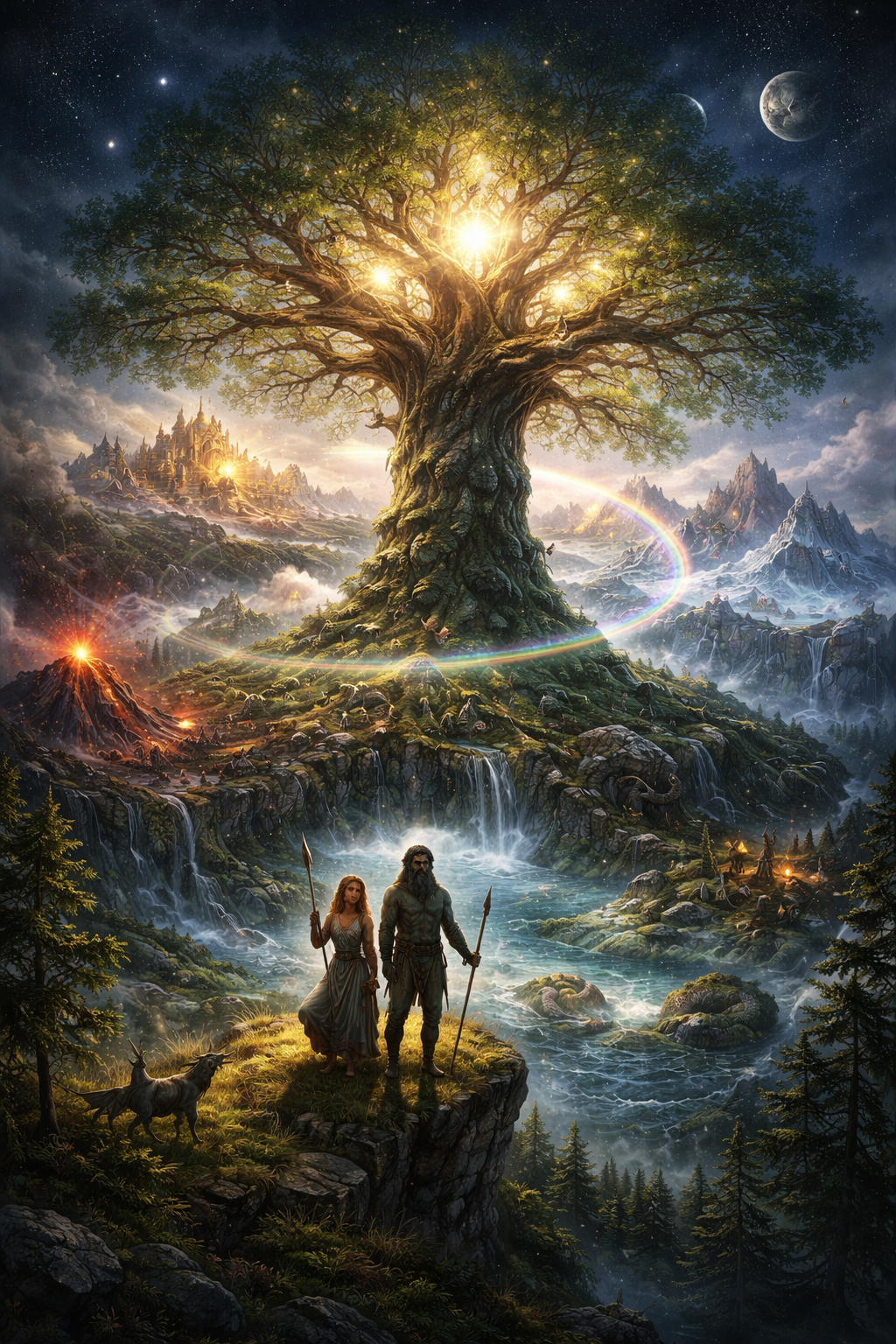
Before Odin ruled in Asgard, before Thor’s hammer ever struck a giant, before the World Tree held the realms together, there was a beginning far stranger and far quieter than most would expect. The Norse creation story does not start with gods shaping the world from nothing, nor with divine words calling light out of darkness. It begins with emptiness. A silent gulf where nothing lived, nothing stirred, and nothing even had a name. This is the atmosphere that sits at the heart of Norse myth - a world born not out of perfection, but out of conflict, tension, and raw natural force.
In the ancient northern imagination, the cosmos was harsh and unpredictable. Winters were long, volcanoes rumbled under the earth, and ice and fire shaped the landscape. It is no surprise that the Norse believed creation began when two extremes collided. In the beginning there were only two realms: icy Niflheim in the north, and blazing Muspelheim in the south. Between them stretched a great emptiness known as Ginnungagap, wide and deep like a breath held before life begins. For untold ages these forces remained separate - until, slowly, frost and flame moved toward each other across the silent void.
From that moment, creation did not simply happen - it unfolded. Ice melted. Sparks hissed. Life appeared in the most unexpected form: a giant named Ymir, and a cosmic cow called Audumbla. Through these beings came the ancestors of gods and giants alike, setting the stage for the struggles and stories that would shape the world. Eventually Odin and his brothers would rise, and from Ymir’s vast body they would build the earth, the mountains, the seas and skies. From emptiness came form. From death came creation. From frost and fire came the world as the Norse understood it.
This story is more than myth. It reflects the environment, fears, hopes and imagination of the people who told it around fires on winter nights. To them, creation was not gentle or orderly, but wild, difficult and awe-inspiring - much like life itself. In this blog, we’ll follow the Norse creation story step by step, from the silent void to the shaping of Midgard, the rise of Yggdrasil, and the birth of humanity. Along the way, we’ll see how each moment reveals something about how the Norse viewed the world and their place within it.
Every myth has a beginning. For the Norse, that beginning is colder, stranger and more dramatic than most. Let’s step into the void, where fire meets ice, and watch the first spark of creation ignite.
The World Before All Things
Before the first world tree stretched its roots into the deep, before the nine realms formed and before any god ever drew a breath, there was nothing. No seasons turning, no night or day shifting overhead, no earth beneath the feet of giants or men. There was only a vast and endless stillness, a space without shape, border or sound. This was the world before all things: a silent expanse where existence had not yet taken its first step.
It can be difficult to imagine this state, because our own world is so full - full of movement, noise, and substance. But the Norse imagined a beginning that was profoundly empty. Not chaos, not swirling elements, but a deep, calm void. No sky hung overhead because there was nothing to support it; no ground lay below because there was nothing to stand upon. There was no wind, because nothing stirred. No shadows, because there was no light to cast them. It was a world waiting to happen.
In this early nothingness, there was no concept of time. Time requires change to measure, and change had not yet begun. There was no death because there was no life. There was no cold or warmth, because neither had been born. The world existed like a held breath or a dream not yet dreamed - full of possibility, but without direction.
And yet, even in this emptiness, something subtle was taking shape. Out of the quiet void emerged two realms, slowly, like distant lights appearing in fog. To the north lay Niflheim, a land of ice, frost, and swirling mists - cold so deep it could bite through bone if there were bones to bite. To the south burned Muspelheim, bright with flame and molten heat, fierce and restless as a fire that has waited too long to spread. These two realms stood apart at first, distant and unaware of one another, like opposites holding their breath across the void.
Between them stretched Ginnungagap, the yawning gulf where nothing lived but everything might. This was the centre of the beginning, the empty space between frost and flame, carrying no shape of its own but holding the potential for all shapes. If the early void was silence, Ginnungagap was the moment before the first note of a song. It was not simply “nothing”; it was waiting - an open place into which creation could unfold.
What makes this stage of the myth so powerful is how understated it is. Many creation stories begin with noise, conflict or divine command. The Norse begin with emptiness. The first movement of existence is not a thunderclap, but a slow creeping of frost and a drifting of sparks. Creation does not burst into being. It drifts, melts, gathers. It begins as gently as winter thawing or fire stretching toward cold air.
This beginning also reflects something about the world that shaped these stories. The Norse lived close to the boundaries of extreme weather - glaciers on one horizon, volcanic fire beneath their feet. Land could be frozen one year and reshaped by flame the next. To them, creation was not smooth or effortless. It came from tension, contrast, and endurance. A world forged in fire and ice is a world that knows struggle from the start.
Before the gods, before giants, before the world, there was the void - still, patient, ancient. A place where the universe had not yet decided what it would become. From that emptiness, the cold of Niflheim crept outward and the heat of Muspelheim pushed forth, and in the open gulf between them, the first threads of existence began to weave together.
Every story needs a beginning. Here, the beginning is silence. Here, the world waits, suspended between what is and what could be. Soon, frost will meet flame, and the first great change will occur. But for now, everything lies in quiet anticipation - the world before all things, holding its breath in the dark.
Ginnungagap - The Primordial Void
At the centre of the Norse creation story lies Ginnungagap - a word that feels ancient even before its meaning is known. It sits like a silent bridge between the world that was not yet formed and the realms that were beginning to take shape. If the world before creation was pure stillness, then Ginnungagap was the vast breath of space where something could finally happen. It was not a place in the way we understand place, and not quite a thing either. It was an open gulf, deep and endless, stretching between frost and fire like the empty pause between two great moments.
Ginnungagap existed before time, before sound, before thought. Imagine a darkness so complete that even the idea of darkness has not yet formed, where there is no up or down, no near or far. A space without stars or wind, where nothing has shape because shape has not been invented. This is what the Norse imagined: a yawning emptiness, patient and still, waiting for the first movement of creation. It wasn’t chaos. It wasn’t turmoil. It was simply potential - a place where everything could one day be.
To the north, cold gathered into Niflheim, where frozen mists swirled and hoarfrost lay heavy as stone. To the south, heat blazed in Muspelheim, wild and fierce, full of flame and molten energy. But neither could create alone. Frost without heat remains frozen forever; fire without cold burns too bright to form anything lasting. They needed a meeting point and Ginnungagap was that meeting point. It was the empty middle, the neutral ground where two extremes could touch. Creation required space to breathe, and Ginnungagap was that first breath.
The very name carries the sense of a gap widening, a mouth opening. People of the north would have spoken it with an understanding that didn’t need explanation. It was the place where nothing stood between opposing forces. A void not dead, but charged with wonder - like the quiet just before a storm breaks or the white hush of a snowfall before dawn. In that stark emptiness, something ancient stirred.
As frost began to creep outward from Niflheim and sparks drifted from Muspelheim, they met within the gulf. Ice cracked. Frost melted. Flame hissed against cold like iron plunged into water. And from that reaction, from that slow dance of fire and ice inside Ginnungagap, came the first stirrings of life. A giant formed from melting ice. A cow emerged beside him. Creation didn’t explode into being - it thawed, piece by piece, as if waking from a long sleep. Without Ginnungagap, there would have been no meeting, no melting, no birth. The void was the cradle.
In myth, emptiness is often uncomfortable. Humans don’t like the unknown. We want solid ground beneath our feet, explanations for what we see, purpose and form. But Ginnungagap reminds us that beginnings rarely start with certainty. Before creation, there must be room. Before something can appear, there must be nothing to hold it. The Norse seemed to understand this. Their universe begins not with light or order but with a chasm - an unshaped space that allows possibility to exist.
Even after the worlds were built, after Odin shaped mountains from Ymir’s bones and placed the stars in the sky, Ginnungagap lingered in the imagination like a shadow behind creation. It is the memory of what came before and what may come after. When the final fires of Ragnarök burn and the seas swallow the land, many believe the world will return to something like that void again - waiting, silent, ready for the next beginning.
Ginnungagap is not just a setting in the myth. It is the mood of the beginning. Wide. Still. Expectant. A space where fire reached out to frost, where nothing turned to something, where silence became the first heartbeat of the world. To step into Ginnungagap is to stand in the moment before creation, in the breath between past and future, where the cosmos lay like an unopened story.
Niflheim and Muspelheim - Frost and Fire
With the vast emptiness of Ginnungagap lying silent and open, the first signs of creation began to emerge at its edges. Far to the north formed Niflheim, a realm steeped in cold so deep it seemed eternal. It was a land of breathless frost, thick mists and ancient ice that creaked like old bones. Rivers sluggish with venom and freezing water wound their way through this shadowed world, and nothing stirred there except the slow, relentless spreading of cold. Niflheim was stillness turned solid - a place where movement froze and sound itself seemed buried beneath layers of frost.
To the south, the opposite realm took shape: Muspelheim, wild with fire and restless light. Where Niflheim was silent and heavy, Muspelheim burned loud and alive. Flames leapt like hungry wolves, sparks flew into the darkness, and the air shimmered with unbearable heat. Volcanic rivers of molten rock flowed like blood. The land was bright where Niflheim was dark, chaotic where Niflheim was calm. At the heart of Muspelheim dwelled beings of fire, ancient and fierce, embodying the raw force of creation through destruction.
These two worlds could not have been more different. Niflheim held the power of ice - stillness, preservation, the weight of ages. Muspelheim held the power of fire - transformation, energy, the unstoppable rush of change. Alone, neither could create. Ice on its own does not grow life; it preserves what already exists. Fire burns too fiercely to allow anything to form. But separated by the open gulf of Ginnungagap, they waited like two forces destined to meet.
Over uncounted ages, frost from Niflheim drifted outward into the void. Mist rolled slowly into the darkness, layer upon layer of rime spreading into Ginnungagap. From the south, Muspelheim sent its bright sparks forward, hot winds driving fire toward the very same emptiness. This meeting was not sudden - it crept, like winter thawing under a distant sun. And when at last frost and flame touched within the heart of the void, something remarkable happened.
The ice began to melt. Steam coiled upward, and droplets formed like the first heartbeat of existence. From melting frost, life stirred - not gentle or small, but immense and raw. The giant Ymir emerged, shaped from thawed ice, heavy with primal strength. Beside him appeared Audumbla, the cosmic cow, steady and nourishing, licking salt from the ice to uncover Buri: ancestor of gods. Creation unfolded not through command or divine intention, but through the reaction of fire and frost in the open gulf of Ginnungagap.
This meeting of Niflheim and Muspelheim lies at the core of the Norse worldview. It reflects the northern landscape itself - glaciers grinding against volcanic heat, ice caves close to bubbling lava fields, winters long and dark, summers bright and fierce. The people who told these stories lived in a world of extremes, and so their universe began with extremes. It wasn’t tidily ordered, nor peacefully crafted; it was born out of tension. Life arrived through conflict, contrast, and the slow push of one force against another.
Fire and ice are not only physical opposites, but symbolic ones. Ice holds, fire releases. Ice preserves, fire consumes. Their meeting creates transformation - water, steam, and ultimately life. The Norse creation myth is not one of harmony at the start, but one of balance forged through struggle. Without Niflheim’s cold, Muspelheim’s fire would have burned into chaos. Without Muspelheim’s heat, Niflheim’s frost would have remained frozen forever. Only together, in the emptiness of Ginnungagap, could creation take place.
In this way, Niflheim and Muspelheim are less like places on a cosmic map and more like forces of existence. They are the first ingredients of reality - the cold that shapes and the heat that awakens. Everything that comes after, from the gods to the nine realms, carries a trace of their meeting. Every river, every star, every human breath begins with a drop of melted ice and a spark of distant fire.
The story of creation begins here: not with a god speaking light into being, but with frost drifting and flames leaping into the void. A slow collision of opposites. A quiet stirring. And from that meeting, life.
When Opposites Meet: The Spark of Creation
Creation in Norse myth does not arrive with fanfare or sudden brilliance - it emerges slowly, almost cautiously, as if the universe is waking from a long sleep. Frost creeps from the north, flame stretches from the south, and both drift across the silent gulf of Ginnungagap. For an age that no one can measure, nothing happens. Ice freezes. Fire burns. The void remains still.
Then, quietly, their edges touch.
Where cold meets heat, the ice begins to soften. Drops of water form and fall like the first tears of existence. Sparks hiss as they sink into frost that has never known warmth. Steam rises into the darkness, coiling through the emptiness like breath. This moment (subtle, understated) is the first movement of creation. Not a command, not a miracle, but a reaction. The universe begins not with order, but with tension relieved.
From the melting frost came something extraordinary. A shape formed within it, slowly, like a figure emerging through mist. This was Ymir, the first giant, vast and heavy with primal power. He was not shaped by a hand or a will. He simply came into being as the ice thawed and the fire breathed life into stillness. His presence turned the emptiness into a place, marking the beginning of story.
Alongside him appeared Audumbla, the great cow formed from the same thaw, gentle yet monumental. She fed Ymir with her milk, sustaining him in the new and fragile world that had only just begun. But Audumbla also performed a second act of creation. As she licked the salty ice for nourishment, she revealed another being hidden within it - Buri, the ancestor of the gods. What began as a reaction now became lineage, purpose, history waiting to unfold.
This moment (when frost and flame meet) is the hinge upon which Norse cosmology turns. It symbolises balance born from opposition. The world was not shaped by a single force, but by two extremes colliding. Fire alone destroys. Ice alone freezes. But together, in just the right measure, they transform. Where heat softens cold, life finds space to grow. Where cold tempers heat, creation can take form instead of burning away.
The myth reflects the land that inspired it. In the far north, people saw glaciers grinding against volcanic earth, steam rising where fire melted ice. They knew that spring arrives only when winter gives way. That iron becomes useful only when fire shapes it. That life depends on balance, not domination by one element alone. The story is not only cosmic - it is earthly, rooted in lived experience.
From this meeting of opposites came the first breath of existence, and from existence came choice, conflict, and creation. Ymir would eventually become the father of giants. Buri would become the forefather of Odin. Their lines would cross, clash, and reshape the world countless times. But all those stories (of gods, giants, humans, trees, stars) began with a moment so small it could almost be missed: a drop of water falling from melting ice.
This is the spark of creation. A gentle beginning to a fierce cosmos. No thunder. No divine announcement. Only fire reaching into cold and cold yielding just enough to let something new emerge. It reminds us that great things do not always start with noise. Sometimes they begin with a breath, a drop, a spark.
The Birth of Ymir - The First Giant
Out of the softening ice within Ginnungagap, where frost and flame finally touched, life took shape in a form as immense as the void that birthed him. From melting rime and dripping frost emerged Ymir - the first being in Norse mythology, and the ancestor of all giants. He was not crafted, chosen or spoken into existence. He simply appeared, born from the meeting of opposites. His arrival marks the moment when creation gains weight, movement and story.
Ymir was vast. His form was so large that later myths describe him as the size of a world himself. He walked within the void, alone at first, breathing in air that only just existed. The myths do not paint him as a hero or a villain, only as a force of nature - raw, unshaped, and ancient. He was creation in its earliest form: powerful, unpredictable, and utterly new.
From Ymir’s flesh came the frost giants, not through love or union in the way later beings would reproduce, but through strange, elemental processes. As Ymir slept, sweat formed beneath his arms, and from it grew two beings - one male, one female. From his legs sprang a six-headed son. Life multiplied from his body as effortlessly as frost forms on winter stone. The giants that descended from him were strong, fierce, and bound more to the old chaotic forces of nature than to order or civilisation.
In those first days, Ymir had no need for food, shelter or purpose. He existed because creation had begun, and through him, it continued. Yet even the first giant needed nourishment. Here the story introduces a second life form, just as strange and important - Audumbla, the great cosmic cow. She too emerged from the melting frost, neither mother nor offspring, but a being of sustenance and quiet power. Her milk flowed in four rivers, enough to feed Ymir and keep him strong. Without her, the first spark of creation might have faded as quickly as it came.
Ymir’s presence also sets up one of the deepest tensions in Norse myth: the conflict between giants and gods. Giants are the old forces, raw and ancient, tied to the chaotic energy of creation itself. They are necessary in the beginning, but they do not rule the world to come. That role would fall to another lineage - born not from Ymir’s body, but uncovered within the ice by Audumbla.
For as she licked the salty blocks for her own nourishment, a new shape began to appear beneath her tongue. Day after day she licked, patiently, until hair emerged, then a head, then a full figure. This was Buri, the first of the gods, ancestor of Odin. From Ymir came giants; from Buri came gods - two lines destined to meet, clash and shape the cosmos.
Ymir stands at a crossroads in the story. He is creation, but he is also the raw material from which creation will later be made. The world needs him to begin, and the world will need his end to take form. In his birth we see the first moment of life; in his death, the shaping of the universe. His existence reminds us that in Norse myth, creation is not gentle. It is a cycle of emergence and sacrifice, a story where beginnings carry the seeds of their own transformation.
For now, Ymir walks through Ginnungagap, sustained by Audumbla, while giants spring from his sweat and blood. The worlds have not yet formed. The gods have not yet risen. But life has begun, and with it comes change - unstoppable, vast, and full of consequence.
Audumbla the Cosmic Cow
Among the most unusual and fascinating figures in the Norse creation story is Audumbla - the great cosmic cow. She appears suddenly, emerging from the same dripping ice that formed Ymir, yet her role is crucial. Without her, the first giant would have starved, and the gods themselves might never have come into being. Audumbla stands at the very beginning of creation as both nourishment and sculptor, a quiet but essential force in shaping the future worlds.
Unlike Ymir, who arrives as a being of raw power, Audumbla embodies gentleness and sustenance. Her presence softens the story of creation, balancing its harshness with life-giving care. From her udders flowed four streams of milk - enough to feed Ymir endlessly. This strange and primal image reminds us that even in myth, existence depends on nourishment. Life requires support, and creation needs a caretaker.
Yet Audumbla was more than a source of milk. While Ymir grew strong, the cow found her own nourishment by licking the salty ice that surrounded her. Day after day, she pressed her tongue to the frost-covered blocks. Slowly, as if sculpting with patience instead of tools, she revealed something hidden within the ice. First came the shape of hair, then a head, and finally, after three days, a full figure stepped forth - Buri, the first of the gods.
The emergence of Buri marks the second lineage of creation. From Ymir came giants - wild, chaotic, powerful. From Buri came gods - beings of will, intention and future order. Without Audumbla’s steady work, Buri would have remained frozen forever, and the story of the gods could not have begun. She is the bridge between primal existence and divine consciousness.
Her presence also adds a layer of symbolism to the myth. In many cultures, cows represent life, nourishment and the sustaining power of nature. Here, Audumbla is creation’s first mother - not through birth, but through care. She feeds Ymir, who becomes the material of the world, and frees Buri, ancestor of Odin. In her, we see the quiet strength behind beginnings. Creation is not only sparked by fire and ice, but also sustained by patience, nourishment and persistence.
It is easy to overlook her role because she is not a warrior, not a ruler, not a figure of thunder or flame. She does not speak or fight or command. She simply feeds and reveals. Yet without her, the story would stop before it began. Ymir would weaken, the gods would never emerge, and the worlds would remain unformed. In a myth filled with battles and endings, Audumbla stands as a reminder that life often depends on small, steady acts - the kind that go unnoticed but shape everything.
The cosmic cow disappears quietly from the narrative once her purpose is fulfilled, as many primordial beings do in myth. But her influence stretches through the story like a hidden thread. From her milk came strength, and from her tongue came gods. In her we see nourishment, transformation, and the subtle power of persistence - forces just as necessary as fire and frost in the making of the cosmos.
Buri and the Line of the Gods
As Audumbla continued to lick the icy blocks within Ginnungagap, something remarkable took form beneath her tongue. First hair appeared from the frost, then a head, and after three full days of revealing, a complete being stepped free. This was Buri - the first of the gods. He emerged not in a burst of light or thunder, but slowly, patiently, shaped by the steady work of the cosmic cow. His birth marks a turning point in the creation story: the moment when divine lineage enters the cosmos.
Buri is a quiet but powerful presence. The texts do not describe him in great detail, which leaves room for imagination. We are told he was strong, beautiful, and noble - qualities befitting the ancestor of gods who would one day shape the world. If Ymir represents raw life force and primal energy, Buri stands for order, awareness and future purpose. His arrival feels like direction entering a universe previously ruled only by chance and elemental reaction.
From Buri came his son Borr, and it is through Borr that the story moves toward figures we recognise. Borr took a wife Bestla, a giantess and descendant of Ymir. This union (between the line of gods and the line of giants) is significant. It shows that creation in Norse myth is not cleanly divided between good and evil, divine and monstrous. Instead, gods are born from the same primordial forces as giants. They share ancestry, blood and history. The world is built on connection and conflict alike.
From the union of Borr and Bestla came three sons: Odin, Vili and Vé. These are the first true Aesir, the gods who will become central to the Norse pantheon. Odin, destined for wisdom and rule; Vili and Vé, bearers of will and sacred power. Together, these three brothers represent mind, purpose and spirit - the forces that guide creation rather than simply endure it.
It is here that the story begins to shift from emergence to action. While Ymir and his offspring exist as results of creation, Odin and his brothers step forward as shapers of it. They look upon the giant whose body dominates the early world and make a decision that will define all that comes after. The gods choose to act. They choose to build. And from that choice, the universe takes form.
Yet it’s important to notice how the Norse myth positions origins. The first gods come from ice, nourishment and patience. They are descendants of a giant and freed by a cow. Nothing about their lineage is straightforward or pure. They are born from tension, cooperation and unexpected connections. The world to come is not crafted from perfection - it is crafted from complexity.
Without Buri’s emergence from the ice, the divine line would never have begun. Without Borr’s union with Bestla, the gods would have no link to the primal forces of creation. It is this mixture (ice and fire, giant and god) that gives Norse mythology its depth and its tension. The cosmos springs not from a single source, but from many threads woven together.
Buri himself soon fades into the background of the myth, like a dawn star disappearing once the sun rises. His purpose is to begin the line, to stand as the first spark of conscious power in a world of raw emergence. Once his descendants step forward to shape creation, his name becomes a foundation stone rather than a figure at the centre of the tale. But foundations matter. Without him, there is no Odin, no Asgard, no Midgard, no story.
From Ymir comes life. From Audumbla comes nourishment. From Buri comes will. And from will, the gods will soon shape a world.
Odin, Vili and Vé - The First Aesir
From Buri came Borr, and from Borr and the giantess Bestla came three sons who would reshape everything: Odin, Vili and Vé. They stand as the first true Aesir - gods born not from accident like Ymir and his brood, but from intention and lineage. With their arrival, creation gains direction. The quiet, drifting world of frost and flame shifts into a story driven by choice.
Odin is the most widely known, yet at this early moment he is not the one-eyed wanderer or the runemaster hanging from Yggdrasil. He is young, whole, and not yet burdened by sacrifice. Still, even here he carries the seed of what he will become: wisdom-seeking, restless, determined to shape things rather than be shaped by them. His brothers Vili and Vé stand beside him - not as mere companions, but as equals. In some traditions, Vili is associated with will and desire, Vé with sacredness and holiness. Together, the three of them represent the forces necessary for world-building: thought, will, and spirit.
They look at Ymir (vast, ancient, heavy with primal power) and recognise that the cosmos cannot grow while he remains. The giant is creation, but also obstacle. His body fills the early world like a mountain blocking the sun. The first act of the gods is not one of peace, but of transformation through destruction. They make a decision that no one had made before: they choose to kill.
This moment is neither gentle nor glorious. It is the first violence in the cosmos, the first irreversible act. Ymir falls, and with his fall comes flood. From the wound of the giant pours a river so vast it drowns nearly all his descendants, leaving few to flee into distant realms. The death of Ymir is both catastrophe and beginning - the moment the shapeless world becomes raw material. The gods do not kill to end life, but to build with it.
From Ymir’s flesh they make the earth. From his blood, the seas. His bones become mountains, his hair becomes forests, his skull becomes the sky - held up by four dwarves at its corners. Even his brains are not wasted; they are flung into the heavens to form clouds. The world is not crafted from nothing, but from the body of the first being. Creation is not a clean act - it is built through sacrifice, through the recycling of life into landscape.
This act defines Odin, Vili and Vé. They are not passive gods. They do not simply exist - they create. They take the raw chaos of existence and give it structure. They draw boundaries, shape land, carve valleys, raise skies. They turn potential into form. And yet, they do so from something that lived. In Norse thought, the world is never separate from life. Mountains once walked. Rivers once breathed. Clouds once dreamed.
The three brothers continue their work, crafting order out of the giant’s remains. They set the sun and moon in motion, place stars across the heavens, establish cycles of night and day. They make a world that moves, a world that grows. But the story is not finished, because a world is only half alive without beings to walk it.
These three gods (born of ice and giant-blood, shaped by fire and void) stand at the threshold of a new epoch. They have ended the age of giants as the only rulers of creation and opened the age of gods. Their choices ripple outward through all of Norse mythology, from the crafting of runes to the halls of Asgard, to the final battle of Ragnarök.
In their hands, creation becomes deliberate. Thought becomes action. Will becomes world.
The Death of Ymir and the Building of the World
With Odin, Vili and Vé now standing as forces of will and intention, the universe begins to take shape through a single monumental act: the death of Ymir. In most mythologies, creation begins with a gift, a word, a spark of divinity - but in the Norse story, it begins with sacrifice. For the world to exist, something immense must fall. Ymir, the first giant and ancestor of the jötunn, becomes that sacrifice.
The three brothers confront Ymir and slay him. There is no record of struggle or words - only the act itself, heavy with consequence. His life spills out across the newborn cosmos. From his blood flows a great flood so vast that it drowns nearly all the frost giants. Only Bergelmir and his wife survive, finding refuge and allowing the line of giants to continue. This detail is important: the giants do not vanish. They remain a part of the story, forever bound to the gods through their shared origin. Creation, in Norse belief, never destroys without leaving echoes behind.
Once Ymir falls, the brothers do something remarkable. They do not leave his vast body to decay. Instead, they use it as material - not with cruelty, but with purpose. From the flesh of the giant, they shape the earth. His bones become the mountains that rise like ribs from the land. His teeth and broken fragments of bone turn into stones. From his blood they pour the oceans and rivers, shaping coastlines and currents. His skull is lifted high and set as the sky, held at four corners by dwarves named Norðri, Suðri, Austri and Vestri - North, South, East and West.
Every part of Ymir becomes something. His hair becomes forests, each strand a tree swaying in the wind. His brain is cast into the sky, scattered and drifting to become clouds. Even his eyebrows are not wasted - they are shaped into Midgard’s boundary walls, forming the ring that shelters the world of humans to come. From death comes structure. From body comes beauty. The world is alive because it was once living.
This might seem grim to modern readers, but to the Norse it was a reflection of the world they knew. Nothing comes without cost. Life is born from struggle. The land itself (volcanic, icy, unpredictable) seemed shaped by ancient violence. Creation, to them, was not a gentle story. It was transformation: from chaos to order, from raw nature to crafted reality. The gods are not separate from the world they made; they build it from the very flesh of existence.
As the brothers worked, the character of the cosmos began to change. The emptiness of Ginnungagap gained contours. Water flowed. Mountains rose. Light began to break the darkness. Yet even with land and sky formed, the world remained incomplete. It needed movement, rhythm, the passing of time. So Odin and his brothers placed the sun and moon in the heavens, guiding their paths so that day and night could follow one another. Stars glimmered like flecks of frost scattered across a velvet sky.
The death of Ymir is both an ending and a beginning. It marks the close of the primordial age, where giants roamed the void alone, and opens the age of gods - architects, rulers and thinkers. The universe is no longer an empty gulf but a crafted world, shaped with intention and layered with meaning. What once lay silent and formless now holds land, seas, sky, and the promise of life.
In this act, we glimpse the heart of Norse cosmology. Creation is not a clean split between good and evil. It is a cycle of change. Giants are not simply monsters - they are ancestors, building blocks, shadows beneath the world. Even in their defeat, they remain woven into the fabric of reality. Every mountain remembers Ymir. Every river is his blood. Every cloud is a fragment of his mind drifting overhead.
The gods have opened the world. Now it waits to be filled.
The Nine Realms Take Form
With Midgard shaped and set at the centre, the gods expanded their crafting outward. The universe would not exist as one world alone, but as a great structure of realms, each distinct yet connected. This cosmic arrangement became known as the Nine Realms - a layered existence linked by roots, branches and unseen pathways.
Above Midgard, they established Asgard, a realm for the gods themselves. High, bright and strong, it became the seat of divine power and the future home of Odin’s hall, Valhalla. From here the Aesir would watch over the worlds, guide fate, and prepare for battles yet unseen. If Midgard was a place for mortal life, Asgard was its mirror in the divine.
Beyond the walls of Midgard lay Jötunheimr, the land of giants - the jötnar, born of Ymir’s line. It was a wild realm, untamed and dangerous, set apart from human lands by necessity. The old chaotic forces of creation did not disappear; they were given their own territory, where they would forever challenge and rival the gods. Order and chaos, always near each other, always in tension.
Deep beneath the earth lay Svartalfheim, realm of dwarves - master smiths and makers of wonders. From dark caverns and glittering halls they forged treasures unlike any other, crafting weapons, tools and magical artefacts that would shape the fate of gods. In their shadow-laced world, brilliance was born from darkness.
Vanaheim formed as the home of the Vanir, gods of fertility, earth and prosperity. Unlike the warlike Aesir, the Vanir were tied to growth and nature. For a time, conflict would divide the two, but later they would join through truce and exchange, symbolising balance between expansion and nurture.
In the lofty heights and shimmering light lay Alfheim, realm of elves - beings of beauty, mystery and subtle power. Not gods, not men, but something in-between. Their presence hints at the delicate forces of fate and magic woven through creation.
Far below Midgard, where shadows grew heavy and the dead walked quiet paths, formed Helheim - the realm of those who died without glory in battle. Not a place of fire and torment, but a cold, still world where time moves slowly. It existed because death exists - part of the balance, inevitable as night.
At the burning edge of existence remained Muspelheim, and in the frost-bitten deep, Niflheim - the two primal realms unchanged since before creation. They stood as reminders of the beginning, guardians of extremes that once met in Ginnungagap and sparked life itself.
When the Nine Realms were set in their places, the universe no longer drifted undefined. It had structure, layers, meaning. Each world had purpose - gods above, mortals at the centre, giants at the borders, the dead below. Heat in the south, cold in the north, magic in the high places, craft in the deep earth. A living, breathing cosmos formed like a great wheel turning around Midgard.
Yet something still stood beyond them all - a tree older than any world, whose roots touched the furthest depths and whose branches brushed the highest heavens.
That tree would bind everything together.
Yggdrasil - The World Tree at the Centre of Creation
With the Nine Realms arranged, the universe needed something to hold them together - a spine, a living axis, a connection between above and below. That force took the shape of Yggdrasil, the great ash tree whose branches stretch through the heavens and whose roots sink into the deepest places of existence. It is not merely a tree, but the very framework of reality, a living map that binds the realms into one cosmos.
Its highest boughs reach toward the sky where Asgard stands proud and golden. Gods walk among its upper branches, their halls shining like light through leaves. Beneath them, the middle reaches of the tree touch Midgard, where humans dwell under sun and moon. Deeper still, roots twist into shadowed earth, drinking from ancient waters that carry memory older than time.
Three great roots anchor Yggdrasil:
• one extends to Asgard, where the gods hold court and fate is woven
• another descends to Jötunheim, land of giants and old power
• the third dives into Niflheim and the Well of Hvergelmir, where serpents coil and bite
At each root lies a well or at least, a source of deep wisdom.
Urdarbrunnr, the Well of Fate, sits beneath Asgard. There the Norns carve destinies, shaping the lives of gods and men alike. They water the tree so it may endure, even as time gnaws at its bark.
In Jötunheim stands Mímisbrunnr, Mimir’s well of knowledge - a place Odin will one day visit at great personal cost.
And in Niflheim, Hvergelmir churns with icy waters, feeding rivers that flow outward into the worlds.
Around Yggdrasil life teems. An eagle sits high in its branches, sharp-eyed and watchful. A squirrel named Ratatoskr scurries along its trunk, whispering words (or insults) between eagle and serpent. Beneath, the dragon Níðhöggr gnaws at the roots, a reminder that even the cosmos is not free from decay.
Yet despite this tension, the tree stands strong. It holds creation in balance, connecting realms that might otherwise spin apart. Through Yggdrasil, gods travel to human lands, giants cross into divine halls, and souls move from life to death. It is the road between worlds, the quiet thread of continuity in a universe born from conflict.
Yggdrasil represents more than structure - it symbolises endurance. It endures storms, age, even the threat of Ragnarök, when it will shudder but not fall. As long as it stands, the worlds remain woven together. It is the living memory of creation, older than gods, older than men, rooted in the moment fire met ice.
But the cosmos was still incomplete. The earth had shape, the sky had stars, the realms were set and the world tree stretched between them - yet no human eyes had opened to witness it. The final act of creation was still to come, carved not from giants or gods, but from simple driftwood on a quiet shore.
Sun, Moon, and Stars - Setting the Heavens in Motion
With the earth shaped and the sky stretched across the world like a great dome, the gods turned their attention upward. The heavens were wide and empty, a silent ceiling over Midgard and the realms beyond. Land and sea had form, Yggdrasil held the cosmos in its living embrace - but nothing yet marked time. No day or night. No seasons. No rhythm. The world needed motion, light, and the steady cycle that would give life a sense of beginning and end.
So Odin and his brothers took sparks and embers that had once flown wildly from Muspelheim and placed them carefully in the sky. These sparks became the first stars - tiny fires set against the dark, glittering like frost in the night. They were more than decoration; they were wayfinders, guardians of direction, silent witnesses to everything that would happen under their pale light. For the Norse, stars were not distant suns as we know them today - they were embers of creation still burning, reminders of the fire that once melted the void.
But the sky needed more than scattered sparks. It needed rhythm - a pattern of light that would wake the world and let it rest. So the gods shaped Sol and Mani, siblings destined to become the sun and moon. Some say they were taken from among the first beings, others that they were lifted from the children of giants, but whatever the origin, they were placed in the heavens and given purpose. Sol drove the chariot of the sun, its blazing wheel rolling across the sky each day. Mani guided the moon, cool and calm, following behind.
Their paths were set deliberately. Sol would ride from east to west, bringing brightness and warmth to Midgard, allowing crops to grow and shadows to shorten. Mani would follow later, lighting the night in softer tones, watching over dreams and secrets. Day and night were born from their journey, and with them came the sense of passing time. Where before the world existed as one long moment, now it flowed - dark to light, light to dark, endlessly turning.
But peace was never simple in the Norse universe. Just as giants remained from Ymir’s fall, so too did danger stalk the sky. Two wolves, Sköll and Hati, took to the chase - one after Sol, the other pursuing Mani. Their hunt is eternal, a reminder that order is never free from threat. Sometimes clouds hide the sun or moon as the wolves draw close; during eclipses, it was said one nearly caught its prey. And in the final days of Ragnarök, they will succeed — the sun will be swallowed, stars will fall, and darkness will return to the world as it was before creation.
Still, in the age of beginnings, the chase keeps time moving. The turning of day and night, the waxing and waning of the moon, the changing seasons - all are guided by this celestial pursuit. Under that steady dance, life could grow. Plants would know when to sprout and when to sleep. Humans one day would measure their days by the sky overhead, celebrating solstices and harvests, knowing the gods had set light in motion so that existence could be lived instead of merely endured.
The stars glittered. The sun blazed. The moon sailed like a pale ship across the night. With their paths fixed, the heavens finally came alive. No longer a blank shell, the sky became a clock, a compass, a story written in light.
Creation was no longer still, it breathed. It moved. It shone.
And on a lonely shore, two pieces of driftwood waited, untouched by gods, not yet alive but ready. Soon, Odin and his brothers would walk there and shape the first humans from those simple forms.
The Gift of Life: Ask and Embla
With the sun and moon racing across the heavens and the stars set to guide night’s quiet hours, the world stood ready - fertile, ordered, and bright. Seas moved, forests breathed, mountains cast long shadows across green earth. Yet no footsteps marked the soil. No voices broke the silence of Midgard’s winds. Creation was magnificent, but empty of thought, hope, and memory. For a world to be whole, it needed eyes to see it - beings who could love and fear, build and destroy, wonder and worship. It needed humans.
One day, Odin, Vili and Vé walked along the seashore where waves curled across the sand like the breath of the earth. There they found two pieces of driftwood, worn smooth by tide and weather. They were nothing more than simple trunks - lifeless, ordinary. But the gods saw possibility in the plain and unremarkable. Where others might have passed them by, Odin and his brothers paused.
Each god stepped forward and gifted something to the wood, shaping it into life.
Odin gave breath - the first and most essential gift. With it came spirit, the invisible spark that moves lungs and dream alike. From this gift, the wood became more than matter; it became a being capable of living.
Vili gave will and consciousness. Thought, memory, awareness - the power to look at the world and know it is there. With this gift, the wood gained the ability to choose, to wonder, to create.
Vé gave form and senses, shaping limbs, voices, sight, and warmth. He made the wood flesh - skin that could feel wind, eyes that could see daylight, hands that could hold tools, hearts that could love, fear, and hope.
From driftwood came the first two humans: Ask, shaped from ash, and Embla, shaped from elm. They stood naked beneath the sky, blinking in the newness of existence. They were fragile compared to giants and gods - small, soft, mortal. Yet in them was something neither giants nor gods possessed entirely: a mixture of earthly body and divine breath. A blend of weakness and potential.
The brothers placed Ask and Embla in Midgard, within the protective walls made from Ymir’s eyebrows. Here they would live, grow, and multiply. Here they would build homes, make fire, sing, labour, dream, and eventually suffer. The gods watched them as one might watch seedlings in a garden. The world was no longer empty; it had purpose.
Humans in Norse myth are not an afterthought - they are central. They carry both vulnerability and resilience. They depend on gods for protection, yet shape their own fate. They live between extremes, just as creation was born between ice and fire. In Ask and Embla, the story of Midgard truly begins.
Wind moved through the new forests. Rivers reflected the bright arc of the sun. Life breathed, walked, and spoke. And in distant halls, giants stirred, and gods made plans. The world was alive - and with life came story.
Order, Chaos and the Role of Giants
Even with humans living in Midgard and the heavens set in motion, creation was far from peaceful. From the very beginning, the Norse universe was built on tension - not a clean separation of good and evil, but a constant balance between opposing forces. On one side stood the Aesir, the gods who shaped the world, seeking order, structure and meaning. On the other side lived the jötnar, the giants, born of Ymir’s blood and bone - ancient, powerful beings tied to the raw forces of nature and chaos.
The giants were not simply enemies. They were necessary. Without them, there would have been no Ymir, no world, no material for creation. The gods themselves carried giant-blood through Bestla, Odin’s own mother. Order was born from chaos, and chaos survived within order. This duality is key to understanding Norse myth. The gods build, but the giants test. The gods protect, but the giants provoke. Creation stands only as long as tension holds.
While the gods reside in Asgard, shaping laws and guarding the realms, the giants dwell in Jötunheim - a land wild as storm winds and deep as ancient forests. They represent untamed power: the strength of winter, the crash of waves, the unpredictable blaze of fire. Their world mirrors natural forces that humans cannot control. Sometimes they are wise, sometimes destructive, sometimes even helpful. They are not evil - they are primal.
From the giants come challenges that drive story forward. Thor battles them, not to wipe them out, but to keep balance. Odin seeks their wisdom, trading eyes and blood for knowledge only they possess. Many goddesses and gods take giants as lovers or spouses. The boundaries are porous, blurred like twilight where night meets dawn. Without conflict, there is no growth. Without resistance, even the gods would stagnate.
The Norse didn’t imagine a perfect world preserved beneath divine rule. They imagined one constantly under pressure - from frost creeping in from Niflheim, from fire stirring in Muspelheim, from giants testing the walls of Midgard. Order survives only through effort. Each sunrise must be earned. Each shield wall must hold. Each decision shapes fate.
This worldview reflects life as the Norse knew it. Winters long and harsh, seas wild and merciless, land unforgiving. To them, existence was a struggle - and beauty lived beside danger. The myth acknowledges what they felt in their bones: life is fragile, yet persistent. Creation is precious because it can be undone.
And one day, according to prophecy, it will be undone. The tension between gods and giants will not hold forever. The wolves chasing sun and moon will eventually catch them. Sky will crack, seas will rise, and fire will return. The world that began with a thaw will end with a blaze.
But that is a story for later - when Ragnarök arrives.
For now, order stands, guarded by the gods, challenged by the giants, alive in the beating hearts of Ask and Embla and all who come after. The world turns beneath the heavens, held together by the roots of Yggdrasil, watched by stars that were once sparks of creation. The story of the cosmos continues with every step humans take across the soil that was once Ymir’s flesh.
The Norns and Fate - Weavers of Destiny
Even with the realms established, humans breathing in Midgard, and gods watching from their high halls, creation still lacked one final thread - fate. Life without fate is directionless, and the Norse did not believe existence moved freely or randomly. They imagined destiny woven like a tapestry, each moment a strand tied to those before it and those yet to come. This responsibility fell not to gods or giants, but to three mysterious beings: the Norns.
The Norns dwell by the roots of Yggdrasil, near the Well of Urd - a place where time itself gathers like deep water. Their names reflect what they govern: Urd (What Has Been), Verdandi (What Is Becoming), and Skuld (What Shall Be). Past, present and future - woven side by side.
They do not ask permission from gods. Even Odin, ruler of the Aesir, is not above their work. The Norns carve runes of fate into wood and stone. They draw water from Urd's well each day and pour it over Yggdrasil’s roots so the great tree will not rot. In doing so, they preserve the fabric of existence, even while they determine its course. Every birth, every victory, every tragedy lives first in their hands.
To the Norse, this idea was not bleak - it was grounding. Life was uncertain, harsh and often short. Fate was not a cage but a compass. People did not believe they could escape destiny, but they could face it with courage, shaping how their story was remembered even if they could not change its ending. Honour mattered because fate was inevitable. Glory mattered because life was fragile.
The Norns weave, carve and water the tree. Around them, time flows like their well’s deep water. The gods rule, but they too must bow to destiny. The giants challenge, but their end is written. Humans build, fight, love and die - knowing the Norns weave their thread just the same.
Yggdrasil stands, ever nourished, ever threatened. Above, the gods feast. Below, serpents gnaw. In distant halls, giants plot. In Midgard, humans live out the stories the Norns have spun.
Creation is whole.. for now.
Yet from the earliest moments of existence, the seeds of its destruction are already planted. Fire and frost, gods and giants, order and chaos - the same forces that shaped the world will one day shatter it. The Norse creation story carries within it the shadow of its ending, just as every beginning hints at its close.
Soon enough, the tale of the cosmos will circle back toward Ginnungagap. But before that final fire, there is a long age of heroes, battles, wisdom, betrayal, and wonder.
What the Creation Story Tells Us About Norse Belief
The Norse creation story is more than mythology - it is a mirror of the world the people knew. To understand why this tale begins with frost and fire, sacrifice and struggle, we only need to picture the harsh landscape of the far north. Winters were long and unforgiving. Storms could claim lives without warning. Volcanoes and glaciers shaped the land with slow, unstoppable force. Life was a constant test, and survival required strength, resilience and community.
The myth reflects this reality with almost poetic honesty. Creation does not unfold gently or perfectly. It is rough, raw, and born from conflict. Fire does not tame ice; ice does not extinguish fire. They meet, clash, and something new emerges - not peaceful, but powerful. This is how the Norse saw existence: not as a gift, but as something fought for and maintained.
Even the gods are not all-powerful or eternal. Odin must sacrifice for knowledge. Thor must battle endlessly to hold chaos at bay. The sun is forever chased by wolves. Fate binds all beings, divine and mortal alike. In these stories, nothing is permanent, not even the cosmos itself. This cycle of creation, endurance and eventual destruction reflects the seasons that ruled northern life - winter’s grip giving way to spring, only to return again.
Land made from a fallen giant reminds us that everything is born from something else - decay becomes growth, death becomes foundation. The world tree holds realms in fragile balance, much like a ship held together by rope and timber against a wild sea. The Nine Realms are not locked in harmony; they lean against one another, tested by conflict and time. Stability is effort, not guarantee.
For the Norse, this myth was not distant or symbolic - it was life. It told them:
• the world began in hardship, so hardship is part of living
• strength is not the absence of struggle, but the ability to endure it
• creation requires sacrifice, and so does survival
• everything is temporary, so honour matters more than eternity
Myth explained the world as they saw it - unpredictable, beautiful, dangerous. A place where warmth is precious because winter is always near. Where courage is sacred because fear is ever-present. Where life and death walk side by side.
And beneath it all lies the knowledge that what begins will one day end.
This acceptance of impermanence is one of the most striking qualities of Norse belief. While some creation stories promise paradise or eternal reward, the Norse story promises only this: fight well, live well, stand strong - because the world itself is destined to fall.
Yet even in that doom is hope. For after fire and flood, after wolves swallow the sun and giants break the sky, a new world is said to rise from the water - green, fresh, waiting to be shaped once more.
Creation and destruction are not separate chapters, but two halves of the same cycle.
Echoes of Creation in Ragnarök
The beginning and end of the cosmos reflect one another like two halves of a circle. Just as the universe was born from a meeting of fire and ice in the silent void of Ginnungagap, so too will it end in a storm of flame and flood, returning once more toward the emptiness from which it came.
Where creation began with potential, Ragnarök begins with prophecy. Signs will appear: wolves will catch the sun and moon, plunging the world into darkness. Snow will fall without end, marking the Fimbulwinter - three bitter winters with no summer between. Giants will stir and break the boundaries that once held them at bay. The sea serpent Jörmungandr will rise from the deep, and the dead will march from Hel. Fire giants will cross the Bifröst bridge, and it will shatter beneath their weight.
At the head of the fire stands Surtr, blazing sword in hand - a figure from Muspelheim, the same realm that provided the spark of creation. His fire will sweep across the world, burning forests and halls alike. If frost gave birth to life, fire will bring its end. It is the reverse of the first moment. Creation unfolded through slow thawing; destruction will come in fierce flame.
Even Yggdrasil, the great world tree that binds realms together, will tremble. Roots will crack. Branches will shiver as though remembering that nothing built from life can last forever. The gods will fight their last battles, each meeting an opponent tied to their story from the beginning - Thor facing the serpent born of chaos, Odin falling to Fenrir, the wolf of fate.
The world will drown in fire and rise again in water, as Ymir’s blood once flooded after his death. Seas will cover the land, darkness will linger, and then (in time) the waters will recede. A new world will emerge, fresh and green, just as the first world emerged from a void. Surviving gods will return. Two humans will rise from hiding, much like Ask and Embla once stood on the empty shore.
Creation and destruction form a cycle. Beginning is inseparable from ending. The myth does not offer a static paradise or eternal world, but a universe that breathes - expanding, collapsing, reborn. The Norse did not fear the end; they expected it. They knew that everything strong must one day fall, and that renewal follows ruin.
In this way, Ragnarök echoes creation:
• Fire meets ice, both at birth and at death.
• The world begins with a giant’s body, and ends with giants breaking boundaries.
• Darkness precedes the first dawn, and will precede the final one.
• Life emerges from the void, and returns to something like it.
• After destruction, new life rises - as it did before.
The Norse creation story is not simply the opening of a myth; it is the first turn of a wheel still spinning. To them, existence was not linear but rhythmic - shaped by struggle, nourished by courage, destined to renew. The story begins in silence and ends in silence, only to begin again.
Creation is not a single event, but a heartbeat.