
Garmr: The Hound Who Guards the End
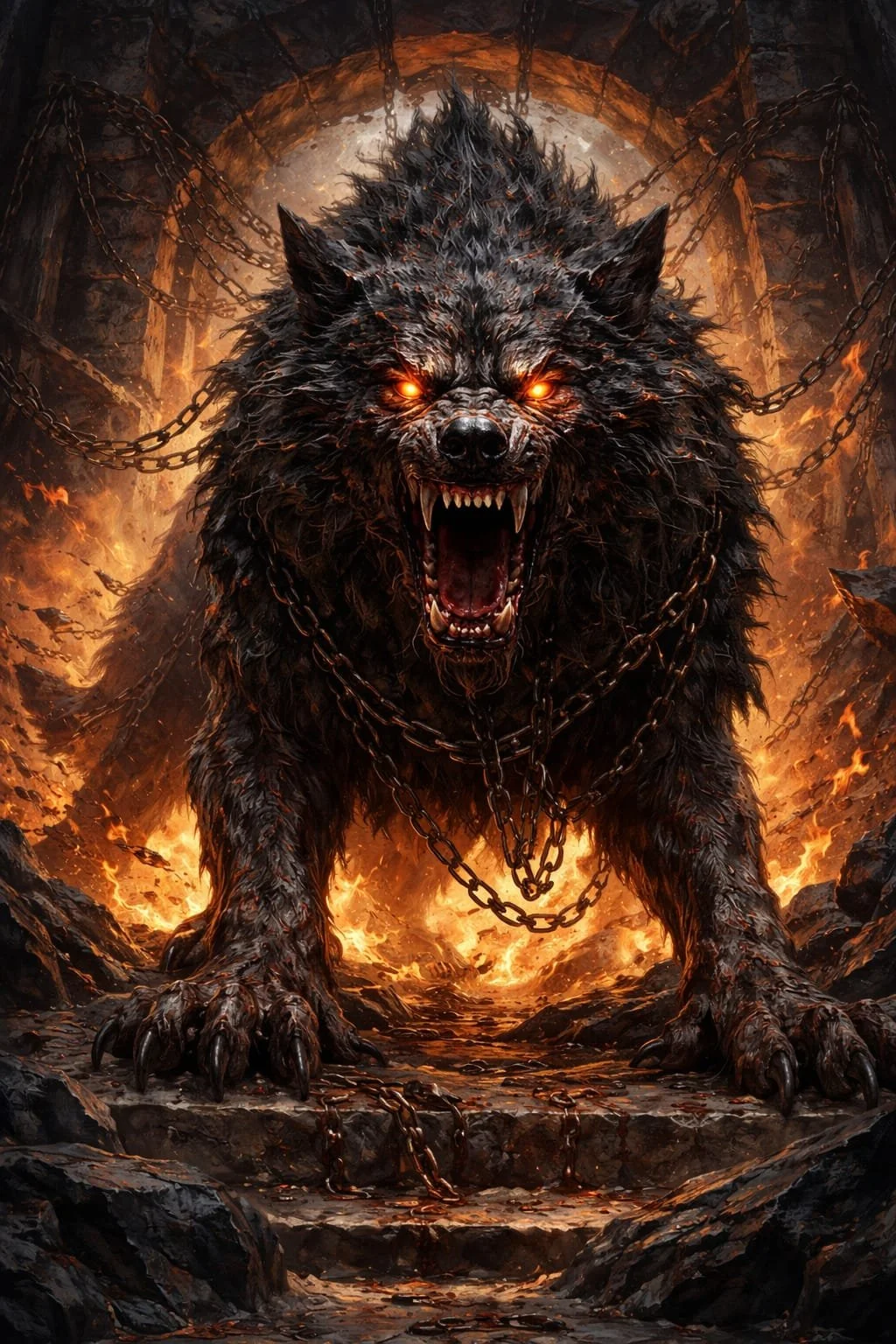
Some things are not meant to be crossed.
Some things exist so that the world remembers where it breaks.
- from the Ash-Sayings, fragment attributed to the North Sea coast, c. 10th century
And though the voices that carried these words have long since scattered into soil and salt, the boundary they describe still holds silent, taut, waiting beneath every step we take toward what cannot be undone.
***NOTE***
Before exploring this blog, it is important to clarify that Garmr is a figure from Norse cosmology. He is often depicted as a fearsome hound associated with death and the underworld, particularly guarding Hel or participating in the events of Ragnarök. Garmr is not a historical dog or literal creature, but a symbolic entity emerging from the cosmogonic myths recorded in sources such as the Poetic Edda and Prose Edda. What follows is a mythopoetic synthesis faithful to the spirit, symbolism, and internal logic of these traditions rather than a single canonical account.
On the Name Garmr
Names in Norse cosmology are never decorative; they are compressed cosmologies. Garmr carries connotations of barking, restraint, ferocity, and the liminal space between life and death. The word evokes not only the howl of a guardian but the echo of inevitable endings, a sound that marks boundaries no living being can cross lightly. Garmr is not simply “the hound of Hel” or “the doorkeeper of the dead.” His name encodes the tension between protection and destruction, between the threshold of life and the certainty of mortality. In his mythic function, he is both sentinel and harbinger: he guards the passage into the underworld, yet his role in Ragnarök signals that no boundary can hold forever.
In Garmr, we find a paradox akin to Auðhumla’s. While Auðhumla gives life, Garmr enforces the limits of life. While Auðhumla embodies quiet abundance, Garmr embodies necessary cessation. Yet both are indispensable to the cosmos: one nourishes existence, the other ensures its order through restraint. Before he acts, he already means inevitability.
Prologue: Born to Hold
Before roads learned where to stop,
before doors learned the meaning of closed,
before death learned to stay where it belonged, there was already a watcher. Not a king. Not a judge. A keeper. In the Norse imagination, not all power moves forward. Some power stands. Some power endures pressure without yielding. Some power exists solely to say: here, and no further.
Garmr was never meant to roam the world. He was never meant to chase the sky or circle the heavens. He was placed - deliberately - at the edge of everything that still breathes. He belongs to the threshold. Garmr did not emerge into a finished cosmos. He was not created after order was secure. He was stationed early, when the line between life and death was thin enough to tear. His presence marks one of the oldest truths in Norse cosmology:
"Not all danger comes from chaos. Some danger comes from crossing too soon."
The Norse did not imagine death as a moral failure or a punishment. Hel is not fire and torment; it is cold, still, inevitable. Death is not evil. But it must remain separate. The living cannot linger there. The dead cannot return unchanged. Garmr exists to enforce that separation. He is not born to destroy. He is born to hold. Where Skóll and Hati ensure motion, Garmr ensures limit. Where the wolves keep time running, the hound keeps time from collapsing inward.
Without him, the world would not explode. It would leak. And so, from his first breath, he waits. Not idle. Not asleep. But alert, every muscle coiled around a single responsibility:
Guard the gate. Hold the line. Remember the end. Even before the first human thought of fear, Garmr was already there, a living shadow at the edge of mortality, a sentinel of endings in the raw and ancient sense.
"Garmr bays loud before Gnipahellir." - Völuspá, stanza 44
The Place He Keeps: Gnipahellir
Gnipahellir is not merely a cave. It is a wound in the world, where stone folds inward as if shivering away from what lies beyond. The air tastes of cold ash, and frost clings to the hollows like the memory of sorrow itself. It sits at the border of Hel, a threshold where the living dare not linger and the dead cannot return unchanged. Here, Garmr waits not pacing, not restless, but taut as the last thread holding a fallen sky.
Waiting is no passive act when the stakes are cosmic. His presence bends the air, a subtle tremor beneath stone and bone. The cave exhales with him; shadows retreat, even the faintest echo of wind hesitates. Gnipahellir is neither locked nor sealed with runes; it is held by presence. By teeth. By breath. By a being who knows that mercy here would unmake worlds.
Though his birth is shrouded in silence, this sentinel’s principle resonates far beyond Hel: every mythic hound, every boundary, every act of restraint across the world echoes the same truth. And in the quiet, even a human heart can feel it the instinct not to cross, the ache that restrains what should not yet be disturbed.
Some things are not meant to be crossed. Some things exist so that the world remembers where it breaks. Here, at the edge of mortality, Garmr teaches that lesson with a presence older than time itself.
The Birth of the Watcher
The sources are quiet about Garmr’s origin. This silence is not accidental. Creatures tied to thresholds rarely receive elaborate genealogies. To explain them too fully would suggest they can be negotiated with. Garmr is not negotiable. Some later scholars attempted to link him to Fenrir, to make him another wolf of destruction. But this does him a disservice. Fenrir is inevitability breaking free. Garmr is inevitability contained. He is more akin to the hounds of the dead found across Indo-European myth: Cerberus at Hades’ gate, Yama’s four-eyed dogs in Vedic lore, the spectral black dogs of later European folklore. But even here, Garmr is harsher, leaner, stripped of ornament.
He does not sit at the gates of a kingdom. He stands at the edge of finality. No mother is named. No father claimed. Garmr does not need lineage. He is defined entirely by function. He exists because the world requires a place where life stops pretending it is endless. He was born before the first sigh of humanity, before the rivers knew their own course. He is a creature of principle, pure and unadorned, a living testament to the idea that some power is not meant to be understood, only acknowledged.
Comparative Mythology / Archetypal Context
Across cultures, threshold hounds appear where humans need a boundary they cannot enforce themselves. Cerberus waits at Hades’ gate, Yama’s four-eyed dogs roam the Vedic underworld, and in the misty hills of Britain, spectral black dogs haunt crossroads. Garmr is the North Sea’s articulation of the same truth: not all guardians are servants; some are principles made flesh. He is both local and universal: a voice older than geography, a law older than memory.
Tales of Garmr in Helheim
- The Whispering Dead
In Hel, it is said that the dead sometimes attempt to trick one another, whispering false directions back toward life. Garmr hears these whispers as clearly as the wind across the sea. One tale tells of a spirit who, yearning for the warmth of the living world, tried to flee the underworld by disguising itself as a shadow. Garmr appeared as a sudden darkness, a living wall, and the shadow dissolved like mist before dawn. No growl, no chase - only presence.
- The Wolf and the Hound
Fenrir once roamed the edges of Hel, testing the boundaries with teeth and rage. It is said that Garmr met him not with fury, but with a stillness that unbalanced the wolf. Fenrir lunged, snapping at the impossibility of restraint, and recoiled at the inevitability in Garmr’s gaze. For the first time, Fenrir recognized a force greater than hunger: order waiting in the jaws of the end.
- The Silent Escort
Mortals and gods alike have glimpsed Garmr in moments of passage. One tale tells of a Valkyrie guiding the spirit of a fallen warrior. Garmr did not interfere, but the air thickened; the world seemed to pause as the warrior’s spirit passed. Even Odin, seeking secrets of Ragnarök, bowed his head to the hound, silently acknowledging that some knowledge must be approached with reverence, not cunning.
- The Lost Child
Once, a mother tried to call her lost child back from Hel, the ache of mourning too sharp to bear. Garmr appeared as a shadow behind her eyes, freezing her steps. When she returned to the living world, she held her sorrow but not her dead, understanding that some returns are never meant to be.
- The Mist That Tests
In the high fjords, a sudden fog is said to be Garmr moving unseen. Sailors and hunters have told of a pressure that stops the heart before danger arrives, a whispering presence that keeps life from spilling into what is forbidden. Those who ignored it never returned the same.
The Sound That Precedes the End
Garmr’s most defining feature is not his size, nor his strength, nor even his blood-slicked fur. It is his voice. The baying of Garmr is not background noise. It is prophecy. When he howls, the cosmos listens. Unlike wolves, who chase in silence, the hound announces. His cry echoes through stone and bone alike.
It is not a warning meant to save, it is a declaration that a line has been reached.
In Völuspá, Garmr’s howl is one of the unmistakable signs of Ragnarök. Not the first sign, not the last, but one of the most chilling. Because his voice means this:
"What was held is about to break. What was guarded is about to open." When Garmr bays, the vibration travels through stone and marrow alike. Even the wind seems to pause, listening. It is not merely a sound; it is an atmosphere, a weather that reshapes the air and hearts alike.
Garmr Among the Gods
The Æsir do not challenge Garmr. Odin, seeking knowledge even in Hel, passes him with caution. Thor does not raise Mjölnir. Strength means nothing at a gate that must remain closed. Even the gods die eventually. They, too, rely on the boundary. Garmr does not serve Hel out of loyalty. He serves the structure of the cosmos. He is not a pet. He is a principle given teeth. His respect is earned not by sacrifice but by recognition: the living cannot alter what has been decreed.
The Nature of His Hunger
Unlike Skóll and Hati, Garmr does not chase. He does not hunger for light or movement. His hunger is for transgression. He feeds on crossing, on defiance, on the arrogance that believes rules end at death. His blood-stained chest is not proof of savagery, it is proof of vigilance.
Garmr does not desire the end of the world. He delays it for as long as he can. But when the world itself demands release, he will not resist.
Ragnarök: When the Gate Opens
At Ragnarök, everything reverses. The chase ends. The bindings fail. The watchers step forward. Garmr breaks free of Gnipahellir not in triumph, but in completion. The gate he guarded is no longer meant to hold.
He runs not toward the living, but toward Tyr. Law meets death. Order meets inevitability. They kill each other. Mutual destruction is not tragedy, it is symmetry. When law can no longer hold, death no longer needs a guard.
"Garmr is loosed; he fares to battle with Tyr,
and each becomes the slayer of the other." - Völuspá, paraphrased
Death Without a Watcher
Garmr’s death is not absence. It is release. With the boundary dissolved, there is no longer a need for a guardian. The distinction between life and death collapses along with the cosmos itself.
When the world is reborn, it is quieter. The line is redrawn elsewhere, by other means. Garmr does not return. Some boundaries only need to be held once.
Garmr in the Human Psyche
Garmr lives in restraint. In the instinct that tells you not to go back. In the ache that says: this grief will kill you if you stay here too long. He is the reason some doors should not be reopened. The reason memory must sometimes remain buried.
Without Garmr, we would linger in what has ended. We would rot beside what we lost. We would confuse mourning with meaning. He is not the voice that tells you no. He is the voice that tells you enough.
We all carry our own Garmr within us - the quiet voice that says some doors, once closed, must remain so. It is the ache that warns us grief is not to be escaped but endured, the instinct that restrains the foolish urge to rewrite endings. He exists in every instinct that holds us back from crossing too soon, reminding us that restraint is not weakness...it is a form of survival.
The Boundary as Mercy
Modern minds often mistake limits for cruelty. The Norse did not. They understood that boundaries are acts of care. A world without Garmr would be one where the dead whisper constantly, where endings never end, where loss never settles into memory.
That would not be beautiful. It would be unbearable. Garmr does not hate the living. He protects them from what they cannot survive.
Tales from the Threshold
There is a story of a fisherman who, in despair, tried to cross into Hel to see his lost love. Garmr’s howl froze him mid-step; he awoke to find his own hands gripping the bow of his boat, alive but shivering with recognition. Another tells of a wolf-spirit from the wilds that challenged Garmr’s patience. It vanished into nothing, leaving only frost where it had trodden.
All tales agree: the lesson is the same. Boundaries are not to be tested. Even gods learn this truth.
Final Reflection: The One Who Holds
Skóll and Hati teach us to move. Garmr teaches us to stop. All three are necessary. Life requires motion, but it also requires an edge. A final door. A place where pursuit ceases and rest, however cold, begins.
Garmr is not evil. He is not monstrous. He is honest. He stands where illusion ends.
And when you feel that deep, animal certainty that something must be let go, that some chapter cannot be revisited, that some threshold, once crossed, cannot be uncrossed that is Garmr. Not barring your way out of cruelty, but holding the world together long enough for meaning to survive.
Question for the Reader
If there is a threshold in your life you have been tempted to cross too soon, do you honor it or do you test it, knowing that even restraint carries a power older than the world itself?
In honoring the hound at the end of things, we honor the rhythm of the cosmos. Some ends must be held, lest the world unravel not in violence, but in loss without meaning.
Garmr reminds us that endings are not only final; they are necessary. The line he draws is not cruelty, but care. Some boundaries exist to protect life, memory, and the fragile order that allows new beginnings to take root.
When you recognize the quiet power of restraint, you are recognizing Garmr. He is the ancient principle that some chapters close so that others may begin.
Wyrd & Flame 🔥🩸🐺
May you know when to run, and may you know when to stop
