
Auðhumla: The Cow Who Licked the World Awake
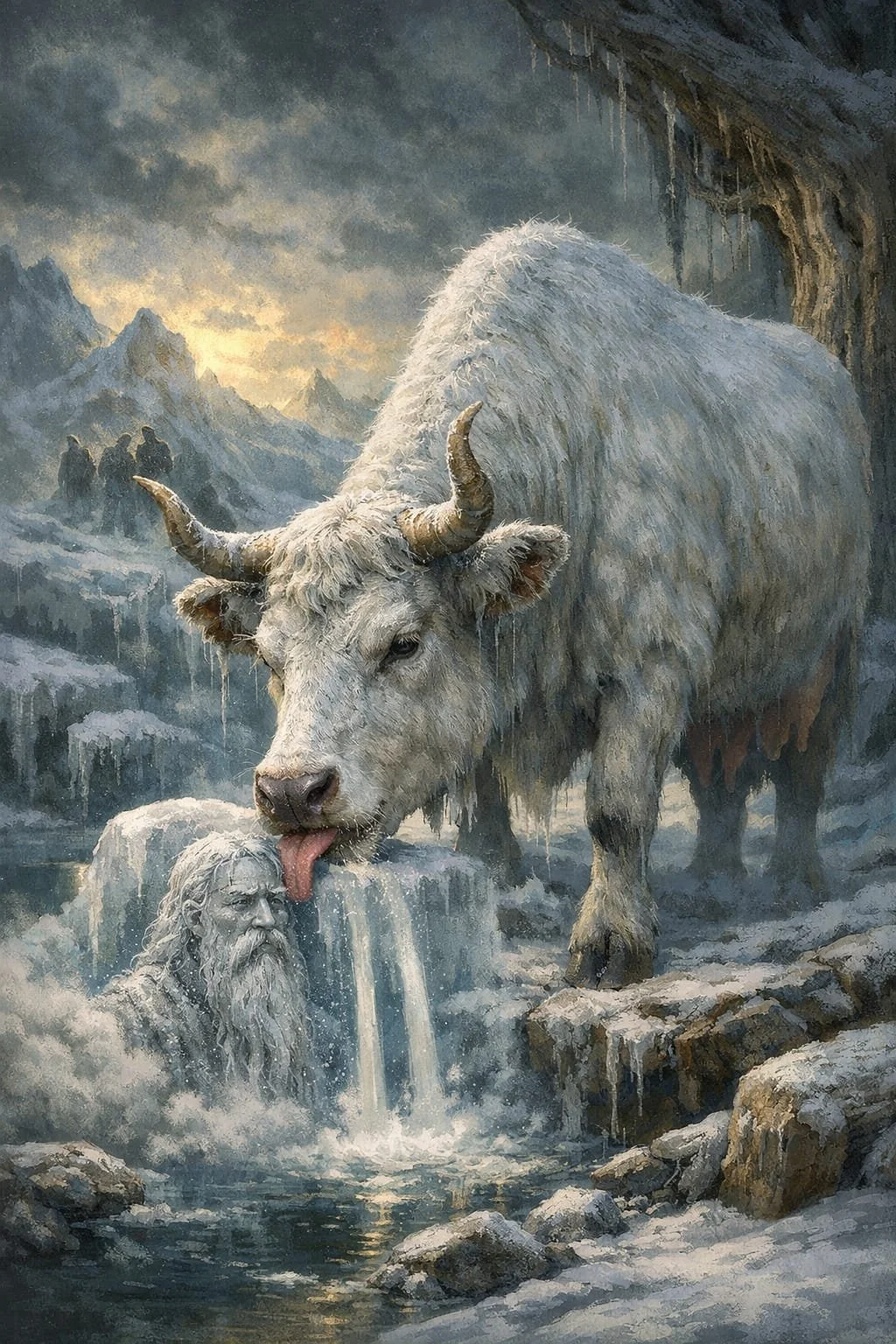
"From salt and ice she drew life, and from her tongue, the first voice of being came."
- Fragment of the Frost-Runes, attributed to early settlers of Jötunheim, c. 10th century
Even before the first breath of wind stirred the frost, before light dared to fracture the void, there was motion. Not frantic, not violent, but deliberate. Not created for spectacle or reward, but necessary. Auðhumla moved because the cosmos demanded it and the cosmos knew, without her, it could not awaken.
***NOTE*** Before diving into this blog, it is important to clarify that Auðhumla is a figure from Norse cosmology. A primeval, cosmic cow who nourished the first being, Ymir, with her milk. She is not a historical animal or a literal creature, but a symbolic entity emerging from the cosmogonic myths recorded in sources such as the Poetic Edda and Prose Edda. What follows is a mythopoetic synthesis faithful to the spirit, symbolism, and internal logic of these traditions rather than a single canonical account.
On the Name Auðhumla
Names in Norse cosmology are never ornamental. They are compressed cosmologies. Auðr carries meanings of wealth, abundance, primordial richness... not gold or possession, but the deep surplus of existence itself. It is the word used for inheritance, for that which flows forward through time rather than being seized. Humla refers to a hornless cow, a giver of nourishment without threat or display.
Together, Auðhumla is not merely “the cosmic cow,” but abundance that nourishes without conquest. She is wealth that does not hoard, power that does not dominate. Her name encodes the central paradox of her myth: that the force which awakens the universe is quiet, sustaining, and unarmed.
Before she acts, she already means persistence.
Prologue: Born of Frost
Before thought could take form, before matter could remember itself as potential, the universe was still. Ice stretched across the void, unbroken and unyielding. Silence was heavy, suffocating in its perfection. There was no pulse, no rhythm, only the weight of what might never be.
Then she appeared. Auðhumla, hooves pressing against nothing, muzzle tracing the frozen silence. She did not roar, she did not demand attention. She simply began to lick. Slowly, persistently, deliberately. Each movement was measured, deliberate, and absolute. In her tongue, the first act of insistence took shape.
Her licking was not hunger. It was instruction. She drew from the salt embedded in ice, coaxing matter to bend, to yield, to transform. Motion became life. Patience became the first form of power. And the universe, patient as the frost, began to awaken under her persistence.
The First Thirst
Before hunger, before need, before desire learned its own name, there was thirst.
Not thirst for survival, not for nourishment, but for movement itself. The frost was complete, too complete, sealed in a perfection that could not endure. Auðhumla felt this imbalance before it could be named. The ice held everything and gave nothing. Salt slept inside it like a memory trapped in stone.
Her tongue met the frost not out of instinct, but out of recognition. The universe was holding its breath too long.
Each lick was an answer to a question the void could not ask. Can stillness remain without becoming death? Can potential endure without motion? The ice answered by yielding, grain by grain, as salt surfaced like a forgotten truth.
Thus the first act of creation was not violence, nor command, but response. The cosmos thirsted, and Auðhumla drank - not to consume, but to awaken.
The Frost and the Salt
Salt and frost together contain both preservation and potential. Salt preserves, frost restrains, yet neither could transform without her attention. Her tongue became the alchemy between stasis and becoming. Ice resisted, unbroken, heavy with the weight of nonexistence. But with each patient stroke, she forced potential into movement.
Creation is never gentle. It is insistence. Ice yields not to threat, but to persistence. Auðhumla shows that beginnings are never sudden; they are negotiated, coaxed, and drawn forth. The frost whispers resistance; her tongue replies with patience. Motion emerges not from violence, but from relentless insistence.
Her light is also a symbol of knowledge, clarity and insight. She teaches that understanding like creation, must be cultivated slowly.
To witness her is to understand a truth that echoes throughout all existence: inertia is never neutral. Stillness is never comfort. It is potential waiting to awaken, or death waiting to claim what cannot endure. Her licking teaches the universe that insistence is the first form of creation.
When the Ice Refuses
There is a moment the myths do not name directly, but which must have occurred.
The frost does not always yield. Salt emerges unevenly. Ice reforms behind her tongue. What she has uncovered threatens to vanish back into stillness. The void presses inward again, heavy with the promise of erasure. Persistence is tested not by opposition, but by repetition that seems to undo itself.
Auðhumla does not change her rhythm.
She does not quicken. She does not retreat. She licks the same place again, not because she is certain, but because certainty is born after endurance, not before it. Creation nearly fails not because she weakens, but because beginnings are fragile. This is the unspoken truth of all origins - persistence precedes proof.
Búri and the Emergence of Form
From her persistence arose Búri, the first of the Æsir. He did not erupt from ice with force or fanfare; he rose slowly, piece by piece, like a thought finally forming in the void. His emergence is not separate from her motion. Every inch of his being owes itself to her patient insistence.
Auðhumla does not push him into being; she invites him into it. She is the teacher who does not speak. She acts, and in that action, the cosmos learns the rhythm of life. Without her, Búri would remain latent, unrealized, the first pulse of order smothered by inertia.
This emergence teaches us about the sacredness of beginnings. They are not miraculous in their speed but in their endurance. What persists slowly, deliberately, becomes essential. Her tongue teaches that creation is layered, patient, and meticulous - a lesson humanity would do well to heed.
The Cow and the Giants
Ymir sleeps, immense and inert, in the void. He is potential given shape, weight given stillness. And yet, it is her licking that allows him to awaken. She does not coerce; she does not challenge. She moves, and his form responds. Motion, insistence, and life are coaxed rather than forced.
Through her, the first giants awaken...not for spectacle, not for battle, but for being. The universe learns balance through her example. Motion need not be violent to be effective; insistence need not demand obedience to be transformative.
Her patience is radical. She creates without forcing, persists without coercing, and awakens life without hurry. Giants, gods, and all beings that emerge after owe their rhythm, their endurance, their pulse of being, to her steady tongue.
Creation Without Battle
Many cultures imagine creation as rupture: gods at war, bodies torn apart, order born from violence. The North remembered something different. Here, the universe awakens not through conquest, but through endurance. No slain monster, no triumphant god. Only repetition. Only insistence. Only a cow and the refusal to stop.
This does not make the Norse cosmos gentler but it makes it honest. It acknowledges that survival is rarely heroic and almost never loud.
The Milk That Fed the Void
Ymir drank before he woke. The milk of Auðhumla flowed before mouths understood hunger, before bodies understood need. It was not sustenance as mortals know it; it was continuity. A binding force that allowed vastness to remain coherent.
Where her milk fell, existence learned to remain. The void, once unable to hold shape, thickened. Potential learned weight. Being learned to stay. This nourishment was not charity. It was balance. Motion must be sustained, or it collapses into chaos. Her milk taught the cosmos that creation requires maintenance - that awakening without care is only destruction delayed.
Thus even the giants, immense and terrible, are children of nurture before conflict. Their strength is borrowed from her patience.
Time’s First Teacher
Time did not exist before Auðhumla began her work. There was only potential, stillness, and waiting. But as she licked, she coaxed duration into existence. Seconds unfolded into minutes, minutes into hours. Motion became measurable; persistence became rhythm.
Her tongue does not accelerate, it does not pause. It sets a tempo that the cosmos follows unconsciously. The cycles of stars, the growth of rivers, the heartbeat of life itself - all trace back to her insistence. Time learns to endure because she teaches it patience, insistence, and continuity.
Time learns not only patience, but also resilience, adapting to each obstacle the cosmos places before it. Every cycle is a lesson in perseverance, instilled by her tongue.
She is the teacher who does not speak. Her lessons are woven into matter and rhythm. Every heartbeat, every cycle of creation, every act of life carries the imprint of her patient insistence. Time is alive because she moves.
Auðhumla and the Weight of Silence
Silence is not empty. It is heavy. Before sound, before rhythm learned to echo, silence pressed inward on all things. It was not peaceful; it was suffocating. Even time, newly born, struggled beneath its weight.
Auðhumla did not break the silence. She bore it.
Her tongue against the ice became the first friction, the first quiet defiance. No sound followed immediately. Creation does not announce itself. It practices. With every deliberate motion, the silence thinned. Not shattered, not erased, but taught to bend. The universe learned that silence could coexist with movement, that stillness need not smother becoming.
Long after, when thunder would roar and words would be spoken, silence would remember her lesson: to make space rather than dominion.
The Cow and the First Light
Before stars, before fire dared to touch frost, Auðhumla’s motion created the first glimmers of illumination. Not sudden, not blinding, but slow, careful, deliberate. Light emerges because she allows it, nurtures it, insists upon it.
Her licking does more than awaken form; it awakens awareness. Stars, rivers, mountains all come into being because persistence, not force, draws them from potential. The first light owes its rhythm and its endurance to her patient insistence.
Illumination is not a gift, but a responsibility. Auðhumla teaches that all beginnings must be coaxed and sustained, not assumed. She demonstrates that nurturing is a form of power, and persistence is a form of creation.
Lessons for Humanity
Auðhumla’s myth speaks to human endurance, persistence, and creation. Every effort, every act of care, every slow coaxing of potential mirrors her patient tongue. Humans inherit her lesson: to move deliberately, to insist persistently, to nurture possibility even when the world seems frozen.
Her patience is radical, even revolutionary. It teaches that beginnings are sacred, not because they are immediate or spectacular, but because they endure. Growth requires care, attention, and repetition. Motion itself is mercy, insistence itself is life.
Humans can also learn to apply her rhythm to emotional, spiritual, and creative endeavors, making every action a sacred co creation.
This work still happens. In hands returning to the same labor each day. In grief that softens only through repetition. In care work that leaves no monument. In creation that advances by fractions no one applauds.
From the outside, it looks like nothing is happening. From the inside, the world is being kept awake.
In every act of creation, humans echo her rhythm. Every decision to continue, to sustain, to nurture, reflects the ancient, slow insistence of the cosmic cow.
If She Had Not Moved
Imagine a universe perfectly preserved. Ice intact. Silence complete. Potential locked forever in flawless stasis. Nothing decays, nothing suffers, nothing grows. A cosmos mistaken for peace because nothing disturbs it.
Without Auðhumla, existence does not become hostile it simply never begins. No conflict, no hunger, no grief, but also no memory, no warmth, no becoming. Perfection reveals itself as extinction without violence. This is the danger her myth warns against that stillness, left unchallenged, is not safety. It is abandonment.
The Persistence of Beginnings
All life flows from her insistence. Motion, time, and awareness are tributaries of her deliberate actions. Her licking ensures that inertia does not claim existence. The cosmos learns that beginnings are sacred not for their speed, but for their endurance.
Her persistence is the template for creation. The smallest acts, repeated with patience, awaken worlds. Every cycle of day and night, birth and death, growth and decay all owe their rhythm to her insistence.
Persistence is sacred because it transforms potential into reality. Motion is life because it refuses to pause. And Auðhumla teaches that enduring patience, not sudden force, is the ultimate form of power.
The Cow and Language
Even sound emerges from her patience. Before humans spoke, before words carried meaning, the universe learned rhythm from her tongue. Language, like life, is coaxed into being through insistence.
She does not teach directly; she demonstrates. The first words are echoes of her tongue tracing the ice, coaxing latent potential into emergence. Sound becomes measure, speech becomes rhythm, thought becomes expression all because she insists.
Her example teaches that communication, like creation, requires persistence. Meaning is drawn slowly, patiently, from silence. Without her insistence, words would remain unformed, thought would remain latent, and the cosmos would never speak.
The Cow and Mortality
All beings she awakens inherit temporality. Mortality is the shadow cast by persistence. Life exists because she insisted; it ends because her work is deliberate, not infinite.
Auðhumla teaches that endurance, not immortality, is the gift. Life’s value is not in its length but in its sustained attention. The first gods, the first humans, and the first giants all owe their rhythms, their cycles, their mortality to her patience.
Even absence and decay are lessons. They remind us that persistence matters more than permanence. Motion, insistence, and deliberate attention create life; mortality shapes it.
When Auðhumla Withdraws
There comes a moment when persistence must release. Auðhumla does not vanish in flame or battle. She recedes. Creation no longer needs her constant touch; it has learned the rhythm. Motion has memory now. Her withdrawal is not absence - it is inheritance.
The universe continues licking itself awake: waves against stone, roots against earth, hearts against despair. What once required her now requires everyone. This is her final lesson. The teacher leaves so the lesson can live. Even Ragnarök will not erase her work. Frost may return, silence may thicken but motion remembers.
And someone, somewhere, will begin again.
The Cow and Cosmic Cycles
Creation is cyclical. Frost, ice, emergence, decay, renewal - all flow through her rhythm. Auðhumla ensures that cycles do not break, that beginnings follow endings, that potential is never extinguished.
Her tongue teaches the universe the rhythm of renewal. Nothing that begins is lost forever; nothing that ends ceases to matter. The cosmos flows because someone persists, even when silence and stillness dominate.
Cycles, like life, are lessons in patience. Her insistence shapes not just beginnings, but continuations. She is the pulse beneath the eternal dance of existence.
The Cow and Wyrd
Before the Norns carved fate into wood and well, Wyrd already moved. It moved in Auðhumla’s tongue. Each stroke traced inevitability into the ice. Not destiny as command, but as consequence. What is repeated becomes law. What persists becomes structure.
Auðhumla does not foresee. She establishes conditions. And from those conditions, fate emerges. The gods would later mistake this for control. Mortals would later mistake it for cruelty. But Wyrd is neither. It is memory shaped by insistence.
The future flows the way the tongue once moved: slow, deliberate, unable to be undone, only continued.
Invocation of Motion
When beginnings feel impossible, when the frost resists, when silence feels eternal, remember Auðhumla.
She does not rush. She does not demand. She teaches that persistence awakens potential, that motion nurtures life, and that patience itself is sacred.
Move. Persist. Coax. Endure. Insist.
The world awakens beneath your touch, as it once did beneath hers.
A Rhythm to Carry
When the world resists, do not wait for certainty. When silence presses inward, do not mistake it for peace.When progress feels undone by repetition, remain.
Move again. Touch the same place.
Persist without spectacle. This is not metaphor. This is instruction.
Final Reflection - “The Cow in Us”
Auðhumla does not roar. She does not command armies or shatter mountains. She does not conquer chaos with violence or announce herself with fire. She licks. She persists. And the cosmos responds.
We live beneath her insistence, whether we recognize it or not. Every cycle of life, every birth and death, every act of creation carries her rhythm like a memory embedded in matter. Rivers continue because something once refused to stop moving. Hearts continue because stillness was never allowed to claim everything. We endure because, at the beginning of all things, someone persisted when the world was frozen.
Her myth reminds us that power does not always arrive as force. Sometimes it arrives as return. As repetition. As the quiet refusal to abandon what has not yet yielded. Persistence becomes sacred not because it guarantees success, but because it keeps possibility alive long enough to matter.
Motion is mercy. It gives the frozen something to become. It gives silence a chance to thin. It gives grief, failure, and exhaustion a future beyond themselves. Beginnings are sacred not because they are dramatic or sudden, but because they endure the long labor of becoming.
The cow lives in us wherever we choose to continue without certainty. In the work that looks like nothing is happening. In the care that leaves no monument. In the effort that must be repeated again tomorrow, and the day after, and the day after that.
Auðhumla teaches us that the world does not awaken all at once. It wakes because someone touches the same place again.
And again.
And again.
Not a destroyer.
Not a ruler.
But the primordial teacher of patience, persistence, and creation itself.
So where, in your own frozen places, will you choose to persist long enough for the world to answer?
Wyrd & Flame 🔥 ❄️ 🐄
