
Seiðr Craft - Chapter 18: The Quiet Initiations
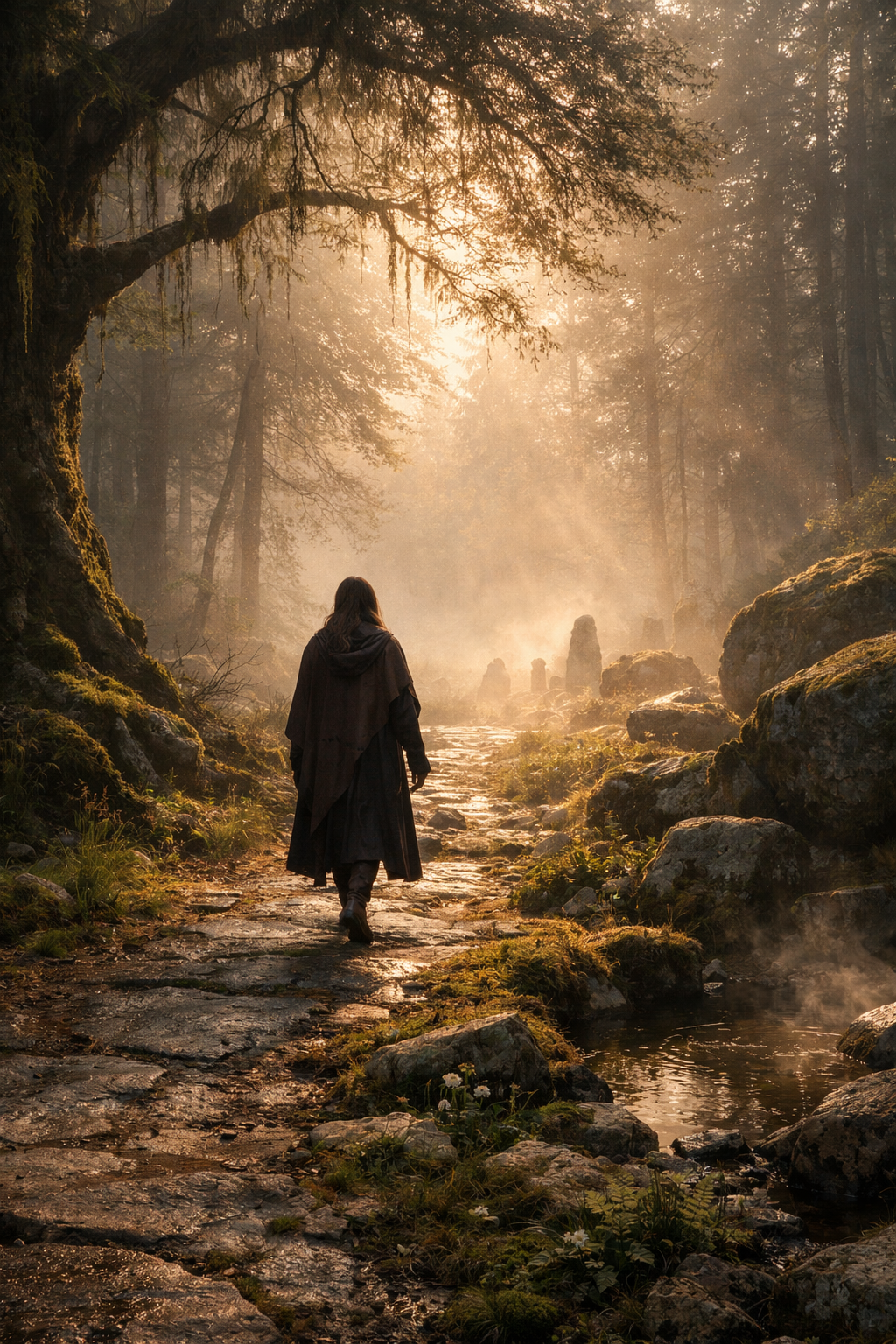
There are initiations in seiðr that no one speaks of.
No drums.
No witnesses.
No circle of fire or chanting names.
Just you and the quiet.
In this path, the deepest turning points arrive not as grand ceremonies, but as moments that split the self in silence. They come in the night when the breath feels heavy, when the spirits are distant, when every familiar thread has slipped from your hands. Some call these trials. Others call them awakenings. In truth, they are neither and both. They are the places where the old self dissolves, and the new self has not yet taken shape.
Quiet initiations are not given - they are endured.
Not bestowed - but lived through.
They appear when life unthreads something inside you. When you lose, when you grieve, when you are cracked open wide enough for truth to enter. They arrive when you realise you are no longer who you were, but have no name for who you are becoming. When the unseen withdraws just long enough for you to walk by your own light. When there is no teacher to reassure you, no sign to confirm your direction - only the slow pulse of wyrd and your willingness to trust it.
Most initiations do not feel like power.
They feel like uncertainty.
Like standing at the edge of a forest you must enter alone.
But in seiðr, this is where the real craft begins - not in visions or voices, but in endurance, awareness, and the ability to remain present through unravelling. Quiet initiations reshape the bones of the practitioner. They teach patience deeper than desire, humility sharper than ambition, courage softer than bravado. They forge presence - not in the heat of spectacle, but in the cold clarity of solitude.
If you walk this path long enough, you will meet these gates. Not once - but many times.
Each one takes something.
Each one gives something.
Each one changes who you are when you return to the world.
This chapter is for those thresholds - the ones passed in silence, marked only by breath and by becoming.
The awakening that forges you again and again.. the spiritual turning of the tide.
What Quiet Initiation Really Is
What quiet initiation really is cannot be pointed to, labelled, or announced like a rite of passage. It arrives without drums, without witnesses, without a moment that says here (now) you have crossed the threshold. Instead, it grows slowly, like frost spreading overnight on a windowpane. You wake one morning and realise something in you has changed. You do not yet know what it means - only that you cannot return to who you were before.
Quiet initiation in seiðr does not look like a ceremony. It looks like life re-arranging you. It looks like the familiar becoming unfamiliar, as though the world is holding its breath around you. It is the shift that happens when your old ways of sensing no longer fit, when silence feels heavier than sound, when you begin to feel watched not with scrutiny, but with expectation. No instruction is given - only space. A space that demands you learn to stand inside it.
It is not an initiation of spectacle, but of depth. One day you notice that the threads around you have texture you never felt before. The land feels closer. Your dreams sharpen. Small moments carry meaning that would have slipped past you a year ago. Nothing dramatic occurs on the outside - but internally, something vast turns. You feel it in your bones more than in your mind. It does not rush. It settles.
Quiet initiation is a kind of remembering. Not learning something new - remembering something ancient. A skill you have never been taught but somehow know how to hold. A voice inside that is not loud, but certain. It asks nothing, yet demands everything. It changes the way you listen. It changes the way you speak. It changes what you are willing to carry and what you quietly lay down.
The gods may play a role in this. Or the land. Or your ancestors. Or none of them directly. Quiet initiation is not always given - sometimes it is grown. Sometimes it is the result of years of work finally catching the attention of something old and watching. Sometimes it is wyrd pressing your life into shape. Sometimes it is you stepping into the person you were meant to become, with no one but the unseen to witness it.
It does not crown you. It deepens you. It does not make you feel powerful - it makes you feel responsible. Initiation in seiðr is not a doorway opening with fanfare. It is a door you only notice after you’ve already stepped through it. And by the time you turn to look back, you realise the threshold has vanished - not because it was never there, but because you are no longer the one you were before crossing it.
Quiet initiation is not the beginning of power.
It is the beginning of presence.
Initiation Without Ceremony or Witness
Initiation without ceremony or witness is one of the oldest forms of seiðr. No circle is cast, no chanting begins, no hand places a token upon your brow. There is no feast, no marked date, no crowd to say you crossed a threshold. Instead - it happens in a room where no one else is watching. In the middle of a quiet night. On a walk you take alone. In a moment where life cracks you open just enough for something ancient to recognise the shape of your becoming.
This is the kind of initiation the old ones knew well. Not every turning of the path was formalised or sung into memory. Most of it happened in kitchens, in fields, by rivers, during winter grief and autumn labour. A woman bent over a loom might have felt her senses sharpen like a blade. A man tending animals could have felt the land breathe beneath him. No rune was carved to mark it - but the thread tightened all the same. The transformation was private, almost secret. Something in the world shifted toward you, and something in you shifted toward the world.
There is a dignity in this quiet form. You are not initiated because someone says you are. You are initiated because you changed, because you endured, because you listened, because you stepped into responsibility without needing applause. No audience validates this awakening - your life does. Your choices do. Your silence holds it. And the unseen watches with still patience, waiting to see if you will honour what began in you.
Some initiations happen when everything is falling apart. A job ends. A friendship breaks. A belief you once clung to slips through your fingers like sand. There is no ritual to ease the transition. Only the long stretch of time where you walk forward without knowing why. But the craft sees you learning to stand without being held. And that is initiation (not dramatic, not triumphant) but honest.
Other initiations come quietly in practice. When you begin to hear what others overlook. When the pressure in the room shifts. When the wind pauses just long enough for you to notice its attention. It is subtle. You doubt yourself. You question whether you imagined it. And that doubt is part of the doorway - because ceremony gives certainty, but the craft gives responsibility.
A witnessed initiation is a celebration.
An unwitnessed one is a becoming.
The former crowns.
The latter changes.
And it is the change that matters.
When no one sees your initiation but you, it does not make it lesser - only deeper. It roots in privacy. It matures without being named. And one day, long after the moment has passed, you realise you have been walking differently ever since. You carry yourself as someone the craft has begun to trust. Not because anyone recognised you - but because you recognised yourself.
The First Gate: When the Spirits Fall Silent
When the spirits fall silent, most practitioners fear they have done something wrong. They reach, they call, they ask for signs that do not come. But this silence is not abandonment - it is a gate. The first gate. The moment when external guidance withdraws so your internal foundation must either strengthen or crumble. It is the space where your practice becomes real rather than responsive, where you are asked to stand not because something moves around you, but because something is beginning to move within you.
Silence arrives like a winter that does not explain itself. The presence you once felt easily now feels distant, or absent entirely. Dreams go quiet. The atmosphere of ritual thins. What was once warm becomes neutral, almost cold. You listen harder, but nothing answers. This is not punishment. It is assessment. The unseen steps back to see whether your devotion is rooted in relationship or in reward. Whether you will maintain your work without encouragement. Whether you are shaped by contact or capable of standing without it.
This is where many stop. They believe the path has ended because the voice no longer calls. But the first gate is crossed only by those who remain still, keep breathing, keep grounding, keep practising with presence rather than expectation. Silence is the initiator here. It presses against you like a weight, revealing every impatience, every hope, every insecurity you still carry. You learn what part of you reached for comfort and what part reached for truth. You learn how much noise within yourself you used to mistake for guidance.
In truth, silence is the classroom where presence is forged. It teaches you to listen deeper than sound - to the body, to instinct, to the subtle pressure behind the sternum when attention is near. It sharpens perception the way night teaches the eyes to see differently. When the spirits fall silent, you are invited to find the current beneath the surface, the one too subtle to recognise when the path was loud.
Sometimes life mirrors this gate. People step back. Certainties dissolve. The familiar warmth of connection lessens. You feel unanchored. But initiation requires solitude — not loneliness, but the capacity to be with yourself without seeking constant affirmation. If companionship was the first leg of your path, this is the second - the walk you take alone to prove that your practice is more than proximity to presence.
Silence demands integrity. It asks you to show up even when nothing shows itself to you. It is the test of whether you will continue the work for its truth rather than its sensation. And when you endure it (not rushing to fill it, not abandoning the craft in frustration) something shifts. Your breath steadies. Your awareness roots. You begin to sense threads you never noticed before. Not bright. Not loud. But real.
The first gate is not about hearing spirits.
It is about hearing yourself clearly enough to meet them when they return.
Those who cross this gate do not emerge triumphant - they emerge quieter, steadier, and unmistakably changed. The silence does not break with fanfare. It softens. It thaws. A single moment will come (subtle, almost ordinary) where you feel watched again. Not constantly, but knowingly. That is when you realise you crossed the threshold.
You endured the winter.
You held your ground.
You did not abandon the thread.
And the unseen noticed.
The Second Gate: When Life Unravels the Old Self
When life begins to unravel the old self, it rarely asks permission. It pulls at threads you didn’t realise were loose - a belief, a habit, a relationship, a role you thought defined you. Something small shifts at first. A discomfort. A restlessness. Then the cracks widen. What once felt certain now wobbles under your hand. You wake one morning and realise you are shedding - not because you chose to, but because something deeper has decided you cannot go forward as you were.
This is the second gate of initiation, and it is seldom gentle. It comes through endings, transitions, losses that hollow you out, questions that no longer accept old answers. The life you built with the first version of yourself begins to fall away. Sometimes slowly, like leaves dropping into autumn soil. Sometimes abruptly, like a tree snapping in wind. You are not being punished - you are being re-shaped.
Initiation in seiðr is not about gaining power; it is about becoming someone who can hold it without breaking. The old self (the one built on certainty, comfort, identity) cannot carry what the deeper work will require. So life, wyrd, or the unseen begins dismantling what is too fragile to survive the next steps. You may feel stripped bare. You may grieve parts of yourself you once loved. But the unraveling is the loom clearing space for new weaving.
During this gate, the practitioner often feels suspended between selves. No longer who they were, not yet who they are becoming. The world goes quiet around them, or chaotic within them. Old coping patterns stop working. Familiar prayers feel flat. Ritual feels like a door with no handle. This is not failure - it is metamorphosis. A snake cannot keep its skin and grow. A caterpillar does not negotiate with its cocoon. The breaking is part of the becoming.
This gate demands honesty. What have you outgrown but still cling to? Where have you been comfortable instead of true? Which parts of you were shaped by survival, not self? Initiation will not carry those pieces through. They fall away - first reluctantly, then inevitably. In their absence you feel exposed, raw, unanchored. But beneath the shedding, a steadier presence begins to form. Quiet. Dense. Real.
The second gate is also a test of surrender. Not passive defeat, but active acceptance: I will not chase what is falling apart. I will not force what is ending to stay. I will meet what arrives with open hands. You do not need to know what you are becoming - you only need to stop holding yourself together in the old shape. The craft is unmaking you so that you can be remade.
There is grief here, and beauty. A strange tenderness in losing the skin that once protected you. Moments where you stand before the mirror and recognise your eyes, but not the person behind them. That is the sign the gate is opening. You are being emptied so that new presence can fill the vessel.
Those who fight the unraveling stall the initiation. Those who let it move through them emerge changed in ways they can feel but not yet name. Softer. Stronger. Less certain, but more real. The old self dies quietly, thread by thread - and what remains is a deeper listening, a deeper breath, a deeper readiness.
The second gate is not crossed when life breaks you.
It is crossed when you remain present through the breaking.
This is the moment the path stops being something you do and becomes something you are.
The Third Gate: When You Meet Yourself Without Masks
When you reach the third gate, the world does not strip away your identity - you do. Not in a violent tearing, but in a gradual revelation. You find yourself standing without the roles, stories, performances, and masks that once made you comfortable. There is no persona to hide behind, no title to lean on, no borrowed language to prove you belong. Only you - bare, unfiltered, unarmoured. For many, this gate is the hardest. It is not the silence of spirits or the unraveling of life. It is the moment you finally face yourself.
The third gate arrives quietly, often after the breaking has softened. You look inward and realise you cannot pretend anymore. You cannot perform devotion, or wisdom, or power. You cannot speak what you do not live. You cannot cling to an identity of “practitioner” if you are not practising. You see yourself with clarity - your strengths, your shadows, your habits of escape. Nothing is hidden from you here. And there is nowhere to look but inward.
This gate is an initiation of honesty. You begin to notice the places where ego was steering your work - the desire to be seen as gifted, chosen, advanced. You notice the ways you reached for experiences to validate your path. The ways you avoided discomfort by dressing it as mysticism. It is uncomfortable, sometimes humiliating. But humility is not humiliation - humility is truth, held gently. And this gate teaches you to hold yourself gently.
Meeting the self without masks is not a moment of shame - it is a moment of return. You meet the child who first felt the quiet between trees. You meet the instinct that noticed presence long before you had words for it. You meet the one inside who does not need to impress anyone - not spirits, not gods, not other practitioners. The one who simply is. And when you meet them, something deep exhales.
Here, you realise initiation was never about becoming more. It was about becoming less - less defended, less postured, less tangled in image. What remains when the masks fall is presence. Soft. Honest. Unforced. The kind of presence the unseen trusts because it has no agenda beyond relationship. You do not ask the craft to make you powerful. You ask to be real.
Some resist this gate, clinging to who they were, afraid they will disappear without their masks. But the truth is gentler: you do not disappear. You emerge. The self beneath the armour is quieter, but stronger. You speak less, but what you say has weight. You do not seek validation, yet connection deepens. You are no longer performing spirituality - you are living it.
This gate marks the moment you recognise that seiðr is not about becoming mystical - it is about becoming transparent, so the thread can move through you without distortion. When you stop performing, the work flows differently. Vision comes more cleanly. Intuition lands more sharply. The weave responds not to image, but to presence.
The third gate is crossed not when you feel enlightened, but when you stop pretending you already are.
It is crossed when you can sit with your flaws without crumbling, and with your gifts without boasting.
When you can say, “This is who I am, and still I walk,” the gate opens.
And beyond it, the work no longer requires noise.
Only truth.
Only presence.
Only you - unmasked, listening, becoming.
Pain as Teacher, Not Punishment
Pain arrives in seiðr not as wrath, nor as cosmic discipline, but as a teacher. It is the force that shapes what comfort cannot reach. When the path begins to carve itself deeper into the soul, pain often takes the role of chisel. It exposes what is weak, brittle, or untrue. It shows you the parts of yourself that collapse under pressure, the beliefs that crumble when tested, the illusions you held because they were easier than honesty. Pain does not come to punish - it comes to refine.
In quiet initiation, pain moves like winter through the branches. It strips what cannot survive the cold. It slows you, stills you, makes you feel rather than flee. It interrupts old habits and demands you witness everything you once avoided. Not to break you, but to make sure what remains is strong enough to hold the work. The craft does not require your suffering - but it will use it. Every wound becomes a door when walked through with awareness, every sorrow a teacher if you are willing to listen.
Pain teaches boundaries - where you say no, where you stop bleeding for others, where you finally stand without apology. It teaches patience - because healing does not rush. It teaches truth - revealing who you are when nothing comforts you. Some lessons can only root when a life has cracked open enough to receive them. The earth does its deepest work in darkness; the seed breaks before it grows. You too break, not into ruin, but into depth.
There is a tenderness to this stage that is often missed. Pain is not the enemy - resistance to pain is. When we brace, we fracture. When we soften, we transform. The initiation here is not to endure agony silently, nor to glorify suffering, but to recognise what pain is pointing toward. A wound that needs tending. A fear that needs meeting. A truth that needs speaking. Pain is the hand that turns your face toward what you would rather look away from.
Walking this gate means learning to ask: What is this pain teaching me, if I stop treating it as a punishment? The answers do not come quickly. They unfold like thaw - slow, patient, inevitable. Over time, you notice that the pain that once felt like breaking becomes space. Inside that space, presence grows. You become someone who can sit with discomfort without fleeing, who can stand in truth without collapsing. That capacity is initiation.
Pain is not the mark of failure.
It is the evidence that the old skin is loosening.
The teacher does not shout.
It presses gently, then firmly, then undeniably -
until you listen.
And when you listen, the lesson becomes a key.
A key that opens the next gate.
The Threshold Where Power Does Not Feel Like Power
There comes a point in quiet initiation where power does not feel like power. It does not rush through the body like fire, nor surge like vision, nor wrap you in certainty. Instead, it arrives as stillness. Soft. Heavy. Barely noticeable unless you stop to feel it. This is the threshold where many expect greatness, but meet gentleness instead. Where they imagine thunder, but find a quiet breath sitting in the centre of the chest. It is easy to miss if you are looking for spectacle.
At this stage, you realise something subtle has changed. You no longer chase signs or sensations. You do not need proof of your path or your worth. There is a calm weight inside you, like a stone warmed by the sun. It holds more strength than any display of power, yet it is almost invisible from the outside. This is what real power feels like when it settles - not loud, but anchored. Not dramatic, but unshakable.
The threshold is disorienting at first. You may wonder if you have lost something - the intensity, the visions, the thrill. But what has fallen away is not the craft, only the noise you once needed to feel connected. What remains is presence. Presence does not push or demand. It stands. It listens. It waits with patience that does not need to prove itself. Power becomes less about what you can do, and more about what you can hold.
Crossing this threshold means you are no longer fed by validation or experience alone. You begin to understand that true strength is measured by stability, by discernment, by the ability to move only when movement is necessary. You feel less driven to call spirits, less compelled to seek vision, less eager to show what you know. Instead, your work becomes quieter, deeper, more deliberate. You conserve energy like a winter tree conserving sap.
Power that does not feel like power is often the beginning of maturity in the craft. It is when the thread tightens, when your voice carries more weight even if you speak rarely. The unseen recognises this shift. They respond not to hunger, but to grounded presence. When you stop seeking constant confirmation, you become someone who can be trusted to listen. To act only when the moment calls for it. To sit in silence without shrinking.
This threshold is not triumphant. It is steady. It is the moment you stop trying to feel powerful and simply become someone who is. No fireworks. No revelation. Just a quiet knowing beneath the sternum - I can hold this now. And that knowing changes everything.
When No One Sees Your Work (And Why That Matter
There will be long stretches of the path where no one sees what you are doing. No teacher applauds your discipline. No spirit rushes in with reward. No friend understands what is shifting inside you. The work becomes quiet, private, unseen. It is here that many falter, because the modern world values visibility more than depth. But in seiðr, the unseen work is often the most important work of all.
When no one is watching, you meet yourself without performance. You practice not to impress, but to align. You sit in silence not to collect visions, but to become steady in your own presence. You learn to hold your craft without needing recognition. This is where integrity takes root - when devotion continues even without witness or praise. The unseen work shapes you more than any public ritual ever could.
Hidden growth is the kind that lasts. A tree does not boast about its roots, yet its strength is built where no eye sees. In the same way, your practice deepens in the soil of solitude. You discover what parts of your path were fuelled by desire to be seen, and what parts are fuelled by genuine calling. When no one sees your work, you find out who you are when nothing is feeding your ego. And that discovery is a gate all of its own.
There is a certain holiness in anonymity. You learn to trust your inner sense without needing external confirmation. You learn to show up on the days that feel empty, to breathe through doubt, to stay when the path offers no comfort. These moments temper the iron of your spirit. They are the forge. Initiation is not loud. It happens in kitchens, in forests, in breath, in beds where you lie awake sensing something waiting inside you.
Why does it matter that no one sees? Because power earned in silence is not fragile. It is not dependent on attention. It does not crumble when unrecognised. It becomes self-sustaining, self-rooted, self-honest. You become someone who does the work because the work is the path - not the reward. This is when the unseen begins to trust you. Not because you are gifted, but because you are consistent.
When no one sees your work, you are building the part of yourself that will stand in ritual long after others have burned out. You are weaving presence. You are learning patience. You are stepping into a depth that does not need to be witnessed to be real.
And one day, without seeking it, that quiet work will speak for you - not through words, but through the way you stand, breathe, listen, and hold the thread.
The Day You Realise You Cannot Go Back
There is a moment in every true initiation where you realise you cannot return to the person you were. Not because you would be punished for trying, but because the old shape no longer fits. It feels like waking up inside a life that looks the same from the outside, yet everything internally has shifted. The familiar world sits differently against your skin. Conversations feel thinner. Habits you once slipped into without thought now feel foreign, as though you are wearing clothes cut for someone else.
This moment does not always arrive with clarity. Sometimes it comes slowly, the way winter melts into spring until one day the snow is simply gone. Sometimes it arrives sharply, like a breath caught in the chest. You are confronted with a choice - continue forward into the unknown, or cling to what you have already outgrown. But even clinging offers no comfort. The old life feels like a room you have already stepped out of, though the door remains open behind you.
You realise you cannot pretend anymore. You cannot un-hear the quiet guidance that reshaped you. You cannot un-feel the presence that taught you to listen. You cannot un-know the truths that surfaced when everything else fell away. This is the day you notice the threshold beneath your feet - not dramatic, not ritualised, but unmistakable. Something in you crossed without ceremony. And now the world asks whether you will follow the self who stepped forward.
There is grief here, even in the beauty. A mourning for the simplicity you once lived in, a softness for the version of you who did not carry this depth. You may long for how things were, only to find they no longer nourish you. The path is not always kind, but it is honest. You are being asked to grow, not to stay comfortable. The day you cannot go back is the day you finally begin to walk the path with intention instead of curiosity.
You may not feel powerful. You may feel small, uncertain, even afraid. But beneath that fear sits something steady - a quiet resolve, a presence that was not there before. The unseen does not force you onward. It simply waits to see if you will honour what has already begun. Initiation does not pull you across the threshold. You walk across by choice. Even if the choice is as soft as a breath, as small as a single step.
This is the moment you become a practitioner not by title, but by living truth. You continue the work not because everything is clear, but because something in you refuses to return to sleep. You choose forward. You choose depth. You choose yourself without the mask.
You cannot go back - because the one who could is already gone.
The Initiation of Loneliness and Belonging
There is a stage in quiet initiation where loneliness becomes its own landscape. Not the loneliness of having no one around, but the ache of walking a path few can recognise. You begin to see, feel, and perceive differently, yet there is no language for the changes happening inside you. The people who once understood you no longer quite do. Their conversations float around you like smoke. You smile, you nod, but a part of you stands at the edge of something deeper, unable to return to the familiar shore.
This loneliness is not a sign of failure. It is a sign of threshold. You are being recalibrated, stretched between what you once were and what you are becoming. The soul grows quietly here - in the nights no one witnesses, in the silent tasks that reshape you. It can feel like exile from your own life, but in truth, it is a clearing. A making-space. Old identities loosen. Old roles shed. You are not being abandoned - you are being unhooked from what cannot walk forward with you.
And then, slowly, belonging returns. Not the belonging that comes from fitting in, but the belonging of resonance. The land begins to recognise you. The unseen leans closer. You feel accompanied by something that does not speak in words but in presence, in breath, in the subtle shift of air during ritual. You meet others on the path not by effort, but by synchrony. Souls find souls through recognition, not searching. The ones who share your language arrive when the old noise has fallen away.
Loneliness becomes the initiation into a new kind of belonging - one that is earned through honesty, quiet endurance, and the willingness to remain true even when no one is watching. The belonging is deeper because it does not require performance. You do not have to shrink or explain. You become yourself fully and are met, not questioned.
This stage teaches an important truth: initiation is both separation and homecoming. You are pulled away so that you may return differently. You walk alone for a time so the world can meet you anew. Belonging arrives only after loneliness has taught you who you are without witness, without audience, without validation. It refines you. It makes you strong without armour, present without approval.
You learn to stand with yourself first. And when others join you, they meet not your masks, but your truth.
When Strength Is Learning to Soften
There comes a moment in initiation where force no longer works. You cannot push your way through the next gate, cannot demand vision, cannot hold yourself rigid against change. Everything that once felt like strength begins to crack under its own tension, and you find yourself asked to do the opposite of what you expected - to soften.
Softening is not weakness. It is a surrender of armour, not integrity. A willingness to feel instead of brace, to listen instead of control. Many enter seiðr believing power is found in endurance, discipline, or unshakeable will. But the deeper work reveals a quieter truth: strength is often the ability to open where you once would have closed. To let the heart remain exposed without collapsing. To trust when certainty is gone.
Softening is the moment the soul unclenches. The jaw eases. The breath drops lower. Tears (long held back) finally come. You meet your own vulnerability without turning away. You realise that hardness protected you once, but cannot carry you further. The path ahead requires permeability, not defence. Your work begins to move through you, not from you.
This is strength that bends like willow, not strength that stands like iron. It is the kind that survives storms because it yields. It is the kind that can hold spirit contact without shattering. When you soften, you stop trying to master the craft and instead allow the craft to reshape you. You become receptive enough for the unseen to touch you deeply, gently, without force.
And there is power in that softness - a power rooted in presence, in honesty, in the courage to remain open even when you could close. It is a strength that holds the weight of experience without hardening against it. A strength that listens more than it speaks. A strength that trusts the tide rather than trying to command it.
Softening is the hinge of transformation. It marks the moment where inner walls fall, where the self expands, where the work begins to move in its true form. You are no longer armoured - you are alive. And in this softened state, the gods do not see fragility.
They see readiness.
Seeing What You Would Rather Ignore
There comes a point in quiet initiation where you are shown something you would rather not look at. It might be a habit, a wound, or a truth about how you move through the world. It rarely arrives gently. Often it appears in reflection, during ritual, or in the way others mirror something back to you, and a part of you pulls away. Not because you are weak, but because the comfort of not seeing feels easier than the responsibility that comes with awareness. This is one of the first tests of seidr initiation - whether you turn from what rises, or face it with steadiness.
Avoiding what surfaces never makes it disappear. It simply waits. The work will show it again and again until it is acknowledged. Looking away delays, it does not protect. What you refuse to see quietly shapes your choices, your reactions, your patterns. When you finally meet it directly, without excuses or spiritual bypassing, something softens. The shadow loses its edge. You begin to understand why it was shown to you, not as punishment, but as preparation for depth.
Sometimes what you would rather ignore is not something dark, but something tender. A grief you have carried without speaking. A longing you told yourself you did not deserve. A part of you that needed gentleness, but instead learned to survive by being hard. Initiation brings these to the surface because they cannot remain buried if you are to move deeper. They need recognition, not fixing. They need presence, not judgment.
Seeing what you want to ignore is slow work. It does not resolve in a single moment. It requires patience, reflection, and honesty without harshness. It asks you to sit with discomfort long enough to understand what it needs from you. When truth is seen clearly, even if uncomfortable, it no longer rules from the shadows. You become more rooted, more aware, and more able to stand in your craft without illusion.
Quiet initiation is rarely about power or vision. It is about facing yourself with integrity. What you can look at without turning away is what you can transform. What you cannot look at continues to shape you quietly. In this way, seeing what you would rather ignore is not a breaking point, but a deep beginning.
Losing What You Thought Defined You
There is a stage in quiet initiation where the identity you have carried begins to loosen. It might be the way you speak about yourself, the role you held in your community, the ideas you had about what your path should look like, or the story you used to understand who you were. These parts feel solid until the work deepens, and then they begin to fall away. Not because you failed them, but because they are too small to carry you further. What once felt like your foundation starts to feel like clothing that no longer fits.
Losing what you thought defined you can feel unsettling. You may feel untethered, uncertain, or even grieving for versions of yourself that you worked hard to build. Some people fight to hold on. Others cling to titles, practices, or personas to feel safe. But initiation is not interested in who you have performed yourself to be. It is interested in who you are when all performance is gone. When the roles fall silent, the real work begins.
This loss is not about erasing your past. It is about freeing you from the limitations of it. The craft will strip away identities that were built from expectation, survival, or imitation, so that what remains is something rooted, lived, and honest. You may stand in a place where you no longer recognise yourself in the way you speak, work, or relate to others. This is not collapse, it is emergence. Space is being made for the self that belongs to the future of your path, not the past of it.
During this stage, you might feel like you are walking without a name. The practices that once felt powerful may feel quiet. The certainty you carried may dissolve. This is not a sign the work is lost. It is a sign that depth is beginning. Emptying comes before refilling. Identity loosens before alignment forms. You are not meant to remain who you were when the path began.
Losing what you thought defined you is one of the hardest initiations because it cannot be forced, and it cannot be rushed. It is a slow unraveling of what was never truly you, so that what is you can finally breathe. With time, what remains is not a persona but a presence. Not an identity built for others, but a self capable of walking the path with clarity, humility, and strength.
The World That Remains After Ego Burns
There comes a point in quiet initiation where ego is not shattered violently, but slowly thinned. Not destroyed, but humbled. The need to prove, to be seen, to be acknowledged begins to fade like mist in morning light. You do not lose self-worth. You lose the urgency around it. The stories that once fuelled you - who you must become, how the work should look, how others should perceive you - soften and slip from your grasp. It is not defeat, but release. A letting go of the noise that kept you reaching instead of listening.
When ego burns, the world does not vanish. It becomes clearer. You no longer chase signs, you notice them. You no longer perform devotion, you live it. The unseen is no longer something you try to touch, it becomes something you meet when both sides are willing. The work loses spectacle and gains depth. You begin to value what is steady more than what is dramatic. Quiet moments carry more weight than impressive visions ever did. Presence becomes enough.
This stage can feel strangely gentle. There is no grand revelation announcing that ego has fallen. Rather, you act differently without trying to. Hunger for validation weakens. The impulse to rush fades. You respond to the world instead of wrestling with it. You speak less, you observe more. You no longer need recognition to trust your path. You know the thread by feel, not by praise.
The world that remains after ego burns is smaller at first. Fewer people understand. Fewer conversations fit. You may walk alone for a while, not in exile, but in clarity. You no longer need to convince or convert anyone. You simply continue. Your work is no longer fuelled by how it looks, but by how it moves within you. This is the quiet that those before us knew - the inward turning that marks true depth.
And slowly, the world expands again, but differently. You find those who listen as you listen. You connect not through intensity, but through resonance. The unseen approaches more consistently, not because you call loud, but because you are steady. You begin to recognise that initiation did not strip you bare to diminish you. It stripped you bare so the true foundation could reveal itself.
What remains after ego burns is not emptiness. It is honesty. It is grounding. It is the self that can hold power without needing to wield it. The self that can speak with the voice of the craft, not the voice of insecurity. It is quieter. It is deeper. It endures.
The Silent Blessing: When the Unseen Approaches Again
After long stillness, when you have walked quietly and endured the weight of your own unravelling, something shifts. Not dramatically. Not with thunder or vision or sudden revelation. It comes soft. Subtle. Like a presence standing just behind your breath. The unseen returns, not because you called, but because you became someone who no longer needs to chase. This return is the silent blessing, and it is rarely spoken aloud.
It does not feel like reward. It feels like recognition. A gentle nod from the worlds that watched you sit through silence without breaking. They approach because you held your centre. Because you did not demand answers. Because you learned to be present without certainty. This is the moment where initiation tips into relationship. The thread tightens in a way you can feel rather than see.
The blessing itself is simple. You notice small signs again. Dreams take on colour. The wind has meaning. A stone calls out with warmth. You feel watched, but kindly. The work opens not with excitement, but with familiarity. It feels like coming home to something you always knew, but could not reach until you softened enough for it to meet you.
There is no fanfare in this return. No proclamation. Often, no one else would even know. But your body knows. Your instincts know. The thread that felt thin now holds weight again, steady and alive. The unseen does not rush you. Instead, it stands close, waiting to see if you honour what you learned in silence. Waiting to see if you reach gently.
This blessing is not power given, but presence shared. It is the moment where you are met as you are, without performance. You no longer beg for contact. You open to it. You no longer fear losing it. You understand it moves in cycles. And with this understanding, trust grows on both sides of the veil.
The return of the unseen marks a new stage: the work is quieter, but deeper. Less dramatic, but more real. You do not rise triumphant. You simply continue walking - slower, steadier, knowing now that presence means more than proof.
The blessing is not in contact alone. It is in who you became while waiting for it.
The Gift Not Asked For, But Earned
There comes a point on the path where something arrives that you did not request, summon, or seek. It is not given because you asked. It is given because you endured. Because you listened. Because you walked when the ground was thin and waited when nothing answered. The gift is not a reward for devotion. It is the natural result of becoming someone who can hold it.
This gift rarely looks like power. Often, it appears as understanding. A knowing that settles quietly into your bones. A shift in how you breathe when the unseen stirs. A sense that a door has opened within you, not around you. It may be a new thread of sight, a deeper connection to land spirits, a dream that teaches rather than confuses. It might be a tool, a name, a song, a whisper in ritual that feels like memory returning. But whatever form it takes, it fits you. It does not overwhelm. It roots you deeper into the craft instead of pulling you forward too fast.
You did not earn this through perfection. You earned it through presence. Through showing up when it was uncomfortable. Through choosing patience over proof. Through quiet integrity when ego burned away. The unseen gives gifts only when they know they will be respected, held, and lived with care. Not displayed. Not wielded. Not used for validation.
The gift is a turning point. A recognition that you have passed through gates that cannot be measured in ceremony or witnessed by others. You changed in silence, and the worlds saw it. This is why some call it initiation without ritual. The gods, the landvættir, the threads themselves acknowledge your growth in the only way they know how - through offering you something that deepens the work.
You may not notice the gift at first. It may reveal itself slowly, unfolding in dreams, instinct, or subtle moments of clarity. Often, it is only in hindsight that you realise something has shifted. You no longer react the way you once did. You speak less, understand more. You no longer seek signs. You recognise them. The gift is integration, not decoration.
And the moment you hold it in your hands - or heart - you will know that no one could have given it to you before now. You would not have been ready. You would have rushed, grasped, or misused it. But now, you carry it quietly. And that is what makes it yours.
A gift not asked for, but earned. Not claimed, but received. Not shown, but lived.
Walking Forward As Someone New
There is a moment after quiet initiation where the world looks the same, yet you are not who you were. Nothing dramatic announces the change. You wake, you walk, you breathe - and only in small movements do you notice the difference. Your reactions are slower. Your listening is deeper. You no longer rush to fill silence or chase certainty. You move with more presence, less hunger. Whatever unravelled in you has been rewoven, but not into the old pattern.
Walking forward as someone new is not about becoming powerful. It is about becoming rooted. Initiation has softened edges, burned illusions, stripped noise. What remains is a steadier self - one who trusts the thread, even when it is fine as spider-silk. Where you once sought signs, you now wait for them. Where you once feared stillness, you now recognise it as home. The path did not make you more, it made you clearer.
You may notice that others do not see the change. They treat you as the person you were, not the person you have become. This can feel strange at first, as if you are walking inside new skin that only you can feel. But quiet initiations are rarely witnessed by the world. The unseen saw. The spirits saw. The land saw. And that is enough. Transformation is not less real because it happened without applause.
The work ahead does not grow louder. It grows deeper. You step forward without needing to prove anything. You speak only when the words are clean. You act with less impulse and more intention. You understand now that strength is not force, but alignment. You do not lean into the unseen - you meet it where you stand. The craft becomes less about reaching and more about reciprocity. Less about vision and more about presence.
Walking forward as someone new does not mean you leave your old self behind like shed skin. Instead, you carry them gently, knowing they were the one who walked you to the gate. But you no longer let them lead. You walk now with a quieter centre - one not moved by validation, fear, or urgency. You walk with memory of silence, with patience earned through waiting, with respect shaped by not-knowing.
From here, the path does not open all at once. It reveals itself step by step. You do not sprint. You do not hesitate. You move with a pace that feels like breathing. Initiation is not the end. It is the beginning of living differently. Of practicing what you learned without being told. Of trusting the unseen without needing proof.
You walk forward as someone new - not loud, not shining, but steady.
And that steadiness is the true sign of initiation.