
The Völva: Seeress, Seiðr and Power in the Norse World
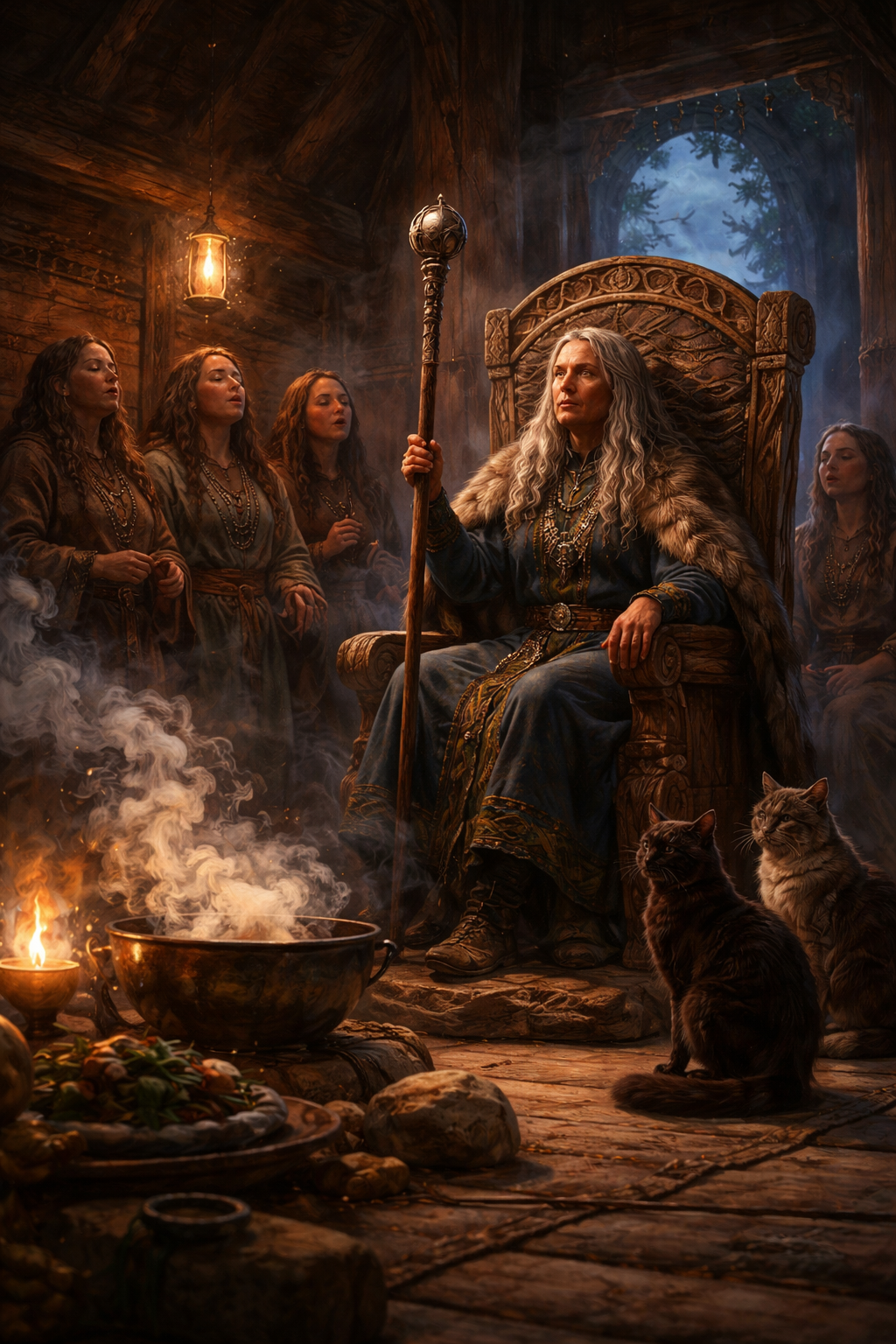
The völva is one of the most fascinating and misunderstood figures in Norse history. Often described today as a “witch”, “seeress”, or “shaman”, the historical völva was something far more complex and deeply rooted in Norse society. She stood at the meeting point of religion, magic, prophecy, and social authority, moving between households and halls, honoured and feared in equal measure.
Unlike many figures in Norse belief, the völva appears clearly in the historical sources. She is not a modern invention, nor a character created by later folklore alone. We find völur (the plural of völva) named and described in the Poetic Edda, the Prose Edda, and the Icelandic sagas. We also find strong archaeological evidence that supports the written accounts, including graves believed to belong to ritual specialists who closely match the descriptions of völur in the texts. This makes the völva one of the best-attested magical practitioners in the Norse world.
At the same time, much about the völva remains uncertain. The sources were written down centuries after the conversion to Christianity, often by Christian authors who viewed pagan magic with suspicion or discomfort. Some details are vague, symbolic, or deliberately obscured. This means that while the völva is real and historically grounded, we must approach her carefully, distinguishing what is clearly supported by evidence from what is later interpretation or modern spiritual practice.
Historically, the völva was a woman who practised a form of magic known as seiðr. Seiðr was associated with prophecy, fate, spirit communication, and influencing events. It was considered powerful and dangerous. The völva did not simply predict the future in a casual sense; she engaged with the deep forces that shaped destiny itself. In Norse belief, fate was not abstract. It was living, woven, spoken, and sometimes negotiated. The völva stood close to this process.
The role of the völva also challenges modern ideas about gender and power in the ‘Viking’ Age. Norse society was patriarchal in many ways, yet the völva held authority that even kings respected. Men sought her counsel, warriors listened to her words, and households prepared ritual space for her arrival. Her power was not political or military, but spiritual and social, rooted in knowledge that others did not possess.
Importantly, the völva was not a priestess in the modern sense. There was no central church or organised clergy in pre-Christian Scandinavia. Religion was woven into daily life, seasonal rites, and family traditions. The völva operated within this world, often travelling between communities, offering prophecy, blessings, and insight during times of uncertainty. She was not always welcome, but she was taken seriously.
What Is a Völva?
A völva was a woman in the Norse world who practised seiðr, a form of magic and spiritual work connected with prophecy, fate, and communication with unseen forces. The word völva comes from Old Norse and means “staff-bearer” or “wand-bearer,” from vǫlr (staff or rod) and the feminine ending -va. This name is important, because it tells us that the staff was not just a tool, but a defining symbol of her role and authority.
Historically, the völva was not a priestess in the modern sense, nor simply a “witch” as later folklore might suggest. She was a specialist in spiritual knowledge, sought out for her ability to see beyond the present moment. People believed she could perceive fate, foresee events, and interpret the hidden patterns that shaped life. Her power was not political or military, but spiritual and symbolic.
Völur (the plural of völva) appear in several Old Norse sources, including the Poetic Edda, the Prose Edda, and the sagas. One of the most famous examples is the völva who speaks in Völuspá (“The Prophecy of the Seeress”), where she recounts the creation of the world, the deeds of the gods, and the coming of Ragnarök. In this poem, the völva is portrayed as ancient, authoritative, and deeply respected, even by Odin himself, who seeks her knowledge.
In saga literature, völur often travel from place to place. They are described as guests who are welcomed into halls, given food, drink, and a high seat. This shows that they were not outsiders in the sense of being rejected by society. Instead, they occupied a special position: separate from everyday life, but still deeply woven into it. People feared them, respected them, and relied on them, sometimes all at once.
The völva’s work was closely tied to fate. In Norse belief, fate was not random, but shaped by complex forces such as wyrd (urðr in Old Norse), luck (hamingja), and ancestral influence. The völva did not “control” fate in a simple way. Rather, she interpreted it, revealed its direction, and sometimes helped people understand how to act within its limits. This made her role both powerful and unsettling.
Importantly, the völva was almost always female. While men could practise seiðr, this was considered socially transgressive and was often mocked or condemned. Female practitioners, however, were seen as inheritors of this tradition. This strongly links the völva to broader themes in Norse culture: women as keepers of fate, lineage, and deep ancestral knowledge.
The völva was also associated with liminal spaces and times. She often appears during moments of crisis, transition, or uncertainty: before major events, during famines, at turning points in a person’s life, or when the future feels unstable. This mirrors a wider pattern in Norse belief, where spiritual insight is strongest at the edges between worlds, seasons, or states of being.
What makes the völva especially important historically is that she represents a form of religious authority that existed outside formal temples or kingship. Her power did not come from land, weapons, or law, but from knowledge, memory, and connection to the unseen. In a society often remembered for warriors and gods of battle, the völva reminds us that wisdom, foresight, and spiritual skill were also deeply valued.
In simple terms, a völva was a woman who stood between worlds. She carried knowledge of the past, insight into the present, and glimpses of what was yet to come. She was respected, sometimes feared, and never ordinary. Her role was not invented by later fantasy, but firmly rooted in the beliefs and practices of the Norse Age and earlier Germanic tradition.
Völva, Seiðkona, Spákona: Related Terms and What’s Different About Them
When reading about Norse magic and prophecy, it is easy to become confused by the different terms used for women with spiritual or magical roles. Words like völva, seiðkona, and spákona are sometimes used interchangeably in modern writing, but in the historical sources they describe related yet distinct roles. Understanding the differences helps us avoid oversimplifying Norse belief.
A völva, as discussed, was a prophetic figure associated with ritual authority, staff symbolism, and deep knowledge of fate. The völva’s role was broad and powerful. She did not simply predict events, but revealed the underlying patterns of the world. Her knowledge could include the past, the future, and the hidden causes behind present troubles. The völva is often portrayed as older, experienced, and deeply connected to tradition.
A seiðkona is a woman who practised seiðr, a form of Norse magic associated with influencing fate, altering luck, and affecting people or events at a distance. Seiðr could be used for many purposes, including prophecy, healing, harm, protection, or manipulation of outcomes. The term seiðkona literally means “woman of seiðr.”
Not all seiðkonur were völur, and not all völur are explicitly described as seiðkonur, though there is overlap. Seiðr is an activity or technique, while völva is a social and ritual role. A völva may have practised seiðr as part of her work, but her authority went beyond a single magical method.
A spákona is more specifically a “prophecy-woman.” The word spá refers to foretelling or divination. A spákona’s role appears to be narrower than that of a völva. She foretells the future, but is not necessarily described as performing complex ritual magic or holding the same level of social authority. In some texts, a spákona may be consulted briefly, rather than hosted with ceremony.
Think of these terms as overlapping circles rather than strict categories. A single woman might be described differently depending on context, region, or the aspect of her work being highlighted. A völva could also be a seiðkona and a spákona, but not every seiðkona or spákona was a völva.
What matters most is that Norse society recognised different kinds of female spiritual expertise. Some women specialised in prophecy, others in magical practice, and some embodied a wider, more authoritative role that combined both.
Where the Völur Appear in the Sources (Eddas, Sagas, Law Texts)
What we know about the völva comes entirely from written sources produced in medieval Iceland and Scandinavia, most of which were written down after the conversion to Christianity. This means that our understanding is filtered through later perspectives, but despite this, the figure of the völva appears often enough, and with enough consistency, that we can be confident she reflects a real and recognised role in pre-Christian Norse society.
The sources that mention völur fall into three main groups: the Eddic poems, the Icelandic sagas, and early law texts. Each of these shows a slightly different aspect of who the völva was and how she was viewed.
The Poetic Edda -
The most famous völva appears in the Poetic Edda, in the poem Völuspá, meaning “The Prophecy of the Völva”. This poem is framed as a speech given by a völva to Odin himself. She recounts the creation of the world, the history of the gods, and the events leading to Ragnarök and beyond.
This is extremely important. The völva in Völuspá is not a minor figure or a village fortune-teller. She speaks with authority, memory, and cosmic knowledge. Odin seeks her out, raises her from the dead, and listens to her words. This places the völva in a position of immense spiritual power. She is presented as someone who remembers the deep past, understands fate, and can see what even the gods do not wish to face.
Other Eddic poems also feature women with prophetic or magical insight, often closely aligned with the role of the völva. These poems consistently link prophecy, deep memory, and fate with female figures, reinforcing the idea that this knowledge belonged to women in the Norse worldview.
The Prose Edda -
In the Prose Edda, written by Snorri Sturluson in the 13th century, völur appear less directly, but their influence is still clear. Snorri retells myths that depend on prophecy and fate, many of which originate in poems like Völuspá. While Snorri does not focus on living völur as practitioners, he preserves the memory of their authority by repeating stories where prophecy shapes the destiny of gods and worlds.
Snorri also describes seiðr, the magical practice closely associated with völur, and notes that it was considered shameful for men to practise. This reinforces the idea that this form of magic and prophecy was seen as a female domain, socially and spiritually.
The Icelandic Sagas -
The sagas provide our clearest picture of völur as human practitioners rather than mythic figures.
One of the most important examples appears in Eiríks saga rauða (The Saga of Erik the Red). In this saga, a völva named Þorbjörg lítilvölva is described in detail. She travels from farm to farm during times of hardship, especially famine. She is welcomed with respect, given a high seat, fed special food, and asked to perform seiðr to see what the future holds.
The saga carefully describes her clothing, staff, companions, and ritual behaviour. This shows that the role of the völva was socially recognised and structured. She was not a fringe figure, but someone called upon when communities needed guidance, reassurance, or insight into what was coming.
Other sagas mention women who practise prophecy, dream-reading, or magic, sometimes using different titles but clearly operating within the same cultural space as the völva. These women are often treated with a mix of respect and fear, suggesting their power was acknowledged but also unsettling.
Law Texts and Social Attitudes -
Early Scandinavian and Icelandic law codes do not describe völur directly, but they give us important context. Laws strongly condemn the practice of seiðr, especially when performed by men. This tells us two things. First, that seiðr was common enough to need regulation. Second, that it was strongly gendered.
The fact that laws focus on punishing male practitioners, rather than banning the practice entirely, suggests that women performing seiðr and prophecy were more socially accepted, even if the practice itself sat uneasily with later Christian values.
After Christianisation, women associated with prophecy and magic increasingly appear in sources as dangerous, deceitful, or morally suspect. This shift helps explain why later texts may exaggerate negative aspects of the völva, while still preserving clear evidence that she once held an important role.
The Völuspá and the “Seeress”: What It Tells Us
The most famous and important source for understanding the völva is the poem Völuspá, found in the Poetic Edda. The title means “The Prophecy of the Völva,” and it is one of the central texts of Old Norse mythology. Unlike many mythological poems that simply tell stories about the gods, Völuspá is framed as a spoken prophecy delivered by a völva herself.
In the poem, the völva addresses Odin directly. She speaks as someone ancient, wise, and powerful, someone who existed before the current world order and who will still be present when it ends. Odin calls upon her to speak, and although she does so, she makes it clear that she is not beneath him. Her tone is authoritative, sometimes challenging, and she demands respect for her knowledge. This alone tells us something important: a völva was not seen as a servant of the gods, but as an independent figure whose wisdom even Odin sought out.
Through her prophecy, the völva recounts the creation of the world, the ordering of the cosmos, the deeds of the gods, and finally the destruction and rebirth of the world at Ragnarök. This shows that the völva’s role was not limited to predicting small personal futures. She was concerned with cosmic time, fate, and the deep structure of reality itself. Her knowledge stretches across past, present, and future.
The way the völva speaks in Völuspá also reflects how seiðr and prophetic knowledge were understood. Her wisdom is not learned from books or teachings, but from experience, memory, and connection to unseen forces. She remembers ancient times, the first giants, the shaping of the worlds, and the weaving of fate. This suggests that völur were believed to access knowledge that lay beyond ordinary human understanding.
Another important detail is that Odin does not command the völva easily. He questions her, urges her to speak more, and offers her gifts and honour. In return, she reveals more of what she knows, but only until she decides to stop. This exchange reflects a wider pattern in the sources: prophetic women hold their power because their knowledge is rare and costly. It cannot be forced. It must be sought, respected, and often paid for.
The völva in Völuspá is also deeply connected to fate. She speaks of the norns, of destiny laid down long before the gods came into power, and of the unavoidable end that awaits even Odin himself. This reinforces the idea that völur were closely linked to concepts of wyrd (fate) and the limits of divine control. Even the gods are subject to what the völva knows.
Importantly, Völuspá does not present the völva as a villain, a witch in the later Christian sense, or a marginal figure. She is central, respected, and necessary. Her voice frames the entire mythic history of the Norse cosmos. This tells us that, at least in the earlier layers of Norse belief preserved in the poem, prophetic women held a place of deep cultural and spiritual importance.
In simple terms, Völuspá shows us what a völva represented at the highest level:
a woman who sees beyond time, who speaks truths even gods cannot avoid, and who stands at the boundary between worlds, memory, and fate.
For any historical understanding of the völva, Völuspá is essential. It shows that prophecy, seiðr, and female spiritual authority were not fringe ideas in Norse culture, but part of its very foundation.
Famous Völur in the Sagas: Short Case Studies
Although völur appear only occasionally in the surviving Norse sources, the examples we do have are vivid and revealing. These figures help us understand how the völva was viewed in society, how she worked, and how people responded to her power. What follows are some of the most important and well-attested völur in the Old Norse sources, presented clearly and historically.
Þorbjörg lítilvölva (Eiríks saga rauða) -
Þorbjörg, known as lítilvölva (“Little Völva”), is the most detailed and best-known völva described in the sagas. Her story appears in Eiríks saga rauða (The Saga of Erik the Red), written in the 13th century but reflecting older traditions.
She is described as a travelling seeress who visits farms during times of hardship, particularly famine. Þorbjörg wears a distinctive outfit that marks her role: a blue cloak trimmed with stones, a staff with a knobbed head, gloves of cat skin, and a hood lined with white fur. Every detail of her clothing signals status, ritual purpose, and separation from ordinary society.
When she arrives at the farm, she is treated with great respect. She is given a high seat and special food prepared just for her. This shows that the völva, while outside normal social roles, was honoured and feared.
Þorbjörg performs seiðr to gain knowledge of the future. Crucially, she cannot complete her ritual alone. She requires a group of women to sing a special chant called varðlokkur, which helps summon the spirits she works with. This detail is extremely important: it shows that seiðr and prophecy were not always solitary acts, but could involve communal female participation.
Through her ritual, Þorbjörg foretells that the famine will end and that better times are coming. She also gives personal prophecies to individuals present. Afterward, she leaves, continuing her journey.
This account gives us invaluable insight into:
the ritual clothing of a völva
the use of a staff
the communal and performative nature of seiðr
the social respect given to prophetic women
Þorbjörg is our clearest window into what a historical völva may have been like.
The Völva in Völuspá -
The völva of Völuspá is not named, but she is arguably the most famous seeress in Norse tradition. Speaking in the first person, she addresses Odin himself and recounts the creation of the world, the deeds of the gods, and the coming destruction at Ragnarök, followed by renewal.
Unlike Þorbjörg, this völva exists in a mythic, cosmic space rather than a realistic saga setting. However, her authority is absolute. Odin seeks her out, not the other way around. She possesses knowledge that predates the gods themselves, suggesting that the völva’s power is ancient, primal, and deeply rooted in fate.
This figure represents the völva as a keeper of cosmic memory and truth, not just a village prophet. While not a historical person, she reflects how powerful and respected the role of the völva was in the Norse imagination.
Heiðr (Völuspá and other traditions) -
The name Heiðr appears in several sources as a seiðr-working woman, and possibly a völva. In Völuspá, Heiðr is described as a woman who practised seiðr and was welcomed into halls, where she foretold the future. She is sometimes associated with Freyja or with Vanir traditions, though the texts are not entirely clear.
Heiðr’s name may be linked with brightness or honour, but also with sorcery. In later traditions, figures named Heiðr are sometimes portrayed more negatively, suggesting that attitudes toward seiðr-working women became more suspicious over time.
She represents the ambiguity surrounding völur: respected for their power, but also feared.
Guðríðr’s Encounter with the Völva (Eiríks saga rauða) -
In the same saga as Þorbjörg, Guðríðr Thorbjarnardóttir plays a key role in assisting the völva’s ritual by singing the varðlokkur. Guðríðr herself is not a völva, but her involvement shows that women without magical status could still participate in prophetic rites.
Later in the saga, Guðríðr becomes an important and respected woman, and some scholars see her participation in the ritual as a symbolic moment linking female knowledge, fate, and the future of lineages.
This case shows that völur did not exist in isolation. They interacted with ordinary women and drew on shared cultural knowledge.
Other Seeresses and Prophetic Women -
Various sagas mention unnamed or briefly described prophetic women who resemble völur, even if they are not explicitly called that. These women often:
predict deaths or disasters
appear before major events
speak truths that are later fulfilled
Examples can be found in Njáls saga, Vatnsdæla saga, and other family sagas. Sometimes these women are portrayed as uncanny or unsettling, which may reflect later Christian discomfort with pagan prophecy.
Even when unnamed, their presence reinforces the idea that prophetic women were a recognised part of the cultural landscape.
What a Völva Actually Did: Prophecy, Seiðr, Counsel, Curses, Blessings
A völva was not a single-purpose figure. She was not only a prophet, nor only a ritual specialist. The sources show that a völva carried out several related roles, all of which centred on knowledge, fate, and influence rather than authority or leadership. What unified these roles was not power over others, but insight into the hidden structures that shaped life.
At the heart of a völva’s work was prophecy. This is the role most clearly and consistently described in the sources. Völur are repeatedly shown as women who could see what others could not: the unfolding of fate, the outcomes of conflicts, the rise and fall of families, and even the end of the world itself. This knowledge was not casual or spontaneous. Prophecy was treated as something rare, costly, and serious. When a völva spoke, people listened, even if they did not like what she said. Her words were understood as revealing what already existed within wyrd, not as guesses or opinions.
Closely connected to prophecy was seiðr, the form of magic most strongly associated with völur. Seiðr was concerned with shaping or influencing fate, emotions, luck, and outcomes. It could be used to bring insight, but also to affect the course of events. The sources suggest that seiðr involved altered states, chanting, ritual posture, and symbolic tools. Importantly, seiðr was seen as morally ambiguous. It could be used for good or harm, and this ambiguity is one reason völur were respected but also feared. A woman skilled in seiðr was not easily controlled or dismissed.
Beyond prophecy and magic, völur also acted as counsellors. In several sagas, a völva is consulted before major decisions: voyages, marriages, disputes, or political changes. Her role here was not to command, but to advise. People sought her out because she could see likely consequences and hidden dangers. This made her valuable in a society where honour, luck, and reputation were deeply intertwined. Ignoring a völva’s counsel was risky, not because she would punish you, but because you would be acting blindly.
The sources also make it clear that völur could pronounce curses. These were not casual insults, but spoken acts believed to have real effect. A curse from a völva might involve calling down misfortune, illness, social ruin, or failure. Words mattered deeply in Norse culture, and words spoken by someone believed to understand fate carried particular weight. Because of this, völur were often treated with caution. Offending one was not wise.
At the same time, völur could give blessings. These might involve protection, good fortune, fertility, or success. Like curses, blessings were not sentimental. They were practical and tied to survival. A blessing might mean safe travel, a good harvest, or the continuation of a family line. In this sense, the völva stood at the boundary between danger and protection, loss and continuity.
What is important to understand is that a völva did not “cast spells” in a modern fantasy sense. Her work was rooted in speech, ritual, knowledge, and reputation. She influenced the world through understanding how it already worked. Fate could be nudged, revealed, or entangled, but not easily rewritten. This is why völur are often portrayed as solemn, restrained figures rather than dramatic ones.
Taken together, these roles show the völva as someone who worked with the deep structures of Norse belief: fate, luck, ancestry, and consequence. She was not a priestess of a temple, nor a servant of a single god. She stood apart, moving between households and communities, carrying knowledge that was both necessary and unsettling. This combination of insight, ambiguity, and independence is what made the völva such a powerful and enduring figure in Norse tradition.
Seiðr in Context: How the Norse Understood This Kind of Magic
Seiðr was one of the most complex and controversial forms of magic in the Norse world. It was not casual spell-casting or folk superstition, but a serious, socially powerful practice connected with fate, prophecy, and the shaping of events. To understand the völva properly, we must understand seiðr as the Norse understood it, not through modern fantasy ideas, but through the cultural values of the ‘Viking Age.’
In Old Norse sources, seiðr is described as a form of magic that could influence the future, alter luck, bring prosperity or hardship, cause illness, stir emotions, or uncover hidden knowledge. It was especially connected to seeing what was not yet visible: fate, outcomes, and unseen forces at work beneath the surface of everyday life. This made seiðr both respected and feared. A person who practised it was believed to have access to knowledge that others did not, and this knowledge could change lives.
Seiðr was strongly associated with women. Most practitioners named in the sources are female, and when men practised seiðr they were often criticised or mocked. This is because seiðr was seen as violating masculine ideals of honour, self-control, and straightforward action. In Norse culture, magic that involved trance, altered states, emotional manipulation, or spirit work was viewed as ergi, meaning unmanly or shameful, when performed by men. Women, however, were not bound by the same expectations, and so seiðr became culturally marked as a female art.
The god most closely associated with seiðr is Freyja. According to Snorri Sturluson, Freyja taught seiðr to the Æsir, including Odin. This detail is important because it shows that seiðr was not marginal or forbidden magic, but something powerful enough that even the chief god sought to learn it, despite the social cost. Odin’s practice of seiðr is explicitly criticised in the sources, which tells us that the stigma around it was real, even for gods.
Seiðr often involved altered states of consciousness. In saga descriptions, the practitioner sits or lies in a raised position, sometimes on a platform or high seat, and enters a trance-like state. Chanting, singing, or rhythmic speech (often called varðlokkur, “spirit-calling songs”) could be used to aid this process. These songs were sometimes performed by other women, showing that seiðr could be communal rather than solitary. The goal was not performance, but perception: to see, sense, or receive knowledge from beyond ordinary awareness.
Importantly, seiðr was not just about prophecy. While foretelling the future was a major part of it, seiðr could also be used to influence outcomes. This included shaping luck in battle, affecting fertility or harvests, protecting households, or bringing harm to enemies. Because of this, seiðr was morally ambiguous. A völva might be sought for help and guidance, but also feared for her ability to curse or disrupt social order.
Seiðr existed alongside other forms of Norse magic, such as galdr (spoken or sung charms), but it was distinct in both method and meaning. Galdr was more acceptable for men and often involved poetic incantation, while seiðr involved deeper trance and interaction with unseen forces. This distinction reinforces the idea that seiðr belonged to a different spiritual and social space, one associated with women, liminality, and the manipulation of fate itself.
In everyday life, seiðr was not something everyone practised. It required knowledge, skill, and social permission. Those who practised it openly, like völur, existed on the edges of society: welcomed, feared, honoured, and sometimes distrusted. Their power lay not only in magic, but in their role as interpreters of uncertainty. In a world shaped by fate, honour, and survival, seiðr offered a way to look ahead, to prepare, and sometimes to intervene.
Understanding seiðr in this context helps us see the völva clearly. She was not a witch in the modern sense, nor a priestess in a formal temple system. She was a specialist in fate-knowledge, trained in a form of magic that crossed boundaries and carried risk. Seiðr was dangerous because knowledge is dangerous, and the völva was respected because she knew things others did not dare to see.
The Seiðr Rite (Seiðr / Seiðr-Sitting): What the Texts Describe About Performance
Our clearest descriptions of how seiðr was performed come from saga literature, especially Eiríks saga rauða, with supporting hints from other sagas, poems, and later commentary. While the sources are limited and written down centuries after Christianisation, they still give us a surprisingly detailed picture of what a seiðr rite looked like in practice.
The most complete account is the story of Þorbjörg lítilvölva in Eiríks saga rauða. This episode is invaluable because it describes a völva performing seiðr in a domestic setting, step by step, rather than referring to the practice in vague or hostile terms.
In this saga, the völva is invited to a household during a time of famine and hardship. Her role is to see into the future and determine when conditions will improve. This already tells us something important: seiðr was often sought during crisis, uncertainty, or transition. It was not casual magic, but something turned to when people needed guidance that ordinary wisdom could not provide.
The völva arrives dressed in distinctive clothing that marks her role. She wears a cloak, gloves, and carries a staff (völr), which is one of the defining symbols of her identity. The staff is not described as decorative. It is clearly a ritual object and a sign of authority, reinforcing the idea that the völva’s power was recognised and formalised.
A high seat is prepared for her. This is crucial. Seiðr is performed from an elevated position, separating the völva from the rest of the household. Sitting above others symbolises her role as one who looks beyond the ordinary world. The act of sitting itself is significant: seiðr is often associated with stillness, altered awareness, and focused vision rather than physical action.
The rite requires helpers, particularly women. In Eiríks saga rauða, a group of women gather around the völva and sing a special chant called varðlokkur. This chant is described as beautiful, powerful, and necessary for the rite to succeed. The song is not optional. Without it, the völva cannot fully enter the state required for prophecy.
This tells us several important things: • Seiðr was communal, not solitary
• Women played a central supporting role
• Voice, rhythm, and sound were essential tools
The varðlokkur are thought to have been spirit-calling or spirit-guiding songs, meant to attract helpful beings or open the way to hidden knowledge. The exact words are not preserved, which means any modern version is speculative, but the function is clear: sound and collective focus were used to alter the spiritual environment.
Once the chanting begins, the völva enters a state where she can “see” beyond the present moment. She then delivers prophecy, speaking about future harvests, weather, marriages, deaths, or wider fate. Importantly, she does not act as a god speaking directly. She interprets what she perceives, often explaining that spirits or powers have revealed these things to her.
After the rite, the völva is treated with honour. She is given food, lodging, and gifts. This reinforces that seiðr was not marginal folk magic. When accepted, it was respected, compensated, and taken seriously.
Other sources support parts of this picture, even if they are less detailed.
References to seiðr elsewhere often mention:
• sitting or stillness
• altered perception
• spirit involvement
• knowledge beyond normal means
Some sources also suggest that seiðr could involve journeying, where the practitioner’s awareness travels to other realms, or sending influence, such as shaping luck or causing misfortune. However, these aspects are more implied than clearly described.
What is just as important is what the sources do not show. There is no evidence of dramatic spell-casting, circles, or spoken incantations like those found in later magical traditions.
Seiðr appears to rely on:
• preparation
• posture
• communal support
• chanting
• trance or visionary states
This makes seiðr closer to ecstatic or shamanic practices found in other cultures than to later ceremonial magic.
It is also worth noting that seiðr was seen as powerful but dangerous. The altered states involved, the crossing of boundaries, and the reliance on unseen forces likely contributed to the discomfort surrounding it, especially when practised by men. This helps explain why völur occupy such a tense but important place in Norse sources.
In summary, the seiðr rite as described in the texts was:
• performed by a specialist, usually a völva
• conducted from a raised seat
• supported by chanting women
• focused on prophecy and guidance
• treated as serious, respected, and potent
While we cannot reconstruct the rite exactly, the sources give us enough to understand its structure, purpose, and cultural meaning. Seiðr was not casual magic. It was a formal, liminal act that placed the völva at the threshold between worlds, speaking for forces most people could sense, but not reach.
Tools, Clothing, and Symbols
The völva was not defined only by what she did, but by how she appeared, how she moved, and the objects that marked her role. The sources give us a surprisingly consistent picture of certain tools, clothing, and symbolic elements associated with völur. While we must be careful not to overstate uniformity, these details help us understand how a völva was recognised and why her presence carried such authority.
One of the most important symbols of the völva is the staff. The very word völva comes from Old Norse vǫlr, meaning “staff” or “wand”. This strongly suggests that the staff was central to her identity, not just an accessory. Archaeologically, several Viking Age graves believed to belong to high-status women contain long iron staffs, sometimes with knobs or decorative elements. These are often interpreted as ritual staffs rather than walking sticks, as their form and burial context suggest symbolic use.
In the literary sources, the staff appears as a tool of authority and connection. It likely marked the völva as someone who mediated between worlds: the living and the dead, the present and the future, humans and spirits. Holding the staff during prophecy or seiðr may have been a way of grounding or directing power, much like a symbol of office. Whether it was believed to channel magic or simply mark her role, the staff was clearly significant.
Another recurring element is the seat. In Eiríks saga rauða, the völva Þorbjörg lítilvölva is given a special high seat during her seiðr rite. This seat separates her physically and symbolically from everyone else present. Sitting elevated during prophecy is a widespread practice in many cultures and reinforces the idea that the völva speaks from a place between worlds. The seat turns her into a focal point, a living axis through which knowledge flows.
Clothing also played an important role. The sagas describe völur wearing distinctive garments, often including cloaks, hoods, or caps. Þorbjörg is said to wear a blue cloak trimmed with stones, a hood lined with white cat skin, and gloves made of cat fur. While some of these details may be stylised or symbolic, they clearly mark her as separate from everyday society. Her clothing signals ritual purpose, status, and otherness.
Animal imagery is especially strong in descriptions of völur. Cats appear repeatedly, particularly in connection with Freyja, the goddess most strongly associated with seiðr. The use of cat skins or fur may symbolise fertility, liminality, or a connection to Freyja’s domain. Other animals, such as birds or livestock, appear in both saga imagery and archaeological contexts, suggesting that animal symbolism was part of how seiðr and prophecy were understood.
Song and voice are also crucial tools. Seiðr often involved chanting or singing special songs, known as varðlokkur. These songs were meant to “call” or attract spirits, powers, or knowledge. The völva herself did not always sing them; sometimes others, often women, were required to assist. This shows that seiðr was not always a solitary act, but a cooperative ritual where sound and rhythm played a key role. The voice, like the staff or the seat, was a means of crossing boundaries.
The overall imagery of the völva is one of liminality. She stands (or sits) at the edge of normal life. Her tools are not weapons, but symbols. Her clothing is not practical, but marked. Her actions involve speaking, seeing, and sensing rather than doing physical labour. Even when welcomed into halls, she remains an outsider, treated with respect but also distance.
It is important to stress that not every völva would have looked or acted exactly the same. The sources span centuries and regions, and practices likely varied. However, the repeated presence of staffs, special seating, distinctive dress, song, and animal symbolism points to a shared cultural understanding of what a völva was meant to embody.
These tools and symbols were not decoration. They communicated meaning to the community. They told people that this woman was not acting as an ordinary individual, but as a seer, a mediator, and a bearer of dangerous and necessary knowledge. Through these visible and audible signs, the völva became recognisable as someone who could see what others could not, and speak truths that shaped fate itself.
The Archaeology: Völva Graves and What They Suggest (and the Limits of Interpretation)
Archaeology gives us some of the strongest physical clues about the völva, but it also requires great care. Graves do not speak for themselves. Objects placed with the dead reflect how a person was viewed by their community, not necessarily everything they did in life. Because of this, archaeology can suggest patterns and roles, but it cannot prove identity or exact practices on its own.
That said, several ‘Viking Age’ graves across Scandinavia and areas of Norse settlement strongly suggest the presence of women who held a special ritual or prophetic role, consistent with what the written sources describe as a völva.
One of the most striking features found in many of these graves is the presence of iron staffs or wand-like objects. These staffs are often long, sometimes slightly curved or knobbed, and clearly symbolic rather than practical tools. They are not walking sticks or weapons. Their placement and form closely match the Old Norse word völva itself, which comes from vǫlr, meaning “staff” or “wand.” This connection between name and object strongly suggests that the staff was a defining symbol of the role.
Some of the most famous examples come from graves in Norway, Sweden, Denmark, and Viking Age settlements such as Birka and Fyrkat. In Birka grave Bj 844, for example, a woman was buried with a staff, imported goods, and rich grave furnishings. At Fyrkat in Denmark, a woman was buried in a wagon box with a staff, exotic items, and evidence of ritual significance. These burials suggest high status, but not the status of queens or ordinary elite women. Instead, they point to a respected specialist role.
Many graves thought to belong to völur contain unusual items alongside the staff. These can include animal bones (especially cats or birds), seeds, amulets, stones, and imported goods. Cats are particularly interesting, as they are strongly associated with Freyja, the goddess most closely linked to seiðr in Norse mythology. While this does not prove a direct cultic link, it strengthens the pattern we see between female magic, prophecy, and fertility-associated powers.
Some graves also show evidence of non-local origins. Isotope analysis and grave goods suggest that certain women buried with staffs may have travelled widely or come from outside the local region. This fits well with saga descriptions of völur as wandering women who moved from settlement to settlement, offering prophecy and ritual services. The idea of the travelling seeress is supported independently by both archaeology and literature, which is rare and significant.
The position of the body and the care taken in burial are also notable. These women were not marginalised or buried in shame. Their graves are often careful, deliberate, and rich. This strongly contradicts the idea that seiðr practitioners were universally feared or despised. Instead, it suggests a complex social position: respected, perhaps slightly outside normal roles, but valued.
However, there are important limits to what archaeology can tell us.
We cannot say with certainty that every woman buried with a staff was a völva. Some staffs may have had symbolic meanings we do not fully understand. Not all völur would have been buried with ritual tools, and not all ritual specialists would have been buried in ways that survive archaeologically. Archaeology shows patterns, not labels.
We also cannot reconstruct exact rituals from grave goods. A staff does not tell us how seiðr was performed, what words were spoken, or what songs were sung. Those details come only from written sources, and even then imperfectly.
There is also a risk of circular interpretation. Because we expect völur to have staffs, we may interpret any staff burial as a völva, which can oversimplify the picture. Good scholarship balances archaeology with texts, linguistics, and historical context rather than relying on one source alone.
What archaeology does allow us to say with confidence is this: women with ritual authority existed in the Norse world, they were recognised as distinct figures, and they were important enough to be buried with powerful symbols of their role. The staff, the exotic items, the animal associations, and the careful burials all align closely with how völur are described in the sagas and Eddas.
Taken together, the archaeology does not prove every detail of the völva’s work, but it strongly supports the idea that the völva was not a literary invention. She was a real figure in Viking Age society, known, recognised, and remembered long enough for both bones and stories to survive.
Social Role and Status: Respected Specialist, Feared Outsider, or Both?
The völva occupied a complex and often uncomfortable position in Norse society. She was neither an ordinary member of the household nor a fully marginal outcast. Instead, she stood somewhere in between: a specialist whose skills were valued and sought after, yet whose presence could also cause unease, fear, or suspicion. Understanding this tension is key to understanding who the völva really was.
On one level, the völva was clearly respected. The sources show that people of high status, including chieftains and household leaders, invited völur into their homes and halls. In Eiríks saga rauða, Þorbjörg lítilvölva is treated as an honoured guest. She is given a special high seat, fed carefully prepared food, and asked directly for guidance about the future. This tells us that her knowledge was considered valuable, especially in times of uncertainty such as famine, illness, or social crisis. People did not consult a völva lightly; they did so because her words carried weight.
At the same time, the völva was not fully “safe” or comfortable within everyday social norms. She often lived a wandering life, travelling from place to place rather than belonging to a single farm or family. This mobility alone set her apart in a society where identity was strongly tied to land, kinship, and household. A woman who moved freely, lived outside normal family structures, and possessed secret knowledge would naturally attract both fascination and suspicion.
There is also the issue of fear. The powers associated with a völva were not gentle or symbolic. Seiðr involved shaping fate, influencing minds, calling spirits, and foretelling death as well as fortune. A woman who could bless could also curse. A woman who could bring luck could also withdraw it. This made the völva someone to be respected, but also someone to be handled carefully. Hospitality toward a völva was not just politeness; it may have been a form of spiritual caution.
Christian-era law codes and later saga attitudes suggest that this unease increased over time. As Christianity spread, practices like seiðr were condemned, and those who practised them were increasingly portrayed as dangerous, deceptive, or morally suspect. Even so, the memory of the völva as a powerful figure never fully disappeared. Instead, she becomes more shadowed: feared for her knowledge, blamed for misfortune, or pushed to the edges of society.
Gender also plays an important role here. Norse society had strong ideas about acceptable behaviour for men and women, but the völva did not fit neatly into those roles. She wielded authority without male backing, spoke publicly, gave counsel, and influenced events through spiritual means rather than marriage or kinship. This made her powerful, but also socially ambiguous. She was not submissive, domestic, or silent, which may explain why she is sometimes portrayed as unsettling or uncanny.
In short, the völva was both respected and feared. She was needed, consulted, and honoured, but also kept at a distance. Her power placed her outside ordinary social categories. She was not simply a wise woman, nor a witch in the later sense, but a liminal figure who stood between worlds: between past and future, order and chaos, the living and the unseen.
This tension is not a flaw in the sources; it is the point. The völva’s authority came precisely from her position on the edge. She could speak truths others could not because she did not fully belong to the structures those truths threatened. In Norse society, that made her indispensable, and dangerous, at the same time.
Community and Economy: Payment, Gifts, Hospitality, and Why People Sought Them Out
Völur did not exist outside society. They were not hidden figures practising in isolation, but people who moved between communities and were actively sought out. The sources make it clear that a völva’s work had social and economic value, even if that value was not measured in coins in the modern sense.
In the ‘Viking Age’, specialised knowledge was currency. A person who could foresee outcomes, diagnose spiritual causes of misfortune, or influence fate held something rare and powerful. Communities turned to völur in times of uncertainty: failed harvests, illness, bad luck, looming conflict, or when important decisions had to be made. Prophecy was not entertainment; it was a practical tool for survival in an unpredictable world.
Payment for a völva’s services usually came in the form of gifts, hospitality, and honour rather than fixed fees. In Eiríks saga rauða, the völva Þorbjörg lítilvölva is received with great respect. She is given a special seat, fine food, and the best provisions available, even during a time of hardship. This tells us two important things. First, hosting a völva was an act of investment: people were willing to give up scarce resources because the insight she offered was worth the cost. Second, proper hospitality was part of the ritual itself. Treating the völva well was not just politeness; it was part of ensuring the rite would work.
Food, clothing, jewellery, animals, or crafted objects may all have been given as payment. In a gift-based economy, these items carried social meaning. Giving a völva a valuable gift created an obligation and acknowledged her status. It also helped maintain her ability to travel and continue her work. A völva who moved between farms and settlements relied on this system to survive.
Hospitality was especially important because many völur appear to have been itinerant. The image that emerges from the sources is of women who travelled from place to place, called upon when needed. This mobility reinforced their liminal nature: they were part of society, but not rooted in one household. Being welcomed into a hall, fed, seated in honour, and listened to marked a temporary but powerful relationship between the völva and the community.
People sought out völur because they offered something no one else could. Kings, chieftains, farmers, and households all wanted access to knowledge of fate. A völva could confirm whether a course of action was wise, explain why misfortune was happening, or reveal what lay ahead. Even when the message was unwelcome, it was still valued. Knowing the future, or at least preparing for it, was better than ignorance.
There is also a social dimension to this exchange. Consulting a völva publicly showed that a leader took responsibility for the wellbeing of their people. Inviting a seeress, honouring her, and acting on her words reinforced a ruler’s legitimacy and care for the community. In this way, völur were woven into the political and social fabric of Norse life.
At the same time, the relationship was not equal. The völva depended on hospitality and gifts, but she also stood apart. Once the prophecy was spoken and the rite completed, she moved on. This distance protected her authority. She was not accountable in the same way a local leader was. Her role was to speak what was seen, not to manage the consequences.
Völva vs “Witch”: Why That Word Can Mislead
The word “witch” is often used today as a quick way to describe a völva, but historically it is a poor and misleading fit. While there are overlaps in the modern imagination, using the word “witch” to describe a völva brings in ideas that do not belong to the Norse world and can distort how we understand her true role.
First, the word “witch” comes from a much later Christian context. In medieval and early modern Europe, a “witch” was defined by Christian theology as someone who made a pact with the Devil, worked harmful magic, or acted against the Church and social order. None of these ideas existed in pre-Christian Norse belief. There was no Devil figure, no concept of heresy in the same sense, and no single moral framework that divided magic neatly into “good” and “evil.”
A völva was not an enemy of society or religion. She operated within the Norse worldview, not outside it. Her work was part of how people understood fate, luck, illness, and the future. When a völva practised seiðr or prophecy, she was engaging with powers that were accepted as real and meaningful, even if they were sometimes feared or treated with caution.
Second, “witch” often implies secrecy, hiding, or illegal practice. This does not match what we see in the sources. Völur were often invited openly into homes and halls. They were fed, given a place of honour, and asked directly for counsel. The seiðr rite described in Eiríks saga rauða is not hidden or forbidden. It is communal, prepared for carefully, and supported by other women through song. This is very different from the stereotype of the lone witch working in secret.
Third, the word “witch” tends to flatten roles that were actually distinct in Norse culture. A völva was not simply someone who “did magic.” She was a prophet, a ritual specialist, a counsellor, and a mediator between the human world and deeper forces such as fate, spirits, and the unseen structure of reality. Her authority came from knowledge, skill, and tradition, not from rebellion or transgression alone.
It is also important to understand that while seiðr could be viewed as dangerous or socially uncomfortable, this does not make the völva the same as a witch in the later European sense. In Norse society, fear and respect often existed together. Something could be powerful and unsettling without being considered evil. The völva sits in this space: respected for her abilities, sometimes feared for the same reason, but still recognised as legitimate.
Modern people sometimes use “witch” because it feels familiar or empowering, especially within modern Pagan or spiritual communities. That is a personal or spiritual choice, and it can have value today. Historically, however, the term carries too much later baggage to describe a völva accurately.
A more honest way to understand the völva is as a ritual specialist and seer within her own cultural system. She was not a Norse version of a medieval witch. She belonged to a world where fate was woven, spirits were present, and knowledge of the unseen was both necessary and risky. Calling her a “witch” can obscure that world rather than clarify it.