
Leif Eriksson: The Voyager Who Carried Dawn Across the Sea
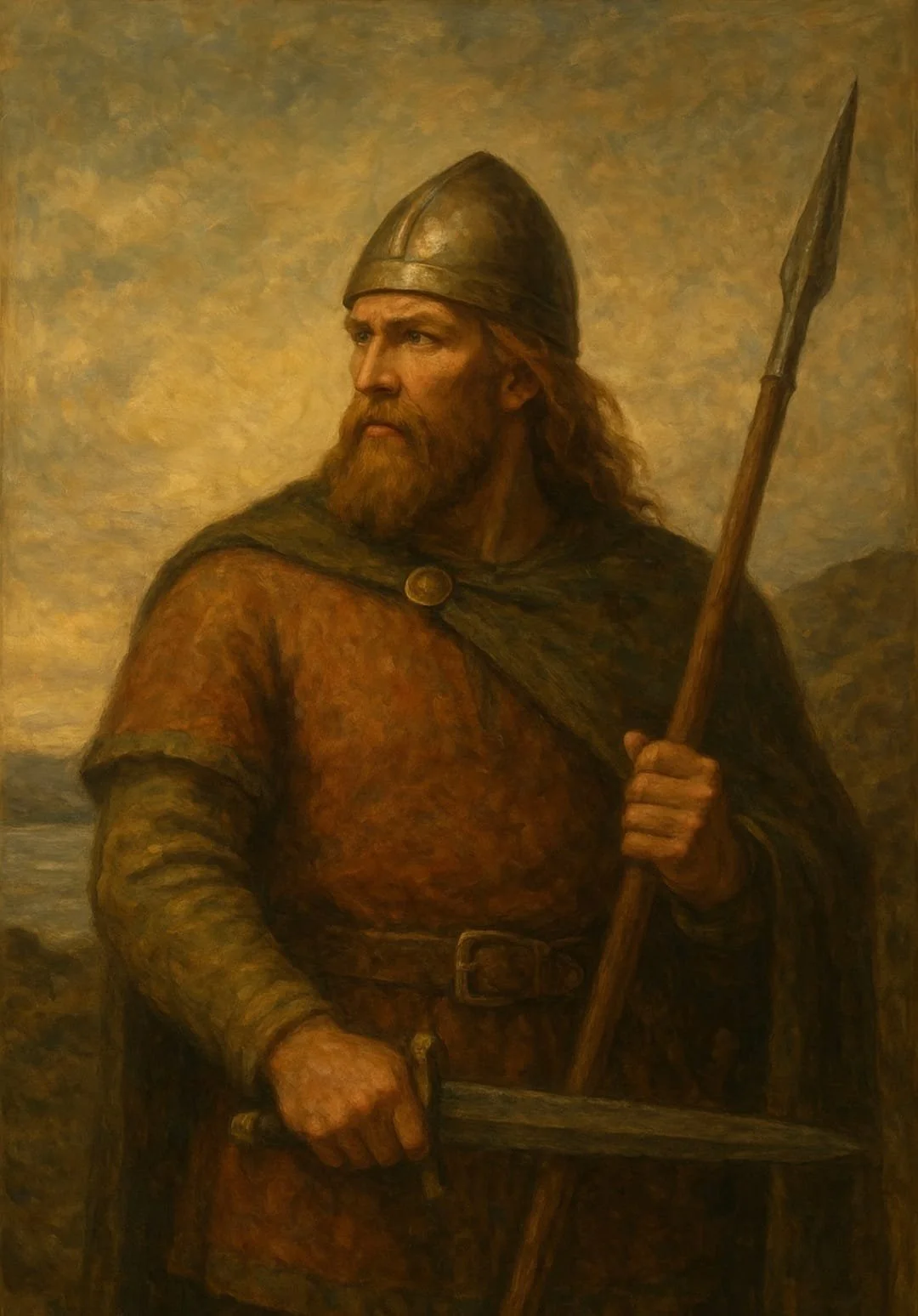
"He bore not crowns, but horizons. Not thrones, but tides. And wherever his prow cut the waves, the world itself seemed to widen."
Prologue: The Skald’s Murmur
Skalds speak his name softly, as if afraid to disturb the mystery that still wraps itself around his memory. They tell of a young man born of exile, tempered by ice, and driven by a hunger deeper than conquest. They say Leif Eriksson did not merely travel - he listened to the sea, followed the whispers of winds that had wandered farther than the maps of men, and answered questions most were too fearful to ask.
They say that even in childhood, the boy seemed half-claimed by the elements as if the sea had lent him its patience, the wind its restlessness, and the northern sky its far-off gaze. Fishermen who returned from long voyages claimed he asked questions no child should have known to ask: about currents that bent strangely westward, about birds that vanished beyond the horizon in seasons when no land was known to lie that way. To the skalds, these were omens - hints that his wyrd was already stirring long before he set foot on a deck as a man.
Sit close, then. Let the fire warm your face while drifting snow presses against the hall door. Listen to the tale of Leif the Lucky, whose wyrd led him across the world’s western edge, where darkness ended and dawn began.
The fire beside you is more than warmth, it is a doorway. Flames are the skald’s parchment, the crackle his quill. Watch closely, for in every spark there is a memory of sails catching wind, and in every fading ember, a shore disappearing behind a ship’s stern. Here, in the hush between storm and song, the old voices rise.
This is not a saga of kings or empires.
It is a tale of curiosity sharpened into courage, of a boy shaped by storms and a man chosen by the sea.
For kings chase dominion, Leif chased the edges of the world itself. Empires grow from ambition but Leif’s journey grew from wonder, a rarer and far more dangerous fire.
This tale remembers him not as conqueror, but as seeker; not as a man who bent lands to his will, but one who let distant lands remake him.
**Note**
The sagas of the Norse are tapestries woven from equal parts truth and wonder. With Leif, these threads blur even further. Chronicles record his voyage to Vinland but they speak little of the human heart behind it, of the doubts, dreams, and driving winds that carried him west.
Poets filled those gaps with myth, granting his footsteps an echo that outlived stone.
Historians seek the facts; skalds pursue the soul.
The Son of Exile and Ice
Leif’s life began in the land of fire and frost Iceland, where the earth bleeds heat and the sky hangs low over jagged cliffs. From his earliest days, the world was shaped by extremes. His father, Erik the Red, had carved a home in Greenland’s bone-white wilderness after exile cast him from Iceland’s shores. His mother, Þjóðhild, was known for her quiet strength, her calm in the face of storms both earthly and human.
Leif inherited from Erik the fire of wandering, and from his mother the steadiness needed to survive it.
Those who knew the family in their earliest years recalled that Leif’s childhood home stood at the edge of a cliff where gulls wheeled endlessly, their cries sharp as knives. They said Þjóðhild would wrap the boy in sealskin and hold him up to the wind so he might learn its voice before he learned words. Erik, meanwhile, taught him that exile was not a mark of shame but a test a forge.“The world rejects only those it cannot contain,” he told his son, and though he spoke lightly, Leif never forgot it.
As a child, he learned to walk on deck before he learned to walk on land. Sailcloth flapped like wings above him. The creak of timber and crash of waves formed the rhythm of his earliest memories. Winter was not merely a season - it was a teacher, showing him how quickly life could be taken and how fiercely it must be held.
He grew among men hardened by cold and silence, men whose laughter came rarely but deeply, and whose stories were carved from survival rather than pride. From them he learned ropework, the secrets of knots that held fast in sleet, and the sharp-eyed vigilance needed to spot a crack in a hull before it widened into catastrophe.
He listened more than he spoke, absorbing every lesson with an intensity that unsettled the older sailors. “The boy watches like a hawk,” they murmured, half wary, half proud.
By age eight, he could climb the cliffs outside Brattahlíð with nothing but raw grit and a rope plaited by his own hands. By twelve, he could hunt seal on drifting ice floes, balancing like a dancer between danger and survival. He learned to read the sky, to understand the moods of wind, to sense a storm forming days before clouds appeared.
He also learned the fragile rhythms of Greenland’s settlers - the way a missed hunt could doom a family, how a sudden freeze could trap ships in the fjord for months. Such precariousness shaped him early: Leif understood that life at the edge of the world demanded not only strength, but adaptability, humility, and an unwavering relationship with the land and sea.
Where others saw desolation, he saw instruction. Where they saw isolation, he saw possibility.
Greenland shaped him.. its emptiness, its silence, its sheer, uncompromising reality. Many men broke under its weight, becoming bitter or fearful.
But Leif? Leif grew curious.
He peered across the western horizon as though it hid a story written just for him.
Some nights, when the aurora painted the sky in ghostly green, he would slip from the longhouse and climb a nearby rise to watch the shimmering lights dance across the heavens. They seemed to him like a vast, wordless message - a promise that the world held more than the icebound cradle he had been born into.
“There is something out there,” he whispered to the cold. “Something the world hasn’t shown us yet.”
In those quiet hours, curiosity shaped itself into destiny.
The Call of the West Wind
Stories came to Greenland on traders’ tongues. Tales of lands beyond the edge of known water. Some spoke of forests so dense the light itself was filtered green. Others of rivers broader than fjords, fields warm even in winter, and shores where grapes grew wild.
Most dismissed them as drunken fantasies.
But for Leif, each tale was a spark landing on dry kindling.
He felt the world pressing against the inside of his ribs. The horizon taunted him, not as a boundary but as an invitation. He spent long nights standing on the cliffs, watching the sun sink beyond the sea, wondering what colors dawn would paint on the far side.
His father warned him.
“The west is full of ghosts,” Erik said.
But the gleam in Leif’s eyes was identical to the one Erik had worn before sailing to Greenland.
Leif prepared - not quickly, but with the patience of a man who knows he is building the foundation of his life’s greatest chapter.
He learned carpentry from shipwrights, navigation from traders, and the old sagas from wandering skalds. He sought counsel from hunters, priests, and fishermen. He listened to everyone and believed no one entirely.
The west wind called, and he answered with careful hands and an open heart.
Yet the call was not only in the stories. It lived in subtler signs - driftwood of unfamiliar trees washing ashore, carried by currents from lands unseen. Migratory birds flying westward in seasons that made no sense. The faint scent of foreign soil carried on storms that rolled in with a strange softness, as if they had crossed fields instead of open sea.
Old sailors muttered about these things but did not dwell on them; the unknown was a place most men avoided, even in conversation. Leif, however, gathered each scrap like a treasure. Every clue hinted at a world waiting just beyond the reach of fear.
He questioned travelers with a hunger that startled them. Some spoke of a shadowed coastline glimpsed through fog, others of rumors passed from ship to ship - a place where the land was gentle and generous, as though untouched by the harshness of northern life. “A dream,” they said. “A fable.” But Leif sensed the truths buried beneath their doubts.
His mind became a map of possibilities, lines drawn not on vellum but across his imagination.
He began crafting a ship not merely to sail, but to seek - selecting timber with reverence, shaping hull curves with a precision that fused intuition and training. Even those who mocked the idea of western lands paused to admire the vessel’s beauty. It seemed built for more than travel; it seemed built for revelation.
And still the west wind blew. Not harshly, not insistently - but like a breath against the ear, a whisper that stirred something ancient within him. It was not simply a call to adventure. It was an invitation to become the man he suspected he was meant to be.
The Storm and the Lucky One
The storm had not come suddenly; it had built itself throughout the day, gathering clouds like an army assembling on a distant ridge. Old sailors muttered warnings under their breath, tracing runes on the rails and whispering pleas to Ægir and Ran, the spirits of the deep. Even the gulls had vanished - always a bad sign. But Leif refused to turn back. “A test,” he murmured, “or a welcome.” No one could tell if he was merely reassuring the crew or speaking to something far older than the wind.
When the storm finally struck, it did so with the fury of a world trying to tear itself apart. Rain fell sideways, needles of ice slicing at bare skin. Waves punched the hull with such force that the timbers groaned like wounded beasts. One crewman swore he saw a serpent coil beneath the ship, illuminated by lightning - a trick of fear or the glimpse of a myth given momentary shape.
More than once men begged Leif to take shelter below deck, but he refused. “A ship mirrors its helmsman,” he said, gripping the steering oar until his knuckles split. His calm became a lifeline; his steadiness, a kind of defiance. While others saw only annihilation, Leif studied the storm’s rhythm - sensing when to lean with a wave, when to cut against the wind, when to surrender to it entirely.
At the storm’s height, a monstrous swell rose before them, a mountain of water that seemed to blot out sky and memory alike. Even the bravest men faltered. But Leif planted his feet, stared into the towering wave as though facing an opponent, and whispered something none could hear. Some claimed it was a prayer, others a challenge, but one man insisted later it sounded like gratitude.
When dawn finally broke, the sea lay quiet and exhausted, like a great beast calmed after frenzy. The crew stared at Leif with a mixture of fear and reverence. He was young, yes, but something in him felt carved from older worlds - a man who could stand on the threshold of death and not blink.
They called him “Lucky,” but among themselves another thought took root:
Perhaps the storm had recognized him.
The Discovery of Vinland
The signs had begun long before land appeared. On the twentieth day, driftwood floated past - thick branches from trees Greenland had never known, their bark rich and dark. Birds with unfamiliar cries circled overhead, their wings beating patterns unlike any species the crew recognized. One sailor caught a branch in his hands and held it like a relic. “This wood comes from a land that knows sunlight,” he whispered, awe softening his voice. Leif said nothing, but hope tightened inside him like a drawn bowstring.
Their excitement deepened when the sea itself began to change. The water grew warmer, gentler, shifting from iron-gray to a softer blue-green. Seaweed floated by in lush tangles, carrying the scent of distant forests. Every mile west felt like stepping out of winter and into an ancient dream.
When land finally rose on the horizon, the men crowded the rails, silent. Some had imagined a barren coast or jagged cliffs, but instead they saw a world drenched in color - forests so dense they looked like sleeping giants, meadows rolling like green waves beneath the sky, and beaches pale as bone but soft underfoot. For men who had lived on frostbitten rock and ice, it felt like stumbling into a forgotten paradise.
Their first steps ashore were hesitant, reverent. The ground felt springy beneath their boots, alive in a way Greenland never was. Leif knelt and dug his fingers into the soil, letting it crumble between them. “The earth here is warm,” he murmured, startled by its richness. “It breathes.” And for a moment, he wondered if this land had been waiting for them or warning them.
Exploration became ritual. Each morning, Leif led small groups inland. They found forests thick with maple and ash, trees taller than any they had known. Wolves watched from the shadows with intelligent curiosity. Rivers ran so clear they reflected the sky like polished glass. When they followed one upstream, they discovered grapes growing wild along the banks, vines twisting over rocks in tangled abundance. Men laughed like children, staining their hands purple as they ate.
Hunting was unlike anything they had known. Deer moved in graceful herds across the meadows. Salmon thrummed through rivers in such numbers that even the laziest cast of a net brought bounty. The men who had lived on dried fish and thin rations felt reborn. One night, after a feast of roasted deer and sweet berries, an older sailor murmured, “If Valhalla had forests, they would look like this.”
But Leif did not let the land’s gentleness lull him. He observed its patterns, its seasons, its secrets. He climbed a tall ridge and gazed out at the unbroken wilderness stretching beyond sight. Something deep in his chest stirred not pride, not triumph, but humility. “The world is larger than our bravest stories,” he whispered. “And kinder than we feared.”
Around their campfires, the men spoke with a reverence they had never known. They built their huts with wood that cooperated instead of resisting, shaping beams from trunks straight and strong. They spoke of the future, of families who might one day call this new world home. Even the hardest hearts softened beneath Vinland’s gentle sky.
As the seasons turned and they prepared to return to Greenland, Leif stood alone at the shoreline. The waves brushed his boots like a farewell. He felt no desire to conquer this land, only to honor it. To understand it. To protect the fragile promise it held.
He knew, with a certainty deeper than the ocean’s pull, that this discovery was not merely a feat of navigation - it was the beginning of a new chapter for the world, one that stretched far beyond him
The Leader of Men
Leif’s leadership was a quiet force, like a current beneath a calm surface. He did not command through fear, nor did he rely on the weight of his father’s name. Instead, he led by example: inspecting boats, helping with harvests, mending roofs, and sleeping alongside men when illness struck. His presence alone inspired loyalty.
He understood the delicate balance between authority and compassion. A dispute over grazing rights could have ended in bloodshed, but Leif listened to both sides, weighed the land itself, and offered a compromise that left all parties satisfied. In this way, he built not only obedience but trust - the rare kind that grows stronger with time.
Stories spread quickly of his deeds. A farmer whose barn had burned down received not just help to rebuild it, but hands-on guidance from the chief himself. Fishermen who returned empty-handed were encouraged, taught new techniques, and given first choice of surplus from his own stores. Leif’s people began to see him as more than a chieftain - he was the anchor in Greenland’s unforgiving world.
Even his children and kin learned from his example. They observed how he weighed decisions carefully, how he never acted in haste, how he could silence a room with a single, thoughtful glance. The boy who had once stood at the prow, staring at the western horizon, had matured into a man whose horizon now included the welfare of every soul in his care.
Yet the sea still called him. He would leave his hall for weeks at a time, not out of restlessness, but to chart new shores, check distant settlements, or simply feel the spray on his face and remember the vastness beyond Greenland’s ice. These voyages reminded his people that their leader was also an explorer, a man who never forgot that courage and curiosity must remain entwined.
To Leif, leadership was less about command than about stewardship: of men, of land, and of the knowledge gained from both. His decisions bore the weight of experience, tempered by the awareness that the world was far larger than any single hall, farm, or settlement.
The Reluctant Hero
The wreck had left debris scattered for miles - splintered wood, cargo tossed into the icy water, and the faint smell of salt and fear lingering on the wind. Witnesses later swore that Leif did not pause for hesitation or calculation. He observed, assessed, and acted with a calm that unsettled even the most experienced sailors.
One young sailor, barely more than a boy, clung to a piece of floating timber, shaking. Leif plunged into the water beside him, holding the rope with one hand while guiding the terrified boy with the other. The current tugged and spun him around, yet he never lost hold. “I have room for one more,” he told the boy, voice steady, as if commanding the ocean itself.
By the time the last man was hauled ashore, Leif was shivering, blue-lipped, and utterly exhausted. He did not accept thanks or accolades, simply returned to his ship, tending to the injured as if this were the most natural thing in the world.
But his deeds left an impression deeper than survival. Among the crew, a story took root that heroism was not the loud clash of sword or shield, but the quiet, relentless act of choosing to step into danger for others.
In longhouses across Greenland, bards sang not only of his daring, but of his calm resolve: the man who faced waves as though they were old friends, who measured courage not by risk, but by necessity. This story became a lesson for children: that true bravery lies in the willingness to act when mercy is offered, when it matters most.
Leif, for his part, never sought recognition. He continued to explore, to lead, to learn - understanding that the world often demanded heroism, but that heroism demanded no applause. In every life he touched, his deeds were a quiet reminder: courage can be gentle, and greatness need not shout.
The Quiet Return to the Waves
The sea called to Leif with a voice older than men, older than stone. It whispered of places yet unseen, of winds that carried secrets of distant lands, and of horizons that shifted like tides. When he sailed, it was not for glory or wealth, but to feel the pulse of the world, to let his mind roam as freely as his ship.
He visited small settlements, bringing guidance and aid quietly, leaving before his presence could overshadow the lives he touched. He traded stories and tools, charted coastlines with meticulous care, and left markers for those who might follow. His maps were as much poetry as they were geography, annotated with observations of tides, winds, and wildlife, hints at the character of lands unseen.
Stories claim he ventured far north, to the edge of ice where the sun barely rises in summer and the wind bites with eternal cold. There, he observed seals and polar bears, mapped fjords choked with glaciers, and sketched the shimmering dance of northern lights. He recorded these things not for fame, but for understanding, a man quietly communing with the edge of the known world.
Some nights, he would anchor in sheltered bays and walk along the shoreline alone. He listened to the waves and whispered to them, asking questions about the lands beyond and the paths yet untraveled. Crewmen said that even the gulls seemed to recognize him, circling in quiet homage as if they knew a mariner who had walked both the known and the impossible.
It was in these voyages that Leif’s true nature became clear: he was never content to merely arrive. Exploration, reflection, and listening to the land, the sea, and the stories of those who lived on its edge were the truest forms of his legacy. His spirit, always at the prow, seemed to chase the horizon itself.
Even in moments of rest, he dreamt of faraway shores, imagining forests untouched by axe, rivers uncharted, and the distant call of the unknown. In his heart, every wave, every wind, every horizon was a question, and every journey an answer.
The Voyager’s End
The final years of Leif’s life were marked by reflection rather than conquest. He walked the shores he had once sailed with the same reverence he had shown in Vinland, feeling the pulse of the sea in his bones. His hair, once the color of sunlit gold, had grayed like driftwood, and lines of storms and laughter marked his face. Yet his eyes retained the spark of the boy who had stared across the western horizon.
Those who saw him in his last days spoke of a calm unlike any other. He would sit for hours, listening to the wind through the fjords, watching tides rise and fall, as if each wave carried a message from the lands he had touched. Children gathered around him, sensing his stories were not just tales, but fragments of a larger, living world.
On the day he passed, the sea was unusually still. Fishermen paused mid-cast, ships floated in silence, and a hush fell over the settlements. Some claimed the horizon seemed closer, bending toward the earth, as if eager to reclaim the man who had always chased it. Others swore they saw a faint shimmer over the water, like the reflection of a ship made of light, gliding toward the west.
Leif’s death left no enemies, no unfinished wars, only echoes of his voyages. His people mourned quietly, honoring him with songs that spoke of courage, curiosity, and the gentle strength of a man who had wandered farther than most could imagine. Skalds described the scene as if the very world had paused to breathe in his passing.
Legends grew from that moment: that the waves whispered his name, that gulls circled with solemn grace, that the horizon itself seemed to fold him into its eternal story. And though Leif was gone from sight, he remained present in every wind-swept cliff, every river glinting under the sun, every forest that dared to grow where none had expected.
His end was not a closure, but a continuation - a melding of man, sea, and horizon, so that the spirit of exploration, curiosity, and quiet courage would endure long after the last sail had vanished from sight.
The Legacy of Leif the Lucky
Leif’s influence reached far beyond the lands he touched. Sailors, traders, and wandering skalds carried tales of his voyages, not as mere stories, but as lessons in courage, observation, and respect for the world’s vastness. Even in places he never set foot, his name became synonymous with the spirit of discovery.
The people of Greenland remembered him not only as a leader, but as a man who embodied the balance between daring and caution. He taught that the horizon is not a boundary, but an invitation, and that the measure of a person is not how far they travel, but how deeply they understand what they encounter.
Modern scholars and archaeologists now glimpse the tangible proof of his journeys in L’Anse aux Meadows, yet the true legacy of Leif Eriksson lies not only in settlements or artifacts, but in the inspiration he left for generations to come - the courage to seek the unknown, the wisdom to listen to the land and the sea, and the humility to honor both.
His life reminds us that history is not written solely in battles and crowns, but in quiet acts of curiosity, perseverance, and generosity. Each ship he sailed, each decision he made, and each life he touched expanded the world - not just geographically, but in human imagination and understanding.
Even today, the echo of his spirit lingers in every horizon pursued, every unexplored coast approached, and every heart daring enough to ask: “What lies beyond?”
Historical Note
Modern archaeology strongly suggests Norse presence in North America around the year 1000 CE, with the site at L’Anse aux Meadows in Newfoundland supporting the Vinland sagas. Though details blur across centuries, the heart of Leif’s legend stands clear: he was one of humanity’s great explorers the first known European to reach the New World.
Reflection
Leif’s life reminds us that curiosity is a compass, and courage its rudder. To explore is not merely to move through space, but to grow through experience. He shows that each step into the unknown, each wave crossed and each risk embraced, shapes not only the journey, but the traveler.
Reflection on his voyages also teaches patience and respect: for the land, for the sea, and for the people who share it. One cannot claim the horizon through force alone it requires observation, humility, and a willingness to listen. In every decision, Leif balanced daring with wisdom, demonstrating that the bravest hearts are often the gentlest.
In contemplating Leif’s legacy, we recognize that exploration is not an act of conquest, but of connection. The true journey is one of understanding of ourselves, of the world around us, and of the stories yet untold.
Invocation
May the horizon ever call to you, as it called to him. May your courage meet the storms of life with calm, steady hands. May your curiosity be insatiable, and your humility equal to your ambition.
And when you stand upon a cliff or peer across an endless sea, may you hear the faint echo of a ship’s prow cutting through the waves - a reminder that exploration is both an outward and inward journey.
Leif Eriksson, voyager, dreamer, and guide, reminds us that the world is wide, the night is full of stars, and the sea carries both danger and possibility. Step forth. Listen. Discover.
Wyrd & Flame 🌊🔥
