
Meili: The Gentle One
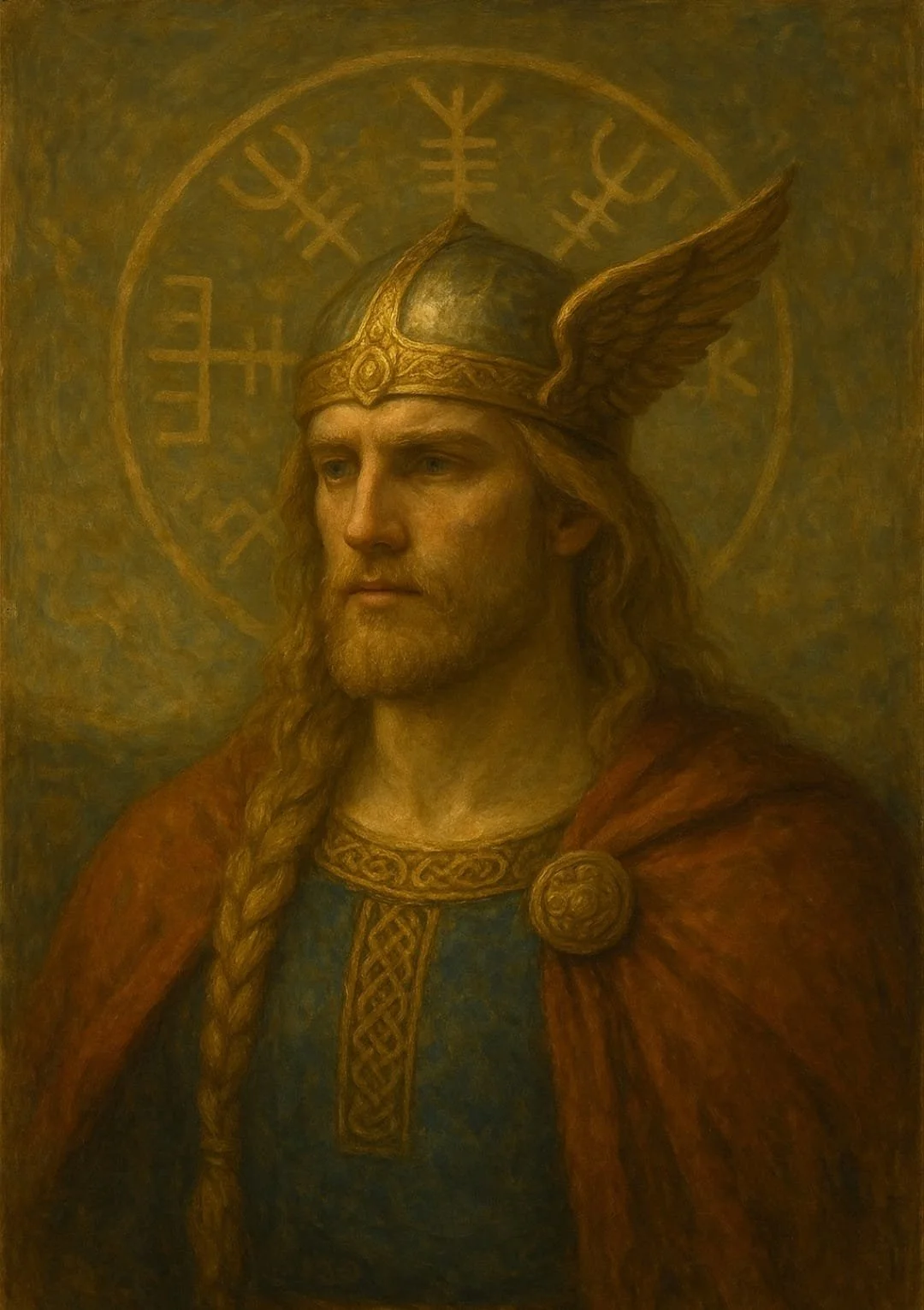
The brother between thunder and silence, the god who walks unbroken between storm and shadow.
The Quiet Between Thunder
Before the hammer struck, before the serpent coiled around the roots of the world, there was Meili. He is the calm in the storm, the pause between lightning and thunder, the soft, enduring presence that moves through chaos without bending. His is the silence that heals, steadies, and guides, not the quiet of absence, but of intention.
Meili’s essence is paradoxical: present but unobtrusive, powerful yet gentle, enduring without drawing attention. Where other gods make themselves known through action, words, or fury, Meili moves like a current beneath the waves, shaping events through the weight of his calm.
He is not often remembered in sagas, yet his presence underpins much of what the gods accomplish. Just as a river can redirect the flow of storms, Meili tempers the tempests of his family and the cosmos, guiding them toward balance without coercion.
In a world dominated by visible action and heroic feats, Meili reminds us that influence can exist quietly, patiently, and with subtle wisdom. He embodies the principle that strength need not announce itself to be transformative.
To understand Meili is to see that the most enduring forces in life are often invisible. His quiet power is a lesson to mortals and gods alike: that enduring change is cultivated through consistency, gentle guidance, and patient restraint.
In the narrative of the cosmos, Meili is the pause, the breath, the quiet moment before the universe moves again. He exists in the space between action and reaction, a stabilizing force that ensures chaos does not devour creation entirely.
The Mythical Context
Few myths dwell on Meili, yet his existence is essential. Brother to Thor, son of Odin, he is a subtle presence in the thunderous world of gods. His role is not to battle giants with force or avenge the fallen, but to maintain the delicate equilibrium of the cosmos.
Skalds hint at his influence in passing, noting that travelers felt safer in his presence, and that gods often sought his counsel before making decisions that could tip the balance of the Nine Realms. He is the unseen thread that binds moments of chaos to eventual stability.
Meili’s subtlety is a lesson in the different forms power can take. While Thor’s might breaks, and Odin’s cunning manipulates, Meili preserves. His influence is felt rather than seen, much like the steadying hand that prevents a vase from toppling even as others rush past.
Legends suggest that Meili was often tasked with protecting the quiet spaces between the great acts of gods. He was present in the lull after battles, in moments of despair, and in the planning that went unnoticed yet shaped the outcome of wars and cosmic events.
In some interpretations, Meili represents the principle that not all action must be loud to matter, and that restraint is sometimes the most potent form of intervention. His myth reminds us that heroes can work in the shadows as effectively as they do in the spotlight.
Finally, the mythical context of Meili highlights a broader Norse understanding of balance. The cosmos is sustained not just through dramatic acts of strength or cunning, but through quiet forces that endure, guide, and heal - the essence of Meili’s being.
Meili and Thor: The Bridge Between Storm and Calm
Thor is the god of thunder, the embodiment of raw, explosive energy. Meili is his counterpart, the gentle current that tempers and directs that power. While Thor moves with immediate force, Meili ensures that his brother’s actions do not tip into reckless destruction.
The bond between the two brothers illustrates a broader cosmic principle: action and restraint must coexist. Thor embodies the storm; Meili embodies the quiet that follows it. Without Meili’s guidance, Thor’s rage could unravel not just battles but the balance of the cosmos itself.
Ancient poets suggest that Meili’s presence near Thor is like the soft soil that absorbs the impact of a hammer strike. He does not oppose Thor, nor does he seek to diminish him; he allows the storm to exist while guiding it toward purposeful impact.
In the sagas, Meili often intervened in moments of potential calamity, speaking softly - or sometimes not at all - but his influence shifted the outcome. Warriors, gods, and mortals alike would find themselves spared the worst consequences of Thor’s fury, often without understanding why.
Their relationship is not one of competition but complementarity. Thor demonstrates what action can achieve; Meili shows what restraint can preserve. Together, they illustrate that the cosmos functions best when extremes are balanced.
Ultimately, Meili’s role is to remind both gods and mortals that even immense strength requires a steadying hand. He demonstrates that calm does not weaken thunder, it directs it.
Epigraph: The Gentle God
Gentle he walks, when storms arise, The calm between the lightning’s cries. Brother to thunder, kin to flame, He softens the fury none can tame.
This verse captures the essence of Meili’s power: subtle, quiet, yet essential. Where others rely on spectacle or force, Meili’s influence shapes outcomes invisibly but decisively.
The epigraph serves as both homage and instruction. It is a reminder that softness can wield power, that gentleness can influence even the loudest storm, and that presence can stabilize what noise cannot control.
Skalds suggest that this verse was recited only in moments of reflection, after battles or storms, when the need for calm was most pressing. It is an acknowledgment that the greatest acts are not always witnessed, and the gentlest influence is often the most enduring.
The imagery of light, fire, and storm mirrors Meili’s nature: he exists in proximity to force but is not forceful himself. He tempers it, shapes it, and allows it to fulfill its purpose without excess.
Finally, the epigraph invites reflection. The quiet god asks us to consider where our gentle power can have the greatest impact, where our presence, patience, and guidance might preserve balance in a chaotic world.
The Unwounded God
Meili is unbroken, not because he avoids adversity, but because he absorbs it differently. Where others display their scars as proof of survival, his endurance manifests as stability, calm, and quiet strength.
This unbroken nature symbolizes resilience that does not rely on confrontation. He is proof that strength can endure invisibly, shaping outcomes without destruction or display.
Ancient myths hint at moments where Meili prevented catastrophic consequences through subtle intervention, never revealing himself, yet altering the trajectory of battles and cosmic events. His quiet guidance spared both gods and mortals from unnecessary suffering.
The concept of the unwounded god also serves as a moral lesson: that true resilience is not measured by visible scars, but by the capacity to maintain equilibrium under stress. Meili demonstrates that preservation can be a form of heroism.
His unbroken nature contrasts with the visible heroics of Thor or the cunning of Odin. It reflects the idea that the cosmos requires both celebrated strength and silent endurance.
Ultimately, Meili teaches that the power to remain whole, steady, and influential often comes from absorbing and transforming the energy of chaos, rather than resisting it with force.
Origin and Nature
Meili is born of Odin and an unknown goddess whose name the sagas barely whisper, a lineage of wisdom, foresight, and subtlety. His nature blends the divine intellect of his father with the quiet fortitude of the forgotten maternal line.
He does not seek glory or attention. Instead, Meili embodies the principle of action in restraint. Every motion is measured, every intervention calculated to produce maximum effect with minimal disturbance.
Legends suggest that his early years were spent observing Thor and Odin, learning not only the mechanics of power but the art of subtlety. From these observations, Meili forged his own path, one where presence outweighed spectacle.
Unlike many gods whose deeds echo loudly across the cosmos, Meili’s early acts were invisible but transformative: redirecting storms, quelling disputes among lesser beings, or gently nudging mortals toward their destinies.
His origin story, though sparse, emphasizes that quiet beginnings often yield lasting consequences. Unlike the dramatic arcs of Odin or Thor, Meili’s tale is one of silent growth, patient cultivation, and enduring presence.
Through his nature, we learn that power is as much in restraint as in action, and that survival and influence can exist without display, applause, or recognition.
The Shield of Tranquility
Among Meili’s symbols is the Shield of Tranquility, an ethereal defense that does not repel by force, but by absorbing and dispersing chaos. It is said to appear as a soft, glowing barrier around mortals or gods in peril, reflecting his calming presence.
This shield is metaphorical as well as literal in myth. Meili’s influence shields not with confrontation but with stability, foresight, and quiet intercession, deflecting harm before it arrives.
Some skalds recount that during moments of divine conflict, the Shield of Tranquility allowed allies to stand firm while chaos roared around them. Warriors and gods alike felt unseen hands steadying their resolve.
The shield also symbolizes emotional guidance. In human terms, Meili’s presence represents a calming influence during crisis, the voice that steadies thought and tempers impulsive action.
Through this emblem, we learn that true protection is not always physical; sometimes it is the ability to maintain calm, guide choices, and preserve equilibrium amidst storms.
His shield is a manifestation of his central lesson: that stillness is a form of strength, and that true guardianship often works invisibly, shaping outcomes without dramatic gestures.
The Path Between Worlds
Meili is often described as walking the spaces between realms, moving where other gods hesitate. While Odin seeks wisdom and Thor strikes with force, Meili traverses the liminal zones—those quiet corridors between life, death, and the fates of mortals.
These pathways are not simply roads or bridges; they are thresholds of balance, where decisions made in silence ripple across all worlds. Meili moves along them with deliberate care, ensuring that actions in one realm do not unbalance another.
Legends suggest that mortals who encountered Meili on these paths were often guided toward choices that would shape their lives for the better, sometimes without ever realizing that a god had influenced them. His interventions are subtle, like a hand guiding a vessel through a storm, unseen but critical.
In some accounts, he walks the path alongside souls transitioning between life and the afterlife, offering calm presence and gentle guidance. This role underscores his nature as a stabilizing force, one who restores order where confusion and chaos abound.
Meili’s traversal of these paths demonstrates that power is not always exercised through action alone. Influence, he teaches, can be quiet, pervasive, and enduring, affecting outcomes without drawing attention to itself.
Through these journeys, Meili embodies a truth central to Norse thought: that equilibrium is maintained not only by dramatic intervention but by persistent, unseen vigilance, the patient work of subtle guidance.
Meili and the Elements
Though less flamboyant than Thor, Meili holds a deep affinity with the natural elements. The wind, water, and earth respond to his presence not with violence but with harmony and balance, reflecting his gentle authority over cosmic forces.
It is said that when storms threaten mortal lands, Meili’s calm can temper winds and redirect torrents of rain, softening devastation without diminishing the natural order. Unlike Thor, who confronts storms head-on, Meili moves like a quiet current within them.
Earth responds to him with patience, yielding without breaking, while rivers follow his guidance as if intuitively aware of his presence. These subtle interactions highlight the idea that enduring power is symbiotic rather than domineering.
The sun and moon are also said to reflect Meili’s influence. His steps leave traces in the rhythm of day and night, the balance of light and shadow, hinting at his pervasive but unspoken governance of the world’s cycles.
In this way, Meili is a living mediator between the raw forces of nature and the needs of mortals, ensuring that the cosmos functions without chaos overwhelming creation. He is the unseen hand shaping the natural order with quiet patience.
Through these elemental interactions, we see that Meili embodies the principle that gentle influence, consistently applied, is as potent as visible power, guiding the world with invisible but undeniable authority.
Meili’s Presence in Battle
Though he rarely fights, Meili’s presence in conflict is profound. Where others wield weapons, he brings clarity, focus, and endurance, tempering the heat of battle with a calm that allows allies to act wisely and survive.
Ancient tales describe armies who, guided by his unseen hand, avoided fatal mistakes. Leaders might feel a sudden clarity, warriors a moment of steadiness, small interventions that often turn the tide without a single swing of a sword.
Meili’s influence is strategic, not violent. His role in battle is not to conquer but to preserve, direct, and sustain, ensuring that strength and valor do not collapse under chaos. He teaches that endurance is sometimes the most decisive weapon.
Some sagas suggest that his presence prevents unnecessary destruction, sparing both mortal and divine alike from reckless loss. Through his guidance, battles may be won with minimal bloodshed, emphasizing wisdom over brute force.
This function highlights the duality of strength in Norse mythology: visible might versus subtle endurance. Meili’s power lies not in destruction but in the preservation of life and balance, shaping outcomes through patience rather than spectacle.
Ultimately, his presence in battle underscores a universal truth: that the quiet hand of wisdom can steer the course of fate as decisively as the loudest hammer or fiercest sword.
Lesson: Strength in Gentleness
Meili teaches that gentleness is not weakness, and that enduring influence comes from calm, steady guidance rather than explosive action. Strength is most potent when measured, restrained, and purposefully applied.
His example reminds mortals and gods alike that impact can be subtle yet transformative, like the slow shaping of stone by wind and water over centuries. What appears quiet may in fact hold the greatest power.
Meili’s lessons extend beyond physical strength. Emotional fortitude, clarity of thought, and the capacity to act wisely under pressure are all forms of power he embodies and imparts. Patience and restraint become tools of lasting influence.
Through myth, we learn that true might lies not in being seen, but in being effective where it matters most. Meili demonstrates that quiet acts of guidance, protection, and stabilization often leave the most enduring marks.
Even in the loud, chaotic cosmos of the gods, Meili stands as proof that silent authority shapes destiny, and that those who act with purpose rather than impulse can have far-reaching consequences.
Finally, the gentle god teaches that compassion and patience are strengths, not indulgences, a reminder that true power is measured by the outcomes it preserves, not the spectacle it produces.
Meili and the Mortal World
Though many myths focus on gods and realms, Meili’s influence often reaches mortals. Farmers, travelers, and warriors occasionally feel his guiding presence, though they rarely understand its origin.
Stories suggest that paths are safer, storms less destructive, and hearts steadier when Meili walks unseen nearby. His role is not to grant glory, but to preserve life and ensure balance, shaping mortal destinies with gentle consistency.
He embodies the principle that endurance and foresight extend beyond the divine, affecting the world through subtle, persistent guidance rather than overt miracles or displays of power.
Mortals may sense his presence in the calm after chaos or in moments of sudden clarity, learning that sometimes the greatest aid comes not from intervention, but from the assurance of stability.
Through these connections, Meili’s myth bridges the divine and human, showing that quiet strength underpins both realms, offering guidance and stability without demanding recognition.
Finally, Meili demonstrates that the most enduring impact often arises from patience, foresight, and consistent support, not from grand gestures or dramatic displays of power.
The Silent Brother
Meili is often called “the silent brother,” a designation that captures both his personality and his cosmic function. Unlike his father Odin, who speaks and schemes, or Thor, who acts decisively, Meili embodies quiet influence.
His silence is deliberate. It allows him to observe, guide, and intervene at the precise moment when his action will be most effective. He listens where others cannot, perceives what others overlook, and shapes outcomes without being noticed.
In mythology, silence is often associated with wisdom and restraint. Meili embodies this, showing that true understanding comes not from constant speech, but from measured observation and timely action.
This silence also conveys humility. Meili’s influence is immense, yet he does not seek recognition. His work is effective because it is unobtrusive, a reminder that enduring impact often requires invisibility rather than fame.
By observing the silent brother, mortals and gods alike learn that subtlety can hold as much weight as force, and that patience and quiet reflection are essential to maintaining cosmic and moral balance.
Meili and the Cosmic Balance
Central to Meili’s myth is his role in maintaining balance between extremes: chaos and order, action and restraint, power and wisdom. Where other gods tip the scale through dramatic deeds, Meili preserves equilibrium quietly.
He ensures that Thor’s storms do not devastate unnecessarily, that Odin’s schemes do not spiral out of control, and that the natural world continues in harmonious cycles. His presence is like a hidden fulcrum on which the cosmos turns.
Legends suggest that Meili intervenes subtly in moments of cosmic tension, nudging events toward stability. He teaches that enduring balance is achieved not through domination, but through careful, thoughtful guidance.
This balance extends to moral and ethical dimensions. Meili’s influence tempers vengeance, anger, and impulsivity, providing a model for gods and mortals to follow in aligning actions with long-term harmony.
Through this archetype, Meili embodies the principle that quiet, deliberate influence can preserve entire worlds, a testament to the power of subtlety in shaping destiny.
Lesson: Calm Amid Chaos
Meili demonstrates that true courage often manifests as calm, not brash action. By embodying serenity in turbulent moments, he ensures that decisions are guided by foresight and reason.
This lesson is vital in both mortal and divine contexts. When chaos erupts, the first impulse may be panic or aggression. Meili teaches that patience and composure create opportunities that rash action destroys.
Through his myth, we learn that influence can stem from presence rather than spectacle. A steady hand, a thoughtful mind, and a calm heart can stabilize situations and prevent disaster more effectively than dramatic force.
His example encourages reflection: when faced with personal storms, we can respond with deliberate calm, shaping outcomes in ways that align with long-term goals rather than immediate emotion.
Finally, the calm of Meili is not passive. It is active restraint, an ongoing, conscious effort to guide, protect, and preserve, proving that serenity is a form of profound, enduring strength.
Meili and the Renewal of Order
In moments of crisis, Meili ensures that destruction does not become permanent. He works to restore balance after conflict, guiding the cosmos back toward harmony.
His interventions may be invisible, yet they are decisive. Mortals and gods may not know why order reasserts itself, but Meili’s hand is always present, shaping recovery and renewal.
This principle teaches that lasting change is often nurtured quietly, through careful attention and patience, rather than through forceful imposition. Meili embodies the long-term, restorative power of guidance.
In myth, he is often associated with rebuilding and preservation, acting after storms, battles, or disruptions to restore what is essential and ensure continuity.
Through his example, we understand that true guardianship focuses on preservation and sustainability, rather than fleeting displays of power, highlighting a subtler but equally critical form of divine influence.
The Modern Relevance of Meili
Even today, Meili’s myth resonates. In a world of constant noise and urgency, his example teaches the value of restraint, patience, and quiet influence.
His lessons remind us that enduring impact is often invisible. Just as Meili shapes events subtly, humans can guide outcomes through listening, observation, and gentle intervention.
He inspires reflection on leadership and personal conduct. True influence may not seek attention, but it can profoundly shape communities, organizations, and relationships when applied with care.
In an age of spectacle, Meili shows that quiet consistency is a source of deep, lasting strength, and that patience can achieve what impulsive action cannot.
Ultimately, he embodies the timeless principle that the most enduring power comes not from loud acts, but from measured presence and subtle guidance, a lesson for both divine and mortal spheres.
Invocation: The Prayer of Quiet Strength
O Meili, gentle guide of the unseen path,
whose steps balance worlds,
whose patience steadies hearts,
teach us the art of enduring without boast,
of acting with precision when the moment demands, and of preserving what is fragile yet essential.
Grant us the wisdom to move where others hesitate, the courage to remain calm amidst chaos, and the foresight to let our quiet actions shape destinies. May we honor your unseen hand in our own lives, guiding without seeking glory, protecting without fanfare, and enduring until the unseen work is done.
Through your example, may we learn that true strength lies in subtlety, patience, and steadfast presence, and that the quiet force within can move mountains, steady storms, and hold the world upright.
Closing Reflection: The Gentle Power That Endures
Meili is the god who walks between storms, a quiet stabilizer, a subtle guide. His myth reminds us that not all heroes wield swords or hurl thunder; some walk softly, yet their influence shapes worlds.
Through Meili, we see that endurance, calm, and patience are as vital to survival as strength and cunning, and that gentle guidance can prevent chaos from consuming creation.
His presence assures mortals and gods alike that balance is possible, even in the face of turmoil, and that subtle, consistent action can yield consequences far beyond immediate perception.
Meili’s enduring lesson is that power is as much about restraint as action, as much about preservation as conquest, and that quiet influence often achieves what spectacle cannot.
Final Thought
In the end, Meili reminds us that the most profound forces often go unnoticed: the still hands guiding the ship through the storm, the calm presence that steadies hearts, the quiet force that sustains life across realms.
Through reflection on Meili, we learn to value patience, subtlety, and steady guidance, honoring the quiet strength that underpins the cosmos and shapes the fates of gods and mortals alike.
The loudest voices do not always shape the course of fate. The greatest power often whispers, unseen and patient,
guiding, supporting, and enduring where chaos rages.
Be like Meili... walk the hidden paths, hold your ground in silence, and let your presence be the calm that steadies worlds. In the quiet accumulation of small, deliberate actions, the impossible becomes inevitable.
Strength is not always thunder.
Sometimes, it is the footstep that holds the world together.
Wyrd & Flame 🔥
