
The Norse Soul Explained: Hugr, Fylgja, Hamingja and the Afterlife
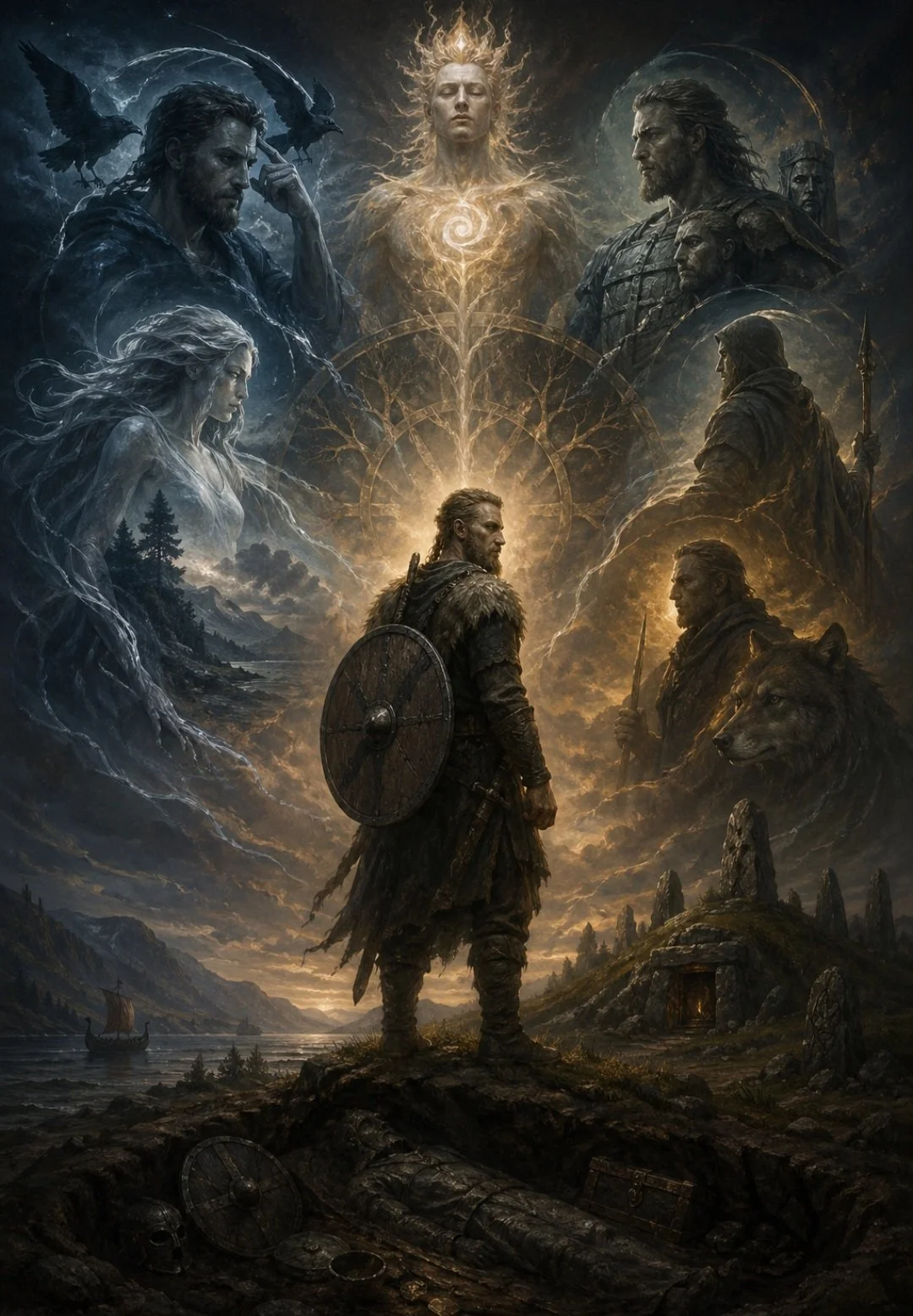
When people ask what the Norse believed about the soul, they are usually expecting a simple answer. One soul. One essence. One thing that lives, dies, and moves on.
That is not how it works.
In the Norse world, a person is not a single, contained being. You are not one thing moving through life toward one final destination. You are a gathering of parts… some visible, some felt, some carried, and some that do not fully belong to you alone. What we call “the self” is not fixed. It is layered. Moving. Interacting with the world in ways that are not always obvious, but always present.
There is the part of you that thinks and chooses. The part that holds shape. The part that carries your presence into a room before you even speak. The part that follows you, the part that protects you, the part that remembers… and the part that will outlast you.
And not all of these parts stay together.
Some can move. Some can be sensed by others. Some can leave before death. Some can remain after. Some are passed on, not as memory, but as force… as something that continues through those who come after you. In this way, a person is not just an individual, but a point in a much larger continuity, shaped by what came before and shaping what comes next.
The Norse did not leave behind a single text explaining this system clearly. There is no one place where the soul is laid out and defined. Instead, it appears in fragments… in the language they used, in the stories told in the and the , and in the sagas where people act as if these things are simply understood. Presence is felt before arrival. Dreams carry warning. A person’s nature can be seen in forms that are not their own.
It is not explained. It is shown.
So to understand the Norse soul, you have to step away from the idea of a single, unified spirit. You have to look at the self as something more complex… something that can divide, extend, and continue in different ways at once.
The Self as Many - Not One
To understand the Norse view of the soul, the first thing that has to be stripped away is the idea of unity.
There is no single “soul” moving through the body like a contained flame. Instead, a person is made up of multiple aspects that work together, overlap, and sometimes even act independently. These parts are not abstract philosophy in the way later systems describe them. They are lived realities, visible through behaviour, presence, dreams, reputation, and the way a person moves through the world.
This is why the sources feel fragmented. In the and the , you are not given a neat explanation. Instead, you see different parts of the self appearing in different contexts. A person’s mind is spoken of as something that can leave. A person’s presence can be felt before they arrive. A person’s nature can take form outside of their body. A person’s strength can continue after death.
These are not metaphors in the modern sense. They reflect a view where the self is not locked into the body.
At the centre of this understanding is the idea that a human being is a composition. The body is only one layer. What animates it is not a single force, but a collection of forces that each carry a role.
There is the hugr, the thinking and perceiving mind. This is the part that shapes intention, thought, and awareness. But it is not entirely contained. In some accounts, it can travel, influence, or be sensed by others. A strong hugr can affect the world beyond the body.
There is the hamr, the shape or form. Not just the physical body, but the idea of form itself. In the sagas, this is what allows for shape-shifting or the projection of oneself in another form. It is the boundary between what you are and how that can appear.
There is the fylgja, often described as a following spirit or presence. It is tied to a person’s nature and fate. It can appear in dreams or visions, often as an animal or woman, reflecting something essential about the individual. It does not act randomly. It reflects who you are at a deeper level.
There is the hamingja, which is closer to fortune, luck, and inherited strength. But not luck in a shallow sense. This is something that can be built, strengthened, and even passed down through family lines. It ties a person to their lineage and their standing in the world.
And there are other aspects spoken of in different ways across sources… breath, spirit, life force… each pointing to the idea that what makes a person “alive” is not singular.
What matters here is not memorising the terms.
It is understanding the pattern.
A person is not a fixed identity moving through time. They are a set of interacting forces, some internal, some external, some inherited, and some shaped through action.
This is why reputation matters so deeply in Norse culture. Because what you do does not stay contained within you. It shapes your hamingja. It affects how your fylgja appears. It strengthens or weakens what continues after you.
You are not just living a life.
You are building the structure of what you are made of.
And that structure does not end cleanly when the body does.
Hugr - The Mind That Moves Beyond the Body
If there is one part of the Norse self that comes closest to what we would call “mind,” it is the hugr… but even that comparison falls short if you treat it too simply.
The hugr is thought, intention, awareness… but it is not locked inside the skull. It is not just internal processing. It is something that can extend, reach, and be felt. In the sagas and poetic material, a strong hugr is not just a sharp mind… it is a presence.
This is where the difference really shows.
In modern thinking, your thoughts are yours alone unless you speak them. In the Norse view, that boundary is thinner. A person with a powerful hugr can influence others, unsettle them, or even reach them across distance. Not in a dramatic, fantasy sense… but in a way that suggests thought itself carries weight.
You see this in the tone of the Poetic edda and the prose edda, where intention and will are not passive things. They are active forces. A person’s mindset is not separate from their effect on the world.
In some saga accounts, people sense another before they arrive. They feel unease, pressure, or awareness without clear reason. This is often understood as the hugr reaching ahead of the body. Not physically travelling, but extending influence.
Dreams also sit close to this.
The hugr is often connected to dream states, where it can move more freely. What is seen in dreams is not always dismissed as imagination. It can be warning, reflection, or interaction. The boundary between waking thought and dreaming perception is not treated as rigid.
But the hugr is not always stable.
It can be strong or weak. Clear or clouded. A person overcome with fear, anger, or confusion can have a disturbed hugr, and that disturbance shows in how they act and how they affect others. This is why mental discipline matters, even if it is not described in modern psychological terms.
Control of the self is not just moral.
It is structural.
A steady hugr creates a steady presence. A fractured one creates instability that others can feel, even if they cannot name it.
This also ties into conflict.
Before action happens, intention forms. And in the Norse view, intention is not neutral. It carries weight. The decision to act… the will behind it… already begins shaping what follows.
So the hugr is not just “thinking.”
It is the direction of the self.
It is what moves first, before the body follows.
And if it is strong enough… it does not always need the body to be felt at all.
Hamr - The Shape That Can Shift
If the hugr is the direction of the self, then the hamr is the form it takes.
At its simplest, hamr can be understood as “shape” or “skin”… but again, that only scratches the surface. It is not just the physical body. It is the idea of form itself. The structure that allows something to appear as something.
In the Norse view, your body is part of your hamr… but it is not the limit of it.
This is why the sagas contain accounts of people appearing in other forms, travelling in animal shapes, or being seen elsewhere while their body remains still. These are not treated as wild fantasy within the texts. They are presented in a matter-of-fact way, as if the boundary between body and form is more flexible than we would assume.
The hamr is what allows that flexibility.
It is the layer of the self that can be altered, projected, or perceived differently depending on the strength of the individual and the situation they are in. Some people are described as having a strong or powerful hamr… meaning their presence, their form, carries weight beyond what is physically there.
You see this especially in figures connected to seiðr and deeper practice. The ability to shift form, whether literally or in perception, is tied to control over the hamr. Not everyone can do this. It requires a level of awareness and discipline that goes beyond everyday life.
But even outside of that, the idea still applies.
Think about how a person can “fill a room” without speaking. Or how someone can feel smaller, diminished, or almost invisible depending on their state. In the Norse view, this is not just emotion or confidence. It is the hamr reflecting and expressing what is happening beneath the surface.
The form shifts with the self.
The hamr also ties into identity in a deeper way. It is not just how you look… it is how you are recognised. It holds the outward expression of who you are, and that expression can change over time through action, reputation, and internal state.
This is why transformation in the sagas is not always treated as unnatural. Change in form reflects change in condition. What a person becomes internally can begin to show externally, whether subtly or dramatically.
And like the hugr, the hamr can be affected.
Fear, weakness, or loss of control can distort it. Strength, clarity, and presence can stabilise it. A strong hamr is not about appearance… it is about coherence. The ability to hold form without collapsing under pressure.
So the hamr is not just the body.
It is the boundary of the self made visible.
It is what allows you to exist as something defined, rather than something that fades into everything else.
And in a system where the self is made of many parts… it is the hamr that holds those parts together in a shape the world can recognise.
Fylgja - The Presence That Follows
If the hugr is what moves and the hamr is what holds shape, then the fylgja is what walks with you.
The word itself means “that which follows,” and that is exactly how it behaves. It is not something you control in the same way as thought or action. It is something tied to you… deeply… but with a kind of independence that makes it different from the rest of the self.
The fylgja is often described in the sagas as appearing in dreams or visions, usually in the form of an animal or sometimes a woman. But these appearances are not random. They reflect something essential about the person they belong to.
A wolf does not appear without reason.
A bear does not appear without weight.
A fox does not appear without implication.
The form of the fylgja shows nature, tendency, and direction… not in a poetic sense, but in a way that reveals something true about the person beneath the surface.
And importantly… it is often seen by others.
This is where it shifts from being internal to something that exists outwardly.
In the sagas, there are moments where someone dreams of another person’s fylgja before meeting them, or sees it as a sign of what is coming. These are not treated as imagination. They are treated as insight… as if part of a person can move ahead of them and be recognised before the body arrives.
The fylgja is closely tied to fate.
Not in a rigid, fixed way… but in the sense that it reflects the direction a person is already moving in. It does not decide your path, but it shows it. If a person is changing, their fylgja can change. If a person is heading toward conflict, that tension can be seen through it.
It is not separate from you… but it is not entirely contained by you either.
There are also moments where the fylgja is connected to death.
Seeing a fylgja can sometimes be a warning. Not always of immediate death, but of something shifting in a way that cannot be undone. It marks thresholds. Changes that are already in motion.
And unlike the hugr or hamr, the fylgja is not something you shape directly.
You shape it through how you live.
Through your actions.
Your choices.
Your consistency… or lack of it.
It reflects you whether you acknowledge it or not.
This is why it matters.
Because in the Norse view, who you are is not hidden. It moves with you. It can be seen, felt, and in some cases… known before you even speak.
The fylgja is that reflection made visible.
It is the part of you that does not need explanation.
It simply shows what is already there… and where it is going.
Hamingja - What Carries Beyond You
If the fylgja shows what you are, then the hamingja is what you carry… and what carries you.
This is where people often reduce things too quickly and call it “luck.” But that word is too thin for what is actually being described. Hamingja is not random fortune. It is not chance. It is not something that simply happens to you without cause.
It is built.
Hamingja is the accumulation of strength, reputation, action, and continuity. It grows through what you do, how you hold yourself, and how consistently you act in line with what you claim to be. It is not just personal either… it is deeply tied to lineage.
This is why in the sagas, some families are described as strong across generations, while others seem to decline or collapse. It is not framed as coincidence. It is understood as something being carried forward… or something being lost.
Hamingja can move through family lines.
It can be passed down, shared, or diminished depending on how people live. A strong line does not just produce strong individuals by chance. It produces them because something is being maintained across time.
And that “something” is not just wealth or status.
It is presence.
It is weight.
It is continuity that does not break easily.
You see this clearly in the way reputation functions. A person does not stand alone. Their actions affect how their name is carried, and that name feeds into the strength of the family. If someone acts dishonourably, it does not stop with them. It weakens what others inherit.
If someone acts with consistency, strength, and clarity… it builds something that outlasts them.
This is hamingja in motion.
It also explains why some people seem to move through life with a kind of force behind them. Doors open. Opportunities align. Others follow them or respect them without needing explanation. In the Norse view, this is not blind luck.
It is accumulated momentum.
And that momentum can shift.
Hamingja is not fixed. It can be strengthened, damaged, or even transferred. There are accounts where a dying person passes their hamingja to another, often within the family. This is not symbolic. It is treated as something real… something that can continue through someone else.
So unlike the hugr, which directs, or the hamr, which holds shape… hamingja extends beyond the individual.
It is what continues when the individual cannot.
It ties you to those before you… and those who come after.
And it raises a harder truth than most people want to sit with:
You are not just living for yourself.
You are shaping what others will have to carry.
Because in this system, nothing ends cleanly.
What you build… stays.
And what you weaken… does too.
Vörðr - The Watcher That Stands With You
If the fylgja follows and the hamingja carries forward, then the vörðr is what stands watch.
This is one of the more subtle parts of the Norse self, and because of that, it is often either ignored or confused with other aspects. But it has its own place… and its own function.
The word itself carries the sense of guarding, watching, or warding. Not in an abstract sense, but in a way that implies presence. Awareness that is not entirely your own, yet not separate from you either.
The vörðr is not your thoughts. It is not your form. It is not your visible nature.
It is what remains alert.
In some accounts, people sense being watched before anything happens. A shift in the air. A feeling that something is not right… or that something is about to change. This is not always treated as fear or imagination. It is treated as awareness of something already present.
The vörðr sits close to that edge.
It is often understood as a protective or guiding presence tied to the individual. Not something you command, but something that is aligned with you. It does not act loudly. It does not announce itself. But it can warn, steady, or hold position when something is about to unfold.
Where the fylgja shows what you are, the vörðr is more concerned with where you stand.
It watches thresholds.
Moments before action.
Moments before danger.
Moments where something shifts and cannot be taken back.
This is why it is sometimes described as a kind of guardian… but not in the sense of an external being assigned to you. It is closer than that. It is bound to your existence, yet able to operate with a level of independence.
And like the other parts of the self, it is not completely fixed.
A person who lives without awareness, who ignores instinct, who repeatedly moves against their own sense of direction… can dull that connection. The warnings become quieter. The signals less clear.
But someone who pays attention… who learns to recognise those moments before something happens… strengthens that awareness.
The vörðr does not speak in words.
It does not explain.
It holds position.
And in a system where the self is made of many parts, it is the one that remains still when everything else begins to move.
It does not push you forward.
It does not pull you back.
It simply stands… and lets you feel that something is there before you step.
Önd - The Breath That Makes You Alive
Everything else you’ve covered so far shapes who you are.
The önd is what makes you alive in the first place.
Without it, none of the rest matters.
In the Norse material, this comes through most clearly in the creation accounts, especially in the , where the first humans are formed from wood. They are shaped… but they are not yet living. It is only when the gods give them breath that they become alive.
That breath is önd.
It is not personality.
It is not identity.
It is not memory or reputation.
It is animation.
The difference between something that exists… and something that lives.
This is important, because it shows that in the Norse view, life itself is given… but what you become is built afterward.
The önd does not decide who you are. It does not carry your nature or your actions. It simply allows the rest of you to function. Without it, the hugr does not think, the hamr does not hold, the fylgja does not reflect, and the hamingja has nothing to build from.
It is the base condition.
And unlike some later ideas of the soul, the önd is not described as something that develops or grows. It is either present or it is not. It does not carry your story. It enables you to have one.
When death happens, this is one of the first things to go.
The breath leaves. The body stops. The animation ends.
But that does not mean you end.
Because in this system, the self is not dependent on one single force.
The önd is what begins life.
But it is not what carries it forward.
It is the simplest part… and in a way, the most fundamental.
You do not build it.
You are given it.
And everything else you are… is what you do with it while it lasts.
Lík - The Body That Grounds the Self
After everything else… it is easy to forget the most obvious part.
The lík… the body.
But in the Norse view, the body is not separate from the self. It is not just a container that holds everything else. It is part of the structure. Part of what makes a person whole while they are alive.
This is clear when you look at how the dead are treated.
Burials matter.
Grave goods matter.
Placement, preparation, and presence in the land matter.
If the body meant nothing, none of that would hold weight. But it does. Because the lík is not discarded as something irrelevant. It is recognised as something that was part of the person… and in some sense, still is.
The body anchors everything else.
The hugr moves, but it acts through the body.
The hamr holds form, but the body gives that form weight.
The fylgja reflects nature, but that nature is lived out physically.
The hamingja is built through action… and action happens through the body.
Nothing exists in isolation.
This is why physical presence matters so much in the sagas. Strength, endurance, skill, the ability to act when it counts… these are not just traits. They are expressions of the self through the body.
And when the body fails… something shifts.
But it does not all disappear.
In some accounts, the dead remain tied to their burial place. Not in a simple ghost story sense, but in a way that suggests part of the person is still connected to where the body lies. The mound is not just a marker. It is a point of presence.
This shows that the lík is not meaningless after death.
It changes role.
While alive, it is the ground everything stands on.
After death, it becomes the place where something remains.
So the Norse view does not reject the body in favour of something “higher.”
It recognises that without the body, nothing else can be expressed in the same way.
You are not just a mind, or a spirit, or a force moving through the world.
You are something that exists physically… acts physically… and leaves physical traces behind.
The lík is that reality made solid.
It is what ties all the unseen parts of the self into something that can actually live… and be known.
After Death - Not One Path, Not One Ending
Once the body stops and the breath leaves, the question is not “where do you go?”
It is… what of you goes where.
Because in the Norse view, there is no single soul travelling to a single place. There is no clean separation where everything that made you “you” moves together into one afterlife.
The self breaks apart.
Not violently… but naturally.
The önd is gone. The life force ends.
The lík remains, placed into the ground or mound.
But the rest… does not follow a single path.
Some parts stay close.
There are accounts of the dead remaining tied to their burial place. Not as restless spirits in the modern sense, but as a continued presence. The mound is not just memory… it is a point where something of the person still exists. This is why graves were treated with respect, and why disturbing them was taken seriously.
Other parts move on.
Some of the dead are said to go to Hel, not as punishment, but as a continuation. A place of the dead… not a place of torment. It is simply where many end up when life is finished.
Others are taken elsewhere.
Warriors who die in battle may go to Valhöll or Fólkvangr, depending on the telling. But even here, it is not all of them… and it is not guaranteed. These are specific outcomes, not universal ones.
And even then… it is not clear that everything of them goes.
Because what continues through hamingja does not go to a hall of the dead.
It stays in the living.
It moves through family. Through name. Through what was built and carried forward. This is one of the clearest continuations… and one of the most overlooked. A person does not just “leave.” Parts of them remain active through others.
The fylgja may no longer follow in the same way.
The hugr no longer directs action through a living body.
But the effects of both do not vanish.
What you were continues to exist in different forms, in different places, for different lengths of time.
This is why the Norse did not build a belief system around a single final destination.
Because the structure of the self does not support it.
You are not one thing in life… so you are not one thing in death.
Some of you stays.
Some of you moves.
Some of you is carried forward by others.
And some of you… simply ends.
Not everything is preserved.
Not everything is lost.
And that is the point.
Death is not a doorway to one place.
It is a separation of what you were into what can continue… and what cannot.
The Self as a Whole - How It All Fits Together
By this point, it should be clear that the Norse view of the self is not built around a single core.
It is a system.
Each part has its place, its role, and its limits. None of them fully define you on their own, and none of them carry everything that you are. What matters is how they function together while you are alive… and what happens to them when you are not.
The hugr directs.
The hamr holds form.
The fylgja reflects your nature.
The vörðr watches and steadies.
The hamingja builds and carries forward.
The önd animates.
The lík grounds everything into reality.
This is not a list of separate pieces that sit side by side.
It is an interwoven structure.
When one shifts, others are affected.
A disturbed hugr can weaken how a person holds themselves.
A fractured sense of self can distort how they are perceived.
Repeated action shapes reputation, which strengthens or damages what is carried forward.
Ignoring instinct dulls awareness.
Losing presence weakens how a person is felt by others.
Nothing exists in isolation.
And this is where the Norse view becomes practical rather than abstract.
Because this is not about defining what a soul is.
It is about understanding how a person functions.
You are not judged purely on belief.
You are measured by consistency.
By action.
By presence.
By what you build over time.
Because those things do not stay contained within you.
They shape your hamingja.
They affect how your fylgja reflects you.
They determine how you are remembered… and what continues after you.
Even while alive, you are already extending beyond yourself.
Your actions affect your family.
Your name carries weight or loses it.
Your presence changes how others respond to you.
So the “whole self” is not something hidden inside you.
It is something expressed constantly.
In how you act.
In how you hold yourself.
In how others experience you.
And when death comes, that structure does not travel intact.
It separates.
Some parts end.
Some parts remain.
Some parts move.
Some parts continue through others.
Which means the real question is not what happens after death.
It is what you are building before it.
Because in this system, you do not just leave a memory behind.
You leave structure.
And that structure… whether strong or weak… does not disappear when you do.
Sources, Sagas and What We Actually Know
One of the biggest mistakes people make when writing about the Norse soul is treating it like a clearly defined system that was written down in one place.
It wasn’t.
There is no single text where the Norse lay out “these are the parts of the soul and this is how they work.” What we have instead are fragments… repeated ideas… and patterns that show up across different sources.
You have to build the understanding from those patterns.
The clearest material comes from the Poetic Edda and the Prose Edda, but even here, you are not given a structured explanation. What you see instead are moments where parts of the self are implied through action.
In the creation accounts, breath is given to the first humans. That tells you something about life force.
In the stories of gods and people, thought, will, and intention carry weight. That shows you how the mind is understood.
In myth, forms shift. Presence moves. Identity is not fixed. That tells you something about shape and form.
None of it is explained directly.
It is shown.
Then you have the sagas… and this is where it becomes more grounded.
In the Icelandic sagas, people act as if these ideas are normal. They sense things before they happen. They dream of others before meeting them. They recognise presence without needing explanation. Reputation carries real force, not just socially, but almost structurally.
You see it in how people respond to each other.
A person known for strength is treated differently before they even act.
A person known for dishonour carries that weight wherever they go.
A family known for consistency builds influence across generations.
This is not just storytelling.
It reflects how people understood the self in lived reality.
There is also archaeological evidence that supports this layered view, even if it does not spell it out in words. Burials include objects, tools, weapons, and personal items. This suggests that what mattered in life was expected to matter after death… or at least remain connected in some way.
The body is treated with care.
The grave becomes a place of presence.
The individual is not treated as something that simply disappears.
But even with all of this… there are limits.
The sources were written down after the Viking Age, often through Christian scribes. That means what we have is already filtered. Some ideas may be missing. Others may be reshaped.
So what you are working with is not a perfect system preserved intact.
It is a reconstruction.
Not guesswork… but careful reading of what appears consistently across different materials.
And when you do that, the pattern is clear:
The Norse did not see a person as a single soul moving through life and into death.
They saw a person as something layered… active… and extended beyond the body.
Not everything was written down.
But enough remains to understand how it worked.
And more importantly…
How it was lived.
What You Are Actually Carrying
By the end of all this, the question changes. It is no longer “what is the Norse soul?” It becomes… what are you, within that structure.
Because this is not a belief system built around comfort. It does not promise that everything you are will be preserved, and it does not guarantee a single destination waiting at the end. It does not simplify you into one thing that continues unchanged. It does the opposite. It shows that you are made of parts, and those parts do not all share the same fate.
Some of you ends. Some of you remains. Some of you moves on. Some of you is carried forward whether you intend it or not. And the part most people focus on… where you “go”… is not even the most important piece.
What matters more is what continues.
Because continuation is not automatic. The önd is given, but it leaves. The lík holds, but it breaks down. The hugr directs, but it does not stay intact forever. The hamr gives shape, but that shape does not last.
What carries weight beyond that is what you build through action.
Your hamingja. Your reputation. Your consistency. The way you shape your life in relation to others. These are not abstract ideas. They are what move outward. They are what affect those who come after you. They are what do not disappear cleanly when you do.
And that brings it back to something simple… and harder than it looks.
You are not just living a life.
You are forming something that will outlast you… whether strong or weak, clear or fractured. Not everything you are will survive. But something will.
And in the Norse view, that is not decided at the moment of death.
It is decided every day before it.