
Magni & Móði: The Sons Who Inherit the Aftershock
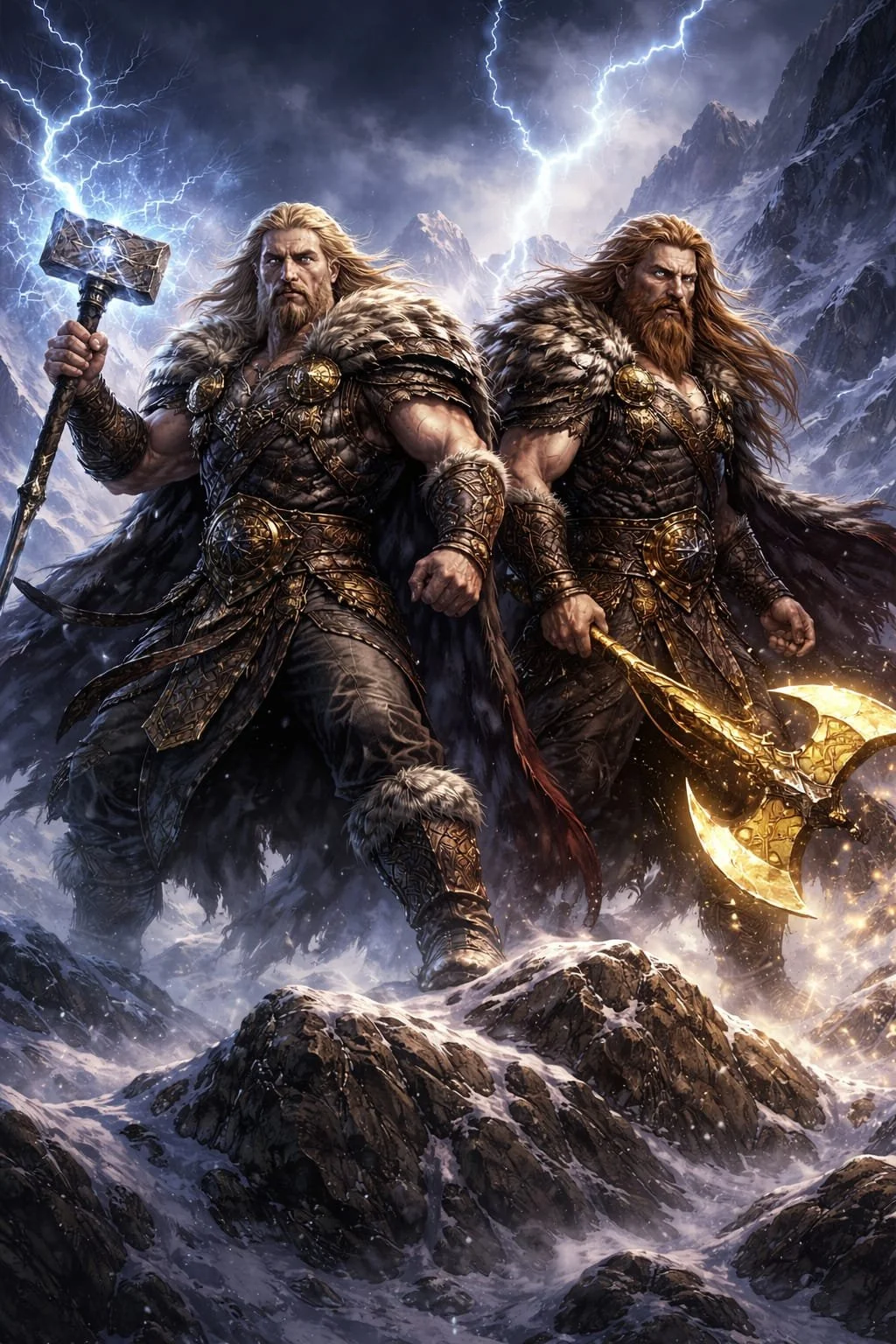
“Strength is not what survives the blow. It is what remains after the world has finished breaking.”
- Fragment from the Post-Song of Thor’s Line, reconstructed from late Eddic marginalia
Before the world ends, there are gods who fight. After the world ends, there are those who remain.
Magni and Móði belong not to the age of ascent, but to the age of aftermath. They are not architects of order, nor heralds of chaos. They are what survives when both have exhausted themselves.
They are the sons of Thor, but more precisely, they are what Thor leaves behind when thunder has finally spent its voice.
Magni is strength that does not ask permission to exist. Móði is rage that refuses to disappear even when its cause is gone.
Together, they are not a continuation of the old world. They are its residuemade conscious.
They are not remembered as heroes of action, but as stabilizers of consequence beings who enter myth only after myth has already begun to collapse under its own weight.
On the Nature of Post-Mythic Continuation
This blog proceeds from a single premise: that Ragnarök does not end myth, but fractures its ability to remain unified.
What survives the collapse of divine order is not reduced divinity, but divided function.
Magni and Móði are not successors in lineage. They are successors in decomposition.
Where Thor was singular force expressed through will, Magni becomes force without narrative justification, and Móði becomes emotional persistence without causal anchor.
They are not “after the gods.”
They are what the gods become when unity is no longer a viable metaphysical condition.
**NOTE**
Before proceeding, it is essential to clarify the mythic status of Magni and Móði within Norse cosmology.
In the Prose Edda and related sources, they appear as sons of Thor: Magni, born of the giantess Járnsaxa, and Móði, whose name is commonly understood as “Wrath.” Both survive Ragnarök, the end of the gods, and inherit Mjöllnir, Thor’s hammer, in the renewed world.
Unlike Odin or Loki, they are not central to the mythic drama of pre-apocalypse intrigue. Their presence is sparse, almost deferred. They do not shape the old order they inherit what remains of it.
This essay treats that sparsity not as marginality, but as design.
In later fragmentary interpretations of the Younger Edda tradition, scribes hint that they were “not raised into godhood, but into aftermath,” suggesting their divine function was only activated once cosmic stability had already failed.
On the Splitting of Thor
Thor cannot be inherited as continuity, because continuity itself is what Ragnarök abolishes. What remains of him must therefore divide along the only axis that still persists after mythic collapse: force that acts on the world and force that remains within experience.
Magni inherits the outward vector of Thor’s being: strength as intervention, strength as alteration of material constraint.
Móði inherits the inward residue: wrath as persistence of affect after referent collapse.
The unity of Thor dissolves not into weakness, but into specialization under conditions of ruin.
To inherit Thor is not to continue him.
It is to separate what he was always forced to hold together.
Note on Sources and Approach
Magni and Móði appear briefly in the Prose Edda, most notably in the aftermath of Thor’s death during Ragnarök, when Magni is strong enough still a child to lift Thor’s fallen hammer from beneath the body of the slain god Hrungnir (in earlier mythic time), and later when both sons survive the end of the world and inherit Thor’s weapon.
They are not elaborated upon. They are not given long narratives, moral arcs, or divine doctrines.
This absence is not neglect. It is compression.
Some scholastic marginalia refer to them as “secondary stabilizers of divine continuity,” implying their role was never to be central, but to prevent total metaphysical collapse after primary forces exhausted themselves.
They are not gods of story expansion. They are gods of story residue.
Where Odin accumulates knowledge and sacrifice, and Thor accumulates battles and scars, Magni and Móði accumulate aftermath.
They are what remains when accumulation stops.
On the Names Magni and Móði
Names in Norse myth are not labels. They are functions condensed into sound.
Magni derives from magn power, force, magnitude. But not abstract power: applied force, the kind that moves bodies, lifts weight, alters physical constraint.
He is strength after it has been proven.
Móði derives from móðr rage, fury, emotional intensity. But unlike divine wrath that initiates war, Móði’s wrath persists after its object is gone.
He is emotion after justification has collapsed.
Together, their names form a paradox: one is force without argument, the other is feeling without target.
They are what remains when reason and narrative no longer govern experience.
Birth: Sons of Thunder, Children of Collapse
Magni and Móði are born under the long shadow of Thor’s violence a violence that sustains the cosmos but also guarantees its eventual exhaustion.
Their births are not celebrated in myth with grandeur. There is no divine announcement, no cosmic omen. Instead, they appear as consequences of proximity.
To Thor, they are offspring. To the mythic system, they are continuation strategies.
Magni is born of a giantess already blurring the boundary between order and chaos. Móði’s maternal lineage is less emphasized, as if emotional force requires less genealogical precision than structural force.
This asymmetry is meaningful.
Strength needs contact with the world to exist. Wrath only needs persistence.
They are not introduced as future rulers. They are introduced as what remains available after rulership ends.
Ragnarök as Collapse of Coherence
Ragnarök is not the destruction of divine beings, but the exhaustion of the principle that once made divine beings mutually intelligible.
In the earlier age, conflict still assumed shared grammar: fate, honor, causality, debt.
At Ragnarök, even conflict loses its grammar.
Jörmungandr and Thor do not oppose each other in meaning. They exhaust each other in function.
The world does not end in fire, but in equivalence. When all forces become equivalent, victory ceases to describe transformation and becomes only a record of expenditure.
It is within this equivalence that Magni and Móði emerge not as responses to the collapse, but as residues that no longer require it to be legible.
Ragnarök is not simply apocalypse. It is exhaustion made event.
The gods do not fall because they are weak. They fall because they have already spent themselves across mythic cycles.
Thor kills Jörmungandr, and in doing so, is killed by it.
This is not victory or defeat. It is equivalence.
And in that equivalence, Magni and Móði become visible.
They do not prevent Ragnarök. They do not reverse it. They do not reinterpret it.
They survive it.
Survival, in this context, is not triumph. It is continuity without justification.
They are the moment after meaning has stopped being produced, but before reality has stopped continuing.
Magni: Strength Without Mythic Demand
Magni’s defining act in surviving myth is not destruction, but lifting.
He is said to be strong enough while still young to lift Thor’s hammer from beneath the fallen bodies after combat.
This is not heroic strength in the classical sense. It is not tested by adversary. It is tested by aftermath.
Magni’s strength does not prove worth. It restores usability.
He is not the god of battle. He is the god of what remains functional after battle.
In a universe governed by escalating violence, Magni introduces a different metric: can what is broken still be carried?
If Thor is thunder, Magni is inertia overcome.
He is not loud. He is weight made movable.
Móði: Wrath After Its Object Has Vanished
If Magni is continuity of force, Móði is continuity of affect.
Wrath in myth is usually directional: it demands enemy, cause, correction. But Móði survives Ragnarök, where most causes have already been erased.
What remains, then, is emotion without object.
This is not madness. It is unresolved energy.
Móði is the condition in which anger no longer knows what it is for, but still refuses to cease existing.
He is not chaos. He is persistence without referent.
Where other gods define wrath through action, Móði defines it through duration.
He is the echo of conflict after the battlefield has been emptied.
On Total Dissolution (What Would Have Been Lost)
To understand Magni and Móði is to understand what their absence would have meant.
Without Magni, strength would not continue it would revert into static weight, indistinguishable from dead matter. The world would cease to offer resistance that could be overcome.
Without Móði, wrath would not subside it would extinguish entirely, collapsing emotional continuity into neutral quiet. Experience would persist without intensity, and thus without direction.
In either case, survival would continue without differentiation.
And a world without differentiation is not peace.
It is the slow cancellation of significance.
Magni and Móði exist as the minimal remainder required to prevent reality from becoming indistinct.
The Inheritance of Mjöllnir: Weapon Without War
After Ragnarök, Magni and Móði inherit Thor’s hammer, Mjöllnir.
This transfer is not merely symbolic succession. It is a structural decision by myth.
Power survives its original owner.
But here, inheritance does not restore the old world. It displaces it.
Mjöllnir without Thor is no longer instrument of divine protection. It becomes ambiguous: is it continuation, or residue?
Magni can lift it. Móði can endure it. But neither can return it to its original meaning.
The hammer still works. The world it worked on does not.
First Interactions: The Sons Without Audience
Unlike Thor, Odin, or Loki, Magni and Móði do not have audiences.
No courts gather for them. No elaborate dialogues define their worldview. They exist in a mythic space where speech has already been overused.
They are defined by presence, not rhetoric.
To encounter them is not to receive explanation. It is to experience continuation.
Where older gods demand interpretation, they demand adaptation.
The Ethics of Aftermath
Magni and Móði introduce a mythic ethics that is rarely acknowledged: what do you do when the story has ended, but the world has not?
Magni answers: you carry what still has weight.
Móði answers: you remain what still feels.
Neither offers resolution. Both refuse disappearance.
They do not heal the world. They persist within it until new conditions emerge.
This is not heroism. It is endurance without narrative reward.
The Absence of Transformation
Unlike Odin, who accumulates sacrifice, or Thor, who accumulates scars, Magni and Móði do not visibly transform.
They do not become wiser. They do not become more complex.
They remain what they were but now without the world that previously explained them.
This creates a subtle rupture: in myth, transformation usually signals meaning. Here, lack of transformation signals survival.
They are constants in a system that has reset itself.
The Shape of Their Power
Magni and Móði do not expand myth. They stabilize its edge.
Magni ensures that force does not disappear entirely from the world. Móði ensures that feeling does not collapse into silence.
They are safeguards against total closure.
Their power is not escalation. It is refusal of termination. They keep the world slightly unfinished.
Post-Mythic Presence: When Gods Become Conditions
In the renewed world after Ragnarök, surviving gods are fewer, quieter. Magni and Móði exist in this reduced field not as rulers, but as conditions under which experience continues.
Magni appears wherever strength still has practical application. Móði appears wherever emotion outlives explanation.
They are not prayed to in the old sense. They are recognized.
What Magni and Móði Are Not
They are not younger versions of Thor. They are not incomplete gods awaiting development. They are not moral lessons about inheritance. They are not symbolic placeholders for human psychology alone.
They are structural survivors of mythic collapse.
To misunderstand them as “next generation gods” is to miss their function entirely.
They are not what comes after the gods. They are what comes after godhood stops organizing reality.
Final Reflection - “What Remains When Thunder Ends”
Magni and Móði ask no questions. They offer no doctrine. They simply remain.
And in that remaining, they pose a quieter challenge: what do you do with strength when there is nothing left to fight? What do you do with feeling when there is nothing left to justify it?
The myth does not answer. It only shows that something continues.
Final Question to the Reader
When meaning collapses but continuation remains, do you rebuild explanation - or learn to live as aftermath itself?
Magni & Móði… Not New Gods. Not Old Gods. What Survives.
They are the after-form of divine intensity.
Not resolution. Not rebirth. Not conclusion.
Just continuation without permission.
Wyrd does not end. It only changes what carries it.
Wyrd & Flame 🔥 🪓
