
Galdr in Norse Tradition: History, Meaning, and the Power of Spoken Magic
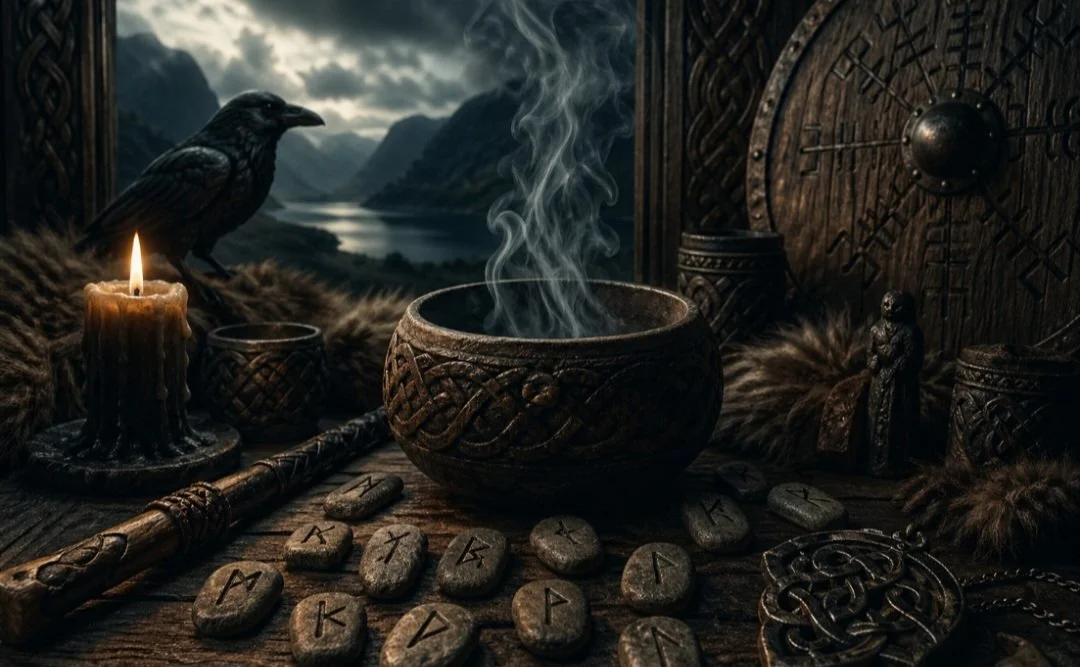
In the Norse world, words were never treated as something small. Speech had weight. A promise spoken before witnesses could shape inheritance, law, and honour. A single insult could start a blood feud that lasted for generations. Blessings were taken seriously, and curses were feared. To speak was not just to make sound - it was to do something.
This is where galdr sits.
Galdr is one of the most talked about parts of Old Norse magic, but also one of the most misunderstood. A lot of people today reduce it to “Viking chanting” or simple spell songs, but it was far more than that. Galdr was tied to voice, rhythm, memory, poetry, and the belief that spoken words could change the world around you.
At its core, galdr is usually understood as magical speech or spell-singing. It could be spoken charms, repeated phrases, protective words, healing songs, invocations, or curses. Sometimes it worked alongside runes, but it was not dependent on them. The power was not only in symbols carved into wood or stone - it was in the voice itself.
The old sources show that galdr was respected, but also feared. It could be used to protect a home, strengthen courage, bring luck, or call healing. It could also be used to bind, curse, or cause harm. Because of that, it sat in a dangerous place between wisdom and accusation. Someone known for galdr could be respected… or watched very carefully.
We do not have one perfect guide explaining exactly how galdr was done. What we have are fragments. The Hávamál, the Poetic Edda, the sagas, and later writings all preserve pieces of it. We see Odin learning powerful songs and charms. We see Egill Skallagrímsson using words and runes together. We see law codes warning against harmful magic and communities fearing the wrong kind of spoken power.
To understand galdr, you first have to understand how the Norse saw speech itself. Words were not separate from action. A word spoken with knowledge, intention, and strength was not just conversation - it was force.
That is also where modern people often get confused. Today, galdr is often mixed together with modern manifestation ideas, occult revival practices, and romantic ideas about “Viking magic.” Some of that can be meaningful in modern spirituality, but it is not always historical. If we want to understand galdr properly, we have to start with the old world first - where words could heal, destroy, protect, and shape fate itself.
The Meaning of the Word Galdr
The word galdr comes from the Old Norse verb gala, which means “to sing,” “to chant,” or sometimes “to cry out.” It is the same root used for the crowing of a rooster or the sharp call of a bird. This already tells us something important - galdr was not imagined as quiet whispering or silent thought. It was something voiced. It had sound, rhythm, and presence.
This is one of the reasons galdr is often translated as “spell-singing” rather than simply “magic.” It was not just about saying words, but about how those words were carried. Tone, repetition, rhythm, and force mattered. A galdr was something performed, not just spoken.
In the Norse world, poetry and memory were closely linked. Important knowledge was often carried through spoken verse rather than written records. Laws were remembered aloud. Stories were preserved through recitation. Names, oaths, and genealogy all carried power through speech. Because of this, words arranged with intention were believed to have greater force than ordinary conversation.
Galdr sits inside that understanding. It was not separate from poetry or ritual speech. In many ways, it was part of the same world - where words shaped reality because they were spoken correctly, with purpose and with weight behind them.
Some scholars connect galdr to formal charms, protective songs, healing incantations, and ritual speech used in both religious and magical settings. Others point to its connection with runes, where spoken words and carved symbols worked together. But even when runes were involved, the voice remained central. The carving alone was often not enough - the words had to be spoken, named, and given life.
This is why galdr cannot be understood as just “casting spells.” It belongs to a culture where language itself was active. To chant, to invoke, to name, to repeat - these were not symbolic gestures. They were acts believed to carry real consequence.
Even today, we still understand this in smaller ways. A vow spoken aloud feels heavier than a thought kept silent. A blessing said over someone carries more presence than one left unspoken. In the Norse world, that understanding was stronger. Speech did not just describe reality. It helped create it.
Galdr in the Old Norse Sources
One of the difficulties with understanding galdr is that there is no single text that explains it clearly from beginning to end. We do not have a “book of galdr” from the Viking Age. Instead, what we know comes from scattered references across poems, sagas, law codes, and later medieval writings. These fragments have to be pieced together carefully.
Some of the strongest references appear in the , especially in the . Here, Odin speaks of learning powerful songs and charms - specific spoken formulas that could heal wounds, calm storms, break bonds, protect in battle, or speak with the dead. These are not described as simple prayers. They are knowledge, secret and powerful, held by those who know how to use them.
One famous section is the list often called the Ljóðatal, where Odin describes eighteen powerful songs or spells he knows. He does not explain the full words of these charms, only what they can do. This suggests that the knowledge itself was not meant to be freely given. Power remained in knowing, not just in hearing about it.
Galdr also appears in the sagas, often in more practical and sometimes darker ways. In , Egill Skallagrímsson uses runes and spoken words together, including healing attempts and curse work. In other sagas, women and men use spoken magic to influence minds, bring illness, protect households, or place harmful intent on enemies.
The law codes also show how seriously this was taken. Certain forms of magical practice, especially those seen as harmful or manipulative, could bring punishment. This tells us that galdr was not treated as fantasy or harmless superstition. People believed it mattered enough to fear it.
Christian writers later recorded some of these ideas with suspicion, often treating galdr as dangerous pagan practice or even witchcraft. This can make the sources difficult, because Christian authors were often writing with judgement rather than neutrality. Still, even through that bias, the repeated appearance of spoken charms and magical songs shows that the belief itself was real and widespread.
What becomes clear across all these sources is that galdr was not one single thing. It could be healing, blessing, protection, cursing, memory, invocation, or sacred knowledge. It sat somewhere between poetry, prayer, ritual, and magic.
That is why it can feel difficult to define. Galdr was not a separate boxed practice. It was part of a world where words were understood to carry force, and where the right voice, spoken in the right way, could change far more than the mood of a room.
Galdr and the Spoken Power of Words
To understand galdr properly, you have to first understand how seriously the Norse took speech itself. Words were not treated as light things. A spoken oath could bind a person for life. A public insult could demand revenge. A blessing could strengthen trust, and a curse could stain a name for years. Speech carried consequence.
This was a world where much of life depended on the spoken word. Laws were remembered aloud before they were written down. Family lines were preserved through recitation. Agreements were witnessed by hearing them spoken, not by signing paper. Reputation lived in what people said about you and what you said before others. In that kind of society, words were never passive.
Galdr grew from that understanding. It was not strange because it believed words had power - that was already normal. Galdr simply took that belief further. If speech could shape law, honour, and memory, then it could also shape protection, healing, luck, and harm.
This is why repetition mattered. A phrase spoken once might be a statement. A phrase spoken with rhythm, intention, and repeated force became something else. It became focused. It carried weight beyond conversation. This is where chant enters the picture. Repetition fixes words into the mind, but it also gives them ritual shape.
Names were especially powerful. To know the true name of something was to hold a form of influence over it. This idea appears across many old traditions, and Norse belief is no different. Naming was never casual. To call upon a god, to name an illness, to speak someone’s honour or shame aloud - all of this mattered.
Poetry also sat close to this power. A skilled skald did more than entertain. Poetry preserved memory, shaped reputation, and could praise or destroy someone’s standing. A sharp verse could be political. A curse spoken in verse could be feared. The line between poetry and magic was not always clean.
Even silence had meaning. Choosing not to speak, withholding words, or refusing an oath could be just as powerful as speech itself. The Norse understood that words create reality, but so does their absence.
Galdr belongs inside all of this. It is not separate from ordinary life - it is the sharpened edge of something already present. It is speech used with full intention. Not casual talk, but words chosen carefully because they were believed to reach further than the mouth.
That is why galdr was respected and feared. Once spoken, words cannot be taken back. In the Norse mind, they do not simply disappear into the air. They move outward, and they leave marks.
The Difference Between Galdr and Seiðr
One of the most common mistakes in modern Norse paganism is treating galdr and seiðr as if they are the same thing. They are closely connected, and they sometimes overlap, but they are not identical. Understanding the difference matters, because each belongs to a different side of Norse magical practice.
Galdr is most strongly connected to the voice. It is spoken magic - chants, incantations, repeated phrases, charms, and the power of words shaped with intention. Its strength lies in sound, rhythm, naming, and the force carried through speech. A galdr could protect, heal, curse, bless, strengthen courage, or call on unseen powers through the spoken word.
Seiðr, on the other hand, is broader and often deeper in its ritual structure. It is more closely associated with prophecy, trance work, fate-working, spirit communication, and the manipulation of wyrd itself. Where galdr is often heard, seiðr is often experienced through altered states, ritual space, and the movement between worlds.
The best known descriptions of seiðr come through the völva - the seeress or ritual specialist who worked with prophecy and spiritual knowledge. In accounts like the one found in Eiríks saga rauða, the völva arrives, is seated in ritual honour, and performs her work with chants around her, often supported by women singing the varðlokkur, songs used to call spirits or open the work.
This is where the overlap becomes clear.
Galdr can exist inside seiðr.
The songs, chants, and spoken formulas used during seiðr may themselves be forms of galdr. But seiðr is the wider ritual practice, while galdr is one of the tools within it.
You can think of it like this: galdr is the voice, seiðr is the working.
Not all galdr is seiðr, and not all seiðr relies entirely on galdr, but the two often meet.
There is also a strong social difference in how they were viewed. Seiðr carried a heavy cultural stigma, especially for men. It was associated with ergi, a serious accusation of unmanliness, weakness, or dishonour when applied to male practitioners. Odin himself is criticised for practising seiðr because it was seen as crossing social boundaries.
Galdr did not carry that exact same stigma. Spoken charms, healing words, and protective chants could exist more openly, though harmful or manipulative use was still feared. A man known for galdr might be respected as wise or feared for dangerous knowledge, but he was not automatically carrying the same accusation that followed seiðr.
This difference tells us something important. Seiðr was seen as entering dangerous spiritual territory, while galdr was closer to the accepted understanding of powerful speech. Both could be feared, but for different reasons.
Modern people often romanticise both and blend them together into one vague idea of “Norse magic.” Historically, the distinction mattered. Galdr was the force of words made sharp. Seiðr was the deeper art of moving through fate, spirit, and hidden knowledge.
Both are powerful.
But they are not the same thing.
Odin and the Mastery of Galdr
When the sources speak most clearly about galdr, they almost always point back to Odin. Not as a distant figure, but as someone who actively sought out this kind of knowledge, learned it, and used it. If galdr is the sharpening of speech into power, then Odin is shown as someone who understood exactly how far that power could reach.
In the Hávamál, Odin does not present himself as a god who simply knows everything by nature. Instead, he is constantly learning, sacrificing, and gaining knowledge through effort. This is important. The power of galdr is not handed to him - it is something he earns.
One of the clearest moments comes when he describes hanging on the world tree, wounded and without food or drink, in order to gain knowledge of the runes. This act is often talked about in terms of runes alone, but it also connects directly to speech and sound. Runes are not just symbols to carve. They are named, spoken, and given force through voice. Without that, they are only marks.
Odin later speaks of knowing specific songs or charms - not vague ideas, but defined workings. In what is often called the Ljóðatal, he lists what these galdrar can do. Some can heal wounds. Some can dull an enemy’s blade. Some can free someone from bonds. Some can calm fear or protect in battle. He does not reveal the full words, only their effects, which suggests that the knowledge itself was guarded.
This is where the nature of galdr becomes clearer. It is not just sound. It is controlled knowledge, held by someone who understands when and how to use it. Odin is not simply chanting at random. He is applying learned speech with intention.
There is also a darker side to this. Odin is not a purely benevolent figure. His pursuit of knowledge often crosses boundaries, and he uses what he learns in ways that are not always kind or fair. This matters when looking at galdr. It shows that spoken power is not automatically “good.” It is a tool, and like any tool, it depends on the one using it.
Odin’s connection to galdr also reinforces the link between speech and authority. As a god associated with kingship, war, and wisdom, his words carry weight on multiple levels. When he speaks, he is not just expressing thought. He is shaping outcomes.
This reflects something human as well. The more authority a person holds, the more their words matter. A leader’s speech can move people, create conflict, or settle it. In the Norse world, that idea is taken further. The right words, spoken with knowledge, could affect not just people, but the unseen forces around them.
Odin represents the extreme of that idea. He is not just a speaker. He is a master of speech used as power.
At the same time, the way he gains this knowledge is important. He sacrifices for it. He seeks it out. He suffers for it. That suggests something about how galdr was viewed. It was not casual. It was not something picked up lightly. It was something learned, often at cost.
That alone sets it apart from how it is often treated today.
Odin’s example shows that galdr is not just about making sound or repeating words. It is about understanding what those words do, where they reach, and what they set in motion once they are spoken.
Because once spoken, they cannot be taken back.
Galdr in the Hávamál and the Rune Poems
If we want to understand galdr from the old sources, the Hávamál is one of the most important places to look. It does not give us a simple step-by-step guide, but it shows clearly how the Norse connected words, runes, wisdom, and power.
The Hávamál is part of the Poetic Edda and is often called “The Sayings of the High One,” with Odin speaking throughout much of the poem. Some parts deal with wisdom, behaviour, and how a person should live. Other parts move into something deeper - knowledge of runes, powerful songs, and hidden speech.
One of the most famous sections is where Odin describes hanging on Yggdrasil for nine nights, wounded by his own spear, sacrificing himself to himself in order to gain the runes. People often focus only on the image of the runes appearing, but what matters just as much is what happens after. Odin does not simply find symbols. He says he took them up, screaming, and then fell back. This is not passive learning. It is force, pain, and transformation.
After this, he speaks of charms and songs he knows - the Ljóðatal, often called the “list of spells.” These are some of the clearest examples of galdr in the surviving sources. Odin says he knows songs that can help in battle, calm enemies, stop weapons, heal sickness, put out fire, break chains, protect ships, wake the dead, and even win love.
What is important here is that these are not random magical ideas. They are spoken knowledge. Songs. Charms. Repeated words with purpose. Odin does not hand over the full wording, only what they do. That tells us something powerful - knowledge itself was guarded. Knowing that a charm exists is not the same as possessing it.
The rune poems also help us understand this connection. In later texts like the Norwegian Rune Poem and Icelandic Rune Poem, each rune carries not just a sound, but an idea, an image, and a force connected to life itself. Wealth, hail, journey, need, gift, harvest - the runes were not just letters. They were symbols tied to meaning and worldview.
This matters because galdr and runes were often connected. A rune carved without voice was incomplete. It had to be named, spoken, and awakened. The sound mattered just as much as the shape. To carve without understanding was dangerous, and the sagas make that clear.
In Egils Saga, Egill corrects badly carved runes used in a healing attempt. The wrong use of runes caused harm instead of healing. This reminds us that both carving and speech required knowledge. Magic was not decoration. It had consequences.
The Hávamál also shows something else - not every charm is for battle or victory. Some are for wisdom, restraint, and protection. This reflects the Norse view that power was not only about dominance. Sometimes the strongest use of knowledge was knowing when not to act.
Modern people often romanticise this section, imagining secret Viking spellbooks or endless lists of magical chants. But the sources are more serious than that. Galdr in the Hávamál is not fantasy performance. It is sacred knowledge, costly to gain and dangerous to misuse.
Odin suffers for it. He sacrifices for it. He does not treat it lightly.
That is the real lesson.
Galdr was never just about saying words. It was about understanding the weight behind them and knowing that once spoken, they move into the world and do not return unchanged.
The Role of Voice, Chant, and Repetition
At the heart of galdr is the voice. Not the written word, not silent thought, but sound carried into the world. This is one of the clearest things the word itself tells us. Galdr comes from the idea of singing, chanting, or crying out. It was something heard, not hidden.
In the Norse world, speaking with intention mattered. The way words were spoken could change their weight. A quiet conversation was not the same as an oath made before witnesses. A passing comment was not the same as a formal blessing or curse. Tone, rhythm, and repetition gave words force.
This is why chant matters.
When words are repeated, they stop being ordinary speech. Repetition fixes them into memory, but it also changes how they are experienced. A repeated phrase becomes focused. It builds presence. It creates a rhythm that can pull both speaker and listener into a different state of attention.
This is true even now. Think about prayer, funeral rites, battle cries, or songs sung together by a group. Repetition creates something stronger than simple conversation. It binds people into the moment. In the Norse world, that same principle existed, but it was understood as carrying magical force as well.
Galdr likely used this same structure. A phrase spoken once might be meaningful, but repeated with rhythm and intention, it became sharper. The voice itself became part of the working. Breath, tone, and pacing all mattered.
There is also power in breath itself. Breath is life. To speak is to push breath outward and shape it into meaning. Across many old traditions, breath is closely tied to spirit, soul, and force. Norse thought is no different. Words carried on breath were not empty. They were living.
This may be one reason chanting and vocal repetition held such importance. The voice made the unseen visible or at least audible. It gave shape to intention.
Volume may also have mattered. Some galdr may have been sung low and close, meant for healing, blessing, or quiet protection. Others may have been sharp, loud, and public, especially in cursing, accusation, or battle-related workings. The emotional force behind the sound would shape how it was received.
The group voice also mattered. In ritual settings, especially around seiðr, there are references to women singing together to support the working. These songs were not background music. They were part of the ritual itself, helping create the conditions for spiritual work.
This tells us something important - galdr was not always solitary. Sometimes it belonged to the community, especially when protection, blessing, or ritual support was needed.
Modern people often imagine magical speech as secret whispers or private affirmations. Historically, it could be much more physical than that. It had presence. It could be heard across a hall, carried across a gathering, or spoken directly into the centre of conflict.
Galdr was not about “positive thinking.” It was the deliberate use of voice as force.
That is why careless words mattered too. If words can protect, they can also wound. If a repeated blessing can strengthen, repeated insult can poison.
The Norse understood that speech leaves marks.
Galdr simply takes that truth and sharpens it.
Not every repeated phrase is magic. But when words are spoken with knowledge, rhythm, intention, and purpose, they stop being ordinary.
They become something else.
Galdr as Spell-Singing and Incantation
When people hear the word galdr, one of the closest modern descriptions would be spell-singing. Not singing in the sense of performance or entertainment, but the use of voice in a rhythmic, intentional way to shape outcome. It sits somewhere between chant, prayer, poetry, and command.
This is why simple translation can be difficult. If we call galdr “magic,” it sounds too broad. If we call it “song,” it sounds too soft. If we call it “spell,” it sounds too modern. In truth, it belongs to all of them at once.
A galdr could be spoken quietly over an injury, repeated for protection before a journey, used to strengthen courage before battle, or spoken with force as a curse against an enemy. The form changed depending on the purpose, but the heart of it remained the same - words arranged with intention and given power through voice.
This is where poetry and magic meet.
Old Norse culture placed enormous value on spoken verse. A skilled skald could preserve memory, shape reputation, and influence how people were remembered long after death. A well-made verse was not just beautiful language. It carried force.
Galdr used that same understanding, but with a sharper edge. The words were not only meant to be remembered - they were meant to act.
This is why many charms likely followed rhythm or repeated structure. Repetition made them easier to remember, but it also gave them ritual shape. The repeated line, the steady pattern, the deliberate naming - these turned speech into incantation.
Naming was especially powerful. To name an illness, a fear, a person, or a god was not neutral. It called attention. It fixed the thing into form. Some traditions believed that naming something gave a degree of influence over it. In galdr, this could mean naming what must be healed, naming what must be bound, or naming the power being called upon.
There is also a difference between ordinary speech and formal speech. A curse shouted in anger is not the same as a curse deliberately spoken with structure and witness. One is emotion. The other is intent shaped into action.
This is part of why law and magic sat so close together in Norse society. Oaths, judgments, blessings, and curses all relied on formal speech. A legal declaration and a magical incantation were not the same thing, but both depended on the belief that words, properly spoken, carried real consequence.
We can also see traces of this in later folk charms. Healing prayers, repeated blessings over livestock, spoken protections over homes, and ritual phrases passed down through generations all carry the same shape. Christianity changed the names and language, but the structure of spoken protective force often remained.
This reminds us that galdr was not always dramatic. It was not always a dark ritual under moonlight. Sometimes it was practical. A few words spoken over a child. A protective phrase before sea travel. A repeated charm over sickness.
Magic often lives in ordinary places.
Modern ideas sometimes turn galdr into something theatrical - loud chanting, staged rituals, or invented Viking performances. But historically, it may have looked much simpler and far more serious. A person speaking because they believed those words mattered.
That is the heart of incantation.
Not performance.
Belief.
The voice was not decoration. It was the working itself.
Protection Charms and Defensive Galdr
Not all galdr was used for dramatic curses or hidden magic. Much of it was likely practical and protective. In a world where illness, harsh weather, travel dangers, feuds, and sudden loss were part of everyday life, protection mattered. People wanted ways to guard themselves, their households, their animals, and their future. Galdr often sat in that space.
A protection charm was not always something grand. It could be a spoken phrase before a journey, words said over a child, a blessing over a doorway, or an invocation before going to sea. These acts may seem small, but in the Norse mind, small things carried weight. If words could wound, they could also shield.
The Hávamál gives some of the clearest examples. In Odin’s list of songs and charms, several are protective by nature. He speaks of knowing a charm that can help if he sees a tree hanging over a man, another that can stop weapons in battle, and others that protect ships or calm danger. These are not abstract spiritual ideas. They are practical protections for a dangerous life.
This tells us something important - galdr was not separate from survival. It was part of how people understood safety itself. A warrior might carry a weapon, but he might also trust in spoken protection. A sailor might prepare his ship, but words of blessing could still matter before the journey began.
Homes were another place where protective speech mattered. The household was the centre of life, and guarding it meant guarding everything - family, food stores, animals, inheritance, and honour. Protective words spoken over the home, the land, or the threshold would have fit naturally into that worldview.
There is also strong evidence across wider Germanic and later Scandinavian folk tradition for spoken charms used to protect livestock and crops. Illness in animals or failed harvests could mean disaster. A few spoken words, repeated with intention, could be treated as part of responsible care, not superstition.
Runes sometimes worked alongside this. A protective rune carved onto wood, bone, or an object often needed spoken words to complete it. The carving gave form, but the voice gave life. Without the spoken force behind it, the act could be seen as unfinished.
This is one reason Thor’s hammer symbols became so important. While not strictly galdr on their own, they show how protection and sacred force were closely tied together. A hammer pendant worn around the neck was not just jewellery. It was a statement of protection and identity. Spoken blessing and physical symbol often worked side by side.
There was also protection against people, not just misfortune. Feuds, envy, curses, and social hostility were real threats. A spoken charm could be used to guard against harmful intent, much like later folk traditions used protective prayers against the evil eye or malicious speech.
This reflects something very old - fear is not always physical. Sometimes protection is needed against what cannot be easily seen: bad will, ill luck, hidden hostility, or spiritual harm.
Modern people often separate practical life from spiritual practice too sharply. The Norse likely did not. Protecting the home, the family, and the body was part of the same world as honour and worship.
Galdr for protection was not about fantasy. It was about survival.
It was the belief that words, spoken rightly, could stand between a person and harm.
And in a hard world, that mattered.
Healing Through Voice and Spoken Magic
Just as words could be used for protection, they could also be used for healing. In the Norse world, healing was not always separated into neat categories of medicine, prayer, and magic the way modern people often think. A wound might be treated with herbs, practical skill, and spoken words all at once. None of these were seen as strange together. Healing was about restoring balance, not choosing one method over another.
Galdr often appears in this space.
A healing charm could be spoken over an injury, repeated during sickness, or used to ease fear and strengthen recovery. The words themselves were believed to carry force. They were not just comforting sounds. They were part of the act of healing.
The Hávamál again gives us strong hints of this. Odin speaks of knowing songs that can help with wounds and sickness. He does not explain the full wording, but the meaning is clear - certain spoken charms were believed to have real healing power.
This idea appears elsewhere too. In Egils Saga, there is a famous moment where a young woman becomes ill because badly carved runes were used in an attempt to help her. Egill discovers the mistake, removes the harmful runes, burns them, and replaces them properly. He then speaks words over the new carving. This scene matters because it shows both rune knowledge and spoken force working together. The healing does not come from symbols alone. Knowledge and voice are both required.
It also shows something important: bad magic could harm just as easily as good magic could heal. This is why knowledge mattered so much. Galdr was not decoration or performance. If used wrongly, it could make things worse.
Healing words were not always dramatic. Sometimes they were likely simple and repeated. A phrase over a fever. A blessing over childbirth. Words spoken over a child in fear. Later Scandinavian folk traditions preserve many of these patterns — spoken healing charms over burns, blood, animals, and illness. Christianity often changed the names involved, but the structure remained familiar: words repeated with purpose over pain.
This suggests strong continuity. The idea that voice could support healing did not disappear when religion changed. It simply changed shape.
There is also the emotional side of healing. Fear weakens people. Confidence strengthens them. A person hearing words of protection, calm, or blessing may stand differently, breathe differently, recover differently. Even without separating “magic” from psychology, the effect is real.
The Norse would not have drawn the same hard line modern people do between physical and spiritual healing. A wound was not just flesh. Illness was not only the body. Strength of mind, luck, fate, and unseen influence all sat close together.
This is why spoken healing mattered.
To name the sickness was to confront it.
To call for strength was to create it.
To speak blessing was to invite order where pain had entered.
Modern people sometimes dismiss this too quickly, either reducing it to superstition or trying to turn it into fantasy. Historically, it was simpler and more serious than either. People used what they had - herbs, skill, and words.
Because sometimes healing begins when someone speaks with certainty against suffering.
Galdr in healing was not about pretending words replaced action.
It was the understanding that words themselves were part of the action.
Curse Work, Binding, and Harmful Galdr
Not all galdr was used for healing or protection. The same spoken power that could bless, strengthen, or restore could also be turned toward harm. This is one reason galdr was respected and feared at the same time. Words could protect, but they could also wound, bind, weaken, and destroy.
In the Norse world, harmful speech was taken seriously even outside of magic. A public insult could trigger violence. A false accusation could ruin reputation. A spoken curse could leave lasting fear. When speech already carried that much social power, it was not a large step to believe that deliberate magical speech could do even more.
Curse work in galdr could take many forms. It might be spoken to bring misfortune, illness, fear, confusion, or weakness. It could be aimed at an enemy, a rival household, or someone believed to have caused dishonour. Sometimes it was not about direct destruction, but about binding - limiting a person’s luck, strength, or ability to act.
This is where the idea of spoken force becomes sharpest. A curse is not just anger. It is intention shaped into words and sent outward with purpose.
One of the strongest examples of harmful magical accusation in Norse literature is the use of the níðstang - the insult pole or curse pole. This was not galdr in the narrow sense of chanting alone, but it shows how words, symbols, and intention worked together. In Egils Saga, Egill raises a níðstang against King Eirik and Queen Gunnhildr, carving runes and speaking words of curse and shame against them. The goal was not simply personal anger. It was public spiritual and social attack.
This shows how closely curse work was tied to honour. To curse someone was often also to shame them, challenge them, or weaken their standing. The magical and the social were rarely separate.
Binding work also appears in references to spells meant to stop movement, weaken enemies, or interfere with relationships and decisions. In the Hávamál, Odin speaks of charms that can stop weapons, loosen bonds, or place control over outcomes. If words could free, they could also hold.
This is one reason accusations of magic were dangerous. A person believed to use harmful galdr might be feared even if nothing could be proven. Suspicion alone could damage trust. Law codes and later Christian writings often show strong concern around harmful magic, especially when it involved illness, manipulation, or hidden attack.
There is also a moral question here. Not every harmful working was seen the same way. A protective curse against an attacker is different from spiteful harm born from envy. Revenge, justice, defence, and malice could blur together depending on who was telling the story.
The sagas are full of this tension. One person’s justified response is another person’s dishonourable attack.
Modern people often romanticise curse work, either making it theatrical or pretending it was always dark and forbidden. Historically, it sat inside the same moral complexity as feud and vengeance. The question was rarely “is harm allowed?” but “is it justified?”
That is a harder question.
Galdr used for harm reminds us that spoken power is never neutral. The voice can heal or it can poison. Once words are spoken, especially with full intention, they move beyond the speaker.
This is why many traditions treated curse work with caution.
Because even if the curse reaches its target…
it also passes through the one who speaks it.
Galdr for Luck, Victory, and Prosperity
Not all galdr was defensive or harmful. A large part of it likely sat in a more everyday space - strengthening luck, improving outcomes, and pushing things in your favour. In a world where survival could depend on weather, harvest, trade, or the outcome of a single fight, the idea of influencing luck was not small. It was part of how people understood success itself.
Luck in the Norse world was not just chance. It was often thought of as something a person carried - a kind of personal force that could grow, weaken, be inherited, or be lost. A strong person had strong luck. A failing household might be seen as losing it. Because of that, it made sense that people would try to strengthen it.
This is where galdr could be used.
A spoken charm before battle might not guarantee victory, but it could strengthen courage, steady the mind, and focus intent. A warrior who believed himself protected or favoured would act differently than one who felt exposed. That alone could shift the outcome.
Before journeys, especially sea travel, spoken words could be used to ask for calm waters, safe passage, and return. The sea was unpredictable and dangerous. A few words spoken with intention may not control the waves, but they gave a sense of order against uncertainty.
Trade and prosperity also sat in this space. A successful exchange depended on trust, timing, and luck. Words spoken over goods, before travel, or during agreements could carry weight beyond simple conversation. Even in everyday life, the line between practical action and spoken reinforcement was not strict.
The Hávamál again hints at this. Odin speaks of charms that can bring success, win favour, and influence outcomes. These are not always dramatic spells. Some are about positioning, perception, and the shaping of circumstance.
There is also a social side to this. Reputation itself was a form of luck. A person known as honourable, strong, or successful would often receive better opportunities. Spoken praise, reputation carried in words, and the shaping of how someone was spoken about could directly affect their prosperity.
This connects galdr to something wider. It was not only about hidden magic. It was also about the visible shaping of outcome through speech. Encouragement, praise, and confident declaration could all strengthen a person’s standing.
Later folk traditions reflect similar ideas. Words spoken over crops, animals, and tools were meant to bring growth and success. Again, this was not always dramatic ritual. Sometimes it was simple, repeated phrases tied to daily work.
Modern people often separate “luck” from action, treating it as something random. The Norse did not always see it that way. Luck could be influenced, strengthened, protected, and sometimes lost through behaviour and circumstance.
Galdr fit naturally into that understanding.
It was not about forcing the world to obey.
It was about leaning into the currents already there and pushing them in your favour.
Sometimes that push was small.
But small shifts can change outcomes.
And in a hard world, that mattered.
Women, Men and the Practice of Galdr
When it comes to magic in the Norse world, people often assume there was a strict divide between men and women - that certain practices belonged only to one or the other. The reality is a bit more complicated.
Galdr, as spoken magic, does not appear to have been limited to one gender in the same way that some other practices were. Both men and women are shown in the sources using words, charms, and spoken force. What differs is how those actions were viewed, especially depending on context and type of magic.
Men in the sagas are often shown using galdr in ways that align with their social roles. This might include protection, battle-related charms, or the use of runes alongside spoken words. Figures like Egill Skallagrímsson show that men could openly use spoken magic without automatically losing status, as long as it was not seen as crossing certain boundaries.
Seiðr, however, was a different matter. That practice carried a strong stigma for men, tied to accusations of ergi - a serious charge that implied unmanliness or moral weakness. Odin himself is criticised in the sources for practising seiðr, which shows how deep that stigma ran.
Galdr did not carry the same weight of accusation.
This suggests that spoken magic sat closer to accepted behaviour. Words, after all, were already powerful in everyday life. Using them with intention did not automatically place someone outside social norms, especially if the purpose was protection, healing, or practical need.
Women, on the other hand, appear more openly connected to a wider range of magical practices, including both galdr and seiðr. The figure of the völva (the seeress) shows women holding recognised roles within spiritual and ritual work. In accounts like the one in Eiríks saga rauða, women support ritual through song and chant, showing how voice and sound were central to their role.
This is where things overlap again. The chanting and vocal elements used in seiðr likely included forms of galdr. Women singing together in ritual space were not simply “background noise.” Their voices were part of the working itself.
There are also hints that women may have used spoken charms in everyday life - in healing, protection, childbirth, and household management. These would not always be recorded in dramatic saga moments, but they fit naturally into the structure of daily life.
This creates an important distinction.
Seiðr was marked, visible, and sometimes controversial.
Galdr could be quieter, more woven into normal life.
Because of that, it may have been more widely used across both men and women, even if it was not always named or recorded directly.
There is also a question of perception. A man using spoken magic in a controlled, practical way might be seen as wise or skilled. A man stepping into deeper trance-based practices risked social judgement. Women, already associated with domestic and spiritual roles, could move within those spaces more freely.
This does not mean women were always safe from accusation. Magic, especially harmful magic, could bring suspicion regardless of gender. But the cultural boundaries were not identical.
Modern ideas often flatten this into simple categories - “women did this, men did that.” The sources suggest something more fluid. Practice existed within social limits, but those limits depended on context, intention, and how the action was perceived by others.
Galdr sits in the middle of that.
It is not owned by one group.
It belongs to anyone who understood the weight of words - and was willing to carry it.
Völur, Seers and Spoken Magic
When we look at the people most closely associated with ritual and deeper knowledge in the Norse world, the figure of the völva stands out. The völva was not simply a “witch” in the modern sense. She was a recognised practitioner, often moving between communities, called upon for insight, guidance, and spiritual work.
The clearest account comes from Eiríks saga rauða, where a völva arrives during a time of hardship. She is given honour, a prepared seat, special clothing, and food. This tells us immediately that her role was respected, not hidden. People sought her out because they believed she could access knowledge beyond ordinary reach.
What matters for galdr is what happens around her.
During the ritual, women gather and sing what are called varðlokkur - songs used to call spirits or support the working. This is one of the clearest moments where we see voice used deliberately in ritual space. These songs were not decoration. They were part of the process itself.
This is where galdr and seiðr meet again.
The völva performs the deeper work - the seeing, the movement through hidden knowledge, the shaping of outcome. But the voices around her create the conditions for that work. The chanting, repetition, and sound help open the space, focus attention, and strengthen the act.
In that sense, galdr is not always the centre of the ritual, but it is often part of its foundation.
It is also important to notice that the völva does not always perform alone. She relies on others. This suggests that some forms of spoken magic were communal. The group voice mattered. The shared rhythm mattered. It was not just one person “doing magic,” but a collective act supporting the working.
Outside of formal ritual, the völva likely also used spoken charms in more practical ways - healing, protection, or guidance. The sources do not always spell this out, but it fits naturally with the wider understanding of galdr as spoken force.
There is also a strong link between memory and speech here. A völva would carry knowledge that was not written down. Songs, phrases, patterns, and invocations would be remembered and passed on through voice. This again shows how closely speech and power were tied together.
The presence of the völva also reminds us that not all knowledge was public. Some things were taught carefully, held within certain roles, or shared only when needed. This matches what we see in other sources, where powerful words are mentioned but not fully revealed.
Modern ideas often turn the völva into something mystical and distant, but in the Norse world she was part of society, even if she stood slightly outside its everyday structure. People relied on her when things became uncertain or unstable.
And when she worked, voice was never far away.
Galdr may not always have been named directly in these moments, but it was there - in the chant, in the repetition, in the shaping of sound into something that reached beyond the ordinary.
Because in that world, silence did not open the path.
The voice did.
Galdr and the Use of Runes
One of the most common questions around galdr is how it connects to runes. Modern ideas often merge the two completely, as if galdr is simply “chanting runes” or activating symbols. The sources suggest something more careful than that.
Runes were not just an alphabet. They carried meaning beyond simple sound. Each rune represented a concept, an idea tied to life - things like need, gift, journey, wealth, disruption, or growth. Writing with runes was not only about recording words. It could also carry intention, identity, and, in some cases, power.
But runes on their own were not always enough.
This is where galdr comes in.
In several references, the act of carving runes is paired with speaking over them. The carving gives the form, but the voice gives the force. To name the rune was to awaken it. Without that, it could be incomplete - or worse, dangerous if done incorrectly.
The clearest example of this comes from Egils Saga. Egill finds that a young woman has become ill after someone attempted to help her by carving runes incorrectly. He recognises the mistake, removes the runes, burns them, and replaces them properly. But he does not stop at carving. He speaks words over them. The healing comes from both knowledge and voice working together.
This moment shows something important. Runes were not casual symbols to be used without understanding. They required knowledge, and they required correct use. Galdr was part of that process, not something separate from it.
It also shows that mistakes had consequences. Badly used runes could harm instead of heal. This reinforces the idea that both carving and speech needed to be handled with care.
There are also examples of runes being carved for protection, love, or harm, often accompanied by spoken intention. In these cases, galdr may have been used to direct or strengthen the purpose behind the carving.
At the same time, it is important not to assume that all galdr involved runes. Spoken charms existed on their own. A person could use galdr without carving anything at all. The voice itself was enough when used with knowledge and purpose.
Modern practice often over-focuses on runes as the centre of everything, treating them almost like a fixed magical system. Historically, they were part of a wider understanding. They worked alongside speech, not above it.
This balance matters.
Runes without understanding are just marks.
Words without intention are just sound.
But when both are used with knowledge, they become something else entirely.
That is where galdr and runes meet - not as decoration, but as tools shaped by the one who uses them.
And like any tool, they can build or break, depending on how they are handled.
Were Runes Necessary for Galdr?
One of the biggest misunderstandings around galdr today is the idea that runes are always required for it to work. A lot of modern practice ties the two together so tightly that people assume galdr cannot exist without rune chanting or carving. When you look at the sources, that does not really hold up.
Galdr, at its core, is spoken force. It exists in the voice - in repetition, rhythm, naming, and intention. That means it can stand on its own. A charm spoken over an injury, a repeated phrase for protection, or words used to strengthen courage do not require anything to be carved or written. The act is in the speaking.
The Hávamál supports this idea. When Odin describes the charms he knows, he speaks of songs - not carvings. He lists what they can do, but he does not say they must be written down. The power sits in knowing the words and using them correctly.
At the same time, runes and galdr clearly worked well together. When runes were used, speaking over them gave them direction and force. The carving gave form, but the voice gave movement. This is why some workings used both. But that does not mean one depended entirely on the other.
The example from Egils Saga shows this balance clearly. The harm came from badly used runes, but the correction involved both removing them and speaking over the new carving. The voice was part of fixing the problem, not just the carving itself.
There is also a practical point here. Most people in the Viking Age were not writing regularly. Literacy was limited, and even where runes were used, they were not always used in long or complex ways. Spoken tradition, on the other hand, was everywhere. People remembered through speech. They passed knowledge through voice. That alone suggests that spoken charms would have been more common than written ones.
This does not make runes unimportant. They clearly mattered, and they carried meaning beyond simple writing. But they were not the only path. Galdr did not need a surface to exist. It needed a voice.
Modern practice sometimes flips this around, treating runes as the main focus and speech as something secondary. Historically, it may have been the opposite more often than not. The voice came first. The carving supported it when needed.
There is also a risk in overcomplicating things. When everything becomes about perfect symbols, exact shapes, and fixed systems, the original idea can get lost. Galdr was not about building a rigid method. It was about using words with knowledge and intent.
So were runes necessary?
No.
They were one tool among others.
Galdr could stand without them.
Because the real centre of it was never the carving.
It was the voice.
Galdr in Saga Literature
If the poems give us the idea of galdr, the sagas show us how it might have looked in practice. They don’t explain it cleanly or step by step. Instead, they show moments where spoken words, runes, and intention are used in real situations - sometimes for healing, sometimes for harm, and sometimes in ways that sit somewhere in between.
One of the clearest examples appears in . Egill Skallagrímsson is not just a warrior and poet, he is also shown using knowledge of runes and spoken force. In one scene, he comes across a young woman who has been made ill by someone trying to help her with runes. The runes were carved incorrectly, and instead of healing, they caused harm. Egill recognises the mistake immediately. He removes the runes, burns them, and replaces them properly. But he does not stop at carving - he speaks over them. The healing comes from knowledge and voice working together. This shows how seriously these acts were taken. Mistakes were not harmless.
The sagas also show darker uses. Spoken curses, threats, and accusations appear in different forms, often tied to honour and conflict. The use of a níðstang, for example, is both symbolic and spoken. Words of shame and curse are directed at a person or ruler, not quietly, but publicly. This is not hidden magic. It is a direct attack on reputation, status, and perceived power.
In , we see another side of this world. Grettir is repeatedly affected by curses and supernatural forces that shape his fate. These are not always explained in detail, but they show how belief in spoken or directed harm could influence how events were understood. Misfortune was not always seen as random. It could be the result of words spoken with intent.
What stands out across the sagas is that galdr is rarely presented as something separate from life. It appears in moments of crisis, illness, conflict, or decision. It is used when something is wrong, uncertain, or threatened.
It is also not always explained.
The sagas assume the audience understands the weight of what is happening. A person speaking certain words over someone, or carving something with intent, is enough to signal that something serious is taking place. The details are often left unspoken because they were likely understood at the time.
This makes things harder for us now, but it also tells us something important. Galdr was not exotic. It was part of the worldview. People did not need it explained in full because it already made sense to them.
Another thing the sagas show is consequence. When galdr is used wrongly, it can harm. When it is used correctly, it can help. But it is never casual. The people involved understand that something real is being done.
Modern ideas often turn these moments into fantasy scenes - dramatic rituals, elaborate chanting, or theatrical magic. The sagas are much simpler. A person speaks. A person carves. A person acts with intention.
And something changes.
That is how galdr appears in the stories.
Not as performance.
As action.
Misconceptions and Modern Interpretations of Galdr
Galdr is one of those things that has been heavily reshaped in modern times. The problem isn’t that people are interested in it - that part is natural. The issue is how quickly it gets turned into something theatrical, simplified, or completely disconnected from the sources.
One of the most common misunderstandings is the idea that galdr was always loud, dramatic chanting done in ritual circles. While chant and repetition were clearly part of it, the sources don’t show constant performance. More often, what we see are direct, purposeful uses of speech - words spoken when they mattered, not endless chanting for effect.
Another misconception is that galdr was a fixed system with specific phrases, tones, and rules that have been preserved exactly. That’s not how the evidence reads. We don’t have full recorded “spell books” from the Viking Age. What we have are references - hints in poems like , moments in sagas, and later folk traditions that carry similar patterns. The structure is there, but the exact wording is mostly lost.
This matters, because modern reconstructions often fill those gaps with invention. Some of that is done thoughtfully, but a lot of it gets presented as “authentic Viking practice” when it isn’t. There’s a difference between building something meaningful today and claiming it comes directly from the past.
Runes are another area where things get blurred. Modern practice often treats galdr as chanting rune names repeatedly, almost like a formula. Historically, runes and spoken words worked together, but they were not the same thing. Galdr is not just “saying runes.” It’s the shaping of speech itself.
There’s also the idea that galdr was always mystical or hidden. In reality, much of it was probably practical. A spoken charm over a wound, a protective phrase before travel, words used to strengthen someone before a difficult task - these are not dramatic, but they fit the world the sources describe.
At the same time, some people go too far the other way and dismiss it entirely as superstition or storytelling. That also misses the point. Whether or not someone today believes in magic the same way, the people of that time clearly treated spoken words as carrying real consequence. That belief shaped behaviour, law, and social interaction.
Another modern habit is separating everything into clean categories - religion, magic, psychology, culture. The Norse didn’t always divide things that way. A spoken charm could be practical, spiritual, and emotional all at once. Trying to force it into one box usually strips away what made it meaningful.
There’s also a tendency to overcomplicate things. Long rituals, complex scripts, strict rules - these can look impressive, but they don’t always reflect what we actually see in the sources. Simpler does not mean weaker. In many cases, it’s probably closer to how things were done.
That doesn’t mean modern practice is wrong. People will always adapt old ideas to their own lives. But there needs to be honesty about where the line sits.
What we know from the sources:
Words mattered.
Speech carried weight.
Repetition and structure gave words force.
Runes and voice could work together.
Knowledge mattered - mistakes had consequences.
What we don’t have: Complete scripts.
A single fixed method.
Proof of many modern “standard rituals.”
Galdr sits somewhere between what we can prove and what people continue to build today.
The important thing is not to pretend those are the same.
Because once everything becomes “authentic,”
nothing is.
Ethics, Responsibility and the Weight of Words
If there is one thing that sits at the centre of galdr, it is this - words are not light.
In the Norse world, speech already carried consequence before we even begin talking about magic. A spoken oath could bind a person. A public insult could start a feud. A false accusation could destroy reputation. Words were not treated as passing noise. They had weight, and people were expected to stand by them.
Galdr takes that idea and sharpens it.
When words are used with intention (repeated, structured, directed) they move beyond ordinary speech. Whether someone believes in magic in a modern sense or not, the cultural understanding is clear: once words are spoken with purpose, they do something. They change situations, relationships, and perception. They leave marks.
This is why responsibility matters.
A person using galdr is not just “trying something.” They are acting. Just as with a blade, the issue is not whether the tool exists, but how it is used. Protection, healing, strengthening - these sit very differently to harm, manipulation, or careless interference.
The sources do not give us a clean moral rulebook. They show something more real. People act, and consequences follow. A curse might be justified in one context and dishonourable in another. A protective charm might be necessary, but still serious. The line is not always drawn clearly.
That is the point.
Responsibility sits with the person speaking.
This also ties closely to reputation. In Norse society, what people believed about you mattered. A person known to use harmful magic, or to speak carelessly, could quickly lose trust. Suspicion alone could isolate someone. Even without proof, reputation carried weight.
On the other side, a person known for measured speech, clear intent, and restraint would carry a different kind of presence. Their words would be taken seriously because they were not thrown around lightly.
This reflects something deeper - restraint is part of power.
Anyone can speak. Not everyone chooses their words carefully. In both law and magic, knowing when not to speak is as important as knowing what to say. The sagas show again and again that uncontrolled speech leads to conflict. Insults escalate. Words turn into violence. Situations spiral because people refuse to hold back.
Galdr sits directly inside that reality.
It is not separate from everyday speech. It is an extension of it.
That means careless use is not neutral. Repeating words without understanding, copying things without context, or speaking with scattered intention weakens the act at best and causes harm at worst. Even if nothing “magical” happens, the effect on people and situations is still real.
There is also the internal side. Words shape the one who speaks them. Repeated anger strengthens anger. Repeated fear strengthens fear. The same is true in the opposite direction. Focus, calm, and clarity can be built through speech as well.
So the question is not just “what does this do outwardly?”
It is also “what does this build inwardly?”
The Norse did not separate these things cleanly. Action, speech, and consequence were tied together. Galdr simply makes that connection more deliberate.
This is why knowledge mattered. This is why restraint mattered. And this is why not everything was spoken openly.
Because once words are shaped with intent and released…
they do not just disappear.
They continue.
And the one who spoke them remains tied to what follows.
Galdr and Seiðr - What’s the Difference?
One of the most common points of confusion is the relationship between galdr and seiðr. They are often grouped together, and while they do overlap, they are not the same thing.
Galdr is spoken. It is the use of voice (chant, repetition, naming, structured speech) to shape outcome. It can be done openly, directly, and in many cases without elaborate setup. The force sits in the words themselves and how they are delivered.
Seiðr is something else.
Seiðr is more immersive. It involves altered states, deeper ritual structure, and what appears to be a form of trance work. It is connected with seeing, shaping fate, influencing outcomes at a deeper level, and interacting with forces beyond immediate perception. It is less about speaking at the world and more about moving within it.
The clearest descriptions of seiðr come from sources like , where a völva performs a ritual supported by chanting women. That chanting (the varðlokkur) is where galdr appears inside seiðr. The voices help create the conditions for the working, but they are not the entirety of it.
This shows how the two connect.
Galdr can exist on its own.
Seiðr often includes elements of galdr.
But they are not interchangeable.
There is also a social difference. Galdr, as spoken magic, seems to have been more widely acceptable, especially when used for practical purposes like protection or healing. Seiðr carried more tension, particularly for men. Accusations of practising seiðr could bring claims of ergi, which was a serious social stigma.
That distinction matters.
It tells us that while both were forms of magical practice, they sat differently within society. One could be part of everyday life. The other moved closer to the edges of what was accepted.
Modern interpretations often blur this line, treating everything as one system. Chanting, runes, trance, ritual - all merged together under one label. Historically, the picture is more layered than that.
Galdr is direct.
Seiðr is deep.
Galdr uses the voice to shape.
Seiðr moves beyond the surface into altered awareness.
Understanding that difference helps keep things grounded. It stops everything from becoming a single, undefined idea and brings us back to how these practices likely functioned in real life.
They are connected.
But they are not the same.
How Galdr Can Be Practiced Today (Without Losing the Roots)
If you strip everything back, galdr is not complicated.
It is the use of spoken words, shaped with intention, to influence outcome.
The difficulty is not in understanding it - it’s in not overcomplicating it or turning it into something it never was.
If someone today wants to work with galdr in a way that stays grounded in what we actually know, the first thing to understand is this: it begins with speech, not performance.
There is no need for long scripts, forced Old Norse phrases, or staged ritual unless someone chooses that for personal meaning. Historically, most of this would have been simple, direct, and purposeful.
Start with clarity.
What are you actually doing?
Protection? Then speak protection.
Healing? Then speak against the harm and toward the recovery.
Strength? Then speak strength into yourself or another.
Keep it direct. The more tangled the words, the weaker the focus.
Repetition matters. Not because it is mystical on its own, but because it fixes intention. A phrase repeated with focus builds presence. It steadies the mind. It sharpens the direction of what is being said.
Tone matters too. A quiet, steady voice carries a different kind of force than something rushed or uncertain. You don’t need to shout. You don’t need to perform. But you do need to mean what you’re saying.
This is where most people get it wrong - they say words, but they don’t stand behind them.
Galdr only works in the space where intention and speech align.
It can be done anywhere. That is another thing people forget. There is no requirement for a ritual setting. A few words spoken over a doorway, over a child, before stepping into something difficult - that fits far closer to how this likely existed than building something elaborate every time.
That said, there is nothing wrong with creating space when it matters. A quiet moment, a focused breath, a clear intention - these help. But they support the act. They are not the act itself.
Runes can be included, but they are not required. If used, they should be understood, not copied. A carved symbol with no knowledge behind it is just a mark. If someone chooses to use them, the same rule applies - know what you are doing, and speak with purpose.
There is also a need for restraint.
Not everything needs to be acted on. Not every emotion needs to be turned into words. Anger spoken repeatedly becomes something else. Fear repeated over and over builds itself. The same principle that strengthens can also damage.
That is why control matters more than creativity.
Modern practice often tries to make things feel powerful by adding layers - more words, more tools, more structure. In reality, power sits in simplicity done properly.
Say what needs to be said.
Mean it.
Repeat it if needed.
And then stop.
Because part of this is knowing when enough has been done.
Galdr is not about constant action.
It is about deliberate action.
Used properly, it becomes part of how a person moves through life — not separate from it, not performed for effect, but used when it matters.
That is the closest you get to the roots of it.
Not imitation.
Not performance.
Just words, spoken with weight.