
Vili & Vé: The Breath and the Becoming
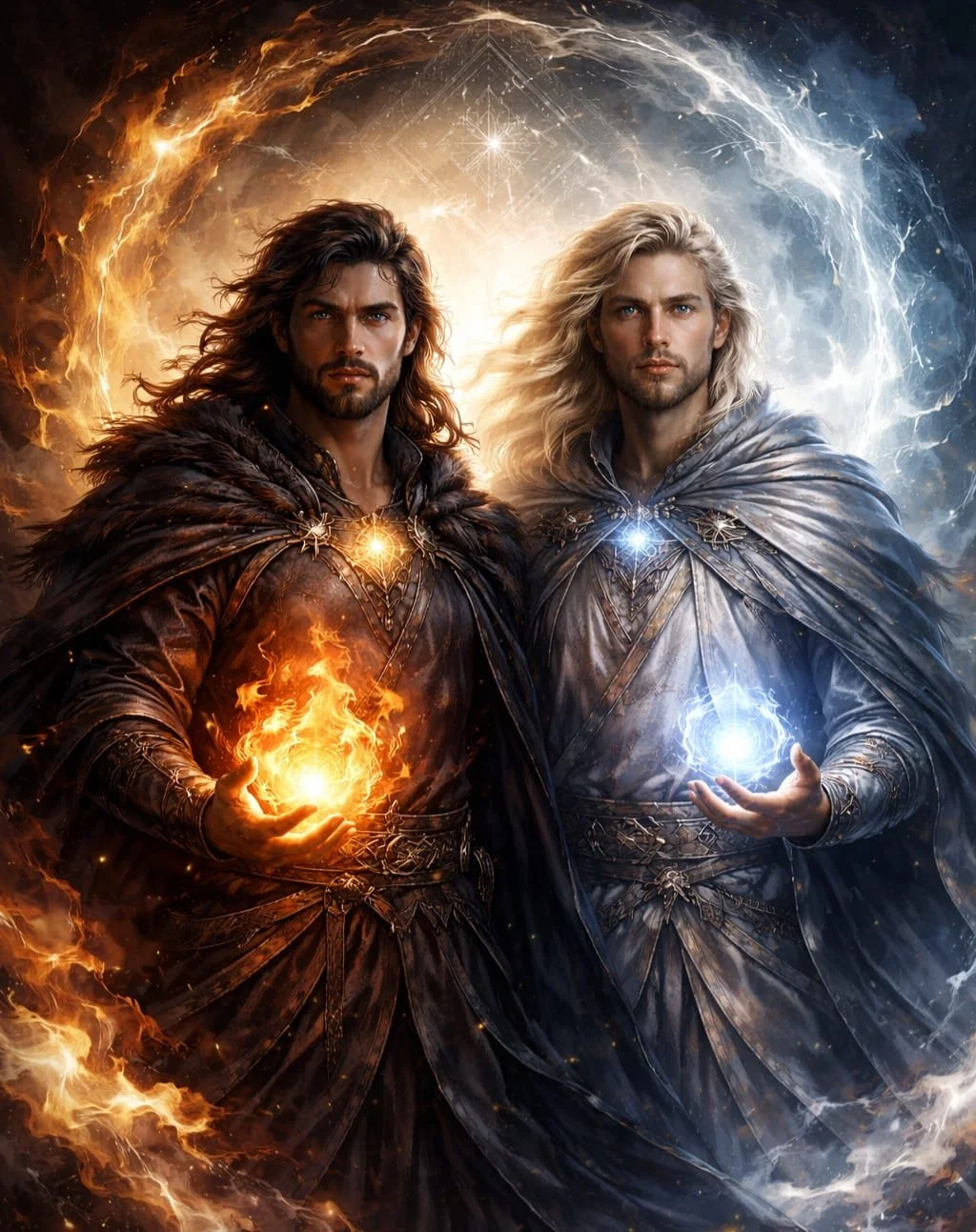
Before anything is truly created, there is a moment so subtle it is almost never noticed... the instant where possibility stops being abstract and begins leaning toward reality. It is not yet action, not yet form, but something more fundamental: the pressure behind existence that insists things do not remain as they are.
The old myths of the Aesir speak not only of gods who rule or war, but of deeper forces that make even divinity possible. Among them are Vili and Vé rarely centered, rarely praised, yet always present. They are not the ones who envision worlds, but the ones who make vision usable. Not the ones who dream reality, but the ones who convert it into something that can actually occur.
Where Odin represents awareness and foresight, Vili and Vé represent what follows the moment awareness becomes unbearable to leave untouched. Vili is the surge that turns knowing into action the inner inevitability that collapses hesitation. Vé is the shaping force that ensures what is done does not dissolve back into chaos, but becomes defined, structured, and real.
Together, they occupy the threshold between thought and existence. They are the unseen transition between “I understand” and “it is done.” Without them, intention would remain weightless infinite in imagination, but incapable of ever touching the world.
These are not gods of spectacle or command. They are the quiet mechanics of becoming itself - the forces that ensure that what is sensed, chosen, or understood does not remain internal, but crosses the final boundary into reality.
The Essence of Vili: Will as the First Fire
Vili is will - not fleeting desire, but the deep, immovable force that says this must be. He is the ignition point of action, the moment where possibility ceases to be abstract and becomes inevitable. Where others hesitate, Vili moves. Where thought lingers, he commits. His will is not reckless, but elemental.
Myths describe him as intense yet silent, his presence felt not in words but in momentum. When he enters a space, decisions accelerate, doubt narrows, and paths clarify not because they are easier, but because they are chosen. He does not debate, he resolves.
To encounter Vili is to feel hesitation collapse, not through pressure, but through recognition - the understanding that the moment for uncertainty has already passed. He teaches that will is not something one finds, but something one accepts, already present and waiting to be acted upon.
In some lesser-known interpretations, Vili is described as the force behind courage... not bravery in battle, but the quieter courage required to act when there is no certainty of outcome. He is the tension just before a leap, the inner voice that does not argue, but insists.
Vili: The Anatomy of Irreversible Motion
Vili is not a single moment of decision, but a spectrum of force that changes as certainty deepens. At first, he appears as a whisper an internal narrowing, where many possibilities begin to feel unnecessary rather than unavailable. This is the earliest form of will: not command, but subtraction. He removes excess until only one direction remains emotionally plausible.
As he strengthens, Vili ceases to feel like thought and becomes momentum. In this stage, action does not feel chosen so much as already begun. The mind may still observe hesitation, but the body and intention no longer wait for permission. This is why Vili is often mistaken for impulsivity, though he is closer to inevitability than reaction.
At his most complete, Vili does not push forward he eliminates the concept of “staying.” The individual is no longer deciding to act; they are simply no longer the version of themselves that could remain still. In this state, will becomes identity compression: all alternatives collapse into a single lived trajectory.
Yet Vili is not blind force. He refines as much as he drives. When aligned, his motion is precise, economical, and strangely calm. There is no noise in true will only direction that no longer argues with itself.
The Shadow of Vili: When Will Becomes Tyranny
Vili’s force is not inherently benevolent. The same certainty that drives creation can also erase doubt too completely. There are moments when will does not clarify, but consumes when the sense of this must be overrides all reflection. In such moments, Vili becomes dangerous, and action continues without meaning. Unchecked will does not create; it imposes. In mythic terms, this is the difference between creation and conquest. The act may appear the same, but without balance, it ceases to participate in becoming and instead becomes domination. Vili teaches not only the necessity of action, but the responsibility of it, for will, once accepted, rarely asks permission again.
The Essence of Vé: Form as Sacred Boundary
If Vili is motion, Vé is meaning. Vé governs form, structure, and the invisible boundaries that define reality. He is the force that determines where something becomes itself.
After Ymir fell, it was Vé who shaped the body into world - flesh into earth, blood into sea, bone into mountain. Yet his work was not merely physical. He gave distinction. He separated sky from ground, inner from outer, sacred from profane.
Where Vili pushes forward, Vé gives direction. He is the architect of identity, ensuring that action does not dissolve into chaos but becomes something coherent and real. Vé teaches that form is not limitation but revelation. To define something is not to restrict it, but to allow it to exist fully.
Vé is also associated with sanctity - his name is linked to sacred enclosures and holy places in Old Norse tradition, suggesting that anything defined with intention becomes set apart from the ordinary. In this sense, Vé does not merely shape the world - he determines what is meaningful within it.
The Shadow of Vé: When Form Becomes Prison
Where Vili risks excess through motion, Vé risks excess through stillness. Form, once defined, can harden, and boundaries that once gave meaning can become walls that restrict growth. Identity can become confinement, and structure can outlive its purpose. In this state, Vé no longer reveals, but limits. A system too rigid cannot adapt, and a definition too fixed cannot evolve. What was once sacred becomes stagnant. Thus, Vé teaches not only the power of form, but the necessity of release. To redefine is not to destroy meaning, but to allow it to continue living.
Creation: The Act That Required Three
The act of creation itself reveals their necessity. Though often attributed to Odin alone, deeper traditions speak of a triad: vision, will, and form.
Odin envisioned what could be, Vili willed it into motion, and Vé shaped it into existence. Without Vili, there is no action. Without Vé, there is no outcome. Creation, therefore, is not a singular act but a convergence of forces.
Every meaningful transformation, divine or mortal, follows this same pattern - an idea, a decision, and a structure that makes it real.
This triadic pattern appears repeatedly in myth and philosophy - the concept that reality emerges only when thought, intention, and manifestation align. Vili and Vé represent the often-unseen middle and final steps, without which creation never completes itself.
The Forgotten Third Act: Destruction as Completion
Creation is often spoken of as a beginning, but within the triad of Odin, Vili, and Vé there is an implied final movement: dissolution. What Vili sets in motion and Vé defines must, eventually, end. Even the world formed from Ymir is destined to fall, not as failure, but as continuation, for new will cannot emerge within forms that never yield. Destruction, then, is not separate from their influence, but the final expression of it. To end something fully is an act of Vili, and to allow its form to dissolve is an act of Vé.
Vili and Desire: The Unavoidable Pull
Vili is often mistaken for desire, but he represents something far more absolute. Desire wavers; Vili does not.
He embodies the moment when desire becomes necessity, when something is no longer merely wanted but must occur. His presence strips away the illusion of endless choice, narrowing possibility until only one path retains meaning.
This is not coercion, but clarity. Vili teaches that true will is not about having many options, but about recognizing the one that cannot be ignored.
In this way, Vili can feel both empowering and unsettling because he removes the comfort of indecision. To feel his presence is to realize that delay is no longer honest, and that inaction has already become a choice.
Vé and Sacred Space: The Power of Definition
Vé’s influence is seen in sacred spaces, boundaries, and identities, anywhere something is set apart and recognized as meaningful.
A place becomes sacred not through decoration, but through the act of defining it as such. Vé draws the unseen line that transforms the ordinary into the significant. In his domain, promises become binding, boundaries become real, and identities take shape.
He teaches that what we define shapes us in return, and that meaning arises through form.
This extends beyond physical space into language and identity every name given, every role accepted, every boundary drawn is an act of Vé. Without definition, experience dissolves; with it, reality becomes navigable and real.
Vili & Vé in Language: Speaking Reality Into Being
Language itself is one of their clearest manifestations. The decision to speak, to express a thought, is Vili, while the structure of language, the words chosen and the form that shapes them, is Vé. Without will, nothing is said, and without form, nothing is understood. Every sentence becomes a small act of creation, and every declaration a boundary drawn in reality. This is why words can transform, bind, or break, for they are not passive, but acts of becoming.
The Gift of Humanity: Breath, Will, and Form
Their combined role is most clearly seen in the creation of humanity. When Ask and Embla were found lifeless upon the shore, it was not Odin alone who gave them life.
Odin granted breath and spirit, Vili gave will and emotion, and Vé bestowed form, speech, and identity. Without Vili, humanity would lack drive; without Vé, it would lack selfhood.
Every human being carries them still - the urge to act and the need to define that action into something meaningful.
Some traditions suggest that this division reflects the full structure of consciousness itself: awareness (Odin), motivation (Vili), and expression (Vé). Together, they form not just life, but lived experience.
The First Choice: Ask and Embla Awaken
When Ask and Embla first opened their eyes, they did not rise immediately.
They breathed, as given by Odin, and felt the stir of will placed within them by Vili, yet they remained still. For though they lived, they did not yet know how to act.
It was only when Vé gave them form of thought and speech that the world became something they could enter. They named what they saw, and in naming, chose.
Their first step was not driven by instinct, but by alignment the moment where breath, will, and form became one.
Thus, humanity did not begin with movement, but with decision.
Vili & Vé in Balance: Movement and Meaning
Vili and Vé exist in constant balance. Vili without Vé becomes chaotic motion, action without direction or consequence. Vé without Vili becomes static perfection, form without life or change.
Together, they create living reality. Their interplay is present in every decision - the impulse to act and the shaping of that action into something real. Where one dominates, imbalance follows.
Too much will leads to destruction. Too much structure leads to stagnation. Their harmony sustains creation.
This balance can be seen in all systems from personal growth to civilizations where unchecked ambition collapses without structure, and rigid systems decay without renewal.
The Builders and the Boundaries
Among the works of the gods, there is a lesser-spoken pattern: every great construction requires both brothers.
When the walls of Asgard were raised, it was not strength alone that brought them into being. The will to complete the impossible drove the work forward, but it was definition that made the walls hold.
Without Vili, the work would never have begun. Without Vé, it would never have endured. Even the gods rely on this balance, though they rarely name it.
The Modern World: A Crisis of Will and Form
In the modern age, imbalance between Vili and Vé is everywhere. There is endless intention without action, ideas that never leave the mind, and endless structure without meaning, systems maintained long after their purpose is forgotten. People hesitate where Vili is needed, and conform where Vé has overreached. The result is a world filled with motion that leads nowhere, and stability that suffocates change. To restore balance is not to reject one for the other, but to reunite them to act with clarity, and to define with purpose.
Among the Aesir: The Unseen Influence
Among the Aesir, Vili and Vé are rarely central figures, yet their influence permeates everything. They do not command storms or rule great halls, but shape outcomes beneath the surface.
Some traditions suggest they faded from prominence after the world was formed, not because they disappeared, but because they became embedded within reality itself. Every act of will and every moment of definition reflects their presence.
They no longer need to stand apart as gods, for they exist within the fabric of existence.
In some interpretations, their absence from later myths is intentional...a reflection that the forces they represent have become so fundamental that they no longer appear as separate beings.
A Quiet Exchange: Vili, Vé, and Odin
There are no loud tales of conflict between Odin and his brothers, yet their relationship is written in absence as much as presence.
Where Odin seeks endlessly knowledge, runes, sacrifice Vili and Vé do not follow. It is said in some interpretations that when Odin hung upon Yggdrasil, neither brother intervened.
Not out of indifference, but because the act had already passed into necessity. Odin had chosen. Vili had already moved within him. Vé had already shaped the outcome.
There was nothing left to give. Their silence, then, is not distance, but completion.
The Silence of the Brothers
Their silence in myth is not absence, but integration. Unlike other gods who remain external, Vili and Vé become internal forces.
Where Vor for example reveals truth, they ensure that truth leads to action and manifestation. They are the continuation of awareness into reality, the bridge between knowing and becoming.
They do not speak because their language is action and form... every decision made and every boundary drawn becomes their expression.
Philosophy of Becoming: Will and Form
They embody a fundamental principle: nothing becomes real without both intention and structure.
To want something is not enough, and to define something without action is meaningless. Only when will and form unite does transformation occur.
This reflects a deeper cycle - recognition, will, and manifestation - each dependent on the others. Without any one of these, the process remains incomplete.
This philosophy suggests that stagnation is not caused by lack of desire, but by the absence of either commitment or structure. Vili and Vé reveal exactly where transformation fails and where it must be completed.
The Man Who Refused to Act
There is another telling, less kind than the one of the crossroads.
A man once knew exactly what he must do. The path was clear, the cost understood, the outcome inevitable. Yet he delayed, convincing himself that more time would bring certainty.
Vili came to him many times, not as force, but as quiet insistence. Each time, he turned away.
In time, Vé followed but not to shape action. Instead, he shaped absence. The man’s inaction became its own form: a life defined by what was never done.
In the end, nothing collapsed, nothing was lost except the life that might have been.
For even refusal becomes structure.
Vili & Vé and the Human Condition
In human life, Vili appears as the moment hesitation ends, when action becomes inevitable. Vé appears as the moment that action is defined, given meaning, and shaped into reality.
Together, they mark every turning point: the choice to begin, the decision to end, the commitment that cannot be undone. They are not loud forces, but their presence is unmistakable when something shifts from idea into reality.
These moments often feel irreversible not because they cannot be undone, but because the person who made them has already changed.
The Personal Invocation: Working With Vili and Vé
To invoke Vili is not a matter of ritual, but of decision. It is the moment one stops negotiating with oneself, the moment delay is no longer honest. To invoke Vé is to follow that decision with structure, to set the boundary, name the path, and give form to what would otherwise remain abstract. Together, they are practiced rather than worshipped: one decides fully, defines clearly, and follows through until action becomes reality. This is their true ritual, the act of becoming carried out consciously.
A Quiet Myth: The Unfinished Path
There is a tale of a man who stood at a crossroads for years, unable to choose his path. He understood every consequence and saw every possibility, yet remained frozen.
One night, Vili passed through him as sudden certainty, and he stepped forward without knowing why. Then Vé followed, and the path beneath him solidified, no longer one among many, but his alone.
The man never looked back, not because the path was perfect, but because it was real.
I personally interprete this story as a reflection of human hesitation that clarity does not always come before action, but sometimes through it.
The Threshold Moment: Where They Meet
There exists a moment between thought and action where both Vili and Vé are present. It is the threshold, where the will to act arises but has not yet moved, and the form of what will be exists but has not yet solidified. Most people remain in this space longer than they realize. It is the space of hesitation, but also of potential. To cross it is to allow Vili to take hold, while to remain is to resist both forces at once.
Symbolism: The Engine of Reality
Together, Vili and Vé represent the engine of existence itself - the propulsion of will and the structure of form.
Every act of creation reflects them, from the shaping of worlds to the forming of a single sentence. Even speech requires both: the will to express and the structure of language.
Without both, nothing emerges.
Even time itself can be seen through their lens movement forward (Vili) shaped into measurable sequence (Vé).
A Whispered Moment: The Unseen Intervention
Not all of their influence is vast or world-shaping. There are quieter moments unnoticed, but absolute. A hand hesitates before writing a final message, then moves.
A person stands at the edge of change, then steps forward. A boundary is drawn where none existed before.
These are not coincidences. They are the smallest expressions of Vili and Vé so subtle they are mistaken for thought, yet so decisive they alter entire lives.
Their Absence at Ragnarok
When Ragnarok comes, many gods fall, and many forces clash openly. Yet Vili and Vé are not counted among the slain, nor among the survivors. Some say they were never meant to stand in that battle.
For what they represent cannot end in destruction, nor rise in rebirth - they are present in both. Every final act of will, every collapse of form, every shaping of what comes after carries them forward.
They do not need to return, because they never leave.
The Living Legacy
They do not demand worship, but participation. Every time a person acts with intention and shapes that action into something real, they invoke Vili and Vé.
They are not distant or unreachable, but present in every meaningful decision.
Their legacy is not found in temples, but in actions completed and identities formed.
Closing Reflection: The Moment After Knowing
If Vor is the moment of truth, Vili is the decision that follows, and Vé is the reality that results.
Together, they form the bridge between awareness and existence, transforming knowledge into action and action into form.
They ensure that truth does not remain abstract, but becomes lived reality.
The Turning Inward: Where They Find You
All of this is not distant.
Vili and Vé are not confined to the shaping of worlds or the acts of gods they are present in you, now, as you read this. Not as abstractions, but as forces already in motion.
There is something within you that already knows what must be done. Not everything, not perfectly, but enough. That quiet recognition, the one that does not argue or explain, is the presence of will. It does not need to grow stronger. It needs to be accepted.
And there is something else the awareness that if you act, you will have to define it. You will have to give it shape, commit to it, allow it to become real and therefore limited, visible, and irreversible. That is the presence of form.
This is where most remain suspended.
Not in ignorance, but between knowing and becoming. Between the pull of Vili and the boundary of Vé. It is not confusion that holds you there, but resistance to what comes after clarity.
For to act is to lose the comfort of possibility. And to define is to lose the illusion of endless change.
Yet this is also where life begins to take shape.
Every meaningful shift in your life has already followed this pattern. There was a moment where something became undeniable, and a moment where it became real. You crossed the threshold, whether consciously or not.
The question is not whether these forces exist in you.
It is whether you will allow them to meet.
Because the moment you do, something will change and once it does, it will not return to what it was before.
Not because it cannot… But because you will not.
Question For You
Ask yourself: what do you already know that you have not yet acted upon, and if you act, what will you create from it?
Will without form is fleeting. Form without will is empty. But together, they create worlds.
To hesitate is to remain between them. To act is to step fully into becoming
Wyrd and Flame 🔥
