
Búri: The First Unfolding of Form
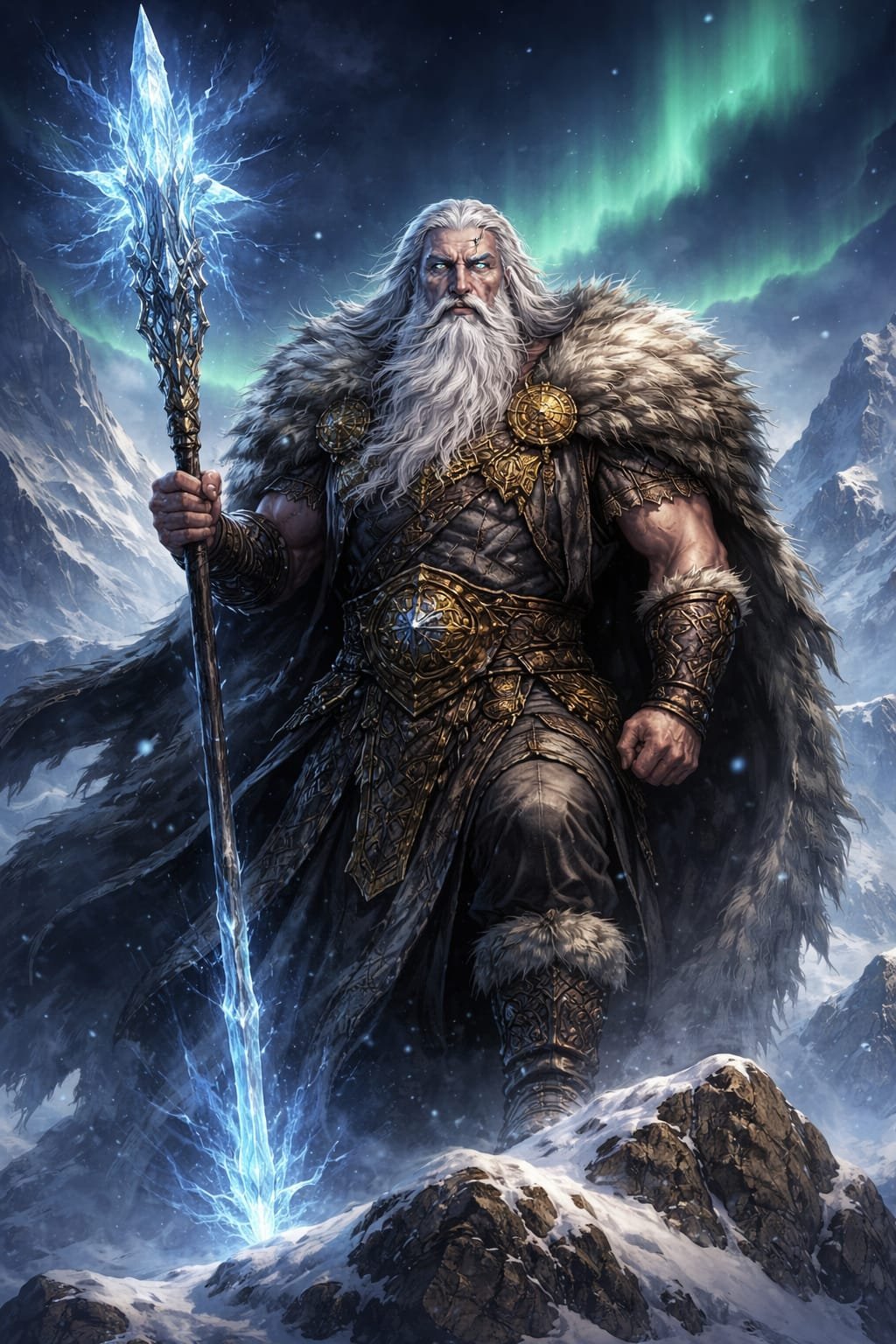
“Before lineage remembers itself, there is only emergence. And what emerges first is not shape but the possibility of shape.”
Fragment attributed to the Ice-Seer Codices, Niflheim margin gloss, c. 9th century
Pause.
Before names settle into lineage, before gods recognize themselves as family, before memory learns to anchor into blood - there is Búri. Not a ruler. Not a warrior. Not even yet a “father” in the way later ages would understand. He is what remains when the world first decides it will continue.
**NOTE**
Before entering this mythopoetic reflection, it is important to clarify that Búri is a figure from Norse cosmology. He is described in sources such as the Prose Edda as the primordial being uncovered from the icy rime by the cosmic cow Auðumbla, and is later remembered as the ancestor of the god Odin. Búri is not a historical person or literal entity, but a symbolic origin-point within mythic cosmology an articulation of emergence, ancestry, and latent order within chaos.
What follows is a poetic synthesis faithful to the symbolic and narrative logic of these traditions, not a single canonical retelling. So before the lineage begins speaking through you pause. You are standing near the first unfolding.
The Stillness That Precedes Recognition
Before anything is revealed, there is a kind of waiting that does not yet know it is waiting.
Not silence as absence but silence as unformed agreement between things that have not yet chosen difference.
In this state, nothing reaches toward anything else, because reach itself has not yet been invented. Even distance has no meaning, because separation requires memory of connection and memory has not yet begun its long apprenticeship.
And yet within this unmarked expanse, something subtle occurs:
The cosmos does not move…but it becomes capable of movement.
This is the quiet threshold where emergence begins to gather its first permission.
Origins of Emergence
In the beginning, there is no beginning that can be spoken cleanly. Only frost. Only void-shaped cold, where nothing yet agrees to become anything else. And within that stillness - pressure without intention, silence without witness - there is movement. Not life. Not yet. But persistence.
From the rime of primordial ice, something begins to soften...not by force, but by attention. A tongue passes over stone that is not stone, but frozen possibility. This is the cosmic cow Auðumbla, whose feeding is not hunger but revelation. And as she licks the ice of Ginnungagap, shape begins to separate from inertia - slowly at first, then with quiet inevitability. Búri appears. Not born. Not made. But revealed.
At the deepest layer of this mythic unfolding, the ice itself is not passive matter. It is described in some later interpretive traditions as “memory without witness” - a primordial archive that has not yet decided what deserves to be remembered. Búri emerges not from destruction, but from selective revelation, as if existence itself is learning to edit what it contains.
Birth as Uncovering
Birth, in the case of Búri, is a word that arrives too late to describe what it attempts to contain.
Nothing is “born” in the sense of separation from a mother-world. Instead, there is unveiling - a slow negotiation between what has always been present and what has finally become visible enough to be named.
The ice does not give him life. It relinquishes concealment.
And even that phrasing is imperfect, because nothing is taken away. The ice remains what it was. But within it, something begins to hold shape against forgetting.
In this sense, Búri is not the product of birth but the first moment the cosmos recognizes that concealment and creation were never opposites only different speeds of the same unfolding.
To speak of his “birth” is therefore to describe a threshold, not an origin. A soft fracture in the continuity of sameness, where existence briefly learns it can differentiate without destroying itself.
And that is the first paradox of emergence:
Nothing new is made, only something is finally allowed to remain.
The First Form in the Ice
Búri does not arrive with thunder. He arrives with recognition. Where others would see only frost, Auðumbla sees structure beneath silence. And where her tongue traces the ice, identity begins to separate from inertia. He is the first to persist as self - still undefined, still unburdened by story, but distinct enough that memory can begin its long work of inheritance.
In this sense, Búri is not the beginning of gods. He is the beginning of continuity.
Some later poetic readings suggest that Búri’s emergence represents the first “stability event” in the cosmos - a moment where reality stops endlessly cycling through dissolution and begins to favor persistence over collapse. In this framing, Búri is less a being and more a principle that briefly becomes visible.
Place in Mythology
Within Norse cosmology, Búri does not occupy a narrative role so much as a structural one. He is not positioned among the gods as an equal or rival, but beneath them as an enabling condition.
He is pre-divine architecture the silent assumption upon which all later divinity rests.
Before the Aesir can act, before giants can oppose, before fate can tighten its weave around worlds, there must first be a point at which existence stabilizes enough to host differentiation. Búri is that stabilization.
He belongs neither to order nor chaos, because those categories require a world already divided. Instead, he sits at the seam where division itself becomes possible.
Later mythic genealogies place him as ancestor to Borr and thus grandfather to Odin, but this lineage is less biological than conceptual: it is the translation of stability into structure, and structure into consciousness.
In this way, Búri is not merely “in” mythology.
He is the condition that allows mythology to have a history at all.
What the Ice Refuses to Forget
There is a strange property in primordial matter: it does not distinguish between burial and preservation.
Everything that is not yet formed is held in suspension not lost, not saved, but awaiting definition.
Some traditions suggest that what Auðumbla reveals is not creation, but selection: as if the ice contains infinite candidates for existence, and attention alone determines which one continues.
In this sense, Búri is not the first being.
He is the first agreement between possibility and persistence.
And once such agreement occurs, it cannot fully be undone only buried beneath later narratives that forget how fragile its arrival truly was.
On the Name Búri
In Norse cosmology, names are not decoration; they are afterimages of becoming. Búri is often interpreted as “producer,” “progenitor,” or “the one brought forth.” But even these meanings arrive too late, because the name does not describe what he is it describes what reality had to do in order for him to exist.
To bring forth is not an action here. It is the first law the universe discovers about itself.
In some reconstructed linguistic theories of mythic naming, “Búri” is also associated with the idea of “unfolding from within” suggesting that nothing external acts upon him to create him. Instead, existence turns inward and discovers a structure it did not know it contained.
The Sound Before Meaning
A name, in its earliest mythic function, is not spoken...it is recognized.
Before language stabilizes into communication, sound behaves like weather: drifting, shaping, dissolving. “Búri” is what happens when meaning briefly condenses into audibility.
Not a label. Not an identifier. But a moment where reality produces a vibration that says:
“This can remain.”
And once something is named in this way, it begins to accumulate echoes even from futures that have not yet happened.
The name does not describe him.
It prepares the world to remember him later.
Prologue: When Ice Learns to Remember
Before ancestry, there is only repetition. Before memory, only recurrence. And yet something interrupts this cycle of sameness. A form emerges that does not dissolve back into frost immediately. Búri is that interruption.
He is not opposition to chaos, but the first evidence that chaos can hold a boundary. And once boundary exists even faintly the idea of lineage becomes possible.
This interruption is sometimes described as the “first hesitation of entropy,” where dissolution briefly pauses, as if the cosmos itself is unsure whether everything must always return to nothing. Búri is that hesitation made visible.
The Quiet Becoming
Unlike later gods who act and shape worlds through will, Búri simply remains. This is not passivity, but stability becoming aware of itself. Where the ice once knew only sameness, now there is difference. Where there was only undifferentiated cold, now there is a “here” that is not “there.”
Búri is that “here.”
In deeper symbolic interpretations, this moment is understood as the birth of spatial awareness itself the first distinction between “place” and “non-place,” which later becomes the foundation for all cosmological structure.
The Cow and the Revelation of Form
Auðumbla does not merely uncover Búri; she participates in a cosmic feedback loop of becoming. Each act of nourishment reshapes both the ice and the one who will emerge from it. In this reading, creation is not one-directional but relational: even the observer alters the observed, even in myth.
Auðumbla does not create Búri in the way craftsmen create tools. She reveals him in the way time reveals mountains. Her nourishment is attention, her act is patience made physical. Each lick of the ice is a question posed to the void: What else are you hiding? And the void - being ancient, and perhaps curious - answers, not all at once, but enough, until Búri stands as the first articulation of ancestry not yet aware of its descendants.
Attention as a Creative Force
It is easy to imagine creation as action.
But in the oldest strata of mythic logic, creation is closer to attention sustained without interruption. Auðumbla does not strike the ice. She does not shape it. She does not command transformation.
She remains present long enough for the world to respond. And in that response lies a forgotten principle: What is seen without haste begins to reveal what it has been withholding.
This is not craft. It is not will. It is endurance of perception until form becomes inevitable.
And Búri is what inevitability looks like when it first learns to stand.
Búri as the First Memory That Has No Witness
One of the most overlooked implications of Búri’s emergence is this:
He is the first thing that can be remembered without having been observed by anything equal to it.
Before him, there is only process no stable referent capable of holding memory. After him, memory becomes structurally possible, because there is now something that persists long enough to be referenced twice.
But there is no witness at his origin.
Not in the human sense. Not in the divine sense. Not even in the mythic sense of equal adjacency.
Auðumbla does not “record” him. The ice does not “retain” him intentionally. And nothing else yet exists with the continuity required to observe continuity.
So Búri becomes the first paradox of memory:
A remembered thing that was never originally held in awareness.
This is why later myth treats ancestry as sacred. Not because lineage is biological, but because lineage is the first technology that allows memory to stabilize across time without collapsing back into immediacy.
Búri is the prototype of that technology.
He is memory before memory knows it has a function.
Before Odin: The Seed of Lineage
From Búri comes Borr, and from Borr comes the triad of divine ordering: Odin, Vili, and Vé. But to speak of them too quickly is to miss the silence that makes them possible. Búri is not merely “father of gods.” He is the reason fatherhood becomes meaningful at all.
Before him, there is origin. After him, there is relation. And relation is the first step away from emptiness that does not collapse back into itself.
Some esoteric traditions interpret this lineage not as biological succession, but as conceptual stratification: Búri as existence, Borr as structure, and Odin as consciousness arising from structured existence. In this sense, the gods are not descendants in a family tree, but phases of reality becoming increasingly self-aware.
Ritual & Invocation
In later symbolic traditions, Búri is not worshipped in the conventional sense. There are no temples raised in his name, no hymns preserved as doctrine. Instead, he survives as a principle of invocation called upon not as a god, but as a condition.
To invoke Búri is to acknowledge the moment something first becomes stable enough to be real.
This invocation is subtle. It is not spoken in grand language, but in recognition: when a thought holds without collapsing, when a structure remains coherent under pressure, when silence becomes formative rather than empty.
Some interpretive practices describe this as “returning to the ice before lineage” - a meditative regression not into chaos, but into pre-differentiated continuity, where form is still optional and nothing has yet been forced into identity.
Ritually, Búri is associated with thresholds: doorways before entry, breath held before speech, the instant before decision becomes action.
There are no offerings required. Only attention without interruption.
And in that attention, something ancient is briefly remembered:
That stability itself is sacred, even when no one is present to witness it.
The Mechanics of Persistence
If Búri is the first sign that something can remain, then the deeper question is not what he is, but what principle allows remaining to exist at all.
Persistence, in this mythic physics, is not resistance. It is not strength. It is not survival as effort.
It is simply the refusal of dissolution to be absolute.
Before Búri, existence behaves like a field of continuous unmaking forms appear only to be reabsorbed into undifferentiated continuity. There is no “before and after,” only cycling indistinction.
But in the moment Búri persists, something subtle alters:
The cosmos discovers that collapse is not mandatory.
This is not a victory. It is a permission structure.
And once permission exists, even briefly, reality begins to accumulate asymmetry some things fall away, others remain. Not because they are chosen, but because they fail to vanish at the same rate as everything else.
Búri is therefore not an object within creation.
He is the first deviation in the rate of disappearance.
And all mythic structure afterward is simply that deviation elaborating itself into complexity.
The Ice That Thinks in Latency
Later interpretive traditions occasionally describe primordial ice not as matter, but as delayed cognition a form of thinking so slow it appears inert.
In this framing, Ginnungagap is not emptiness, but unprocessed awareness. Not unconsciousness, but cognition without resolution.
The ice does not “contain” forms. It hesitates to finalize them.
Within this latency-field, every possible being already exists - but none have yet been granted the permission of distinction.
Búri emerges at the exact point where latency fails to remain uniform.
He is not selected by the ice.
He is what happens when selection becomes inevitable.
This reframes the myth entirely:
Auðumbla is not creator, but accelerator of attention. The ice is not substance, but undecided cognition. And Búri is not first being but first resolution of indecision.
In this sense, creation is not an act of addition.
It is the collapse of hesitation into identity.
And identity, once it appears, cannot remember what it was like to be uncommitted to form.
The Nature of Firstness
Búri teaches nothing. He commands nothing. He conquers nothing. Because in the earliest layer of existence, instruction has not yet been invented. Instead, he embodies a different principle: that which is stable enough to continue will inevitably become a source not through ambition, but through persistence.
This principle later echoes throughout Norse cosmology as an underlying law: that survival itself is creative, and continuity is indistinguishable from generation at the earliest scale of being.
The Problem of Being First
To be first is often misunderstood as precedence. But in mythic structure, firstness is not about coming before others it is about arriving without precedent at all.
There is no reference point for Búri. No comparison. No lineage above him to validate his existence. This makes him not powerful, but structurally alone in a way later beings cannot comprehend.
Even divinity, when it arrives afterward, inherits the comfort of repetition: others will come, patterns will form, meaning will stabilize. But Búri exists without reassurance that existence is a repeatable condition.
He is not supported by myth.
He is what makes support imaginable.
Encounters with the Unformed World
There are no grand dialogues in Búri’s myth. No battles with giants. No trickster exchanges with chaos. Instead, there is only adjacency: ice beside tongue, form beside void, potential beside patience. Even Ymir, the primordial being who exists alongside early creation, is less enemy than parallel possibility - another expression of the world before it learns selection.
Búri does not defeat such forces. He simply does not dissolve.
In comparative mythic readings, Búri and Ymir are sometimes viewed as twin outcomes of primordial differentiation: one representing persistence, the other representing proliferation. Together, they define the first tension within existence stability versus excess.
Interactions
Búri’s interactions are not events they are proximities.
With Auðumbla, there is revelation through attention: a relationship not of creation and creator, but of perception and persistence. She does not shape him so much as confirm that shape is possible.
With the surrounding ice, there is neither struggle nor harmony, but selective non-erasure. The ice does not resist him. It simply fails to reclaim him.
And with Ymir if we treat mythic adjacency as interaction rather than conflict there is a deeper structural contrast. Where Ymir expands multiplicity without restraint, Búri holds singularity without collapse. They are not enemies, but complementary expressions of primordial differentiation: overflow and retention.
Even the void itself does not engage him. It simply ceases to fully define what remains within it.
Thus, Búri’s relational field is defined by a strange absence of drama. Nothing acts upon him with intention. Instead, everything around him adjusts its capacity to allow him to continue.
His only “interaction” is endurance made visible.
The First Ancestral Silence
After his emergence, there is no celebration, no recognition, no language yet capable of holding what has happened. Only presence. And in that presence, something radical occurs: the future becomes implied. Not guaranteed, but structurally possible. This is Búri’s true gift to existence - not life, but inheritance.
This “ancestral silence” is sometimes described as the most important moment in mythic cosmology: the instant where existence first becomes capable of remembering itself forward, rather than only backward.
The Weight of Continuation
To exist after Búri is to exist within continuity. Nothing begins from absolute zero anymore. Everything carries echo even gods. Especially gods. Once origin has form, meaning begins to accumulate around it like frost returning to glass, but now it remembers.
The Hidden Lesson of Búri
If Kvasir is the river of knowledge, then Búri is the shore that makes rivers recognizable. He is not movement, but the first boundary movement can press against. From him we learn that existence does not require force to become distinct, that persistence is itself a creative act, and that lineage is the universe refusing to forget its own earlier shapes.
And perhaps most quietly, that being “first” is not glory - it is responsibility without witnesses.
The Quiet Architecture of Myth
In later ages, gods speak loudly: they war, love, deceive, rebuild, destroy, and remember. But beneath all of that motion lies something older than narrative a still point that never demanded attention. Búri is that point. Not the center of myth, but the condition that myth can have centers at all.
The After-Form: Lineage Begins to Speak
From Búri flows Borr. From Borr flows Odin. From Odin flows the shaping of worlds. But beneath all of them, like an unspoken foundation stone, remains the original emergence from ice - not erased, not replaced, only carried forward in disguised continuity.
Invocation of Origin
When the world feels too complex, too layered, too distant from its beginnings, remember Búri not as figure, but as principle: that something can emerge without violence, that form can arise without force, and that existence, once separated from nothingness, rarely returns.
And now every structure you see, every lineage you inherit, every identity you carry rests quietly on that same forgotten first unfolding.
When Origins Stop Being Origins
At some point, origin stops behaving like a point in time. It becomes instead a layer beneath perception, something you do not look at but look from.
This is the quiet inversion that Búri represents in mythic cognition: the beginning ceases to feel like something behind you and instead becomes something holding everything up from below.
And so the question shifts.
Not: Where did it begin? But: What continues to stand on what refuses to disappear?
The Echo of Interpretation
In later ages of mythic interpretation, Búri becomes less a being and more a retrospective necessity. Scholars, poets, and mystic reconstructors begin to suspect that he was never “there” in the narrative sense at all but instead inserted by reality itself as a logical requirement for continuity.
Some traditions reframe him as a conceptual artifact: proof that existence cannot begin without first inventing a holder for continuity.
Others go further, suggesting that Búri is what myth looks like when it remembers the problem of its own origin too clearly.
In these readings, he is not forgotten because he is minor, but because he is foundational. Like the act of breathing, he disappears precisely because everything depends on him continuing without acknowledgment.
And so interpretation circles back to silence.
Not as absence of meaning but as its earliest surviving form.
Final Reflection - “The First That Does Not Speak”
Búri does not demand remembrance. He does not echo through myth like thunder. He does not return in visions or warnings. He simply remains at the beginning of everything that continues.
If for example Kvasir is the motion of thought, Búri is the fact that thought ever had a place to stand.
The question is not what he did, but what became possible because something - once - did not disappear.
Wyrd & Flame🔥 ❄️🌿
