
Norse Marriage: History, Rituals, and Sources
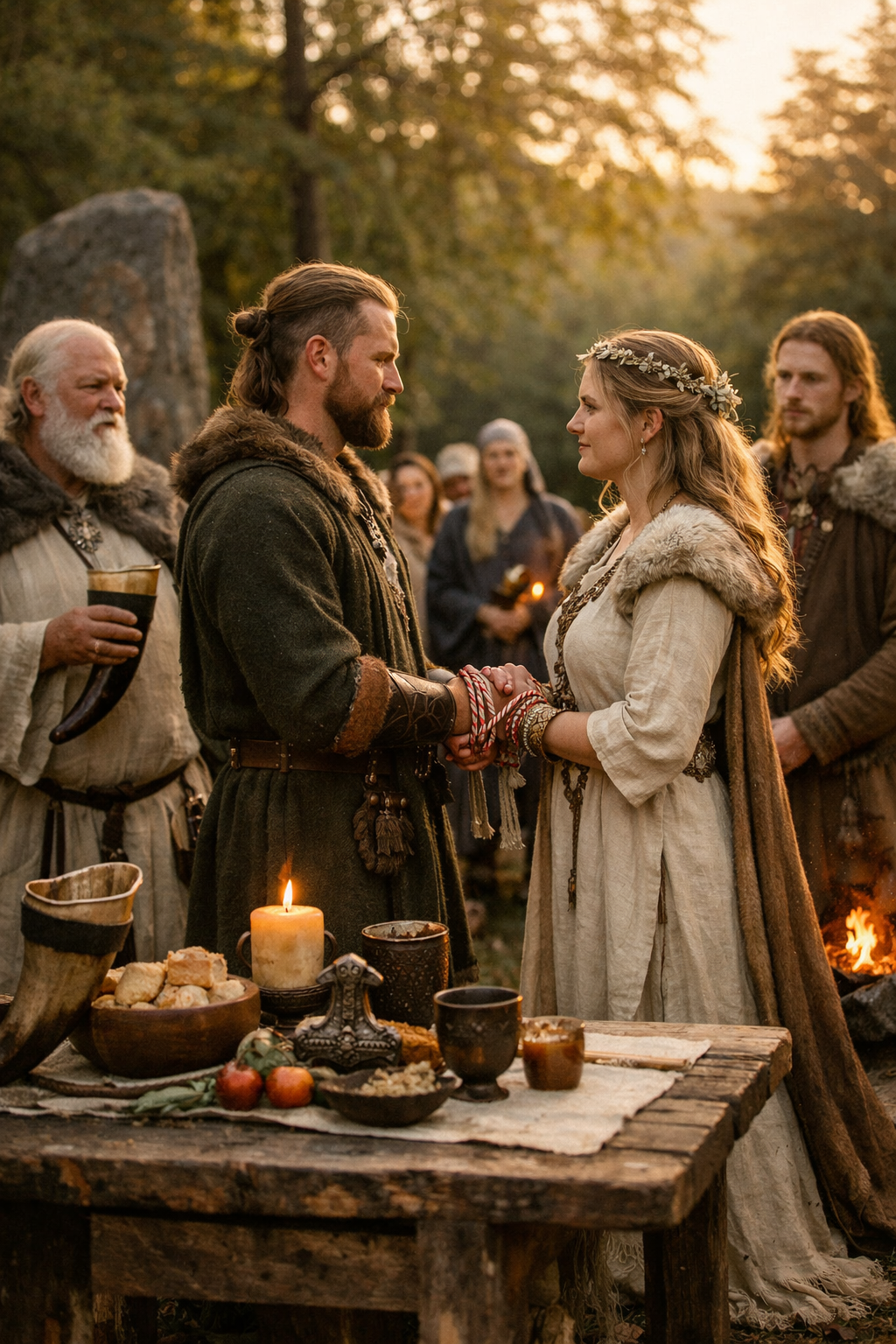
Marriage in the Norse world was not simply about two people choosing to live together. It was a formal agreement that joined families, property and obligations. Through marriage, households formed alliances, secured inheritance, and strengthened the stability of their community.
In the Viking Age, marriages were usually arranged through discussion between families. These negotiations set out the terms of the union, including payments, property, and responsibilities. Once agreed, the marriage was recognised publicly through witnesses and feasting.
Saga literature and medieval Scandinavian law codes show that marriage was treated as a serious legal matter. Agreements were recorded, property rights were defined, and both families became tied together through the union. While affection could grow between husband and wife, the primary purpose of marriage was the continuation of family lines and the maintenance of social order.
Marriage as a Foundation of Norse Society
In the Norse world, family was the centre of social life. A person’s identity, protection, and reputation were closely tied to their kin. Because of this, marriage was not simply a personal relationship. It was a way of linking families together and strengthening the structure of society.
When two people married, their households became connected through obligation and cooperation. These connections could influence trade, land ownership, inheritance, and even the settling of disputes. Marriage therefore helped maintain stability between families and communities.
For this reason, marriages were usually arranged with careful thought. Families considered reputation, wealth, alliances, and future security. A good marriage could strengthen a family’s position, while a poorly chosen one could create tension or conflict.
Through these unions, the Norse world maintained networks of kinship that shaped everyday life, from household management to wider political relationships between families and regions.
Kinship, Honour, and the Maintenance of Frith
Kinship formed the backbone of Norse society. A person was rarely seen as an individual standing alone. Instead, they were part of a wider network of family, relatives, and allies. The actions of one member of a family could affect the reputation and standing of the entire kin group.
Because of this, honour was deeply connected to family relationships. Marriage helped strengthen these ties by creating bonds between households. When two families were joined through marriage, they gained new responsibilities towards one another. These relationships could provide support in times of need, strengthen alliances, and reduce the chances of conflict between kin groups.
Marriage also played a role in maintaining frith, the social peace that allowed communities to function. By linking families together through shared obligations and mutual respect, marriages helped create stability within society.
The Marriage Proposal (Bónorð)
The first step in forming a marriage was the proposal, known in Old Norse as bónorð. This was not usually a private request between two individuals. Instead, it was a formal approach made to the bride’s family, normally through her father or closest male guardian.
The groom, or members of his family, would visit the bride’s household to ask for her hand in marriage. These discussions were taken seriously and often involved careful negotiation between both families. The purpose was to decide whether the match was suitable and to agree on the terms of the union.
Several factors were considered during this stage. Families looked at reputation, wealth, alliances, and the potential benefits the marriage could bring to both households. A marriage could strengthen social ties, settle disputes, or create new partnerships between families.
Saga literature shows that these proposals were often direct and practical. The focus was not on romantic expression but on responsibility, agreement, and the long-term stability of the families involved. Once the proposal was accepted, negotiations would move on to the legal and financial arrangements that would form the foundation of the marriage.
Family Negotiations and the Role of Guardians
Once a proposal was accepted, discussions between the families continued. These negotiations were an important part of the marriage process and helped establish the terms that both households would agree to.
In most cases, the bride was represented by her father or closest male guardian. This person had the responsibility of protecting her interests and ensuring that the agreement was fair. The groom and his family would discuss the practical details of the union with him, including payments, property, and expectations within the marriage.
These discussions were not rushed. Marriage created long-term obligations between families, so it was important that both sides were satisfied with the arrangement. Agreements often covered matters such as the bride price, the property the bride would bring with her, and how inheritance would be handled in the future.
Saga accounts show that these negotiations could sometimes be complex. Families might consider reputation, wealth, and alliances before giving their approval. In some cases, a proposed marriage could even help resolve tensions between families by creating a bond that encouraged cooperation rather than conflict.
Through these negotiations, the marriage was shaped not just as a personal relationship, but as a formal agreement that connected two households.
Bride Price (Mundr) and the Meaning of Commitment
One of the central parts of a Norse marriage agreement was the mundr, often called the bride price. This was a payment made by the groom to the bride’s family when the marriage was arranged.
The mundr was not simply a purchase of the bride. Instead, it acted as a formal sign that the groom was taking on responsibility for the marriage. By making this payment, he demonstrated that he was able to support a household and honour the agreement being made between the families.
The size of the mundr could vary depending on the status and wealth of the families involved. It was usually paid in silver, valuables, or property. The payment also helped confirm that the marriage had been properly negotiated and recognised by both sides.
Norse law codes show that the mundr formed an important part of the legal structure of marriage. Without it, the union could be considered incomplete or lacking full legal recognition. The mundr helped establish the seriousness of the agreement and the obligations that came with it.
Dowry (Heimanfylgja) and the Bride’s Property
Alongside the bride price, another important part of the marriage agreement was the heimanfylgja, often described as the dowry. This was property that the bride brought with her from her family when she entered the marriage.
The dowry could include items such as livestock, land, clothing, household goods, or silver. These possessions helped establish the new household and contributed to its stability. In many cases, the dowry represented the bride’s share of her family’s wealth.
Although the husband would usually manage the property within the household, the dowry was still closely connected to the bride. Norse law recognised that certain property remained tied to her rights within the marriage.
This arrangement helped provide a degree of security. If the marriage ended through divorce or widowhood, the dowry could play a role in ensuring that the woman retained access to property and support.
Through the combination of mundr and heimanfylgja, Norse marriage agreements balanced the responsibilities and contributions of both families, forming the economic foundation of the union.
Festarmál: The Legal Binding of the Marriage
After the negotiations and agreements were settled, the marriage moved into the stage known as festarmál, the formal betrothal. This was the moment when the arrangement became legally recognised.
Festarmál was more than a promise of future marriage. It was a binding agreement between the families that confirmed the terms they had negotiated. Once this stage was completed, the marriage was expected to go ahead according to the conditions that had been set.
The agreement usually took place in the presence of witnesses. Their role was to confirm that the terms had been openly accepted and that both sides understood the obligations involved. Witnesses were important because they could later testify if any dispute arose.
At this stage, the payments, property arrangements, and responsibilities of the marriage were clearly established. The bride price would be confirmed, and the dowry that the bride would bring with her would be acknowledged.
Festarmál therefore acted as the legal foundation of the marriage. It marked the point where negotiations ended and the union became formally recognised within the community.
Witnesses, Agreements, and Public Legitimacy
Witnesses played an important role in Norse marriages. Their presence ensured that the agreement between the families was recognised by the wider community and could be upheld if any dispute later arose.
During the betrothal and marriage arrangements, respected members of the community would observe the agreement. These witnesses confirmed that the terms had been openly accepted and that the marriage had been properly arranged. Their testimony could later be called upon if disagreements occurred over property, inheritance, or the validity of the union.
Public recognition was essential in a society where law was often enforced through community knowledge and reputation. When people knew that a marriage had been witnessed and agreed upon, it strengthened the legitimacy of the union.
Norse law codes emphasise the importance of witnesses in many legal matters, including marriage agreements. Their role helped ensure that marriages were not private arrangements but recognised social contracts that bound families together.
What Happened on the Wedding Day
By the time the wedding day arrived, the most important decisions surrounding the marriage had already been made. The proposal, negotiations between families, and the betrothal agreement had established the legal foundation of the union. The wedding day itself was therefore not primarily about forming the agreement, but about publicly recognising and confirming it before the community.
In Norse society, community recognition carried real weight. A marriage was not simply a private matter between two individuals. It created new obligations between families, affected inheritance and property rights, and reshaped alliances within the local community. Because of this, it was important that the marriage was known, witnessed, and acknowledged by others.
The wedding day served this purpose. It was the moment when the agreed marriage moved from negotiation into lived reality, with the wider community present to observe and celebrate the union.
Weddings were social events that brought together not only the immediate families of the couple but also extended kin, neighbours, allies, and respected members of the community. These gatherings could be quite large, particularly when the families involved were influential or well connected.
Inviting guests served several purposes. It allowed both families to demonstrate their standing within the community, strengthened relationships between kin groups, and ensured that many people could witness the marriage. The more widely known the union was, the more secure its social recognition became.
Guests arriving at the gathering would bring news, gifts, and support. Hospitality played an important role in Norse culture, so providing food, drink, and a welcoming atmosphere was part of the responsibility of the hosting household.
The Bride’s Journey
One of the most meaningful symbolic acts of the day was the movement of the bride from one household to another. In many cases, the bride was escorted from her family’s home to the place where the wedding feast was held, often the groom’s household.
This journey represented more than simple travel. It marked the bride’s transition from the authority of her birth family into the household where she would now live as a married woman. Within Norse society, a household was not only a place of residence but also a centre of economic and social life. Joining a new household meant taking on new responsibilities and roles.
The escorting of the bride therefore symbolised the joining of two families and the beginning of a new household unit within the wider network of kinship.
The Ceremony: Words and Ritual
Unlike modern weddings, where the ceremony itself is the central moment of the marriage, Norse marriages did not revolve around a single structured ritual. The surviving sources from Scandinavia do not describe a fixed ceremony with a priest, a scripted set of vows, or a standard order of events. Instead, the marriage was confirmed through a combination of agreements, witnesses, and public acknowledgement.
By the time the wedding day arrived, most of the important arrangements had already been settled. The families had negotiated the terms of the union, the bride price and dowry had been agreed, and the betrothal had made the marriage legally binding. Because of this, the ceremony itself was less about forming the agreement and more about recognising the marriage before the community.
Spoken words still played a role, even though no exact script survives. In Norse society, agreements were often confirmed verbally in the presence of witnesses. During the gathering, the marriage would likely have been acknowledged aloud so that those present understood that the two families had accepted the union. These spoken recognitions functioned in a similar way to vows, though they were focused more on confirming the agreement than expressing personal promises.
The ceremony itself appears to have blended into the wider celebration of the wedding feast. The gathering of relatives and community members allowed the marriage to become publicly recognised. Feasting, hospitality, and shared drinking were all part of this process, reinforcing the alliance between the two families and marking the beginning of a new household.
Religious elements are harder to identify with certainty. None of the surviving law codes or sagas describe a formal wedding sacrifice or blot that was required for marriage. However, feasts in the Norse world were often connected with offerings to the gods or ancestors. It is possible that some families included small acts of devotion or acknowledgement during the celebrations, particularly to deities associated with fertility, family, or household stability. Even so, marriage itself appears to have remained primarily a social and legal institution rather than a religious ceremony.
Several symbolic actions helped mark the transition into married life. The movement of the bride from her family’s household to the groom’s household represented her joining a new family. Shared drinking during the feast reinforced the alliance between the families and the acceptance of the marriage by those present. Finally, the couple being led to the bridal bed confirmed that the union had moved from agreement into reality.
These actions formed the Norse equivalent of a ceremony. Rather than a single scripted ritual, the marriage was confirmed through a series of public acts that showed the agreement had been accepted, witnessed, and recognised by the community.
The Wedding Feast (Brúðhlaup)
After the agreements and betrothal were completed, the marriage itself was marked by a wedding feast, known in Old Norse as brúðhlaup. This feast was the public celebration of the union and an important social event for both families.
The word brúðhlaup is often translated as “bride feast” or “bride running.” It referred to the gathering held to recognise the marriage before relatives, friends, and members of the community. Hosting a feast allowed the families to publicly acknowledge the union and show that the marriage had been properly arranged.
These feasts could be large occasions depending on the status of the families involved. Guests would gather to share food, drink, and conversation while celebrating the new alliance between the households. Gift giving and speeches may also have taken place, reinforcing the bonds being formed.
Saga literature frequently mentions wedding feasts as important social gatherings. The celebration made the marriage visible to the community, confirming that the agreement had moved from negotiation into a recognised union.
Ritual Drinking and the Marriage Toast
Drinking formed an important part of gatherings in the Norse world, especially during feasts that marked significant events. Weddings were no exception. Shared drinking helped create a sense of unity among those present and publicly confirmed the agreements that had been made between families.
During the wedding feast, cups or drinking horns would be passed among the guests. These moments were often accompanied by toasts, speeches, or words of acknowledgement. In Norse culture, raising a drink in honour of someone or something was more than simple celebration. It was a way of recognising bonds, agreements, and shared commitments.
One tradition known from Norse feasting culture is the bragarfull, sometimes called the “cup of vows.” During such moments, a person might drink while making a promise, declaring an intention, or honouring someone important. Although references to this cup appear more clearly in descriptions of royal feasts and seasonal celebrations, it shows how drinking could be connected to public declarations and commitments.
At a wedding feast, similar moments likely took place. Guests could raise drinks to honour the couple, their families, and the future of the new household. These toasts acknowledged that the marriage had been agreed upon and that those present recognised the bond now formed between the families.
Drinking together also reinforced the social aspect of the marriage. By sharing drink from cups or horns, the gathered guests participated in the celebration and showed acceptance of the union. This collective participation helped strengthen the alliance created through the marriage.
Saga literature often mentions drinking during important gatherings, including weddings. While the sources rarely describe each step of the ceremony in detail, they make it clear that feasting and shared drinking were central parts of these occasions. Through these rituals, the marriage became not only a private agreement but a publicly recognised event within the community.
Public Recognition of the Marriage
While the feast provided celebration, it also fulfilled a practical purpose. The gathering of witnesses ensured that the marriage was known and recognised within the community.
In societies where law depended heavily on testimony and reputation, the presence of witnesses was important. Those who attended the feast effectively served as confirmation that the marriage had been properly arranged and publicly acknowledged.
This public recognition helped prevent later disputes. If questions arose about inheritance, legitimacy of children, or property rights, witnesses could confirm that the marriage had taken place according to accepted customs.
The Bridal Bed and the Completion of the Marriage
One of the final moments of a Norse wedding day was the leading of the couple to the bridal bed. This act marked the point at which the marriage moved from agreement and celebration into the beginning of married life itself.
In Viking Age society, marriage was not only a social alliance but also the foundation of a household and family line. The union of the couple confirmed that the marriage would produce a new household and, in time, legitimate heirs. Because of this, the moment when the couple were brought to the bridal bed carried clear symbolic meaning.
After the wedding feast had taken place and the guests had shared food and drink, the couple would be escorted to the bedchamber. This was often done in the presence of close relatives or trusted members of the community. Their role was not to intrude on the couple’s privacy, but to confirm that the marriage had reached its final stage.
The public nature of this moment helped remove any doubt about the legitimacy of the union. In societies where law and inheritance depended heavily on reputation and testimony, witnesses played an important role. If questions later arose about property, lineage, or inheritance, those present could confirm that the marriage had been properly completed.
Although the sagas rarely describe this stage in great detail, references to couples being led to the bridal bed appear within the wider context of medieval European marriage customs. These references suggest that the act was understood as the final step in confirming that the marriage had moved from agreement into reality.
Once this moment had taken place, the couple were recognised as fully married. The bride had joined the groom’s household, the families had publicly acknowledged the union, and the marriage had become part of the recognised social structure of the community.
The following days often continued with further celebration or the gradual departure of guests, but the essential transition had already occurred. The couple had now begun their shared life, and the alliance between their families had been firmly established.
The Authority of the Housewife
Once a woman entered marriage in the Norse world, she took on an important and respected role within the household. The household was the centre of daily life, production, and family activity, and the woman who managed it held real responsibility and authority.
While the husband often represented the household in external matters such as law, trade, and alliances, the wife oversaw the internal running of the home. This included organising food stores, supervising textile production, managing servants or workers, and ensuring that the household functioned smoothly throughout the year.
One of the clearest symbols of this authority was the set of keys worn at the woman’s belt. Archaeological finds from Viking Age graves show that many women were buried with keys, suggesting that they were closely associated with the role of managing the household. These keys symbolised control over storage chests, food supplies, and valuable goods kept within the home.
The responsibility of the housewife extended beyond practical tasks. She also helped maintain the stability and reputation of the household. Hospitality was an important part of Norse culture, and the management of guests, feasts, and gatherings often fell within her domain.
Saga literature also shows women exercising influence within their families. While men frequently handled external affairs, women could advise relatives, shape family decisions, and play a role in maintaining or challenging alliances between households.
Through these responsibilities, the housewife held a central position within the Norse household. Her authority over domestic life helped sustain the family, support the wider kin network, and ensure that the household remained a stable and respected part of the community.
Keys, Household Power, and Domestic Leadership
In the Norse world, keys became a powerful symbol of a woman’s authority within the household. Archaeological finds from Viking Age graves often show women buried with sets of keys hanging from their belts, suggesting that these objects represented more than simple tools.
Keys were used to open storage chests, cupboards, and locked areas of the home where valuable goods were kept. These could include food supplies, textiles, tools, silver, and other important household resources. Controlling access to these items meant managing the everyday economy of the household.
Because of this, the possession of keys symbolised responsibility and trust. The woman who carried them oversaw the organisation of supplies, the protection of household goods, and the careful use of resources needed to sustain the family through the year. In farming communities where survival depended on careful planning, this role was vital.
The image of a woman wearing keys at her belt therefore came to represent her position as the keeper of the household. It showed that she held authority over the domestic sphere and was responsible for maintaining order within the home.
Saga literature also reflects this understanding of household leadership. Women are often portrayed as figures who maintain the stability of the home, manage hospitality, and influence decisions affecting their families. Their authority within the household balanced the external responsibilities typically carried by men.
Marriage as Partnership Within the Household Economy
Marriage in the Norse world was closely tied to the running of the household economy. A household was not simply a place where a family lived. It was a working unit responsible for producing food, clothing, tools, and other goods needed for everyday life. Because of this, marriage created a partnership that helped sustain and strengthen the household.
Both husband and wife had important roles within this system. Men were often responsible for work outside the home such as farming, managing livestock, building, trading, or travelling. Women oversaw many of the internal tasks that kept the household functioning, including food preparation, textile production, storage management, and the organisation of daily work.
Textile work alone could take a great deal of time and effort. Producing cloth involved spinning wool, weaving fabric, and making clothing for the family. These tasks were essential, as clothing, bedding, and sails for ships all relied on textile production.
Food storage and preparation were equally important. In northern climates where winters were long, careful management of food supplies helped ensure that the household could survive until the next harvest. This required planning, organisation, and experience.
Because the household depended on both external and internal labour, marriage formed a practical partnership between husband and wife. Each contributed to the survival and success of the family. A well-run household required cooperation and shared responsibility.
Marriage as a Tool for Peace Between Families
In the Norse world, marriage could do more than unite two individuals. It could also help create peace between families. Because kinship played such an important role in society, relationships between households were often strengthened through marriage alliances.
When two families became connected through marriage, they gained new obligations toward one another. These connections encouraged cooperation and made conflict less likely. A dispute between families who were linked by marriage could affect many relatives, so maintaining peace became more important.
Marriages could therefore help stabilise relationships that might otherwise become tense or competitive. By joining two households together, a marriage created a shared interest in maintaining frith, the social harmony that allowed communities to function.
Saga literature frequently shows how marriages influenced relationships between families. In some cases, marriages strengthened alliances and brought powerful families closer together. In others, they helped ease tensions by creating bonds that encouraged negotiation instead of conflict.
Because of this, marriage was sometimes used deliberately to strengthen peace. A well-chosen match could bring stability to a region, connect families through shared responsibility, and create networks of support that extended beyond the household itself.
Through these alliances, marriage played a quiet but important role in shaping the balance of relationships within Norse society.
Political and Clan Alliances Through Marriage
In the Norse world, marriage could also serve a wider political purpose. When influential families arranged marriages, they were often thinking not only about the couple involved but also about the alliances that the union could create. Through marriage, families could strengthen their position within the community and build networks of support that extended beyond their own household.
Power and influence in Norse society were closely connected to kinship. A family with many strong alliances had greater protection and influence in local affairs. By marrying into another respected family, a household could expand its network of relatives and allies. These connections could be important during disputes, legal matters, or times of conflict.
Saga literature shows many examples of marriages being used to form or reinforce alliances. Families sometimes sought marriages with households that held land, wealth, or respected reputations. In doing so, they created bonds that encouraged cooperation and mutual support.
These alliances could also have political consequences. In regions where powerful families competed for influence, marriage could help secure loyalty or strengthen a leader’s position. By linking families together through kinship, marriage helped create a network of relationships that supported stability and cooperation.
Through these alliances, marriage became more than a personal relationship. It was a way of shaping the social and political landscape of the Norse world, connecting families into larger networks that influenced community life.
Divorce Rights in Norse Law
One of the more notable features of Norse marriage is that divorce was legally possible. Unlike later Christian marriage, which treated the union as permanent and difficult to dissolve, Norse law recognised that a marriage could end if serious problems arose.
Sources such as the Icelandic law code Grágás show that both men and women could initiate divorce under certain circumstances. While the process still required formal steps, it was not impossible for a marriage to be dissolved if the relationship had broken down.
For a divorce to be recognised, it had to be declared publicly before witnesses. The person seeking the divorce would make a formal statement that the marriage was ending. This declaration ensured that the separation was known and recognised within the community, helping prevent later disputes.
Divorce could occur for several reasons. Saga literature and law codes suggest that abuse, failure to provide support, or behaviour that brought dishonour to the household could all be grounds for ending a marriage. Because marriage involved agreements between families and property arrangements, the separation also required decisions about how possessions and responsibilities would be divided.
Property played an important role in these situations. The bride price and dowry were part of the legal framework of the marriage, so the ending of the union could involve returning or redistributing these assets according to the original agreement.
Although divorce was not taken lightly, its existence shows that Norse marriage was understood as a legal and social contract rather than an unbreakable religious bond. If the agreement could no longer function properly, the law allowed the union to be formally dissolved.
Grounds for Separation
Although marriage in the Norse world was intended to create stability between families, the law recognised that some marriages could break down. For this reason, Norse legal traditions allowed for separation if serious problems arose within the household.
One important expectation within marriage was that both partners fulfilled their responsibilities. A husband was expected to provide for the household and ensure the wellbeing of his family. If he failed to support the household or neglected his duties, this could become a reason for separation.
Abuse was also recognised as a serious issue. Some sources indicate that if a husband repeatedly mistreated or harmed his wife, she could declare a divorce. Saga literature contains examples of women leaving marriages where they felt they had been treated unjustly or dishonourably.
Behaviour that brought shame upon the household could also lead to separation. Honour was highly valued in Norse society, and actions that damaged a family’s reputation could affect many relatives. If a spouse’s conduct threatened the standing of the household, ending the marriage might be seen as a way to protect the family’s honour.
In some cases, long periods of absence could also strain a marriage. Travel and warfare were part of life in the Norse world, but if a husband disappeared for an extended time without fulfilling his responsibilities to the household, the stability of the marriage could be affected.
These situations show that Norse law treated marriage as a partnership built on responsibility and mutual respect. When those responsibilities were seriously broken, separation could be considered a necessary step to restore balance within the household and the wider family network.
Frigg and the Sacred Household
In Norse tradition, the goddess most closely connected with marriage and the stability of the home is Frigg. She is often associated with the protection of the household, the wellbeing of families, and the responsibilities that come with married life.
Frigg is described in the sources as the wife of Odin and the queen of the gods. She is linked to wisdom, foresight, and the quiet authority that comes with managing a household and maintaining family order. While many gods in Norse mythology are connected with war, travel, or power, Frigg represents the more grounded side of life: the home, the family, and the relationships that hold society together.
Within the household, Frigg’s presence is often understood as symbolic of care, responsibility, and stability. The management of the home, the raising of children, and the maintenance of family harmony all reflect qualities associated with her. These roles were essential to Norse society, as the strength of the household supported the wider network of kinship and community.
Although the historical sources do not describe a formal ritual to Frigg during wedding ceremonies, her association with marriage and domestic life suggests that she would have been a natural figure to honour within the context of family life. Her presence in Norse tradition reflects the understanding that the stability of the household was just as important to society as the actions of warriors or leaders.
Through this connection, Frigg represents the enduring centre of the home. She embodies the values of care, loyalty, and responsibility that allowed households to remain strong and stable across generations.
Freyja and the Powers of Fertility
Another goddess often associated with marriage and family life in Norse tradition is Freyja. She is widely known as a goddess connected with fertility, love, desire, and the continuation of life. Because marriage in the Norse world was closely tied to the creation of families and the continuation of lineage, Freyja’s influence naturally sits alongside these themes.
Freyja belongs to the Vanir, a group of gods strongly associated with fertility, prosperity, and the natural cycles of life. In the mythological sources she is described as powerful, independent, and deeply connected to both love and fertility. These qualities link her to the aspects of marriage that involve attraction, partnership, and the hope for children.
In the Norse world, fertility was not simply about childbirth. It also referred to the wider idea of growth and prosperity. A successful household depended on healthy families, productive land, and the continuation of the family line. Because of this, the idea of fertility carried both personal and social importance.
Although the historical sources do not describe a formal wedding ritual dedicated to Freyja, her connection with fertility and relationships suggests that she would have been a meaningful figure in the cultural understanding of marriage. Some later traditions and modern interpretations associate her with blessings for love, fertility, and the wellbeing of the household.
Through this connection, Freyja represents the life-giving side of marriage: attraction between partners, the potential for children, and the growth of families across generations. Her presence in Norse mythology reflects how closely marriage was linked with the continuation and prosperity of the household.
Marriage Negotiations in Saga Literature
The Icelandic sagas provide some of the clearest insights into how marriage was arranged and understood in the Norse world. Although these texts were written down in the medieval period, they often preserve traditions and social practices associated with earlier Scandinavian society. Within these stories, marriage negotiations appear frequently and reveal how seriously such arrangements were treated.
In many sagas, marriage discussions take place between families rather than between the couple themselves. Fathers, relatives, or respected members of the community often speak on behalf of those involved. These negotiations focus on matters such as family reputation, alliances, property, and the practical advantages that the marriage might bring. Through these conversations, the sagas show that marriage was seen as a matter of careful judgement rather than purely personal choice.
One clear example appears in Laxdæla Saga, where marriages play an important role in shaping relationships between families. The saga tells the story of several prominent figures, including Guðrún Ósvífrsdóttir, whose marriages become closely tied to questions of family honour, influence, and personal ambition. The negotiations surrounding her marriages show how family approval, social standing, and long-term advantage were all considered when arranging a union.
Another well-known example can be found in Njáls Saga, where marriage alliances influence both friendship and conflict between families. Throughout the saga, marriages are used to strengthen connections between households and to reinforce existing relationships. At the same time, the story also shows how tensions between families can still arise despite these alliances, reminding us that marriage did not always guarantee peace.
Through these narratives, the sagas illustrate how marriage functioned within the wider social structure of Norse society. Rather than being treated simply as personal relationships, marriages appear as important events that shaped alliances, influenced family reputation, and affected the balance of power between households.
The Thor’s Hammer Bridal Ritual
One of the most widely discussed ideas about Viking weddings is the claim that a hammer of Thor (Mjǫllnir) was placed in the bride’s lap during the ceremony. This idea comes from a passage in the poem Þrymskviða, part of the Poetic Edda.
In this poem, the giant Þrymr steals Thor’s hammer and demands the goddess Freyja as his bride in exchange for returning it. The gods create a plan to retrieve the weapon. Thor disguises himself as Freyja and travels to the giants’ hall for the wedding feast.
During the wedding scene, the giants bring out Mjǫllnir and place it in the bride’s lap as part of the marriage ritual. Thor then grabs the hammer and reveals himself, defeating the giants.
Because this moment appears during a wedding scene, it has often been interpreted as evidence that Thor’s hammer was used in Viking marriage ceremonies as a symbol of blessing, fertility, or protection.
However, historians approach this passage with caution. Þrymskviða is a mythological poem and also contains elements of humour and parody. The story is built around disguise and deception, with Thor pretending to be a bride and behaving in exaggerated ways during the feast. This makes it difficult to know whether the hammer placement reflects an actual wedding custom or simply a narrative device used in the story.
Despite this uncertainty, the scene does show that Thor’s hammer was strongly associated with protection and sanctification in Norse belief. Archaeological evidence supports this connection, as many small hammer-shaped pendants have been found in Viking Age graves and settlements. These pendants suggest that Mjǫllnir was worn as a symbol of identity, protection, or devotion to Thor.
Because of this association, some modern interpretations of Norse weddings include a symbolic use of Thor’s hammer to represent protection over the marriage. While this idea may be meaningful in contemporary practice, the historical sources only give us a single mythological reference rather than clear evidence of a widespread wedding ritual.
The story from Þrymskviða therefore shows how Thor’s hammer could be linked symbolically with marriage, but it does not provide definite proof that the ritual was commonly performed in Viking Age wedding ceremonies.
Handfasting and Later Folk Traditions
One custom often associated with “Viking weddings” today is handfasting, the act of binding the couple’s hands together with a cord or cloth during the ceremony. This practice is widely used in modern pagan and historical-themed weddings, but the historical evidence linking it directly to Viking Age Scandinavia is limited.
The term handfasting comes from later medieval and early modern traditions found in parts of Britain and northern Europe. In these contexts, it referred to a form of betrothal or marriage agreement, sometimes made by joining hands as a symbol of the promise being made. The act of physically joining hands reflected the idea of two people entering into a binding agreement.
While handfasting appears in various European traditions, there is no clear evidence in Norse sagas, law codes, or mythological texts that it was a standard Viking marriage ritual. The Icelandic sagas describe marriage negotiations, feasts, and public recognition of the union, but they do not mention the tying of hands as part of the ceremony.
The modern association between handfasting and Viking weddings largely developed in more recent centuries, particularly during the revival of interest in pre-Christian traditions in the nineteenth and twentieth centuries. Writers and practitioners looking to reconstruct ancient customs often drew on a mixture of folklore, historical interpretation, and symbolic practice.
This does not mean that the symbolism behind handfasting is entirely out of place. The idea of physically binding two people together reflects the broader Norse understanding of marriage as a binding agreement between families and households. However, the specific ritual of tying the couple’s hands is best understood as a later tradition rather than a clearly documented Viking Age practice.
Today, many people who hold Norse-inspired or pagan weddings choose to include handfasting as a meaningful symbolic act. While it may not be directly attested in the historical sources of Scandinavia, it reflects the continuing effort to express commitment, unity, and shared responsibility within marriage.
Sword Exchanges and Marriage Traditions
Another idea that often appears in modern descriptions of Viking weddings is the exchange of swords between the bride and groom. In many modern reconstructions, the groom is said to present a sword to the bride, or the bride is described as passing a sword from her father to the groom. The sword is usually interpreted as symbolising protection, honour, and the joining of two family lines.
This idea is partly influenced by an early historical reference from the Roman writer Tacitus in his work Germania. Writing in the first century CE, Tacitus described a Germanic marriage custom in which the groom presented the bride with weapons such as a spear or shield as part of the marriage gifts. These gifts symbolised that the woman was entering a household where warfare and defence were part of life, and that she would share in the responsibilities and hardships of that world.
However, Tacitus was describing Germanic tribes several centuries before the Viking Age, and historians are careful about assuming that the same practices continued unchanged in later Scandinavian societies.
Within Norse literature itself, swords do appear at wedding gatherings, but usually in the form of gifts rather than ritual exchanges. For example, in Völsunga saga, a dramatic scene takes place during a wedding feast where a mysterious stranger (later understood to be Odin) drives a sword into the tree Barnstokkr. The hero Sigmund pulls the sword from the tree and keeps it. Although the event occurs during a wedding feast, it is part of a mythological story rather than a description of a typical marriage ritual.
Other sagas also show weapons being given as gifts during important occasions. Because swords were valuable heirlooms that could be passed down through generations, giving a sword could represent trust, honour, or alliance between families.
Despite these examples, the surviving Norse law codes and sagas do not describe a formal sword exchange ceremony as part of Viking Age weddings. The idea of the bride and groom exchanging swords during the ceremony appears mostly in modern interpretations and reconstructed pagan wedding practices.
Today, some Norse-inspired weddings include sword exchanges as a symbolic gesture representing protection, loyalty, and the joining of two families. While this symbolism reflects the cultural importance of weapons in Norse society, the historical sources suggest that swords were more likely valuable gifts rather than a standard ritual within the wedding ceremony itself.
How to Hold a Modern Norse Pagan Wedding
A modern Norse pagan wedding is usually built around the same core ideas that shaped marriage in the Norse world: community witness, household responsibility, and spoken commitment. Unlike modern church weddings, which follow a fixed ceremony, a Norse-inspired rite is usually more flexible. It focuses less on a strict script and more on clear actions that show two people choosing to build a household together.
Most couples begin by separating the legal marriage from the spiritual ceremony. In the UK, the legal part must be done through a registrar or licensed venue. Many people complete the legal paperwork either before or after the pagan ceremony, allowing the Norse rite itself to focus on community, tradition, and personal meaning rather than legal formality.
The ceremony is usually held outdoors or in a place that feels grounded and communal. This could be a woodland clearing, a garden, a hall, or anywhere that allows family and friends to gather comfortably. The important part is that the space feels like a shared gathering, similar to how feasts and assemblies brought people together in the Norse world.
A small focal point is often created at the front of the gathering. This might include a simple table or stone used as an altar, a drinking horn or cup for toasts, and a bowl for offerings. Some couples place bread, salt, grain, or mead there as symbolic offerings to the gods, ancestors, or land spirits. These objects are not meant to create spectacle but to mark the moment as something serious and meaningful.
The ceremony usually begins with a short opening that establishes frith, the peaceful state that allows the gathering to take place. The person leading the ceremony might welcome everyone present and ask those gathered to witness the union. This moment sets the tone for the rite, reminding everyone that they are not simply spectators but part of the community recognising the marriage.
Some couples choose to include a moment acknowledging ancestors or the wider family line. In Norse culture, family and lineage were deeply important, and many modern practitioners feel it is meaningful to recognise those who came before them. This can be done simply by speaking a few words of remembrance or by placing a small offering on the altar.
Offerings to the gods may also be included. A small amount of mead or ale might be poured into a bowl or onto the ground, accompanied by words of thanks or respect. Couples sometimes honour figures such as Frigg for the stability of the household, Freyja for love and fertility, or Thor for protection of the home. These offerings are usually brief and respectful rather than elaborate rituals.
The central part of the ceremony is the exchange of vows. In a Norse-inspired wedding, these vows are often direct and practical rather than highly poetic. They focus on commitment, honesty, shared responsibility, and the building of a household together. The couple may promise to support one another, maintain frith within the home, and face both hardship and prosperity side by side.
Some ceremonies include handfasting, where the couple’s hands are lightly bound with a cord or cloth to symbolise their commitment. While this practice is widely used in modern pagan weddings, it is generally understood to be a later folk tradition rather than a confirmed Viking Age ritual. Even so, many couples include it as a symbolic way of representing the binding nature of marriage.
Another common element is the sharing of a drinking horn. The couple may drink from the same horn or cup, sometimes followed by toasts to the gods, ancestors, and the future household. In Norse culture, shared drinking often accompanied important agreements, so this moment reflects the idea of sealing the marriage in the presence of witnesses.
After the vows and symbolic actions are completed, the person leading the ceremony usually declares the couple joined. This declaration does not “create” the marriage in the legal sense but confirms that the couple’s commitments have been made openly and recognised by those present.
The ceremony often concludes with words of thanks to the witnesses, the gods, and the ancestors. Once the rite is closed, the gathering usually moves directly into a feast or celebration. This part of the event reflects one of the most historically consistent elements of Norse weddings: the communal feast, where family and friends celebrate the new union and welcome the couple into their life together as a household.
Through these elements, a modern Norse pagan wedding focuses less on spectacle and more on community, responsibility, and shared recognition. The ceremony becomes a moment where the couple publicly commits to building a life together, supported and witnessed by the people around them.