
Kvasir: The Breath That Knows
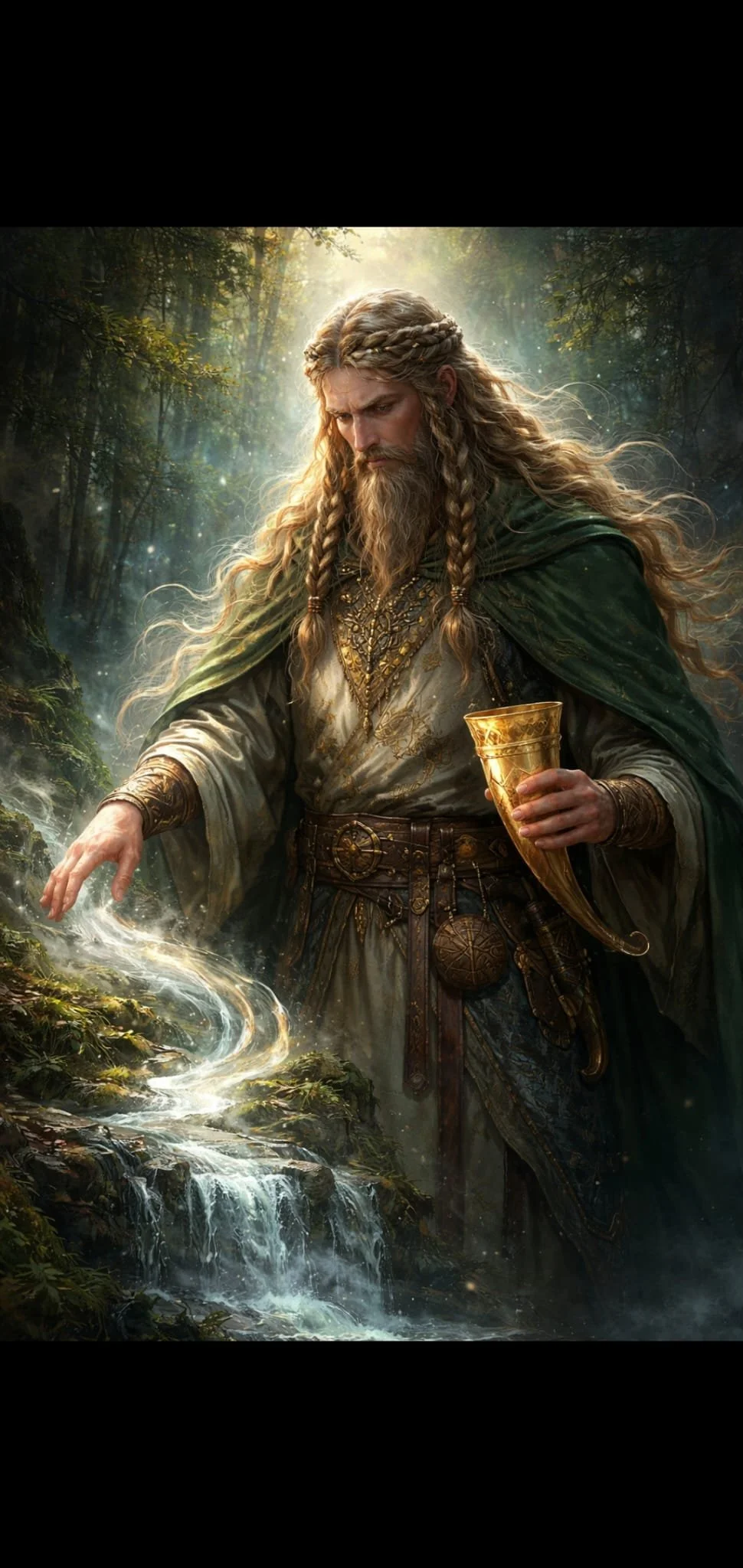
“Wisdom flows where speech dares not wander, and the lips that taste silence learn more than those that babble.”
- Fragment from the Eddaic Scrolls, Hrafnheim, c. 11th century
Pause. Breathe. Let the words sink.
Even when voices fall silent, even when knowledge seems lost in ash and echo, Kvasir lingers. Not in form, but in flow. Not in being, but in transmission.There is a pause here, though the tale does not name it:
A breath between the worlds.
A moment when even the gods lean close to hear what has not yet spoken. Kvasir is born in that pause… not as sound, but as readiness.
***NOTE***
Before exploring this blog, it is important to clarify that Kvasir is a figure from Norse cosmology. He is often depicted as a being of wisdom born from the collective spittle of the Æsir and Vanir, embodying knowledge, creativity, and the interconnectedness of all things. Kvasir is not a historical person or literal entity, but a symbolic figure emerging from the cosmogonic myths recorded in sources such as the Prose Edda and Skáldskaparmál. What follows is a mythopoetic synthesis faithful to the spirit, symbolism, and internal logic of these traditions rather than a single canonical account. So, Before you step fully into this current, pause. It is important to understand: Kvasir is no mere story.
Origins of Flow
Before Kvasir’s birth, before the first thought touched form, the cosmos already moved.
Currents of understanding swirled between Aesir and Vanir, invisible yet alive, seeking connection. Rivers of potential, winds of knowing, sparks of insight - they whispered in unison, forming the first liquid thoughts.
In that stillness and motion, the first breath of wisdom stirred. Kvasir was not born from nothing; he emerged from the cosmos learning itself, a conduit for what the world already longed to know. To meet him is to meet the current before the stream, the echo before the word.
On the Name Kvasir
In Norse cosmology, names are never ornamental. They are distilled worlds, each syllable a vessel of power, a spark of being.
He is a figure of Norse cosmology, born from the collective spittle of Æsir and Vanir, a living emblem of wisdom, creativity, and the threads that weave all things together.
Kvasir is not a historical person, not a literal entity to be circumscribed by time or record. He is a symbol, a river of understanding flowing from the cosmogonic myths preserved in the Prose Edda and Skáldskaparmál.
What follows is a mythopoetic synthesis faithful not to a single text, but to the spirit, the pulse, the internal logic of these stories. Let the words move through you as they were meant... not to be possessed, but to be experienced.
Prologue: Born of Spit and Thought
Before the first word was spoken before meaning itself found its anchor in the world, before the runes were carved to capture thought there was agreement. Not law. Not covenant. But a meeting of minds so perfect it produced life itself. Kvasir emerged from this union, born of the spit of gods… a mingling of Æsir and Vanir wisdom, a liquid remembrance of what both sides understood but neither could fully hold.
The spit cooled as it fell. What touched it remembered. What drank from it awoke.
Even the air bent toward the forming mind, as if thought itself carried weight for the first time.
He was not born into a quiet world. The cosmos was still testing its currents, learning which could bear life and which would unravel it. Kvasir’s wisdom was never ornamental. It was functional. Essential. A force that prevented forgetting.
He was the first to speak truths that even the gods did not yet understand.
And those who heard him too clearly often found themselves unable to return to who they were before.
The River of Words
Kvasir did not hoard knowledge. He flowed through it, like water carving its way through the landscape of thought.
Anyone who drank from him literally, later, in myth - tasted understanding. But knowledge is never neutral. To hold it is to feel the weight of inevitability, the burden of seeing connections invisible to others.
He wandered between worlds, visiting gods and giants alike - not as judge, but as messenger. Ideas traveled in his wake.
Poetry. Law. Prophecy. All came through him as currents, not commandments.
Wisdom was never static in Kvasir’s presence. It was living. Moving. Insisting.
Challenging the world to respond.
The Nature of Forgetting
Knowledge left unmoved turns brittle.
Gods who hoard, mortals who resist, even rivers that cease to flow - all risk stagnation.
A skald who forgets the song sees only silence. A king who forgets the lesson sees only tyranny. Even the smallest moment lost can ripple across worlds.
Kvasir knew that death and transformation were not ends, but safeguards. To flow, to disperse, to circulate - that is the eternal antidote to forgetting.
Interactions with Gods and Mortals
Kvasir’s life was woven of dialogue and exchange. He spoke with Odin on the intricacies of fate, debated with Freyja on the nature of love and magic, and challenged Loki, whose mischief often skirted the edges of understanding. Yet he approached each encounter with humility. Kvasir taught that true wisdom listens before speaking, observes before acting, and connects without claiming dominion.
Mortals, too, felt the ripple of his presence.
Once, a woman grinding grain stopped mid-turn, tears falling without knowing why.
A truth passed through her, small, wordless - and gone. She would never name it, but her children felt it, in the way she taught them to listen.
Skalds sought him out, though he rarely stayed in one place long enough to be possessed. His lessons were subtle: a phrase caught mid-wind, a sudden insight in the middle of night, a dream borrowed from the stars.
In all these ways, Kvasir invited participation, not reverence.
Once, a god asked Kvasir a question he would not carry. Kvasir turned away, and the silence taught more than words could have.
Some knowledge cannot be given; it must be grown. Even Kvasir sometimes wondered if flow was enough, if some truths, left to wander, would be lost to silence forever.
This doubt followed him like a shadow, making him careful with what he released.
The Gift of Inspiration
Kvasir teaches that insight does not arrive unbidden. It must be chased, coaxed, caught in motion. The skalds learned this from tasting his blood after his death: Poetry arises not from possession, but from consumption; from surrender to a force greater than self.
Every verse written from his essence carries fragments of the cosmos, truths that could not exist without motion, without letting one’s mind run free through the infinite.
The gods understood the danger.
To hold a being who carried all wisdom in his veins was to wield power beyond control.
But they underestimated the gift: Wisdom is only dangerous if it remains still. Kvasir moved. He flowed. He left traces without binding them, and so survived in memory even when his flesh did not.
Murdered, Yet Unbroken
Kvasir’s death is a lesson in paradox.
The dwarves Fjalar and Galar killed him - not to destroy wisdom, but to transform it into something they could shape: the mead of poetry.
Blood became inspiration. Loss became possibility.
But some who drank too deeply drowned in their own brilliance, mistaking the current for the shore.
Knowledge, once concentrated in a single being, dispersed into the world, where it could be drunk, shared, reshaped.
Even in death, Kvasir taught. He showed that the value of knowing is not in possession, but in circulation.
Truths that linger without movement harden into tyranny. Knowledge that flows nourishes, challenges, and sustains.
Journey After Death: Blood, Mead, and Eternal Flow
Kvasir’s death was not an end - it was transformation.
The dwarves Fjalar and Galar, cunning and ambitious, murdered him - not to destroy wisdom, no...but to shape it.
His blood became their instrument, mixed with honey to create the mead of poetry, a substance as potent as the cosmos itself.
In this dark act, Kvasir’s essence was freed from flesh, becoming a liquid conduit of insight, creativity, and understanding.
The dwarves believed they could control it, bottle inspiration for their own gain.
But they underestimated the nature of Kvasir. Wisdom, like water, cannot be dammed. Its currents slip through the smallest cracks, seep into hearts, awaken minds.
The mead could be stolen, but it could not be contained.
(Odin’s Quest: Reclaiming the Stream)
Word of the mead reached Odin, who recognized that the gift or curse of ultimate wisdom could not remain in mortal or dwarf hands alone.
The Allfather, master of cunning and disguise, set forth on a perilous quest to reclaim it. He transformed into an eagle, infiltrated the dwarves’ hall, and drank deeply of the mead, escaping before they realized what had been lost.
But Odin did not hoard it. He shared it selectively with poets, seers, and mortals destined to shape worlds through thought and song.
Kvasir’s essence, distilled into mead, became a bridge between divine and mortal, a living reminder that creativity and insight are not possessions - they are rivers to be navigated.
(The Spread of Inspiration)
From Odin, the mead flowed into humanity.
A skald in a distant hall could drink from its influence unknowingly, finding the perfect word, the turning of a phrase, the insight that changes perception.
A ruler could enact justice, guided by understanding deeper than law.
A dreamer could glimpse truths hidden between worlds.
In this way, Kvasir’s wisdom transcended death. Though his body was gone, his knowledge remained dynamic, flowing through those who dared to taste it.
Every poem, every prophecy, every work of insight carries a drop of Kvasir’s original spirit - proof that the currents of thought cannot die, only transform.
Lessons from the Afterlife
Kvasir teaches us that: Death does not silence wisdom; it can amplify it.
Knowledge, once concentrated, becomes more powerful when shared.
Inspiration is a river, not a reservoir; it must flow to sustain life.
The line between life and myth is never fixed; through transformation, one becomes eternal.
Kvasir’s journey after death is a testament to the enduring, circulating nature of thought.
He reminds us that wisdom is not meant to be owned, only experienced, shared, carried forward.
Mead of the Gods
From Kvasir’s blood, the mead of poetry was born. It is not merely a drink - it is a river of perception, a fluid capable of awakening the dormant mind.
To taste it is to remember: thought is never solitary. Insight belongs to motion.
To write. To speak. To create.
Is to continue Kvasir’s endless wandering through ideas, connecting the seen and unseen, the remembered and imagined.
This is why the gods valued it and feared it.
Inspiration cannot be contained.
It cannot be commanded.
Those who seek it must chase it, much as one chases the sun or moon.
But in chasing, one becomes part of its eternal current.
Life and Skills
Kvasir was more than wisdom made flesh.
He was a master of memory, able to recall the smallest truth from the largest event.
He understood the languages of men, gods, and nature alike. Plants, rivers, mountains, even stones had lessons to impart, and he listened.
His skill in mediation was unmatched.
Where others saw conflict, he saw conversation. Where others sought to conquer, he sought to comprehend.
This subtlety, this refusal to dominate, made his wisdom not merely clever, but enduring.
It was alive, relational, and woven into the very fabric of the cosmos.
Kvasir and Nature
Mountains spoke of endurance. Rivers taught patience. Falcons whispered clarity.
Trees hummed the rhythm of time.
Kvasir listened to them all. Not as an outsider, not as master, but as participant in the eternal conversation. Every leaf, stone, and windblown seed carried truth waiting to be heard. To touch Kvasir’s mind was to feel the cosmos itself speaking in subtle harmonies.
Kvasir’s Mirror Moments
Sometimes he paused. Sometimes he looked into a still lake or the dark glass of a river. There, he saw reflection, not just of form, but of understanding itself. What is wisdom, he wondered, if it does not teach, guide, or flow? Even he, born of the currents of divine thought, could not grasp all threads at once.
Doubt touched him like wind over water.
Yet in that hesitation, he discovered the pulse of humility...the rhythm that keeps insight alive. To know too much, or to hold it still, was as dangerous as not knowing at all.
And so he moved, always moving, aware that every pause, every reflection, was part of the current.
Encounters and Tales of Kvasir Dialogue with Odin: Threads of Fate
Dialogue with Odin: Threads of Fate
Kvasir wandered into Asgard, finding Odin beneath Yggdrasil, one eye closed in meditation. The Allfather sought counsel on the tangled threads of wyrd, the destinies of gods and men.
Kvasir spoke not in riddles, but with clarity:
“The future is not written in stone; it is inscribed in currents. To grasp one thread is to feel the pull of countless others.”
Odin listened, humbled. Even he, master of runes and secrets, recognized that wisdom flowed through Kvasir like a river - uncontainable, unpredictable, necessary.
The Giant's Question
Among the giants of Jotunheim, Kvasir met Mimir’s cousins, who posed questions meant to trap him.
“If truth is in motion,” they asked, “can it ever be caught?”
Kvasir smiled, eyes reflecting sky and sea.
“Truth is like the wind. You cannot hold it, but you can feel it, measure it, and let it guide your sail.”
By the end, the giants found their questions transformed into reflections, their challenges becoming invitations to thought. Kvasir did not conquer; he transformed misunderstanding into curiosity.
Mortal Skalds: The First Inspiration
Kvasir occasionally wandered into the mortal realm, appearing as a fleeting figure along riverbanks, forests, or crossroads.
A young skald, frustrated with blank scrolls and silent nights, once encountered him beneath an ancient oak. Kvasir bent low and whispered: “Words are not found; they are earned.”
The skald drank from the water of insight he offered, and for the first time, verses poured forth as naturally as a river flowing over rocks.
Songs of Kvasir
And so the skalds sang. Verses arose as rivers, carrying truth, insight, and quiet wonder across the lands. In halls of kings, in quiet villages, in lonely forests, his songs shaped thought and courage alike.
Each note, each phrase, was a drop of the mead of poetry, a trace of Kvasir’s eternal flow. A word could awaken justice; a line could stir compassion; a melody could bridge worlds unseen. Kvasir’s essence became living poetry, flowing through human hearts, transforming the ordinary into the extraordinary.
The Tricksters and the Test
Even Loki, ever curious and mischievous, sought Kvasir’s counsel. Loki wanted secrets of the gods, shortcuts to power, ways to stir chaos.
Kvasir responded with patience: “The path of knowledge is not a ladder to climb, but a stream to follow. Missteps are part of the current; they teach more than leaps ever could.”
Loki laughed frustrated, yet enlightened. Even mischief, Kvasir seemed to say, could be harnessed toward understanding if approached with awareness.
Conversations with Nature
Kvasir’s wisdom extended beyond gods and mortals. He conversed with rivers and trees, mountains and stones, hearing their stories and recording their truths in the flow of his mind. A river taught him patience, a mountain, endurance, a falcon, clarity of sight. Through this communion, Kvasir learned that knowledge is not only human, nor divine - it is woven into the very fabric of the cosmos.
The Limits of Wisdom
Even Kvasir did not answer all questions.
Some truths must be earned, discovered, wrestled with. Not all insight can be handed over; some must emerge from effort, curiosity, and courage.
He sometimes turned away. He sometimes remained silent, letting the seeker learn the value of patience, observation, and reflection. Wisdom is a river, not a gift; it must be followed, explored, and respected.
The Last Walk Before Death
Before the dwarves Fjalar and Galar ended his mortal journey, Kvasir wandered the lands of men and gods alike, reflecting on all he had shared and learned.
He was serene, aware that knowledge, like water, could not be stopped.
He offered his final gifts through conversation and presence: a thought to challenge a king, a story to inspire a skald,
a question that would haunt a god until answered.
Enduring Footprints
These encounters left ripples across worlds.
A poet hears a line and feels a touch of Kvasir’s insight. A king changes a law, recalling a question he cannot quite place. Even mischief-makers pause, unknowingly guided by the subtle currents of his thought.
If your eyes have slowed, if your breathing has changed, that too is a trace. You are already standing in the shallows.
Kvasir does not demand attention.
He leaves traces for those who seek, for those brave enough to follow the river of words, the stream of insight, the ever-moving breath of knowing.
The Lessons of Kvasir
Kvasir reminds us that: Wisdom is relational, not owned.
Insight comes in motion, in risk, in exposure.
Death does not end knowledge; it transforms it.
Inspiration is not a reward; it is responsibility.
In every poet, in every thinker, in every quiet insight that strikes unbidden, Kvasir runs.
Not behind us, like a wolf. Not as a hunter.
But as a current we can tap if we dare.
The Quiet Persistence
While Skóll and Hati demand movement from the heavens, Kvasir demands movement from the mind.
He is the whisper behind questions, the pressure that keeps curiosity alive.
A world without him would not stop - it would never begin. Without the urge to understand, all motion becomes empty repetition, all light a pattern without meaning.
Invocation of Insight
When thought stagnates, when creation falters, when the mind feels barren:
remember Kvasir.
Drink. Think. Speak. Write. Question.
And now, the river listens back.
Flow with him, and your ideas will run as rivers through the world, reshaping what they touch.
Wisdom is not given. It is traced, followed, earned, passed along.
The Eternal Current in Humans
Look closely. You can feel it. In the poet’s line, in the ruler’s choice, in the quiet thought that arrives unbidden - Kvasir runs.
Every act of creation, every question, every moment of curiosity is a drop in the eternal river. You are not merely reading. You are flowing. You carry fragments of the first breath, the first insight, the first spark of wisdom.
To live with Kvasir is to participate, not possess. To follow him is to move with the current, not against it. And in that flow, the cosmos awakens...again, endlessly, beautifully.
A Personal Invitation
Look closely. Feel it. The current runs through you, whether you name it or not.
Every fleeting idea, every sudden insight, every question that lingers - these are Kvasir’s whispers.
You are not separate from the river. You are already moving with it. Drink from it. Let it stir your mind, your words, your heart.
Follow the currents where they lead, and in following, you will become part of the eternal motion.
The cosmos is awake, and so are you.
The river flows. The river waits. The river listens. And now, in your thought and your action, the current continues, endlessly, beautifully, alive.
Final Reflection - “The Current in Us”
Kvasir lives in the questions we dare to ask. He flows in the verses we write, in the music we hum, in the fleeting brilliance of an idea glimpsed and pursued. He does not chase; he is chased, and in being caught, he transforms.
If you have ever felt thought move before you were ready, you already know him.
To live under his influence is to accept that knowledge is alive. That curiosity is sacred. That motion of mind, of word, of spirit is survival.
We are running too, in thought as in life, following trails left by Kvasir, drinking from currents we may never fully comprehend. And in that pursuit, we are alive.
Kvasir: The Breath That Knows
Not conqueror.
Not judge.
But the eternal current that keeps wisdom moving through the cosmos.
If wisdom is already moving in you, what part of you must change to follow it?
Wyrd & Flame 🔥 🌿✨
May the currents of thought carry you, and may you never stop running with Kvasir.
