
The Huldra: The Hidden One Beneath the Hill
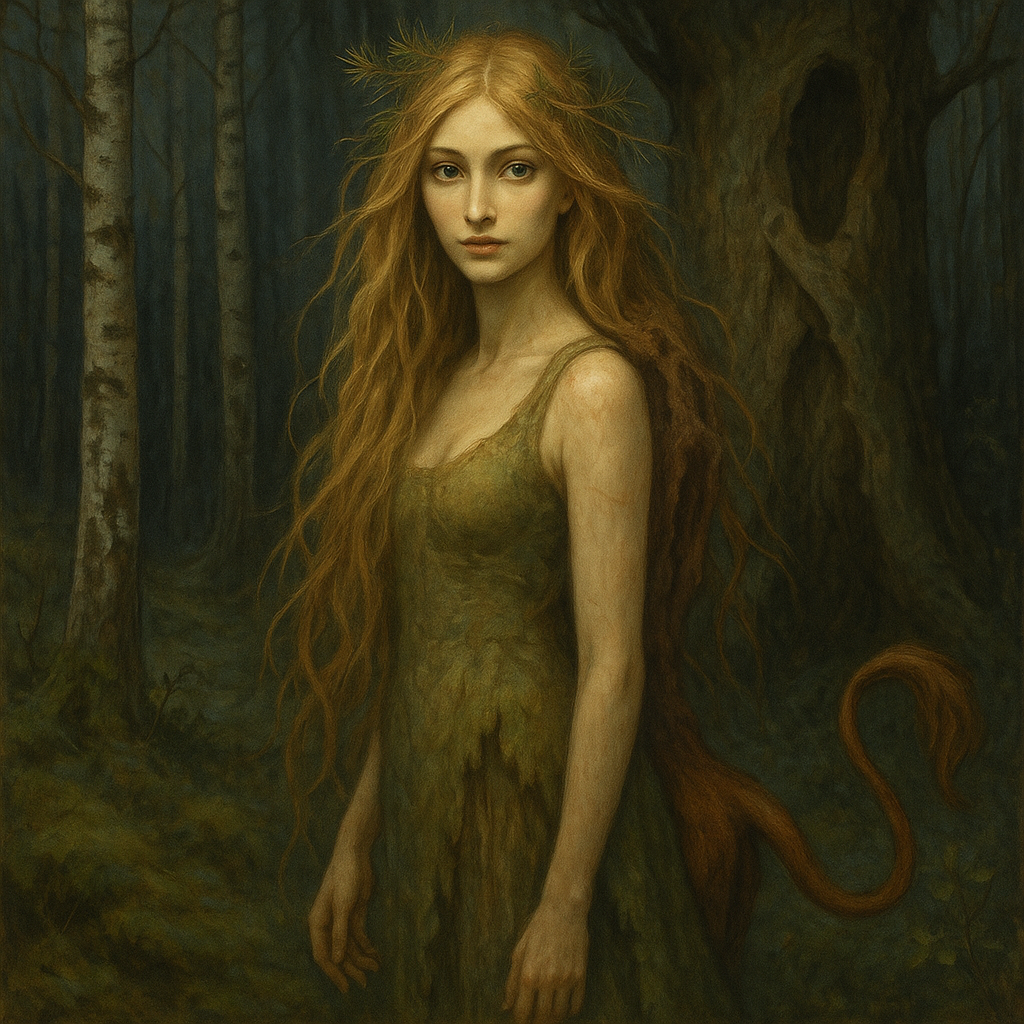
“Not every beauty blesses. Some are roots in disguise, pulling the heart down to where the moss remembers.” - from The Lay of the Hollow Hill, anonymous, c. 1300
I first heard of the Huldra in a half-remembered folktale from the forests of Dalarna - a woman who appeared at dusk, hair like sunlight tangled in pine, voice soft as wind through birch. She smiled at travelers, and they followed her. Few returned unchanged.
Among the Nordic woods, her names shift like mist: Skogsrå, Huldrefolk, The Hidden Ones. But always, she is the same - the boundary given shape. The wild disguised as woman. The secret beneath the green.
Where the Hafgufa is the abyss that consumes, the Huldra is the hollow that calls. She is not the sea’s hunger, but the forest’s lure. The whisper in the branches that asks:
“Do you still remember me?”
The Hollow Hill
In the oldest tales, the Huldra dwells within the hills - not beneath them, but inside, where roots become ribs and stone turns to flesh. To the untrained eye, her realm looks like any mossed mound or standing hillock, but to those who listen, it hums with the low breath of life itself.
Farmers spoke of hearing music from within the hills at midsummer - flutes and laughter, faint as echoes in water. Sometimes a doorway appeared, rimmed with gold light. To enter was to vanish for a hundred years or a heartbeat, the difference mattered little.
In Telemark, they say a young fiddler once followed that sound. He entered the hill and played until dawn, his bow moving like wind. When he emerged, his hair was white as snow, and his tune could no longer be repeated. He never married, never spoke of what he saw, but villagers swore that when he played alone in the fields, the forest itself swayed closer to listen.
In the sagas, the Huldra emerges only at dusk, when the world’s edge blurs. Her beauty is unearthly, flawless - save for the detail that gives her away: a tail of a cow or fox, sometimes hollowed bark where her back should be. She turns so you cannot see it. She smiles so you forget to care.
She is the forest’s mask. The perfection that hides its depth.
The Gift That Costs
They say the Huldra rewards those who treat her kindly - a silver coin that never runs out, a well that never dries, a voice that can charm the beasts. But these gifts are never given; they are exchanged. The price is attention, devotion, sometimes one’s very sense of time.
In the valley of Hallingdal, an old story tells of a farmhand who shared his bread with a woman in the woods. She thanked him and promised her favor. For years, his crops never failed, and his cattle grew fat. But one winter’s night, he found himself walking toward the birches again, as if called. The next morning, he was gone. Only his footprints led into the trees - and stopped.
A shepherd once met her near a birch grove. She offered him a kiss if he would follow her into the green. He did, and vanished for what felt like an hour. When he returned, the farm was gone, the fields turned to forest, and the church bell that tolled was rusted through. The kiss still burned on his lips. His shadow never touched the ground again.
Old women whispered that she was once of humankind - a woman who turned her back on the world’s noise and was taken by the earth in kindness or punishment. Others say she is one of the old spirits, older than Christ or Odin, a remnant of the time when every tree had a name and every hill had a heart.
Whatever her origin, she is both gift and warning:
To take from nature what you will without reverence is to marry its silence.
The Huldra’s Song
Under root, under rain, she hums the names men forgot. Those who answer walk soft, and are never wholly theirs again.
Old hunters swore they heard that song when snow fell without wind - a melody woven through the hush, reminding the living that beauty is not a comfort, but a covenant.
The Hidden Folk
The Huldra is not alone. In Norse and Sámi tradition, she is kin to the Huldrefolk - “The Hidden People” - beings who live parallel to our world, unseen yet ever present. They are said to be beautiful, but hollow-backed, perfect from the front, void behind.
The priests called them demons; the old ones called them kin.
They tend their cattle of smoke and silver, milk them by moonlight, and walk unseen beside the living. When they take a human lover, they demand secrecy; to speak of them aloud is to lose them forever. And yet, those who keep their word are blessed with uncanny fortune, or cursed with longing that never fades.
A tale from Jämtland tells of a young woodcutter who vanished into the hills one winter’s night. Years later, his brother found him in a dream - still young, still singing beside a woman with golden hair. When he woke, a single strand of moss lay on his pillow, damp as if from dew.
The Huldra herself is the bridge between the worlds. Her body is the boundary. Her eyes, the doorway. Her touch, a pact.
The Wild Feminine
To the old mind, the Huldra was not temptation but reflection, the wild soul made visible. She is the anima of the North: the voice of the untamed psyche calling its wandering self home.
In dreams, she is not a woman, but a threshold. To meet her is to face the self’s own longing for wholeness, for surrender, for return. She is the pulse beneath reason, the soft refusal of the world to be tamed.
The Seduction of Stillness
The forest, to the old Norse mind, was not mere wilderness. It was a mind-space - the unknown within the self. To walk into the woods was to enter the unconscious, to risk never returning whole.
The Huldra embodies that threshold. She is the moment when curiosity overcomes caution, when solitude becomes voice. To meet her is to confront the self’s most alluring danger - the temptation to dissolve into the wild, to abandon identity for belonging.
Those who returned from her embrace spoke of hearing their own names whispered in the rustle of leaves, as if the forest itself had learned to speak them. They walked slower after that, gentler. They never cut trees without apology.
In the old ways, to see the Huldra was to be marked - not cursed, but reminded that the forest keeps its own kind of memory.
The Church and the Hill
In later centuries, when Christianity spread through the North, the Huldra changed.
She became a test of faith - the temptress of the woods, the unbaptized child of Eve who hid her offspring from God. For this sin, her descendants became invisible to human eyes, forever yearning for acknowledgment.
Yet even the priests who cursed her warned not to offend her. When men built churches near her hills, they left small doors open at the back, “for the Huldra’s kin to pass unseen.” Bells were muffled during the blessing of the land, lest the hidden ones take offense. Because even faith knew better than to mock the unseen.
In the parish records of Västergötland, there’s an entry from 1734 describing a church whose roof collapsed during Mass. The only survivor, a child, claimed he saw a woman in green standing by the doorway, shaking her head. The priest later wrote:
“It may be that not all saints dwell in heaven.”
Rituals of Respect
In every northern valley, traces of her rites remain - quiet, half-forgotten gestures meant to keep peace between worlds.
- The Bread Offering -
Before a long journey or the felling of trees, a small piece of fresh bread or cheese was left on a stump, often with the words:
“For those who see without being seen.”
To take without giving was to invite misfortune. To share was to remain known to the land.
- The Water Greeting -
Before drinking from a stream, travelers dipped a finger first, whispering:
“Let me share, not steal.”
The gesture acknowledged that the water had spirit - that the unseen watched, and might withhold its blessing if ignored.
- The Hill Knock -
When crossing a wooded boundary or passing a strange mound, one would knock three times on stone or tree.
The sound signaled intention, not intrusion.
Children were taught to say, “We pass in peace.”
- The Leaving of Bells-
Small iron bells were sometimes hung near paths or forest shrines. They rang when the wind moved, a sign that both humans and Huldra might share the space without fear.
Some said the sound reminded her that men still sang; others said it kept the forest awake.
- The Midsummer Braid -
Young women braided herbs - yarrow, fern, thyme - and left them on stones before dawn. It was said that if the Huldra was pleased, she would weave a single golden hair into the braid by nightfall. Those who found it would dream true dreams for a year.
These rituals were not superstition, but conversation.
The old people understood that respect was the oldest magic.
To honor the hidden was to remain part of the world, not apart from it.
The Children of the Huldra
The Huldra’s lineage is one of secrecy and twilight. In many tales, she bears children - some fathered by men who wandered too far from home, others by spirits of her own kind. These children walk between worlds.
Some live among humans, quiet and strange, their eyes too deep, their hair touched with green. They grow quickly, speak little, and are said to vanish at dusk if one calls their name. In Sweden, it was whispered that such children - the Huldrebarn - brought blessings to the land they lived on, though they seldom aged past youth.
In one tale from Hardanger, a farmer’s wife awoke to find a newborn at her doorstep wrapped in moss. She raised it as her own, but the child never spoke. When the first frost came, it disappeared. In its cradle, she found a single birch leaf and a whisper written upon it:
“You fed the forest’s hunger; it will feed you in turn.”
That year, her crops flourished though snow lay heavy on the fields.
To bear the Huldra’s child was both miracle and omen. Some mothers were said to nurse them at night only to wake to find milk on the windowsill and hoofprints in the snow. The Huldra’s bloodline ran through generations in subtle ways - an uncanny ear for music, a voice that could calm animals, an unaging grace that marked them as neither wholly mortal nor divine.
The Huldra and the Gods
The Eddas do not speak her name directly, but the echoes are there - between lines, in the shadows of the Aesir’s forests.
Some say the Huldra was kin to Freyja, the Vanir goddess of love and wild magic, sharing her domain of beauty and the primal body of the world. Freyja ruled love through passion; the Huldra ruled it through invitation - the call to return to what was forgotten.
Others whispered she was beloved of Odin in his wanderings. When the Allfather walked the earth in mortal guise, he is said to have rested by her forest halls. The ravens refused to follow him there, for the trees themselves bore witness. She offered him wine from roots, and he taught her runes. From that meeting, the stories say, came the Huldreskrift - the secret signs used by forest witches, carved not in wood or stone but in breath and wind.
Still others name her kin to Jörð, the Earth herself - her daughter, perhaps, or her voice made manifest. When Odin fathered Thor upon the Earth, some said he also fathered something else: the Hidden, those spirits who would remain unseen to remind humankind that not all creation wished to be known.
Thus, the Huldra stands as a lesser god’s echo - not one of Asgard’s shining halls, but of the old Earth’s whisper before the gods were born.
The Echoed Ones
Across the world, she wears other names - Lauma in the Baltic mists, Rusalka in the Slavic lakes, Leanan Sídhe in the Celtic glens. Each is a reflection in another forest’s pool, each a whisper of the same memory: that beauty and peril share a single root.
Even far to the east, the Yuki-onna drifts through snow with the same half-sorrowful grace, a sister of frost to the Huldra’s green. Every land remembers a woman of the threshold, one who invites us to cross, and asks if we remember our way back.
The Huldra’s Place in the Norse Cosmos
In the mythic geography of the North, every realm has its guardian.
The sea has Rán. The mountain has Dvergar. The night has Nótt.
The forest belongs to the Huldra.
She is the rå, the warden - not a deity of command, but of balance. She keeps the wild from being forgotten, and the human from becoming arrogant. Her presence marks the living boundary between innangard (the ordered world of men) and utangard (the untamed beyond).
To the early Norse, she was not evil, nor benign - she was the moral neutrality of the world itself. Her beauty tempts, her voice enchants, yet her purpose is not to destroy but to remember. She is the check against hubris, the quiet demand that humanity remain humble before the unknown.
If Ægir’s wife Rán drowns the arrogant sailor, the Huldra seduces the arrogant wanderer, both returning him to the greater order of nature.
In the cosmology of Yggdrasil, she is the spirit that walks between Midgard and the roots of the World Tree, a custodian of life’s underside. Her laughter is said to echo in the dark hollows of Jötunheim, her shadow seen in Alfheim’s green light. She belongs to every realm where the seen and unseen overlap.
The Huldreskrift
The runes that bear her name are not carved, but breathed, marks of mist and wind. Witches of the northern woods once traced them in air before felling a tree or birthing a child.
The first is a curve, open as a cup, meaning to offer.
The second, a spiral drawn instone. - meaning to listen.
The third, a mirrored rune - meaning to be seen.
Together, they spell her truest law: that what is taken must first be acknowledged. The forest, after all, keeps accounts.
Dreams and Visitations
In dreams, the Huldra often appears in twilight places - a meadow you’ve never walked, a birch grove that hums with memory. She does not chase. She waits.
Her eyes are the color of the forest floor after rain, and her voice is the sound of moss growing over stone.
I once dreamed of her myself. She stood where fog met birch, her hair heavy with dew. When she looked at me, I heard my own name as if spoken by the earth.
I woke with pine needles in my hair, and the scent of soil on my hands. For days after, mirrors seemed deeper than before, as though something watched from beneath the glass.
Those who wake from such dreams often feel a strange grief, as though they’ve left something precious behind - a name, a promise, or a part of themselves that remembers how to listen.
Some say these dreams are the land’s way of calling us home.
Others say they are warnings.
Either way, the forest speaks.
The Hidden One Remembered
In the end, the Huldra is not merely myth, she is memory. Memory of when we spoke softly to trees, when the land was alive and not owned, when beauty was not separated from danger.
She is the wild soul calling us home, not to comfort, but to truth. The part of us that still listens when the wind moves through pine, when twilight deepens and the earth hums like a heartbeat beneath our feet.
The Huldra waits not to steal you, but to remind you.
That what is hidden is not gone.
That the roots remember your name.
That beneath every hill, something still breathes.
The Huldra’s Shadow
She walks still, though the forest has changed. Her birches have become antennas; her streams run through copper veins. Yet the hunger is the same, the longing for something alive that looks back.
We meet her now in other guises: in the reflection of a black phone screen, in the quiet ache before a storm, in the dream that smells of pine when we’ve forgotten the sound of wind.
She no longer lures the wanderer from the path. She waits instead at the edge of our exhaustion, whispering what she always has:
“Come home."
Invocation of the Hidden
When you walk beneath trees, remember her.
Leave a crumb, a word, a breath. Not for worship - for kinship.
Knock once on stone, whisper once to moss, and keep walking.
If the wind stirs and something ancient stirs with it, do not fear.
You have been remembered.
And the forest, once more, is awake.
The Hidden One Beneath the Hill.
Not enemy. Not angel.
Only the oldest question, still whispering:
“Do you remember where you came from?”
Beneath every hill, something still breathes.
Wyrd & Flame 🔥
