
Unn the Deep-Minded: The Matriarch Who Built Iceland | Norse History & Myth
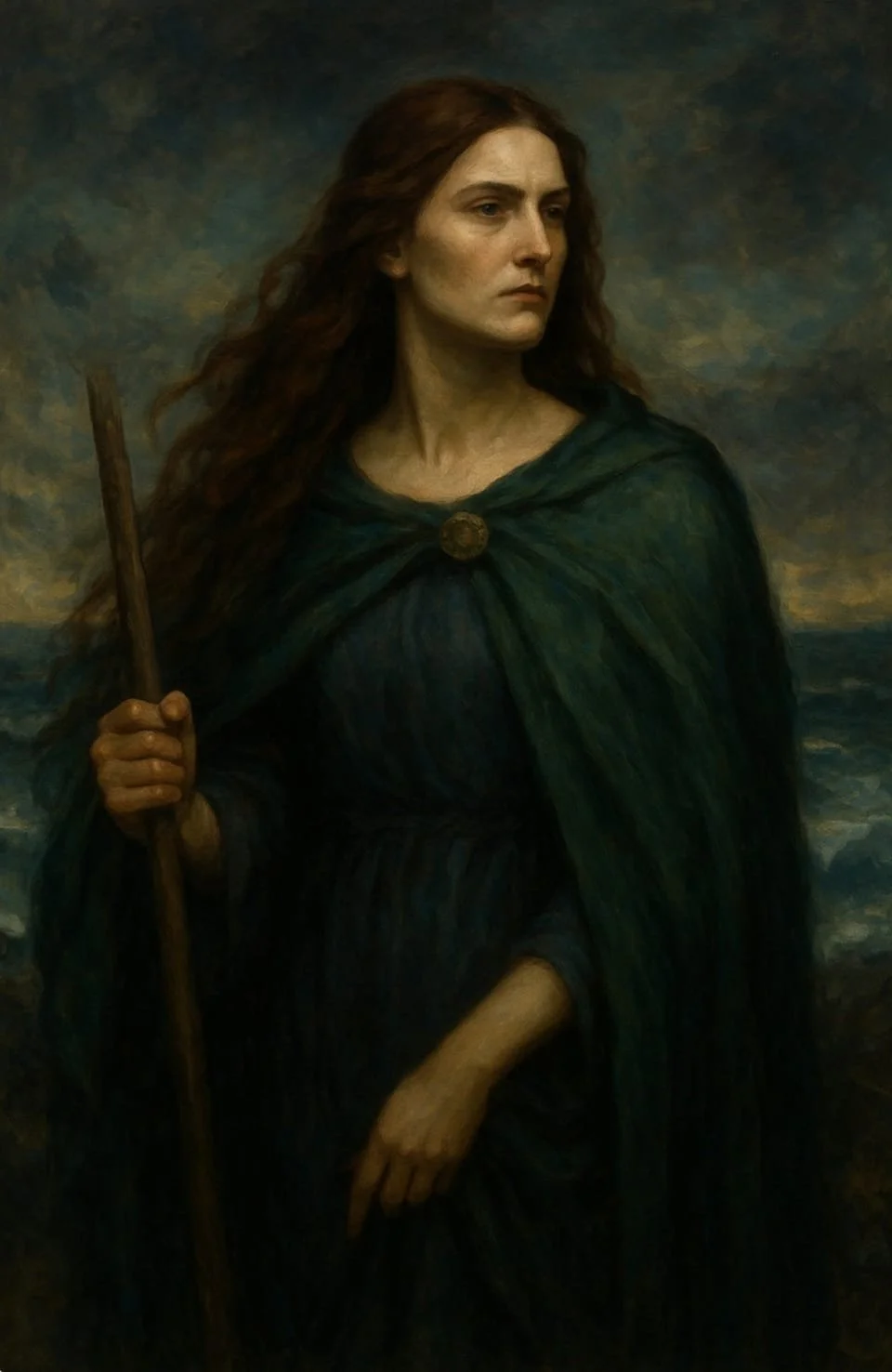
“She carried a world through silence - and the silence crowned her.”
*NOTE - This is a mythopoetic retelling, drawing on history, saga, and imagination.*
Long before Iceland bore names and songs, when Europe was still waking from its dark ages, there moved upon the edge of the world a woman who thought as the ocean thinks - in depth, in silence, in inevitability.
They called her Auðr djúpúðga, Unn the Deep-Minded - daughter of Ketill Flatnose, widow of a fallen sea-king, and architect of survival in an age of collapse.
When her kin were broken by war and her kingdom drowned beneath foreign hands, she did not kneel before the storm. She built a ship to master it.
“She built not to flee, but to begin again.”
(Laxdæla Saga, imagined fragment)
Her story begins where most legends end - not in triumph, but in ruin. And from that ruin, she shaped a people.
It is said that the sea remembers all names whispered into its foam. Mariners of later centuries spoke of hearing her voice in the wind off Breiðafjörður, a low murmur that seemed to bless or warn, depending on the heart of the listener.
Her saga became a compass for those who had lost their own north - for wanderers, widows, and exiles who sought not glory, but ground.
In the monasteries of Iona, a monk once recorded: “There is a woman beyond the edge of Christendom who builds as God built the earth - from chaos into form.”
And so Unn’s legend spread not by sword, but by the salt trade and the songs of sailors - an undercurrent running from Norway to the Hebrides, from Dublin’s quays to Iceland’s uncharted fjords.
The Blood of Kings and the Weight of Exile
Unn was born into the twilight of Norse dominion. Her father, Ketill Flatnose, ruled the western isles - a lord among the Norse-Gaelic kings who traded, raided, and ruled the seas between Ireland and Norway.
Her husband, Olaf the White, was a warlord of Dublin, famed in the annals of the Landnámabók and the Irish Annals as one who built kingdoms with sword and ship alike.
But kingship on the western sea was a fire that burned its holders. When Olaf fell in battle, and Ketill’s power waned beneath Christian and Norse alike, the world of Unn’s youth collapsed.
“When the sea takes the crowns of men, only those who can build endure.”
(Fragment of the Western Isles Chronicle, lost source)
Her kin scattered; her people became refugees. And in that moment of unmaking, Unn’s true sovereignty began.
In her youth, Unn had known the courts of Ireland - the harp-song and the smoke, the strange mingling of Gaelic and Norse tongues. She had walked beside monks who spoke of one God, and seeresses who spoke to many. From each, she took something: from the monks, the patience of the builder; from the seers, the courage to dream beyond ruin.
Some chronicles suggest she held brief dominion in the Hebrides after her husband’s fall - not as queen in name, but as keeper of oaths. There, she gathered her scattered kin and former thralls, forging a fragile peace among those made bitter by loss.
But peace is brief where hunger rules. Raids from Norway’s jarls and Irish kings alike shattered the isles’ safety. Her nephew Thorstein the Red rose as warlord for a time - and fell, betrayed in Caithness. Unn buried his body herself, singing a dirge no skald ever wrote down, for it was made of silence.
When all her lineage lay broken and her household fire dimmed, she made her decision.
She would build a ship - not to chase conquest, but to preserve memory, the living thread of her people.
The Ship in the Forest
They say she went north, into the forests of Caithness, where the mist hung like mourning veils over the trees. There, in secret, she ordered a ship to be built - not the small, swift vessels of raiders, but a knarr, a deep-bellied craft made for carrying lives, not loot.
No saga tells what she felt when she laid her hand upon its keel, but the poets imagine silence, the kind that lives between memory and intent.
They worked in silence. For a woman to command such a task was defiance enough.
And so she built.
The sea was watching.
Silence was not surrender
When it was finished, she filled it not with wealth, but with people - slaves freed, kin gathered, orphans of old wars.
“The sea does not judge who is worthy of passage. It only asks: will you risk becoming?”
(Sailor’s proverb, Hebridean origin)
And when all was ready, she launched her ship at dawn, the mist swallowing its shape.
Those who saw it said it moved like a ghost of intention - silent, certain, unreturning.
Some say she sought counsel from a völva - a wandering seeress - before she left. The woman wove runes upon a driftwood plank and said, “Your fate lies west, where no name yet binds the land. There the dead may rest, and the living begin.”
Others claim Unn herself walked the beaches at night, selecting stones for the ship’s ballast and speaking to each as if to kin. “You will remember where I came from,” she said.
The men who built the ship were sworn to secrecy, bound by oath to tell no one until the sea had claimed her wake. Among them was a freed thrall from the Hebrides named Maelduin, who later became her helmsman - a Christian who carved a small cross into the prow beside her runes. Thus, wood and faith mingled: Norse and Gaelic, pagan and new, in one vessel born of necessity and grace.
Before dawn on the day of departure, she is said to have stood before the ship, her cloak heavy with dew. “Let this be my hall,” she murmured. “The sea, my roof-beam. The wind, my kin.”
The people who followed her called her The Queen Without Throne, and believed that wherever she landed, the ground would remember her step.
The Counsel of the Seeress
Before the ship departed, Unn is said to have climbed the cliffs above Caithness to seek the counsel of an old woman known only as Hildr of the Stones, a prophetess who lived among ravens.
The seeress greeted her not as exile, but as builder. “The gods break what they mean to renew,” Hildr told her. “You will carry a kingdom in your bones, and your blood will write its laws.”
Unn asked, “And what of peace?”
The seeress replied, “Peace is not given - it is built in the space where no one else dares to stand.”
When Unn descended from the cliffs, the ravens followed her to the forest edge, as if escorting a queen.
Later generations said that on calm nights, two ravens circled her grave-mound - one black as winter, one gray as dawn - whispering to the sea.
The Long Road of Salt and Silence
For months, Unn and her people sailed the whale-road - through wind and storm, from the Orkneys to the Faroes, and beyond into the open vastness.
There were no maps, only memory and the stars. The crew whispered that their lady did not sleep - that she stood upon the prow each night, face turned toward the horizon, her eyes reflecting the sky.
“She saw farther than sight, deeper than knowing. Her silence steered us when the stars hid their faces.”
(The Voyage of Unn, oral retelling, collected 13th century)
At last they reached Iceland - a land of ice and moss, mountains and promise. To most it seemed barren, but to Unn it was potential unspoken, a page the gods had left blank.
The voyage itself became legend. In the Orkneys, she traded salt and woven wool for iron and oats, but more than trade, she sought allies. There she met Earl Sigurd, who ruled the islands under Norway’s distant claim. The earl, impressed by her bearing, granted her safe harbor and sent three of his best sailors to guide her through the treacherous northern passages.
Storms tested them near the Faroes. Ice formed upon the ropes, and one mast split in the night. When fear threatened the crew, Unn sang a song her mother had taught her - a low, rhythmic chant said to calm the sea spirits. The wind eased, and the ship endured.
They encountered other exiles - Norsemen fleeing the tyranny of Harald Fairhair, Gaels escaping debt or blood-feud. To each she offered passage, provided they swore to build, not burn. Thus, her company became a mosaic of tongues and tales: Irish, Norse, Pictish, and even a lone Frankish stonemason who would later carve the first boundary stones in Iceland.
It was said that when the fog thickened and men lost heart, Unn would stand at the prow holding a driftwood staff carved with runes of guidance. “We follow the line between worlds,” she told them, “where land dreams itself into being.”
The Voyage to the Orkneys
The sagas hint that Unn paused in the Orkneys longer than a single winter. There, she arranged the marriage of her granddaughter Ólafsdóttir to a local jarl, a union meant to bind sea routes and kin alike.
During that season, she was said to walk often upon the cliffs, watching the horizon. Fishermen saw her cloak streaming like a banner in the wind, and they whispered that the ocean itself rose gentler when she watched it.
She left gifts to the islanders - a silver torque to the temple of Njord, and a bell from Ireland to the small Christian chapel. “Both gods deserve remembrance,” she said. “The sea is wide enough for all prayers.”
When spring came, she gathered her household and spoke:
“Between old gods and new, between exile and home, we will make the middle way - a kingdom built not on rule, but on remembrance.”
Thus she sailed from the Orkneys, carrying not plunder but peace, a rarity in her age.
The Queen of the Sea-Road
She claimed the western fjords and built her hall at Hvammr, where the green land bowed to the dark water.
There she became not merely a settler, but a sovereign of her own making. She ruled through kinship, not conquest; through custom, not decree.
In her lifetime she arranged marriages, granted land, and founded lineages that would shape Iceland’s history - the Laxdæla, the Burnt Njal’s kin, the poets of Eyrbyggja.
“In her hall, law was born from memory, and peace was her weapon.”
(Saga fragment, attributed to Snorri the Elder)
Where others saw wilderness, she saw inheritance. Where others built walls, she built belonging.
Her people called her djúpúðga - deep-minded - not for cunning alone, but for the calm that came when others faltered.
She ruled as the sea rules: quietly, endlessly.
Hvammr was no mere homestead, it was a living symbol. Its hall beams were cut from driftwood she herself selected, each bearing a rune for strength, patience, or foresight. She sat not upon a throne, but a high seat carved with knotwork of waves and serpents, symbolizing the unbroken flow of her lineage.
Unn welcomed both freedmen and strangers into her household, provided they pledged honesty in labor. It was said she greeted every new arrival with the same words: “Here, all who endure are kin.”
Her wisdom drew others. One autumn, the poet Ketill the Wanderer came to her hall. He had been cast out from Norway for mocking a jarl. He offered her a verse, and she offered him land. In his poem he wrote:
“She builds not with walls, but with will.
Her silence is the shape of law.”
When disputes arose among settlers, Unn gathered the claimants beneath the birches outside Hvammr and listened more than she spoke. Her judgments were remembered as fair and final - so much so that the early Icelandic Thing later adopted her customs of mediation and witness.
Travelers from Norway told of her hall’s peace. Even Harald Fairhair, hearing of her through passing merchants, is said to have remarked, “She has built more lasting than I have conquered.”
The Winter of the Founding
The first winter in Iceland was harsh beyond measure. Snow buried the roofs; rivers froze. Yet no one in Unn’s settlement perished.
Before the frost came, she had ordered great stores of dried fish, seal fat, and barley ale. She had learned from Irish monks the craft of underground cold cellars, and from Norse traders the art of smoke preservation. Her hall became both refuge and school - there she taught the children how to weave rope, the men how to mend sails, and the women how to chart the stars for future voyages.
That winter, she gathered her people each full moon for what she called the Night of Hearthfire. Together they told stories - of home, of gods, of exile and new beginnings. These nights, some say, gave rise to the first oral sagas of Iceland.
By spring, the settlement had become not just survival, it was community. They planted new crops, built boats for fishing, and sang songs that mixed Norse meters with Gaelic refrains.
Unn watched the first lambs born on Icelandic soil and whispered, “The land accepts us.”
The Feast of Farewell
When her hair had turned the color of foam and her years had become tide rather than time, Unn prepared her own ending.
She summoned her kin to a final feast - a grand celebration of life, lineage, and gratitude. They ate, drank, and sang as though no death waited beyond dawn.
And when the mead horns emptied and the torches dimmed, Unn rose, clothed in white, and walked from the hall.
Beyond the door lay the grave-mound she had built with her own hands. She entered it alone, and was never seen again.
“The sea does not drown its own. It merely takes them home.”
(Epitaph carved at Hvammr, modern reconstruction)
Her people said she died as she had lived - in dignity, in silence, by her own design.
No god took her. No man buried her. She crossed the final horizon by choice.
The feast lasted three days - one for her ancestors, one for her descendants, and one for all who had walked beside her in exile. She blessed each in turn: warriors with courage, poets with memory, farmers with patience.
As dawn neared, she stood and said, “I have built enough. Now let the land build itself.”
Some claimed they saw a faint light over the fjord that night - not the northern aurora, but something softer, like a single ship-lantern drifting west.
When her kin entered the mound the next morning, they found her cloak folded neatly and a small driftwood carving of a ship beside her bier. No body remained, only salt upon the stones.
The people said the sea had claimed her, as it had once carried her. The waves at Hvammr were calm for seven days thereafter.
The Legacy of the Deep
In time, her descendants became the architects of Icelandic saga and law. From her blood came chieftains, poets, and dreamers.
But her true legacy was not blood, it was pattern. The shape of her endurance became the shape of a nation.
“Those who survive without bitterness, those who build from loss - these are her heirs.”
(Modern skaldic reflection, ‘The Line of the Deep’)
When scholars write of her, they call her the “greatest woman of the Settlement Age.”
But titles fade; symbols remain.
She is the Matriarch of Renewal, the Sea’s Daughter, the Queen of Exile Made Home.
In her, the North remembers what it means to begin again.
Long after her passing, the settlers of Breiðafjörður told that on still nights her hall-lights could be seen shimmering beneath the water - a phantom hall where voices murmured, laughter echoed, and songs rose like bubbles from the deep.
The Laxdæla Saga speaks of her descendants’ pride: how generations after, when disputes arose, one would simply say, “Remember Unn,” and silence would fall, as if her calm itself still ruled.
Her kin traced their power not through conquest, but through wisdom. The Thing at Þingvellir carried her methods of counsel into Icelandic law, and her descendants - through the line of Olaf Feilan - became known as peaceweavers.
In Ireland, the bards kept a different memory. They called her Una an Fhíorfhiosrach, “Una the True-Knowing,” and claimed she had once dreamed of an island of green fire - the promise of a people who would one day belong to both sea and soil.
Even in Norway, Harald’s chroniclers wrote of her with reluctant admiration: “She defied a king not by sword, but by survival - and founded a realm no crown could touch.”
The Three Lessons of the Deep-Minded
I. The Power of Quiet Creation
Unn teaches that power need not roar.
True sovereignty is not in command but in continuity - the ability to keep what matters alive through change.
“Silence can be a throne, if one knows how to listen from it.”
(Rune-commentary, anonymous Icelandic monk, 12th century)
In a world of feuding jarls and burning halls, she ruled through stillness - and it was this stillness that endured when all other empires crumbled. In her hall, words had weight not because they were loud, but because they were listened to.
The builders of early Iceland remembered her way: that law is built from memory, not fear. The monks who later wrote the sagas adopted her principle - that preservation is itself a sacred act.
II. The Sanctity of Exile
Where others saw banishment, she saw transformation. Exile purified her purpose - stripping away all that was not essential.
Her voyage across the sea is the soul’s passage through loss: you leave what dies to find what endures.
Every exile carries a silent gift - the power to see the world anew. Unn’s journey taught that exile is not an ending, but an alchemy: sorrow into structure, wandering into wisdom.
The Icelanders who came after her - poets, mystics, wanderers - saw themselves reflected in her myth. To them, Unn was not merely an ancestor but an archetype: proof that to be cast out can be the beginning of creation.
And so she became the spiritual foremother of all those who crossed seas - not just by boat, but by heart.
III. The Mind as Ocean
Depth is not darkness; it is spaciousness. To think deeply, one must hold contradiction - calm and storm, grief and creation, memory and vision.
Her wisdom was not a flame to burn, but a tide to sustain.
The poets of the 13th century said: “She carried the sea within her skull.” They meant that her thoughts moved like water - fluid, shaping to every vessel, reflecting light even in shadow.
She knew that every empire begins as a whisper and ends as a wave returning to the deep. Thus her mind became a map for her people - vast, enduring, unbroken.
In the later Christian retellings, she was compared to Mary of the Sea, who bore the world’s salvation across silence. The Norse still called her queen, the monks saint, and both were right.
Unn Through Time
Historians have argued her reality - whether she was a single woman or the amalgam of many - yet the sagas speak of her as if she were carved from inevitability itself.
In later retellings she becomes archetype:
The Builder in Exile.
The Queen Without Crown.
The Woman Who Walked Into Her Own Tomb as One Enters a Doorway Home.
Where Brynhildr for example burned to end a curse, Unn endured to begin a civilization.
Fire and sea - rebellion and restoration - both necessary, both sacred.
“In the North, the fire purifies; the sea preserves. Between them, the world is remade.”
(Commentary of Skald Asgrim, 1320)
Through centuries her image evolved. The 17th-century Icelandic poets painted her as a symbol of stoic reason; the Romantics saw her as the Mother of the New North. Modern feminists name her the first matriarch of Icelandic identity.
Even now, ships departing Reykjavik sometimes bear her name. On their prows, carved into steel or wood, the figure of a woman stands - cloaked, calm, eyes fixed westward.
In folklore, it is said that when a woman leads a voyage or rebuilds after loss, Unn walks beside her unseen, her hand upon the rudder.
The Modern Tide
Today, her story returns each time a life begins again from ruin. Every migrant, every survivor, every quiet builder carries a spark of her deep mind.
She is the patron of the second beginning - of those who do not seek vengeance, but renewal.
“She is not the echo of what was lost, but the seed of what will come.”
(Modern invocation, Wyrd & Flame Almanac)
To remember Unn is to remember that healing itself can be heroic. That to lead is not always to conquer, sometimes it is simply to endure with grace.
Across the North Atlantic diaspora, women who founded communities in foreign lands took her as silent guide. In Greenland’s colonies, in the settlements of Vinland, her name appeared in toasts and blessings.
Modern archaeologists at Hvammr have found remnants of her hall - not grand, but enduring: whale-bone foundations, hearthstones arranged in careful circles, as if marking both home and horizon.
Each year, when Iceland celebrates its Settlement Days, children recite her tale beside the fjord. They speak her epitaph aloud so the sea will remember anew.
Some say the wind changes then - turning soft, salt-sweet, like the breath before a voyage.
The Question of the Deep
The sagas end her story with her silence.
But perhaps that silence is not an ending, but an invitation.
What sea waits for you to cross it?
What ship must you build in the forest of your own exile?
When all you have left is what you can carry - will you carry it forward?
Every generation stands again at her shore - hands calloused, hearts uncertain - hearing the same whisper that moved her to build. The question is not whether the sea will open, but whether you will trust its voice.
Unn’s lesson is not to seek safe harbor, but to become one.
The Deep Remembers
The waves still speak her name on Iceland’s western shore.
In their rhythm is her lesson:
build, endure, begin again.
For the deep does not forget the builders.
It only waits, for the next voyager who dares to trust the silence between storms.
“The gods may have vanished,
but the sea remembers every soul that carried light through exile.”
“She ruled no land but her own resolve - and from that, a nation rose.”
And if one listens long enough at the cliffs of Hvammr, as dusk falls and gulls grow quiet, a sound emerges - not mere surf, but cadence. It is said to be her heartbeat, woven with the sea’s.
“The sea remembers her - not as myth, but as motion.
- Wyrd & Flame 🔥
