
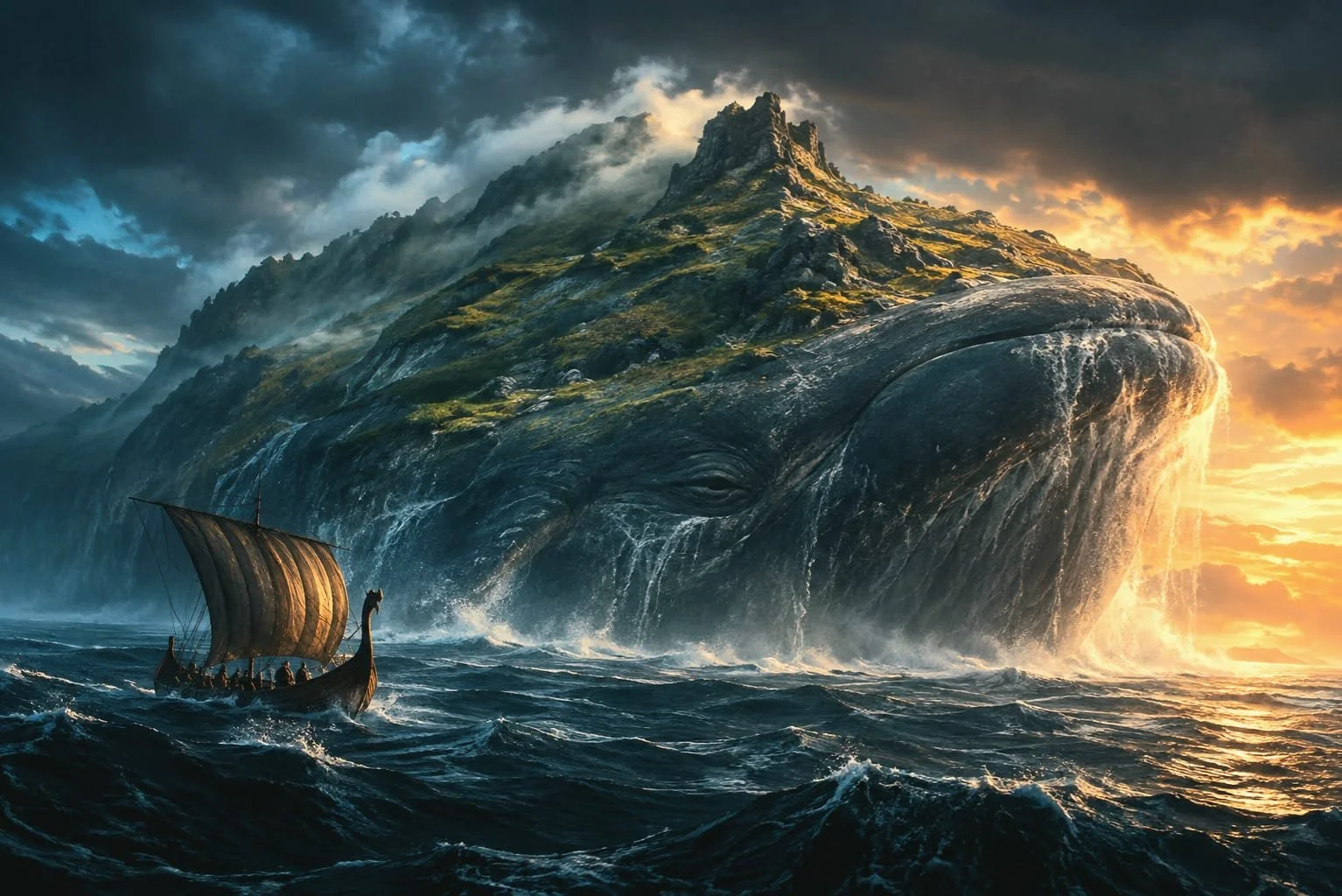
The Hidden Giant, the False Shore and the Deception of the Deep
“Not every island is stone, and not every shore is still. Beneath the northern mist, the sea may carry a back vast enough to deceive the eye and when it sinks, the world you trusted disappears with it.”
The words above are a mythopoetic reconstruction inspired by the wider northern traditions surrounding lyngbakr, monstrous whales, deceptive waters and the dangerous uncertainty of the open sea. They are not a surviving quotation from an old norse source.
***NOTE***
Lyngbakr is not one of the central gods, giants or cosmic beings of the poetic edda or prose edda. The creature is primarily preserved through medieval Icelandic saga tradition, most famously in örvar odds saga, where it appears as an enormous whale like sea creature whose vast back is mistaken for land. As with many beings preserved through saga literature, later interpretations, modern fantasy and popular retellings often expand lyngbakr far beyond what the surviving sources actually tell us. This article therefore separates the surviving folklore from later interpretation while exploring the deeper symbolic and spiritual meaning that may be drawn from the creature.
Prologue: Before the Sea Had a Map
Before the oceans were charted, before coastlines were accurately measured, before sailors possessed instruments capable of telling them precisely where they stood upon the world, the sea was not simply a route between places. It was an immense and shifting boundary, a living expanse of darkness, mist, cold, storm and uncertainty. A person could leave a known shore with confidence and discover, only days later, that every familiar certainty had been stripped away. The horizon became indistinguishable from the sky. Fog erased distance. Waves transformed themselves into hills and valleys. Floating vegetation could resemble land. Ice could appear like stone. Whales could rise from the depths like moving islands. The ocean did not merely conceal dangers beneath its surface; it could deceive the eye itself, causing a traveller to mistake threat for refuge and movement for stillness.
Within this world of uncertainty, stories of enormous sea creatures were not simply childish tales intended to frighten sailors. They expressed something much deeper about the northern understanding of the natural world. The sea was a place where the ordinary rules of perception could fail. What appeared solid might move. What seemed distant could suddenly be upon you. What looked like a harmless rise upon the horizon might possess a living body beneath it. The ocean was not an empty space waiting to be crossed by human ambition. It was a realm with its own power, its own moods and its own inhabitants, many of which were beyond the scale of human comprehension.
Among the strangest of these beings is lyngbakr, a creature whose terror does not depend upon fangs, claws or a dramatic attack. Lyngbakr is frightening because it resembles something safe. It appears as land. It offers the illusion of stability in a world of instability. Its back is so vast that sailors may mistake the creature for an island, a place where they might find rest, shelter or solid ground. Yet the island is alive. The landscape is flesh. The apparent refuge is part of the very sea they are attempting to escape.
And when the creature sinks, the illusion collapses.
The story of lyngbakr is not merely the story of a gigantic whale seekers. It is the story of false certainty, deceptive appearances and the terrifying realisation that the world may not be as still, secure or understandable as the human eye assumes. The sea does not always hide a monster beneath it. Sometimes, the sea itself becomes the monster.
The Name Lyngbakr: The Heather-Back
The Old Norse name lyngbakr is generally understood as being formed from lyng, meaning heather, and bakr, meaning back. It is often translated or interpreted as “heather back,” “heatherback” or “the creature with the heather covered back.” This is a remarkable name because it immediately connects the monster with the appearance of land. Heather is not something associated with the open ocean. It belongs to hillsides, moorlands, islands and northern landscapes. It grows upon the earth, covering the ground in low purple and green vegetation. To name a sea creature after heather suggests that its back is not merely large, but so convincing in its appearance that it resembles a piece of the natural world rising from the sea.
The name may describe the creature’s physical appearance, its resemblance to an island or the vegetation-like impression created by its enormous back. It is possible that the term reflects the way sailors might perceive a distant whale through mist and poor visibility, seeing a dark, uneven mass that appears covered in moss, grass or heather. Yet it is equally possible that the name belongs to the imaginative language of folklore, where a creature’s identity is defined not only by what it is, but by what it causes humans to believe it is.
Lyngbakr is therefore named according to deception. Its name does not primarily tell us that it is powerful, vicious or ancient. It tells us that it looks like something else. This is central to understanding this creature.
A dragon may be recognised as a dragon. A serpent may reveal itself through its shape. A wolf may announce danger through its teeth and movement. Lyngbakr is more unsettling because it does not necessarily appear monstrous at first. It appears geographical. It resembles a feature of the world rather than an inhabitant of it. It is not merely a beast in the sea; it is a beast that disguises itself as the sea’s apparent solidity.
The name “heather back” consequently carries a strange poetic tension. Heather represents land, rootedness, stillness and familiarity, while the creature beneath it represents movement, depth, uncertainty and concealed life. Lyngbakr is the collision of those two realities - the solid earth and the restless ocean, the familiar landscape and the unknowable creature, the promise of refuge and the possibility of destruction.
The Folklore of Lyngbakr: The Living Island Beneath the Northern Sea
The best known surviving account of Lyngbakr comes from the medieval Icelandic örvar odds saga, or arrow odd’s saga. This saga belongs to the legendary saga tradition, where heroic adventures, distant voyages, supernatural encounters and monstrous beings are woven into the lives of larger than life figures. The world of the saga is not presented as a systematic mythology in the same way as the eddic poems. Instead, it is a world encountered through travel, danger and extraordinary events. The supernatural often appears suddenly, at the edge of the known world, where the hero and his companions leave familiar shores and enter regions where ordinary expectations no longer apply.
During the saga’s maritime adventures, the voyagers encounter enormous sea creatures associated with the northern waters. Among these is lyngbakr, whose immense back is mistaken for land. The sailors perceive what appears to be an island or a stretch of solid ground upon the sea. The apparent land is so convincing that it becomes a possible destination, a place toward which a ship might travel. Yet the thing they have seen is not an island at all. It is the back of a living creature.
The horror of the encounter lies in the reversal of expectation. The sailors are not necessarily approaching something that looks immediately dangerous. They are approaching what appears to offer safety. The ocean is exhausting, unpredictable and hostile, and the sight of land would naturally bring relief. Land means rest. Land means food, shelter, orientation and the end of uncertainty. But lyngbakr transforms that most welcome sight into a trap of perception.
The creature’s enormous scale is essential to the story. It is not simply a whale that briefly surfaces and is mistaken for a rock. Its back is so vast that it creates the impression of a landscape. The distinction between animal and island becomes almost impossible to maintain. The sailors are not merely misidentifying a creature; they are confronted with something that challenges the categories through which they understand the world. An animal should move. An island should remain still. A whale should have a recognisable body. Land should have a horizon, vegetation and solidity. Lyngbakr confuses all of these expectations at once.
The creature’s descent into the water reveals the truth in the most terrifying way possible. The “island” does not remain where it appears to be. It sinks. The supposed ground disappears beneath the waves, exposing the sailors to the realisation that they had been looking at a living body. The event demonstrates how little control human beings possess when navigating the open ocean. A sailor may believe he has identified a safe destination, but the sea can transform that certainty into disaster in an instant.
The folklore surrounding lyngbakr is therefore built around one central image... a living creature so immense that its body becomes indistinguishable from the landscape.
It is a monster whose greatest weapon is not attack, but misinterpretation.
The False Island: When Refuge Becomes Threat
The motif of the false island is one of the most powerful elements of lyngbakr’s story. Throughout maritime folklore, there are tales of sailors approaching what they believe to be land only to discover that it is a whale, a sea creature, a floating mass or some other deceptive formation. This motif appears in different forms across northern and wider maritime traditions, but lyngbakr gives it a distinctly norse character because it emerges from a culture intimately familiar with the danger of the sea and the limits of navigation.
For a traveller at sea, the sight of land is not neutral. It is emotionally charged. It represents hope. It means that the voyage may be nearing its end. It promises a place where the body can rest and the mind can recover from the endless strain of watching waves and horizon. The false island is therefore not simply a visual mistake. It is the physical embodiment of a desperate human desire: the desire to find stability.
Lyngbakr weaponises that desire without necessarily needing to pursue anyone. The creature does not need to roar, chase a ship or strike with a monstrous limb. It only needs to exist beneath the sailors’ misunderstanding. The danger comes from the gap between appearance and reality.
This is why lyngbakr can be interpreted as a creature of false refuge. It reminds us that not everything that appears to offer safety is safe. Not every solid looking thing is stable. Not every opportunity to rest should be accepted without question. In a broader symbolic sense, the creature represents anything that appears to be a foundation but is actually unstable, deceptive or alive with forces we do not understand.
The false island is particularly meaningful in northern mythic thinking because the Norse world was full of thresholds and uncertain boundaries. The sea separated known lands from distant lands. Fog concealed the coast. Mountains could mark the edge of human habitation. The wilderness was never entirely empty. A person moving beyond familiar territory entered a world where the rules of recognition could fail.
Lyngbakr takes that uncertainty and gives it a body.
The lesson is not that one should never trust appearances, for no human being can live without perception. The lesson is that perception must be accompanied by judgement. A sailor must not merely see land; he must consider whether the land behaves like land.
Is it still? Does it have a shoreline? Does it remain in the same place? Does the water move around it naturally? Does it cast the expected shadow? Does it possess the signs of a genuine island?
The story turns navigation into a moral and intellectual discipline. Survival depends upon refusing to confuse what one hopes to see with what is actually present.
The Back That Became a Landscape
Lyngbakr’s back is the heart of the creature’s identity. It is not simply large; it is landscape like. This is an important distinction. The monster’s size is so extreme that it ceases to be perceived as an animal and begins to be perceived as geography. Its body crosses the boundary between creature and environment.
In most monster stories, the beast enters the landscape as something foreign. It moves through forests, attacks settlements or rises from a cave. Lyngbakr is different because the landscape itself is the beast. The sea appears to contain an island, but the island is actually alive. The ground is not ground. The horizon is not what it seems. The natural world has become animate in a way that human beings cannot immediately recognise.
This connects the lyngbakr to a wider northern imagination in which the boundaries between land, animal, spirit and giant are often unstable. Mountains may be associated with giants. Rocks may be transformed beings. Islands may carry stories of sleeping creatures. The world is not always divided into neat categories of “living” and “non living.” A thing that appears inert may possess hidden agency, while a creature may become so large that it resembles a feature of the earth.
Lyngbakr represents this uncertainty on a colossal scale.
Its back is a landscape without being land. It is a body that masquerades as terrain. The creature suggests that the world is not necessarily made of passive objects waiting to be used by humanity. Even the apparent ground beneath one’s feet may possess a will, a movement and a hidden life beyond human control.
There is also a profound sense of scale here. Human beings understand bodies through proportion. We know what a person looks like, what a horse looks like, what a whale looks like. But lyngbakr is beyond ordinary proportion. Its size exceeds the normal relationship between animal and observer. A human standing upon its back would not feel as though they were standing upon an animal. They would feel as though they were standing upon an island.
This is where the creature becomes almost cosmic without being a cosmic serpent like jörmungandr. Lyngbakr does not need to encircle the world. It only needs to become too large for the human mind to process properly.
Its terror is the terror of encountering something that cannot be held within familiar categories.
Lyngbakr and Hafgufa: Two Different Monsters of the Northern Sea
Lyngbakr is frequently mentioned alongside hafgufa, another enormous sea creature found in medieval norse literature.(Another creature we have covered before.) Because both beings are associated with gigantic marine monsters, modern retellings sometimes merge them into one creature or treat them as interchangeable names for a norse kraken. However, it is important to distinguish them.
Lyngbakr is primarily associated with the image of the false island - an enormous back mistaken for land, a living mass that appears stationary and geographical. Its terror comes from deception, scale and mistaken refuge.
Hafgufa, by contrast, is often described in traditions as a more actively predatory sea monster. In accounts associated with northern maritime lore, hafgufa is connected with the image of a gigantic creature whose mouth may resemble a fjord or inlet. It is sometimes said to attract prey through foul breath or by creating the impression that something edible is present in the water. Ships or creatures drawn toward it may discover too late that what looked like an opening in the sea was the mouth of a monster.
The difference is symbolically significant. Lyngbakr is the false island. Hafgufa is the false opening. Lyngbakr deceives through apparent solidity; hafgufa deceives through apparent emptiness or invitation. One looks like land. The other may look like a natural feature of the water. Both are examples of the sea becoming deceptive, but they represent different forms of danger.
Lyngbakr says: “What appears stable may be alive.”
Hafgufa says: “What appears open may be waiting to consume you.”
They belong to the same broad imaginative environment, but they should not be treated as identical. The norse sea monster tradition was not necessarily a fixed catalogue of species with clear biological classifications. These creatures emerged through stories, descriptions, regional traditions and literary imagination. Their forms could overlap, but their narrative functions were different.
Lyngbakr is especially important because it represents the monstrous landscape, while Hafgufa represents the monstrous appetite.
One is the island that sinks.
The other is the opening that swallows.
Lyngbakr in the Wider Norse Sea-Monster Tradition
The northern seas were filled with creatures both real and imagined. Medieval scandinavian writers knew of whales, seals, sharks, strange fish, serpents and enormous marine animals. Whales could appear in many different forms within literature, sometimes as ordinary animals, sometimes as omens, sometimes as dangerous beasts and sometimes as creatures whose size challenged the limits of description. The distinction between natural history and supernatural folklore was not always as rigid as it is today.
In medieval thought, an animal did not have to be entirely imaginary to become monstrous. A real creature could become legendary through distance, fear, rarity and exaggeration. A whale seen briefly through fog might become larger in memory than it had been in life. A strange carcass washed ashore could generate stories of unknown beasts. A storm, an optical illusion or a floating object could become the foundation of a tale about a living island or a serpent beneath the waves.
Yet reducing lyngbakr to “a misunderstood whale” would miss the point of the story. Folklore does not survive merely because it records an animal inaccurately. It survives because it expresses a meaningful fear or insight. Lyngbakr gives shape to the experience of being at sea and discovering that the world cannot always be trusted to appear as it is.
The wider norse sea monster tradition reflects a worldview in which the ocean was not fully known or controlled. Beyond the coastline lay immense waters, distant islands, dangerous currents, storms and regions where sailors could disappear without explanation. The sea was a place of commerce and opportunity, but also a place where men could vanish, ships could be broken and entire expeditions could be lost. Sea monsters gave narrative form to those dangers.
They were not necessarily believed in by every sailor in the same way, nor were all accounts intended as literal descriptions. But they allowed people to speak about the ocean’s hostility, mystery and scale. They turned the unknown into something that could be named, remembered and passed from one generation to another.
Lyngbakr belongs to this tradition as the monster of deceptive magnitude. It is the ocean’s ability to create an illusion so convincing that even experienced travellers might mistake danger for salvation.
The Ocean as a Living Boundary
In norse cosmological imagination, the sea was never merely a blank space. It was a boundary between worlds, a region associated with giants, serpents, storms, death, wealth and uncertainty. The gods themselves are connected to the sea through beings such as Ægir and Rán, while njörðr represents the wealth and prosperity of seafaring, wind and maritime fortune. The ocean could provide abundance, but it could also claim lives without explanation.
Lyngbakr emerges naturally from this worldview. It is a creature of the boundary, neither entirely part of the land nor entirely separate from it. It belongs to the sea, yet it imitates the earth. It is an inhabitant of the deep that presents itself as a piece of the surface world.
This makes lyngbakr a deeply liminal being. It occupies the threshold between land and water, animal and landscape, movement and stillness, safety and danger. It is not simply “in” the sea. It challenges the distinction between what the sea contains and what the sea appears to be.
The ocean in northern tradition is often portrayed as a place where human beings encounter forces older and greater than themselves. It is not necessarily evil, but it is indifferent to human expectation. A storm does not hate a sailor. A wave does not seek revenge. A whale does not need to understand a ship in order to destroy it. The danger comes from the difference between human vulnerability and the immense scale of the natural world. Lyngbakr clealry embodies that difference.
It does not need to be malicious in the human sense. Its mere existence is enough to threaten those who misread it. The creature may not even understand that sailors are approaching its back. Its danger is not necessarily intentional cruelty, but the overwhelming consequences of human ignorance.
This is an important distinction. Many modern fantasy depictions turn sea monsters into villains with motives, personalities and deliberate hostility. Lyngbakr is more ancient and more unsettling than that. It represents a world that does not need to hate humanity in order to destroy it.
The sea is not wicked. The sea is vast. And vastness alone can be absolutely terrifying.
The Failure of Perception
One of the deepest themes within the lyngbakr story is the unreliability of human perception. The sailors see land because their minds interpret the shape before them according to what they expect or need. Their eyes provide information, but their minds complete the image. The ocean offers a vague form, and the human imagination turns it into an island.
This is not simply stupidity. It is how perception works. Human beings interpret incomplete information through memory, expectation and desire. A person lost at sea may be more likely to perceive land because they desperately want land to be there. A traveller exhausted by waves may see a dark shape and assume it is a shoreline. Hope can influence vision. Lyngbakr becomes a mythic expression of this psychological vulnerability.
The creature warns that people do not always see what is present. They see what their minds are prepared to recognise. A sailor expects land to appear as a distant mass, so the creature’s back becomes land. A person seeking rescue may mistake danger for salvation. A person desperate for certainty may force uncertainty into a familiar shape.
This symbolism extends far beyond maritime travel. Lyngbakr can represent false assumptions, misleading appearances, deceptive promises and the human tendency to turn the unknown into something comfortable. It asks whether we are truly seeing the world or merely seeing what we wish the world to be.
The story is especially powerful because the deception is not necessarily created by an enemy. The sailors may deceive themselves. The creature simply exists, and their expectations do the rest.
There is a warning here for anyone who travels through unfamiliar territory, whether physically, spiritually or emotionally. When the world becomes uncertain, the desire for certainty can become dangerous. We may cling to the first explanation that makes us feel safe. We may call something a foundation simply because we need somewhere to stand. We may mistake a temporary appearance for a permanent truth.
Lyngbakr teaches the importance of patience before commitment.
Look again. Wait. Observe whether the thing before you behaves according to what you believe it to be. Not every apparent island is land. Not every promise of safety is refuge.
The Living Landscape
The idea of a living island is one of the oldest and most haunting motifs in maritime folklore. Across different cultures, sailors have encountered stories of enormous creatures whose bodies were mistaken for land. Some traditions speak of giant fish, whales or sea beasts so large that vegetation grows upon their backs. Others describe islands that move, sleep, sink or awaken. These stories blur the distinction between the natural environment and the creatures within it.
Lyngbakr is a northern expression of this ancient motif, but it carries a particular atmosphere because of its connection to heather. Heather belongs to the harsh landscapes of the north - moorland, windswept hills, rocky islands and remote coastlines. It is a plant associated with endurance, survival and the rugged beauty of northern terrain. To place heather upon the back of a sea monster is to create an image of land carried upon the ocean.
The creature becomes a moving piece of the homeland. It is as though a fragment of the northern landscape has broken free from the earth and begun to wander beneath the waves. The familiar world is no longer fixed in place. The island is not anchored. The land itself has become mobile, and therefore unreliable.
This may be interpreted as a reflection of the northern experience of island geography. In Scandinavia and Iceland, land and sea are closely intertwined. Islands, skerries, fjords and rocky outcrops dominate the landscape. A sailor’s survival depends upon distinguishing real land from dangerous shallows, reefs and illusions. The idea of an island that is not truly an island would have carried a very specific terror.
Lyngbakr transforms the coastline into something that cannot be trusted.
The creature reminds us that even the landscape may have hidden depths. A mountain can conceal a giant. A cave can contain a monster. A rock can be a transformed being. An island can be alive. The world is not always passive scenery. It may possess an existence beyond the human gaze.
The Ship as Human Order
The ship is one of the most important symbols in the Lyngbakr story. A ship represents human order imposed upon the chaos of the sea. It is built through craftsmanship, cooperation and knowledge. Its timber is shaped into a vessel capable of carrying people across an environment that would otherwise be deadly. A ship is a declaration that humanity can enter the ocean without immediately being consumed by it. But the ship remains fragile.
It floats because of carefully balanced design, yet a single wave can overturn it. It travels through a vast realm that it does not control. Its crew may possess experience, weapons and courage, but none of these things make the ocean subject to human command.
Lyngbakr represents the moment when that human order encounters something beyond its calculations. The sailors believe they have found land, and their understanding of the voyage changes. They may alter their course, approach the apparent island or prepare for rest. But the creature reveals that their interpretation of the environment was false.
The ship is not defeated by brute force.
It is defeated by mistaken knowledge.
This makes lyngbakr particularly relevant to the heroic ideals of the sagas. Courage alone is not enough. Strength alone is not enough. A warrior may be fearless in battle and still perish through poor judgement at sea. The monster tests perception, restraint and the ability to recognise the limits of one’s own understanding.
The ship is human order. Lyngbakr is the reminder that the world beyond the ship remains greater than the order carried within it.
Lyngbakr and Jörmungandr: The Difference Between Cosmic and Maritime Monsters
It is tempting to compare lyngbakr with jörmungandr, the midgard serpent, because both are enormous creatures associated with the sea. Yet they represent very different forms of monstrosity.
Jörmungandr is a cosmic being. It encircles midgard, exists on a scale connected to the structure of the world and is woven into the destiny of the gods. Its struggle with thor belongs to the ultimate conflict between divine order and the forces that will emerge during ragnarök. Jörmungandr is not simply an animal encountered during a voyage. It is a world serpent whose existence has cosmic significance.
Lyngbakr is more local, more ambiguous and more connected to the practical dangers of maritime travel. It does not encircle the earth. It does not have a defined role in ragnarök. It is not presented as a central enemy of the gods. Instead, it appears in the uncertain waters of heroic saga, where sailors must navigate a world full of strange and dangerous things.
Jörmungandr represents the threat that lies at the foundations of the cosmos. Lyngbakr represents the threat that lies beneath an apparently ordinary voyage. Jörmungandr is the serpent beneath the world. Lyngbakr is the island beneath the illusion.
This difference matters because it prevents us from inflating Lyngbakr into something the sources do not establish. Lyngbakr is not secretly another name for jörmungandr, nor should it be treated as a forgotten primordial deity without evidence. Its power lies in its own specific narrative function. It is a creature of the sea’s deceptive surface, a being whose enormous body turns perception into danger.
The Monster Beneath the Horizon
The horizon is one of the most psychologically powerful features of the sea. On land, the horizon is interrupted by trees, buildings, hills and mountains. At sea, the horizon can become almost perfectly continuous. The sky and water meet in a line that seems both close and impossibly distant. Anything beyond that line is hidden. A ship may approach from nowhere. A storm may rise from an apparently clear horizon. A creature may surface without warning.
Lyngbakr belongs to this space beyond the horizon. It is not necessarily a monster that lives in a known cave or guards a particular treasure. It is encountered in the open waters, where the world is too large to be fully observed. It represents the possibility that something immense may exist just beyond the limits of sight.
This is a recurring fear in maritime folklore: the knowledge that the visible world is only a fraction of what surrounds the traveller. The surface of the sea may appear calm, but beneath it is depth. The horizon may appear empty, but beyond it are storms, islands, creatures and unknown shores. The sailor is surrounded by what cannot be seen.
Lyngbakr gives that invisible magnitude a form. Its body is hidden not because it is small, but because it is too large to be recognised correctly. The creature is not concealed in the ordinary sense. It is visible, yet misunderstood. This makes it more unsettling than a hidden monster lurking beneath dark water. The danger is not simply that something is unseen. The danger is that something can be seen and still remain unknown.
The Sea’s Refusal to Be Owned
Human beings have always attempted to name, map and control the world. Naming a thing makes it easier to understand. Mapping a place makes it easier to navigate. Measuring a distance makes it easier to cross. Yet the sea repeatedly resists these efforts. It shifts, changes, conceals and reveals. Its boundaries are never entirely fixed. Its depths cannot be fully observed from the surface. Lyngbakr is an embodiment of that resistance.
The sailors may believe they have identified a piece of land, but the creature refuses to remain within their map. It is not where they think it is. It does not behave according to the category they have assigned to it. It cannot be possessed simply because it has been seen. The creature exposes the arrogance of assuming that everything encountered must be immediately understandable.
In this sense, lyngbakr can be read as a guardian of the unknown, though not necessarily a conscious guardian in the manner of a mythic gatekeeper. It does not have to deliberately protect the sea’s mysteries. Its very existence demonstrates that the ocean contains realities beyond human ownership.
The creature says, in effect:
You may cross the sea, but you do not command it. You may observe the horizon, but you do not possess everything beyond it.
You may name the waters, but naming them does not make them yours. You may build ships, but you remain dependent upon forces greater than your craft.
Lyngbakr is not necessarily an enemy of humanity. It is a reminder of humanity’s proper scale.
The Deeper Fear: Being Swallowed by the World Itself
Many monsters threaten human beings from outside. They attack from the forest, the cave, the mountain or the sea. Lyngbakr creates a more profound kind of fear because it makes the environment itself uncertain. The sailors are not merely threatened by something entering their world. They discover that the world they thought they understood was never what they believed.
The island is not an island. The ground is not ground. The apparent refuge is not refuge.
The landscape is alive.
This can be interpreted as the fear of being swallowed not merely by a creature, but by reality itself. The sailors’ mistake reveals how fragile the categories of the world can be. The distinction between land and animal collapses. The boundary between solid and fluid disappears. The thing they thought would support them becomes the thing that threatens to take them beneath the waves.
There is something deeply existential in this image. Human beings depend upon stable categories to feel secure. We need to believe that the floor is solid, that the shore is fixed, that the road leads somewhere, that the world will remain recognisable from one moment to the next. Lyngbakr disrupts that trust.
It reminds us that stability may be temporary.
The world may appear still because we have not yet seen it move.
Natural Inspirations and the Limits of Explanation
It is entirely possible that lyngbakr’s folklore was influenced by real maritime experiences. Large whales can be astonishingly difficult to judge in size when seen at a distance. A whale’s back may rise above the water in a broad, dark curve. Through fog or poor light, it might appear like a rock or low island. Floating vegetation, driftwood, ice formations, reefs and distant skerries could also create confusion.
The northern seas were especially suitable for such stories. Fog, storms, low light and long periods of travel could distort perception. Sailors were often exhausted, cold and eager for land. A vague shape upon the horizon could easily become something more definite in the mind.
But natural explanations should not be used to dismiss the folklore. Saying that Lyngbakr may have originated from whale sightings does not erase its symbolic importance. Myths and legends often begin with real experiences but develop into stories that express cultural fears, values and questions. A whale may have inspired the image, but the story became something more than an account of an animal.
Lyngbakr is not important merely because someone may once have mistaken a whale for an island. It is important because the story captures a universal truth - human beings can mistake danger for safety when they are desperate to find certainty.
The natural explanation and the symbolic explanation can exist together. One concerns how the story may have originated. The other concerns why the story endured.
Medieval Saga Tradition and Christian Literary Influence
As with many creatures preserved in Icelandic saga literature, lyngbakr must be approached through the surviving medieval texts rather than through assumptions about an untouched pre christian mythology. The sagas were written down in christian Iceland, often centuries after the periods they describe. Their authors inherited older oral traditions but shaped them through literary conventions, heroic storytelling and the intellectual world of medieval christianity.
This does not mean that lyngbakr is meaningless as a pre christian survival. It means that we must be cautious. The creature does not come to us through a complete pagan religious system with known rituals, prayers or cult practices. We do not possess evidence that lyngbakr was worshipped as a deity, invoked as a spirit or understood by all norse people in exactly the same way.
What we have is a literary survival of a sea monster motif within a saga tradition.
That is still valuable.
The sagas preserve fragments of the imaginative world of northern seafarers: their fears of distant waters, their awareness of strange creatures, their understanding of the sea as a dangerous boundary and their willingness to populate the unknown with beings of extraordinary scale. The christian authors may have shaped the presentation, but the underlying imagery belongs to a much older environment of maritime uncertainty.
Lyngbakr should therefore neither be dismissed as “merely medieval fiction” nor falsely elevated into a fully documented pagan god. It stands in the middle ground: a legendary sea creature preserved in medieval literature, carrying older northern ideas about the ocean, danger, perception and the limits of human knowledge.
Lyngbakr as a Creature of Thresholds
Lyngbakr belongs to several thresholds at once. It exists between sea and land, animal and landscape, movement and stillness, reality and illusion. It appears at the point where the known world begins to dissolve into the unknown. It is encountered not in the safety of a settlement, but during a journey beyond familiar boundaries.
This makes the creature deeply liminal.
Threshold beings often appear in folklore when a person is leaving one state of existence and entering another. A traveller crosses a bridge, enters a forest, approaches a mountain, journeys across the sea or passes from life into death. The threshold is dangerous because the old rules may no longer apply. Lyngbakr appears during such a transition: the sailors have left the known shore and entered a realm where ordinary categories cannot be trusted.
The creature may therefore be understood as a symbol of transition itself. It appears when people are between destinations, between certainty and uncertainty, between safety and danger. It is the living embodiment of the moment when a person realises that they have gone farther from home than they truly understand. The sea is a threshold between worlds. Lyngbakr is the threshold made flesh.
What Lyngbakr Teaches About Wisdom
The story of lyngbakr does not primarily celebrate physical strength. A warrior cannot defeat an island by striking it with a sword. A ship cannot overpower the sea through courage alone. The correct response to the creature is not simply aggression, but recognition.
This makes lyngbakr a creature of wisdom rather than warfare. Its lesson is that survival depends upon knowing when perception is incomplete. The wise traveller does not rush toward every apparent opportunity. They do not mistake hope for evidence. They do not allow desperation to dictate judgement. They understand that the world may contain things that cannot be immediately classified.
In a broader spiritual sense, lyngbakr teaches humility before the unknown. It reminds us that the world is greater than our current understanding and that the desire to possess certainty can become a danger in itself. Sometimes wisdom means slowing down. Sometimes it means questioning what appears obvious. Sometimes it means accepting that the safest course is not to approach the thing that promises relief.
The creature asks:
What have you assumed to be solid?
What have you accepted without examination?
Where have you mistaken desire for truth?
What appears to be a refuge in your life, but may actually be unstable?
Lyngbakr does not need to be interpreted as a literal spiritual being to carry these questions.
Its story is powerful precisely because it transforms an experience of maritime danger into a lesson about human judgement.
The Folkloric Image of the Sleeping Giant
Although the surviving accounts do not provide lyngbakr with an elaborate biography, later imagination often develops the creature as a sleeping giant beneath the sea, carrying vegetation upon its back and remaining motionless for long periods. This is a natural expansion of the false island motif. If its back resembles land, then it is easy for later storytellers to imagine moss, grass, heather or even small ecosystems growing upon it.
Such expansions should be recognised as later imaginative development rather than treated as firmly established details from the original sources. Nevertheless, the image is poetically consistent with the creature’s role.
A sleeping lyngbakr becomes the ultimate expression of concealed magnitude... something so enormous that the world mistakes its body for part of the environment. The sleeping giant also introduces another powerful idea - the danger of disturbing what appears dormant.
A sailor may believe the island is dead, still and harmless. But it is merely sleeping or submerged. The movement that follows is not an attack in the ordinary sense; it is the awakening of something whose existence was never dependent upon human awareness.
This image reflects a broader northern respect for sleeping forces. Mountains, forests, caves, burial mounds and ancient places may contain beings whose stillness should not be confused with absence. The world is full of powers that do not need to announce themselves constantly.
Lyngbakr’s silence is part of its terror.
It does not need to move to be dangerous.
Its stillness is what makes the deception possible.
Lyngbakr and the Modern Kraken Image
In modern popular culture, lyngbakr is sometimes merged with the broader image of the kraken...a gigantic tentacled sea monster capable of dragging ships beneath the waves. This comparison is understandable because both belong to the family of enormous maritime creatures. However, lyngbakr’s original identity is different.
The kraken is generally associated with tentacles, grasping limbs and active attacks upon ships. Lyngbakr is associated with its enormous back and its resemblance to land. The kraken is a predator that reveals its monstrous nature through movement and attack. Lyngbakr conceals its nature through apparent stillness.
Modern fantasy may combine these features, creating a giant whale like creature with tentacles, vegetation and island like proportions. Such imagery can be visually impressive, but it should not be mistaken for the exact surviving folklore. Lyngbakr’s distinctiveness lies in its simplicity it is terrifying because the sailors cannot initially tell that it is a creature at all.
The monster does not need to look monstrous. That is the point.
Why Lyngbakr Is More Than “Just a Giant Whale”
To call lyngbakr a giant whale is not entirely wrong, but it is incomplete. The creature may indeed belong to the broad category of enormous whale like sea monsters. Yet its narrative purpose goes beyond zoology. It is a story about mistaken identity, deceptive appearances, the emotional power of landfall and the dangers of navigating an environment that cannot be fully understood.
A normal whale is an animal. Lyngbakr is an experience.
It is the experience of seeing safety where danger exists. It is the experience of approaching something that does not behave according to its appearance. It is the experience of discovering that the landscape is not passive and that the ocean can conceal its inhabitants in plain sight.
Its significance lies not only in what it is, but in what it does to the minds of those who encounter it. Lyngbakr turns perception into a trial.
Research Guide: Where to Begin with Lyngbakr
Those wishing to study lyngbakr should begin with örvar odds saga, paying close attention to the maritime episodes and the descriptions of the monstrous creatures encountered during the voyage. Different translations may render the creature’s name and details differently, so it is useful to compare more than one translation where possible. The old norse term lyngbakr should also be examined etymologically, particularly the relationship between lyng, “heather,” and bakr, “back.”
It is also valuable to study the passages concerning Hafgufa, while maintaining a clear distinction between that creature and lyngbakr. Their proximity within discussions of northern sea monsters makes them easy to merge, but their narrative functions differ considerably. Broader reading in medieval Icelandic literature, including works that describe whales and strange sea creatures, can help place lyngbakr within the wider maritime imagination of the North.
Comparative folklore may also be useful. The motif of a whale or sea creature mistaken for an island appears in various maritime traditions, including stories connected with the ancient concept of the island whale or aspidochelone. These parallels do not prove that every tradition derives from the same source, but they demonstrate how widespread the fear of deceptive land at sea has been.
Research should always distinguish between the surviving medieval material and modern fantasy additions. Details such as vegetation covered backs, entire forests growing upon the creature, deliberate attacks upon ships or divine origins may be imaginative expansions rather than securely documented elements of the original lyngbakr tradition.
The most rewarding study of lyngbakr is not simply an attempt to discover “what the monster looked like.” It is an examination of why northern storytellers imagined a creature whose body could be mistaken for the earth itself.
Questions for Further Reflection
What does it mean that lyngbakr’s greatest danger comes from being mistaken for something safe rather than from appearing openly hostile?
Why is the false island such a powerful image in maritime folklore?
Could lyngbakr represent the danger of allowing desperation to influence perception?
How does the creature reflect the realities of medieval northern seafaring, where fog, distance, fatigue and unfamiliar waters could distort judgement?
What is the significance of the name “heather back,” and how does the imagery of heather connect the creature to the northern landscape?
How does lyngbakr differ symbolically from hafgufa, jörmungandr and later kraken traditions?
Does lyngbakr function as a guardian of the unknown, or is it better understood as an indifferent force whose existence exposes human limitations?
What does the creature teach us about the difference between seeing something and understanding it?
Where in modern life do people mistake apparent stability for genuine safety?
What “islands” do we approach in our own lives without first asking whether they are truly solid?
Final Reflection: The Island That Was Never Land
Lyngbakr is one of the most haunting creatures in the northern maritime imagination because it does not need to behave like a conventional monster. It does not need horns, claws, fire or a terrible roar. It only needs to rise beneath the mist in the shape of something familiar. It only needs to allow the human eye to make the wrong assumption.
The creature’s back becomes an island because the sailors need an island to be there. Their minds transform an uncertain shape into a promise of safety. But the promise is false. The island is alive. The ground moves. The refuge sinks.
In this way, lyngbakr becomes a symbol of the dangers hidden within certainty. It reminds us that human beings often interpret the world through hope, fear and expectation. We see what we are prepared to see. We approach what we believe will save us. We trust appearances because the alternative is to remain uncertain.
Yet the unknown cannot always be made comfortable. The sea does not owe us clear signs. The world does not promise that every apparent foundation will hold. The thing we believe will carry us is already moving beneath us.
Lyngbakr teaches that wisdom is not the absence of fear. It is the ability to pause before fear or desire dictates our judgement. It is the discipline to look again. It is the humility to recognise that the world contains forms of life, power and mystery far beyond the limits of human understanding.
The creature is not simply the monster beneath the sea. It is the warning beneath appearances. It is the living island. The false shore. The hidden giant beneath the horizon.
Invocation to Lyngbakr
O lyngbakr, heather back of the northern waters, Ancient shape beneath the mist,
Living island beneath the uncertain sea,
You who remind the traveller that appearances may deceive, Teach us to look beyond the first shape our eyes provide.
Let us not mistake desperation for wisdom.
Let us not call unstable ground a foundation.
Let us not rush toward every promise of refuge. Let us remember that the unknown is not made smaller by our assumptions.
May we carry humility across uncertain waters. May we recognise the difference between what is seen and what is understood. May we respect the forces greater than ourselves. And may we never forget that even the quietest horizon may conceal a world beyond our imagining.
The Last Lesson of Lyngbakr
Not everything that looks like land can bear your weight. Some things appear stable only because they have not yet moved. Some promises look like refuge only because we are desperate to believe in them. Some dangers do not announce themselves with violence; they wait beneath the shape of something familiar.
Lyngbakr teaches us to question appearances without becoming paralysed by suspicion. It teaches us to observe before approaching, to think before trusting and to remember that the world is deeper than the surface it presents.
The wise traveller does not fear every island.
The wise traveller asks whether the island is truly land.
🔥 Wyrd & Flame 🔥
Lyngbakr is the living island beneath the northern sea, the hidden giant whose back becomes landscape and whose stillness becomes deception. It belongs to the old maritime imagination of the North, where the ocean was not empty, the horizon was never entirely trustworthy and the unknown could take the shape of something comforting before revealing its true nature.
May we learn from lyngbakr to respect the unseen, question the obvious and recognise that not every apparent refuge is meant to carry us.
For the sea is deep, the world is wide, and the greatest dangers are not always those that look like monsters.
Sometimes, they look like home.
Heil the mysteries beneath the waves.
Heil the wisdom to look twice.
Heil the strength to stand upon what is truly solid.
Heil lyngbakr, the Heather Back, the Living Island and the Hidden Giant of the Northern Sea.
