
Before the rise of the Norseman - Runic History
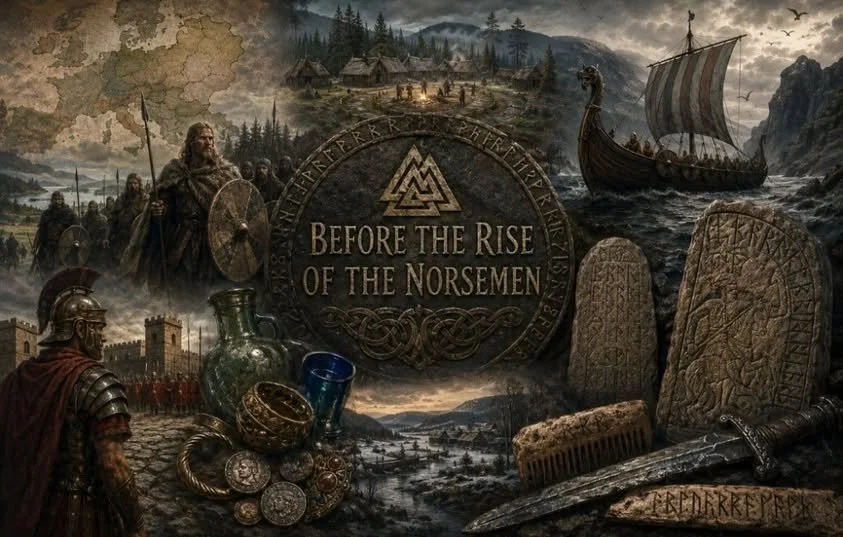
The origins of these peoples lay deep in prehistory. By the time Rome encountered them, they were the descendants of many earlier migrations: farmers who had moved north from southern Europe during the Neolithic; Indo-European herders from the Eurasian steppe who brought with them new languages and social structures more than two thousand years earlier; and the old hunter-gatherer bands who had lived in the northern forests since the end of the Ice Age. Over time, these different groups mixed and settled into what the Romans came to recognise as the Germanic tribes.
Roman authors, who delighted in naming and cataloguing their neighbours, left us with the identities of many of these groups. They wrote of the Cherusci, who famously ambushed three Roman legions in the Teutoburg Forest, and of the Marcomanni and Alemanni, who pressed constantly against the empire’s borders. They told of the Chatti, Chauci, Frisii, and Suebi, each with their own leaders and customs. Further north, at the edges of Roman knowledge, they recorded the Suiones and the Sitones - names that many historians believe may point to the early ancestors of the Scandinavian peoples. Yet it is impossible to draw a single, unbroken line from any one of these tribes to the later Norse. They moved, they split, they merged, they vanished - shaped by centuries of migration, war, and survival.
Although Rome never conquered Scandinavia, its influence reached far beyond the empire’s frontiers. Goods from the south (coins, glassware, and fine jewellery) have been unearthed in Scandinavian graves, proof of trade routes stretching across forests and seas. Germanic warriors sometimes fought for Rome as mercenaries, bringing home not only wealth but also new ideas of tactics, equipment, and prestige. Even those who opposed Rome absorbed its presence, for conflict as well as trade carried elements of Roman culture northward.
It was during this time that one of the most significant developments of early northern Europe appeared: the runic script. The earliest known system, the Elder Futhark, emerged in the second century. Its shapes were clearly inspired by the alphabets of the Mediterranean world, most likely Latin or North Italic scripts encountered through contact with Rome. But the runes were no mere imitation. They were adapted to the sounds of the Germanic tongue and carved with straight, angular lines suited to wood, bone, and stone. Unlike Roman letters, which recorded laws, histories, and vast chronicles, runes were often brief and powerful - names, dedications, charms, or memorials. They carried both sound and symbolic meaning, becoming at once a tool of communication and an expression of belief.
The centuries between 300 and 700 were marked by upheaval across the continent in what is known as the Migration Period. Pressed by the arrival of the Huns from the east and drawn by the weakness of a declining Rome, tribes moved in great waves, reshaping the map of Europe. The Goths, Vandals, and Lombards carved out kingdoms in former Roman lands, while others disappeared into history’s shadows. In the north, the peoples who would become the Norse remained beyond Rome’s grasp, but they were not isolated. Trade, mercenary service, and the shifting tides of migration all touched them, shaping their world and laying the foundations for the culture that would later flourish in the so-called Viking Age.
Life in these lands was demanding. Small farming settlements dotted the landscape, each household tied to kin and clan. Power rested with local chieftains who ruled by strength, reputation, and generosity rather than by decree. Honour and loyalty were vital, for in a world without central authority it was reputation that bound men to their leaders and communities together. Oral tradition carried stories and memory across generations, but slowly the runes began to fix words in a more permanent form. Each carved inscription was a voice from the past, a fragment of thought preserved against the silence of time.
Among the earliest of these voices is the Svingerud Stone, discovered in Norway and dating to the early second century. It is the oldest known runestone, proof that the art of writing had already reached Scandinavia long before the Viking Age. Its carved symbols are faint, but they tell us that the people of the north had begun to experiment with the permanence of words, setting their language into stone even as their lives moved with the seasons.
The Norse who would later set sail across Europe did not appear suddenly, nor did they emerge from isolation. They were the heirs of centuries of movement and exchange, of tribal wars and encounters with the empire that loomed to the south. Their runes, their warrior traditions, their sense of honour and kinship - all were shaped in these early centuries of flux and contact. To understand them is to look beyond the age of the Vikings, into the deeper roots of the Germanic world from which they grew.
Between the 3rd and 7th centuries CE, Europe experienced what historians call the Migration Period, a time of immense upheaval during which many different peoples moved across the continent. Germanic groups such as the Goths, Vandals, Franks, Saxons, Burgundians, and Lombards shifted into new territories, while non-Germanic groups (including the Huns, Slavs, and Avars) also played major roles in reshaping Europe. These migrations were driven by a combination of pressures: population growth, environmental change, pressure from nomadic groups advancing from the east, and, above all, the gradual weakening of Roman political and military control.
The Germanic tribes were never a single, united people, but they became formidable opponents (and at times allies) of Rome. Some groups were settled within Roman territory as federates, tasked with defending imperial frontiers, while others launched raids or large-scale invasions. The Visigoths sacked Rome in 410 CE; the Vandals seized North Africa and later Rome itself in 455 CE; the Ostrogoths established a kingdom in Italy; and the Lombards followed them a century later. The Franks gained power in Gaul, creating a realm that would later develop into medieval France, while the Anglo-Saxons established themselves in Britain.
Far from extinguishing these groups, Rome’s wars and treaties often strengthened them. Germanic leaders adopted elements of Roman administration, military organisation, and even religion, blending them with their own traditions to create enduring states on former imperial soil. The symbolic end of the Western Roman Empire came in 476 CE, when the last emperor, Romulus Augustulus, was deposed by the Germanic military leader Odoacer. From that point onward, the political centre of gravity in western Europe shifted to these new kingdoms.
During this same period, the runic alphabet known as the Elder Futhark was already in use. The earliest inscriptions, appearing in the 2nd century CE, show that Germanic peoples had adapted writing for their own purposes. These inscriptions are found on everyday objects such as combs and weapons, as well as on stones, and they range from personal names to symbols whose meanings are still debated. The runes could serve practical functions, such as marking ownership, but their presence in ritual and funerary contexts suggests that they were also invested with symbolic or magical significance.
By the late 7th and 8th centuries, linguistic change made the Elder Futhark’s 24-character system less suited to the evolving sounds of Old Norse. This led to the development of the Younger Futhark, a reduced set of 16 characters. The simplification made carving faster and reflected phonological shifts in the spoken language. Several runes (such as Eiwaz, Ingwaz, Dagaz, and Jera) were no longer required and were dropped from the system.
The transition from Elder to Younger Futhark illustrates how adaptable the runic tradition was, evolving in step with the societies that used it. From its origins during the Roman period to its flourishing in the Viking Age, the runic script remained deeply connected to both communication and cultural identity. These inscriptions provide us not only with names and words, but also with a glimpse of how early Germanic and Norse peoples understood writing itself.
Many people mistakenly believe that the Elder Futhark was the runic system used during the Viking Age, but this is not the case. The Elder Futhark, consisting of 24 runes, was primarily in use from around the 2nd century to the early 8th century CE. It predates the Viking Age by several centuries and is generally associated with early Germanic tribes during the Roman Iron Age and the Migration Period. By the time the Viking Age began in the late 8th century, the Elder Futhark had evolved into the Younger Futhark, a reduced system of only 16 runes.
Despite having fewer symbols, the Younger Futhark was required to represent a greater range of sounds, reflecting changes in the Old Norse language. It became the dominant runic system of the Norse and was the script in use throughout the Viking Age.
The runic system was primarily phonetic, meaning that each rune represented a sound (phoneme) that could be combined to form words. However, unlike modern alphabets, each rune also had a name and carried symbolic or mystical associations. For example, the rune fehu (ᚠ) meant “cattle” but symbolised wealth and prosperity, while tiwaz (ᛏ), linked to the god Tyr, represented justice, honour, and battle.
This dual nature of the runes (both practical letters and carriers of symbolic meaning) has led some to compare them with logographic systems such as Chinese characters. Strictly speaking, however, runes were not logographic; they were alphabetic, but infused with layers of cultural, spiritual, and magical significance.
The original function of the runes has long been debated among scholars. Some believe that the earliest uses of Elder Futhark inscriptions were magical or ritualistic, intended to invoke protection, power, or divine favour rather than to record extended texts. Many of the earliest finds, carved into weapons, jewellery, or memorial stones, support this interpretation and suggest symbolic or talismanic use. Over time, however, runes came to be employed more widely for communication, commemoration, and even everyday inscriptions such as property marks, makers’ names, or simple graffiti. By the period of the Younger Futhark, runes were unquestionably being used as a functional writing system, although their magical and symbolic associations continued alongside their practical role.
After the Migration Period, the Latin alphabet spread across Europe with the rise of Christianity. In most regions, local writing systems were gradually abandoned in favour of Latin script, as church, law, and administration became increasingly tied to Latin literacy. Scandinavia, however, maintained its runic tradition well into the medieval period.
The Younger Futhark itself branched into regional variants. Long-branch runes, sometimes called “Danish runes,” were typically used for formal inscriptions on stone monuments. Short-twig runes, often termed “Swedish Norwegian runes,” were more practical and suited to everyday writing on wood, bone, or other materials. A third form, the staveless runes, developed as a cursive style that allowed for faster carving.
In the 12th and 13th centuries, the runic system expanded into the so-called medieval runes, which added new symbols to reflect the increasing complexity of Old Norse phonetics and the influence of Latin loanwords. In Greenland, Norse settlers even developed their own distinctive runic variant, a testament to the adaptability of the script.
The study of runes is complicated by the diversity of their use. Although the Younger Futhark provided a common foundation, local practice varied greatly. Individual carvers could adapt the runes differently depending on material, region, or tradition. Norse traders, settlers, and warriors carried this script far beyond Scandinavia, and runic graffiti has been discovered as far afield as Constantinople, including on the walls of the Hagia Sophia.
Beyond their practical use, the runes carried deep symbolic weight. According to the Poetic Edda, Odin himself discovered the runes through an ordeal of self-sacrifice, hanging upon Yggdrasil, the World Tree, for nine nights to gain their wisdom. This mythic origin shaped how runes were perceived: not only as letters, but as sacred signs bound up with magic, fate, and divine knowledge. Viking Age runestones often blended commemoration with spiritual meaning, serving both as records of the dead and as invocations of higher powers, whether pagan gods or, later, Christ.
While the Elder Futhark represents the earliest stage of runic writing, it was long obsolete by the time of the Vikings. The Younger Futhark, leaner in form but rich in use, was the script of the Norse world. More than just an alphabet, the runes embodied a unique fusion of language, symbolism, and spirituality - part practical writing system, part cultural identity, and part sacred art.
Before the rise of the Norsemen, before their ships carved paths across the seas and their names echoed in sagas and chronicles, the lands of the far north belonged to a world the Romans called Germania. This was not a single nation, but a vast, shifting expanse of forests, rivers, and marshes stretching from the edges of the Slavic world in the east to the windswept coasts of Britannia in the west. Its people lived in scattered tribes, bound together not by empire or city walls, but by kinship, loyalty, and the need to endure the long winters of the north.