
Modern vs History - Midsummer
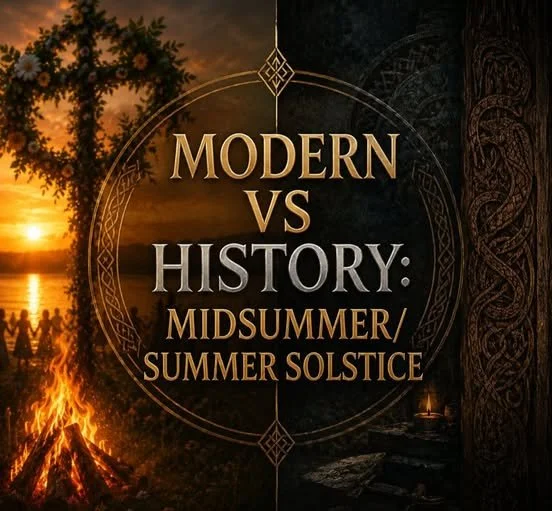
Midsummer is widely celebrated in modern Norse Paganism today, especially around the Summer Solstice in June. Many people honour the sun, fertility, land spirits, ancestors, gods, and the height of summer at this time.
However, historically speaking, we need to be careful.
There is no clear surviving Norse source that tells us the old heathens held a specific “Midsummer blót” on the June Summer Solstice. That does not mean nobody ever marked that time locally, but it does mean we cannot honestly claim it as a clearly documented Norse holy tide in the same way we can discuss things like Jól or sacrifices mentioned in the sagas.
We have surviving references to many other holy observances. For example, Álfablót is mentioned in the account of Sigvatr Þórðarson, who was refused hospitality because households were privately observing the rite. We have references to Jól in numerous saga and legal sources. We have descriptions of sacrifices at Uppsala from Adam of Bremen. Yet despite the amount of material discussing sacrifices and religious observances, there is no equivalent source describing a major Midsummer holy tide taking place on the June solstice.
One of the key sources often used when discussing old Norse blóts is Ynglinga saga. It speaks of three major sacrifices:
• One toward winter, for a good year
• One at midwinter, for good crops
• One in summer, for victory
That “summer” sacrifice is usually connected with Sigrblót, the victory blót. But the source does not place it at the June solstice, and it does not call it Midsummer.
In fact, the wording is remarkably brief. The source simply states that sacrifices were held "at summer" for victory. It gives no date, no mention of the solstice, no description of rituals, and no indication that it was intended to mark the middle of summer. Everything beyond that is interpretation.
This is where modern confusion comes in.
Today, we think of summer as June, July, and August. So when people hear “summer blót,” they naturally imagine June or midsummer. But the old Norse calendar did not work like our modern four-season calendar.
The year was mainly divided into two halves:
• Summer
• Winter
Summer began much earlier than our modern idea of summer. Winter began around Vetrnætr, or Winter Nights. This means that “summer” in an old Norse context does not automatically mean June.
The traditional Icelandic calendar placed the First Day of Summer around what we would now consider mid-April. This means that by June, summer had already been underway for quite some time. If we were to speak of a literal "mid-summer" within a two-season system, it becomes much less obvious that June would have been the intended point.
A lot of the old holy tides were also not seasonal in the modern “spring, summer, autumn, winter” sense. They were often tied to survival, crops, harvest, victory, ancestors, fertility, livestock, and the turning points of the working year.
This makes sense when viewed through the realities of Norse life. Religious observances often revolved around practical concerns such as successful harvests, healthy livestock, favourable weather, safe travel, victory in conflict, and maintaining relationships with ancestors and local spirits. The ritual year appears to have been shaped more by survival and prosperity than by astronomical events alone.
So when we look at the rhythm of the year, we see something more like:
• Dísablót
• Sigrblót / beginning of summer
• Haustblót, the autumn blót
• Álfablót, often connected with the elves and ancestors
• Vetrnætr / Winter Nights
• Jólablót
Because of this, placing “Norse Midsummer” directly on the June Summer Solstice is mostly a modern interpretation. It is heavily influenced by modern pagan calendars, later Scandinavian folk customs, and the way we now understand the seasons.
Modern Scandinavian Midsummer traditions themselves are very real and culturally important, but most of the customs people associate with Midsummer today are documented much later than the Viking Age. Flower crowns, maypoles, community dancing, and solstice celebrations belong primarily to later Scandinavian folk traditions. While these traditions may preserve older themes connected to fertility and seasonal celebration, we cannot automatically assume they reflect a documented Viking Age religious festival.
That does not make modern Midsummer wrong.
It simply means we should be honest about what it is.
Modern Norse Midsummer can be a beautiful celebration of the sun, land, fertility, growth, warmth, and life. But historically, we cannot say with certainty that the old Norse celebrated a fixed June solstice blót as a major documented holy tide.
The most historically accurate position is therefore not that the Norse definitely celebrated Midsummer, nor that they definitely did not. Rather, it is that the surviving sources do not tell us. What many modern Norse Pagans celebrate today is a reconstruction built around seasonal symbolism, Scandinavian tradition, and modern pagan spirituality rather than a clearly attested Viking Age holy tide.
There is also a difference between:
“What is historically recorded?”
and
“What do modern Norse Pagans meaningfully practise today?”
Both matter, but they are not the same.
So yes, people can absolutely celebrate Midsummer today. But it should be understood as a modern Norse Pagan observance inspired by older themes, not a fully documented ancient Norse festival with a fixed historical date.