
Bygul and Trjegul: The Cats Who Pulled the Chariot of Freyja
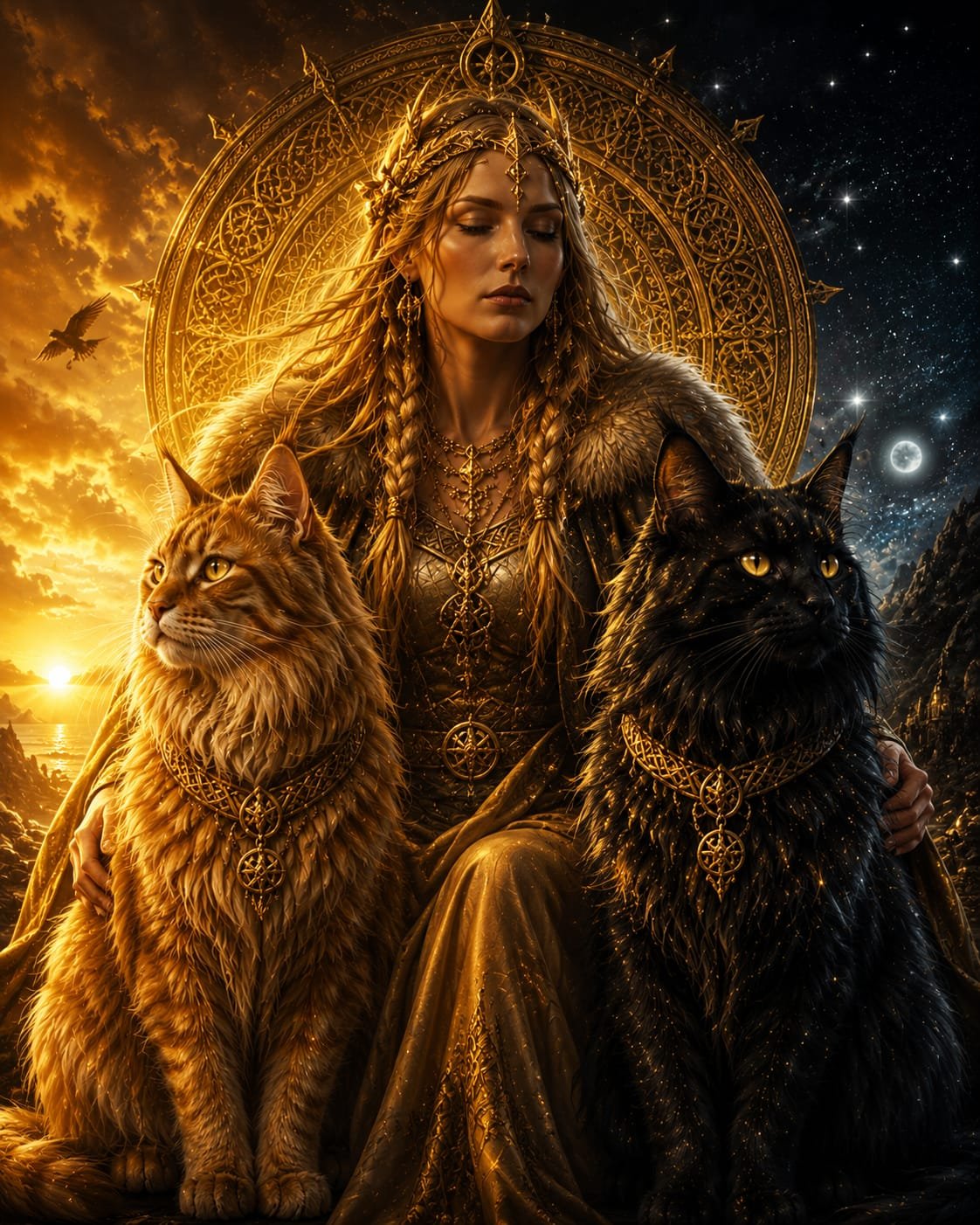
“Companions are not always chosen for comfort. Sometimes they are chosen for balance.” - fragment attributed to a later medieval marginal gloss on vanir tradition
And though no rune records this line with certainty, the sentiment feels fitting whenever the goddess of love, war, and seiðr moves across the worlds in her wheeled chariot.
In norse mythic storytelling, divine travel is rarely symbolic only, it often encodes cosmological principles. Movement between worlds implies interaction between layers of reality, where even direction, speed, and method of transport carry meaning. Freyja’s chariot, therefore, is not just a vehicle but a statement: that desire, magic, and sovereignty do not passively drift through existence, they are actively drawn through it.
**NOTE**
Before exploring this piece, it is important to clarify that bygul and trjegul are figures associated with norse cosmology through later manuscript tradition, most notably referenced in the prose edda. They are described as the two cats who draw the chariot of the goddess freyja, linked with movement between worlds, divine travel, and the symbolic mechanics of transition and balance within the mythic landscape. They are not historical animals or literal beings, but mythic constructs shaped by the narrative, poetic, and symbolic frameworks of old norse tradition.
In the surviving sources, their role is functional rather than psychological: they do not appear as characters with developed dialogue, inner life, or independent myth cycles. Instead, they serve as structural companions to greyja’s motion integral to her passage across realms. Their presence emphasizes continuity, alignment, and the cosmological principle that even divine movement requires traction, partnership, and relational balance.
What follows is not a strict reconstruction of attested lore, but a mythopoetic interpretation grounded in the broader patterns of norse cosmology where movement and stillness, structure and flow, autonomy and interdependence coexist within a single system of meaning. This piece draws from those structural tensions rather than claiming to expand the historical record.
So pause here, just for a moment.
Because bygul and trjegul do not exist as companions to be observed from a distance. They exist as the mechanism by which divine motion becomes possible and what moves through them is never only a goddess, but the principle of transition itself.
Prologue: The Goddess Who Would Not Walk Alone
Before gold was merely metal and before love was softened into poetry, there was freyja daughter of the sea-faring vanir, bearer of Brísingamen, and master of seiðr. She did not travel as the Æsir did, with spear and oath alone. She did not move as giants did, with force and friction. When freyja crossed the boundaries between realms, she rode and her chariot was not drawn by horses, but by cats. Not wolves. Not stags. Not thunder. Cats. Two of them. Bygul and trjegul.
In broader Indo-European mythic patterns, deities associated with fertility, war, and liminality often travel with symbolic animals rather than purely functional beasts. Horses represent conquest and sovereignty; wolves represent destruction and instinct; but cats occupy a different symbolic register autonomy. Their presence suggests Freyja’s power is not based on domination but negotiation with wildness itself.
Freyja’s association with seiðr also reinforces this: seiðr practitioners in sagas are frequently depicted as liminal figures, neither fully inside nor outside social order. The cats mirror this position perfectly domestic yet untamed, familiar yet unknowable.
The Naming of the Felines
Names in myth are never incidental; they are instructions disguised as sound. Bygul is often interpreted as “bee-gold,” an image of sweetness, productivity, nectar, and the quiet industry of gathering. Bees do not conquer fields, they pollinate them. They move between blossoms, carrying continuity from one life to another.
In ecological terms, bees are foundational agents of systemic continuity. Their role is not extraction but transmission. If bygul reflects this, she represents the idea that value in a system is not static wealth, but movement of nourishment between nodes, a concept surprisingly aligned with pre-modern understandings of cyclical economy.
Trjegul, interpreted as “tree-gold,” evokes rootedness, structural endurance, and solar warmth filtered through growth. Trees in mythic cosmology often function as axis points... world-poles connecting underworld, middle realm, and sky. In norse tradition, this is most clearly expressed in yggdrasil, the world-tree, which acts as both structure and system rather than mere organism.
Together, bygul and trjegul form a symbolic economic and ecological pair circulation and stability, flow and structure. One moves value; the other holds it in place long enough for meaning to form.
The First Sight of Bygul and Trjegul in Myth
There are no surviving eddic poems that directly describe the first appearance of bygul and trjegul, yet fragmentary traditions in later folklore and reconstructed oral motifs suggest a consistent image - the cats were not “given” to freyja - they were already with her when she was first recognized as a goddess of movement.
In some reconstructed interpretations of vanir mythic memory, greyja’s earliest crossings between realms were unstable. Her seiðr was powerful but unanchored, causing distortions in space around her presence. It is in this period that the cats appear not as gifts, but as stabilizing companions who “refused to leave her motion.”
Bygul is described in these later retellings as the first to step onto the chariot when it was still forming its shape before it was fully real in the mythic sense. Trjegul follows not out of obedience, but recognition, as if the structure of freyja’s movement required her presence to remain coherent.
This moment establishes an important mythic principle here and that is that the cats are not additions to freyja’s power, they are part of what makes her power travelable.
The Cats as Cosmic Counterweight
In Norse cosmology, movement is never casual. The gods do not travel without consequence. Every journey across the Nine Worlds implies tension. Freyja, as a goddess of both desire and war, carries duality within herself. She presides over Fólkvangr, receiving half of the slain, sharing the dead with Odin. She embodies attraction and battlefield consequence.
Her cats are not decoration. They are balance. Cats, in mythic symbolism, are liminal creatures. They move silently between spaces. They hunt without spectacle. They choose their proximity. They are neither fully domesticated nor entirely wild. That ambiguity mirrors freyja herself...a goddess who does not fit comfortably into any single category. Bygul and trjegul pull her chariot not because she cannot walk, but because she does not move through the worlds alone.
From a myth-structural perspective brothers and sisters, paired animals often represent equilibrium forces acting on a divine center. In indo-european myth, dual animals frequently signify controlled tension, two opposing impulses that allow a deity to remain stable while in motion. Freyja’s cats can thus be read as stabilizers of divine volatility.
The Oath of Movement
Some traditions, particularly those influenced by later medieval reinterpretations of norse cosmology, suggest that freyja’s chariot was bound not by physical reins, but by an oath of move across a binding agreement between goddess and companions.
Unlike mortal oaths, which are spoken and sealed, divine oaths in norse cosmology are structural. They are woven into reality itself. To break them is not dishonor, it is collapse of function.
The oath of movement, as it is sometimes called in reconstructed mythic commentary, is simple in form but absolute in implication - Freyja will not move without balance, and the cats will not pull without direction.
This mutual constraint is what prevents freyja’s motion from becoming uncontrolled seiðr expansion. Without bygul and trjegul, her movement would dissolve into unanchored magical drift. Without freyja, the cats would have no axis to define their motion.
Thus, their relationship is not companionship in the emotional sense... it is contractual cosmology.
The Shape of Their Motion
Unlike the stags of the world-tree for example, which regulate through consumption, the cats regulate through traction. They do not feed the cosmos; they pull across it. Their work is not erosion, it is connection.
In physics terms, friction is not a flaw in motion, it is what makes motion possible in the first place. Without traction, force cannot translate into direction. Bygul and Trjegul embody this principle mythologically: they are the interface between divine will and physical reality.
When freyja rides, the chariot does not float above reality. It engages it. The wheels turn against earth, frost, stone, and memory. Bygul and trjegul create friction, and friction is what makes movement possible. Without resistance, there is no direction. Without tension, there is no path. Their paws do not tear the world apart; they anchor it as it moves.
This framing aligns closely with norse fatalism, where resistance is not an obstacle to meaning but its generator. Without struggle, there is no saga.
The Theft of Stillness (A Lost Tale)
One fragmentary tale preserved only in late folkloric reinterpretation speaks of an attempt to capture stillness itself.
In this story, a unnamed jötunn often interpreted as a personification of stagnation seeks to trap greyja during her passage between worlds. The giant does not attack her directly, but instead attempts something more subtle...it removes motion from the road ahead, creating a zone where causality “slows into non-action.”
Freyja’s chariot begins to lose traction. Even Bygul and Trjegul struggle, their paws finding no responsive ground.
In response, bygul is said to have “stolen the scent of forwardness” from the air itself, while trjegul anchors memory of motion into the wood beneath them, restoring continuity where it had been erased.
Freyja does not fight the jötunn. She simply continues forward once motion is restored, and the act of continuation itself breaks the illusion of stillness.
The jötunn is not destroyed. It is forgotten by movement. This tale, whether literal or symbolic, reinforces a core norse idea...
stagnation is not defeated by force, it is undone by continued becoming.
Comparative Threads: Cats, Goddesses, and the Liminal
Across cultures, feline companions often belong to deities associated with independence, fertility, or protection. In egyptian tradition, the goddess bastet is associated with cats as protectors of home and sacred space. There, too, the cat embodies gentleness and fierce defense.
In mesopotamian traditions, feline-associated deities often bridge domestic safety and wild unpredictability, reflecting early human awareness that control over nature is always partial. Cats sit at the threshold of domestication, tolerated wildness within civilization.
But in norse tradition, bygul and trjegul are not guardians of a hearth. They are engines of transition. They pull the chariot of a goddess who moves between love and war, life and death, seiðr and sovereignty. Their role is not domestic, it is cosmological. They make motion sacred.
Ritual Echo - What Moves With Us
If the stags of yggdrasil represent maintenance through reduction, the cats represent progression through partnership. The tree endures because something trims it. The goddess advances because something draws her. Both systems rely on a subtle truth: power is not solitary.
In ritual anthropology, movement rituals (processions, sacred travel, pilgrimage) often require structured accompaniment. This ensures that transition is not chaotic but socially and cosmically legible. Freyja’s chariot can be understood as a divine procession one that encodes meaning into movement itself.
Seiðr requires focus, vulnerability, and exchange. In that sense, bygul and trjegul are symbolic companions to her craft, reminders that even magic requires grounding. A chariot without pull would drift. A goddess without companions would become abstract. A movement without tension would dissolve.
Ritual Echo: The “Cat-Pull” Blessing
In later folkloric reinterpretations, particularly within neo-mythic reconstruction traditions, a symbolic ritual known as the “cat-pull blessing” appears.
This ritual is not historical in a strict archaeological sense, but it reflects mythic logic derived from freyja’s movement. Participants imagine two forces in their life not as opposition, but as pull and grounding.
One force represents aspiration, desire, or movement forward (Bygul). The other represents stability, memory, or rooted endurance (Trjegul). The ritual involves acknowledging both as necessary for meaningful motion rather than treating one as obstacle.
Unlike sacrifice-based rituals such as blót, this is not about offering loss. It is about recognizing alignment, the idea that progress requires structure, and structure requires motion.
In symbolic terms, it is an invocation of balanced becoming.
The Sound of Their Passage
Imagine the chariot moving across frost-covered ground. The wheels whisper. The air tightens slightly around them. Two sets of paws strike in alternating rhythm. Not thunder. Not roar. Steady impact.
In acoustic terms, rhythm without sharp peaks tends to be perceived as stability rather than threat. The cats’ movement creates a cadence rather than a disruption... a patterned continuity that the mind reads as order.
Cats do not run in panic; they move with precision. Their stride is economical, their energy measured. That economy mirrors Freyja herself - passion without chaos, war without frenzy, love without collapse. Bygul and Trjegul do not shout her arrival. They announce it through motion.
Dialogue Myth: Freyja and Her Cats
The chariot rests between realms. The air is thin and bright. Freyja lowers her hand to bygul’s fur. “Do you tire?” she asks.
Bygul does not speak, but leans forward not in exhaustion, but in readiness.
Trjegul circles once, tail raised.
“You are not my burden,” greyja says quietly. “You are my direction.” The cats watch the horizon. Freyja smiles.
“If I walked alone, I would still arrive.
But I would not arrive in motion.” Bygul stretches into the harness. Trjegul settles into alignment.
The chariot moves.
Not because it must.
But because they agree.
Mythic Interaction - Within the Broader Pattern
In the wider norse cosmos, everything participates in tension. The world-tree stands amid stags, eagle, serpent, and squirrel. Nothing exists without counterforce. Freyja’s cats fit this same structure. They are not antagonists, nor threats, but vectors.
Mythologically, “vector beings” are entities that define direction rather than opposition. They are less about conflict and more about orientation. If the stags define internal regulation of growth and the serpent defines subterranean entropy, the cats define horizontal motion, the act of crossing space itself.
The cosmos does not rely on stillness... it relies on motion held in balance.
Interaction with Other Divine Beings
Though freyja’s cats rarely appear in direct mythic encounters with other gods, reconstructed thematic analysis suggests they are indirectly present in several divine interactions.
With odin, freyja shares a complex exchange of knowledge for power. In some interpretations of seiðr transmission, it is bygul who represents the “exchange principle” the idea that knowledge must be carried between realms rather than possessed in one place. Trjegul, in contrast, reflects the structural endurance required to contain such knowledge without destabilization.
With thor, whose motion is forceful and linear, the cats represent contrast. Where Thor moves through direct impact, bygul and trjegul embody adaptive movement, change through continuity rather than collision. Some symbolic readings suggest that if thor represents momentum, freyja’s cats represent guidance of momentum.
Even among the Vanir themselves, freyja’s cats mark her as distinct...she is not only a goddess of fertility or war, but of transition itself and her companions ensure she never becomes fixed within any one role.
Comparative Chariot Mythology
Many mythic traditions use animal drawn chariots to express divine authority.
In greek tradition, the sun god travels by chariot across the sky. In vedic tradition, solar and storm deities move in radiant vehicles drawn by powerful beasts. In these systems, the chariot often symbolizes cosmic order in motion.
What makes freyja’s chariot distinctive is not the vehicle itself but the species that pull it.
Cats are not animals of conquest. They are animals of precision. They do not symbolize domination over nature, but engagement with it.
This distinction matters.
Where other divine chariots emphasize speed, freyja’s emphasizes balance.
Where others emphasize power, hers emphasizes continuity. Where others imply supremacy, hers implies partnership.
This positions bygul and trjegul not as decorative mythic elements, but as philosophical counterpoints to more force-driven cosmologies.
Philosophical Reflection - Companionship as Structure
Modern imagination often treats animals in myth as decorative symbols, but in older cosmologies, animals are structural participants. Bygul and Trjegul suggest something subtle - even the divine does not move alone.
This reflects a broader indo-european philosophical pattern where power is distributed rather than centralized. Even gods express function through relational systems. Freyja’s cats are not servants, they are partners in direction.
Without them, freyja’s chariot would lose its relationship to the ground. With them, she becomes movement itself.
Symbolic Correspondences: What the Cats Represent
Bygul and trjegul can be read not only as animals, but as structural metaphors embedded in myth.
Bygul (Gathering / Circulation / Exchange)
Represents movement of value, transition of energy, the principle that growth requires distribution. In ecological terms, this aligns with pollination systems, networks rather than singular power.
Trjegul (Structure / Continuity / Grounding)
Represents stability, endurance, and form. In cosmological terms, this reflects axis symbolism, the idea that motion requires a center.
Together they form -
Motion and Stability
Desire and Restraint
Flow and Ground
Change and Continuity
Their pairing reflects a broader norse tendency toward dual tension systems balance through opposition rather than harmony through uniformity.
A Human Parallel
There are moments in life when we attempt to move forward in love, ambition, healing, or change and imagine that will alone is enough. But motion requires support. Just as Bygul and Trjegul pull Freyja’s chariot, we move through the world supported by unseen forces, relationships, disciplines, routines, constraints.
Psychologically, this aligns with the idea that sustained change is rarely driven by motivation alone, but by systems of support that provide continuity when intention fluctuates. These are not limitations. They are traction.
What pulls you forward is not always dramatic. Sometimes it is quiet consistency. Sometimes it is sweetness. Sometimes it is rootedness.
The Cats After Ragnarök (Speculative Tradition)
While norse sources do not explicitly describe the fate of bygul and trjegul during ragnarök, later interpretive traditions suggest that beings tied to movement and transition are not subject to final destruction in the same way as fixed structures.
If the world-tree survives as a wounded continuity, and if the forces that maintain it persist in altered form, then the cats of Freyja are sometimes understood as surviving not as individuals, but as principles.
Bygul becomes the memory of movement continuing after collapse. Trjegul becomes the structural persistence that allows motion to begin again.
In this reading, they do not survive the end, they redefine what “survival” means in a post-collapse world.
They are not present after ragnarök as travelers.
They are present as conditions for travel itself.
Closing Invocation
Bygul: gatherer of light.
Trjegul: bearer of wood and warmth.
Cats of the Vanir goddess. Companions of desire and war. Keepers of motion between worlds.
May your stride be steady. May your direction be intentional. May what pulls you forward keep you in contact with the ground beneath you. For in the mythic understanding of things: to move is sacred, to be drawn is not weakness, and to travel with companions is to acknowledge that even gods honor balance.
The Hymn of the Chariot
When the worlds align and the veil thins,
freyja rises, not alone, but drawn. Bygul steps first upon the frost, soft as pollen carried on wind. She does not rush. She measures the road with breath.
Trjegul follows, warmth in her stride, wood-light under paw, anchoring the turning of the wheel.
The chariot does not break the earth.
It persuades it. The wheel does not conquer distance. It negotiates it. And where the cats pass, motion becomes meaning.
Freyja does not command the path. She moves because balance agrees to move with her. And so the worlds are crossed without fracture, without silence, without stillness.
Only rhythm.
Wyrd & Flame 🔥🌙🐾
May what carries you keep you steady, and may what steadies you allow you to travel far
