
Tanngrisnir and Tanngnjóstr: The Goats Who Are Eaten and Return
“What is consumed in the presence of power is not always lost. What is returned is never the same as before.” - fragment attributed to a skaldic reinterpretation of Þór’s household rites, reconstructed from later Icelandic marginalia
And though no single hand preserved those words in full, their meaning persists wherever thunder is drawn across the sky and then given flesh to feed a god who refuses permanence.
**NOTE**
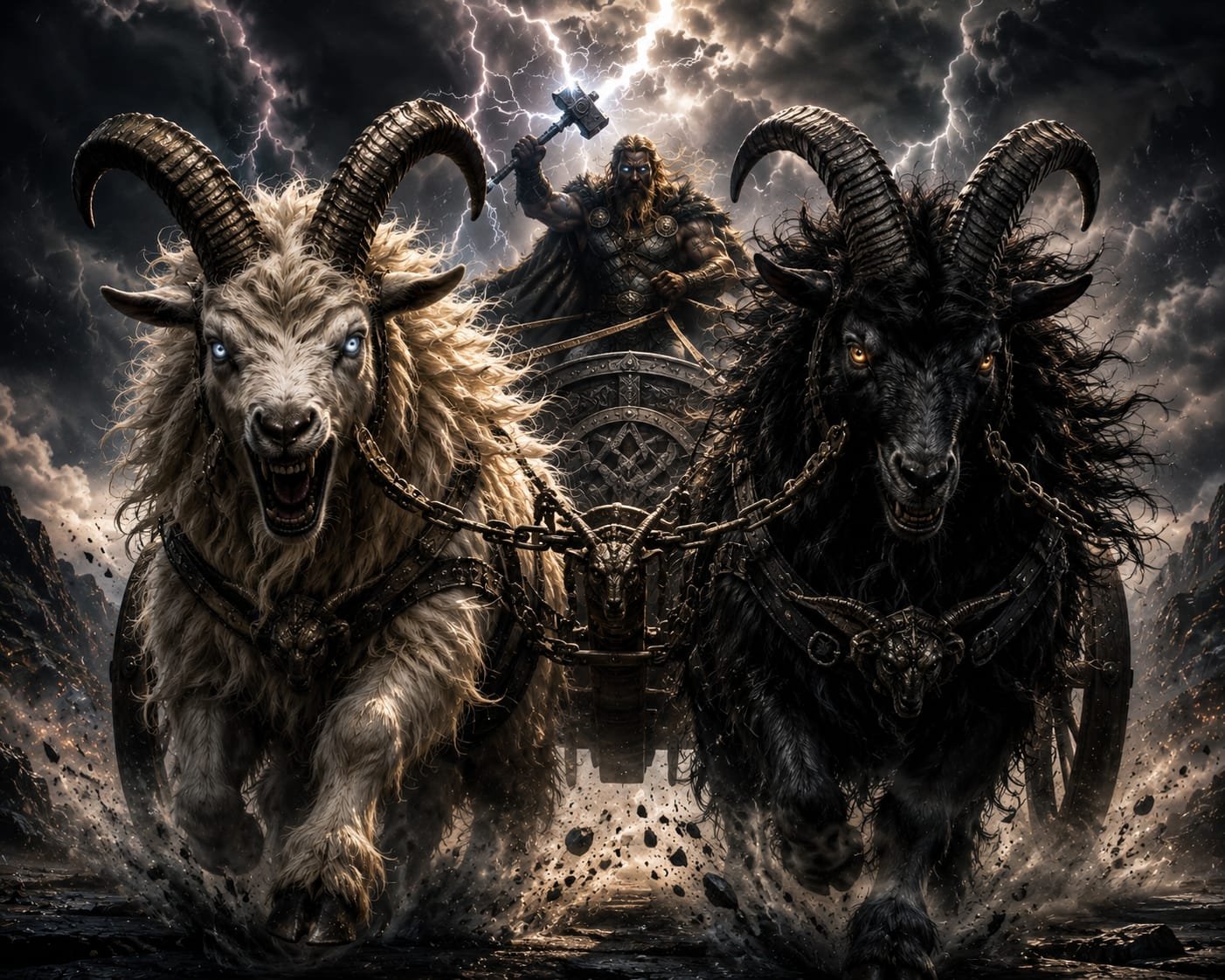
Before exploring this piece, it is important to clarify that Tanngrisnir and Tanngnjóstr are figures from norse cosmology, most notably described in the Prose Edda. They are the two goats who draw the chariot of the god Thor, associated with thunder, movement across the worlds, and a cyclical system of consumption and restoration in which they are eaten and later brought back to life through ritual means. They are not historical animals or literal beings, but mythic constructs shaped by the symbolic and narrative framework of Old Norse tradition.
In the surviving sources, their role is functional rather than psychological: they do not appear as characters with inner lives, but as integral components of divine motion and hospitality law, where the integrity of their bones determines the success of their return.
What follows is not a strict retelling, but a mythopoetic interpretation faithful not to a single source, but to the deeper patterns, structural logic, and cosmological tensions of the norse worldview where consumption and restoration, motion and stillness, and continuity and rupture exist within the same system of meaning.
So pause here, just for a moment.
Because Tanngrisnir and Tanngnjóstr do not exist as things to be observed from a distance. They exist as the mechanism by which movement itself becomes possible and what moves through them is never only thunder.
Prologue: The Chariot That Never Runs Out of Hunger
Before the gods were imagined as distant and untouchable, before divinity became something separated from appetite, Thor was already moving through the world in a chariot that did not belong to stillness. It was not a throne, not a symbol, not an ornament of power. It was motion made audible.
Across the roar of iron wheels and sky-stretched storms, two goats pulled forward what could not be stopped. They did not strain like beasts beneath burden, nor suffer like animals under weight. They participated. And in their participation, they defined a strange and unsettling truth: that even gods must eat what they command to live again.
These were not ordinary creatures of pasture or field. They were named forces, structured continuities, living cycles bound to divine necessity - Tanngrisnir and Tanngnjóstr. Together, they formed a loop that no myth before them had dared to make so literal...to be eaten, and to return.
In a broader mythological sense, the chariot functions as an extension of divine identity rather than a vehicle in the human sense. In Norse cosmology, movement is often inseparable from power itself, meaning Thor’s presence is not relocated by the chariot so much as expressed through it. The goats therefore act less like animals and more like structural components of divine manifestation, translating raw divine force into navigable motion across the worlds.
Canonical Presence in the Eddas
Before interpretation, there is record.
Tanngrisnir and Tanngnjóstr appear within the prose edda (skáldskaparmál) as the paired goats of Thor’s chariot. They are not given lineage, psychology, or origin. They are introduced already in function already bound to motion, already embedded in divine necessity.
The poetic corpus does not linger on them. They are not characters that develop, but mechanisms that recur. Their significance is not elaborated through story density, but through procedural consequence: travel, consumption, restoration.
In this sense, their presence in the Eddas is minimal but absolute. What is not explained is nevertheless enforced. They exist not as narrative subjects, but as operational constants within Thor’s movement through the worlds.
The Origin That Is Not Recorded
No surviving account describes the creation of Tanngrisnir and Tanngnjóstr. They enter myth without genesis, which in Norse narrative logic is not absence but instruction: that their beginning is irrelevant compared to their function. Unlike beings born into lineage or forged through explicit act, they appear already synchronized to a system that requires them.
Their origin, therefore, can only be inferred as structural rather than historical. They are not “made,” but instantiated as if divine motion required them into existence the moment traversal of the worlds became necessary.
They begin where movement begins.
The Habitat of Readiness
The goats do not dwell in any pasture described by myth. When not in motion, they are not relocated but suspended. Their state is not rest in a geographical sense, but containment within readiness. They exist in proximity to Thor’s chariot as a condition rather than a place an unresolved potential for movement.
To speak of where they live is therefore misleading. They do not inhabit space. They inhabit the threshold between activation and stillness. Their “home” is the moment before thunder resumes.
The First Motion of Thunder
The chariot is never described as arriving. It is always already there in motion. When thunder breaks across the sky in old accounts, it is not a sound that begins but a sound that continues. Within that continuation are hooves, not striking earth but striking the boundary between worlds. Tanngrisnir the “Teeth-Barer”and Tanngnjóstr “Teeth-Grinder” do not describe personality but function.
One reveals, one reduces. One exposes what must be taken, the other processes what has been claimed. Between them, the movement of Thor is sustained, not carried, not transported, but sustained. And when they run, the sky itself behaves as though it remembers impact.
From an interpretive standpoint, thunder in Indo-european myth systems is frequently associated with divine authority enacted through motion or strike. In this framework, the goats can be read as intermediary mechanisms converting divine intent into physical consequence. Their movement is not symbolic but operational, bridging the conceptual gap between godhood and environmental effect.
The Cycle of Daily Operation
The movement of thor is not continuous without structure. It follows a rhythm that does not depend on time, but on completion.
At the commencement of motion, the goats are not awakened but engaged. Their function begins as extension of force rather than independent will.
The chariot becomes operational through them; without their participation, movement does not merely slow it becomes conceptually incomplete. During traversal, they are not carried but enacted. Thunder is not produced as side effect but as consequence of sustained strain between worlds.
At cessation, the system does not simply stop. It is dismantled. Consumption is not indulgence but closure of operational integrity. The goats are reduced, processed, and then restored, not as reversal of loss, but as reinitialization of structure. What repeats is not life, but function.
The Bone Law (Oath of Integrity)
There exists an unspoken law embedded in the structure of the goats - that bones are not residue, but instruction. Thor’s warning to mortals during the hospitality episode is not moral instruction but technical requirement. The breaking of bone does not violate sentiment, it corrupts the blueprint of return.
To preserve the bones is to preserve the logic of restoration itself. To fracture them is to introduce deviation into the cycle.
The oath is not spoken by the goats. It is enforced by the impossibility of perfect return once structure has been altered.
What is broken does not refuse to return. It returns incorrectly.
The Naming of the Goats
Names in norse cosmology are never decoration but compressed actions. Tanngrisnir, “the one who bares teeth,” is not aggression alone but exposure the moment before consumption, the revealing of structure beneath surface. Tanngnjóstr, “the one who grinds teeth,” is not destruction in a single blow but repetition, processing, transformation through reduction. Together they are not opposites but sequence: to reveal, to consume, to continue.
Linguistically, old norse compound names often encode function rather than identity, particularly in mythic contexts. This reflects a worldview where essence is tied to action rather than static being. In that sense, the goats’ names function almost like procedural instructions embedded into narrative form, reinforcing their role as processes rather than characters.
Coloration as Operational Function
No canonical source assigns color to Tanngrisnir or Tanngnjóstr. Color, therefore, becomes a field of interpretation rather than inheritance.
In structural reading, they may be understood not as visually fixed beings, but as contrasting operational states that -
One goat may be understood as exposure light-toned, reflective, associated with ignition and forward articulation of force.
The other as compression darker, absorbing, associated with consolidation and sustained continuity.
This is not aesthetic description, but functional encoding. Their difference is not appearance, but role within motion.
Where one initiates, the other stabilizes. Between them, movement does not scatter.
It holds.
Behavioral Structure (Without Personhood)
The goats do not exhibit personality in the human sense. They do not express desire, fear, loyalty, or hesitation. What distinguishes them is not interiority, but asymmetry of function.
Tanngrisnir may be understood as the articulation of forward displacement the initiation of kinetic demand. Tanngnjóstr as the regulation of that demand into sustained movement.
Neither acts independently. Neither deviates.
Together they form a system in which agency is irrelevant, and execution is complete by design rather than decision.
They do not choose movement.
They are movement distributed into form.
The Feast That Becomes Return
Thor does not simply travel with his goats; he consumes them. Every evening, when movement ceases and the sky settles into the lowered breath of night, the cycle is enacted. The goats are slaughtered, carefully and precisely, not in rage but in function. Their flesh is prepared, their bodies shared, and Thor eats what drives him across the world. Then what should be final is interrupted. Because thor gathers the bones...every fragment, every remnant, every structural truth left behind after consumption. He places them upon skins, and with Mjölnir, he consecrates them back into motion. And the goats return whole, restored, living not as they were, but as they must be. Except when they are not.
This cycle reflects a mythic logic of controlled resurrection where material integrity is essential to restoration. The bones act as a structural blueprint, implying that continuity depends on precision rather than memory. The failure of this process in later narratives underscores a key principle... mythic restoration is conditional, not absolute, and depends on adherence to hidden rules.
The Naming of Consequence
There is a story often left in margins: a farmer’s home, a night of hospitality, a warning unheeded. Thor shares his goats with mortals and instructs them clearly not to break the bones, because bones are not remnants but instructions. One child misunderstands or perhaps understands too literally and breaks them to reach the marrow. Morning arrives, mjölnir is raised, and the ritual is performed. One goat rises imperfect, lame, altered, permanently marked. Not destroyed, but changed in a way that cannot be undone. This is the first recorded interruption in divine maintenance, and it teaches something even gods cannot ignore resurrection preserves structure, not error.
This narrative mirrors broader mythological motifs where divine systems fail not due to power limitation but due to rule violation. It also introduces the concept of irreversibility within otherwise cyclical systems, suggesting that even gods operate within constraints where error accumulates rather than resets.
Comparative Mythology - Beasts That Return
Across mythic traditions, echoes appear of beings consumed and restored. In vedic tradition, Agni consumes offerings only to return them transformed through fire, where consumption becomes transmission rather than loss. In certain Siberian cosmologies, animals eaten in ritual continue in spirit form, their bodies temporarily relinquished to necessity. In northern european folklore, enchanted livestock sometimes return after death when treated correctly, preserving a memory of structured restoration. But Tanngrisnir and Tanngnjóstr are distinct because they are not symbolic return but literal return. There is no metaphor strong enough to soften what they represent - that consumption and restoration are part of the same mechanism.
Comparative mythology often reveals shared structural intuitions rather than direct borrowing. The recurrence of “return-through-consumption” motifs suggests a widespread ancient attempt to reconcile entropy with continuity. These systems do not deny loss; instead, they reframe it as a necessary phase in cyclical maintenance.
The Shape of Their Existence
The goats are not companions in the mortal sense. They are not pets, steeds, or symbols of loyalty. They are a system of continuity attached to motion. When they run, the world is traversed. When they are eaten, the world is sustained. When they return, the world is permitted to continue without collapse. They are maintenance disguised as creaturehood, and Thor does not break this cycle...he embodies it.
This framing aligns with functionalist interpretations of myth, where beings represent processes rather than individuals. In such readings, identity is secondary to role, and persistence is defined not by survival of form but by repetition of function across cycles.
The Sound of the Chariot
If one could stand where the gods pass, they would hear not a single sound but layers of force - the impact of hooves that strike not ground but definition, the grinding rhythm of movement that does not pause for terrain, and thunder that follows not after lightning but alongside intention. Tanngrisnir would sound like the opening of inevitability, the moment before force becomes action. Tanngnjóstr would sound like consequence made audible, the slow certainty of what has already been decided. Between them, the chariot does not move - it insists.
Acoustically interpreted, thunder mythologies often encode layered perception immediate strike, delayed resonance, and environmental echo. The goats therefore function as narrative sound-design elements, structuring how divine motion is perceived across time rather than space.
Ritual and the Logic of Return
Norse ritual sacrifice, blót, is often misunderstood as appeasement, but it is more accurately exchange. What is given is not lost but relocated within a cycle that does not permit accumulation without cost. The goats represent the most extreme version of this principle. They are not offerings to the gods but offerings by the gods to themselves. Thor consumes what allows him to continue acting and restores it so that continuation does not end. This is not indulgence but structure.
Anthropologically, reciprocal sacrifice systems function as mechanisms for maintaining balance between human and divine domains. In this myth, however, the reciprocity is internalized within divinity itself, suggesting a closed-loop system where even gods must participate in their own economy of loss and renewal.
The Goat as Cosmic Engine
Where other myths place birds or serpents at the structure of the world, this myth places livestock at the center of divine mobility. The goats are not beneath thor; they are the mechanism through which he moves. Without them, no chariot, no thunder procession, no enforced motion across worlds. With them, movement becomes infinite because consumption is reversible, and reversibility replaces exhaustion. The cosmos does not collapse under this logic, it stabilizes through it.
This positions the goats as a proto engine model within mythic language a renewable energy system where output depends on controlled degradation and restoration. It reflects an intuitive grasp of cyclical resource systems long before formal conceptualization.
Why Thor Does Not Keep Them Alive
One might ask why the cycle requires death at all. Why not permanent life or unbroken continuity? Because unbroken continuity becomes stagnation. A living being that is never consumed becomes weight without renewal, and a system that never resets becomes rigid. The goats must be eaten so they may be corrected, must die so they may return without error. Even gods cannot maintain what is never reprocessed.
This principle reflects a broader mythic understanding that transformation requires interruption. Without cessation, no recalibration is possible, and without recalibration, deviation accumulates until collapse becomes inevitable.
Mythic Ecosystem - Thunder Within a Structured World
The goats exist within a wider system of pressure and response. Thor moves across realms in opposition to giants, chaos, and entropy. Odin seeks knowledge through sacrifice of stability, loki introduces disruption that forces adaptation, and within this system Tanngrisnir and Tanngnjóstr ensure that movement itself does not become depletion. Even thunder must eat.
This ecosystem reflects Norse cosmology’s emphasis on tension rather than harmony. Stability is not static but actively maintained through opposing forces, each preventing the system from collapsing into either chaos or rigidity.
The Human Reflection - What Must Be Consumed to Continue
There is something unsettlingly familiar in this cycle. Attention, energy, time, relationships, identities all are consumed to permit continuation. We are sustained by what we deplete, and if nothing is released, nothing can be renewed. The goats make this visible: consumption is not destruction but transformation that permits motion.
Psychologically, this mirrors cognitive and emotional processing, where experiences must be “used up” and integrated rather than retained indefinitely. Without release, accumulation becomes cognitive weight that impedes further development.
A Traveler Beneath Thunder
A mortal hears thunder and imagines distance, imagining gods far away and unchanged. But if they were closer, they would realize something less comforting: that motion has cost, that power requires intake, and that even divinity must process itself to continue existing. If they listened carefully, they would hear hooves that do not fade, only repeat.
This reframes mythic distance as perceptual limitation rather than spatial separation. The divine is not elsewhere - it is operating continuously within the same system, only scaled beyond immediate human perception.
Stories Told of the Broken Bone
One story persists - a household, a night of hospitality, a rule spoken clearly. Do not break the bones, because bones are not leftovers but conditions of return. When the rule is broken, what returns carries memory of error...not vengeance, but correction. A limp that cannot be healed is instruction, not punishment. The system remembers what was altered.
This introduces the concept of persistent error within cyclical systems, where deviation is not erased but encoded into future iterations. It reflects a mythic understanding of consequence as structural rather than moral.
Ragnarök and the Question of Continuity
At the end of all things, myth does not clearly say what becomes of the goats. But the logic of their existence suggests that cycles do not simply end they fracture, scatter, reconfigure. Even destruction must process itself, even endings require structure. Somewhere within collapse, what once was Tanngrisnir and Tanngnjóstr continues not as identity, but as function.
This aligns with Norse apocalyptic patterns where destruction is not absolute termination but systemic reset. Elements of the old world persist in altered configurations, implying continuity through transformation rather than cessation.
Final Reflection - What Must Be Eaten to Move Forward
We tend to think of consumption as loss, but the goats suggest otherwise. Consumption is transformation that permits motion. What is taken is not erased, what is broken is not always destroyed, and what is eaten may return if the structure is respected. A life that refuses consumption becomes immobile; a life that refuses return becomes irreversible. Between these extremes lies the cycle: to be taken and to continue.
Philosophically, this mirrors broader existential models where identity is defined not by preservation but by managed change. Stability is not the absence of loss but the capacity to integrate it.
Invocation of Motion
When depletion feels like loss, remember the goats: Tanngrisnir and Tanngnjóstr. What is spent may return, what is taken may be restored, and what is broken may yet carry forward if structure is honored.
This invocation functions as a ritual compression of the entire mythic logic, translating cosmological principle into personal reflection. It reinforces the idea that myth serves not only as narrative but as interpretive framework for lived experience.
Tanngrisnir and Tanngnjóstr systems of return rather than symbols of sacrifice, engines of continuity rather than victims of hunger. The reason thunder never stops moving. And perhaps the deeper question is not what is being consumed, but what is being allowed to continue through what is consumed.
Wyrd & Flame 🔥⚡🐐
May what is taken from you return in form wiser than before, and may what you release keep your path from becoming too heavy to move.
