
Dáinn, Dvalinn, Duneyrr, and Duraþrór: The Stags Who Feed the World
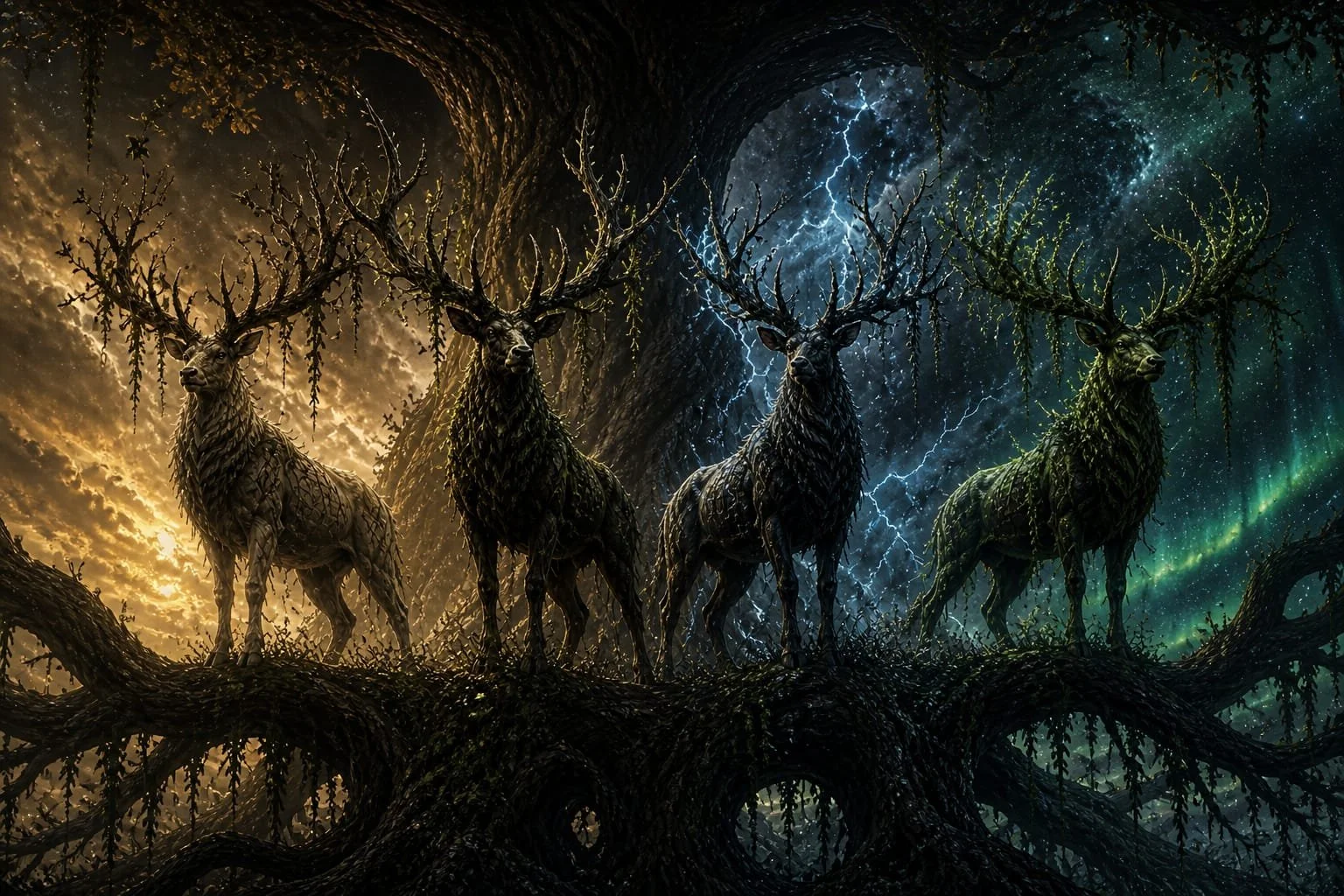
“What is taken is not always lost. What is consumed is not always destroyed.”
- fragment from an unnamed ash-wood carving, attributed to eastern norway, c. 11th century
And though the hands that carved those runes have long since turned to soil, the truth within them still rises, quietly, through root and branch.
Prologue: The Tree That Could Not Stand Alone
Before the world learned the illusion of stability, before mountains convinced themselves they were permanent, there was a tree already growing beyond reason.
Not gently. Not peacefully. It did not sprout and settle. It strained. It stretched. It tore its way upward and downward at once, its branches clawing into sky while its roots gripped the unseen. This was no ordinary tree. It was structure itself the scaffold of existence. And yet, even in its vastness, it could not remain untouched. Because in Norse thought, nothing that lives is permitted stillness. Not even the axis of the cosmos.
Where there is growth, there must be consumption. Where there is height, there must be pressure. Where something reaches upward, something else must feed upon it.
And so, among the highest boughs, where light brushes against eternity, four stags began to move. They did not arrive as invaders. They were already there.
The First Biting of Leaves
The leaves did not fall. They were taken.
At first, the tree did not notice. Its branches extended endlessly, each new shoot unfurling with quiet confidence. Growth felt infinite. Expansion felt effortless. There was no reason to suspect that anything could limit it. Then came the first absence.
A cluster of leaves vanished not torn by storm, not withered by frost, but removed with precision. Something had fed.
The tree adjusted. It grew again, filling the gap, pushing outward as though nothing had occurred. But the absence returned. And again. And again. Soon, the pattern emerged: growth answered by consumption, expansion met with quiet reduction. High above, where branches met the thinning edge of the sky, four shapes moved with steady purpose.
They grazed not in hunger, not in desperation, but in function.
Dáinn.
Dvalinn.
Duneyrr.
Duraþrór.
Their teeth met leaf, bark, and tender shoot, and the tree learned its first lesson -
To grow is not enough. One must also endure being diminished.
The Naming of the Stags
Names, as ever, are fragments of deeper truths.
Dáinn - often rendered as “the dead one” or “the faded.” But death, in norse thought, is rarely final. It is transition. Transformation. Dáinn represents the quiet erosion that accompanies existence, the subtle fading that makes renewal possible.
Dvalinn - “the delayer,” or “the one who dwells.” He is not destruction, but pause. The slowing of growth, the interruption that forces reconsideration. Where fvalinn feeds, time thickens.
Duneyrr - “the thunder in the ear,” or “the noisy ine.” He is disturbance. The reminder that consumption is not always silent. Some losses echo. Some changes demand attention.
Duraþrór - “the thriving sleeper,” or “the enduring ine.” A paradox. He feeds, yet persists. He consumes, yet remains. He is the embodiment of continuity through contradiction.
Together, they are not a herd in the mortal sense. They do not wander. They do not scatter. They remain. Always in the branches. Always feeding.
Comparative Mythology - The Grazers Across Cultures
The four stags are not alone in the architecture of myth.
Across cultures, there exist beings whose purpose is not to destroy the world, but to regulate it through measured taking.
In vedic tradition, the sacred fig tree is said to be inverted, its roots in the heavens, its branches below. It too is fed upon not by animals of flesh, but by time itself, which consumes all manifestations hanging from its limbs. What grows must be reabsorbed.
In greek myth, the deer of artemis move through sacred groves untouched by hunters, yet they themselves partake of the wild in ways that preserve its balance. They are not symbols of innocence, but of controlled wildness consumption without collapse.
Among certain siberian cosmologies, antlered beings climb or inhabit the world tree, carrying souls between realms. Their antlers mirror branching pathways, suggesting that what feeds upon the tree is also what connects it.
Even in later folklore, the image persists that horned creatures in forests, not as threats, but as custodians of ecological rhythm.
The pattern is clear here that the world is not maintained by what protects it from harm, but by what ensures it is never free from it.
The Shape of Their Feeding
The stags do not devour the tree.
This is essential. If they wished destruction, the myth would say so plainly. Norse myth does not hide catastrophe it names it, celebrates it, fears it openly. But here, the language is quieter. More precise. The stags graze. They take just enough. They consume without collapse. Their feeding creates a tension a balance so fine it appears, from a distance, as stability. But it is not stability. It is maintenance.
Every leaf taken forces the tree to grow again. Every branch stripped demands renewal. Without the stags, the tree would not flourish it would stagnate. Growth without loss becomes excess. Excess becomes weight. Weight becomes fracture.
The stags prevent this. Not by protecting the tree. But by wounding it, carefully, endlessly.
Ritual and Offering - Feeding the Balance
If the cosmos is sustained through measured consumption, then ritual becomes an imitation of that truth. In norse practice, offerings were rarely about abundance alone. To give was to remove something from oneself...food, wealth, blood, time and place it into a cycle beyond personal control. This was not loss. It was alignment.
Blót, the act of sacrifice, was not performed to appease gods in desperation, but to participate in exchange. Something must always be given so that something else may continue.
The stags reflect this principle in its purest form. They do not hoard. They do not destroy. They take, and in taking, they ensure that the tree continues to give. To live ritually, then, is not to avoid being diminished.
It is to choose, at times, what is given.
A life without offering becomes swollen.
A life with only offering becomes empty.
Balance lies in knowing what must be released and when.
The Tree Learns to Endure
At first, the tree resisted. Each bite felt like theft. Each absence like violation. Its instinct was to outgrow the damage to stretch faster, to reach higher, to overwhelm the consumption with sheer abundance. But the stags did not tire. They did not slow. No matter how much the tree produced, they remained, quiet, patient, precise. And so the tree learned something deeper than growth.
It learned resilience. Not the resilience of hardness, but of adaptation. It bent its patterns. It redirected its strength. It grew not just outward, but wisely. Branches thickened where they had once been thin. Leaves grew in cycles rather than floods. The tree began to understand rhythm. It began to understand that being fed upon was not the same as being destroyed.
Why the Gods Do Not Drive Them Away
The gods see the stags. They are not hidden. Odin, who seeks knowledge in all things, knows their names. Thor, who crushes giants and monsters alike, could strike them down with a single blow. And yet he does not. None of the Æsir interfere. Because they understand what the tree learned slowly: Remove the stags, and the tree would grow unchecked. Unchecked growth is not strength. It is imbalance.
A world-tree that only expands becomes top-heavy, fragile, doomed to collapse under its own abundance. The stags are not parasites. They are regulators. They ensure that even the axis of existence must participate in the cycle of taking and giving, loss and renewal. The gods do not protect the tree from the stags. They trust the stags to protect the tree from itself.
Oaths and Cosmic Restraint
The gods do not act freely, not in the way mortals imagine. They are bound by oaths, by roles, by the structure they themselves inhabit. In norse myths, an oath is not merely a promise. It is a binding force woven into reality itself. To break it is not just dishonor it is destabilization. Though no surviving text records an explicit oath concerning the stags, their untouched presence implies one. Not spoken, perhaps but understood.
The gods refrain because interference would violate a deeper order. The stags are not intrusions into the system. They are part of its law. To remove them would not be an act of protection. It would be a breaking. And in a cosmos where even gods must face consequence, restraint is not weakness, it is survival.
The Sound of Feeding
Most imagine the cosmos as silent. It is not. If one could stand among the branches if such a thing were possible one would hear it - The soft tearing of leaves. The steady grinding of bark. The breath of creatures that do not rush, do not hesitate.
Duneyrr’s presence would be unmistakable, the echoing crack of branch under hoof, the subtle thunder of movement across living wood.
Dvalinn would feel like a pause in the air itself, a moment where growth hesitates before continuing.
Dáinn would be quieter still the almost imperceptible fading, the sense that something has diminished without spectacle.
And Duraþrór…
He would feel eternal. Not loud, not still, but enduring. Always there. Always feeding.
Together, they create a rhythm.
Not destruction. Not chaos. But the sound of a world being kept in balance.
Mythic Interaction - The Unseen Ecosystem of Yggdrasil
The stags do not exist alone in the branches.
Above them, the great eagle watches, unmoving, its vision spanning worlds. Between its eyes sits the hawk veðrfölnir, sharp and restless. Below, along the trunk, the squirrel ratatoskr carries words insults, truths, distortions between eagle and serpent. And beneath it all, the serpent níðhöggr gnaws at the roots. The tree is not a symbol of unity. It is a structure of tension.
The stags feed above. The serpent feeds below. Messages move between. Stillness watches over all. No part acts in isolation.
Each force answers another. The stags do not need to know the serpent. The serpent does not need to see the eagle. And yet, together, they create a system that holds.
This is the deeper truth of yggdrasil
not harmony, but interdependence.
The Goal That Is Not a Goal
Do the stags seek to strip the tree bare?
The myth does not say. Because, like the wolves, desire is irrelevant. They feed because feeding sustains the system.
If they stopped, the tree would swell beyond reason. If they consumed too much, the tree would weaken beyond repair. Their purpose lies in the middle. In the endless, careful act of almost. Almost too much. Almost too little. Never enough to end. Never little enough to stop. Their “goal” is continuation. Their success is invisibility. If the world still stands, they have done their work.
Philosophical Role – Maintenance vs. Meaning
Modern minds search for purpose in terms of outcome. What is the goal? What is the end? What is being achieved? But the stags resist this framing entirely. They do not build toward a conclusion. They do not improve the tree. They do not perfect it. They maintain it.
This distinction is subtle, but profound.
To maintain something is to accept that it will never be finished. To accept maintenance is to accept repetition, limitation, and impermanence .In this sense if we look closer, the stags represent a worldview older than progress the understanding that existence is not a problem to be solved, but a condition to be sustained.
The Stags Within the Human Story
Dáinn lives in the quiet fading of things we once held tightly, memories softening, passions cooling, identities shifting. Not loss as catastrophe, but loss as transformation.
Dvalinn lives in delay the moments where life does not move as quickly as we wish. The pauses that frustrate us, yet force us to reconsider, to reshape, to grow differently.
Duneyrr lives in disruption, the sudden changes, the loud fractures, the undeniable moments where something must be acknowledged.
Duraþrór lives in endurance, the part of us that continues, even while consuming and being consumed, changing and being changed.
Together, they are the forces that keep us from becoming too fixed, too certain, too complete. Because completion, in Norse thought, is not a blessing. It is the beginning of the end.
A Human Beneath the Tree
A person stands beneath vast branches, though they do not see them. They feel something, though they cannot name it, a subtle pressure, a rhythm in their life that does not come from their own will.
They build something a relationship, a dream, a sense of self. It grows. It flourishes.
Then, slowly, pieces begin to change. Not all at once. Not catastrophically. A memory fades. A plan shifts. A certainty weakens.
It feels, at first, like loss. But something else follows. Adaptation. Reshaping. Growth not as it was imagined, but as it must become.
The person looks up, though they see only sky. If they could see the branches, they would understand - They are not being undone. They are being maintained.
Stories Told of the Stags
There are no grand epics devoted to the four.
No sagas where they speak, no battles where they fall. But this absence may itself be the story. In imagined tellings, the wanderer came from the lower forests, where trees are still understood as individuals rather than systems. They had heard the old claims that above the world there is a great structure, older than kings, older than memory, where the roots of existence converge into a single living axis. Most dismissed it as metaphor. The wanderer did not. They climbed.
Not all at once, and not in triumph, but in persistence. In cold. In hunger. In the slow disappearance of familiar sound. Birds became fewer. Wind changed its language. The bark beneath their hands grew older not in years, but in presence, as if time itself thickened the higher they went.
After long ascent, the forest ceased to behave like a collection of separate trees. It became continuous. The wanderer did not notice the stags at first. At that height, perception narrows. One begins to believe that silence is emptiness rather than fullness, that stillness is absence rather than activity. The wanderer believed they had reached a sacred still point, where nothing moved because nothing needed to.
It was only when a leaf vanished from a branch beside them that they paused. Not fallen. Not decayed. Removed. Cleanly, as if the world had been gently edited. Then another disappeared. Then another. The wanderer’s attention sharpened, following the pattern upward into the structure. And then they saw them.
Four presences among the upper limbs of the great tree, moving with a patience that did not resemble hunger, but function. They were not tearing. They were not rushing. They were selecting. The wanderer did not yet know their names, only their effect: where they fed, the tree adjusted; where they lingered, growth changed direction. It was not destruction. It was correction. But the wanderer did not understand correction. They understood only ownership.
“This is wrong,” they said.
The words felt small in the vastness, like sparks falling into deep water. The stags did not respond. So the wanderer did what many do when silence refuses to answer...they interpreted it as permission. They raised what they carried...blade, axe, or carved intent...and struck at the nearest presence. The branch did not break from resistance, but from imbalance. A deep sound moved through the structure, not heard in air but felt in the rhythm of the tree itself. Somewhere far below, leaves shifted in patterns that had no human name.
The stag did not fall. It stepped aside. Not in fear, not in aggression, but in continuity. The wanderer struck again.
What followed was not punishment, but consequence without intention. The branch beneath them, already altered by disrupted rhythm, could no longer distribute weight as it had for centuries. Growth that had been carefully balanced across unseen systems attempted, in an instant, to correct itself. The wanderer felt the world tilt not violently, but decisively.
They did not fall into darkness. They fell into return.
When they opened their eyes again, they were at the base of the tree. The lower forest received them as if they had never left. Time had not been broken, only their position within it. Their hands still carried the memory of resistance. Their mind still held the shape of the upper branches, though it now felt distant, like something half-remembered after waking.
Slowly, understanding began to form not as revelation, but as erosion of certainty. They had mistaken regulation for threat. They had mistaken balance for harm. They had mistaken being shaped for being attacked.
Above them, unseen but not absent, the great structure continued its endless negotiation between growth and restraint. And within it, the four stags continued to feed not as enemies, not as guardians, but as part of the ongoing maintenance of what could not stand without being continually adjusted.
The wanderer never spoke of it clearly afterward. Not because they were forbidden, but because language no longer held it cleanly. Some said they became quiet. Others said they stopped dividing the world into harm and protection. A few said that when they looked at growing things trees, people, even cities, they would sometimes say only... “It is being kept.”
Ragnarök and the Fate of the Tree
At Ragnarök, many things end. The wolves catch the sun and moon. The gods fall. Fire consumes what once seemed eternal.
But the tree does not simply vanish.
It trembles. It endures. It survives, scarred but standing.
And though the myths speak less clearly here, one truth lingers between the lines:
If the tree survives, then so too must the forces that sustain it. Even in the end, there must be balance. Even in destruction, something must regulate what remains.
The stags, like the wolves, are not bound to a single cycle. They belong to the structure itself.
Final Reflection - “What Feeds Upon Us”
We are taught to fear what takes from us.
Loss, delay, disruption, change these are framed as enemies, as obstacles to overcome, as wounds to heal. But the stags suggest something more unsettling.
What if these forces are not opposing our lives… but maintaining them?
What if the things that diminish us are the very things that keep us from breaking under our own weight?
A life without loss would not be full it would be suffocating. A life without delay would not be efficient it would be reckless. A life without disruption would not be peaceful—it would be stagnant.
We are not meant to remain untouched.
We are meant to be shaped. Gradually. Continuously. Endlessly.
Invocation of Balance
When something fades, when something slows, when something breaks the rhythm you thought was certain, remember the stags.
They are not there to ruin you. They are there to refine you. Let something go. Pause when you must. Endure what remains. Grow again.
Dáinn, Dvalinn, Duneyrr, and Duraþrór -
Not destroyers. Not thieves. But the quiet keepers of proportion. The unseen grazers of excess. The patient sculptors of endurance.
The reason the world-tree does not collapse under the weight of its own becoming.
And so, perhaps the question is not -
What is being taken from you?
But rather - What in you is being kept from growing too heavy to survive?
Wyrd & Flame 🔥🌿🦌
May what feeds upon you leave enough for you to grow, and may what you lose teach you how to endure.
