
Borr: The Father Who Stands Before the Story
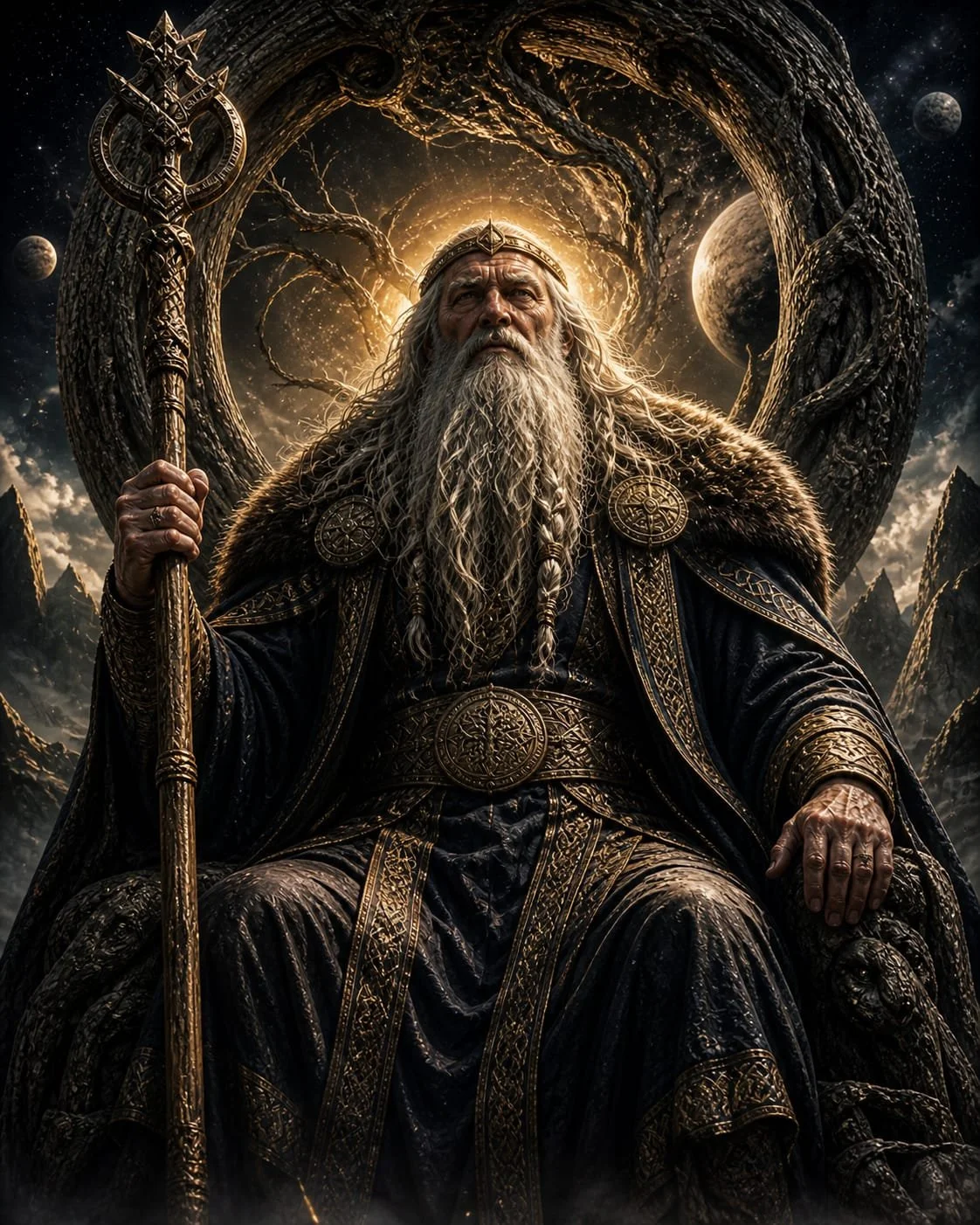
“There are figures who shape the world by what they do. And there are those who make the world possible by simply being where it begins.”- Fragment attributed to reconstructed mythic commentary
Pause. Not to search for action, but to notice absence. Because there is a kind of presence in myth that does not announce itself through deeds, yet without it, nothing that follows could occur. These figures do not fight. They do not speak often. They are not remembered for choices, but for position.
Borr is one of these.
Not a conqueror. Not a creator in the active sense. But a threshold...quiet, foundational, and almost entirely unexamined. Before you go further, understand this borr is not the one who shapes the cosmos. He is the condition that allows the shapers to exist.
And perhaps that is why he is so rarely named with weight. We remember beginnings in terms of action, the slaying of giants, the forging of worlds, the rise of gods. We rarely remember what stood just before those moments, holding the space in which they could happen at all.
Borr exists there. Not in the act, but in what makes the act possible.
**NOTE**
Before exploring this piece, it is important to clarify that borr is a figure from norse cosmology, most notably referenced in early mythic genealogies preserved in sources like the prose edda. He is the son of búri and the father of odin and his brothers vili and vé...the figures responsible for shaping the world from the body of ymir.
His partner is named as bestla, daughter of the giant Bölthorn, reflecting the deeply interwoven relationship between gods and giants in Norse myth. Borr is not described performing deeds or actions. His importance is preserved through lineage alone.
What follows is not a strict retelling, but a mythopoetic interpretation grounded in both the surviving sources and the deeper structural patterns of norse cosmology.
So pause here, just for a moment.
Because borr does not arrive through narrative. He is already there when narrative begins.
The Space Before Action
Before the first act of creation, there is a condition that allows action to emerge. Not will, not force, not intention...but existence aligned in such a way that something can happen.
In the cosmological account preserved in gylfaginning, existence begins in ginnungagap...a vast emptiness between fire and ice. From this tension emerges ymir, the first being, and alongside him, through a different process, búri the ancestor of the gods.
Borr belongs to what comes next. While búri emerges directly from the ice, fully formed, borr represents a shift from spontaneous existence to generational continuity. For the first time, existence is not simply appearing, it is being carried forward.
Borr exists in that alignment.
He does not initiate the shaping of the cosmos. His sons do that. He does not confront chaos directly. That confrontation belongs to the next generation. And yet, without him, that generation does not arise.
This is not passivity. It is positioning. He is not the story. He is why the story has somewhere to begin.
The Silence Around His Name
There is something striking about how little is said of borr. In a tradition that remembers conflict, cunning, sacrifice, and fate with vivid intensity, borr remains nearly silent. He is named, placed, and then… passed through. no speeches. No defining moments. No myth centered around his will. This absence is not accidental.
In norse cosmology, genealogies were a primary way of encoding meaning. To be placed within a lineage was to be given significance. Borr does not need narrative elaboration because his role is structural—he is the necessary link in a chain that cannot be broken without collapsing the entire sequence.
He is the bridge between origin and action.
Búri emerges. Odin acts. Borr connects.
The Problem of Missing Myth
There is a tendency, when encountering silence in myth, to assume that something has been lost. That once, there were stories here…that time has simply worn them away.
But not all absence is erosion. Some figures were never meant to stand at the center of narrative. In sources like the prose edda, where even minor figures are occasionally given voice or action, borr remains almost entirely structural. He is placed, named, and then passed through.
This does not necessarily indicate loss. It may indicate function. Norse cosmology does not treat every figure as a bearer of story. Some exist to hold continuity rather than to express it. Borr may not be a character whose myths were forgotten, but a figure whose role never required mythic elaboration in the first place.
To search for his story may be to misunderstand his position. He does not disappear from the tradition. He is simply never asked to speak within it.
On the Name Borr
Names in norse myth are rarely empty.
The exact linguistic origin of “borr” is uncertain, though it is often associated with roots relating to birth or generation. What matters more than precision is placement. In old norse tradition, meaning is often relational rather than descriptive.
Borr is not defined by what he does, but by where he stands.
Between búri and odin. Between emergence and action. Between what is and what will be shaped. His name does not need to declare his role. His position already does.
Ritual Without Record
If myth preserves action, ritual preserves repetition. And yet, there is no surviving record of rites dedicated to borr. No invocation calls his name. No offering is clearly made in his honor. Within what remains of Norse practice, he is not a figure of worship or appeal. This absence is consistent with his placement. Ritual, by its nature, calls upon forces that act, that intervene, that respond. But borr does not intervene. He does not answer. He does not alter outcomes. He is not the force one turns to, but the condition that allows turning to occur at all. If he exists within ritual, it is not as recipient, but as foundation.
Every oath sworn, every lineage named, every act performed within a chain of continuity…these depend on something prior that holds them in place. Not invoked, not seen, but already present. Borr belongs there.
Not in the ritual itself, but in what allows ritual to have meaning.
The Birth of the Shapers
Borr’s most defining role is also his only clearly stated one - he is the father of odin, vili, and vé. And through them, the world changes.
According to the prose edda, these three brothers confront ymir and bring about one of the most significant acts in norse cosmology. They do not create the world from nothing. They shape it from what already exists. Ymir’s body becomes the foundation of reality, his flesh the earth, his blood the seas, his bones the mountains, and his skull the sky. This is not creation. It is transformation.
Order is not made separately from chaos. It is carved out of it. Borr does not participate in this act. But without him, it does not happen. He does not shape the world.
He produces those who can.
Oath and Lineage
To speak of lineage in norse tradition is to speak of more than descent. It is to speak of continuity that binds past, present, and future into a single thread. Oaths were not isolated declarations. They carried weight across generations. To swear was to position oneself within a line that extended both backward and forward, anchored in those who came before. In this sense, borr is not merely the father of odin and his brothers. He is part of the unseen structure that gives their existence legitimacy. Before action, there must be continuity. Before authority, there must be origin that holds.
Borr does not enforce oaths. He does not witness them. But the very idea that a lineage can carry meaning depends on figures like him...those who stand behind the visible chain, ensuring that it does not begin in isolation. Without that continuity, even the greatest acts lose their grounding.
The Pattern of the Unseen Predecessor
The sequence from búri to borr to odin is more than genealogy. It is structure.
It reflects a progression Emergence... Continuity....Action.
This pattern is not unique to Norse myth, but it is uniquely understated here. Where other traditions expand on transitional figures, Norse myth compresses them. Borr is not explored because he does not need to be.
His role was understood as part of the underlying logic of existence itself.
He is not a turning point. He is what allows turning points to exist.
Interactions That Never Occur
There are no recorded words exchanged between borr and his sons. No moment of instruction. No transfer of knowledge. No conflict, no guidance, no farewell. This absence is striking, not because it leaves a gap in the story, but because it defines the boundary of his role. The transition from continuity to action does not occur through dialogue. It occurs through separation.
Where later myths are filled with exchanges between gods, giants, and fate itself this earlier moment remains silent. The shapers of the world do not receive their purpose through speech. They emerge into it.
Borr does not teach. He does not direct. He does not participate in the decisions that follow.
He stands before them, not beside them.
And when they act, they do so without looking back.
The Unnoticed Dependency
Remove borr, and the sequence collapses.
There is no direct leap from primordial existence to structured creation. Something must carry that transition. Something must hold continuity long enough for it to take form. In norse tradition, this continuity is encoded through lineage.
The gods are not self-originating. Even odin, the most powerful of them, emerges from a chain that connects him back to earlier, more primal forms of existence. Borr is a critical link in that chain. Not because of what he does, but because of where he stands.
Place in the Cosmos
To understand where borr stands, it is necessary to see what surrounds him.
Before him is búri, emerging from the ice unformed, spontaneous, without precedent. Alongside that emergence is the presence of ymir, whose body will later become the material of the world. After borr comes transformation. The shaping of reality from what already exists.
He does not belong fully to either side.
Not to the raw emergence of being, nor to the deliberate structuring of the cosmos. He occupies the narrow space between them, where existence becomes continuity, and continuity prepares for change. This is not a place of action. It is a place of alignment.
And once alignment is achieved, it no longer needs to be seen.
Comparative Mythology: The Unnamed Middle Figures
Across mythological systems, there is a recurring structural pattern figures who do not create, rule, or destroy, but instead exist between those functions holding transitions in place without being the focus of narrative attention. borr belongs to this category.
In the norse material preserved in the prose edda, he is positioned between primordial emergence and cosmic action between búri, who appears without lineage, and odin, who actively reshapes reality. This intermediate position is structurally essential, yet narratively minimal.
This pattern is not unique. In greek tradition, genealogical figures such as uranus and gaia give way to the titans, who in turn give way to the olympians yet many transitional generations are only partially individualized, existing more as links than characters. In Indo european myth more broadly, early generational figures often serve as stabilizers of succession rather than agents of transformation.
What is consistent across these systems is not the presence of detailed stories for these figures, but their necessity as connective tissue. Myth does not move directly from origin to action. It passes through intermediaries who are often underdeveloped precisely because their function is structural rather than dramatic.
Borr’s significance becomes clearer in this context.
He is not an exception in norse myth. He is an example of a broader mythological principle that continuity itself requires figures who do not dominate narrative space, but make narrative progression possible.
To overlook such figures is to misread myth as a sequence of events rather than a system of transitions.
The Philosophy of Precondition
Borr represents a principle that extends beyond myth: that outcomes depend on conditions that are often invisible once the outcome is achieved. Norse cosmology does not present creation as a singular, isolated act. It presents it as part of an unfolding sequence, one that depends on continuity, positioning, and relation. Borr is not the cause of creation. He is the condition that allows it.
And once creation occurs, that condition fades into the background. Not because it is unimportant. But because it has already done its work.
Borr and Wyrd
In norse thought, fate is not imposed from outside. It is woven through existence itself a pattern known as wyrd. Wyrd does not begin at the moment of action. It extends backward, through lineage, through condition, through all that makes an event possible before it occurs. In this sense, borr is not a figure of fate, but a figure through which fate can move.
He does not decide outcomes. He does not shape destiny. But he belongs to the structure that allows destiny to unfold without rupture. Wyrd is continuity carried forward. And borr stands within that continuity, not as its weaver, but as one of its necessary threads.
Before Ragnarök, Before Everything
Even in a cosmology defined by endings, such as ragnarö kthe question of beginnings remains. After ragnarök, the world does not end absolutely. It renews. Survivors remain. New generations emerge. The cycle continues.
This reflects a deeper structure within Norse myth: existence is not linear, but continuous.
Borr belongs to that continuity. He is not present at the end. But without what he represents, there is no beginning to return to.
Contrast: The Acting Gods
To understand what borr is, it helps to see what he is not. Odin seeks knowledge, sacrifices himself, shapes events through will and cunning. His presence is defined by interruption by the ability to alter the course of what would otherwise unfold. Borr does none of this. Where odin acts, borr allows. Where odin transforms, borr precedes. Where odin is remembered for what he does, Borr is forgotten because he does not need to do anything at all.
This is not lesser importance. It is a different kind of necessity. Action changes the world. But before change can occur, there must be something that holds long enough for change to take form. That is where Borr remains.
The Lasting Lesson
Borr teaches that not all essential forces are visible through action. Some exist through placement, through continuity, through being exactly where they must be for something else to emerge.
He is not the moment you remember. He is the reason there was a moment to remember at all.
Invocation of the Unseen Foundation
When you look at what has been built whether in your life, your work, or your understanding, ask not only what created it, but what allowed it to be created. What stood before it? What carried it forward before it had form? What existed quietly, without recognition, so that something visible could emerge? That is where borr resides. Not in the act. But in the condition that makes the act possible.
Ritual of Recognition (Modern Reflection)
There is no rite dedicated to borr. No formal practice that calls his presence into the moment. But recognition itself can take the shape of a kind of ritual. To pause, not at the point of achievement, but just before it. To look at what has taken form and ask what allowed it to do so. Not who acted, but what stood in place long enough for action to become possible.
This is not invocation. It is awareness.
A quiet acknowledgment that what is visible is rarely self-originating. That beneath every outcome lies a structure that does not announce itself, yet holds everything that follows. To recognize that structure, even briefly, is to stand where borr stands.
Not in the act. But just before it.
Recognition
What precedes you is not always visible.
It does not announce itself. It does not demand acknowledgment. And yet, it shapes the path you walk long before you realize there is a path at all. Borr does not require remembrance. But to notice him is to understand something deeper about existence itself that beginnings are rarely singular, and that what allows something to start is often as important as what it becomes.
Borr: The Father Who Stands Before the Story
Not creator. Not conqueror. But the quiet presence that ensures there is something to be created at all.
If you look at where you stand now…
can you see what stood there before you?
Wyrd & Flame 🔥🌿✨
