
Sleipnir: The Steed Between Worlds
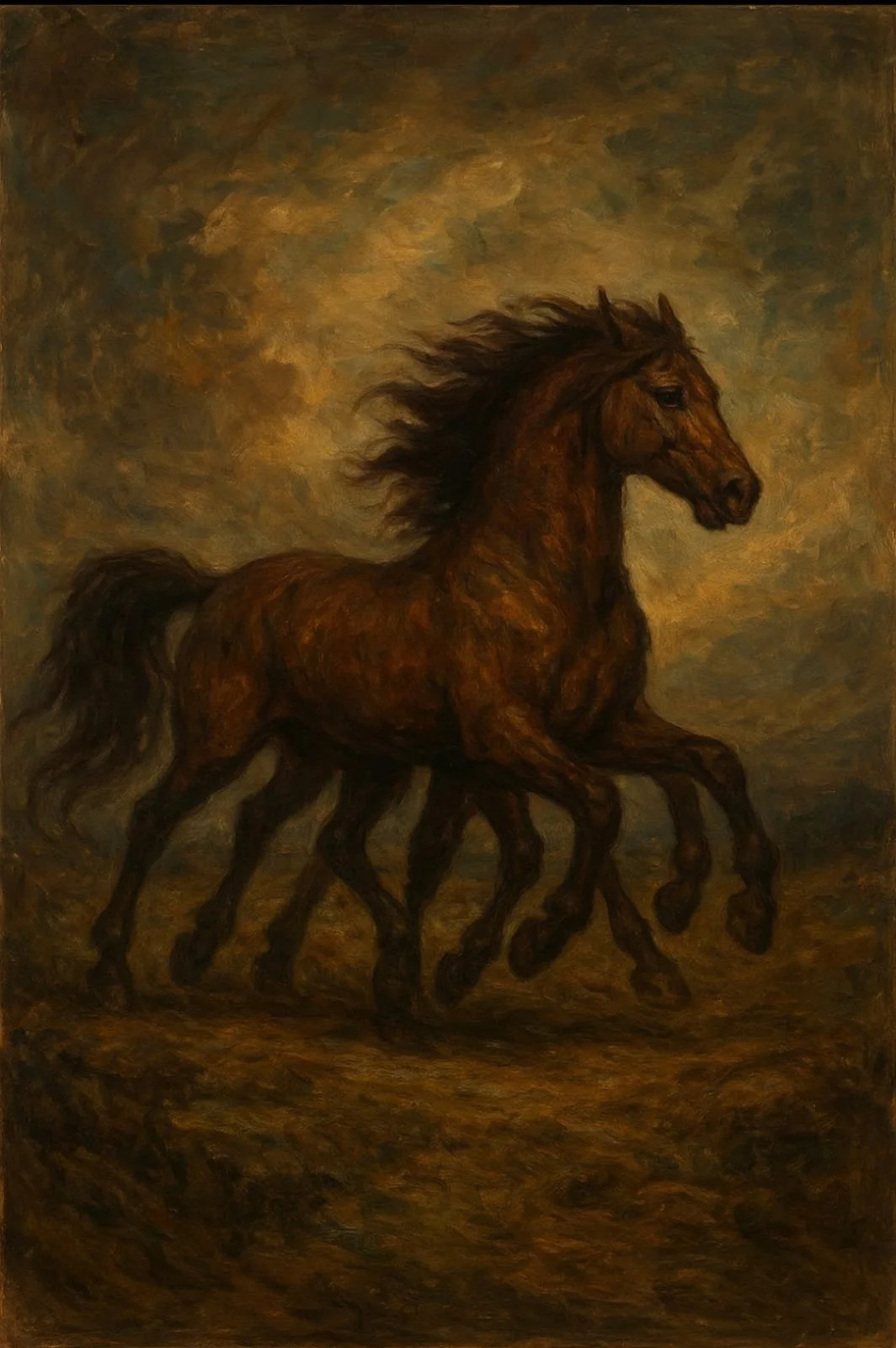
In the first age, before Asgard’s wall was laid, before men had names for fear or faith, the wind carried whispers of a being who could cross what none could bridge.
Not yet a horse, not yet a symbol, but a motion waiting to be born.
The poets of old said all worlds were once connected by a single road - the rainbow Bifröst - and that road itself was a thought of Odin’s. Sleipnir was that thought made flesh.
For when the gods first imagined a steed strong enough to carry the All-Father between realms, the world itself shuddered.
Out of dream and deceit came he who would bear the burden of the skies.
“Átt fætr hafði hann,
bestr var hann hesta,
hann bar Óðinn,
yfir mar og mjötuðr.”
(‘Eight legs he had, the best of horses, he bore Odin over sea and fate.’ - Grímnismál 44)
The forge of Names
In the old tongue, to name was to bind.
Sleipnir “the slippery one” was no mere epithet, but a spell against stillness.
For to name him was to confess that no hand, godly or mortal, could hold motion itself. Even Odin, when he spoke the name, felt it slip from his mouth like mist.
The Bargain at Asgard’s Gate
The tale begins in craft and treachery.
When the gods raised Asgard’s fortifications, they struck a perilous bargain with a stranger - a mason giant who claimed he could build the wall in one winter.
His price: the Sun, the Moon, and Freyja’s hand.
The gods agreed, thinking the task impossible. But the builder had a stallion, Svaðilfari, whose might was greater than ten men’s labor. Each stone he hauled leapt into place as if the earth obeyed him.
Day by day the wall rose, and the gods grew uneasy. If the wall were finished, they would lose the heavens themselves.
So they turned to Loki, the shapeshifter, who said with his sly smile,
“Fear not. I shall delay the work - but the means will not be spoken of.”
That night, beneath a moon of shifting cloud, a mare wandered into the forest.
Her neigh was soft as seduction.
Svaðilfari, hearing her call, broke his harness and followed. The two vanished into the mists.
The Mare and the Moon
It is said Loki, in mare’s form, ran with Svaðilfari for nine nights.
They coursed through rivers and thickets, leaving silver hoofprints upon stone.
When at last the giant builder found his stallion gone, the work ceased.
The walls of Asgard remained unfinished, and the gods laughed - then slew the mason, revealing him for the Jötunn he was.
But Loki did not laugh.
For from his womb came pain and wonder: a foal grey as winter mist, with eight legs, each as strong as destiny.
And Loki, ashamed and awed, brought the creature to Odin.
“He is your gift, All-Father,” said Loki.
“Born of deceit, yet free of it.”
Odin laid a hand upon the foal’s mane and said,
“He shall bear me where none other dares. His name shall be Sleipnir (the Slippery One)
for he will run where thought cannot tread.”
The Gift and the Guilt
When Loki returned to Asgard, no laughter followed him. The gods averted their eyes, for they had never seen the Trickster weep.
Yet in his arms lay the foal who would outshine them all - born not of love, but of cunning turned to creation. Thus Loki tasted what even gods rarely know: that deceit, when turned inward, can birth truth.
The Eightfold Mystery
Eight legs. The number of directions, of horizons, of transcendence. Four for this world, four for the next.
Scholars and seers alike have sought meaning in this form. Was it a symbol of shamanic travel, where the soul rides an otherworldly horse into trance? Or perhaps a mark of duality - life and death, matter and spirit, bridged in one body?
To the Norse, Sleipnir was no deformity but perfection: the living diagram of cosmic motion.
“Átt fætr hafði hann, en einn var hann,” - the poets say,
“Eight legs he bore, yet one being was he.”
He is speed without friction, thought without hesitation, motion incarnate.
The horse that carries gods, souls, and symbols alike.
Odin’s Chosen Steed
Odin tested Sleipnir across the nine realms. He rode him over Bifröst, through storm and shadow, across the frozen rivers of Jötunheim, and through the air like a hawk on wind. None could match his pace.
He did not gallop; he flowed - like time itself unspooling.
When Odin’s one eye beheld the vastness of all things, Sleipnir was the thread binding vision to motion.
He became more than a mount - he was the extension of divine will.
“No creature living nor dead shall outpace this steed,” Odin proclaimed.
“For he moves as the mind moves -
between moments, between worlds.”
The Breath Between Worlds
When Sleipnir ran, the world inhaled. Mountains bent; seas parted; time stretched like a lung. Each stride was a pulse of the cosmos, each breath a bridge. For movement is the oldest prayer - and Sleipnir was its Amen.
Descent to Hel
Then came Odin’s darkest journey. When his son Baldr died, struck by the mistletoe spear, the All-Father could not bear ignorance. He mounted Sleipnir and rode toward the underworld, seeking the dead’s wisdom.
The Baldrs Draumar says:
“Then Odin rode to Niflhel’s gate, upon Sleipnir, his grey steed. He called to the hound that guards Hel, until the ground split with echo.”
The hooves of Sleipnir clattered upon the bridge Gjallarbrú, which glowed like fire beneath frost. The maiden Móðgudr demanded his name.
“I am Vegtamr, the Way-Tamer,” said Odin.
“And this is my steed, born of shadow and storm.”
She let them pass, saying,
“Few ride this way living - fewer still return.”
But Sleipnir did not falter. Through the gates of Hel he trod as if they were meadows of summer.
The Völva’s Question
In the hall of Hel, the seeress rose from her grave at Odin’s call.
Smoke coiled about her eyes.
“Who rides so loudly to my door,
shaking the world of the dead?” she asked.
Odin answered:
“It is Sleipnir who carries me, grey among ghosts.
I come for truth, not for peace.”
The Völva gazed upon the horse and whispered:
“Never have I seen one so made -
eight legs for the eight roads of the soul.
Even Hel’s hound yields to his tread.”
And Odin knew then that Sleipnir was more than a beast - he was the road itself.
The Tree and the Rope
The Hávamál tells how Odin hung upon Yggdrasil, wounded by his own spear, to gain the runes of power. He called the world-tree “Yggdrasil” - literally Yggr’s horse, “the steed of the Terrible One.”
Some whisper that this name hides the truth:
that Sleipnir and Yggdrasil are mirrors of each other.
The horse that carries Odin through worlds is the same as the tree that bears him between life and death. To “ride” the tree is to traverse the same path Sleipnir knows - the axis mundi, the cosmic road.
Thus, Sleipnir is the living Yggdrasil, his legs the roots and branches that connect every realm.
Runes on the Teeth
In Sigrdrífumál, the valkyrie Sigrdrífa teaches Sigurd:
“Carve victory-runes upon your blade, and on Sleipnir’s teeth, and on the reins and the sledge.”
The horse’s teeth, the tools of speech and bite, were to bear runes - for even the horse’s mouth is a gate of magic. Every breath from him was a spell of movement.
This image reveals Sleipnir as a rune-bearer: his body inscribed with sacred signs, his gait the meter of Eddic verse itself.
The Race of Giants
Once Odin rode Sleipnir into Jötunheim and met Hrungnir, the strongest of the giants. Hrungnir boasted that his horse, Gullfaxi, could outrun any steed.
They raced across the worlds - over clouds, mountains, and rivers of flame. But Sleipnir outpaced him by leagues, his eight legs striking sparks upon the air. Hrungnir’s wrath birthed war between gods and giants.
Thus Sleipnir became the measure of divine supremacy - the speed that even pride cannot match.
The Riderless Hour
There are nights when even gods sleep, and the grey horse walks alone. His hooves sound softly upon the stars, tracing forgotten constellations. No rider, no command - only the sound of being itself. Then the cosmos remembers that even obedience has its own kind of freedom.
The Wild Hunt
In later centuries, when thunder rolled through the northern sky, people said:
“There rides Odin with Sleipnir and his host - the Wild Hunt.” Eight hooves became the storm’s pulse, and the grey blur of Sleipnir was seen between lightning and cloud.
Those who saw him knew that the dead rode with him, carried to judgment or rebirth.
Sleipnir’s gallop became the sound of fate itself - the world’s heartbeat in winter skies.
The Silence of the Steed
Throughout the myths, Sleipnir never speaks. No word passes his lips, no neigh breaks the air. And yet his silence is sacred.
He obeys only Odin’s will. He embodies motion without motive, service without self. He is kenosis - the emptied vessel of the divine.
Where Loki’s cunning created him, Odin’s discipline perfected him. He is the reconciliation of chaos and order.
The Colour of the Between
Grey - neither black nor white, neither life nor death. In Norse poetry, grey is the hue of mist, of revelation hidden in veil.
It is the colour of becoming. Sleipnir’s hue thus marks him as liminal not pure light, not pure dark,
but the twilight that holds both.
To dream of a grey horse was to stand at the threshold of the unseen.
It meant a journey was at hand.
Symbol of Sovereignty
On the ancient Gotland stones, carvings show Odin astride Sleipnir, holding a ring - Draupnir, the ring that multiplies itself.
This is no mere ornament: it is the mark of kingship. Only one who has ridden to Hel and returned may wield power over life and death.
Thus Sleipnir is not just Odin’s steed but his proof of authority - the covenant between wisdom and mortality.
The Horse of the Soul
Across Indo-European myth, the horse is always sacred. To the Celts, Epona was goddess of horses and souls.
To the Vedic poets, the Ashvins carried the light of dawn. To the Greeks, Pegasus bore inspiration itself. Sleipnir stands among them as the Norse soul-steed, the bridge over Gjöll, the chariot of dream. In him converges the whole Indo-European vision of transcendence through motion.
The Dreaming Path
Those who travel not by feet but by spirit have felt his breath. In the twilight of trance, when vision loosens from the skull, they hear his hooves - eightfold rhythm of awakening. He carries not bodies, but awareness itself.
The dreamer who rides him returns changed - never wholly in one world again.
The Shadow of the Trickster
Though Sleipnir bears Odin’s weight, the glimmer of Loki still runs in his veins.
His laughter is in the wind that follows him; his mischief in every flash of grey across the horizon. Thus, every gallop is both a vow and a rebellion - the Trickster’s redemption written in speed.
The Heir of Loki
Though Loki fathered monsters - Fenrir, Jörmungandr, Hel - he also bore Sleipnir, his paradoxical redemption.
From deceit came truth. From chaos, order. From the trickster, the god’s greatest servant.
Sleipnir proves that even the chaotic can birth the sacred. He is the quiet reconciliation of shadow and light in the Norse cosmos.
Sleipnir and the Valkyries
When the Valkyries ride to claim the slain, they follow Sleipnir’s paths. Their steeds are reflections of him - white, grey, eight-hooved in spirit. They cross the battlefield’s smoke and carry heroes to Valhalla,
their hooves echoing the first steed’s rhythm. It is said that when a warrior dies and the wind stirs the grass, it is Sleipnir’s breath leading their way.
The Iron of the Sky
When the spears are cast and the ravens cry, Sleipnir’s hooves strike thunder from the firmament. Lightning gathers in his mane; his nostrils breathe storm. He is the forgefire of war - the pulse that drives gods toward their doom. Yet in his gallop, there is no rage. Only inevitability.
The Last Ride: Ragnarök
At the end of all things, when the wolf devours the sun and fire consumes the sky, Odin will mount Sleipnir one final time.
The Eddas say the All-Father will ride to meet Fenrir, knowing his doom.
Eight hooves will strike the plain of Vigrid, shaking the ashes of creation.
The horse will bear his master into fate itself.
But death cannot bind what already crosses death’s gate. Even after Odin falls, Sleipnir will run - carrying his spirit through the smoke of the dying world.
The Dawn Beyond Doom
When the new world rises from the sea, green and reborn, some say a grey horse will stand upon the shore, looking east. No rider upon him, yet no loneliness either. For his task is eternal - to connect what has been broken.
Sleipnir will wait, as he always has, between dusk and dawn.
The Stillness After the Storm
When all fires fade, and the sea smooths itself once more, Sleipnir stands among the ruins. His coat gleams pale as dawnlight over ash. The gods are gone, yet motion remains. For even the end cannot end what moves between worlds.
The Steed of Thought
Sleipnir is not only myth but metaphor. He is thought made motion, spirit given form, connection incarnate.
In our age of invisible bridges - data, dreams, minds - he rides still. Every leap across worlds, every bridge between the seen and unseen, every moment when imagination outruns matter - that is Sleipnir’s gallop through us.
He is the continuity between gods and ghosts, between old songs and new minds.
“He runs where no road leads,
and where all roads end.”
- Eddic Fragment, attributed to the lost Skald of Hrafnhóli
Reflection - The Rider Within
Sleipnir’s story, at its heart, is not only that of Odin’s steed, but of the human spirit’s journey between opposites.
Born of chaos yet bearer of order, he is what we all must ride: our paradoxes, our wounds, our transformations.
When Loki - trickster, outcast, shapeshifter - birthed Sleipnir, the impossible was made flesh. From deceit came the bridge of truth.
From shame, the tool of transcendence.
The myth whispers: Nothing unworthy cannot also become holy.
Odin, the seeker of all knowledge, rides Sleipnir not because he commands him,
but because he trusts him - trusts the thing born of shadow to lead through shadow.
He dares to mount what others would flee.
In this, Sleipnir becomes the archetype of transformation. He is the means by which we cross our own Hel, our own night of unknowing, to return wiser, quieter, whole.
Each of us, in the end, becomes both Odin and Sleipnir: the rider and the ridden, the will and the way, the thought and the breath that carries it onward.
To walk this path - to move through fear, shame, and death toward rebirth - is to hear the eightfold thunder of Sleipnir’s hooves within our own chest.
For he is not gone.
He never was.
He runs through dream and dusk, through myth and mind,
waiting for each of us to take the reins.
Closing Quote
“Ride not to flee the dark,
but to pass through it.
For the path of Sleipnir lies not over the world,
but through the soul.”
— Fragment of the Skald Eyvindr, c. 10th century (Lost Verse of the Grey Steed)
Epilogue – The Eighth Step
There are seven worlds we can name, seven journeys we can trace -
but the eighth is not of map or measure.
It is the unseen stride, the motion beyond motion.
It is the step Sleipnir takes when the road itself dissolves.
For even gods end, and even myths fade,
but the act of crossing - the courage to move through shadow into light, endures.
That is the eighth step:
not toward another world, but through the heart of this one.
When the skald’s voice falters,
when the ink dries,
listen -
somewhere, the sound of hooves upon wind.
Eightfold rhythm, carrying the silence forward.
It is not the sound of a god’s return,
nor the echo of an ancient story,
but the pulse of becoming itself -
the reminder that all boundaries are invitations.
Sleipnir runs still,
between thought and thunder,
between loss and renewal,
between what we are and what we dare to be.
And when at last we take that step - the eighth step -
we do not follow him.
We become him. 🐎
Wyrd & Flame 🔥
