
Nisse: The Guardian of Hearth, Hay, and Snow
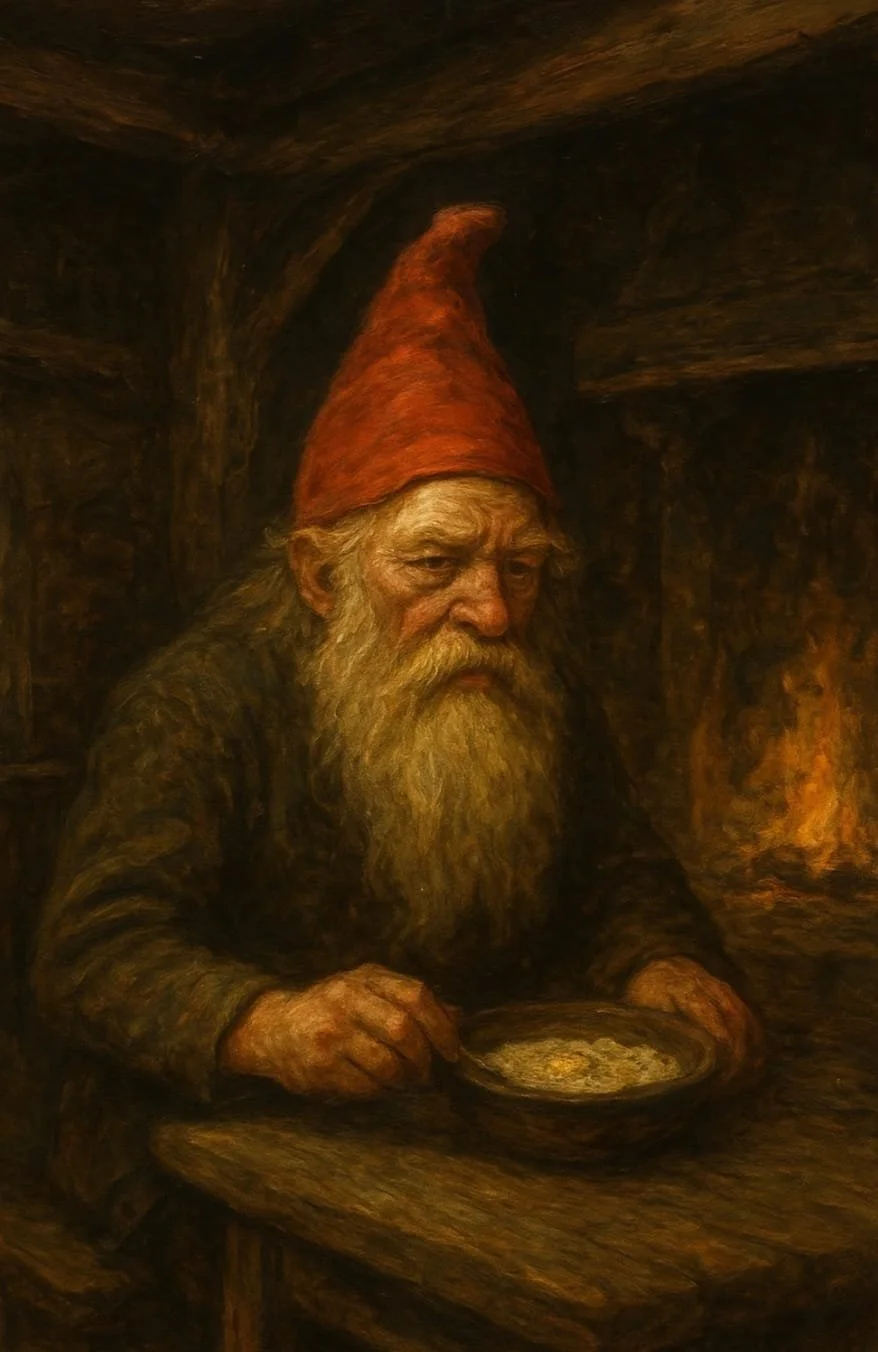
(The Nisse are later Scandinavian folklore creatures)
"Small of stature, vast in memory, he carries the frost in his breath and the farmstead in his gaze." - from The Winter Tales of Hedmark, anonymous, c. 1400
I first heard of the Nisse on a solstice night, in a farmstead near the edge of Østerdalen. The wind rattled the barn, rattled the house, and through the hollow of that storm, I felt him - an unseen weight in the hayloft, a warm pulse beneath the beams. The farmer whispered of him, of the small man who kept the barn, who corrected what was wrong, who waited for nothing but respect.
In our world of electric hum and sleepless light, the old stories still whisper the same truth: attention is sacred, and neglect has a price.
Across the North, he wears many names - Nisse, Tomte, Tonttu - but the essence is constant. He is the guardian of domestic borders: the line between human care and the wild, between order and entropy, between neglect and reverence. He is neither malevolent nor wholly benevolent. He is the principle of accountability made flesh.
The Hearth and the Hayloft
Unlike the Huldra, the Nisse is not of the forest’s edge, nor of the hidden hill. He dwells within the human sphere, yet in a realm the human eye rarely sees. In the rafters of barns, beneath the eaves of houses, in the warmth of the hearth, he moves silently. He tends cattle, corrects mislaid tools, guides the young animals, and whispers warnings into the night.
Farmers spoke of him in reverence, for to forget the Nisse was to court calamity. One story tells of a farmer whose hayloft caught fire after a year of ignoring the small figure’s needs. When he awoke, nothing remained but frost on blackened beams, and a single small footprint pressed into the snow outside the barn door. The lesson was clear: the Nisse’s care cannot be taken for granted.
Yet, when honored, his presence is transformative. A barn left in disorder might be found neat by dawn. Cows milk themselves with ease. The hearth burns long into winter nights. He is a guardian of prosperity, but prosperity earned through attention and humility.
In older tales from Gudbrandsdal, it is said that the Nisse’s touch can quicken dying embers or calm a frightened mare. He works not with spells but with intent, the quiet power of care made manifest. When humans labor well, he labors beside them; when they grow lazy or prideful, he withdraws, and the frost creeps in.
Songs and Sayings of the Nisse
In every valley where snow lingers and smoke curls low, there are songs that speak of him - short verses sung by farmers’ wives or whispered to children before sleep.
“Keep the bowl full, keep the barn clean, The Nisse works where he is seen.”
Another, from Hallingdal, carries both humor and warning:
“He’ll braid your mare and steal your shoe, If you forget his Christmas brew.”
These songs are fragments of memory, the oral contracts between humankind and their unseen caretaker. Some are lullabies; others are work chants meant to accompany milking or hay-cutting. A few old sayings persist in rural speech, such as, “The Nisse’s eye never sleeps,” meaning that even the smallest neglect will be noticed.
In the north of Finland, elders still murmur an invocation before the first snow:
“Little watcher, little hand,
Keep my hearth and bless my land.”
Such verses are not prayers in the divine sense, but acknowledgments - small offerings of breath and voice to the one who listens beneath the eaves.
The Porridge and the Price
The rituals surrounding the Nisse are quiet, simple, intimate.
The Bowl of Yule - In some regions, the porridge is mixed with a few drops of beer or mead, “for warmth,” they say, “so the old man remembers he is welcome.” Others hide a coin beneath the bowl to ensure prosperity for the year ahead.
The Porridge Offering - Traditionally served on Christmas Eve or the winter solstice, a bowl of warm porridge is left in the barn or by the hearth, sometimes topped with a pat of butter. It is an acknowledgment, a gift in exchange for vigilance.
The Candle in the Window - A small flame guides him through the long night, honoring his work and his presence.
The Whispered Thanks - Gratitude is spoken softly, acknowledging the unseen, respecting the watchful eyes that never rest.
The Nisse is not bribed but engaged in a pact. Forgetfulness, negligence, or disrespect draws his quiet wrath. Milk sours, tools vanish, animals falter, and the smallest errors expand into catastrophe. His anger is never dramatic; it is the subtle undoing of what is ignored, the gentle assertion of consequence.
“He gives what is earned, not what is wished for,” says an old proverb from Jutland. “And he takes what is wasted.”
Encounters and Traveler's Tales
Throughout the 17th and 18th centuries, travelers and ministers crossing the Scandinavian countryside recorded strange happenings in their journals - always discreetly, for fear of ridicule.
In one entry from 1712, a Lutheran priest near Trondheim wrote of a “small, gray man” seen carrying a lantern through the snow, who vanished when approached but left behind footprints no larger than a child’s. Another, penned by a Swedish soldier in 1808, speaks of being guided through a blizzard by a flickering red cap until the outline of a farmhouse appeared. When he looked back, there was only moonlight and the sound of soft laughter.
Later tales from 19th-century folklorists describe the Nisse as a moral test: those who show greed or cruelty find their wagons stuck, their goods missing, or their food turned to ash. Yet the kind and the weary are often rewarded with shelter or warmth - invisible kindnesses beneath the howling wind.
In these accounts, the Nisse is not only a myth but a constant presence on the road - a symbol that every journey, no matter how harsh, passes through the unseen care of the old spirits.
Mischief and Memory
He is small but cunning. Some say he carries the patience of centuries, the memory of all farms ever tended, all hands that ever labored. In Hedmark, it is said that a Nisse once rearranged every tool in a miller’s workshop after a season of forgetfulness. When the miller awoke, nothing was where it belonged. Some claimed it was mischief; others whispered it was a lesson in order, in vigilance, in respect for labor.
Other tales speak of playful tricks: a horse left muddy at the door, a cow’s tail mysteriously tangled, a bucket of water tipped by the smallest of unseen hands. Mischief is his pedagogy. It teaches boundaries, humility, and the necessity of care.
In Västergötland, there is a tale of a Nisse who wagered with a raven that he could move an entire haystack by moonrise. When the farmer awoke, he found the hay neatly stacked atop the roof, and the raven’s black feather left in the yard as proof. The story is told to children to remind them: the Nisse’s humor runs deep, but never cruel.
The Nisse in Dreams
The Nisse appears in dreams as he does in barns: small, watchful, impossible to ignore. His eyes are dark as soil, his hair golden like autumn hay. He may guide, he may warn, or he may demand attention. Those who dream of him awake with a sense of being observed, of being accountable not only to human eyes but to something older, quieter, and infinitely patient.
Some farmers report waking to find their boots lined neatly, tools restored, and the faint smell of hay and smoke. Others find small gifts: a single coin, a sprig of holly, a knot of straw tied into a protective shape. Each is a message: you are seen. You are remembered. The farm’s well-being is tied to your attentiveness.
In the oldest dream-tales, the Nisse sometimes speaks. His words are few but heavy: “Tend the flame,” he says, “and it will tend you.” These phrases pass from dreamer to dreamer, becoming proverbs, becoming prayers.
Kinship and Lineage
The Nisse is sometimes said to have children, tiny spirits who shadow him in the barn and yard. These small helpers inherit his vigilance, his cunning, and his moral neutrality. Some live among humans unnoticed, teaching attention and care by quiet example.
A rare few tales tell of human children who disappear into the barns during long winters, returning wiser and smaller in spirit, as if the Nisse had taught them the art of silence and observation. They become “watchers” - those who see the small things others miss.
In rare cases, they take a human mentor, usually a child or young farmer who has shown respect, patience, and diligence. Through these bonds, the Nisse’s influence persists, subtle and persistent, across generations.
The Nisse and the Gods
Unlike the Huldra for example, the Nisse does not appear prominently in the sagas. Yet whispers place him near Odin’s wanderings, as a witness to the human realm, a keeper of the domestic order that the gods rarely intervene in. Some say he is a reflection of Freyr’s concern for fertility and abundance: the prosperity of the farm, the health of livestock, the growth of the crops, and the vigilance of those who work the land.
Others hint that he shares kinship with Jörð, the Earth herself, embodying the principle that the human and natural must coexist in careful balance. Like Freyr, he is beneficent when treated with respect - but neglect brings consequences, subtle yet uncompromising.
A few late Icelandic verses name him “Odin’s Footprint,” the unseen step left behind after the god’s passage through mortal lands. In this view, the Nisse is not a being of his own, but a remnant - the embodied memory of divine order lingering in the mortal world.
There are even whispered sagas that tell of Thor once meeting a Nisse in disguise, testing his strength by lifting a frozen ox-cart. The Nisse, being small, simply whispered to the frost, and the ice melted beneath the wheels. Thor laughed and declared him “the smallest of giants,” a title that persists in some folktales to this day.
Tales of Frost and Fire
In the valleys of Telemark, an old tale is told of the Nisse and the wandering flame. When a careless farmer left his forge untended, sparks caught the hay. The Nisse leapt from the rafters, carrying the fire out into the snow. He burned his hands, it is said, and from then on, his palms bore a faint red glow, marking his devotion to both warmth and warning. “He saves by burning,” the old folks say. “He teaches by frost.”
Another legend from Finland speaks of the “Snow-Wife of the Nisse,” a being made of rime and moonlight who visits during blizzards to count the living fires. If a farm neglects its offering, she sighs once through the chimney - and the next morning, frost flowers bloom on every window, a sign of her disappointment.
Solstice and Season
The Nisse is bound to the rhythms of the year. The winter solstice is his sacred night, when offerings must be made, fires tended, and attention paid. He reminds humanity that the smallest actions resonate: a bowl of porridge left, a tool returned, a cow gently stroked.
Spring and summer bring other forms of vigilance: ensuring the livestock are safe, the granaries full, the fences mended. Through the cycles of season, the Nisse teaches attentiveness, respect, and patience.
In autumn, he is said to walk the fields unseen, counting the sheaves of grain. Each unharvested stalk is a mark against the farmer’s diligence, each broken fence a sigh. But if the fields are well-kept, he leaves small gifts in the soil: mushrooms that glow faintly at dusk, a sign of quiet blessing.
Regional Faces of the Nisse
Across Scandinavia, the Nisse wears many guises. In Denmark, he is the ‘Gårdbo,’ a farm ghost wrapped in gray wool, who smokes a tiny pipe and mutters about misplaced tools. In Norway, he is shorter, sterner, with eyes like cinders and a beard white as hoarfrost. The Swedes call him ‘Tomten,’ a gentler spirit who hums as he works, content with order and porridge.
The Finnish ‘Tonttu’ is different still - a being half-bound to the sauna, keeper of heat and purity. To spill dirty water in the sauna after dark, they say, is to offend him, and the next steam will feel cold no matter how much wood you burn.
Each form shares a single heart: protect the home, respect the labor, remember the unseen. Whether gray, red, or white, their caps mark them as liminal - standing between man and myth, between frost and flame.
Modern Echoes
Today, he survives in folklore, in small figurines on shelves, in Christmas cards and miniature haylofts, but the essence remains unchanged. The Nisse is memory made physical: a reminder of human responsibility, of care, of the intimate connection between effort and reward.
Some see him in the quiet moments of domestic life: when a barn is unusually tidy, when animals thrive, when the winter fire burns bright and warm. He is the observer, the quiet judge, the patient guardian of labor and home.
There are even accounts from modern farmers who claim odd happenings - tractors that start after months of stillness, a single red mitten left on a gatepost, a small footprint in the snow beside steel doors. They say the Nisse has adapted: where hay once lay, he now guards the hum of electricity and the rhythm of machines. “The spirit remains,” one farmer said, “only the tools have changed.”
He walks still, though the world has changed. The haylofts are now steel, barns now metal and glass. Yet he waits, invisible, insisting that attention matters, that respect for labor and life remains sacred.
The Nisse: Guardian of Hearth, Hay, and Snow
Not angel, not demon. Not spirit, not god. Only patience, memory, and the oldest question, still whispering beneath the rafters: "Have you remembered the small things?"
Beneath every beam, every bundle of hay, something still watches.
Not angel, not demon. Not spirit, not god. Only patience, memory, and the oldest question, still whispering beneath the rafters:
"Have you remembered the small things?"
Beneath every beam, every bundle of hay, something still watches.
Legacy and Reflection
Though centuries have passed, the lesson of the Nisse endures. He is not merely a spirit of barns but a symbol of equilibrium - of right relation between labor and land. Where once he tended cattle and kindled hearths, now he watches over the electric hum of cities, the quiet diligence of workers who still honor unseen crafts.
In the modern world, his teachings find new soil: sustainability, stewardship, the quiet ethics of care. To tend the earth well, to honor effort, to keep balance between consumption and gratitude - these are his new commandments, though unspoken.
Some poets call him “the conscience in the rafters,” the voice that asks if we have remembered to care for what sustains us. Others name him “the Old Neighbor,” the enduring presence that binds humanity to the living world.
Perhaps he no longer wears a red cap or walks the snowbound roof. Perhaps he moves now through circuitry and dust, watching the lights we build instead of the fires we once fed. Yet the whisper remains: attention is sacred, care is survival, and respect is the oldest form of worship.
“He lives,” the Norwegians say, “wherever work is done with love.”
And so, when winter deepens and frost takes the fields, ask yourself one final question: “Who watches while you sleep, and what do you owe the watching?”
Leave your comments below!
- Wyrd and Flame 🔥
