
Seiðr Craft - Chapter 10: Working With Silence
Silence is not the absence of sound..
It is the sound beneath all sounds.. the resonance beneath breath, beneath thought, beneath the world’s constant hum. It is the layer of the work most practitioners avoid for years, not because it is empty, but because it is full and they do not yet know how to bear its fullness.
Most mistake silence for a void. In truth, it is a presence. A density. A field. The dark water beneath the current that holds more life than the surface ever reveals. It is the stillness in which true sight ripens, where impressions gather, where the unseen arranges itself before taking form.
Many come to seiðr expecting spectacle.. visions that blaze, voices that instruct, sensations that prove something is happening. But the sagas do not describe spectacle. They do not speak of wild lights or sensory fireworks.
They describe waiting..
They describe stillness..
They describe the völva seated on the high seat, poised at the threshold, breathing with the rhythm of the worlds. Not grasping at impressions. Not forcing sight. Simply listening (with her whole being) for what chooses to rise.
Silence in seiðr is not passive. It is not the inert quiet of an empty room. It is a medium, a realm, a living threshold.
To sit in silence is to step into the same space the Norns inhabit as they listen for the threads beneath the threads. It is to sit where Odin sat when he hung from the Tree - no visions, no answers, only the raw ache of stillness and the knowing that nothing will come until it is ready.
Silence confronts you with yourself.
It reveals every tension you carry, every thought you chase, every expectation you cling to. It shows you the noise you bring into ritual long before any spirit or god ever approaches - This is why so many avoid it.
Silence is honest. It reflects back every part of you that is not yet settled, not yet aligned, not yet able to hear.
To work with silence is to learn to endure this honesty without flinching. To let the noise inside you rise, crest and dissolve - until the mind grows quiet enough that what is not you can finally reach you.
Until you can sit with the weight of silence…
with its texture…
with its unsettling clarity…
your craft cannot mature.
Working with silence is the shift from chasing experience to receiving it.
It is the transition from trying to pull visions toward you to letting the unseen meet you on its own terms. This is the point where seiðr ceases to be performance and becomes communion; where you stop reaching outward and begin listening inward and downward, into the depths where the threads of wyrd hum.
Silence is the door..
Vision is what enters through it.
If you cannot remain at the door, unmoving, the visitor will not come.
Learning to work with silence is the beginning of all true seiðr. It is the seat, the well, the breath, the dark and the invitation. And once you can sit within it without fear or demand, the craft begins to open slowly, steadily and with a depth no spectacle can ever match.
Silence as a Living Presence
Silence is not empty; it is full - dense, layered, and undeniably alive. It is one of the oldest forces in seiðr, older than words, older than ritual, older even than the stories we inherit. When you enter silence correctly (not as an escape, not as a performance, but as a placement) you begin to notice its living quality. It has a pulse, a temperature, a weight. It thickens or thins. It recedes or advances. It can feel like breath held at the edge of revelation or like a vast, cool darkness waiting without impatience.
Most people never meet this silence because they flee long before it reveals itself. They expect a void and fear what they believe is nothingness. But silence in seiðr is not nothingness. It is everythingness before form. It is potential. It is listening.
When you first settle into it, the silence may feel flat - like an empty room. But wait longer. Let your muscles soften, your breath lengthen and your mind stop reaching. The silence begins to change. It acquires texture: thick like fog, soft like wool, sharp like cold air in winter. For some, it presses inward, as if something unseen is focusing its attention on you. For others, it expands outward, dissolving the edges of the body until you feel suspended in a hollow of stillness.
This is not imagination. This is perception without narrative.
Silence speaks through shift, not sentence.
It answers not with words, but through:
• pressure (subtle or unmistakable),
• alignment (sudden settling, as if the inner axis straightens on its own),
• clarity (something becoming known without any mental reasoning),
• discomfort (a sign you are holding tension or resistance),
• ease (a sign you are aligned and receptive).
This is the silence in which the Norns weave. Not the loud clatter of fate making, but the deep, submerged hum at the root of the Tree. Urðarbrunnr is not a noisy place; it is a place where sound is swallowed into meaning.
This is the silence Oðinn endured on the Tree - nine nights with no voice answering back, no vision shouting into his skull. Only the long, merciless listening that breaks illusions and reveals truth. His sacrifice was not just pain; it was submission to silence until it finally gave him the runes.
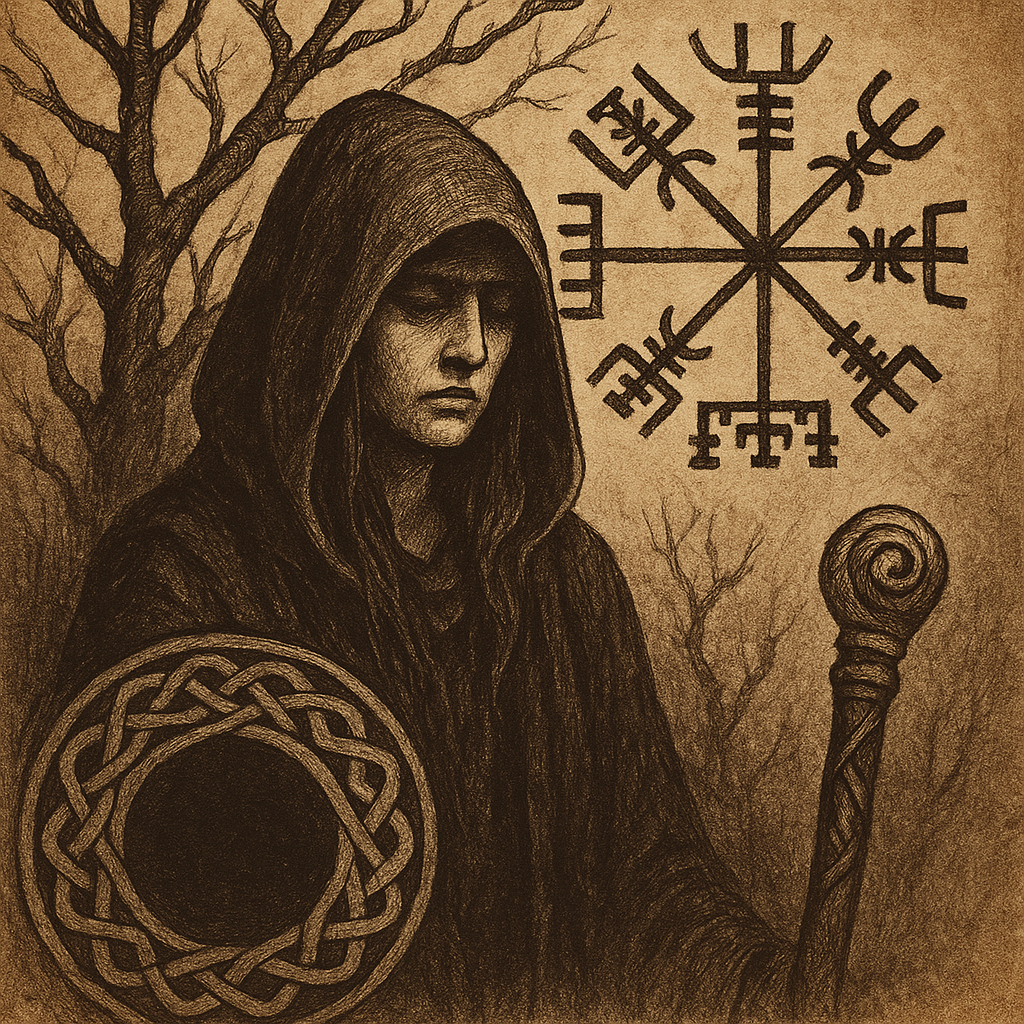
This is the silence carried in the völva’s staff. Not mere authority, but the deep interior hush that marks someone who has spent time in the unseen without flinching, without begging, without filling the gaps with fantasy.
And it is the silence that modern practitioners avoid because it shows them the truth of their own minds.
When you sit long enough in trance, a moment comes (quiet, vast, unsettling) where you feel a presence that is not quite you and not quite other. It does not announce itself. It does not rush in. It simply is. The atmosphere changes. The breath catches. The boundary shifts from personal silence to cosmological silence.
This is the world listening back.
It is not a deity yet, not a spirit yet - simply the presence of being witnessed. That recognition (mutual, delicate, unmistakable) is the threshold of authentic seiðr. Cross it, and you are no longer performing a technique. You have entered relationship.
This is the birthplace of true sight..
This is the soil in which prophecy grows..
This is the hearth where magic takes its first breath..
Working with silence is to work with the very medium of the unseen. It is to enter the oldest temple, the deepest well, the first room of all creation. It is where the craft stops being something you do and becomes something you receive.
Silence is not absence..
Silence is presence waiting for you to become quiet enough to hear it.
The Fear of Silence
Most practitioners do not realize how afraid they are of silence until they finally meet it.
It is not the gentle hush they imagined, nor the peaceful quiet of an empty room. Silence in seiðr has weight. It has gravity. It exposes.
Silence forces you into direct contact with all the things you have successfully avoided while busy, distracted, or spiritually reaching. It presses you inward, into the tight corners of your psyche where you tend to store what you do not want to feel. Within the first minutes of true stillness, you come face to face with:
the tension you usually outrun
truths you have not admitted
emotions you have not metabolized
the parts of you that distort your sight
the impulses you mistake for intuition
the wounds that disguise themselves as “messages”
This is why so many flee. Not from the silence itself, but from what the silence reveals.
When a practitioner is unready, silence feels like a void. They panic, reach outward, and immediately grasp for something (anything) to fill the space. They summon “guides,” force imagery, invent sensations or generate inner dialogue to avoid the discomfort of being with themselves. They confuse noise for contact, imagination for presence, and projection for revelation.
Silence becomes threatening because it refuses to participate in these illusions. It gives nothing unless you are steady enough to meet it. This is why silence is the gatekeeper of seiðr.
Until you can sit with the discomfort of your own mind without fleeing, the unseen world will not open in any clean or trustworthy way. If you cannot withstand silence, your craft will tilt toward fantasy the moment your emotions surge or your fears surface. If you cannot rest in stillness, you will chase signs you invented yourself and mistake inner static for otherworldly contact.
Silence demands maturity.
It demands self-honesty.
It demands that you be able to withstand your own presence before you ask to withstand anything else.
The völva does not sit on the high seat surrounded by noise. She sits in the vastness of quiet and waits, letting the silence strip her of assumption, distraction and desire. Only when she has met herself fully in that stillness can the true messages of the worlds rise.
To pass into authentic seiðr, you must become someone who does not run from silence, but into it - someone who understands that the first voice you must confront is your own, and the first presence you must withstand is the one living behind your ribs.
If you cannot tolerate silence, you cannot pass.
Not because the worlds refuse you, but because you cannot yet tell the difference between what rises from within and what approaches from beyond.
Silence trains you to see.
Silence trains you to hear.
Silence is the first initiation.
Why Silence Appears in the Work
Silence isn’t punishment. It is calibration. It is how the worlds adjust your pace, your depth and your reach so that contact does not break you. When silence descends on your practice, it does not mean “nothing is happening.” It means something specific is happening - just not on the layer your impatience wants.
Silence arrives when your nervous system is settling. You have stopped demanding spectacle long enough for your body to downshift. Heartbeat slows. Breath deepens. Muscles unclench. In that state, you are finally capable of receiving without scrambling or flooding. The worlds often wait for this before revealing anything of weight.
Silence arrives when your boundaries are holding. You are not flinging your awareness outward in all directions, hoping something will answer. You are rooted, contained, clear about where you end and the unseen begins. In that posture, the silence can thicken safely around you, building a container strong enough to hold genuine contact.
Silence arrives when the otherworld is present but not yet speaking. Like a guest standing in the doorway, it pauses to see if you notice, if you can feel the shift in the room without needing it shouted into your face. This is where many practitioners fail: they ignore the subtle density of presence because it does not come with flashy images or voices. They miss the meeting because they cannot bear the waiting.
Silence arrives when your mind has finally quieted enough to listen. Until then, there is no point in speech. Why answer someone who interrupts constantly? The gods and spirits are no different. If your inner chatter drowns out everything, silence comes first as a cleansing field, a way of teaching your consciousness how to stop talking over what it says it wants to hear.
Silence appears when something is aligning rather than revealing. Threads are being woven, not yet shown. The answer you want is still in motion. The path you are asking about is still forming under the surface of your life. To speak too soon would distort it. So the worlds hold their tongue, trusting that if you are aligned, you will wait.
Silence appears when you are being asked to wait, not search. There are times when any reaching would be interference - with another person’s wyrd, with unfolding events, with work that does not concern you. In those moments, silence is a boundary. It says: This is not yours to grasp at. Let it move without your hand on it.
The worlds do not rush to meet you. They watch. They measure. They assess whether you can hold what you are asking for without breaking, twisting it, or leaking it everywhere. Silence is part of that assessment. How you respond to it tells them everything: whether you are ready, whether you are patient, whether you respect their timing as much as your own longing.
When you begin to see silence this way, it loses some of its sting. You stop treating it as abandonment and start treating it as information. You ask different questions:
What is being calibrated in me right now?
What might be aligning that I cannot yet see?
What is this silence protecting - me or someone else?
In those questions, the relationship shifts. Silence stops being a wall and becomes a language. And once you learn to read that language, you realise that the work was never empty at all. It was simply moving in a deeper register, waiting for you to meet it there.
Silence vs absence
There is a fundamental difference between silence and nothing happening, and learning to distinguish the two is one of the most important skills in seiðr. Many beginners confuse them, panic at both, or try to “fix” them with frantic effort. But the seasoned practitioner knows: silence is a presence, while absence is simply a lack of connection.
Silence has texture.. Absence has none.
Silence feels like stepping into a dim room where someone else is already there, breathing quietly in the corner. You cannot see them yet, but the atmosphere changes. The air feels denser, more aware. Absence, by contrast, feels like walking into a cold, echoing hall. Nothing shifts. Nothing responds. Nothing meets you.
Silence has weight - a soft pressure within or around you. Absence is hollow.
In true silence, there is often a gentle pressure around the chest, back or skull - subtle, steady, unmistakable. It may feel like someone watching or like the land leaning closer or like your own awareness deepening into its root. Absence feels like a vacuum. Your thoughts scatter, your focus breaks, and there is nothing to meet you no matter how deeply you reach.
Silence feels like waiting. Absence feels like wandering.
When silence descends during seiðr, there is a sense of expectancy. Something is forming. Something is listening. Something is not ready yet - but it is near. The atmosphere is taut like a string drawn back. Absence feels disorganized. You drift. Your awareness slides. Your posture loses integrity. You feel unanchored rather than held.
Silence sharpens your senses. Absence dulls them.
In silence, your peripheral awareness heightens. Your hearing becomes more sensitive. The tiniest internal shift becomes noticeable. Colours may feel slightly more vibrant, the body slightly more “lit from within.”
In absence, everything feels grey. Blunted. Disconnected. Your mind replays old thoughts. Your focus slips sideways. You feel more “in your head” than in the work.
Silence is a threshold. Absence is a sign to return to your foundation.
Silence means you are in the right place, but the moment is still ripening. You have arrived early; something is about to begin. Absence means you have not arrived at all - your grounding faltered, your mind wandered or your intention was unclear.
When silence arrives, your task is simple: stay.
Do not try to fill it, push it, or interpret it prematurely. Meet it with the steadiness of someone who trusts the work.
When absence arrives, your task is to return to center.
Ground again. Reset your breath. Re align your boundaries. You are not being denied; you are being asked to begin properly.
As your skill grows, this distinction becomes instinctive. You will feel silence the way a hunter feels the shift in the forest before an animal appears.
You will recognise absence the way a sailor recognises dead wind.
And once you can tell them apart, your seiðr will deepen - because you will no longer chase what isn’t there, nor overlook the presence that speaks only in stillness.
Sitting Inside Silence
Working with silence requires a very specific kind of stillness - one that is awake, embodied and deliberate. It is not dissociation. It is not spacing out. It is not letting your mind drift into fog. True stillness is posture, presence and participation. It is the choice to remain fully in your body while opening yourself to the currents that move behind the visible world.
You sit.
You breathe.
You hold your axis.
And you listen - not to sound, but to reality shifting around you.
Silence is a medium that speaks in movements smaller than thought. When you rest inside it long enough, you begin to perceive subtleties you were previously too loud to detect. You start noticing:
pressure (as if the air thickens or presses inward)
temperature changes (cool at the back, warm at the sternum, heat along the spine)
emotional shifts (calm, dread, anticipation, sorrow, clarity - arising from nowhere)
micro movements of awareness (your attention orienting toward something unseen)
symbolic impressions (shapes, echoes, metaphors that emerge unforced)
the “tilt” of the unseen (a directional pull, as if something is leaning toward or away from you)
These sensations rarely announce themselves with drama; they accumulate quietly. Many who first encounter these subtleties dismiss them as imagination. Yet these are the earliest signs of presence. The sagas describe them indirectly: the völva pausing, the audience holding breath, Odin sitting motionless before revelation. Seiðr is built on these thresholds.
Silence teaches orientation before it teaches vision. This is one of the greatest secrets of the craft.
People imagine seiðr as sight - images, visitations, clear messages. But in practice, the worlds speak first by shifting where you stand within them. Silence reveals your position in the weave:
Are you centered or leaning?
Are you grounded or floating?
Are you stable or porous?
Are you reaching or being approached?
Are you in a human realm, an ancestral field, or a mythic current?
Silence answers these questions long before any voice or vision appears.To sit inside silence is to let the work perceive you.
Your steadiness.
Your sincerity.
Your boundaries.
Your readiness.
The unseen approaches slowly at first. It listens back. It tests the stability of your presence. And if you remain steady (breath slow, body anchored, mind unforced) silence begins to open, and you will feel the faintest shift: a gathering, a direction, a subtle “leaning” of the world toward you.
That moment is not glamourous. It is not cinematic. But it is the doorway through which all true seiðr begins.
Silence is not the gap between messages. Silence is the message. It is the space in which the worlds decide whether to speak at all.
Learning to sit inside silence (to neither rush toward sensation nor flee from stillness) is one of the most mature acts of the practitioner. It is what distinguishes those who chase experience from those who cultivate relationship. Silence is where the real work begins, where the laws of your craft take shape, and where your presence is tempered enough to hold what may follow.
In time, silence becomes not a void to endure, but a companion. A presence. A threshold.
And once you can sit inside it without trembling, doubting or reaching - the worlds open..Every time.
When Silence Speaks
Silence rarely breaks like a cracked shell. It almost never arrives with a flash of revelation or a dramatic voice echoing through your inner world. Instead, silence moves. It changes its texture. It shifts its weight. It begins to behave like something alive.
At first, you may think you are imagining it - but imagination feels airy, self generated, and quick. Silence, when it speaks, feels deliberate. Slow. Intentional. As though something beyond you has leaned just slightly closer.
You might notice:
a faint pull in a direction - a subtle leaning of awareness, like your inner compass turning of its own accord
the impression of a presence - not a face, not a voice, just someone else in the room of your mind
a single image rising without effort -not conjured, but emerging, as though it came from the silence
a change in air quality - density, coolness, warmth, or a gentle pressure surrounding you
a sudden clarity - not a conclusion, but a knowing
a question forming without thought - as though something wants you to notice your own direction
a soft inner “yes” or “no” - wordless, felt rather than heard
These are not fantasies. These are the first movements of communication.
In seiðr, the unseen rarely announces itself with spectacle. It prefers precision. When truth moves, it moves quietly. When presence arrives, it approaches without fanfare. When guidance is given, it comes in the smallest adjustments - because in true silence, a small shift is louder than thunder.
The gods do not shout.
The ancestors do not perform.
The llandvættir do not waste their breath.
Their language is nuance. Their speech is pressure, orientation and resonance. Their messages live in the subtle changes you would miss if you were still chasing visions. To hear silence speak is to be acknowledged.
It means your grounding is holding, your axis is steady, your mind is quiet enough to receive and your presence is strong enough to stand without distraction.
Silence speaks when you are finally listening.. truly listening.
And from that moment on, your seiðr changes.
You no longer search for voices. You no longer strain to see. You learn to sense. To feel. To respond.This is the art of seiðr: Not seeking noise, but reading the movement within stillness.
Not collecting revelations, but receiving the one shift that changes everything. Not being overwhelmed, but becoming attuned.
When silence speaks, the work has begun.
Mistaking Silence for Failure
Most practitioners abandon the work long before it has a chance to ripen. They encounter silence and immediately interpret it as rejection. This misunderstanding is so common (and so tragic) that it has derailed more seiðworkers than any lack of talent ever has.
The inner monologue is nearly universal:
“I’m not gifted.”
“The gods aren’t listening.”
“I must be doing it wrong.”
“Other people get visions.. why don’t I?”
“Maybe the worlds don’t want to speak to me.”
These thoughts arise because silence confronts the ego in a way that nothing else in seiðr does. When nothing “happens,” you feel exposed. You feel unacknowledged. You feel as if the unseen is withholding something you haven’t earned. But this interpretation is based on expectation, not reality.
Silence is not the absence of response - it is the response.
It is the return to stillness that prepares the ground. It is a clearing, a settling, a recalibration of your inner field so that the next layer of perception can emerge without distortion.
If silence truly meant failure, every völva in the sagas would have failed.
The seeresses of the old world did not step onto the high seat and immediately receive torrents of prophecy. They sat while attendants sang. They waited while the air thickened. They held themselves in a posture of stoic presence until the worlds chose to open. Even Oðinn, hanging on the Tree, was answered only after nine days of total, brutal silence.
Silence is not a void; it is the womb of sight.
Many practitioners make the mistake of assuming that rapid, dramatic experiences are signs of spiritual talent. In truth, it is the ability to endure silence (without collapsing, without grasping, without inventing) that marks someone who is ready to be shaped by the craft. Silence is the grindstone against which your perception is sharpened.
When you mistake silence for failure, you cut the process short. You interrupt the weaving before the first thread has been laid. You walk away from the door just before it opens.
But when you learn to remain with silence (without judgment, without fear, without the frantic need for it to become something else) you step into the lineage of those who waited with discipline. Those who let the unseen come in its own time. Those who understood that seiðr begins in quiet, not spectacle.
Silence is not the proof that nothing is happening. Silence is the proof that something is being prepared. It is, quite literally, the first initiation.
The Discipline of Not Filling
One of the hardest (and most essential) skills in seiðr is the discipline of leaving silence untouched. Not manipulated. Not decorated. Not padded with imagination or inner chatter. Just left as it is.
Most people do not realize how compulsively they fill space. Modern minds rush to interpret, add meaning, create imagery, or “make something happen.” In seiðr, this impulse is poison. The moment you begin to generate inner noise, you drown out the very subtlety you are trying to perceive.
Not-filling means:
no forcing. You do not reach for visions like grabbing reeds in a river. The moment you strain, the thread snaps.
no guessing. Guessing is the mind’s attempt to feel safe. But seiðr is rooted in truth, not comfort.
no embellishing. A single genuine impression is worth more than ten embellished fantasies.
no layering story over sensation. The story comes later. First comes the raw data: the shift, the pressure, the pull.
no chasing symbols. Symbols rise when they choose. Chasing them pulls you out of trance and into performance.
no performing for yourself. Many unconsciously generate visions because they want to feel successful. This is the death of true sight.
Practitioners must learn to sit in the raw, unshaped quiet like a still pool. If nothing arises, nothing arises. This is not failure. This is fidelity. It shows the worlds that you are willing to remain honest.
Silence is the loom.
Your presence is the thread.
If you begin weaving before the pattern appears, you distort the whole cloth.
This is why the old seers were feared and respected - they did not flinch from silence, nor did they try to sweeten it. They let the unseen speak in its own time, its own manner, and its own language. Silence must be trusted. More importantly, silence must be protected from you.
This discipline (the ability to not add, not invent, not embellish) is what separates the practitioner from the pretender. A pretender chases visions. A practitioner waits for truth.
In the sagas, wisdom does not come to the frantic; it comes to the still. Odin did not chatter on the Tree. He hung in silence until the runes revealed themselves. The völva did not demand answers; she held her seat and let the worlds turn toward her.
To work seiðr well, you must become able to sit inside silence without needing to fill it.
Only then can the silence fill you.
Silence as a Teacher
When you choose to sit with silence (truly sit with it, without fidgeting, without grasping for visions, without scrambling to “make something happen”) you enter the oldest classroom in the entire craft. Silence teaches differently than spirits, differently than trance, differently than runes. Spirits may guide you. Runes may reveal to you. But silence forms you.
It is the grindstone that shapes the blade.
Silence teaches patience - not the surface level politeness the modern world calls patience, but the ancient kind: the capacity to sit with the unknown without panicking or rushing into fantasy. It teaches you to remain when every instinct wants to flee or force.
Silence teaches humility. It strips away the illusion that you can command revelation or bend the unseen to meet your timeline. In silence, you learn your true size - not small, but positioned, one thread among many in the weave.
Silence teaches discernment. When nothing distracts you, you begin to notice the difference between genuine impressions and the subtle tricks of your own mind. You learn to feel the texture of truth. You learn when something is “yours” and when something is “other.” You learn the quiet interior movements that precede actual contact.
Silence teaches emotional regulation. Without noise to hide behind, your nervous system becomes visible to you. You feel the fluttering, the bracing, the grasping. You learn to soothe the body, steady the heart, and remain coherent even as the inner landscape shifts. This steadiness will later become the foundation on which trance is built.
Silence teaches deeper grounding. It shows you exactly when your roots slip and where your presence wavers. It teaches you to return to yourself again and again, until returning becomes instinct. Silence reveals the cracks in your foundation so you can strengthen them.
Silence teaches steadier presence. You learn to inhabit your body fully, not halfway; to hold your axis without tension; to breathe with intention instead of urgency. Presence is the doorway through which the unseen can step. Silence teaches you how to keep that doorway open without collapsing.
Silence teaches truth over fantasy. When you no longer allow yourself to fill every gap with your imagination, a new kind of clarity emerges. You stop decorating the unknown with your hopes and fears. You stop confusing emotional charge with spiritual contact. You stop reaching, and start receiving.
Silence teaches waiting without anxiety. You learn to sit in the middle of uncertainty without demanding answers. You learn to trust timing - not your timing, but the timing of the work itself.
Silence teaches listening without agenda. You learn to open your awareness not to what you want to hear, but to what is actually present. You stop trying to pull messages toward you and let them come in their own form.
Silence teaches allowing without forcing. It trains you to soften, to widen, to let impressions arise naturally rather than dragging the mind into constriction.
These qualities are not optional.
They are the internal architecture required for the gods to approach safely. They are the qualities that keep ancestors from overwhelming you, that keep wights from slipping into the cracks of your uncentered mind, that keep your own psyche from distorting everything you perceive.
Silence teaches you how to meet the worlds with clarity. Silence tempers you until you can hold contact without breaking. Silence is the teacher that turns seiðr from a performance into a path.
The Gift of Silence
Silence is not empty. It is not a void you must escape, nor a pause between "real" moments of the craft. Silence is a presence, a field, a living intelligence that tests, teaches, and transforms the practitioner who has the courage to remain inside it. Those who flee from silence never reach the heart of seiðr. Those who stay become vessels worthy of the work.
Silence is the place where wyrd speaks the loudest. Not through voices, not through visions, not through omens, but through the deep, resonant hum of alignment itself. Before any god will approach you, before any ancestor will draw near, before any land-wight will trust you with its presence, they listen for one thing: can you hold silence without breaking?
If you can, you become readable - clear, steady, grounded enough for other beings to interact with you without interference from your own noise.
If you cannot, the worlds remain closed.
Silence is the cradle of all authentic contact. It is where the threads gather. It is where the practitioner’s mind stops inventing, the emotions stop surging, and the body stops bracing. It is the first moment the unseen can actually meet you.
And the deeper you sit within it, the more it reveals.
Silence shows you the structure of your own inner world. It shows you where your discipline holds and where it collapses. It shows you the difference between yearning and perception. It shows you the places where you are still tangled, still reactive, still porous, still projecting your fears or desires into the dark.
But it does not reveal these things to shame you.
It reveals them so you can become stronger.
Silence is a teacher - not a gentle one, but a wise one. It forces you to face yourself before you face the unseen. It strips away the theatrics. It dismantles the fantasy. It leaves you alone with what is true and what is not. Only from that raw honesty does real sight grow.
Those who master silence become trusted - not because they are perfect, not because they are powerful, but because they can listen without distorting what they receive. The gods value this. The ancestors rely on it. Wights require it. Wyrd demands it.
Silence is not barren; it is fertile.
It is the field where contact is seeded.
It is the soil in which sight takes root.
It is the chamber where threads align.
It is the breath before the revelation.
It is the night sky where the first star appears.
When you step into silence long enough, you discover its true nature:
It is not the absence of the work.
It is the work.
Silence is the place where the practitioner stops performing and starts perceiving. It is where you learn to hear what is actually being spoken - not what you want to hear. It is where your presence becomes clean, your awareness becomes sharp, and your craft deepens from effort into instinct.
This is the gift silence gives:
It transforms you into someone the worlds can approach.
It turns your mind from a noise maker into a vessel.
It turns your presence into a stable axis.
It turns your craft from chase into communion.
Silence is not the gap between moments.. it is the moment. Silence is not where the work pauses.. it is where the work begins.