
Draumr - Why Not Every Dream Is a Sign
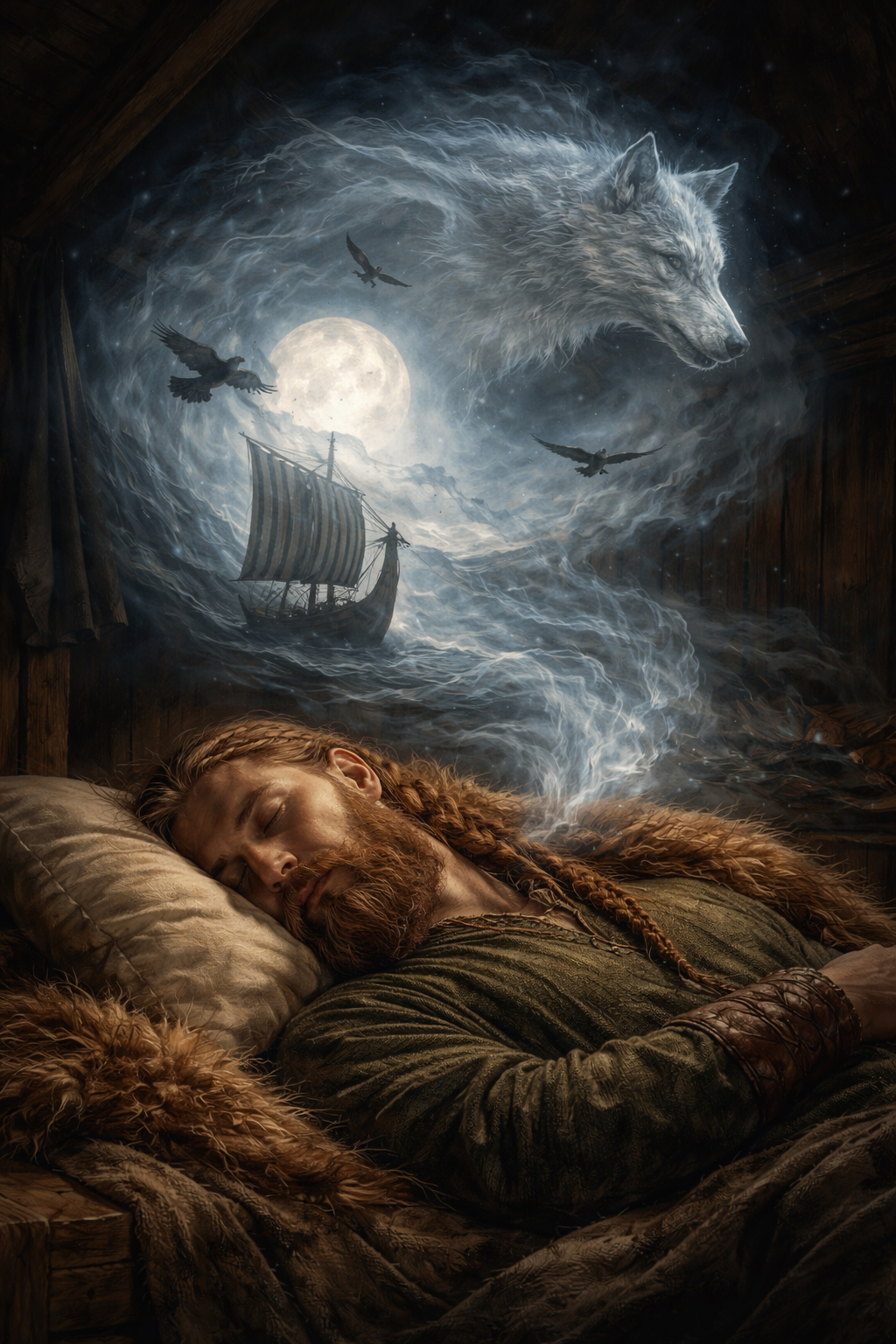
Dreams are one of the quickest places people turn when they start walking this path.
Something vivid happens in sleep. It feels real. It sticks. And the first thought is often the same - that must be a sign… that must be the gods trying to speak.
But that way of thinking doesn’t come from the Norse sources.
It comes from later ideas, where dreams are treated as direct messages, sent clearly and meant to be followed without much question. When people bring that mindset into Norse practice, it creates a problem. Because the Norse didn’t leave us anything that supports the idea that every dream is divine communication.
In fact, what they show is something far more grounded and far more complex.
To understand draumr properly, you have to understand how the Norse saw the self. A person was not made up of one single, fixed soul. They were understood as a combination of different parts, each carrying its own role, each influencing the others. Thought, will, presence, fortune - all of these sat within a person, but not as one neat, unified thing.
That matters when we talk about dreams.
Because what you experience in sleep does not come from one clear source. It is shaped by what you carry within you. Your state, your thoughts, your tensions, your direction.. all of this feeds into what appears. Sometimes clearly. Sometimes in ways that feel chaotic, symbolic, or difficult to make sense of.
That doesn’t mean dreams are meaningless.
But it does mean they are not automatically divine.
The Norse material shows that some dreams were taken seriously, especially when they carried weight or later aligned with events. But it also shows that dreams could be misread, ignored, or simply experienced without deeper meaning. There is no system that says every dream is a message, and no expectation that everything seen in sleep should be acted on.
This is where things need to be brought back into line.
Because when everything becomes a sign, nothing is understood properly.
This piece is not about dismissing dreams. It’s about placing them where they actually sit in Norse thought. Looking at what the sources show, what they don’t show, and why so many people today are mistaking their own inner state for something coming from outside of them.
Because more often than not…
What you are seeing in a draumr is not the gods speaking.
It’s something within you, finally being noticed.
What Draumr Is
When people hear the word draumr, it’s usually translated straight to “dream,” and left at that. Something that happens during sleep. Something random. Something easy to dismiss or, at the other extreme, something treated as automatically meaningful.
But in the Norse understanding, it sits somewhere in between.
A draumr is not always meaningless, but it is not automatically significant either.
In the sources, dreams appear as part of life. They are described, remembered, and sometimes discussed, especially when they feel strong, strange, or difficult to ignore. But they are not treated as a fixed system with clear rules. There is no set method for interpreting them, no guaranteed meaning behind them, and no assumption that they always come from an outside source.
This is important to understand early on.
Because a draumr is not separate from the person experiencing it.
It is shaped by them.
What appears in a dream is influenced by what is already there - thoughts, tension, memory, expectation, and inner state. This is why dreams can feel symbolic, distorted, or confusing. The mind is not working in the same structured way as it does when awake. It presents things in forms that are not always direct, but still connected to something real beneath the surface.
At the same time, the Norse did not ignore dreams completely.
There are examples in the sagas where dreams seem to carry weight. They can appear before events, sometimes reflecting what later unfolds. In these cases, people may pay attention to them, discuss them, or try to understand what they might mean.
But even here, there is no certainty.
Dreams are not always understood correctly. Some are dismissed too quickly. Others are taken too seriously. This shows that draumr was not treated as something clear or reliable in every case. It was something that required judgement.
This is where the balance sits.
A draumr can reflect something real, but not always in a way that is easy to understand. It can carry meaning, but not every time. It can feel important, but that feeling alone does not confirm what it is.
And this is where many modern interpretations go wrong.
They move too quickly to assign meaning. They treat every dream as a message, every image as a sign, and every strong feeling as proof of something external reaching in. But the sources do not support that level of certainty.
What they show instead is a more grounded approach.
Dreams are part of experience.
Sometimes they matter. Sometimes they don’t. And part of understanding them is knowing the difference.
That difference does not come from the dream alone.
It comes from understanding the self first.
Because without that, a draumr is just an image without context and context is what gives it any real meaning at all.
The Norse View of the Self
To understand draumr properly, you have to understand how the Norse saw the self. Without that, it’s too easy to assume that whatever appears in a dream must be coming from something outside of you.
But that isn’t how it was understood.
The Norse did not see a person as made up of one single, fixed soul. What we find in the sources instead is a layered understanding — a person made up of different parts, each carrying its own role, each influencing the others. These parts are not neatly separated, and they do not always act in full alignment. At times, they can feel like they move in different directions.
That alone changes how we look at dreams.
Because what you experience is not coming from one single source.
One of the central aspects is hugr - the inner state of thought, intention, mood, and will. This is what shapes how you act, how you perceive, and how you respond. It is active, shifting, and always influencing your experience. It does not switch off when you sleep. It continues, and it plays a major role in what appears in draumr.
Then there is the fylgja, often described as a following presence connected to a person’s nature or fate. In the sources, it can appear in dreams or visions, sometimes taking animal form. It is not something consciously controlled, and it does not act like a guide giving instructions. It reflects something tied to who the person is, not something separate trying to direct them.
Hamingja is another part - often understood as fortune, luck, or strength tied to family and reputation. It is something that can be built, inherited, and affected by action. It does not appear in dreams as a voice or message, but it influences the wider context of a person’s life.
There are also concepts like hamr, relating to form and presence, and önd, the breath or life force, along with óðr, which connects to inspiration, emotion, and heightened states of mind. Each of these reflects a different aspect of what makes up a person, but none of them create a system where dreams are simply messages being sent from outside.
What this shows is that the self is not unified in the way people often assume.
It is layered.
And those layers interact.
When you dream, it is not just “you” in a simple sense experiencing something. It is a combination of these aspects, your inner state, your perception, your condition at that time. This is why dreams can feel fragmented, symbolic, or difficult to understand. They are not coming from a single clear voice.
They are shaped by a complex inner structure.
This is the part that often gets missed.
Because if you assume there is one single source behind a dream, it becomes very easy to label it as divine communication. But once you understand that the self itself is made up of multiple interacting parts, it becomes clear that there are many internal sources that can shape what you experience.
And most of the time, that is where the answer sits.
Not in something reaching in from outside…
But in something already within you, taking form in a way that finally gets your attention.
Hugr and Draumr
The strongest connection to draumr sits with the hugr.
If hugr is the inner state (thought, will, mood, and intention) then it does not simply stop when you fall asleep. It continues. It shifts. And without the structure of waking awareness, it begins to show itself in a different way.
This is where draumr forms.
What you carry in your hugr shapes what you experience in your dreams. If something is unsettled, it can appear in a way that feels distorted or chaotic. If something is being ignored, it can push forward more strongly in sleep than it does when you are awake. If you are already leaning toward a certain decision or direction, your hugr can present that path in a way your waking mind has not yet fully accepted.
That is why dreams can feel so real.
Not because they are always coming from something outside of you, but because they are coming from something within you that already holds weight.
This is also why dreams do not always make sense straight away.
The hugr does not present things in clean, logical steps when you are asleep. It uses images, situations, and symbolic forms that reflect what is being processed. A door may represent a choice. A path may represent direction. A person may represent a part of your own thinking or conflict. The meaning is not always direct, but it is still connected.
At the same time, this does not mean every dream carries a message.
The hugr is active all the time. It processes, reflects, and responds to what you experience throughout your life. Some dreams are simply that process playing out. They do not need to be interpreted or followed. They are part of how the mind works through things.
This is where balance is needed.
Because people often move too quickly in one direction or the other. Either dismissing dreams completely, or assuming every dream must mean something important. The Norse material does not support either extreme.
What it shows is that dreams can reflect something real, but that reality is often tied to the self.
Not something external sending instruction.
This is why understanding your own state matters.
If your hugr is unsettled, your dreams may reflect that instability. If you are under pressure, it may show itself in exaggerated or confusing ways. If you are already leaning toward a decision, your dreams may present that direction more clearly than you are willing to admit while awake.
Without awareness of your own hugr, it becomes easy to misread what you are seeing.
You may take something internal and treat it as something external. You may assume meaning where there is none, or miss what is actually being shown because you are looking in the wrong direction.
Hugr and draumr are not separate.
They meet in the same space.
One shapes the other.
And more often than not, what appears in a dream is not something being given to you…
It is something already within you, finally taking form.
Why Dreams Feel Real or Symbolic
One of the main reasons people assume their draumr is something external (something sent to them) is because of how real it feels.
Dreams don’t feel distant or unclear while you’re in them. They feel immediate. Present. Sometimes even more intense than waking life. You can feel fear, urgency, connection, or recognition in a way that doesn’t feel imagined at all. And when you wake up, that feeling stays with you.
That’s what makes people stop and think, that must have meant something.
But the feeling alone doesn’t tell you where it came from.
The way dreams are experienced is different from waking thought. The usual structure (logic, sequence, control) is reduced. What takes its place is something more direct. Images, situations, and emotions are presented without the same filtering. The hugr is still active, but it is not being held in the same way.
Because of that, things become amplified.
A small concern can become a full situation. A passing thought can turn into a clear scene. Something you’ve been ignoring can appear in a way that feels unavoidable. The intensity doesn’t come from something being added - it comes from something no longer being held back.
This is also why dreams often appear symbolic.
Not because they are always meant to be decoded like a message, but because the mind does not present things in straight lines during sleep. It uses forms that carry meaning in a different way. A place, a person, an action - these can all stand in for something else. Not randomly, but based on what your hugr associates with them.
That doesn’t mean every symbol has a fixed meaning.
There is no set system where a certain image always means the same thing for every person. The meaning is shaped by the one experiencing it. What something represents comes from your own understanding, your own state, and what you connect it to.
This is where things often go wrong.
People take a strong or symbolic dream and immediately assume it must be something being sent to them. But what they are feeling is intensity, not proof. The clarity, the emotion, the sense of importance - these come from how the dream is experienced, not necessarily from where it comes from.
And because the experience is so strong, it is easy to trust it without question.
That’s where misinterpretation begins.
A dream can feel meaningful without being a message. It can feel important without being instruction. It can feel clear in the moment, but lose that clarity when looked at properly afterward.
This doesn’t make dreams useless.
It just means they need to be approached with awareness.
Recognising that the way something feels is not the same as understanding what it is. Recognising that intensity does not equal truth. Recognising that symbolic form does not automatically mean something is being communicated from outside.
When that line is clear, draumr becomes easier to understand.
Not as something mysterious or unreachable…
But as something shaped by the same inner state that guides you while awake.
Dreams in the Sources
When we look at the Norse sources, dreams are there - but not in the way many people expect.
They appear in the sagas, sometimes in detail, often before important events. A person might dream of animals, figures, or strange situations that later seem to connect to what unfolds. In some cases, these dreams are taken seriously. They are spoken about, shared, and sometimes interpreted by others.
But even here, there is no fixed system.
There is no clear method laid out for how dreams should be understood. No rule that says a dream must be followed. No consistent explanation of where they come from. What we see instead is something far more grounded - people experiencing dreams, reacting to them, and sometimes getting it right, and sometimes not.
That part matters.
Because it shows that dreams were not treated as automatic truth.
In some saga accounts, a dream is recognised as important, and events later align with what was seen. These are the examples people often focus on. But they are only part of the picture. There are also moments where dreams are dismissed, misunderstood, or simply left without action. The person experiences it, but nothing comes of it.
This tells us that dreams sat in a space of uncertainty.
They could carry weight, but they could also be wrong.
They could reflect something real, but that reality was not always clear at the time. People did not always know what they were looking at, and they did not treat every dream as something that needed to be acted on.
In some cases, others would help interpret a dream, especially if it seemed significant. But even then, interpretation was not guaranteed to be correct. It was an attempt to understand, not a certainty.
This is a key difference from modern assumptions.
Today, people often look for clear answers. They want to know exactly what a dream means and what they should do about it. But the Norse material does not give that kind of certainty. It shows a world where dreams are experienced, considered, and weighed - not automatically believed.
It also shows that dreams are not always separate from the person.
Many of the images and situations described reflect things that already exist in the person’s life - conflict, tension, expectation, or direction. Even when a dream seems to point forward, it is often connected to something already present.
Because of this, dreams in the sources are not treated as a clear line of communication from the gods.
There is no consistent pattern of gods appearing in dreams to give instruction. No system where divine messages are regularly delivered through sleep. When gods appear in the material, it is not presented as something that happens to everyone, or something that can be expected.
That alone should be enough to pause the modern assumption.
Because if dreams were a primary way the gods communicated, we would expect to see that clearly reflected in the sources.
But we don’t.
What we see instead is something more grounded.
Dreams exist. Sometimes they matter. Sometimes they don’t.
And the challenge is not in having them…
It’s in knowing how to understand them without assuming too much.
Not All Dreams Are Messages
This is where things need to be said clearly.
Not every draumr is a message.
Not every dream is a sign.
And not every strong or vivid experience in sleep is the gods trying to reach you.
This idea has become common in modern spaces, but it is not supported by the sources. It comes from later ways of thinking, where dreams are treated as direct communication that must be understood and acted on. When that mindset is brought into Norse practice, it creates a false expectation - that every dream carries meaning, and that meaning must come from something outside of you.
That is not how the Norse material presents it.
Dreams happen.
Some are clear. Some are confusing. Some feel important. Others are forgotten the moment you wake. The fact that a dream feels strong does not make it a message. The fact that it stays with you does not make it divine.
What matters is understanding where it may be coming from.
Most of the time, a draumr is shaped by the hugr. It reflects what is already within you - your thoughts, your tensions, your direction, your conflict. It may present something you already know but have not fully accepted. It may bring something to the surface that has been sitting beneath your awareness.
That can feel powerful.
It can feel like something has been shown to you.
But that does not mean it has been sent to you.
This is where people often go wrong.
They feel the weight of the experience and immediately assign it to the gods. They skip over the possibility that it comes from within, and they treat it as instruction rather than reflection. Over time, this builds a habit of looking outward for meaning instead of understanding what is already there.
That weakens understanding rather than strengthening it.
Because once everything becomes a message, there is no way to tell what actually matters.
The Norse sources do not support that kind of certainty. They show that dreams can carry weight, but they also show that dreams can be wrong, unclear, or simply part of ordinary experience. There is no indication that every dream should be followed, or that the gods are constantly communicating through sleep.
If that were the case, we would see it clearly.
We don’t.
That doesn’t mean the gods cannot appear in dreams.
It means you cannot assume that they are.
There is a difference.
And that difference matters.
Understanding draumr properly means holding that line. Recognising that a dream can feel important without being a message. Recognising that meaning does not always come from outside. Recognising that most of what you experience in sleep is connected to your own state, your own path, and your own understanding.
Because more often than not…
What you are seeing is not something being given to you.
It is something already within you, being shown in a way you can no longer ignore.
When Dreams Were Taken Seriously
Although not every draumr was treated as meaningful, there are moments in the sources where dreams are taken seriously.
These are usually the ones people remember.
In the sagas, certain dreams appear before important events. They may involve strong imagery, repeated symbols, or a feeling that lingers beyond waking. In these cases, the dreamer (or those around them) may stop and consider what it could mean. Sometimes they speak about it openly. Sometimes they seek another person’s view.
What stands out is not just the dream itself, but how it is approached.
There is caution.
There is discussion.
There is no immediate assumption that it must be followed without question.
Even when a dream seems important, it is still weighed.
And this is where modern understanding often shifts too far.
People see these examples and assume that because some dreams were taken seriously, all dreams should be. But that is not what the sources show. They show that certain dreams stood out from others. Not because all dreams carry meaning, but because some were different in how they appeared and how they were experienced.
They carried weight.
But even then, that weight did not equal certainty.
There are examples where dreams are misunderstood. Where the meaning is read incorrectly, or only becomes clear after events have already happened. This tells us something important - even when a dream is significant, it is not always clear what it means at the time.
That uncertainty is part of it.
A dream might point toward something, but it does not lay it out in a simple or direct way. It still requires judgement. It still requires awareness. And even then, it may not be understood properly until later.
This is why dreams were not treated as instruction.
They were not commands.
They were not something a person followed blindly.
At most, they were something to consider.
Something that might reflect what is coming, or what is already present, but not something that removed the need for thought, awareness, or responsibility.
There is also no indication that these kinds of dreams were constant.
They are not described as something that happens regularly to everyone. They appear in specific moments, often tied to tension, conflict, or turning points. That alone suggests they were not part of everyday experience in the way people sometimes assume now.
This is where balance comes in.
It is not about dismissing all dreams as meaningless.
And it is not about treating all dreams as messages.
It is about recognising that some dreams may carry weight, but that weight must be approached carefully. Without assumption. Without rushing to label it as divine. Without removing the need to think.
Because even in the sources, where dreams sometimes mattered…
They were never treated as something that spoke with complete clarity.
And they were never treated as something that replaced a person’s own judgement.
Misreading Draumr
One of the most common issues, both in the sources and today, is not the dream itself - it’s how it’s understood.
A draumr can feel clear in the moment. It can feel direct, meaningful, even urgent. But that feeling does not guarantee that it has been understood properly. In fact, the sources show the opposite more than once.
People misread dreams.
They take something symbolic and treat it as literal. They assume meaning too quickly. Or they ignore something that later proves to have carried weight. In each case, the issue is not the dream - it is the interpretation.
This is where the state of the hugr becomes important again.
A person does not interpret a dream from a neutral place. They interpret it through their own condition. If they are fearful, they may read threat into something that is not there. If they are hopeful, they may see confirmation where there is none. If they are unsettled, they may try to force meaning onto something simply because it felt strong.
The dream itself does not change.
But the way it is understood does.
This is where modern practice often goes wrong.
People have a vivid or emotional dream and immediately decide what it means. They label it. They assign it to the gods. They treat it as instruction. And once that happens, they stop questioning it. The interpretation becomes fixed, even if it was built on assumption rather than understanding.
That is how misreading begins.
Not from the dream being unclear, but from the person being too certain.
The Norse material does not support that kind of certainty. Even when dreams were taken seriously, they were still discussed, questioned, and sometimes misunderstood. There was space for uncertainty. There was an awareness that interpretation could be wrong.
That awareness is important.
Because once you remove it, every dream becomes something that must be believed rather than something that should be considered.
And that leads to problems.
It can push a person in the wrong direction. It can create false certainty. It can cause someone to act on something that was never meant to be taken as instruction in the first place. Over time, it weakens judgement rather than strengthening it.
This is why restraint matters.
Not in ignoring dreams, but in how they are approached.
A draumr should not be taken at face value straight away. It should be looked at with distance. With awareness of your own state. With an understanding that what you are seeing may not be as direct as it feels in the moment.
Because most of the time…
The risk is not that a dream has no meaning.
The risk is that it is given the wrong one.
Fylgja and Dream Appearances
One of the reasons people assume their draumr is something external is because of what they see in it.
Animals. Figures. People who feel separate from them. Presences that seem to act on their own.
It’s easy to look at that and think, that must be something coming to me.
But this is where the concept of fylgja is often misunderstood.
In the sources, the fylgja is described as a following presence connected to a person’s nature, fate, or character. It can appear in dreams or visions, often taking animal form, and sometimes reflecting traits or patterns tied to the individual. But it is not something separate in the way people imagine today. It is not a guide giving instructions, and it is not a god appearing in disguise.
It is part of the person.
That distinction matters.
Because when something appears in a dream that feels “other,” it is not automatically something external. It can be a form that reflects something within - something tied to behaviour, nature, or direction. The way it appears does not change where it comes from.
This is also why the forms can vary.
An animal may appear because it reflects a trait - strength, caution, aggression, persistence. A person may appear because they represent a situation, a relationship, or a part of the dreamer’s own thinking. The form is shaped by what the hugr can recognise and present, not by a fixed system of meaning.
That doesn’t make it random.
But it does mean it is not always literal.
In the sagas, when fylgjur appear, they are not treated as something a person controls or calls upon. They are observed. Sometimes they are understood, sometimes not. They reflect something deeper, but they do not act as direct communicators in the way people often assume today.
This is where confusion happens.
A dream figure appears. It feels separate. It behaves in a way that seems intentional. And the immediate assumption is that it must be a god, a spirit, or something reaching out.
But the Norse material does not support jumping to that conclusion.
Because the self itself is not simple.
It has layers.
And those layers can take form.
Understanding this removes the need to assign everything to something external. It brings the focus back to where it should be - on the relationship between what is experienced and the person experiencing it.
That does not mean nothing external ever appears.
It means you cannot assume that it has.
The presence of a figure, an animal, or something that feels separate is not proof of anything on its own. It is part of the experience, not an explanation of it.
And without that understanding, it becomes very easy to misread what is actually being shown.
The Role of Interpretation
A draumr on its own does not carry fixed meaning.
What gives it meaning is how it is understood.
This is where interpretation comes in, and it is also where most mistakes are made.
A dream can feel clear while you are in it. It can feel like it makes complete sense. But that sense of clarity often fades when you wake, or changes depending on how you think about it. What felt direct becomes uncertain. What felt obvious becomes open to different readings.
That is because the dream itself is only part of the process.
The rest sits with the person interpreting it.
Interpretation is shaped by the state of the hugr. If your hugr is unsettled, your understanding will reflect that. You may see threat where there is none. You may see confirmation of something you already want to believe. You may take something symbolic and treat it as literal simply because it felt strong in the moment.
The dream has not changed.
But your reading of it has.
This is why interpretation cannot be separated from self-awareness.
Without awareness of your own state, you are not interpreting the dream clearly. You are filtering it through whatever you are already carrying. That does not make your interpretation useless, but it does mean it may not be accurate.
And accuracy matters.
Because once you decide what a dream means, that decision can shape what you do next. If the interpretation is wrong, the action that follows may also be wrong. This is how misreading a dream can lead to real consequences.
The Norse material reflects this.
Dreams are sometimes discussed with others, not because someone else holds the “correct” answer, but because interpretation benefits from distance. Another person can see things differently. They may notice something you have missed, or question something you assumed.
Even then, there is no guarantee of certainty.
Interpretation is not about finding a single fixed answer.
It is about weighing what is there.
Looking at the dream without rushing to label it. Considering your own state at the time. Asking whether what you are seeing reflects something already present in your life. And recognising that not everything needs to be turned into a clear message.
This is where restraint becomes important.
Not every dream needs to be explained immediately. Not every image needs to be broken down. Sometimes the most accurate approach is to leave it, observe it over time, and see whether it connects to anything real as events unfold.
Because meaning is not always immediate.
And forcing it too quickly often leads to the wrong conclusion.
Understanding draumr is not just about the dream itself.
It is about the ability to interpret without assumption.
To question your own reading.
And to recognise that the strongest feeling is not always the clearest truth.
Modern Misunderstandings
Most of the confusion around draumr today does not come from the sources.
It comes from how people are approaching them.
There is a strong tendency in modern spaces to treat every vivid or emotional dream as something external. Something sent. Something meaningful in a direct and personal way. And most of the time, that meaning is immediately assigned to the gods.
“I had a dream, so it must be a sign.”
That mindset is not Norse.
It comes from later religious frameworks, where dreams are often treated as direct communication, guidance, or instruction. When that way of thinking is brought into Norse practice, it reshapes everything. It creates an expectation that dreams should be clear, purposeful, and sent from outside.
But that expectation is not supported.
The Norse material does not show a culture where people regularly received messages from the gods through dreams. It does not show a system where dreams were relied on as guidance. And it does not show people assuming that what they experienced in sleep must be something divine.
What it shows is far more grounded.
Dreams were experienced. Sometimes considered. Sometimes ignored.
Not automatically believed.
This is where modern interpretation moves too quickly.
A strong dream happens. It feels real. It stays with the person. And instead of asking what does this reflect, the question becomes who sent this to me. That shift takes the focus away from the self and places it onto something external without evidence.
Over time, this builds a pattern.
People begin to rely on dreams for direction. They start looking for signs instead of understanding their own state. They place weight on things that may not carry any real meaning, while missing what is actually present in their waking life.
This does not strengthen practice.
It weakens it.
Because it removes responsibility from the person and places it onto something assumed rather than understood.
There is also a tendency to overcomplicate dreams.
To assign fixed meanings to symbols. To build systems around interpretation that claim certainty where there is none. But the sources do not give us a structured method for decoding dreams. There is no set meaning for specific images, and no universal system that applies to everyone.
Meaning is not fixed like that.
It is shaped by the person, their state, and their situation.
This is why caution matters.
Not in rejecting dreams completely, but in how they are approached. Recognising that a dream can feel important without being instruction. Recognising that not everything needs to be turned into a sign. Recognising that most of what appears in sleep is connected to what is already within you.
Because once everything becomes a message…
Nothing is understood clearly.
Bringing things back to a grounded position does not remove meaning.
It makes it more accurate.
And it brings the focus back to where it should be - not on what might be reaching in from outside, but on what is already there, waiting to be understood properly.
Staying Grounded in Practice
Understanding draumr means nothing if it isn’t applied properly.
This is where most people slip.
They either dismiss dreams completely, or they go the other way and treat every dream as something important, something sent, something that must be followed. Both of those positions miss the point. The Norse material sits in the middle and staying grounded means holding that position.
The first step is simple.
Do not assume.
Just because a dream felt strong does not mean it carries meaning. Just because it stayed with you does not mean it came from the gods. The feeling is part of the experience, not proof of where it came from.
That pause (not jumping to a conclusion) is where grounding begins.
The next step is looking at yourself first.
Before asking what does this mean, ask what state was I in. What has been on your mind? What have you been avoiding? What direction have you already been leaning toward? Most of the time, the dream reflects something already present. Not something being given to you, but something already there being shown more clearly.
If you skip that step, you skip understanding.
And that’s where misinterpretation starts.
It’s also important not to rush interpretation.
A dream does not need to be understood the moment you wake. In many cases, it is better to leave it. Let time pass. See if it connects to anything real in your waking life. If it does, that connection will become clearer. If it doesn’t, then it may not have carried meaning in the first place.
Forcing meaning too quickly often leads to the wrong conclusion.
Another key point is restraint in action.
Even if a dream feels important, it should not be treated as instruction. The Norse sources do not show people acting blindly on dreams. They still think, weigh, and decide. The dream does not remove responsibility. It does not replace judgement.
You still choose what to do.
This is where grounding protects you.
Because without it, a person can start making decisions based on assumption rather than understanding. They can start seeing patterns that are not there, or following something that was never meant to be followed. Over time, that creates confusion rather than clarity.
Staying grounded also means accepting that not every dream matters.
Some are just the mind working through things. Some are fragments. Some are noise. There is no need to turn everything into something more than it is. Knowing when to leave something alone is just as important as knowing when to pay attention.
In the end, grounded practice is not complicated.
It is awareness.
It is patience.
It is restraint.
And it is the ability to recognise that what you experience in a draumr is not automatically something coming from outside of you.
Most of the time…
It is something already within you, being shown in a different way.
And understanding that properly is what keeps your path steady.
Closing Reflection: Looking Inward First
When everything is treated as a sign, nothing is understood clearly.
That is where most people end up when it comes to draumr.
They stop looking at themselves, and start looking outward for answers. Every dream becomes something sent. Every image becomes something to decode. Every feeling becomes something to follow. And over time, that pulls them further away from understanding what is actually happening.
Because the focus is in the wrong place.
The Norse material does not show a world where people relied on dreams for direction. It shows a world where people were expected to think, to weigh, and to take responsibility for how they understood what they experienced. Dreams were part of that experience, but they were never something that replaced judgement.
That is the line that needs to be held.
Draumr can reflect something real.
But that reality is often within you.
Your state.
Your direction.
Your conflict.
Your awareness - or lack of it.
If you do not understand your own hugr, you will not understand your dreams. You will read into them what you want to see, or what you fear, or what you expect. And once that happens, the dream is no longer being understood — it is being shaped by assumption.
That is where people lose their footing.
Looking inward first does not mean dismissing everything.
It means starting in the right place.
It means recognising that what you experience in a draumr is connected to you before anything else. That meaning, if there is any, is not something to grab onto immediately, but something to approach with awareness and restraint. That not everything needs to be turned into a message to be understood.
Because understanding does not come from forcing meaning.
It comes from recognising what is already there.
The Norse did not build their understanding of the world on assumption.
They built it on awareness, consequence, and the ability to hold themselves steady in uncertainty.
That applies here just as much as anywhere else.
So when a dream comes, the question is not:
Who is speaking to me?
It is:
What does this reflect?
And more importantly:
What am I actually carrying that made this appear?
Because more often than not…
What you are seeing is not something reaching in from outside.
It is something within you, finally being seen for what it is.