
Nøkken: The Song Beneath the Surface
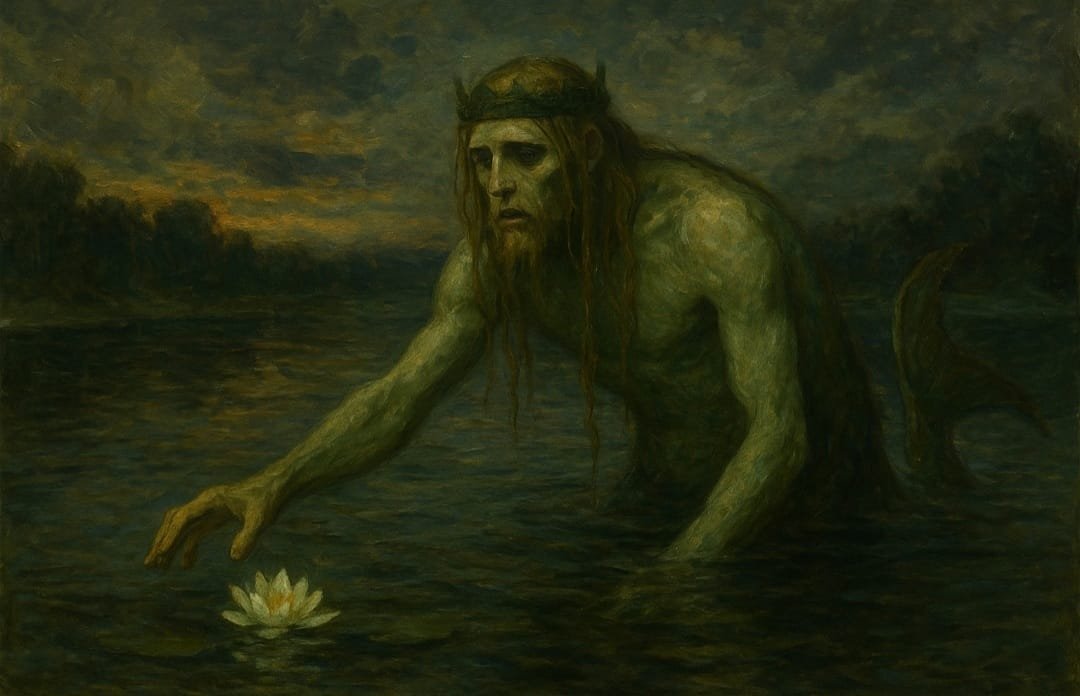
“Not all music frees. Some melodies bind and some remember.”
From The Lake’s Last Lullaby, anonymous, c. 12th century - and though that century has drowned in its own silt, the truth beneath it still rises, cold and waiting, whenever water holds its breath.
Prologue: The Becoming of a Lure
Many first heard of the nøkk not in stories, but in the silence that comes just before a ripple. That thin seam of time when the world listens, uncertain whether it has been touched by breeze, or by something with intention.
A figure, a reflection, a presence beneath a surface that mirrors everything except itself.
For transformation rarely begins with drowning; it begins with longing - a longing sharp enough to pull, soft enough to sing. The nøkk was once a whisper in reeds, a nameless watcher in the mirrored world of water. A creature formed not of soil or scale but of yearning given depth.
He is said to be kin to rivers, to still ponds, to the tongues of waterfalls. A child of water’s memory, which never forgets what sinks into it. The old stories claim he was neither man nor beast, but possibility - shaped by every fear that stares too long into dark water, and every beauty that glimpses its own perfected face and cannot look away.
Reflection is a dangerous architect.
Some rune-singers claim the nøkk was not born at all, but gathered, drawn out of the first moment a human saw their own face in water and wished it were different. Others say he formed around the memory of a forgotten god who drowned willingly, seeking the silence beneath creation. And some insist he is simply what happens when longing looks back. Whatever the truth, the nøkk is older than language, younger than fear, and shaped entirely by what the world hides from itself.
He learned early the power of longing.
He discovered that the heart, when caught between want and fear, becomes a taut string - one that can be plucked into a song.
And so he became the music that calls to what is missing.
The sagas name him nøkk, bäckahäst, grim names shifting like currents, never fixed.
A being of thresholds.
Not the monster in the water.
But the water in the monster.
A depth shaped into a question.
Eldra, the Fire-Wraith of the Hearth
In older myths, the nøkk had a quiet adversary Eldra, the fire-wraith of the hearth, a spirit born of ember-light and breath.
Where the nøkk whispered inward, Eldra spoke outward. Where water reflected, fire revealed.
If the nøkk was the ache of unspoken depth, Eldra was the truth one cannot avoid.
She taught boundaries through warmth rather than fear. A fire draws a circle around itself - the first home, the first law. “Here,” Eldra intoned through curling flame, “you may rest. But step beyond this heat, and the dark must be entered with intention.”
The two were said to circle each other across the worlds: water showing the truth one hides, fire showing the truth one must face.
Some rituals invoked both, for a heart needs reflection, but it also needs heat - for without warmth, depth becomes drift; without depth, warmth becomes blaze.
Yet unlike the nøkk, Eldra did not lure.
She waited, steady as coals, for the moment one chose to approach. Her light did not seduce - it clarified. Those who sat before her flame saw not what they longed for, but what remained unfinished. Fire is an honest teacher.
Old tales insist the nøkk feared her not because she could banish him - she could not - but because she named him. Flame speaks plainly. Water does not.
When Eldra’s glow brushed the lake’s edge,
the nøkk’s reflections jittered, fractured, and scattered - not destroyed, but revealed for what they were: shapes of longing without anchor.
And in that brief trembling of the surface, the nøkk remembered something water rarely allows: that even depth needs direction.
For it is fire, not water, that grants the courage to descend without surrendering.
The Lure Beneath the Skin
The nøkk was not born with a violin in his hands. He acquired music the way lakes acquire secrets - one disappearance at a time.
In Fornaldarsögur Norðurlanda, the water-spirit is described simply: “unnatured, yet knowing the nature of all who approach.” But myth rarely speaks plainly. Beneath that phrase lies the oldest tension of enchantment: that the one who understands yearning can stir it with a single note.
The nøkk learned that beauty is a current stronger than any undertow.
He learned that the shape one wears is not identity, but invitation. Sometimes he appeared as a pale youth with lakeweed hair, skin the color of moonlit fog. Other times a horse, gleaming as though carved from smooth river-stone. Or merely a ripple that resembled a face, but vanished when reached for.
Every guise was a door.
Every door opened inward.
A Tale of the Fiddler’s Apprentice
They still whisper of the young man who lived by Lake Hjartavatn, a wandering fiddler whose music was earnest but unremarkable.
One dusk, he heard a melody that seemed carved from moonlight itself. Drawn to the water, he found a pale youth seated upon a stone, bow in hand, eyes deep as mirrored night. “I can teach you,” the figure said, “if you offer what weighs you most.” The apprentice, aching from a grief he never named, placed his sorrow into the music. And the nøkk played it back. Note for note. Wound for wound. By morning, the boy’s fiddle could make stones weep, but his grief was gone - taken into the deep where the nøkk kept what others could no longer bear. Some say the boy lived a long, peaceful life. Others insist he walked into the lake one winter night, following the echo of a familiar song.
To lure is not merely to deceive.
It is to hold up a mirror polished by desire, and watch what steps toward its own reflection.
The Music That Binds
Humans came to the water for solace, for escape, for a moment of undivided beauty in a world too often fractured. The nøkk gave them that beauty - perfected, distilled, sharpened like ice.
But beauty that does not breathe becomes blade.
The nøkk knew that longing, when answered too precisely, becomes surrender.
And surrender, when taken too deep, becomes silence.
Thus he learned the oldest magic of water: that the boundary between offering and consuming is thinner than a ripple.
In the ballads of Sweden and Norway, the nøkk’s fiddle is described as “tuned on sorrow, tightened by moonlight.” His melodies are said to awaken every unspoken ache within the listener. But music is never only sound - it is memory given shadow.
The nøkk’s songs were not crafted. They were echoed.
Each note a reflection of the listener’s own unlived life. Each melody the shape of a longing left too long by the shore.
In Nøkkens Vise, the spirit sings:
“Come nearer, heart-weary one. The water knows the name you have not spoken.”
To hear the nøkk is to be recognized.
And recognition, when given by something that sees beneath the surface, can become an irresistible gravity.
Music draws out what the heart hides from daylight. Desire becomes riverbank.
Fear becomes depth.
And the nøkk swims between them, guiding each into the other.
The danger is not that his song deceives, but that it reveals. For what is revealed cannot be easily abandoned - and the one who cannot abandon becomes the one who begins to follow.
Even into water.
Even into silence.
They say the nøkk’s bow is strung not with horsehair, but with the threads of promises broken beneath moonlight. His fiddle’s wood is driftwood smoothened by years of forgotten wishes brushing against it.
Before he plays, there is always a silence - so complete it feels like the world taking a breath it may not release. Some claim he once played a song not meant for human ears, a melody so pure that the lake itself rose to listen. The ripples from that night, they say, still move across every body of water on earth.
The Price of Listening
Legend says that the nøkk demands payment for music: a drop of blood, a strand of hair, a silver coin cast into stillness.
But payment is not transaction.
It is threshold.
The offering is not for the nøkk, but for the listener - to mark the moment they stepped beyond certainty, into the fluid place where meaning dissolves into instinct.
Silver was favored because it mirrored moonlight, and the nøkk loved nothing more than a reflection that could be shaped with a fingertip. But silver tarnishes. And so do intentions left in water too long.
Yet even the nøkk has limits. He cannot cross running water swift enough to carry its own reflections away. He weakens in the presence of true hearth-fire - not the electric glow of bulbs, but living flame fed by intention. And he cannot take one who names their longing aloud, for clarity breaks enchantment. Recognition protects as surely as ritual.
The price was never the coin, but the surrender implied in throwing it. For once you give yourself to the mirror of the lake, the mirror gives something back. Not peace.
But depth. Depth is rarely gentle.
The Brother of Silence
Few remember that the nøkk was not alone in northern myth. He had kin - huldras of the forest, draugar of the grave mounds, the sjøorm that twisted in the sea’s throat. Each spirit embodied a human boundary: desire, death, wilderness, the unknown.
The nøkk embodied uncertainty.
Where the huldra tempted through promise of pleasure, the nøkk tempted through the ache of what might have been. Where the draugr haunted with what refuses to rest, the nøkk haunted with what refuses to surface.
His magic was gentle until it wasn’t.
He drowned not out of malice, but because longing carried too far becomes weight.
And weight, when held by water, descends.
Even now, when a swimmer vanishes in a perfectly calm lake, the old people say: “He was listening.”
Not to danger.
But to himself.
The Mirror of Water
Jung might have named the nøkk the Anima made perilous - the reflection of the inner feminine not met with reverence, but with hunger. The water-spirit is the embodiment of the heart’s unspoken depths: the emotions we fear to feel, the truths we fear to name.
To face the nøkk is to face the self the daylight rejects.
Water is the unconscious made visible.
To stare into it too long is to see not what is, but what is missing. And what is missing has claws.
The nøkk’s lake is the mind’s locked pool beautiful, alluring, and deep enough to swallow without struggle.
He does not threaten with teeth.
He threatens with understanding.
The danger of the nøkk is not drowning.
It is recognition.
The Song of Fire and Water
In the Icelandic rune-poems, the laguz rune - water - is described as both “the well of birth” and “the abyss of ordeal.” Water gives life. Water takes memory. Water erodes. Water reflects.
The nøkk is this paradox given voice.
He is the beauty that seduces. He is the depth that claims. He is the serenity that hides the undertow.
Even now, in a world with electric lights and measured shorelines, the principle remains:
The things that soothe us most deeply can consume us most quietly.
But the nøkk has not vanished. He lives in the dark reservoirs beneath cities, in storm drains that sigh during heavy rain, in neon puddles on late-night sidewalks where reflections distort and stretch. He hums in the white noise of bathrooms and the hush inside noise-cancelling headphones, modern stillnesses where the mind finally hears itself. Wherever water waits, so does he.
Every era has its nøkk.
Every era believes its reflection harmless.
Denial is the first ripple on the lake.
The Depth Beneath the Heart
There are waters within us that no daylight touches - grief held like a stone, desire folded beneath duty, fear that hums like a submerged current.
The nøkk teaches not the danger of water, but the danger of ignoring what waits beneath it.
When we refuse to acknowledge the deep, it does not vanish. It sings.
And its song grows sweeter the longer we pretend we are not listening.
The nøkk is every feeling we push beneath the surface. He waits not to drown us, but to be met.
For what the heart will not face, the water will.
The Rider and the River
One of the oldest tales tells of a nøkk in horse-form (the bäckahäst) who allows children to climb upon his back. Each child finds room for their weight. Each child laughs as the horse steps into the river.
But the horse grows longer. Stronger. Its back stretches with each addition.
And when the final child climbs on, the horse leaps into the deepest part of the water.
The lesson is not cruelty. It is accumulation.
A single grief is bearable. A second still floats. But a dozen unspoken losses carried together? They pull.
We drown not in one sorrow, but in the sum of those we carry unnoticed.
The nøkk’s horse is the burden that invites us gently, one thought at a time, until we no longer feel our own weight, only the plunge.
Rituals Against the Deep
Our ancestors built small rites to keep the nøkk at bay - not to banish him, but to honor the depth he represented.
The Pin-Prick Offering:
Before crossing a bridge at dusk, a traveler pricked their thumb and let a single drop fall into the river. “Take what is mine so I may keep the rest.” A recognition of burden, shared.
The String On the Wrist:
Children were given red thread to wear near water - fire’s color, boundary’s color. A reminder that warmth protects against depth.
The Name Left Unspoken:
One never said a loved one’s name near a still lake after sunset. Names are invitations.
Water hears every one.
The Stone Kept in Pocket:
A small stone, warmed by the hearth, carried when walking near the river. Earth to counter water. Memory to counter forgetting.
These rites were not fear. They were respect.
For the old people knew: the nøkk cannot be defeated, only acknowledged.
The old people said that a single candle by the window was enough to keep the nøkk’s call soft. For where water listens, even a small flame remembers.
Echoes Across Kingdoms
Every culture has met the water-spirit.
The Japanese have the kappa, keeper of drowned secrets. The Celts have the each-uisge, horse of the loch. The Russians have the rusalka, born of sorrowful depths. Even Greek myth has Narcissus, whose longing for reflection was enough to drown him.
Water remembers what humans forget: that beauty and danger are twins. And longing, when unmoored, becomes current.
The Bloodline of Water
Some say that every human carries within them a shard of the nøkk’s awareness, a stillness that listens too sharply whenever rain falls on quiet ground.
A shiver near deep water. A fascination with reflection. A melody stuck in the mind, without origin or end.
Perhaps we are not his victims, nor his prey.
Perhaps we are his inheritors. Water is, after all, the first mirror the world ever made.
And we learned to seek ourselves in it.
The Dream of the Lake
I once dreamed of the nøkk.
He sat upon the surface of a lake as though it were stone, his hair drifting like trailing weeds. His eyes were dark, not from malice, but from depth - windows into unvisited memory.
“Why do you call them?” I asked.
He looked at me, and the reflection of my face flickered in his pupils as though caught between currents.
“I call only those who already lean toward the water,” he said. “I take no one who does not yearn to fall.”
Then he lifted his violin, carved from driftwood and moon-shadow.
He drew the bow across the strings.
The sound was familiar.
Too familiar.
It was the memory I had been avoiding.
I woke with my pillow damp, though I had not cried. The room smelled faintly of lake-mist and night air. My hands were open, though I could not recall releasing anything.
For days after, whenever I passed still water, it seemed to tremble with a question I had not yet answered.
That night, as I drifted near waking, a whisper rose from somewhere between dream and depth: “I do not tempt,” he said. “I answer. I echo. I become what they bring to me.”
And the water in the room - cup, windowpane, even my own breath - seemed to listen.
The Keeper Remembered
In the end, the nøkk is not a monster, nor a warning. He is a recognition given shape.
What becomes of a heart that never learns to listen to its own depths?
His story endures not because of his drownings, but because of what they mirror - that the surface we present to the world is thin, and the life beneath it deep.
The nøkk does not drag us down. He waits for the moment we no longer resist the pull. For the truth beneath every myth is this: What we refuse to feel becomes what consumes us.
What we acknowledge becomes what frees us. We are not meant to silence the water. We are meant to enter it with open eyes. Water’s burden is its memory. Ours is the fear of our own.
Let the depths rise. Let the surface break. Let the heart hear its own hidden music without drowning in it.
For when we listen without fear, the nøkk’s song changes.
Not a lure.
A lullaby.
Not a trap.
A tide.
Not an ending.
A returning.
All that calls to us from beneath the surface, calls us home.
Invocation of Stillness
If the nøkk is the depth that calls you inward, Eldra is the ember that holds you steady as you listen.
When the water within you stirs, do not flee.
Place your hand upon the surface of your own unrest.
Say: “I hear you. I do not fear you. Sing, but do not swallow.”
For naming the depth is the first step toward crossing it.
A second rite, older than the first, was meant for moments when one stood at the edge of a choice: Hold a stone in your right hand, a whisper in your left. Drop only one into the water. The stone sinks. The whisper changes. Then say: “Let what pulls be seen. Let what rises be mine.” For the heart does not drown when it chooses which weight to release.
The nøkk’s true lesson lies not in drowning,
but in remembering that what lies beneath the surface is part of us.
Stillness is not absence. It is invitation.
Nøkken: The Song Beneath the Surface.
Not monster. Not myth. Only the oldest truth, whispering through water:
“What you fear to feel waits to become what frees you.”
Wyrd & Flame 🔥
- and may every depth you meet become a mirror, not a mouth
