
Freyr: Lord of the Golden Season
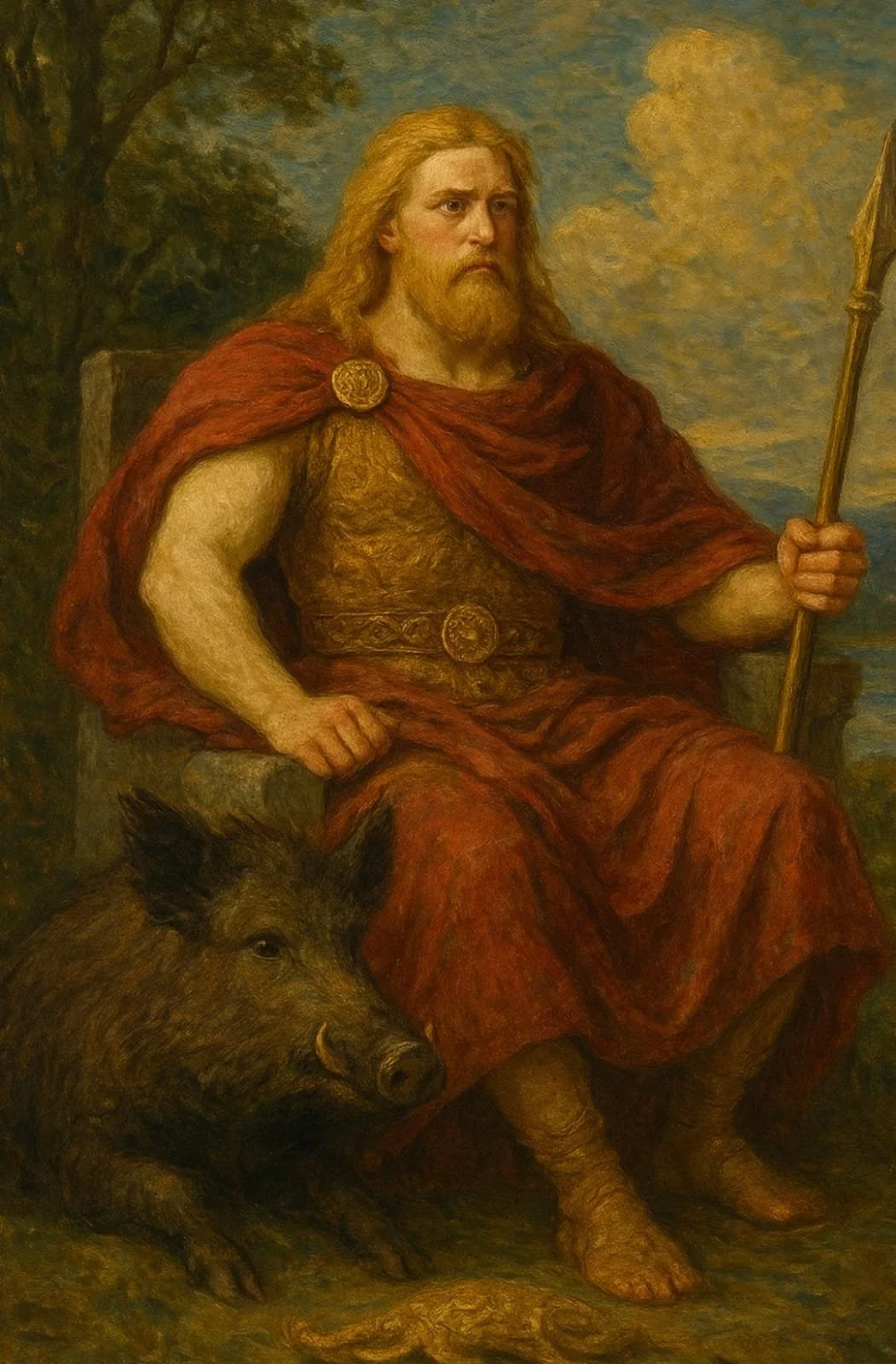
Before swords gleamed in the halls of men, before ships split the salted sea, before winter learned its name, there was brightness - a warmth at the heart of the Nine Realms. That brightness bore a name: Freyr, Lord of the Golden Season, Bringer of Fruitfulness, King of the Vanir’s promise.
This work is not merely a retelling of his deeds, but a meditation on what abundance means: that it is born of surrender, sustained by harmony, and fated to pass so that it may rise again.
What follows is both story and reflection an offering to the god who rules not by conquest, but by the generosity that makes all life possible.
Before the first plow cut earth, before the meadows burst with bloom, before even the gods divided sky from sea, there was a quiet expectancy, the hush before growth.
In that hush, light gathered.
From Vanaheim’s seas and sacred fields rose a god whose domain was not battle, but balance; not fire, but fertile glow. Freyr walked among the earliest shoots of creation, shaping peace where others shaped dominion. He governed the hidden pulse in roots, the swell of grain, the calm in fair weather, the seed that sleeps and wakes according to ancient rhythm.
His strength was not in storm or fury, but in presence - the beauty that asks no allegiance yet nourishes all.
Where others ruled through force, Freyr ruled through fruitfulness.
Where others counted victories, he counted harvests.
Where others carved their names into stone, he wove his into every living thing that grows toward the sun.
Epigraph (in the style of the Poetic Edda)
Golden is Freyr, and golden his peace, Lord of the season when sorrows cease. Fields bow before him, forests rise tall - Life is his banner, and life he gives all.
But gift-givers pay for the boons they bestow;Even bright gods meet the shadows below. Freyr gave his sword, for love as his due - The harvest is won, but the reaping comes too.
Freyr: Lord of Bounty and Becoming
Freyr is one of the most ancient gods of the Norse world - a deity of prosperity, fertility, and sacred kingship. His very name signifies “Lord,” yet he embodies a kind of rulership rooted not in power over others, but in the flourishing of the whole.
To the Norse, Freyr was not a gentle pastoral figure; he was vitality made divine - the unstoppable force of growth that splits stone, the warmth that coaxes the world from winter’s grip. He ruled over:
- peace that enables prosperity,
- sunlight gentle enough to nurture yet strong enough to transform,
- the sacred bond between ruler and land,
- and the glimmering, irreversible flow of seasons.
He was the god upon whom kings modeled themselves the giver who blesses, the sovereign who sacrifices, the radiant one whose presence sustains worlds.
But Freyr’s bounty was never simple prosperity; it was the lived rhythm of the cosmos itself. His blessings were not guaranteed, but invited - through gratitude, harmony, and balance. Where greed or cruelty reigned, his light withered. Where community flourished, his radiance multiplied. Freyr thus existed not as a remote deity but as a living covenant, a reminder that abundance is co-created between mortals, nature, and the divine.
To worship Freyr was to understand that prosperity is a relationship, not a possession.
Origin and Nature
Born among the Vanir, Freyr’s origins reach back to a divine clan older than war, older than the ambition of the sky-gods, born of earth, water, and the deep rhythms of creation.
His bloodline speaks of cycles:
his father is Njord, god of sea and wind;
his sister is Freyja, flame of desire and fate.
Yet Freyr’s domain is both gentler and more immense - the domain of growth itself, the miracle of life rising again after each descent into cold and shadow.
In ancient rites, Freyr was invoked not merely for fields and flocks, but for kingship. For in old Northern thought, a king who failed to honor the land could not rule it. Freyr embodied the sacred exchange between leader and world: to receive abundance, one must give; to sustain peace, one must sacrifice.
This would become the defining truth of his myth.
The Birth of Freyr: Light Carried from Sea to Soil
The sagas rarely dwell on his birth, yet traditions whisper that Freyr was born at the moment sea-mist first kissed the fertile lands of Vanaheim. Njord, the wandering wind-lord, carried the infant god from the waves, while the earth herself - Jord or her Vanir equivalent - warmed the newborn with the first sunlit breath of creation.
It is said that Freyja wept with joy at his arrival, and her tears became pearls in the surf. Freyr’s first step caused tender shoots of grain to rise beneath him, marking him forever as the god whose tread awakens life.
Thus Freyr’s birth was not an event but an emergence, the meeting of sea, soil, and sun.
The Golden Hall and the Boar of Brilliance
Among the treasures of the gods, few shone brighter than those bound to Freyr:
Gullinbursti - the Golden-Bristled Boar;
Forged by dwarves, radiant as dawn, its mane illuminated valleys and battlefields alike. It symbolized:
- unceasing life
- the spark at the heart of creation
- the god’s ability to move even through winter’s dark.
Some traditions say Gullinbursti was more than a mount - he was a companion born from the same primal light that shaped Freyr at his birth. In certain cultic rites, boar-shaped offerings were placed in the earth during midwinter feasts to honor this bond, symbolizing courage, rebirth, and the warmth of returning light.
Skíðblaðnir - the Ship That Never Falters;
The perfect vessel, fair-winded always, able to fold into a pouch yet carry gods across sea and sky. It embodied:
- abundance made mobile
- the effortless grace of seasonal cycles
- the promise that prosperity could reach every realm.
Skíðblaðnir was not just a marvel of craft but a metaphor: prosperity is portable. Peace, fair winds, and generosity are not static blessings but forces meant to travel. When Freyr visited distant realms, he brought with him the assurance that life could flourish anywhere light dared to enter.
In the lost songs of Vanaheim, it is said that Freyr’s Golden Hall shimmered with gentle warmth - never too hot, never dim - embodying perfect balance. There, feasts of peace were held, not to celebrate victory, but to honor connection itself.
These treasures served not as tools of dominance but as blessings made tangible - the Vanir’s artistry manifest in gold and wind.
The Peace-Bringer and the Height of Harmony
In the epoch before the age of men, Freyr’s presence shaped an era of prosperity across the realms.
Where he walked, fields softened, rains gentled, seeds stirred. He was invoked in treaties, in marriages, in the vows of chieftains seeking to rule with wisdom rather than bloodshed.
His essence was the quiet miracle:
Growth without violence, strength without cruelty, power without coercion.
The sagas speak of him sitting upon Hliðskjálf, the high seat, gazing across worlds not to control them but to understand them. From this moment came the turning point of his fate and the greatest love in Northern myth.
Freyr’s Interactions Across the Nine Realms
- With the Æsir:
Freyr’s bond with Odin was cautious respect: the Allfather admired Freyr’s ability to govern without fear, while Freyr recognized Odin’s hunger for knowledge and dominion. The two were complementary yet wary, wisdom and fertility circling each other like summer and winter.
- With Thor:
Thor and Freyr shared a kinship of weather and growth. Thor’s rain and storms shattered obstacles so Freyr’s seeds could thrive. In some oral traditions, Thor calls Freyr “Brother of the Sun-Warm Soil,” and Freyr answers with “Breaker of the Unyielding Sky.”
- With Loki:
Loki mocked Freyr’s gentleness, yet never underestimated him. They argued over the nature of sacrifice - Loki insisting all giving hides a concealed bargain, Freyr replying that true gifts ask only to be passed forward. Their debates are echoed in later skaldic verses as riddles of generosity.
Alfheim: Realm of Living Light
Alfheim, the realm gifted to Freyr, shimmered not merely with beauty but with intention. It was said the air itself glowed, not from sun or flame, but from life lived in perfect harmony. The elves who dwelled there were artisans of light - shaping music, craft, and subtle magic that nurtured rather than conquered.
Freyr walked among them not as a ruler but as a welcome presence, a warmth that deepened their natural radiance. They called him Sun-Guest, for wherever he stepped, the luminous fields brightened, and the flowing rivers sang a clearer tune.
In Alfheim, Freyr found a mirror for his own soul: a realm where prosperity required no force, where peace was a craft and creation a sacred duty. It was said that Alfheim reflected the heart of Freyr as the dawn reflects the sun - softly, faithfully, beautifully.
There, the god’s laughter was common.
There, his radiance took its fullest shape.
There, the seeds of his later love for Gerðr were first stirred,
for only one who knows deep warmth can recognize the beauty in frost.
The Love That Cost a Kingdom
One day, looking out from the high seat, Freyr beheld a being of such beauty that his heart altered course forever: Gerðr, daughter of a frost-giant clan, radiant as moonlit frost on a silent field.
She was not his opposite; she was his completion - the cold that preserves what heat awakens, the stillness that balances light.
Freyr’s desire was not lust alone, but the yearning of the world for harmony.
But love demanded sacrifice.
To win her, Freyr gave away his greatest possession: his sword, a blade that fought of its own accord, flawless and fated.
He surrendered not merely a weapon, but his future strength.
A king gives not what is easy, but what is essential.
Freyr gave the very thing that would have saved him at the world’s end.
Lesson: Love Requires a Gift of Power
“What you hold most dear is what love will ask of you.” To choose connection is to choose vulnerability.
The Marriage That United Worlds
When Gerðr finally agreed to meet him - in a grove nine nights hence, symbolizing the lunar cycle of renewal - the union between them became more than romance. It represented:
- the marriage of warmth and winter,
- the covenant between abundance and restraint,
- the eternal dance between growth and the quiet that prepares for growth.
In their joining, the Nine Realms were blessed with a golden age of fertility.
Their love was mythic agriculture: the sowing and reaping of joy.
Their marriage was the reenactment of the world’s first thaw - that moment when winter loosens its grip and warmth awakens what sleeps beneath the soil. Norse farmers celebrated their union in rites marking the return of spring, believing that each tender shoot echoing from the earth was a sign of the couple’s ongoing harmony.
Gerðr herself became a symbol of transformation: not conquered, but courted; not forced, but honored. Her acceptance of Freyr was not surrender but partnership. This ideal - the union of strength and stillness, passion and patience - became the foundation for countless stories of love that binds rather than consumes.
In certain Edda fragments, Freyr and Gerðr’s wedding is described as the only celebration where all beings - elf, Vanir, mortal, and mild frost-giant - were welcome, foreshadowing the world Freyr would someday help rebuild after Ragnarök.
Lesson: Love Requires a Gift of Power -
“What you hold most dear is what love will ask of you.” To choose connection is to choose vulnerability
The Marriage That United Worlds
When Gerðr finally agreed to meet him - in a grove nine nights hence, symbolizing the lunar cycle of renewal - the union between them became more than romance. It represented:
- the marriage of warmth and winter,
- the covenant between abundance and restraint,
- the eternal dance between growth and the quiet that prepares for growth.
In their joining, the Nine Realms were blessed with a golden age of fertility.
Their love was mythic agriculture: the sowing and reaping of joy.
Their marriage was the reenactment of the world’s first thaw - that moment when winter loosens its grip and warmth awakens what sleeps beneath the soil. Norse farmers celebrated their union in rites marking the return of spring, believing that each tender shoot echoing from the earth was a sign of the couple’s ongoing harmony.
Gerðr herself became a symbol of transformation: not conquered, but courted; not forced, but honored. Her acceptance of Freyr was not surrender but partnership. This ideal - the union of strength and stillness, passion and patience - became the foundation for countless stories of love that binds rather than consumes.
In certain Edda fragments, Freyr and Gerðr’s wedding is described as the only celebration where all beings - elf, Vanir, mortal, and mild frost-giant - were welcome, foreshadowing the world Freyr would someday help rebuild after Ragnarök.
Gerðr’s Voice: Winter Speaks of Sunlight
They say the giant-maiden was silent as frost, yet the ancient songs offer a fragment of her thought, words carried like drifting snow across the ages:
“I was the stillness before dawn, the breath that crystalizes upon the window of the world. Men feared my kin for our chill, yet in that stillness lived a kind of truth - the truth that not all growth is loud.”
“When Freyr’s gaze found me from the high seat, I felt the world tilt, as though the sun itself remembered my name. He did not seek to melt me, nor to banish the winter I bore. He sought only to understand.”
“When he laid aside his sword, I understood what love meant to him: a warmth chosen, not demanded; a surrender given without regret.”
“So I came to the grove at Barri, nine nights after his longing stirred the worlds. There I felt the thaw within my chest, not a breaking, but a softening like ice turning to water beneath the first breath of spring.”
“Together we became the season between seasons, the hush before life returns, the promise held in the half-light.”
Thus Gerðr’s voice completes the myth: winter’s daughter opening to the sun’s embrace, not conquered, but met.
Trade, Prosperity, and Freyr’s Blessing
Freyr was not merely a god of crops - he was a god of exchange. In ancient belief, good harvests created good trade, and peaceful roads ensured the flow of wealth. Freyr blessed: merchant caravans crossing forest borders, ships bearing timber, amber, and grain, marketplaces where strangers met in honest bargain, and treaties sealing trade routes with shared offerings of mead and bread.
He was invoked before journeys as often as before plantings, for prosperity moves like wind: from hand to hand, from port to port, from heart to heart.
Rites of the Golden God: Worship, Festivals, and Sacred Practice
Long before scholars gave names to the seasons, the people of the North shaped their gratitude with hands, breath, and ritual. Freyr’s worship was not confined to temples of timber and gold, but woven into the very rhythms of daily life - plow and hearth, contract and marriage, seed and sickle.
In midwinter, when the sun thinned to a pale memory, the folk gathered for the sonargöltr, the boar-sacrifice. A boar carved from bread or flesh - symbol of Freyr’s fearless abundance - was offered to coax the returning light. Men laid hands upon its back and swore oaths: promises of kinship, honor, and peace. These were not offerings of fear but of trust. For Freyr’s gaze, it was said, saw not transgression but intention.
Spring rites honored the first thaw: women buried sheaves of last year’s grain beneath new soil so the old harvest might rise again in blessing. Fields were circled with torches, not to burn but to warm the earth into remembering. Children scattered barley at crossroads for wandering spirits, calling Freyr’s name so that all who traveled the land might walk beneath his peace.
At summer’s height, garlands adorned with yellow flowers - Freyr’s own color - were hung in doorways, inviting prosperity into every threshold. Mead was poured onto fields with whispered invocations: “Golden One, walk with us.”
And at harvest, when the last sheaf was cut, it was bound into a figure called the Freyr’s-man, carried into feasting halls as a living symbol of the god’s constant presence. For where Freyr dwelled, life endured.
These rituals were not attempts to command the divine. They were acts of alignment - gestures of harmony between mortal intent and the god who blesses through balance.
The Sacred Kingship of Freyr
To human kings, Freyr’s guidance was foundational. He taught that a ruler must:
- give more than he takes,
-act in accordance with the land’s rhythms,
- preserve peace so that life may bloom,
- and sacrifice what is dear for the prosperity of the whole.
In many traditions, Freyr was worshipped as the ancestor of kings, and in some regions, it was believed he continued to rule even after death, granting peace from within his burial mound.
Dead, yet reigning.
Gone, yet overflowing.
A harvest cut down but destined to rise again.
Early Scandinavian kings modeled their rule after Freyr, viewing themselves not as owners of land but as partners with it. If a king’s reign brought poor harvests or drought, it was believed he had fallen out of alignment with Freyr’s sacred rhythm. Thus kingship was measured not in battles won but in fields nourished.
This idea birthed the tradition of the sacral king - the ruler whose health, humility, and ritual duties maintained the well-being of the entire community. Freyr’s image was carved into high-seat pillars and boundary markers as a reminder that leadership blooms only when firmly rooted in peace.
Even after death, Freyr was believed to continue his rule from the mound at Uppsala - a rare mythic motif where a god becomes a perpetual king in the earth itself, nurturing the land from within like a buried seed.
Life, Death, and the King in the Mound
Behind every harvest lies a secret: that life rises only by embracing the quiet dark.
Freyr, radiant as midsummer, was also keeper of this deeper rhythm - the knowledge that all flourishing is shaped by its descent. His worshippers understood that death is not an end but a turning. Thus the idea of the sacral king reached its most profound expression in Freyr himself.
At Uppsala, it was whispered that Freyr continued to rule even after death, enthroned in his burial mound. Within earth’s hushed chambers, he lingered as a guardian of fields and folk, a seed-god whose power grew stronger beneath soil rather than above it. The mound was not a tomb but a womb of continuity.
Here lies the paradox of Freyr’s dominion:
He is sunlight, yet he governs the fertile shadow. He is life’s warmth, yet he abides in the cool earth. He is king, yet he teaches that every king must one day surrender to the land he serves.
This duality made Freyr unlike any other god. He was not a lord of death, yet he wove death into the tapestry of renewal. Where other deities conquered, Freyr completed. Where others defied fate, Freyr fulfilled it.
To place abundance in his hands was to accept the full cycle: growth, giving, falling, rising again.
Freyr’s Adventures: Tales of the Golden Wanderer
The Journey to Alfheim:
Freyr’s realm, Alfheim, was gifted to him by the Æsir as a sign of peace. But one tale says he journeyed there alone first, guided by Gullinbursti, through forests thick with living light. The elves welcomed him not with fealty but with song, declaring him their “Sun-Guest,” whose arrival began the first midsummer feast.
The Contest of the Singing Stones:
In another saga fragment, Freyr calmed a mountain whose stones sang with such fury they shattered slopes and terrified nearby settlements. Freyr placed his hand upon the earth and taught the stones a gentler rhythm a lesson in harmony that endured until Ragnarok’s roar.
The Frostbound Bargain:
Before winning Gerðr’s hand, Freyr is said to have traveled north to parley with the Frost Jarl, her uncle. There he offered warmth not as a threat but as a covenant, melting a single icicle to show the mingling of realms. The Jarl granted safe passage - a rare moment of trust between heat and cold.
The Deed of the Sun-Edge: A Tale of Freyr’s Living Sword
Before the blade left Freyr’s hand, it lived as few weapons have ever lived.
Forged in the elder fires that once shaped the heavens, the sword gleamed with its own will - an echo of the first sunrise. When drawn, it sang like light striking water. When wielded, it moved faster than thought, cleaving shadow from truth.
One tale tells of a time when a rift split the border between Midgard and a realm of restless spirits. Night-creatures poured through, hungering for warmth. Freyr descended upon them with the Sun-Edge in hand. Yet he did not strike them down in fury. Instead, his blade shone so fiercely that the creatures remembered what they once were - fragments of the world’s earliest dawn - and they dissolved into harmless radiance.
Thus the sword did not merely destroy; it revealed.
Because of this, the blade was more than a weapon. It was a shard of cosmic order, a guardian of balance. To relinquish such a thing was to relinquish a piece of creation’s first light.
And yet, for love, Freyr gave it freely.
The Sword Given Away - The Fate Accepted
Freyr’s myth is woven through with radiance, but its center is a shadow.
The god who embodies life and peace is also marked by the knowledge that all seasons turn. He will face a foe at Ragnarök - a fiery being born of chaos and he will meet that doom without the blade he once possessed.
Here lies the deepest truth of his story:
- Sacrifice is the seed of renewal.
- What is given returns in another form.
- Abundance can only exist through loss.
Just as crops must be cut to feed the people, just as leaves must fall for spring to rise, Freyr’s gift of his sword is the cosmic acknowledgment that:
Life thrives because it cycles.
Life blesses because it surrenders.
Life ends so that it may begin again.
The sword itself was no mere tool of war - it was crafted from the primal flame left over from creation. By relinquishing it, Freyr surrendered his claim to immortality in the old world. Yet paradoxically, this act ensured the rebirth of the new.
In some interpretations, the sword represents sovereignty: the authority to decide, to act, to conquer. Freyr’s willingness to part with it demonstrates a radical truth - that real power does not cling, it releases. Real kingship does not fear vulnerability; it embraces it as a form of sacred trust.
Skalds sometimes speak of the sword as the “Sun’s Edge,” meaning that Freyr gave away a shard of his own light. When he meets the fire-giant at Ragnarök, he stands unarmed because he has poured everything into life before him. His fall becomes a cosmic planting, the seed of the next age.
Lesson: The Courage of Abundance
“Prosperity is not hoarding. Prosperity is flow.”
Freyr teaches that generosity is a form of bravery, and that to let life pass through your hands is to participate in eternity.
Lost Stanzas of the Vanir (Edda-style fragments)
From late poetic reconstructions and imagined lore:
Golden grows barley where Freyr has trod,
Soft is the soil when he blesses the sod.
Give him your offering - grain, song, or mead
For peace is a harvest sown only by deed.
Swordless he stands when the fire-wolf wakes, Yet fearless is he for the world’s own sake. Bright is the god who gives all away - His light will be seed for the world’s new day.
Though the myths say Freyr will fall at Ragnarök, they also whisper that the world reborn will know his warmth again. For what is Freyr if not the cycle itself?
He dies as the harvest dies,
the end cannot end them.
Symbolism and Archetype
Freyr stands as an archetype woven into human memory:
The Just King, who rules through peacehe Fertile Lord, who blesses land and lineage.
- The Light-Bearer, who brings warmth without burning.
-The Lover, who gives everything away for union.
he Sacrificed God, who ensures renewal through loss.
He is every dawn after a long night,
every harvest after a lean year,
every act of generosity that multiplies in giving.
Freyr is hope with its sleeves rolled up not fragile, but luminous with purpose.
Psychologically, Freyr represents the part of the human spirit that seeks harmony over domination, creation over conquest. He is the inner sovereignty established through compassion, competence, and connection - not force.
His sacrifice for love resonates as an archetype of mature devotion: the willingness to risk ego, safety, and even destiny for something greater than oneself. This motif echoes across mythologies from agricultural gods to resurrected kings but Freyr’s uniqueness lies in how gentle, practical, and deeply human his archetype feels.
As a symbol, he invites us to consider leadership not as elevation above others but as a willingness to be warm enough for others to grow in our light.
Signs of the Golden Season: Icons, Animals, and Sacred Imagery
Throughout Northern memory, Freyr’s presence is marked by symbols as luminous as his domain.
The Boar -
Gullinbursti stands as Freyr’s foremost emblem: the courageous heart, the unstoppable surge of life, the radiance that runs even through winter. Boar-shaped carvings adorned altars, and boar-shaped breads marked holy feasts.
The Stag -
Where stags roamed unafraid, it was said Freyr’s peace was strong. Antlers symbolized branching abundance, the many paths of prosperity springing from a single root.
Grain and Sheaves -
Barley, oats, and wheat were more than crops - they were vessels of Freyr’s promise. The final sheaf of harvest, bound in human form, carried the god’s presence into the heart of communal celebration.
The Sunlit Gold -
Gold, to the Norse, was not greed’s metal but sunlight made solid. Its warm color called to mind Freyr’s unburning radiance.
The Oak and the Apple -
Trees associated with strength and sweetness spoke of his power: growth both steadfast and nourishing.
Colors -
Yellow for warmth and abundance.
Green for renewal.
Red for the lifeblood that flows through earth and root.
Each symbol was a doorway - a small, shining reminder that Freyr’s spirit lived not in distant heavens but in every thriving thing.
The Golden God in Modern Reflection
Though often overshadowed in retellings, Freyr’s spirit remains vivid wherever warmth breaks through cold, wherever peace is chosen over victory, wherever generosity becomes power.
His presence lives in:
the quiet confidence of those who nurture a community, the courage of someone who gives up something precious for love, the steady rhythm of a life built on reciprocity rather than force, the resilience of growth after devastation.
Freyr is not the god of naïvete; he is the god of courageous abundance.
In a world shaped by striving and scarcity, Freyr offers a counter-myth: that gentleness can be strength, that prosperity is a shared act, and that vulnerability is not weakness but wisdom.
To live in Freyr’s spirit today is to practice sustainable generosity - to give without burning out, to build without dominating, to create systems of mutual thriving rather than cycles of extraction.
He appears in modern life wherever compassion moves into action: in community gardens, in conflict mediation, in partnerships built on respect, in art that heals, in every moment when someone chooses growth over destruction.
Thus Freyr remains a living archetype for the age of renewal - not ancient, not forgotten, but quietly rising like dawn after a long night.
Masculinity in the Light: Freyr and the Gentle Strength of Kings
In Freyr, the old North envisioned a form of masculinity rarely remembered in tales of iron and storm. His was not the strength that scars, but the strength that sustains. The masculinity of open hands, not closed fists.
To embody Freyr is to understand that gentleness can be vast. His power was rooted in competence, in the quiet assurance of one who knows how life works and chooses to nurture rather than dominate it. He was a lover without possessiveness, a king without tyranny, a warrior who chose peace when peace could be chosen.
This is no soft ideal, it is a formidable one.
For to give is harder than to take.
To remain warm in a cold world requires fierce courage. To let go of one’s greatest weapon for love demands a bravery that no battlefield can teach.
Freyr’s example invites a new kind of sovereignty:
leadership grounded in generosity,
partnership grounded in respect,
strength grounded in compassion.
It is a masculinity that protects not through fear, but through flourishing.
Closing Reflection: The Light That Lives in the Soil
Beneath the cycles of the world, the earth waits. A single seed rests in darkness, holding within it the memory of sunlit fields.
Freyr’s presence is like that seed -
quiet, shining, inevitable.
He does not shout.
He does not demand.
He simply gives,
and in giving, transforms.
The world blooms because he blesses it,
and he blesses because he loves.
His sword may be gone,
but his radiance remains jmg
in every act of generosity,
in every renewal after loss,
in every warmth that follows winter.
“Grow if you will,” whispers the god of golden seasons. “But know - every blessing is a gift you must be brave enough to give.”
The light returns because we choose to rise.
Invocation of the Golden Season
Freyr, Radiant One, Lord of the gentle sun and the earth that answers,
walk with us in the turning of our days.
Bless our labors with balance,
our homes with peace,
our hearts with the courage to give.
Teach us the rhythm of seasons -
to rise, to ripen, to release,
to return renewed.
May our lives be fields open to your light.
May our choices be seeds that flourish in others.
May our days grow golden in your grace.
Hail Freyr,
Golden of heart,
Bright of hand,
Ever-giving, ever-returning.
What do you offer back to the world so it may grow through you?
Wyrd & Flame 🔥
