
Mother’s Night (Mōdraniht): The Anglo-Saxon Midwinter Rite and Its Germanic Roots
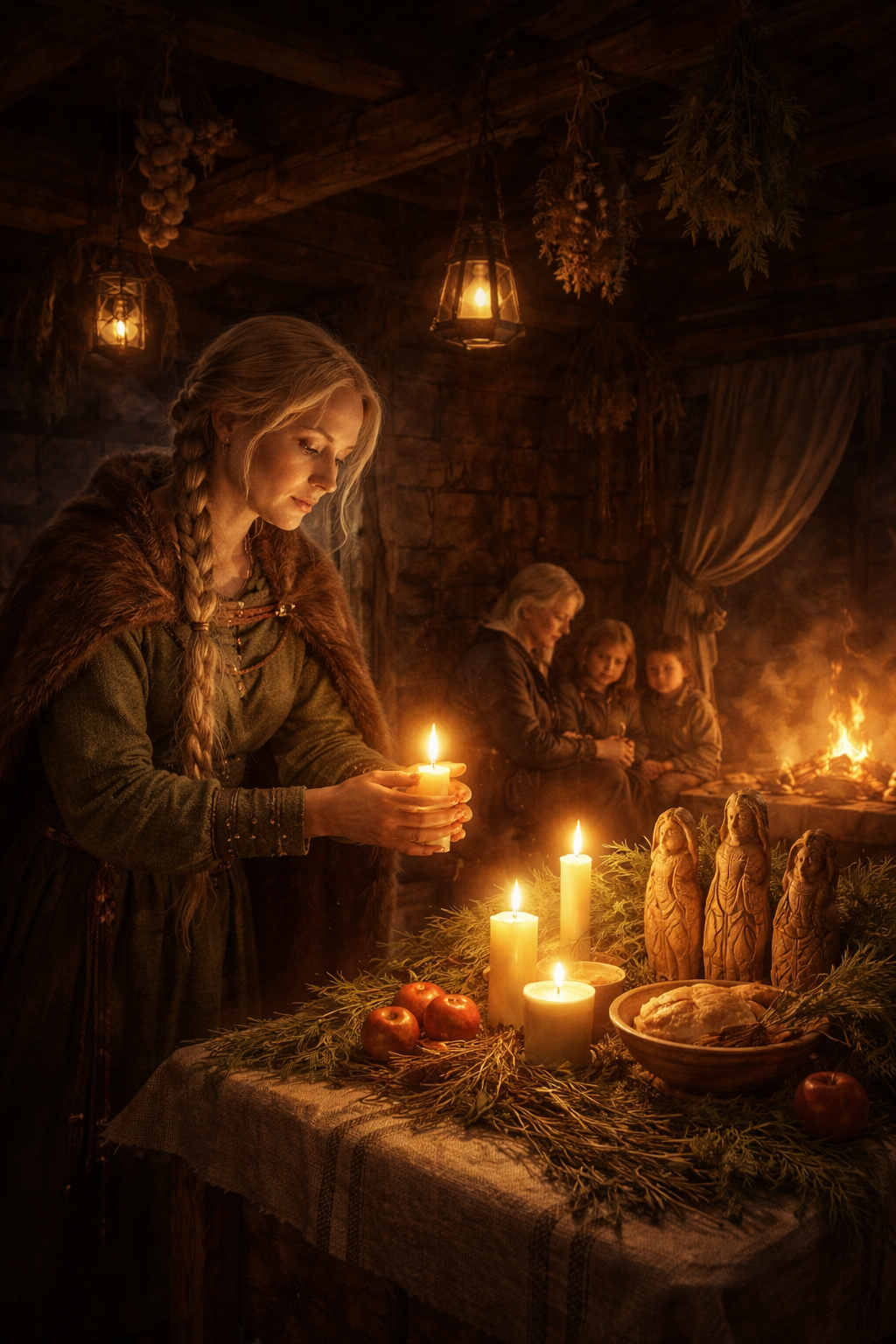
Mother’s Night, written in Old English as Mōdraniht, is a winter observance from the early Anglo-Saxon world. It is not a Norse festival in its own right, and it does not appear in the Norse sagas or Eddas. What we know about it comes from a single written source, but that source points toward a much older Germanic way of thinking about ancestry, protection and the turning of the year.
Mother’s Night is mentioned by the Anglo-Saxon monk Bede in the 8th century. He tells us that the Anglo-Saxons marked a night called Mōdraniht at midwinter, and that this night was important enough to be named as the beginning of their year. Bede does not explain the rites or practices, but the name itself, meaning “Mother’s Night”, strongly suggests that it was a time connected with female ancestral or protective figures.
Although Mother’s Night is Anglo-Saxon, it did not exist in isolation. The Anglo-Saxons came from the same broad Germanic cultural world as the Norse, and they shared many beliefs long before their cultures separated geographically. Because of this, Mother’s Night appears to reflect an older, shared Germanic tradition that existed before the Norse and Anglo-Saxon peoples developed distinct religious systems.
In Norse belief, we see similar ideas expressed through the dísir, female beings connected with ancestry, protection, and family lines. However, there is no clear evidence that the Norse celebrated a specific “Mother’s Night” in the same way as the Anglo-Saxons did. This means we should not label Mother’s Night as a Norse festival. It is better understood as Anglo-Saxon in practice, with roots in a wider Germanic worldview that the Norse also inherited in different forms.
Mother’s Night matters because it shows how important mothers, ancestry and female protective forces were at the turning of the year. Midwinter was a dangerous and uncertain time, and honouring the Mothers may have been a way of asking for protection, fertility and the safe continuation of family and community. The fact that it was observed at night suggests a quiet, household-focused practice rather than a public feast.
Today, Mother’s Night is often blended into modern Norse Pagan Yule celebrations. While this can be meaningful for people spiritually, it is important to be clear about the history. Mother’s Night is Anglo-Saxon, not Norse, but it likely comes from a much older Germanic tradition that both cultures once shared. Understanding this helps us honour the past honestly, without forcing separate traditions into one shape.
What Does “Mōdraniht” Mean?
The name Mōdraniht comes from Old English, the language spoken by the Anglo-Saxons. It is made up of two words: mōdra, meaning “mothers”, and niht, meaning “night”. Put together, Mōdraniht simply means “Mother’s Night”.
This name is important because it is the only real clue we have about what the observance was for. Bede, the monk who recorded it, does not describe any rituals or beliefs connected to Mother’s Night. He only tells us that it existed and that it was marked at midwinter. Because of this, the meaning of the name itself carries a lot of weight.
The use of the plural “mothers” is especially significant. It suggests that this was not about honouring one single goddess or mythological figure, but a group of female beings. These could have been ancestral mothers, protective female spirits, or figures connected with fertility, birth, and the continuation of family lines. This fits well with what we know about wider Germanic beliefs, where groups of female beings often played an important role in protecting households and guiding fate.
In other parts of the Germanic world, we see similar ideas. On the European mainland, Roman-era inscriptions refer to the Matronae or Matres, groups of mother goddesses worshipped together and associated with fertility, protection, and family wellbeing. While we cannot say for certain that the Anglo-Saxon Mothers were the same as the Matronae, the shared idea of multiple maternal figures suggests a common cultural pattern.
The word “night” is also meaningful. In many ancient cultures, night-time observances were linked to liminal moments, times when the boundaries between worlds were thinner. Midwinter nights, in particular, were seen as powerful and dangerous, but also full of potential. Holding Mother’s Night at night may have reflected beliefs about protection, renewal, and the unseen forces that guarded the household during the darkest part of the year.
What is important to understand is that Mōdraniht does not tell us exactly who the Mothers were or how they were honoured. The name points to their importance, but it leaves the details open. This lack of detail is frustrating, but it also reminds us to be careful. We should not fill in the gaps with later Norse mythology or modern ideas unless we clearly label them as interpretation.
In simple terms, Mōdraniht means a night set aside for the Mothers. It tells us that the Anglo-Saxons recognised the importance of female ancestral or protective powers at midwinter, even if the full shape of that belief is now lost to time.
The Only Historical Source: Bede and De Temporum Ratione
Everything we know for certain about Mother’s Night comes from one short reference written by the Anglo-Saxon monk Bede in the early 8th century. This appears in his work De Temporum Ratione (On the Reckoning of Time), which was written to explain calendars, seasons, and how the Christian year replaced earlier pagan systems.
Bede tells us that the pre-Christian Anglo-Saxons began their year at midwinter, and that this starting point was marked by a night called Mōdraniht, or Mother’s Night. He does not describe any rituals, prayers, or offerings. He does not explain who the Mothers were. He simply names the night and places it clearly at the beginning of the year.
This brief mention is important because it confirms three key facts:
First, Mother’s Night was real. It was recognised enough to be recorded by a Christian writer who was actively explaining how pagan customs had been replaced.
Second, it was connected to midwinter. Bede places it at the same point in the year where other cultures marked turning points, renewal, and the start of a new cycle.
Third, it was significant. Bede notes it as the start of the year, which tells us it held deep meaning for the Anglo-Saxons. Festivals that marked the beginning of the year were never small or unimportant.
At the same time, Bede’s silence on details is just as important as what he does say. As a Christian monk, he was not interested in preserving pagan rituals. His goal was to explain how Christian timekeeping had replaced older systems, not to record pagan beliefs accurately or respectfully. This means he likely knew more about Mother’s Night than he chose to write down.
Because of this, we must be careful. We cannot invent practices or claim certainty where none exists. Any description of rituals, offerings, or beliefs beyond what Bede states is educated interpretation, not direct evidence.
What Bede gives us is a name, a time, and a cultural importance. That may seem small, but in early medieval history, even a single named festival is a valuable piece of evidence. It tells us that honouring the Mothers at midwinter mattered enough to shape how the Anglo-Saxons understood time itself.
All later discussion of Mother’s Night must begin and end with this source. Everything else is comparison, context, and careful reconstruction based on wider Germanic belief, not direct proof.
When Was Mother’s Night Celebrated?
According to Bede, Mother’s Night was celebrated at midwinter, and it marked the beginning of the Anglo-Saxon year. This places it around the winter solstice, when the nights are longest and the daylight is at its shortest. Unlike modern calendars, the Anglo-Saxons did not use fixed dates like 21 or 25 December. Their understanding of time was seasonal and flexible, shaped by the natural world rather than numbered days.
Because of this, Mother’s Night was likely observed on the night of midwinter itself, or very close to it. It was a single night, not a long festival, and it seems to have carried a quiet but powerful significance. Starting the year at the darkest point makes sense in a culture where survival through winter was uncertain and where renewal was deeply valued.
Midwinter was a time when people stayed close to home. Travel was difficult, food was limited, and the household became the centre of life. A night dedicated to the Mothers fits naturally into this setting. Rather than being a public feast or a large gathering, Mother’s Night was probably a domestic observance, focused on the family, the home, and the unseen forces believed to protect both.
It is also worth noting that many early Germanic cultures began their day and sometimes their year at night rather than in daylight. Night was seen as a powerful and meaningful time, not just an absence of light. Beginning the year with a night dedicated to the Mothers reflects this way of thinking.
In modern practice, Mother’s Night is often placed on the evening of the winter solstice, sometimes treated as the opening of Yule. While this timing makes sense symbolically, it is important to remember that this is a modern choice rather than a confirmed historical date. What we can say with confidence is that Mother’s Night belonged to midwinter and marked a turning point in the year.
Who Were the “Mothers”?
The biggest question surrounding Mother’s Night is also the hardest to answer: who were the Mothers?
The honest answer is that we do not know their exact identity. No Anglo-Saxon text explains who the Mothers were, gives them names, or describes them as individual goddesses. What we have instead is a pattern found across the wider Germanic world, which helps us understand the role they likely played.
The word “Mothers” strongly suggests that these were not single figures, but a group of female beings. In early Germanic belief, groups of female powers were often connected with ancestry, protection, birth, fate, and the wellbeing of the household. These were not distant sky-gods, but close, familiar presences tied to family lines and land.
In Roman-era Europe, especially in areas with strong Germanic populations, there are hundreds of inscriptions dedicated to the Matronae or Matres. These were groups of three mother figures, often shown seated, holding baskets of fruit, children, or symbols of abundance. They were honoured for protection, fertility, healing, and the continuation of family and community. While these inscriptions come from outside the Anglo-Saxon world, they show that the idea of collective “Mothers” was widespread among Germanic peoples.
It is important to be clear here: we cannot say that the Anglo-Saxon Mothers were exactly the same as the Matronae. However, the similarity in name and role strongly suggests a shared cultural root. This points to an older Germanic belief system that existed before different groups spread across Europe and developed their own traditions.
The Mothers of Mother’s Night were likely connected to ancestors. They may have been seen as the first mothers of the family line, or as protective female spirits who watched over birth, children, and the home. In a time when survival depended on healthy families and strong kinship, honouring such figures at midwinter makes deep sense.
They may also have been connected with fate and renewal. Midwinter marked the turning of the year, and the Mothers may have been honoured as those who carried life forward through darkness, ensuring that the family line did not end. This links them to wider ideas of female powers shaping destiny, even if the Anglo-Saxons did not describe these ideas in detailed myths.
What matters most is that the Mothers were not abstract ideas. They were likely felt as close and personal, tied to the home rather than temples, and honoured quietly rather than through large public rituals. Mother’s Night was probably about protection, continuity, and gratitude, rather than worship in a modern religious sense.
In short, the Mothers were collective female figures connected with ancestry, protection, and the survival of family and community. We cannot name them, but we can understand why they mattered, especially at the darkest point of the year.
why do people sometimes link it to Norse belief?
The Anglo-Saxons were part of the larger Germanic cultural world. Before the tribes that later became the English, Norse, Goths, Franks, Saxons and others split into distinct cultures and languages, they shared many common beliefs and practices. Some themes persisted in different forms in different places.
Mother-figures connected with protection, fertility, ancestors and fate appear in many branches of the early Germanic world, though not always under the same names:
Matronae (or Matres) - In the Roman period (roughly 1st-3rd centuries CE), groups of female deities called the Matronae or Matres were worshipped across the Rhineland and other parts of continental Europe. Stone altars with inscriptions dedicated to these “Mothers” have been found in Germany, the Netherlands and northern France. These figures are usually shown in groups of three and are associated with protection, fertility, family wellbeing and safe childbirth.
While the Matronae are not Norse deities, and their cult was a local European phenomenon recorded in the Roman era, their existence shows that Germanic-speaking peoples had a long tradition of honouring motherly or protective female powers. This shared cultural background makes it plausible that some form of Mother’s Night may reflect an older Germanic idea that existed before the Anglo-Saxon and Norse traditions fully diverged.
The Norse did have important female spirits connected with family and fate, such as the dísir. The dísir are mentioned in the sagas and skaldic poetry as guardian spirits associated with family lines, protection, luck and women. However, this is not evidence that the Norse celebrated a festival called Mother’s Night. It simply shows that female powers were important across Germanic belief systems, albeit under different names and forms.
What We Can Say With Confidence:
• Mother’s Night (Mōdraniht) is Anglo-Saxon, not Norse BUT may be inspired by older Germanic tradition - It appears only in Bede’s De Temporum Ratione.
• The exact practices of Mother’s Night are not described, so we cannot say how it was celebrated.
• The name reflects a belief in powerful mother figures or female ancestral spirits.
• Similar ideas about motherly or protective female figures occur widely among early Germanic peoples (for example, the Matronae cult in the Roman Rhineland and the Norse dísir) but the observances are culturally distinct.
In summary, Mother’s Night is Anglo-Saxon and not directly Norse, but it likely reflects an older Germanic tradition of honouring maternal or protective female powers, which was present in different forms among related cultures. This is a genuine historical pattern, not a modern invention, but it should not be conflated with specific Norse ritual unless clearly stated as interpretation rather than evidence.
What Could Mother’s Night Have Been Inspired By?
Because Mother’s Night is only mentioned once in the historical record, we cannot say with certainty where it originally came from. However, when we place it alongside what we know about early Germanic belief, ancestry, and midwinter customs, several strong and historically reasonable influences emerge. These are not guesses pulled from myth, but patterns seen across the Germanic world over many centuries.
Mother’s Night was almost certainly not invented suddenly by the Anglo-Saxons. Instead, it appears to be a late survival of much older ideas that had already existed among Germanic peoples long before they settled in Britain.
Below are the most likely inspirations, based on evidence.
1. Ancestral Mother Veneration -
One of the strongest influences behind Mother’s Night is ancestor reverence, particularly focused on female ancestors.
Across the Germanic world, family and lineage were central to identity. Survival, inheritance, and social standing all depended on kinship. Women were the bearers of lineage, the keepers of the household, and the link between generations. Honouring ancestral mothers would have been a natural and meaningful practice.
Mother’s Night, placed at midwinter and marking the beginning of the year, fits perfectly with this idea. At the darkest and most uncertain point of the year, people may have turned to the Mothers (those who had come before) for protection, continuity, and blessing. This would not have required temples or public ritual, but could have taken place quietly within the home.
This household-based ancestor focus matches what we see elsewhere in Germanic religion, where many rites were domestic rather than public.
2. The Cult of the Matronae and Matres -
As discussed earlier, the Matronae (or Matres) provide the clearest archaeological parallel.
From the 1st to 3rd centuries CE, people across continental Germania honoured groups of Mother figures associated with fertility, protection, childbirth, and family wellbeing. These figures were not individual goddesses with myths, but collective powers tied to specific regions and communities.
The similarities are striking:
plural Mothers, not a single deity
protective and nurturing roles
strong connection to family and land
worship rooted in everyday life rather than heroic myth
While we cannot prove that Mother’s Night directly descended from the Matronae cult, it is very likely that both came from the same deep-rooted Germanic understanding of maternal protective forces. The Anglo-Saxons may have carried a simplified or adapted version of this belief with them when they migrated to Britain.
Mother’s Night may represent the final trace of this older cult, preserved only as a name by the time Bede recorded it.
3. Midwinter as a Liminal Time -
Another major influence is the importance of midwinter itself.
In pre-Christian northern Europe, midwinter was not simply a season - it was a dangerous threshold. Food was low, cold was intense, illness spread easily, and death was more common. At the same time, midwinter also marked the turning of the year and the slow return of the sun.
Liminal times (moments between one state and another) were seen as powerful. Night, winter, and year’s end all carried this quality. A night dedicated to the Mothers at midwinter suggests a belief that female ancestral powers were especially important at moments of transition, when protection and renewal were needed most.
This idea appears again and again in Germanic belief, where female beings are often connected with fate, birth, death, and turning points.
4. Female Powers of Fate and Continuity -
Across the Germanic world, female figures are repeatedly linked with fate, life cycles, and continuity.
In Norse belief, these roles appear later as the norns and the dísir. In continental sources, they appear as the Matronae. In the Anglo-Saxon world, Mother’s Night may reflect an earlier or parallel expression of the same idea: that female powers govern the unseen structure of life.
Importantly, these beings are rarely loud, warlike, or dramatic. They work quietly, shaping outcomes over time. A night-time observance fits this pattern well.
Mother’s Night may therefore have been inspired by the belief that the Mothers watched over:
births and deaths
family luck
the passing of years
the survival of the household
5. The Domestic Focus of Early Germanic Religion -
Finally, Mother’s Night fits what we know about early Germanic religion being centred on the home.
Not all religious life took place in halls or sacred groves. Much of it happened around the hearth, within families, through small acts of respect, offering, and remembrance. A night focused on the Mothers would have suited this perfectly.
Rather than a public festival, Mother’s Night was likely a quiet household observance - a moment of acknowledgement rather than celebration. This may be why it left so little trace in written sources.
What This Tells Us -
When we look at all of these influences together, a clear picture emerges.
Mother’s Night was likely inspired by:
ancient Germanic ancestor reverence
widespread belief in collective mother figures
the protective role of female spirits
the danger and importance of midwinter
household-based religious practice
It was not a Norse festival, but it came from the same deep Germanic soil that later produced Norse, Anglo-Saxon, and continental traditions. By the time it was recorded, it had already faded into memory - but its name preserves the truth of what mattered: the Mothers, the night, and the turning of the year.
The Dísir and Female Spirits in Norse Belief
While Mother’s Night itself is Anglo-Saxon, the Norse world had its own powerful tradition of female spirits connected to family, protection, and fate. These beings are known as the dísir. Looking at the dísir helps us understand why Mother’s Night feels familiar to modern Norse Pagans, even though it is not a Norse festival.
The dísir appear in several Old Norse sources, including sagas and skaldic poetry. They are not described as a single goddess or a fixed group, but as female spirits linked to family lines and ancestry. In many cases, the dísir seem to be ancestral women, protectors of a household or kin group, rather than distant gods living far from human life.
The word dís can mean “lady” or “woman,” and the dísir are often connected with:
protection of the family
luck and wellbeing
fertility and birth
fate and destiny
the continuity of the family line
In the sagas, people sometimes speak of “their dísir,” which suggests a personal or family connection rather than a universal group worshipped by everyone in the same way. This is very important. It shows that Norse belief placed great value on female ancestral powers tied to specific families, not just named gods like Odin or Thor.
We also know that the Norse held a festival called Dísablót, a sacrifice to the dísir. This festival is historically attested and took place in late winter or early spring, not at midwinter. It was especially important in Sweden and was linked with both religious rites and public gatherings. This confirms that the dísir were taken seriously and honoured through formal ritual.
However, even though the dísir were honoured, there is no evidence of a specific “Mother’s Night” in Norse practice. The Norse did not name a midwinter night after the dísir in the way the Anglo-Saxons named Mōdraniht. This difference matters. It shows that while the belief in female protective spirits existed in both cultures, it was expressed differently.
What connects the dísir to Mother’s Night is not a shared festival, but a shared worldview. Both the Anglo-Saxons and the Norse believed that female beings connected with ancestry, protection, and fate played a vital role in human life. These beings were especially important during dangerous or liminal times, such as winter, childbirth, or moments of transition.
In this sense, Mother’s Night and the dísir reflect the same deep Germanic idea: that the family is guarded not only by living members, but by unseen female powers tied to bloodline and memory. The Anglo-Saxons expressed this through a single named night at midwinter. The Norse expressed it through ongoing reverence for the dísir and seasonal rites like the Dísablót.
So while Mother’s Night is not Norse, the concept behind it would not have felt strange to the Norse mind. Both traditions grew from the same older Germanic soil, even though they flowered in different ways.
Mother’s Night vs Dísablót: Similar Themes, Different Traditions
Mother’s Night and Dísablót are often spoken about together in modern Pagan spaces, but historically they are not the same festival, and they come from different cultural contexts. While they share similar themes, understanding the differences is important if we want to be honest about the history.
Mother’s Night (Mōdraniht) is Anglo-Saxon and is only recorded once, by Bede, as a midwinter observance marking the beginning of the year. Dísablót, on the other hand, is clearly Norse and is attested in several sources connected with Scandinavia.
The Dísablót was a sacrifice made to the dísir, the female protective and ancestral spirits of Norse belief. Unlike Mother’s Night, which seems to have been a single night, Dísablót was a public festival in some regions, especially in Sweden. It was closely tied to the Disting, a large assembly and market held at Uppsala. Medieval law codes and saga references place Dísablót in late winter or early spring, usually around February or March, not at midwinter.
This difference in timing matters. Mother’s Night belongs to the darkest point of the year, while Dísablót took place as winter was beginning to loosen its grip. One looks inward, toward survival, ancestry, and protection in darkness; the other looks forward, toward fertility, growth, and the coming agricultural season.
There is also a difference in scale and setting. Mother’s Night appears to have been household-focused, quiet, and domestic. It was likely centred on family, lineage, and the unseen powers that protected the home. Dísablót, especially in Sweden, could be large and communal, involving chieftains, assemblies, and public ritual. This reflects differences between Anglo-Saxon and Norse social structures, rather than a shared festival.
Despite these differences, the two observances clearly share deep thematic roots. Both centre on female spiritual powers. Both are connected to family, fate, and protection. Both reflect the old Germanic understanding that women, mothers, and female spirits were closely tied to the wellbeing of land and people.
Because of this, it is likely that Mother’s Night and Dísablót grew out of a shared older Germanic worldview, rather than one being copied from the other. Over time, as cultures separated and developed independently, those shared ideas took on different forms, names, and timings.
So while Mother’s Night is not a Norse Dísablót, and Dísablót is not an Anglo-Saxon Mother’s Night, they can be seen as cultural cousins. They reflect the same deep-rooted belief that female ancestral powers mattered, especially at turning points in the year, but they express that belief in ways shaped by local tradition.
In modern practice, people often blend the two together. Spiritually, this can be meaningful. Historically, however, it is important to keep them distinct. Doing so doesn’t weaken either tradition; it allows both to be honoured for what they truly were.
Mother’s Night and Midwinter
Mother’s Night is firmly placed at midwinter, the darkest point of the year. This timing is not accidental. In the early Germanic world, midwinter was a deeply important and often dangerous time. The days were short, the nights were long, food stores were under pressure, illness spread more easily, and survival was never guaranteed. Because of this, midwinter was seen as a liminal time - a threshold between the old year and the new, between death and life, darkness and returning light.
A liminal time is a moment “in between”, when normal rules feel softer and the world is thought to be more open to unseen forces. Across many ancient cultures, these in-between moments were believed to be powerful but risky. This helps explain why Mother’s Night was marked at night rather than during the day. Night itself was liminal: quieter, more mysterious, and closer to the unseen world.
For the Anglo-Saxons, beginning the year at midwinter shows that this darkness was not only feared, but respected. It was understood as the point from which renewal begins. The sun may have been weak, but it was about to return. The year was not ending in darkness; it was being reborn from it.
This is where the focus on the Mothers makes sense. Female figures connected with birth, ancestry, and protection are especially fitting for a moment of renewal. Honouring the Mothers at midwinter may have been a way of asking for:
protection through the hardest part of winter
the safe continuation of family lines
fertility and health in the coming year
balance between loss and renewal
Darkness, in this context, was not evil. It was the womb of the year. Just as life grows unseen before birth, the next year was believed to be forming in the dark of winter. The Mothers, whether understood as ancestral women, protective spirits, or divine figures, would have been the right powers to watch over this process.
We also see this pattern elsewhere in the Germanic world. The Matronae cult on the continent focused on fertility, protection, and family wellbeing. In Norse belief, female beings such as the dísir and norns are deeply tied to fate and the unseen shaping of life. While these are not the same as Mother’s Night, they reflect a shared belief that female powers stand at the turning points of existence.
Mother’s Night, then, can be understood as a quiet acknowledgement of this truth: that life continues because it is guarded, remembered, and renewed, even in darkness. It was not a loud celebration, but a moment of pause. A night when families stood at the edge of the old year and entrusted the new one to the care of the Mothers.
Seen this way, Mother’s Night fits naturally into the wider Germanic understanding of midwinter as a time of endings and beginnings, where protection mattered more than victory, and continuity mattered more than conquest.
What Mother’s Night Likely Involved
Because Mother’s Night is only mentioned once in the historical record, we do not have direct descriptions of what people actually did on that night. However, by looking at wider Anglo-Saxon and older Germanic practices, we can make careful, honest suggestions about what Mother’s Night may have involved, without claiming certainty.
First, Mother’s Night was almost certainly a household observance, not a public festival. Early Germanic religion placed great importance on the home, the family, and the protection of the household. Many rites connected with female spirits, ancestors, and fertility were carried out privately rather than in large communal spaces. The fact that Mother’s Night was marked at night and at the turning of the year strongly suggests it was observed within the home, among family members, rather than in halls or temples.
Offerings were likely simple and domestic. Across Germanic cultures, offerings to protective spirits and ancestors were usually food-based. Bread, grain, dairy, or drink would have been the most common and meaningful gifts, as these represented survival, nourishment, and continuity through winter. If offerings were made on Mother’s Night, they would not have been elaborate sacrifices but quiet acts of giving, intended to honour and thank the Mothers for protection and future blessing.
Mother’s Night may also have involved remembrance of ancestors, especially female ancestors. In early societies, mothers were seen as the carriers of lineage and life. Honouring the Mothers at midwinter may have been a way of recognising those who had given birth, sustained families, and ensured survival across generations. This remembrance would likely have been spoken rather than written, passed down through names, stories, and quiet acknowledgment rather than formal ritual.
Protection was almost certainly a central theme. Midwinter was the most dangerous time of year. Cold, hunger, illness, and darkness were real threats. Many Germanic beliefs focused on keeping harmful forces away from the home during this period. Mother’s Night may have been a time to ask the Mothers for protection of children, livestock, and the household itself as the year turned. This could have taken the form of spoken words, careful behaviour, or symbolic acts meant to keep the home safe.
Silence and restraint may also have played a role. Some scholars suggest that night-time observances connected with ancestors and spirits were marked by quietness rather than celebration. Instead of feasting or loud activity, Mother’s Night may have been a time of inward focus, respect, and calm. This fits with the idea of night as a liminal space, when unseen forces were close and needed to be approached carefully.
What is important to stress is that Mother’s Night was likely simple, quiet, and domestic, not dramatic or ceremonial. There is no evidence for temples, priests, or formal rituals connected with it. Everything points toward a night of acknowledgement rather than performance, rooted in the home and the family rather than public religion.
By understanding Mother’s Night in this way, we stay close to what the evidence allows. We avoid turning it into something grand or complex, and instead recognise it as a moment of pause at midwinter, when families may have honoured the Mothers through small, meaningful acts meant to ensure protection, continuity, and renewal as the new year began.
Mother’s Night in Modern Pagan Practice
In modern Pagan practice, Mother’s Night is often observed as part of the wider winter season, especially around the winter solstice. However, it is important to be clear that most modern celebrations of Mother’s Night are reconstructions or inspirations, not direct continuations of an unbroken tradition. This does not make them meaningless, but it does mean they should be approached with honesty about their historical limits.
Today, many Pagans honour Mother’s Night as a time to recognise ancestral mothers, female lineage, and protective feminine forces. This may include remembering grandmothers and foremothers, acknowledging the role of women in family history, or simply reflecting on the unseen support systems that allow life to continue through difficult times. These themes align well with what Mother’s Night may originally have represented, even if the exact rituals are unknown.
In Heathen and Norse Pagan spaces, Mother’s Night is sometimes blended into Yule or Jól celebrations. This is a modern choice, influenced by the shared Germanic ideas of female spirits such as the dísir and the strong symbolic connection between midwinter, birth, and renewal. Historically, this blending did not exist in the Norse world in the same form, but modern practitioners often use Mother’s Night as a way to honour feminine powers that feel underrepresented in other winter rites.
Common modern practices include lighting candles, offering food or drink, speaking the names of ancestors, or holding quiet, reflective moments within the home. These acts reflect the likely household-focused and inward nature of the original observance, even if the details differ. Many people also choose to keep Mother’s Night calm and private, rather than celebratory, which fits well with its character as a night rather than a feast.
It is also worth noting that modern Pagan practice is diverse. Some people approach Mother’s Night spiritually, others culturally, and some simply as a time of reflection and remembrance without religious belief. There is no single “correct” modern way to observe it. What matters most is being clear about what is historical, what is inspired by history, and what is personal tradition.
When practised with this awareness, Mother’s Night in modern Paganism can serve as a meaningful pause in the winter season. It offers space to reflect on ancestry, protection, and continuity, while respecting the fact that the original observance belongs to the Anglo-Saxon past and survives today only in fragmentary form.
Practising Mother’s Night Today
Practising Mother’s Night today can be meaningful and respectful, as long as it is done with honesty about what is historical and what is modern inspiration. Because we only have one brief historical reference to Mother’s Night, we cannot reconstruct it in the same way people attempt to reconstruct Norse blót or other better-documented rites. Any modern practice must therefore be understood as inspired by history, not a recreation of it.
A historically honest approach begins with acknowledging that Mother’s Night was Anglo-Saxon, household-based, and likely quiet rather than ceremonial. It was probably not a public festival, not centred on named gods, and not filled with elaborate ritual. Keeping modern practice simple reflects this reality far better than complex ceremonies.
One of the most appropriate ways to mark Mother’s Night today is through remembrance and acknowledgement rather than worship. This might involve quietly honouring ancestral mothers, foremothers, or the women who formed and protected family lines. This does not require names, prayers, or offerings taken from later traditions. A simple act of remembrance, spoken aloud or held privately, fits the limited evidence far better than formal ritual.
Because Mother’s Night was associated with midwinter and the beginning of the year, modern practice can focus on themes of protection, continuity, and renewal. This could mean lighting a single candle at night to mark the turning of the year, reflecting on family wellbeing, or setting intentions for protection and care in the coming months. These acts align with the symbolic meaning of the night without claiming historical certainty.
Offerings, if included at all, should remain modest and domestic. Food, such as bread, milk, or grain, reflects what would realistically have existed in an early medieval household. These should be understood as symbolic gestures inspired by wider Germanic customs, not as proven elements of Mother’s Night itself. It is important to avoid claiming that specific offerings were historically used unless clear evidence exists.
Crucially, modern practitioners should avoid blending Mother’s Night directly into Norse Yule or Jól without explanation. While it is common in modern Paganism to place Mother’s Night on the eve of Yule, this is a modern framework, not a historical one. If it is done, it should be clearly stated as a personal or spiritual choice rather than an ancient practice.
An honest modern observance of Mother’s Night is quiet, reflective, and grounded. It respects the limits of the sources, avoids inventing false traditions, and focuses on the core ideas suggested by the name itself: mothers, ancestry, protection, and the turning of the year. Practised in this way, Mother’s Night becomes a thoughtful act of remembrance rather than a reconstructed ritual, honouring the past without misrepresenting it.
Closing Reflection
Mother’s Night stands quietly at the edge of what we know and what has been lost. It is mentioned only once in the historical record, yet it opens a door onto something much older and deeper in early Germanic belief. What survives is not a set of instructions or rituals, but a name, a time, and a feeling: midwinter, darkness, beginnings, and the presence of the Mothers.
What makes Mother’s Night powerful is not certainty, but meaning. It reminds us that the people of early England marked time differently from us. They began their year in the dark. They trusted that life starts unseen. They honoured the forces that protect family, land, and lineage when the world feels most fragile. Whether these Mothers were ancestral spirits, protective female beings, or divine figures now lost to history, they mattered enough to name the night itself after them.
Being historically honest means accepting limits. We cannot recreate Mother’s Night exactly as it was. We do not know the prayers spoken, the offerings given, or the stories told. But we can understand the values behind it: respect for ancestors, protection of the household, trust in renewal, and reverence for the quiet power of women and mothers, both human and unseen.
In a modern world that often rushes past darkness or tries to fill it with noise, Mother’s Night offers something different. It invites stillness. It invites remembrance. It invites us to acknowledge where we come from, and to honour the unseen foundations that carry life forward.
Practised thoughtfully today, Mother’s Night does not need to be dramatic or elaborate. It can remain what it likely always was: a quiet moment at midwinter, held close to home, focused on protection, continuity, and care.