
Kraken: The Tentacled Silence
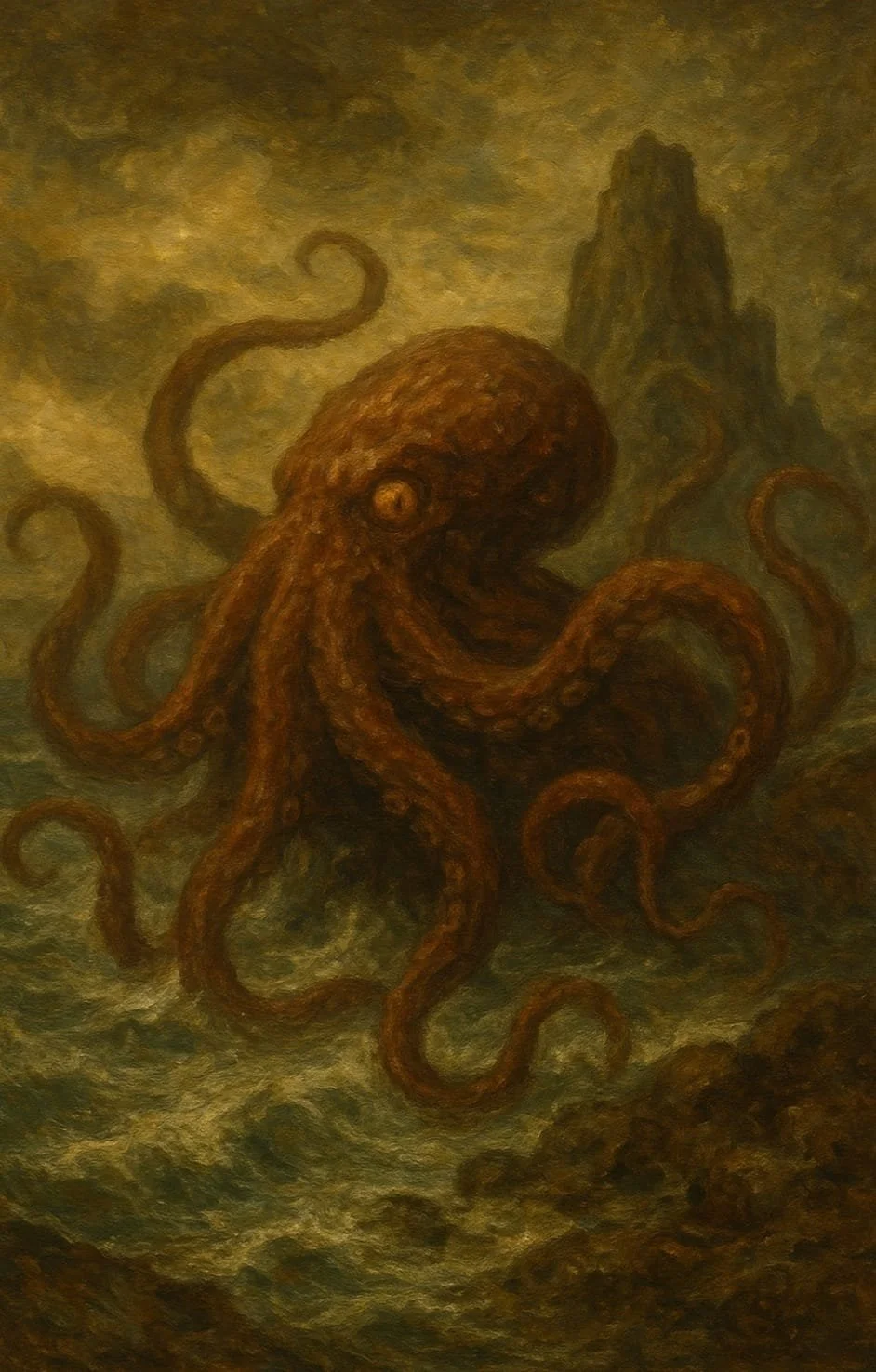
“Ships are but driftwood in the hands of the deep, And the deep is patient beyond all reckoning.” - Fragments of the Sea Codex, anonymous, c. 1300
Long before any sailor ever saw a storm, the Kraken was whispered into existence. It was known not by a single name but by a dozen: hafgǫfa’s cousin, marbotn, tentacle of the abyss. Its first breath, if such it has, was said to disturb the waters of Scandinavia before the first Norse keel ever cut a fjord. Unlike other monsters that rage and strike, the Kraken’s presence is a long pause in the ocean’s song - a darkness pressing against the edges of the world.
It is not a beast so much as a principle of depth, the sea made patient and aware. To meet it is to feel the gravity of the void, the slow measure of time in a place beyond human reckoning. Its existence is less about corporeal violence and more about the awareness of vastness, a reminder that human ambition and hubris are fleeting against the scale of the deep.
Whispers from the Deep
Before the first sail ever sliced through fjord or bay, before storm or sky had names known to men, there were whispers in the water. Long, slow murmurs, patient as stone, spoke of a presence too vast for mortal eyes.
Mariners gave it many names: kraki, marbotn, hafgǫfa’s cousin, tentacle of the abyss. Yet names failed. The Kraken was not a creature one met - it was a scale glimpsed, a shadow that measured the folly of those who called themselves masters of the sea.
Leif tightened the ropes on his small fishing boat, eyes straining at the mist. The waves paused mid-crest, and the horizon seemed to stretch endlessly. He felt it before he saw it: the subtle, deliberate pull of something vast beneath him. His hand hovered over the bell at the bow. Instinct told him that ringing it might save him. He did.
A faint resonance traveled down through the water. The swell eased, almost in acknowledgment. Leif exhaled. He had glimpsed patience incarnate.
When the Kraken stirs, the ocean itself holds its breath. Waves freeze mid-crest. Fog drifts without wind. The horizon stretches toward infinity. Ships float, unmoored. Sailors whisper of it not as a beast of rage, but as a patient arbiter - a slow pulse beneath all tides and tempests.
The Sleeper of the Fjords
The Kraken is not merely squid or leviathan. It is the ocean rendered conscious, its arms instruments of thought as much as limbs. Sagas and sailors’ tales converge on this point: it is vast beyond comprehension, slow as eternity, deliberate as the turning of seasons.
“And the black arms of the sea lifted, curling and uncurling, and the men whispered that even Ægir’s halls would tremble beneath such weight.” - Saga of the North Sea, c. 1250
The term kraken appears in early Icelandic manuscripts as kraki, meaning “twisted tree” or “pole,” evoking the image of long, spindly limbs rising from the depths like a forest grown in reverse. Some scholars suggest this reflects a cultural understanding of the deep: dangerous, alien, yet strangely familiar in shape.
The Kraken’s form defies comprehension. Tentacles extend for leagues, sometimes mistaken for chains of islands or drifting kelp forests. Its movements are slow, undetectable until noticed, yet catastrophic when the full bulk shifts. Sailors reported the “arms of the sea” lifting a ship into the air or folding a vessel into a living coil. Its power is inexorable, not chaotic. Death or disappearance comes by inevitability, not rage.
The Isle That Was Arms
A tale persists of a fishing vessel lost off Lofoten, seeking shelter from storm and fog. They found an island, black and slick, built fires, and slept.
Eira lit a small lantern on the deck, the only warmth in the chilling fog. She thought the island offered safety, a respite from the wind. At dawn, the “island” shifted. Peaks writhed, tentacles unfurled, black arms stretching into the sea like slow ink strokes.
Her heartbeat quickened, but she did not scream. She dropped her lantern into the water, letting it drift as an offering. The black bulk paused, almost curious, then sank beneath the waves. Her village’s fishermen would speak of it for decades, but only she knew that survival required acknowledgment, not defiance.
“The island moved with thought, and in the stillness of its waking, men became part of the sea itself.” - Vestfjord Chronicles, anonymous
Other accounts are subtler. A single black arm coils beneath a ship’s hull, nets vanish, whales disappear mid-song, and birds circle endlessly, waiting for the surface to breathe again. Some claim the Kraken’s calm is a test - a moment when humility is observed before action.
In Norse tradition, monstrous sea creatures often embody liminality: the boundary between life and death, the known and unknown. The Kraken, as the largest of these liminal figures, is a threshold. It is not evil; it is the ocean’s patience personified. Scholars of medieval Norwegian texts note that Kraken tales often coincide with real giant squid sightings (Architeuthis), yet the mythic framing imbues these sightings with existential and spiritual significance.
The Widow of Hvalfjord
Astrid of Hvalfjord wrote a single line in her ledger after her husband and sons were taken:
“The arms rose, and I felt the sea fold around their laughter.”
Each night she walked the fjord, clutching a piece of driftwood, speaking softly into the fog. Her words were not prayers; they were acknowledgments, signals of presence. The waves whispered back in the slow rhythm of currents and unseen eyes. Astrid felt the Kraken’s attention like a gentle weight upon her shoulders, a reminder that the sea measured grief as carefully as it measured tides.
Over time, fear gave way to quiet understanding. She was small, fleeting, yet her awareness mattered in the vast calculus of the deep. Old fishermen recounted seeing her leave driftwood offerings along the shore, each piece marked with carved runes meant not to ward, but to acknowledge presence, signaling respect for the Kraken’s dominion.
Saga sources occasionally describe widows leaving offerings for sea monsters, tying small iron charms to the shore or chanting the names of the taken. These acts are neither prayer nor plea - they are ritual acknowledgment, aligning human consciousness with the deep’s will.
The Silence Made Flesh
Unlike storms, the Kraken’s terror is methodical, invisible, inevitable. Its tentacles are not merely limbs; they are extensions of the ocean’s consciousness. Ships drift into them, fish and whales too, not by chance but by subtle gravitational pull - a lure of curiosity more than hunger.
“The kraki lies beneath the waves, patient and immense, as if the sea itself contemplated the folly of men.” - konungs skuggsjá, c. 1250
Comparisons:
Hafgufa: Feeds through stillness, a principle rather than predator. Its presence is cosmic, consumption total yet indifferent.
Leviathan: Old Jón drifted on the North Sea, and in the fog glimpsed a vast shadow. The waves roared unbidden, and his boat pitched as if the ocean itself were alive. Leviathan embodies chaotic power, fear of uncontrollable energy.
Charybdis: Whirlpools as agents of destruction, natural laws masking hidden peril.
Tiamat: The Babylonian sea serpent embodies creation through destruction. Kraken shares this duality, but with subtler, patient agency.
The Kraken represents measured inevitability - the law of the abyss applied silently to form and motion. Its method is patience: it waits until conditions align, then acts with perfect timing. It is the ocean’s conscience, judging not by morality but by scale, consequence, and inevitability.
The Art of Survival
Coastal communities understood that survival was not found in battle, but in ritual:
Offerings of driftwood and iron: Small, carefully carved objects were cast into the sea to acknowledge Kraken dominion. Some carried inscriptions of gratitude or remembrance for lost sailors, signaling human respect for the deep. Sagas record monks leaving blessed iron rods to mark “safe passage” lanes - almost neutral territory between two intelligences: human and abyssal.
Sound charms: Bells, songs, and drums were not meant to repel the Kraken, but to assert human presence. Sound resonates through water, alerting the Kraken to living intent. In the Vestfjord Chronicles, a captain survives by singing an old lullaby learned from his mother, repeating each line until dawn. The Kraken paused, uncertain whether to engage.
Navigational humility: Certain tides, lunar cycles, and wind patterns were avoided entirely, demonstrating that humans must yield temporality to the ocean. Skaldic poems often reference “the quiet tide,” a time when Kraken activity was most pronounced. Ignorance of these rhythms often spelled disappearance.
Some shamans believed that even a whispered name of the Kraken could prevent swallowing - not by magic, but by asserting awareness within the ocean’s consciousness. This was a subtle negotiation rather than confrontation.
The Kraken in Dreams
Dreams of the Kraken are not about fear. They are confrontations with the unconscious, moments when the self drifts on glassy water. Tentacles rise. The horizon dissolves. Identity unravels.
There is no struggle, no pain. Only the slow, inevitable awareness of being part of something larger than oneself.
“I saw arms coil beneath me, as if to cradle or consume, and in that embrace I understood the tide of my own being.” - Anonymous dream account, Faroe Islands, 1400
In dreams, the Kraken embodies the oceanic unconscious - vast, unknowable, transformative. Confrontation brings insight. Survival does not lie in flight, but in acceptance, recognition of scale, and surrender that yields clarity.
Legends of the Tentacle
The Fishermen of Vestfjord: Leif tied an iron bell to his boat after hearing tales from his grandfather. One night, a black swell rose higher than the horizon. Tentacles swept silently below. The bell rang. The Kraken paused, then sank beneath the waves. Survival lay not in defiance but acknowledgment, ritual, and measured awareness.
The Vanishing Island: A monk from Bergen recorded a “safe harbor” that disappeared overnight. Black arms had risen beneath the crew’s sleep, folding reality in silence. Only humility and careful observation spared them, suggesting the Kraken observes human behavior and responds proportionally.
The Kraken’s Whispered Bargains
Across scattered fjords, tales survive of sailors “bargaining” with the Kraken - not in words, but in action. Leaving half-caught fish, untied knots, or unharvested shellfish was said to appease the monster, a quiet acknowledgment of shared dominion.
One tale tells of a captain who survived a storm not by skill, but by casting his most prized catch into the sea and bowing - unseen by any human eye. The Kraken measured, paused, then let the ship pass.
The Kraken as Archetype
The Kraken embodies the oceanic Self, the shadow of consciousness projected onto water, an archetype of awe and existential reflection:
Patient: The Kraken waits, observing the foolish, the curious, the bold. No storm, no rage - only the slow measure of the deep.
Transformative: Sailors who glimpse its arms often wake changed. Ego dissolves; fear and ambition realign with currents beyond their control.
Indifferent: Morality and intent do not exist beneath its shadow. Only acknowledgment matters. A bell rung, a driftwood offering cast, and life continues.
Through these dimensions, the Kraken transcends myth to become a symbolic framework: patience, transformation, and indifference converge to teach humans the necessity of humility, reflection, and awareness. In this archetypal role, the Kraken is no longer a mere creature of legend - it is a mirror, a teacher, and a threshold between the self and the vast, unplumbed currents of existence.
Mythic Echoes in Norse Lore
Stories from the Orkneyinga Saga and coastal skaldic poems describe Kraken-like beings interacting with gods themselves. In one account, Loki attempts to lure such a tentacled monster with fire and song, yet the creature retreats, “not in fear but in curiosity, as if gauging the chaos of mortals.” Such interactions frame the Kraken as a liminal actor - an entity neither fully mortal nor divine, observing but rarely interfering unless balance is disrupted.
Saga of the Kraken and the Sea-Gods - Chapter I: The Summoning of Ægir
In the earliest nights of the North Sea, when fjords were young and mountains still sang with frost, there came a whisper from the abyss. Ægir, lord of waves, heard it first; his halls trembled at the silence. The Kraken had stirred.
Skadi, the winter huntress, noticed fish leaping oddly beneath the ice. “The deep grows restless,” she said. Ægir poured ale into the waters to call forth his servants. The Kraken responded not with fury, but with a slow, rolling swell that bent the moon’s reflection.
“Even the halls of the gods must reckon with patience,” whispered Njord, watching his children drift in fjords unseen.
Chapter II: Loki’s Curiosity
Loki, ever cunning, sought to measure the monster with trickery. He carved a firewood raft shaped like a whale and sang an old skaldic rhyme, hoping to lure the Kraken into rage. The tentacles circled, lifting the vessel gently, then let it drift back unharmed.
“It judges not by anger, but by the measure of folly,” Loki muttered, scratching his chin. “This is a godly test, and I - perhaps - am not yet wise enough to pass.”
Chapter III: The Offering of Men
A mortal village on the Vestfjord coast, fearing their vessels would vanish, sent a young woman named Eira as tribute. She carried a basket of salt and carved driftwood, leaving it where waves lapped the shore. A black arm rose, paused, then sank. The village was spared.
“They honor the rhythm of the deep,” Njord observed, “and so the Kraken honors them in return.”
Chapter IV: The Kraken’s Counsel
In the final chapter, it is said that Odin himself glimpsed the Kraken from Hliðskjálf, his high seat. The beast’s eyes, vast and eternal, reflected the cosmos.
“Here is patience beyond wisdom,” Odin murmured. “Here is the tide of all being.”
The Kraken withdrew to the unplumbed trenches, leaving Ægir’s halls quiet. Sailors passing those waters later swore that if one whispered acknowledgment, sang a lullaby, or left a simple offering, the ocean itself would part like a friend, not a foe.
Chapter V: The Eternal Watch
The saga closes with words inscribed on driftwood centuries later:
“He who sees the arms sees not death, nor life, but the measure of the deep. Fear is folly; patience is wisdom; humility is the only sail.”
Thus, the Kraken became not merely a monster, but a teacher of gods and men alike. Its law is written in stillness and time, not in violence.
Cross-Cultural Echoes
Across the seas of human imagination, the Kraken has taken many forms, each a mirror of the ocean’s unknowable depths.
In the North, Leviathan’s shadow rose through Hebrew waters: chaotic, consuming, beyond mortal comprehension. Sailors whispered of it not with fear alone but with humility, for its mere presence reminded them that human order is fragile, and limits are sacred.
Across Babylon, Tiamat churned primordial waters into creation and destruction alike. Her scales shimmered with cosmic duality, a patient echo of the Kraken’s inevitability. Those who glimpsed her feared not anger, but the vast, impartial unfolding of time and consequence.
Far east, the umibōzu haunted the Japanese coasts. Storms would rise without warning, black shadows upon the waves. Fishermen left offerings and whispered prayers, not to repel, but to acknowledge - a quiet negotiation with a presence both invisible and exacting.
In the Mediterranean, Charybdis spun her silent whirlpool. Ships vanished not through rage but inevitability. Mariners learned that stillness could be as deadly as tempest, that the ocean’s laws are subtle, hidden in currents that defy perception.
Across cultures, the message is the same. Chaos, stillness, creation, and consumption - the sea’s consciousness - is vast beyond measure, indifferent, yet teaching those who dare to witness. In every story, a single truth surfaces: acknowledgment, humility, and understanding are the only ways to survive the depths.
Modern Metaphors
The Kraken persists today in symbolic form:
Psychological: The Kraken stirs in dreams and quiet minds alike - depression, anxiety, slow erosion of certainty. Resistance is futile; acknowledgment is survival.
Societal: Vast systems - bureaucracies, digital networks - move like unseen tentacles, reshaping lives with indifferent efficiency.
Environmental: Rising seas, shifting climates, ceaseless upheaval - forces larger than humanity. Respect, adaptation, humility remain the only paths.
The tentacles stir - not in wrath, but in memory and awareness, echoing the ancient lesson: humans are not the measure of existence, and survival requires understanding the magnitude of the world around them
Encountering the Kraken
To meet it is to confront totality: unacknowledged fears, suppressed desires, unconscious drives. Survival requires recognition, humility, and alignment with forces larger than the ego.
Leif remembered the first time a tentacle brushed beneath his boat. Terror clawed at his chest, yet he did not flee. He rang his bell, left a driftwood offering, and whispered a lullaby his mother had taught him. Time slowed. The Kraken’s presence pressed around him like an invisible hand, measuring, patient, immense. When he finally dared to lift his eyes, the sea lay calm. The boat drifted free. He understood something ineffable: the deep was not wrathful, only aware. Respect was the only bridge between survival and oblivion.
Resistance invites erasure; acknowledgment invites passage.
Rituals of Passage
Some coastal traditions held that young sailors must spend a night adrift on glassy water, leaving a candle floating as an offering. If the tentacles brushed but did not disturb the vessel, the sailor was considered “marked” by the Kraken - initiated into understanding the deep and its quiet authority. This rite linked community, knowledge, and respect into a lived experience of mythic awareness.
Closing Vision
Beneath the dark mirror of the sea, the Kraken waits. Tentacles coil beneath the surface, eyes unseen but eternal. Stars shimmer like forgotten thoughts.
Astrid, Leif, and Eira - separated by time and fjord - felt the same weight of inevitability in the water. Their hearts had learned patience, humility, and surrender. To see the Kraken was to see oneself reflected in the abyss: fragile, fleeting, yet acknowledged. The ocean breathed. The Kraken waited. And humans who bore witness remembered: awareness, not resistance, was their path back to form.
To see the Kraken is to witness patience, inevitability, and the measureless void within existence. It does not rage - it remembers. Sailor, dreamer, shaman: all glimpse their reflection in the abyss. Awareness and humility are the only paths back. The ocean breathes. The Kraken waits.
Always. ⚓🌊
Wyrd & Flame 🔥
