
Helgi Hundingsbane: The Wolf-Born King Who Walked With Destiny
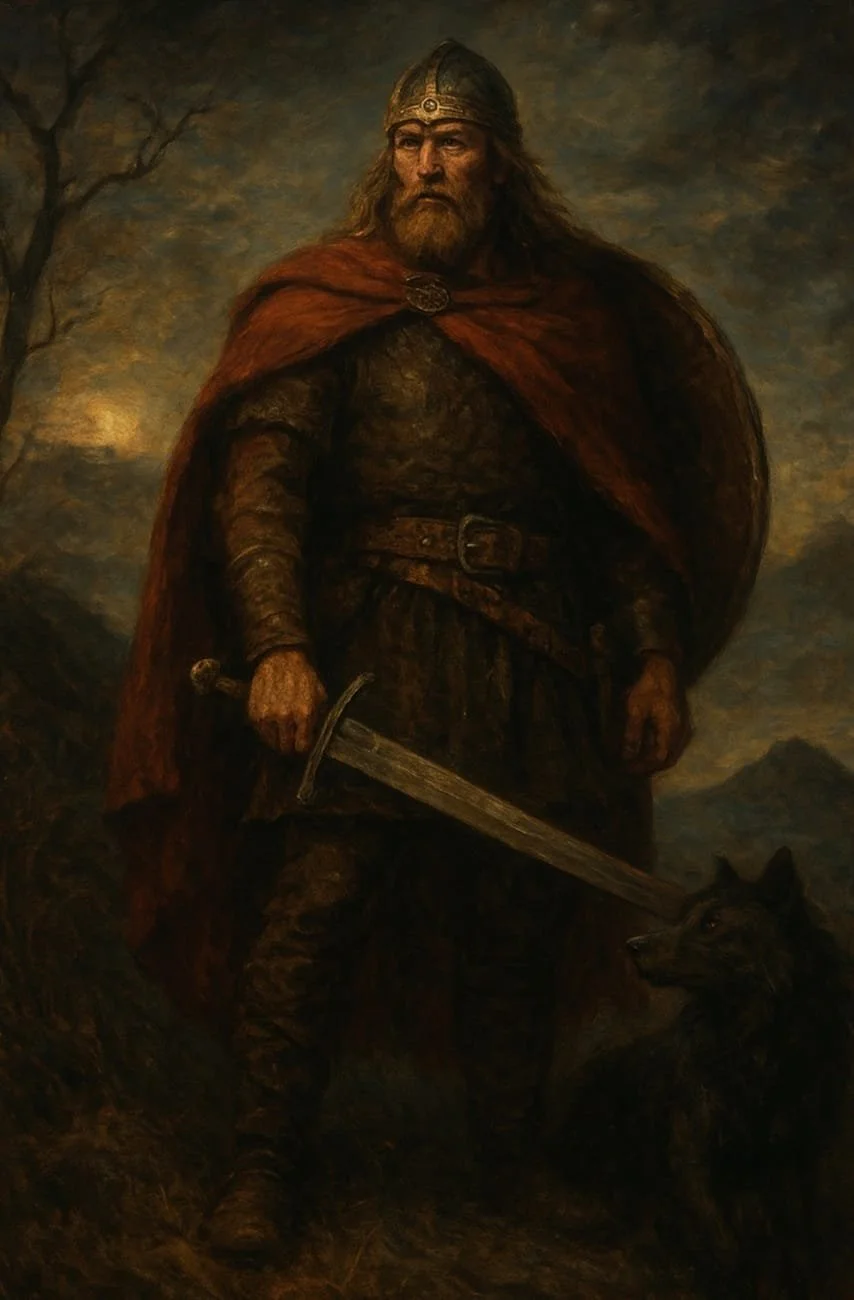
“Some warriors carve their fate with steel. Others awaken to find fate already waiting for them in the dark.”
Was Helgi Hundingsbane a Real Norse Hero? The Shape of a Mythic King
Among the luminous heroes of Norse legend, the name Helgi Hundingsbane rises again and again like a ghost of thunder. His story appears in the Poetic Edda in fragments - two Helgi lays and hints across other poems. Yet even these canonical sources speak of him in a way that feels larger than myth and older than the written word. He is both king and revenant, lover and avenger, born beneath omens that crack open the sky.
What follows is not a translation of the Eddic poems, nor a reconstruction of a lost saga. It is a tribute - a reweaving of Helgi’s mythic presence, binding the ancient verses with modern breath. This is an offering to a hero who walks the narrow edge between life and legend, a creation born of respect for the old stories and the timelessness they still hold.
The Wolf-Star Over the Barrow
Long before Helgi was called Hundingsbane, before he ruled lands or lifted the sword that would change his fate, there were whispers of him. Travelers spoke of a child born under a wolf-shaped star, a boy whose cry echoed like distant storm-claps across the fjords. Some feared the omen. Others welcomed it.
Even the winds seemed to know his name. A cold gust swept across the old burial mounds where kings slept beneath the earth, stirring long grasses that whispered secrets to the night. From within one barrow, an unseen spark trembled - some said it was Helgi’s spirit before his birth, knocking faintly on the walls between worlds.
A raven perched upon a cracked stone, black feathers rustling, eyes glittering like wet obsidian. It watched the horizon as though expecting the boy who would one day change the North.
The omen was clear - the king-to-be had already taken his first breath in the unseen realm.
The omens surrounding Helgi’s coming were spoken of for generations, yet even those who whispered them rarely grasped their weight. Long before his birth, wanderers claimed to hear low growls rolling beneath the earth, as though some ancient guardian stirred in anticipation.
Mothers tightened cloaks around their children when the wolf-shaped star rose in the winter sky, believing it to be a sign that a soul both blessed and burdened approached the mortal realm.
On the night of his birth, the northern lights danced fiercely across the sky, painting green and violet streaks that seemed to bow toward the timber hall, as if heralding the arrival of a child destined for legend.
Old skalds later recalled that the wind carried whispers not of this world: faint, haunting voices murmuring, “He comes, he comes, the wolf-star child.
Birth Beneath Thunder
Helgi was born into the clan of the Ylfingar during a night thick with storm-clouds. Lightning tore the sky open again and again, each burst illuminating the timber hall in a pulse of silver-blue.
His mother, Sigurlín, clutched the infant to her breast and whispered, “This child has walked before. I see it in his eyes.”
A low thunder rolled across the fjord, almost answering her. The fire cracked, sparks dancing up the smoke-hole. Outside, the scent of rain-soaked earth drifted in, mingled with the cold purity of mountain snow.
Helgi did not cry. He stared upward, wide-eyed, unnervingly calm.
His father, Hjörvarðr, a stern king who spoke little, stepped close to the cradle. “He watches,” he said quietly, “as though the world is familiar to him.”
And so it was said that Helgi entered the world not as a blank slate, but as a soul returning to claim a destiny left unfinished.
The midwife murmured prayers to Thor as she cleaned the infant, her hands trembling slightly. Lightning flared outside, casting sharp shadows over the hall, and for a moment, the faces of the assembled kin looked like specters. They did not speak, for all sensed that this child carried something beyond mortal reckoning.
Even the family hound, a gray wolf-dog named Fenrik, whimpered softly and pressed against the mother’s side, its eyes reflecting the storm outside. It was said in later years that Fenrik alone understood the boy’s first thoughts.
Some travelers later recounted seeing strange shapes in the snow around the hall that night - fleeting silhouettes that moved like wolves yet vanished when approached, as if the land itself acknowledged Helgi’s arrival.
The Silent Boy and the First Prophecy
Helgi grew slowly, quietly. While other boys laughed, wrestled, and shouted, Helgi listened. He noticed the flicker of torchlight against shields, the whispered gossip of thralls, the subtle way his mother grew anxious each time ravens gathered on the hall roof.
He walked the forest alone, boots sinking into moss, fingertips grazing pine bark, breath steaming in the sharp morning air. The world felt familiar, as if he’d traversed its paths in another life.
When he was seven, a one-eyed wanderer visited the hall. He bore the scent of distant roads and the strange charisma of men who belong more to dreams than to waking life.
The wanderer placed a rough hand on the boy’s shoulder.
“You have been named,” he murmured.
Helgi frowned. “Named by whom?”
“By wyrd. Before your first breath.”
Then the stranger vanished into the rain.
That night Sigurlín dreamed of a wolf standing guard over her son, teeth bared not at him but at fate itself.
Helgi’s silence was not empty; it was a listening, a weighing of the world. He would trace the runes carved into the hall beams with his tiny fingers, feeling the vibrations of old words as if they spoke directly to his soul.
When the one-eyed wanderer spoke to him, Helgi did not merely hear; he understood, as though a thousand voices from past lives had converged in that single moment.
One night, he muttered softly in sleep, “Wolves run ahead of me, but they do not lead me. I am my own path.” Even Sigurlín, who had always feared the child’s quiet intensity, shivered at the certainty in his voice.
ln the evenings, the ravens that gathered on the hall roof would caw unusually loud, circling above him, and some swore they saw shapes in their wings forming runes of warning and guidance.
The Naming at Last: A Child Becomes Helgi
Though born without a name - an old custom for the sons of kings - Helgi received his name only after near tragedy. One winter’s night, while wandering the fjord cliffs, he slipped on black ice and tumbled down a narrow ravine.
Helgi lay among the jagged stones, breath shallow, yet something inside him hummed like the memory of storms long past. He felt neither fear nor pain, only the pull of a destiny that refused to release him.
He returned at dawn covered in frost, cheeks bloodless, but alive. His mother found him at the door, leaning heavily against the frame.
The wind carried a faint whisper, almost like the voice of a raven: ‘Helgi, rise. Walk as the wolf walks.’ Sigurlín shivered at the sound, though the world seemed otherwise still.
“What saved you?” she whispered.
Helgi looked past her, toward the mountains where the first pale light glimmered.
“A voice,” he said. “Like wind over stone. It called me by a name.”
And in that moment, the snow seemed to settle around him, forming a circle of quiet that marked the beginning of his life’s saga, as though the earth itself recognized him.
“What name?”
“Helgi.”
Thus spoke the runes of fate - and so the boy was named.
The skalds would later write: “Helgi, whose heart holds both wolf and fire, has been named and the world trembles in waiting.”
The Poison-Blood of Hunding’s Line
War came early to Helgi’s life, carried on the blades of the Hundings - a rival clan whose blood-feud with the Ylfingar ran deep as mountain roots. Their chieftain Hunding was a man of rigid pride and ruthless judgement, known for punishing insults with fire and iron.
The feud began again when Helgi was barely fifteen winters. A raiding party struck one of the Ylfingar farms, burning it to blackened logs. Smoke choked the sky; the smell of charred thatch lingered for days.
Helgi stood among the ashes, fists clenched, jaw tight. Sparks drifted like dying stars in the wind.
“This is not justice,” he murmured. “This is rot.”
The raven landed on a beam beside him, feather tips glowing faintly in the late sunlight.
He felt something stir in him then - an anger not wild, but cold and certain.
A king’s anger.
Helgi remembered fragments of old tales, of Hunding’s ancestors spilling Ylfingar blood, of the curse that seemed to cling to both clans. In whispered Eddic lines, it was said: “Hunding’s kin will taste no peace; the wolf shall answer with teeth and steel.”
He vowed silently to honor his own bloodline, to carve justice where wyrd demanded, even if the mountains themselves shook in warning.
In the nights following the raid, Helgi patrolled the ruins, his shadow long beneath the moonlight. He spoke to no one, yet the wind carried his oath: a silent promise to the ancestors and the wolves that ran beyond the fjords.
The Sword Found in the Barrow
Some say it was the spirit of a dead king who called to him. Others claim Helgi was guided by dreams. But one night, Helgi walked alone to an ancient burial mound older than any living memory.
The grass parted beneath his boots. The moon hung low, pale and bruised-looking, above the world.
Inside the barrow, the air was cold enough to sting his lungs. Shadows clung to the earthen walls like old spirits.
Then he saw it: a sword resting across the skeletal lap of a forgotten warrior. Its blade shone faintly, as though remembering sunlit battles centuries past.
Helgi reached out.
The hilt was shockingly warm.
A voice echoed - perhaps from the grave, perhaps from within his own blood:
Take me. I remember your hand.
He did.
And the barrow lights flickered, then died.
As he lifted the sword, visions of ancient kings filled his mind. He saw battlefields carved from stone and snow, heartrending cries, and the wolf-shadows of warriors long gone. The sword seemed alive with memory, acknowledging the hand destined to wield it.
The walls whispered in a voice half-mortal, half-divine: “Helgi, Hunding’s bane, your path has begun. Steel and wyrd shall follow your every step.”
Outside, the wind howled through the barrow’s grass, carrying a scent of iron and pine, as though the forest itself saluted the newly armed hero.
In later years, skalds would recount that the sword sang faintly in moonlight, a song of victory and doom, marking Helgi not just as a boy, but as a force of fate returned to the world.
First Blood: The Making of Hundingsbane
Armed with the barrow-sword, Helgi set out alone to confront King Hunding.
The stories say he moved like a shadow across the fjord paths, cloak snapping in the wind. The air tasted of snow and iron. Wolves howled in the pines as if heralding him.
He found Hunding’s men camped beneath the roots of a twisted pine. Their laughter carried across the cold air.
Helgi struck before they sensed him. Sparks flew as steel met steel. Blood hissed against frost. One by one the men fell, their breath steaming in the bitter air.
When Hunding himself confronted the young warrior, he mocked him.
“A beardless boy challenges a king?”
Helgi’s voice was steady, almost quiet.
“I challenge a murderer.”
Their blades clashed like winter thunder.
Moments later, Hunding lay dying in the snow, breath rattling in his throat.
Helgi wiped the blade clean and whispered, “I am Helgi - Hunding’s bane.”
The wind seemed to repeat the words, hollow and triumphant.
As Hunding fell, Helgi felt the weight of ancestral eyes upon him. The fallen king’s lineage would not forget this night, and yet the boy felt no triumph, only the cold clarity of justice served.
The forest seemed to exhale in response, a hush of trees and frost settling around the battlefield, as if the land itself acknowledged the passing of an age.
Wolves appeared at the edges of the clearing, their eyes gleaming. Helgi recognized in them companions of fate, creatures that had run before him and would run with him beyond this moment.
Later, skalds would remember this night with the line: “Helgi, the wolf-born, tasted first blood and walked not in anger but in the silent accord of destiny.”
Sigrún: The Valkyrie of Fate
It was after Hunding’s fall that Helgi met Sigrún, the shield-maiden and valkyrie whose destiny twined with his like braided gold. She appeared to him on a battlefield soaked in blood, her armor gleaming pale against the dusk.
Her eyes were sharp as ice, yet full of life’s fire.
“You are the one,” she said softly.
“The one?”
“The one I saw in my visions. The king who walks with wolves.”
Helgi felt something stir in his chest - not fear, not awe, but recognition.
Their bond deepened swiftly, as though forged in some older lifetime neither fully remembered.
But Sigrún was promised to another - Hödbróðr, a king whose wrath would soon darken Helgi’s days.
Sigrún’s visions had shown her Helgi standing upon cliffs of storm and shadow, sword in hand, wolves at his side. She had seen both the beauty of his courage and the tragedy that would follow.
When they met, the air between them seemed charged with threads of fate, invisible yet tangible, as if the Norns themselves had woven their encounter into the loom of destiny.
The wind carried whispers of battles yet to come, of blood-debts and love’s trials, and Sigrún knew that choosing Helgi would mean challenging forces older than any living king.
In that moment, she saw the reflection of past lives in his eyes, and felt a recognition that transcended time: two souls bound together, walking a path written in the stars.
War for a Valkyrie’s Love
Hödbróðr’s fury was a storm without mercy. He marshaled his forces, raising banners red as the blood he promised to spill.
Helgi gathered warriors of his own - Ylfing veterans, wandering swordsmen, men who believed he walked with destiny.
Before battle, Helgi knelt beside a stream. The cold water bit at his fingers. In its rippling surface he saw Sigrún standing behind him, her reflection merging with his.
“Will you fight for me?” she asked.
“No,” Helgi said, rising. “I fight for us.”
Snow swept across the battlefield in biting waves. Shields glimmered with frost. Horses stamped nervously, their breath forming clouds.
When the armies clashed, the sound was deafening - iron on iron, cries muffled by snow, arrows hissing through the grey sky.
Helgi fought like a man carved from fate’s own bone. His barrow-sword moved with eerie grace, slicing through shield rims and spears.
At last, Hödbróðr fell beneath Helgi’s blade.
But though victory crowned him, Helgi felt the weight of something darker stirring in the weave of his life.
As he battled, Helgi glimpsed visions of wolves racing across frozen landscapes, shadows of the fallen whispering counsel and warning. Each strike he made was not only with strength, but with the guidance of ancestral spirits.
The snowstorm itself seemed to obey his movements, winds swirling around him as if the elements had chosen a champion.
Sigrún watched from the ridge, her heart pounding with both fear and hope, sensing the threads of fate tightening around them, foretelling both triumph and loss.
Skalds would later write of this day: “He fought not for glory alone, but for the entwined destinies of hearts and bloodlines, and the wolves howled their assent.”
A King Crowned in Twilight
With his foes defeated and Sigrún beside him, Helgi took his place as king. His hall rang with song and laughter; the smell of roasted boar and mead hung heavy in the warm air. Children ran between the fire pillars, and the skalds sang verses newly minted for the Wolf-Born King.
Yet Helgi’s eyes often drifted toward the mountains where storms brooded.
He had won love and crown, but peace felt like borrowed time.
The dreams began soon after.
In them he saw a shadowed figure - a man with piercing eyes, bearing the scent of wolf and grave-moss.
Sometimes the figure whispered:
“Not yet. You have not finished what was begun.”
Helgi always woke sweating, breath ragged.
Even amidst the laughter and songs of the hall, Helgi felt the pull of unseen threads tugging at his mind. Shadows flickered in the corners, and the wind carried murmurs he could not place.
At night, the wolves that roamed the high ridges seemed to gather beneath his windows, howling with a rhythm that resonated with the heartbeat of destiny itself.
The skalds, though joyous in song, whispered quietly amongst themselves of the king who dreamed of shadows and listened to the winds; many believed he was a ruler both of the living and of what lay beyond.
Helgi’s heart was heavy with a silent knowing: that the threads of wyrd were never still, and even a king’s crown could not shield him from the design of fate.
The Betrayal in the Shadows
Helgi’s end came not in open battle, but through the treachery of Hödbróðr’s kin. They dared not face him blade-to-blade; instead they lay in wait within a narrow valley shrouded in night-mist.
A spear flew from the darkness.
Helgi had no time to react.
It pierced his side - cold, sharp, merciless.
He stumbled, hand pressed to the wound. Blood seeped through his fingers, hot against winter’s chill.
The moon swam in and out of cloud. The mist thickened. The enemy melted away like ghosts.
Helgi sank to his knees.
Footsteps approached - light, hurried.
Sigrún.
She caught him as he collapsed, her fingers trembling, breath hitching with grief.
“Stay,” she whispered. “Stay with me.”
Helgi’s voice was faint.
“Do not mourn me. This life was only one thread.”
Her tears fell on his face, warm as summer rain.
He exhaled once, deeply - then no more.
Around them, the valley seemed to hold its breath, the trees and rocks silent witnesses to the king’s final moment. Even the wind softened, as if honoring his passing.
Sigrún clutched him, her heart a storm of sorrow and resolve. She swore that the blood spilled in betrayal would not be forgotten, and that Helgi’s name would echo through generations.
Wolves gathered at the valley’s edge, howling a mournful lament that blended with the night mist, marking the moment when fate and loyalty met in cruel union.
In later retellings, skalds claimed that even after death, Helgi’s spirit lingered, a guardian shadow among the peaks, waiting for the day destiny would call him once more.
The Burial Mound and the Whispering Wind
Helgi was buried with the sword he stole from the barrow, his cloak wrapped around him, his wolves howling in mourning across the ridgeline.
Sigrún refused to leave the mound for three days. The wind tore at her hair, carrying a strange whisper - almost a voice.
Some nights, travelers saw a bright shape riding the sky - a warrior and a valkyrie side by side. Others claimed the barrow shuddered at midnight, as though something inside stirred.
The skalds would later sing:
“Helgi does not die. He merely waits.”
As she mourned, Sigrún carved runes into the stones surrounding the mound, prayers and warnings intertwined, calling on the spirits of ancestors and the Norns to watch over him in death as in life.
The wolves circled the mound endlessly, their howls echoing against the mountains, a perpetual vigil that would be remembered in tales for generations.
On certain nights, the northern lights glimmered more brightly above the barrow, and it was said that Helgi’s spirit walked once more, a shadow among the stars, guarding his people and his love
Travelers who braved the ridges often reported feeling a presence, a warmth or a whisper, as if Helgi’s essence lingered between worlds, a testament to the wolf-born king whose destiny spanned life and beyond.
Legacy of the Wolf-Born
Helgi Hundingsbane lives on not merely as a hero of the Eddas but as a symbol - of destiny’s weight, of love carved through war, of the strange half-life between the mortal world and the echoing halls of myth.
To speak of Helgi is to speak of the moment where the human and the divine brush against each other like flint striking steel.
His deeds inspired generations of warriors, kings, and skalds who sought to walk the path of courage and honor, even when the threads of wyrd pulled them toward darkness.
Songs of Helgi and Sigrún traveled across the fjords and mountains, whispered from hearth to hearth, and carved into runestones to preserve the memory of love and valor intertwined.
Scholars of later ages remarked that Helgi embodies the eternal archetype of the fated king: one who rises from obscurity, is forged in vengeance, blessed and burdened by love, and walks ever with the wolf-shadow of destiny.
Legends tell of Helgi’s spirit appearing to those in dire need, a spectral protector whose sword may no longer be wielded in the flesh, yet whose influence shapes courage and loyalty wherever his story is remembered.
Some legends say he was reborn again in another Helgi, another time.
Others say he waits still, sword across his knees, for the day fate calls him once more.
Either way, he remains unforgettable.
A king shaped not only by victory, but by the mysterious thread that binds every soul to the tapestry of things unseen.
Why Helgi Still Matters
Helgi Hundingsbane endures because he embodies the archetype of the fated king - a figure who rises from obscurity, is forged in vengeance, blessed and burdened by love, and who walks ever with the wolf-shadow of destiny.
He stands for:
the inevitability of fate
the courage to claim one’s path
the tragedy of love bound to a warrior’s fate
the cycle of death and rebirth that echoes through Norse poetry
He reminds us that even heroes cannot outrun their destiny - but they can meet it standing tall.
Helgi’s story continues to resonate because it reflects universal human struggles: the tension between personal desire and destiny, the sacrifices required for honor, and the enduring power of love that transcends mortality.
Modern storytellers and scholars draw inspiration from his legend, finding in Helgi a model of courage, resilience, and the profound influence one life can have on the tapestry of culture and myth.
The wolf-born king teaches that destiny is not a chain, but a path to be walked with awareness and bravery, and that even in death, the deeds of the valiant leave an echo that shapes generations.
A King Between Worlds
Helgi Hundingsbane is both myth and mirror. Part historical echo, part poetic dream. A hero whose story feels carved into the bones of northern mountains.
Whether he once lived, or whether he is purely the child of skaldic imagination, does not matter.
He lives in the places where frost and fire meet. In the rustle of pine needles under winter wind. In the quiet courage of those who rise when fate calls their name.
A question remains - one the skalds murmur beside crackling hearth-fires: If destiny marked you from birth, would you surrender to its pull… or carve your own path through the shadows?
- Wyrd Walks With Those Who Listen - And Steel With Those Who Dare
Helgi’s legend reminds us that the line between the mortal and the mythic is thin. His deeds, love, and courage are threads that connect the human experience to the eternal patterns of fate.
In every whisper of wind, every echo across the fjords, there is the pulse of Helgi’s story, calling each of us to stand in the face of destiny with both resolve and heart.
He is a king who exists in the liminal space between life and legend, a constant reminder that heroes are not defined solely by their victories, but by the spirit with which they confront the tapestry of the world.
(Wyrd And Flame) 🔥
